Backtracking Technique Eg. Big Castle  –  Large Rooms &  “ Sleeping Beauty ” Systematic search - BFS, DFS Many paths led to nothing but  “ dead-ends ”   Can we avoid these  unnecessary labor ? ( bounding function  or  promising function ) DFS with bounding function (promising function) Worst-Case : Exhaustive Search
Backtracking Technique Useful because it is efficient for  “ many ”  large instances NP-Complete problems Eg. 0-1 knapsack problem D.P. :  O (min(2 n , nW)) Backtracking : can be very efficient if good bounding function(promising function) Recursion
Outline of Backtracking Approach Backtracking : DFS of a tree  except that nodes are visited if  promising DFS(Depth First Search) Procedure  d_f_s_tree ( v : node) var  u  : node { visit  v ;  // some action  // for each child  u  of  v   do  d_f_s_tree ( u ); } 1 2 3 5 7 11 4 6 8 9 10
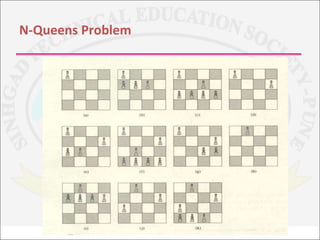
N-Queens Problem
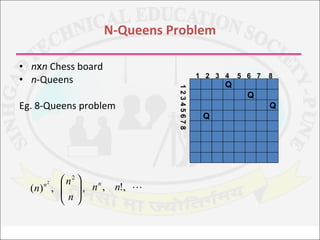
N-Queens Problem n ⅹ n  Chess board n -Queens Eg. 8-Queens problem Q Q Q Q 1  2  3  4  5  6  7  8 1 2 3 4 5 6 7 8
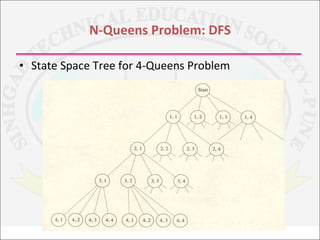
N-Queens Problem: DFS State Space Tree for 4-Queens Problem
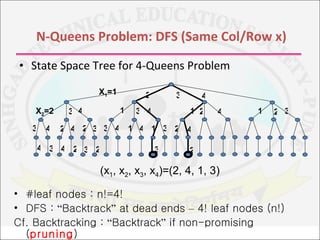
N-Queens Problem: DFS (Same Col/Row x) State Space Tree for 4-Queens Problem X 1 =1 X 2 =2 3 4 4 3 4 3 4 2 3 2 3 2 2 4 3 2 3 4 1 4 1 3 2 4 1 3 4 1 2 4 3 2 1 2 3 4 (x 1 , x 2 , x 3 , x 4 )=(2, 4, 1, 3) #leaf nodes : n!=4! DFS :  “ Backtrack ”  at dead ends  –  4! leaf nodes (n!) Cf. Backtracking :  “ Backtrack ”  if non-promising ( pruning )
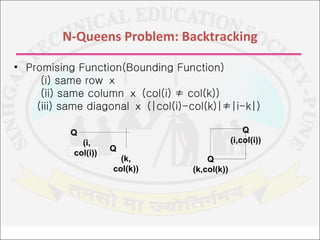
N-Queens Problem: Backtracking Promising Function(Bounding Function) (i) same row ⅹ (ii) same column ⅹ (col(i) ≠ col(k)) (iii) same diagonal ⅹ (|col(i)-col(k)|≠|i-k|) Q  (i, col(i)) Q  (k, col(k)) Q (i,col(i)) Q (k,col(k))
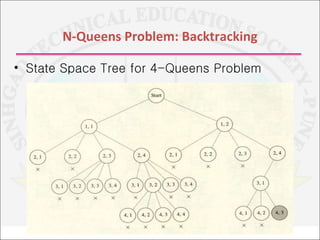
N-Queens Problem: Backtracking State Space Tree for 4-Queens Problem
N-Queens Problem Better (faster) Algorithm Monte Carlo Algorithm “ place almost all queens randomly,  then do remaining queens using backtracking. ” #Nodes Checked DFS   (n n )  #Nodes Checked DFS (same col/row X) (n!) #Nodes Checked Backtracking 341 19,173,961 9.73 ⅹ10 12 1.20ⅹ 10 16 24 40,320 4.79 ⅹ10 8 8.72ⅹ 10 10 61 15,721 1.01 ⅹ10 7 3.78ⅹ 10 8 4 8 12 14 n
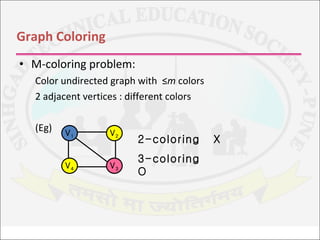
Graph Coloring M-coloring problem: Color undirected graph with  ≤ m  colors 2 adjacent vertices : different colors (Eg) V 1 V 2 V 4 V 3 2-coloring  X 3-coloring  O
Graph Coloring State-Space Tree :  m n  leaves Promising function : check adjacent vertices  for the same color start 1 2 3 2 1 3 2 1 3 2 1 3 X X X X X
Hamiltonian Circuits Problem TSP problem in chapter 3. Brute-force: n!, (n-1)! D.P. :  When  n =20, B.F.    3,800 years D.P.   45 sec. More efficient solution?  See chapter 6 Given an undirected or directed graph, find a tour(HC).  (need not be S.P.)
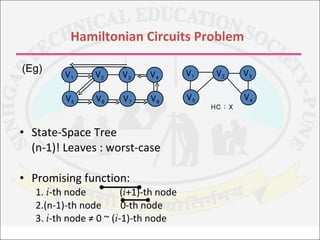
Hamiltonian Circuits Problem State-Space Tree (n-1)! Leaves : worst-case Promising function: 1.  i -th node  ( i +1)-th node 2.(n-1)-th node   0-th node 3.  i -th node  ≠ 0 ~ ( i -1)-th node HC : X (Eg) V 1 V 2 V 6 V 5 V 3 V 7 V 4 V 8 V 1 V 2 V 5 V 3 V 4
Sum-of-Subsets Problem A special case of 0/1-knapsack S = {item 1 , item 2 , … , item n }, w[1..n] = (w 1 , w 2 ,  … , w n ) weights & W Find a subset A⊆S s.t. ∑w i =W (Eg) n=3, w[1..3]=(2,4,5), W=6 Solution : {w 1 ,w 2 } NP-Complete State Space Tree :  2 n  leaves A w 1 w 2 w 3 w 2 w 3 w 3 w 3 O O O O O O O {w 1 ,w 2 }
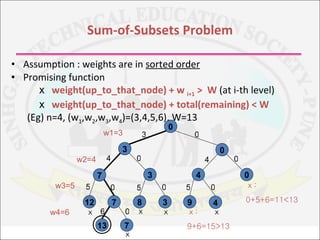
Sum-of-Subsets Problem Assumption : weights are in  sorted order Promising function ⅹ  weight(up_to_that_node) + w  i+1  >  W  (at i-th level) ⅹ  weight(up_to_that_node) + total(remaining) < W (Eg) n=4, (w 1 ,w 2 ,w 3 ,w 4 )=(3,4,5,6), W=13 ⅹ 12 7 3 9 7 8 13 4 0 0 3 3 0 4 5 0 0 4 5 5 6 0 0 0 0 ⅹ ⅹ :  0+5+6=11<13 ⅹ ⅹ : 9+6=15>13 ⅹ ⅹ w1=3 w2=4 w3=5 w4=6 0 4 3 7
0-1 Knapsack Problem w[1..n] = (w 1 , w 2 , … ,  w n ) p[1..n] = (p 1 , p 2 , … ,  p n ) W: Knapsack size Determine A⊆S maximizing State-Space Tree 2 n  leaves x 1 =1 x 2 =1 x 3 =1 x 4 =1 0 0 0 0 0 0 0 0 0 0 0 0 0 0 1 1 1 1 1 0 1 1 1 1 1 x 2 =1
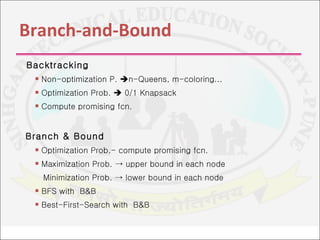
Branch-and-Bound Backtracking Non-optimization P.   n-Queens, m-coloring … Optimization Prob.    0/1 Knapsack Compute promising fcn. Branch & Bound Optimization Prob.- compute promising fcn. Maximization Prob. -> upper bound in each node Minimization Prob. -> lower bound in each node BFS with  B&B  Best-First-Search with  B&B
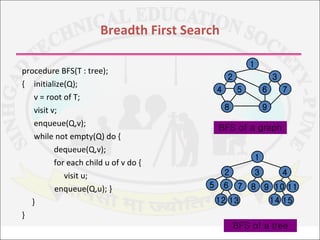
Breadth First Search procedure BFS(T : tree); { initialize(Q); v = root of T; visit v; enqueue(Q,v); while not empty(Q) do { dequeue(Q,v); for each child u of v do {   visit u;  enqueue(Q,u); } } } BFS of a graph BFS of a tree 1 2 3 4 5 6 7 8 9 1 2 5 6 7 8 9 3 4 10 11 12 13 14 15
0-1 Knapsack Problem BFS  with B&B pruning (Eg) n=4,  p[1 … 4]=(40,30,50,10) ,  w[1 … 4]=(2,5,10,5) ,  W=16 0 0 115 40 2 115 0 0 82 70 7 115 40 2 98 120 17 0 70 7 80 80 12 80 70 7 70 90 12 98 40 2 50 100 17 0 90 12 90 30 5 82 80 15 82 30 5 40 0 0 60 p1=40 ,  w1=2 p2=30 ,  w2=5 p3=50 ,  w3=10 p4=10 ,  w4=5
0-1 Knapsack Problem Bound  = current  profit  + profit of  remaining  “ fractional ”  K.S. Non-promising  if  bound ≤ max profit   (or  weight ≥W ) (Eg) n=4,  p[1 … 4]=(40,30,50,10) ,  w[1 … 4]=(2,5,10,5) ,  W=16 0 0 115 40 2 115 0 0 82 70 7 115 40 2 98 120 17 0 70 7 80 80 12 80 70 7 70 90 12 98 40 2 50 100 17 0 90 12 90 30 5 82 80 15 82 30 5 40 0 0 60 p1=40 ,  w1=2 p2=30 ,  w2=5 p3=50 ,  w3=10 p4=10 ,  w4=5
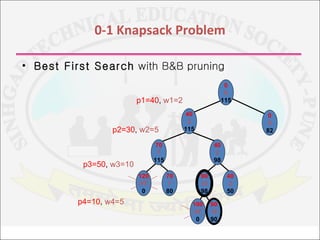
0-1 Knapsack Problem Best First Search  with B&B pruning 0 0 115 40 2 115 0 0 82 70 7 115 40 2 98 120 17 0 70 7 80 90 12 98 40 2 50 100 17 0 p1=40 ,  w1=2 p2=30 ,  w2=5 p3=50 ,  w3=10 p4=10 ,  w4=5 90 12 90

01 knapsack using backtracking

  • 1.
    Backtracking Technique Eg.Big Castle – Large Rooms & “ Sleeping Beauty ” Systematic search - BFS, DFS Many paths led to nothing but “ dead-ends ” Can we avoid these unnecessary labor ? ( bounding function or promising function ) DFS with bounding function (promising function) Worst-Case : Exhaustive Search
  • 2.
    Backtracking Technique Usefulbecause it is efficient for “ many ” large instances NP-Complete problems Eg. 0-1 knapsack problem D.P. : O (min(2 n , nW)) Backtracking : can be very efficient if good bounding function(promising function) Recursion
  • 3.
    Outline of BacktrackingApproach Backtracking : DFS of a tree except that nodes are visited if promising DFS(Depth First Search) Procedure d_f_s_tree ( v : node) var u : node { visit v ; // some action // for each child u of v do d_f_s_tree ( u ); } 1 2 3 5 7 11 4 6 8 9 10
  • 4.
  • 5.
    N-Queens Problem nⅹ n Chess board n -Queens Eg. 8-Queens problem Q Q Q Q 1 2 3 4 5 6 7 8 1 2 3 4 5 6 7 8
  • 6.
    N-Queens Problem: DFSState Space Tree for 4-Queens Problem
  • 7.
    N-Queens Problem: DFS(Same Col/Row x) State Space Tree for 4-Queens Problem X 1 =1 X 2 =2 3 4 4 3 4 3 4 2 3 2 3 2 2 4 3 2 3 4 1 4 1 3 2 4 1 3 4 1 2 4 3 2 1 2 3 4 (x 1 , x 2 , x 3 , x 4 )=(2, 4, 1, 3) #leaf nodes : n!=4! DFS : “ Backtrack ” at dead ends – 4! leaf nodes (n!) Cf. Backtracking : “ Backtrack ” if non-promising ( pruning )
  • 8.
    N-Queens Problem: BacktrackingPromising Function(Bounding Function) (i) same row ⅹ (ii) same column ⅹ (col(i) ≠ col(k)) (iii) same diagonal ⅹ (|col(i)-col(k)|≠|i-k|) Q (i, col(i)) Q (k, col(k)) Q (i,col(i)) Q (k,col(k))
  • 9.
    N-Queens Problem: BacktrackingState Space Tree for 4-Queens Problem
  • 10.
    N-Queens Problem Better(faster) Algorithm Monte Carlo Algorithm “ place almost all queens randomly, then do remaining queens using backtracking. ” #Nodes Checked DFS (n n ) #Nodes Checked DFS (same col/row X) (n!) #Nodes Checked Backtracking 341 19,173,961 9.73 ⅹ10 12 1.20ⅹ 10 16 24 40,320 4.79 ⅹ10 8 8.72ⅹ 10 10 61 15,721 1.01 ⅹ10 7 3.78ⅹ 10 8 4 8 12 14 n
  • 11.
    Graph Coloring M-coloringproblem: Color undirected graph with ≤ m colors 2 adjacent vertices : different colors (Eg) V 1 V 2 V 4 V 3 2-coloring X 3-coloring O
  • 12.
    Graph Coloring State-SpaceTree : m n leaves Promising function : check adjacent vertices for the same color start 1 2 3 2 1 3 2 1 3 2 1 3 X X X X X
  • 13.
    Hamiltonian Circuits ProblemTSP problem in chapter 3. Brute-force: n!, (n-1)! D.P. : When n =20, B.F.  3,800 years D.P.  45 sec. More efficient solution? See chapter 6 Given an undirected or directed graph, find a tour(HC). (need not be S.P.)
  • 14.
    Hamiltonian Circuits ProblemState-Space Tree (n-1)! Leaves : worst-case Promising function: 1. i -th node ( i +1)-th node 2.(n-1)-th node 0-th node 3. i -th node ≠ 0 ~ ( i -1)-th node HC : X (Eg) V 1 V 2 V 6 V 5 V 3 V 7 V 4 V 8 V 1 V 2 V 5 V 3 V 4
  • 15.
    Sum-of-Subsets Problem Aspecial case of 0/1-knapsack S = {item 1 , item 2 , … , item n }, w[1..n] = (w 1 , w 2 , … , w n ) weights & W Find a subset A⊆S s.t. ∑w i =W (Eg) n=3, w[1..3]=(2,4,5), W=6 Solution : {w 1 ,w 2 } NP-Complete State Space Tree : 2 n leaves A w 1 w 2 w 3 w 2 w 3 w 3 w 3 O O O O O O O {w 1 ,w 2 }
  • 16.
    Sum-of-Subsets Problem Assumption: weights are in sorted order Promising function ⅹ weight(up_to_that_node) + w i+1 > W (at i-th level) ⅹ weight(up_to_that_node) + total(remaining) < W (Eg) n=4, (w 1 ,w 2 ,w 3 ,w 4 )=(3,4,5,6), W=13 ⅹ 12 7 3 9 7 8 13 4 0 0 3 3 0 4 5 0 0 4 5 5 6 0 0 0 0 ⅹ ⅹ : 0+5+6=11<13 ⅹ ⅹ : 9+6=15>13 ⅹ ⅹ w1=3 w2=4 w3=5 w4=6 0 4 3 7
  • 17.
    0-1 Knapsack Problemw[1..n] = (w 1 , w 2 , … , w n ) p[1..n] = (p 1 , p 2 , … , p n ) W: Knapsack size Determine A⊆S maximizing State-Space Tree 2 n leaves x 1 =1 x 2 =1 x 3 =1 x 4 =1 0 0 0 0 0 0 0 0 0 0 0 0 0 0 1 1 1 1 1 0 1 1 1 1 1 x 2 =1
  • 18.
    Branch-and-Bound Backtracking Non-optimizationP.  n-Queens, m-coloring … Optimization Prob.  0/1 Knapsack Compute promising fcn. Branch & Bound Optimization Prob.- compute promising fcn. Maximization Prob. -> upper bound in each node Minimization Prob. -> lower bound in each node BFS with B&B Best-First-Search with B&B
  • 19.
    Breadth First Searchprocedure BFS(T : tree); { initialize(Q); v = root of T; visit v; enqueue(Q,v); while not empty(Q) do { dequeue(Q,v); for each child u of v do { visit u; enqueue(Q,u); } } } BFS of a graph BFS of a tree 1 2 3 4 5 6 7 8 9 1 2 5 6 7 8 9 3 4 10 11 12 13 14 15
  • 20.
    0-1 Knapsack ProblemBFS with B&B pruning (Eg) n=4, p[1 … 4]=(40,30,50,10) , w[1 … 4]=(2,5,10,5) , W=16 0 0 115 40 2 115 0 0 82 70 7 115 40 2 98 120 17 0 70 7 80 80 12 80 70 7 70 90 12 98 40 2 50 100 17 0 90 12 90 30 5 82 80 15 82 30 5 40 0 0 60 p1=40 , w1=2 p2=30 , w2=5 p3=50 , w3=10 p4=10 , w4=5
  • 21.
    0-1 Knapsack ProblemBound = current profit + profit of remaining “ fractional ” K.S. Non-promising if bound ≤ max profit (or weight ≥W ) (Eg) n=4, p[1 … 4]=(40,30,50,10) , w[1 … 4]=(2,5,10,5) , W=16 0 0 115 40 2 115 0 0 82 70 7 115 40 2 98 120 17 0 70 7 80 80 12 80 70 7 70 90 12 98 40 2 50 100 17 0 90 12 90 30 5 82 80 15 82 30 5 40 0 0 60 p1=40 , w1=2 p2=30 , w2=5 p3=50 , w3=10 p4=10 , w4=5
  • 22.
    0-1 Knapsack ProblemBest First Search with B&B pruning 0 0 115 40 2 115 0 0 82 70 7 115 40 2 98 120 17 0 70 7 80 90 12 98 40 2 50 100 17 0 p1=40 , w1=2 p2=30 , w2=5 p3=50 , w3=10 p4=10 , w4=5 90 12 90