GCSC - GTO THYRISTOR
CONTROLLED SERIES CAPACITOR
PRESENTED BY
LEO PAUL
CHITTILAPPILLY
INTRODUCTION
• Proposed by Karady & others in 1992.
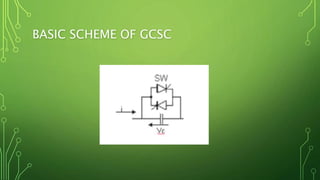
• It consists of Fixed capacitor in parallel with anti parallel GTO
pair or valve.
• Thyristor valve has the capability to turn on and turn off
mechanism.
• Act as a dual of TCR.
BASIC SCHEME OF GCSC
• The GCSC controls the voltage across the capacitor (Vc) for a
given line current.
• when the GTO is closed the voltage across the capacitor is zero
• when the GTO is open the voltage across the capacitor is at its
maximum value
• The magnitude of the capacitor voltage can be varied continuously
by the method of delayed angle control
• For practical applications, the GCSC compensates either the
voltage or reactance
WORKING
• Closing and opening of valve is carried out in each half cycle in
synchronism with supply frequency.
• Turn off instant of each half cycle is controlled by a delay angle ᵞ
wrt peak of line current.
• Here ᵞ varies from 0 to 90 degrees.
• Line current i and Vc are shown for ᵞ =0 and at an arbitary value
of ᵞ
principle of turn-off delay angle control
• Variation of VCF is
normalized to maximum
voltage
• GCSC can be operated
in either to control
Voltage or reactance
• Fundamental
component of the series
capacitor voltage vs.
the turn-off delay angle
γ.
GCSC IN VOLTAGE COMPENSATING MODE
• GCSC can be operated either to compensate voltage or to compensate
Xc(ᵞ).
• In first case, GCSC is used to maintain the rated compensating voltage
in association with decrease of line current over an interval
I min ≤ I ≤I max
• n this case, Xc is selected in such a manner that Vc max/I min = Xc.
• When I is increased from I min to I max, ᵞ is also increased
GCSC IN REACTANCE COMPENSATING
MODE
• GCSC is used to maintain the max rated compensating reactance
at any line current up to max.
• In this case, Xc is selected in such a manner that
Vc max/I max = Xc.
• GCSC can be used to vary Xc from
0≤ Xc(ᵞ) ≤ Xc
Gcsc   gto thyristor controlled series capacitor

Gcsc gto thyristor controlled series capacitor

  • 1.
    GCSC - GTOTHYRISTOR CONTROLLED SERIES CAPACITOR PRESENTED BY LEO PAUL CHITTILAPPILLY
  • 2.
    INTRODUCTION • Proposed byKarady & others in 1992. • It consists of Fixed capacitor in parallel with anti parallel GTO pair or valve. • Thyristor valve has the capability to turn on and turn off mechanism. • Act as a dual of TCR.
  • 3.
  • 4.
    • The GCSCcontrols the voltage across the capacitor (Vc) for a given line current. • when the GTO is closed the voltage across the capacitor is zero • when the GTO is open the voltage across the capacitor is at its maximum value • The magnitude of the capacitor voltage can be varied continuously by the method of delayed angle control • For practical applications, the GCSC compensates either the voltage or reactance
  • 5.
    WORKING • Closing andopening of valve is carried out in each half cycle in synchronism with supply frequency. • Turn off instant of each half cycle is controlled by a delay angle ᵞ wrt peak of line current. • Here ᵞ varies from 0 to 90 degrees. • Line current i and Vc are shown for ᵞ =0 and at an arbitary value of ᵞ
  • 6.
    principle of turn-offdelay angle control
  • 7.
    • Variation ofVCF is normalized to maximum voltage • GCSC can be operated in either to control Voltage or reactance • Fundamental component of the series capacitor voltage vs. the turn-off delay angle γ.
  • 8.
    GCSC IN VOLTAGECOMPENSATING MODE • GCSC can be operated either to compensate voltage or to compensate Xc(ᵞ). • In first case, GCSC is used to maintain the rated compensating voltage in association with decrease of line current over an interval I min ≤ I ≤I max • n this case, Xc is selected in such a manner that Vc max/I min = Xc. • When I is increased from I min to I max, ᵞ is also increased
  • 9.
    GCSC IN REACTANCECOMPENSATING MODE • GCSC is used to maintain the max rated compensating reactance at any line current up to max. • In this case, Xc is selected in such a manner that Vc max/I max = Xc. • GCSC can be used to vary Xc from 0≤ Xc(ᵞ) ≤ Xc