SINGLE-PHASE INDUCTION MOTOR
Kongunadu college of Engineering & Technology Single phase Induction Motor
Contents:
Introduction
Construction
Double field revolving theory
Cross field theory
Starting of Single phase induction motor
Split phase methods
References
 A single-phase induction motor is structurally
similar to a three-phase induction motor; the
difference is only in the stator winding
arrangements.
 The stator windings of a single-phase
induction motor are distributed, pitched and
skewed to produce a sinusoidal m.m.f. in
space.
Kongunadu college of Engineering & Technology Single phase Induction Motor
 The construction of a single-phase induction
motor is similar to that of a three-phase
induction motor.
 The single-phase motor stator has a laminated
iron core with two windings arranged
perpendicularly – one is the main and the other
is the auxiliary winding or starting winding.
 The motor uses a squirrel-cage rotor, which has a
laminated iron core with slots in it. Single-phase
induction motor is not self-starting and requires
some mechanism to assist it in the starting
process.
Kongunadu college of Engineering & Technology Single phase Induction Motor
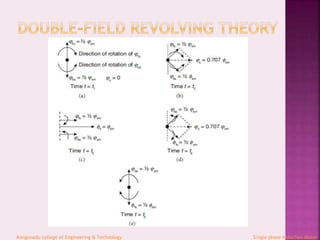
According to this theory, a pulsating field
of a single-phase motor can be resolved into
two rotating field of half its amplitude
rotating in opposite direction at synchronous
speed.
Kongunadu college of Engineering & Technology Single phase Induction Motor
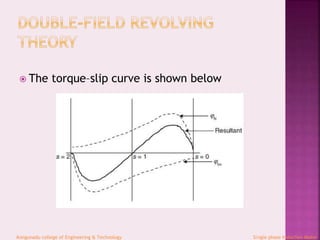
 The torque–slip curve is shown below
Kongunadu college of Engineering & Technology Single phase Induction Motor
 When a single-phase supply is given to the
stator of a single-phase induction motor, an
alternating flux is produced in the stator.
 This alternating flux will produce an induced
e.m.f. in the rotor windings, which is initially
at standstill.
 No torque will be produced in the rotor
Kongunadu college of Engineering & Technology Single phase Induction Motor
If the rotor is rotated by giving some
external force, an e.m.f. will be induced in
the rotor and thus a current will flow
through the rotor. This current will be
displaced by 90 degree (electrical) from the
stator axis.
Kongunadu college of Engineering & Technology Single phase Induction Motor
Some of the starting methods are,
i) Split-phase method
ii) Shaded-pole method
iii) Reluctance-start method
Kongunadu college of Engineering & Technology Single phase Induction Motor
The different split-phase techniques are:
i) Split-phase resistance-start motor.
ii) Split-phase capacitor-start motor.
iii) Capacitor-start – capacitor-run induction
motor
iv) Permanent single capacitor induction
motor.
Kongunadu college of Engineering & Technology Single phase Induction Motor
S.No Book s / Web Sources
1
A.E. Fitzgerald, Charles Kingsley, Stephen. D. Umans, ‘Electric Machinery’, Tata Mc Graw Hill publishing
Company Ltd, 2003.
2 D.P. Kothari and I.J. Nagrath, ‘Electric Machines’, Tata McGraw Hill Publishing Company Ltd, 2002.
3 P.S. Bhimbhra, ‘Electrical Machinery’, Khanna Publishers, 2003.
4 M.N.Bandyopadhyay, Electrical Machines Theory and Practice, PHI Learning PVT LTD., New Delhi, 2009.
5 K. Murugesh Kumar, ‘Electric Machines’, Vikas Publishing House Pvt. Ltd, 2002.
6
Syed A. Nasar, Electric Machines and Power Systems: Volume I, Mcgraw -Hill College; International ed
Edition, January 1995.
7 J. Ganavadivel, ‘Electrical Machines II’, Anuradha publications, Fourth edition, 2015.
8 U.A.Bakshi &M.V.Bakshi, ”Electrical Machines II,” Technical Publications, Second revised edition, 2016.
9 Google and Wikipedia
Kongunadu college of Engineering & Technology Single phase Induction Motor

Single phase induction motor

  • 1.
    SINGLE-PHASE INDUCTION MOTOR Kongunaducollege of Engineering & Technology Single phase Induction Motor Contents: Introduction Construction Double field revolving theory Cross field theory Starting of Single phase induction motor Split phase methods References
  • 2.
     A single-phaseinduction motor is structurally similar to a three-phase induction motor; the difference is only in the stator winding arrangements.  The stator windings of a single-phase induction motor are distributed, pitched and skewed to produce a sinusoidal m.m.f. in space. Kongunadu college of Engineering & Technology Single phase Induction Motor
  • 3.
     The constructionof a single-phase induction motor is similar to that of a three-phase induction motor.  The single-phase motor stator has a laminated iron core with two windings arranged perpendicularly – one is the main and the other is the auxiliary winding or starting winding.  The motor uses a squirrel-cage rotor, which has a laminated iron core with slots in it. Single-phase induction motor is not self-starting and requires some mechanism to assist it in the starting process. Kongunadu college of Engineering & Technology Single phase Induction Motor
  • 4.
    According to thistheory, a pulsating field of a single-phase motor can be resolved into two rotating field of half its amplitude rotating in opposite direction at synchronous speed. Kongunadu college of Engineering & Technology Single phase Induction Motor
  • 5.
    Kongunadu college ofEngineering & Technology Single phase Induction Motor
  • 6.
     The torque–slipcurve is shown below Kongunadu college of Engineering & Technology Single phase Induction Motor
  • 7.
     When asingle-phase supply is given to the stator of a single-phase induction motor, an alternating flux is produced in the stator.  This alternating flux will produce an induced e.m.f. in the rotor windings, which is initially at standstill.  No torque will be produced in the rotor Kongunadu college of Engineering & Technology Single phase Induction Motor
  • 8.
    If the rotoris rotated by giving some external force, an e.m.f. will be induced in the rotor and thus a current will flow through the rotor. This current will be displaced by 90 degree (electrical) from the stator axis. Kongunadu college of Engineering & Technology Single phase Induction Motor
  • 9.
    Some of thestarting methods are, i) Split-phase method ii) Shaded-pole method iii) Reluctance-start method Kongunadu college of Engineering & Technology Single phase Induction Motor
  • 10.
    The different split-phasetechniques are: i) Split-phase resistance-start motor. ii) Split-phase capacitor-start motor. iii) Capacitor-start – capacitor-run induction motor iv) Permanent single capacitor induction motor. Kongunadu college of Engineering & Technology Single phase Induction Motor
  • 11.
    S.No Book s/ Web Sources 1 A.E. Fitzgerald, Charles Kingsley, Stephen. D. Umans, ‘Electric Machinery’, Tata Mc Graw Hill publishing Company Ltd, 2003. 2 D.P. Kothari and I.J. Nagrath, ‘Electric Machines’, Tata McGraw Hill Publishing Company Ltd, 2002. 3 P.S. Bhimbhra, ‘Electrical Machinery’, Khanna Publishers, 2003. 4 M.N.Bandyopadhyay, Electrical Machines Theory and Practice, PHI Learning PVT LTD., New Delhi, 2009. 5 K. Murugesh Kumar, ‘Electric Machines’, Vikas Publishing House Pvt. Ltd, 2002. 6 Syed A. Nasar, Electric Machines and Power Systems: Volume I, Mcgraw -Hill College; International ed Edition, January 1995. 7 J. Ganavadivel, ‘Electrical Machines II’, Anuradha publications, Fourth edition, 2015. 8 U.A.Bakshi &M.V.Bakshi, ”Electrical Machines II,” Technical Publications, Second revised edition, 2016. 9 Google and Wikipedia Kongunadu college of Engineering & Technology Single phase Induction Motor