Byte and String Manipulation
Unit -1
Presented By
Mrs. M.P.Sasirekha
String Instruction in 8086
• The String Instruction in 8086 are namely,
• REP/REPE/REPZ/REPNE/REPNZ
• MOVS/MOVSB/MOVSN
• CMPS/CMPSB/CMPSW
• SCAS/SCASB/SCASW
• LODS/LODSB/LODSW
• STOS/STOSB/STOSW
REP/REPE/REPZ/REPNE/REPNZ
Instruction
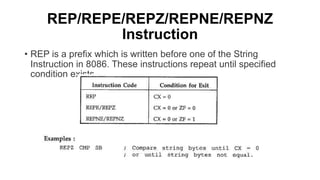
• REP is a prefix which is written before one of the String
Instruction in 8086. These instructions repeat until specified
condition exists.
MOVS/MOVSB/MOVSW Instruction
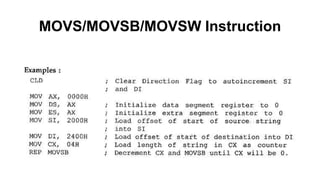
• This instruction copies a byte or word from a location in the data
segment to a location in the extra segment.
• The offset of the source byte or word in the data segment must
be in the SI register.
• The offset of the destination in the extra segment must be
contained in the DI register.
• For multiple byte or multiple word moves the number of
elements to be moved is put in the CX register so that it can
function as a counter.
• After the byte or word is moved SI and DI are automatically
adjusted to point to the next source and the next destination.
MOVS/MOVSB/MOVSW Instruction
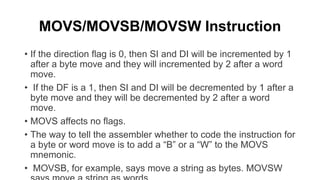
• If the direction flag is 0, then SI and DI will be incremented by 1
after a byte move and they will incremented by 2 after a word
move.
• If the DF is a 1, then SI and DI will be decremented by 1 after a
byte move and they will be decremented by 2 after a word
move.
• MOVS affects no flags.
• The way to tell the assembler whether to code the instruction for
a byte or word move is to add a “B” or a “W” to the MOVS
mnemonic.
• MOVSB, for example, says move a string as bytes. MOVSW
MOVS/MOVSB/MOVSW Instruction
CMPS/CMPSB/CMPSW Instruction
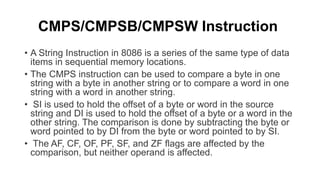
• A String Instruction in 8086 is a series of the same type of data
items in sequential memory locations.
• The CMPS instruction can be used to compare a byte in one
string with a byte in another string or to compare a word in one
string with a word in another string.
• SI is used to hold the offset of a byte or word in the source
string and DI is used to hold the offset of a byte or a word in the
other string. The comparison is done by subtracting the byte or
word pointed to by DI from the byte or word pointed to by SI.
• The AF, CF, OF, PF, SF, and ZF flags are affected by the
comparison, but neither operand is affected.
CMPS/CMPSB/CMPSW Instruction
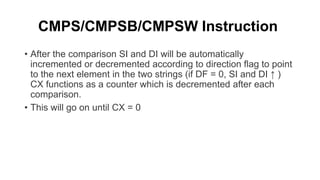
• After the comparison SI and DI will be automatically
incremented or decremented according to direction flag to point
to the next element in the two strings (if DF = 0, SI and DI ↑ )
CX functions as a counter which is decremented after each
comparison.
• This will go on until CX = 0
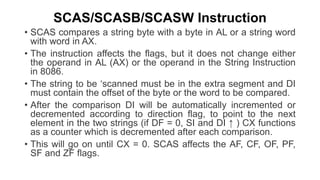
SCAS/SCASB/SCASW Instruction
• SCAS compares a string byte with a byte in AL or a string word
with word in AX.
• The instruction affects the flags, but it does not change either
the operand in AL (AX) or the operand in the String Instruction
in 8086.
• The string to be ‘scanned must be in the extra segment and DI
must contain the offset of the byte or the word to be compared.
• After the comparison DI will be automatically incremented or
decremented according to direction flag, to point to the next
element in the two strings (if DF = 0, SI and DI ↑ ) CX functions
as a counter which is decremented after each comparison.
• This will go on until CX = 0. SCAS affects the AF, CF, OF, PF,
SF and ZF flags.
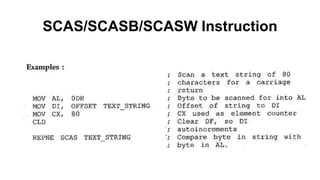
SCAS/SCASB/SCASW Instruction
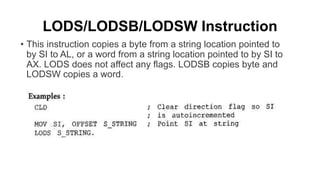
LODS/LODSB/LODSW Instruction
• This instruction copies a byte from a string location pointed to
by SI to AL, or a word from a string location pointed to by SI to
AX. LODS does not affect any flags. LODSB copies byte and
LODSW copies a word.
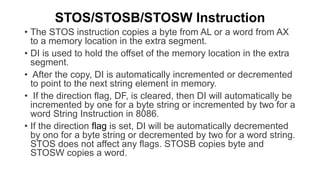
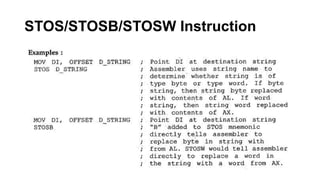
STOS/STOSB/STOSW Instruction
• The STOS instruction copies a byte from AL or a word from AX
to a memory location in the extra segment.
• DI is used to hold the offset of the memory location in the extra
segment.
• After the copy, DI is automatically incremented or decremented
to point to the next string element in memory.
• If the direction flag, DF, is cleared, then DI will automatically be
incremented by one for a byte string or incremented by two for a
word String Instruction in 8086.
• If the direction flag is set, DI will be automatically decremented
by ono for a byte string or decremented by two for a word string.
STOS does not affect any flags. STOSB copies byte and
STOSW copies a word.
STOS/STOSB/STOSW Instruction
Thank you

Byte and string manipulation 8086

  • 1.
    Byte and StringManipulation Unit -1 Presented By Mrs. M.P.Sasirekha
  • 2.
    String Instruction in8086 • The String Instruction in 8086 are namely, • REP/REPE/REPZ/REPNE/REPNZ • MOVS/MOVSB/MOVSN • CMPS/CMPSB/CMPSW • SCAS/SCASB/SCASW • LODS/LODSB/LODSW • STOS/STOSB/STOSW
  • 3.
    REP/REPE/REPZ/REPNE/REPNZ Instruction • REP isa prefix which is written before one of the String Instruction in 8086. These instructions repeat until specified condition exists.
  • 4.
    MOVS/MOVSB/MOVSW Instruction • Thisinstruction copies a byte or word from a location in the data segment to a location in the extra segment. • The offset of the source byte or word in the data segment must be in the SI register. • The offset of the destination in the extra segment must be contained in the DI register. • For multiple byte or multiple word moves the number of elements to be moved is put in the CX register so that it can function as a counter. • After the byte or word is moved SI and DI are automatically adjusted to point to the next source and the next destination.
  • 5.
    MOVS/MOVSB/MOVSW Instruction • Ifthe direction flag is 0, then SI and DI will be incremented by 1 after a byte move and they will incremented by 2 after a word move. • If the DF is a 1, then SI and DI will be decremented by 1 after a byte move and they will be decremented by 2 after a word move. • MOVS affects no flags. • The way to tell the assembler whether to code the instruction for a byte or word move is to add a “B” or a “W” to the MOVS mnemonic. • MOVSB, for example, says move a string as bytes. MOVSW
  • 6.
  • 7.
    CMPS/CMPSB/CMPSW Instruction • AString Instruction in 8086 is a series of the same type of data items in sequential memory locations. • The CMPS instruction can be used to compare a byte in one string with a byte in another string or to compare a word in one string with a word in another string. • SI is used to hold the offset of a byte or word in the source string and DI is used to hold the offset of a byte or a word in the other string. The comparison is done by subtracting the byte or word pointed to by DI from the byte or word pointed to by SI. • The AF, CF, OF, PF, SF, and ZF flags are affected by the comparison, but neither operand is affected.
  • 8.
    CMPS/CMPSB/CMPSW Instruction • Afterthe comparison SI and DI will be automatically incremented or decremented according to direction flag to point to the next element in the two strings (if DF = 0, SI and DI ↑ ) CX functions as a counter which is decremented after each comparison. • This will go on until CX = 0
  • 9.
    SCAS/SCASB/SCASW Instruction • SCAScompares a string byte with a byte in AL or a string word with word in AX. • The instruction affects the flags, but it does not change either the operand in AL (AX) or the operand in the String Instruction in 8086. • The string to be ‘scanned must be in the extra segment and DI must contain the offset of the byte or the word to be compared. • After the comparison DI will be automatically incremented or decremented according to direction flag, to point to the next element in the two strings (if DF = 0, SI and DI ↑ ) CX functions as a counter which is decremented after each comparison. • This will go on until CX = 0. SCAS affects the AF, CF, OF, PF, SF and ZF flags.
  • 10.
  • 11.
    LODS/LODSB/LODSW Instruction • Thisinstruction copies a byte from a string location pointed to by SI to AL, or a word from a string location pointed to by SI to AX. LODS does not affect any flags. LODSB copies byte and LODSW copies a word.
  • 12.
    STOS/STOSB/STOSW Instruction • TheSTOS instruction copies a byte from AL or a word from AX to a memory location in the extra segment. • DI is used to hold the offset of the memory location in the extra segment. • After the copy, DI is automatically incremented or decremented to point to the next string element in memory. • If the direction flag, DF, is cleared, then DI will automatically be incremented by one for a byte string or incremented by two for a word String Instruction in 8086. • If the direction flag is set, DI will be automatically decremented by ono for a byte string or decremented by two for a word string. STOS does not affect any flags. STOSB copies byte and STOSW copies a word.
  • 13.
  • 14.