THREE PHASE INDUCTION
MOTORS
Dr.R.Subasri
Professor, Kongu Engineering College,
Perundurai, Erode, Tamilnadu, INDIA
Dr.R.Subasri, KEC, Erode, India
Induction Motor
• One third of the world's electricity consumption
is used for running induction motors driving
pumps, fans, compressors, elevators and
machinery of various types
• Also called as Asynchronous Motors
-always runs at a speed lower than synchronous
speed
speed of the rotating magnetic field of the stator
Construction
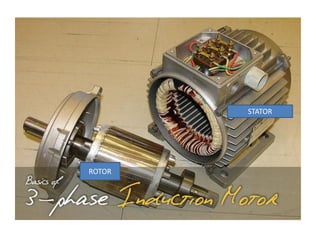
• Stator: Made up of numbers of slots to construct a 3
phase winding circuit which is connected to 3 phase
AC source.
• The three phase winding are arranged in such a
manner in the slots that they produce a rotating
magnetic field after AC is given to them.
• Rotor: Consists of cylindrical laminated core with
parallel slots that can carry conductors. Conductors
are heavy copper or aluminium bars which fits in
each slots & they are short circuited by the end rings.
STATOR
ROTOR
•Very simple and almost
indestructible construction
•A cylindrical laminated core,
having parallel slots to carry
rotor conductors on it.
•Heavy bars of copper,
aluminium or alloys are used as
rotor conductors instead of
wires.
SQUIRREL CAGE ROTOR
1.it reduces locking tendency of the rotor, i.e. the tendency of rotor
teeth to remain under stator teeth due to magnetic attraction.
2. increases the effective transformation ratio between stator and
rotor
3. increases rotor resistance due to increased length of the rotor
conductor
Rotor slots are slightly skewed
•The rotor bars are brazed or electrically welded to
short circuiting end rings at both ends.
•Thus this rotor construction looks like a squirrel
cage .
•The rotor bars are permanently short circuited,
hence it is not possible to add any external
resistance to armature circuit.
SQUIRREL CAGE ROTOR
Slip Ring (or) Wound Rotor
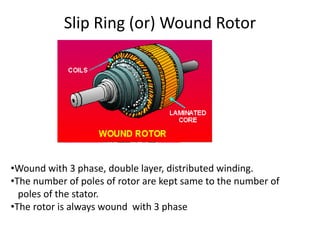
•Wound with 3 phase, double layer, distributed winding.
•The number of poles of rotor are kept same to the number of
poles of the stator.
•The rotor is always wound with 3 phase
•These three brushes are connected to an external star
connected rheostat (for starting purposes and for
changing the speed / torque characteristics)
•When motor is running at its rated speed, slip rings are
automatically short circuited by means of a metal collar
and brushes are lifted above the slip rings to minimize the
frictional losses.
•Rotor winding is internally
star connected.
•The other three terminals of
the winding are taken out via
three insulated sleep rings
mounted on the shaft and
the brushes resting on them.
WOUND ROTOR
•Very simple and rugged(almost unbreakable)
construction
•Very reliable and having low cost
•High efficiency and good power factor
•Minimum maintenance required
•3 phase induction motor is self starting hence extra
starting motor or any special starting arrangement is not
required
ADVANTAGES
•Speed decreases with increase in load, just like a DC
shunt motor
•if speed is varied, then efficiency get reduced
DIS ADVANTAGES
Rotating Magnetic field
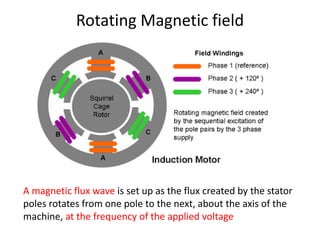
A magnetic flux wave is set up as the flux created by the stator
poles rotates from one pole to the next, about the axis of the
machine, at the frequency of the applied voltage
VR= Vm sin t
VY=Vm sin(t-120)
VB=Vm sin(t-240)
3 voltage waveform representation
3 voltage Phasor representation
3 voltage mathematical representation
This field is such that its poles do no remain in a fixed position
on the stator but go on shifting their positions around the
stator. For this reason, it is called a rotating field. It can be
shown that magnitude of this rotating field is constant and is
equal to 1.5 m where m is the maximum flux due to any
phase.
Relation between frequency and
speed
• P be the total number of field poles
• N is the speed of the field in revolution per
minute (r.p.m)
• f is the frequency of the generated voltage in
hertz
• One cycle is generated in an armature coil
when a pair of field poles passes over the coil.
• The number of cycles generated in one
revolution of the rotor will be equal to the
number of pairs of poles (P/2).
PN 120f
f Hz and N
120 P
= =
N is called Synchronous speed (Ns)
Operating Principle
• Operation depends on three electromagnetic
phenomena
Motor Action - When an iron rod (or other magnetic material)
is suspended in a magnetic field so that it is free to rotate, it will
align itself with the field. If the magnetic field is moving or rotating,
the iron rod will move with the moving field so as to maintain
alignment.
Rotating Field - A rotating magnetic field can be created from
fixed stator poles by driving each pole-pair from a different phase of
the alternating current supply.
Transformer Action - The current in the rotor windings is induced
from the current in the stator windings, avoiding the need for a direct
connection from the power source to the rotating windings
• When the motor is first switched on and the
rotor is at rest, a current is induced in the
rotor windings (conductors) by transformer
action.
• Here the relative velocity between the
rotating flux and static rotor conductor is the
cause of current generation.
• As per Lenz’s law the rotor will rotate in the
same direction to reduce the cause i.e. the
relative velocity.
• Once current is flowing in the rotor windings,
the motor action due to the Lorentz force on
the conductors comes into effect.
• The reaction between the current flowing in
the rotor conductors and the magnetic flux in
the air gap causes the rotor to rotate in the
same direction as the rotating flux as if it was
being dragged along by the flux wave.
• But rotor speed should not reach the
synchronous speed produced by the stator.
SLIP
• When the rotor speed builds up , the relative
motion between the rotating stator field and
the rotating rotor conductors is reduced.
• If the two speeds equals, there would be no
such relative velocity, so no emf induction in
the rotor, & no current would be flowing, and
therefore no torque would be generated.
• The difference between the stator
(synchronous speed) and rotor speeds is called
the slip
Induction Motor never runs at synchronous speed
s r
s
N N
% slip 100
N
−
= 
• http://youtu.be/Mle-ZvYi8HA
• http://youtu.be/LtJoJBUSe28
Torque –Slip Characteristics
The torque produced by three phase induction motor depends
upon the following three factors:
➢ the magnitude of rotor current
➢ the flux which interact with the rotor of and is responsible for
producing emf in the rotor part of induction motor
➢the power factor of rotor
T   I2 cos 2
flux φ produced by the stator is proportional to stator emf E1
Rotor current I2 is defined as the ratio of rotor induced emf
under running condition , sE2 to total impedance, Z2 of rotor
side,
Power factor of the rotor circuit is
Stator emf E1 is supply voltage – constant
Rotor emf E2 = K E1, where K is transformation ratio -constant
Low slip region :
In normal speed, 's' is very small (free running with no or
less load). Due to this, the term (s X2)2 is so small as compared
to R2
2 that it can be neglected.
Torque –Slip Characteristics
As load increases, speed decreases, increasing the slip. Hence the
graph is straight line from zero slip to a slip corresponds to full-
load.
Max.Torque point :
As slip increases beyond full load, torque also increases and becomes
maximum at s =R2/X2 .This torque is called pull-out torque or break
down torque.
Here it can be assumed that the term R2
2 is very small as
compared to (s X2)2. Hence neglecting from the denominator, we get
High slip region:
When the slip increases beyond the maximum torque point, i.e. slip value
is approaching to 1, R2
2 is very small as compared to (s X2)2, hence
neglected in the denominator.
So in high slip region torque is inversely proportional to the slip. Hence its
nature is like rectangular hyperbola.
If load increases, speed further decreases motor can not continue to
rotate at any point in this high slip region. Hence this region is called
unstable region of operation.
torque - slip characteristics has two parts,
1. Straight line called stable region of operation
2. Rectangular hyperbola called unstable region of operation.
Generally full load torque is less than the
maximum torque (breakdown torque)
The breakdown torque is also called stalling torque.
Condition for Max Torque:
R2 = s X2
Necessity of Starters
• At the time of starting, the motor slip is unity,
and the starting current is very large.
• If an induction motor is directly switched on
from supply, it takes 5 to 7 times its full load
current.
• This large starting current will produce large
voltage drop in line, which may affect the
operation of other devices connected in the
line.
Starting Torque
• Torque T   Ir cos r
•   E1(supply voltage); Ir  E2 (rotor induced
voltage =K E1).
• The starting torque of the induction motor is
proportional to the square of the applied
voltage. Hence T  E1
2.(cos r depends on R2
and X2 as slip is 1 at starting )
Starting methods
• Objective:
• Starting current to be reduced
• Starting torque should be improved
The starting current is reduced by reducing the supply
voltage to stator.
When supply voltage is reduced, starting torque will be
reduced.
To improve the starting torque , the resistance of the rotor
to be increased during starting condition to get improved
power factor.
Starting methods
• Objective:
• Starting current to be reduced
• Starting torque should be improved
The starting current is reduced by reducing the supply
voltage to stator.
When supply voltage is reduced, starting torque will be
reduced.
To improve the starting torque , the resistance of the rotor
to be increased during starting condition to get improved
power factor.
There are three main methods of Starting of
Cage Induction Motor. They are as follows.
Since external resistance cannot be included in
Squirrel cage rotor, the starting torque will be less.
Stator side
Direct on line starter
It is simple and cheap starter
Started by directly connecting to the supply
Suitable for small capacity motor
Star –Delta Connection
V
3
VL
IPZ
st
V
I
3 Z
=
Z
st
V
I
Z
=
Starting current is 1/3 of running condition
Star Delta Starter
Used where high starting torque is required such as
machine tools , pumps, etc.
Star Delta Starter
Auto transformer starter
In starting position supply is
connected to stator windings
through an auto-transformer
which reduces applied
voltage to 50, 60, and 70% of
normal value depending on
tapping used.
Starters used in lager industries,
it is larger in size and expensive.
Rotor resistance starter (slip ring
Motor) Rotor side
Speed control of IM
Speed Control From Stator Side
a) By changing the applied voltage:
If supplied voltage is decreased, torque decreases and hence the
speed decreases.
easiest and cheapest, still rarely used
1) A large change in supply voltage is required for relatively small
change in speed.
2) Large change in supply voltage will result in large change in flux
density, hence disturbing the magnetic conditions of the motor.
• b) By changing the applied frequency
• Synchronous speed changes with change in supply
frequency, and thus running speed also changes.
•Not widely used
•Used when the induction motor is supplied by a
generator (so that frequency can be easily change by
changing the speed of prime mover).
c) Changing the number of stator poles
• Change in stator poles is achieved by two or more
independent stator windings wound for different
number of poles in same slots.
• For example, a stator is wound with two 3phase
windings, one for 4 poles and other for 6 poles.
for supply frequency of 50 Hz
i) synchronous speed when 4 pole winding is
connected, Ns = 120*50/4 = 1500 RPM
ii) synchronous speed when 6 pole winding is
connected, Ns = 120*50/6 = 1000 RPM
• Generally used for squirrel cage induction motors
2. Speed Control From Rotor Side:
a) Rotor rheostat control:
only applicable to slip ring motors, as addition of
external resistance in the rotor of squirrel cage
motors is not possible.
b) Cascade operation
•In this method of speed control, two motors are
used.
•Both are mounted on a same shaft so that both
run at same speed.
•One motor is fed from a 3phase supply and other
motor is fed from the induced emf in first motor via
slip-rings.
Cascade Control
With this method, four different speeds can be obtained
1. when only motor A works, corresponding speed: Ns1 = 120f / P1
2. when only motor B works, corresponding speed: Ns2 = 120f / P2
3. For comulative cascading, speed of the set: N = 120f / (P1 + P2)
4. For differential cascading, speed of the set = N = 120f (P1 - P2)
c) By injecting EMF in rotor circuit:
By injecting a voltage in rotor circuit.
• It is necessary that voltage (emf) being injected
must have same frequency as of slip frequency.
•If emf injected is in opposite phase with the rotor
induced emf, rotor resistance will be increased.
•If injected emf is in phase with rotor induced emf,
rotor resistance will decrease.
•By changing the phase of injected emf, speed can
be controlled.
•A wide rage of speed control (above normal as well
as below normal) can be achieved.
•Methods used are: Kramer, Scherbius system

Induction motor 3ph

  • 1.
    THREE PHASE INDUCTION MOTORS Dr.R.Subasri Professor,Kongu Engineering College, Perundurai, Erode, Tamilnadu, INDIA Dr.R.Subasri, KEC, Erode, India
  • 2.
    Induction Motor • Onethird of the world's electricity consumption is used for running induction motors driving pumps, fans, compressors, elevators and machinery of various types • Also called as Asynchronous Motors -always runs at a speed lower than synchronous speed speed of the rotating magnetic field of the stator
  • 3.
    Construction • Stator: Madeup of numbers of slots to construct a 3 phase winding circuit which is connected to 3 phase AC source. • The three phase winding are arranged in such a manner in the slots that they produce a rotating magnetic field after AC is given to them. • Rotor: Consists of cylindrical laminated core with parallel slots that can carry conductors. Conductors are heavy copper or aluminium bars which fits in each slots & they are short circuited by the end rings.
  • 4.
  • 5.
    •Very simple andalmost indestructible construction •A cylindrical laminated core, having parallel slots to carry rotor conductors on it. •Heavy bars of copper, aluminium or alloys are used as rotor conductors instead of wires. SQUIRREL CAGE ROTOR 1.it reduces locking tendency of the rotor, i.e. the tendency of rotor teeth to remain under stator teeth due to magnetic attraction. 2. increases the effective transformation ratio between stator and rotor 3. increases rotor resistance due to increased length of the rotor conductor Rotor slots are slightly skewed
  • 6.
    •The rotor barsare brazed or electrically welded to short circuiting end rings at both ends. •Thus this rotor construction looks like a squirrel cage . •The rotor bars are permanently short circuited, hence it is not possible to add any external resistance to armature circuit. SQUIRREL CAGE ROTOR
  • 7.
    Slip Ring (or)Wound Rotor •Wound with 3 phase, double layer, distributed winding. •The number of poles of rotor are kept same to the number of poles of the stator. •The rotor is always wound with 3 phase
  • 8.
    •These three brushesare connected to an external star connected rheostat (for starting purposes and for changing the speed / torque characteristics) •When motor is running at its rated speed, slip rings are automatically short circuited by means of a metal collar and brushes are lifted above the slip rings to minimize the frictional losses. •Rotor winding is internally star connected. •The other three terminals of the winding are taken out via three insulated sleep rings mounted on the shaft and the brushes resting on them. WOUND ROTOR
  • 9.
    •Very simple andrugged(almost unbreakable) construction •Very reliable and having low cost •High efficiency and good power factor •Minimum maintenance required •3 phase induction motor is self starting hence extra starting motor or any special starting arrangement is not required ADVANTAGES •Speed decreases with increase in load, just like a DC shunt motor •if speed is varied, then efficiency get reduced DIS ADVANTAGES
  • 10.
    Rotating Magnetic field Amagnetic flux wave is set up as the flux created by the stator poles rotates from one pole to the next, about the axis of the machine, at the frequency of the applied voltage
  • 11.
    VR= Vm sint VY=Vm sin(t-120) VB=Vm sin(t-240) 3 voltage waveform representation 3 voltage Phasor representation 3 voltage mathematical representation
  • 12.
    This field issuch that its poles do no remain in a fixed position on the stator but go on shifting their positions around the stator. For this reason, it is called a rotating field. It can be shown that magnitude of this rotating field is constant and is equal to 1.5 m where m is the maximum flux due to any phase.
  • 13.
    Relation between frequencyand speed • P be the total number of field poles • N is the speed of the field in revolution per minute (r.p.m) • f is the frequency of the generated voltage in hertz • One cycle is generated in an armature coil when a pair of field poles passes over the coil. • The number of cycles generated in one revolution of the rotor will be equal to the number of pairs of poles (P/2).
  • 14.
    PN 120f f Hzand N 120 P = = N is called Synchronous speed (Ns)
  • 15.
    Operating Principle • Operationdepends on three electromagnetic phenomena Motor Action - When an iron rod (or other magnetic material) is suspended in a magnetic field so that it is free to rotate, it will align itself with the field. If the magnetic field is moving or rotating, the iron rod will move with the moving field so as to maintain alignment. Rotating Field - A rotating magnetic field can be created from fixed stator poles by driving each pole-pair from a different phase of the alternating current supply. Transformer Action - The current in the rotor windings is induced from the current in the stator windings, avoiding the need for a direct connection from the power source to the rotating windings
  • 16.
    • When themotor is first switched on and the rotor is at rest, a current is induced in the rotor windings (conductors) by transformer action. • Here the relative velocity between the rotating flux and static rotor conductor is the cause of current generation. • As per Lenz’s law the rotor will rotate in the same direction to reduce the cause i.e. the relative velocity.
  • 17.
    • Once currentis flowing in the rotor windings, the motor action due to the Lorentz force on the conductors comes into effect. • The reaction between the current flowing in the rotor conductors and the magnetic flux in the air gap causes the rotor to rotate in the same direction as the rotating flux as if it was being dragged along by the flux wave. • But rotor speed should not reach the synchronous speed produced by the stator.
  • 18.
    SLIP • When therotor speed builds up , the relative motion between the rotating stator field and the rotating rotor conductors is reduced. • If the two speeds equals, there would be no such relative velocity, so no emf induction in the rotor, & no current would be flowing, and therefore no torque would be generated. • The difference between the stator (synchronous speed) and rotor speeds is called the slip Induction Motor never runs at synchronous speed s r s N N % slip 100 N − = 
  • 19.
  • 20.
    Torque –Slip Characteristics Thetorque produced by three phase induction motor depends upon the following three factors: ➢ the magnitude of rotor current ➢ the flux which interact with the rotor of and is responsible for producing emf in the rotor part of induction motor ➢the power factor of rotor T   I2 cos 2 flux φ produced by the stator is proportional to stator emf E1 Rotor current I2 is defined as the ratio of rotor induced emf under running condition , sE2 to total impedance, Z2 of rotor side, Power factor of the rotor circuit is
  • 21.
    Stator emf E1is supply voltage – constant Rotor emf E2 = K E1, where K is transformation ratio -constant Low slip region : In normal speed, 's' is very small (free running with no or less load). Due to this, the term (s X2)2 is so small as compared to R2 2 that it can be neglected. Torque –Slip Characteristics As load increases, speed decreases, increasing the slip. Hence the graph is straight line from zero slip to a slip corresponds to full- load.
  • 22.
    Max.Torque point : Asslip increases beyond full load, torque also increases and becomes maximum at s =R2/X2 .This torque is called pull-out torque or break down torque. Here it can be assumed that the term R2 2 is very small as compared to (s X2)2. Hence neglecting from the denominator, we get High slip region: When the slip increases beyond the maximum torque point, i.e. slip value is approaching to 1, R2 2 is very small as compared to (s X2)2, hence neglected in the denominator. So in high slip region torque is inversely proportional to the slip. Hence its nature is like rectangular hyperbola. If load increases, speed further decreases motor can not continue to rotate at any point in this high slip region. Hence this region is called unstable region of operation.
  • 23.
    torque - slipcharacteristics has two parts, 1. Straight line called stable region of operation 2. Rectangular hyperbola called unstable region of operation. Generally full load torque is less than the maximum torque (breakdown torque) The breakdown torque is also called stalling torque. Condition for Max Torque: R2 = s X2
  • 24.
    Necessity of Starters •At the time of starting, the motor slip is unity, and the starting current is very large. • If an induction motor is directly switched on from supply, it takes 5 to 7 times its full load current. • This large starting current will produce large voltage drop in line, which may affect the operation of other devices connected in the line.
  • 25.
    Starting Torque • TorqueT   Ir cos r •   E1(supply voltage); Ir  E2 (rotor induced voltage =K E1). • The starting torque of the induction motor is proportional to the square of the applied voltage. Hence T  E1 2.(cos r depends on R2 and X2 as slip is 1 at starting )
  • 26.
    Starting methods • Objective: •Starting current to be reduced • Starting torque should be improved The starting current is reduced by reducing the supply voltage to stator. When supply voltage is reduced, starting torque will be reduced. To improve the starting torque , the resistance of the rotor to be increased during starting condition to get improved power factor.
  • 27.
    Starting methods • Objective: •Starting current to be reduced • Starting torque should be improved The starting current is reduced by reducing the supply voltage to stator. When supply voltage is reduced, starting torque will be reduced. To improve the starting torque , the resistance of the rotor to be increased during starting condition to get improved power factor.
  • 28.
    There are threemain methods of Starting of Cage Induction Motor. They are as follows. Since external resistance cannot be included in Squirrel cage rotor, the starting torque will be less. Stator side
  • 29.
    Direct on linestarter It is simple and cheap starter Started by directly connecting to the supply Suitable for small capacity motor
  • 30.
    Star –Delta Connection V 3 VL IPZ st V I 3Z = Z st V I Z = Starting current is 1/3 of running condition
  • 31.
    Star Delta Starter Usedwhere high starting torque is required such as machine tools , pumps, etc.
  • 32.
  • 33.
    Auto transformer starter Instarting position supply is connected to stator windings through an auto-transformer which reduces applied voltage to 50, 60, and 70% of normal value depending on tapping used. Starters used in lager industries, it is larger in size and expensive.
  • 34.
    Rotor resistance starter(slip ring Motor) Rotor side
  • 35.
    Speed control ofIM Speed Control From Stator Side a) By changing the applied voltage: If supplied voltage is decreased, torque decreases and hence the speed decreases. easiest and cheapest, still rarely used 1) A large change in supply voltage is required for relatively small change in speed. 2) Large change in supply voltage will result in large change in flux density, hence disturbing the magnetic conditions of the motor.
  • 36.
    • b) Bychanging the applied frequency • Synchronous speed changes with change in supply frequency, and thus running speed also changes. •Not widely used •Used when the induction motor is supplied by a generator (so that frequency can be easily change by changing the speed of prime mover).
  • 37.
    c) Changing thenumber of stator poles • Change in stator poles is achieved by two or more independent stator windings wound for different number of poles in same slots. • For example, a stator is wound with two 3phase windings, one for 4 poles and other for 6 poles. for supply frequency of 50 Hz i) synchronous speed when 4 pole winding is connected, Ns = 120*50/4 = 1500 RPM ii) synchronous speed when 6 pole winding is connected, Ns = 120*50/6 = 1000 RPM • Generally used for squirrel cage induction motors
  • 38.
    2. Speed ControlFrom Rotor Side: a) Rotor rheostat control: only applicable to slip ring motors, as addition of external resistance in the rotor of squirrel cage motors is not possible. b) Cascade operation •In this method of speed control, two motors are used. •Both are mounted on a same shaft so that both run at same speed. •One motor is fed from a 3phase supply and other motor is fed from the induced emf in first motor via slip-rings.
  • 39.
    Cascade Control With thismethod, four different speeds can be obtained 1. when only motor A works, corresponding speed: Ns1 = 120f / P1 2. when only motor B works, corresponding speed: Ns2 = 120f / P2 3. For comulative cascading, speed of the set: N = 120f / (P1 + P2) 4. For differential cascading, speed of the set = N = 120f (P1 - P2)
  • 40.
    c) By injectingEMF in rotor circuit: By injecting a voltage in rotor circuit. • It is necessary that voltage (emf) being injected must have same frequency as of slip frequency. •If emf injected is in opposite phase with the rotor induced emf, rotor resistance will be increased. •If injected emf is in phase with rotor induced emf, rotor resistance will decrease. •By changing the phase of injected emf, speed can be controlled. •A wide rage of speed control (above normal as well as below normal) can be achieved. •Methods used are: Kramer, Scherbius system