Prepared by:
Ashvani Kumar Shukla
Dy. Manager(C&I) BGR Energy
ME Modular, Electrical(I&C) 2015
Roll No-151503,NITTTR Chandigarh
1
Speed control of three phase induction motor
 Introduction
 Requirement of Speed control
 Types of Methods to control the speed of Induction motor
 Advantages & disadvantages
 Industrial applications of AC drives
 Conclusion
 Research
2
Agenda
A three phase induction motor is basically a constant
speed motor .
 It is widely used in industry due to low cost and
rugged construction .
The speed control of induction motor is done at the
cost of decrease in efficiency and low electrical power
factor.
3
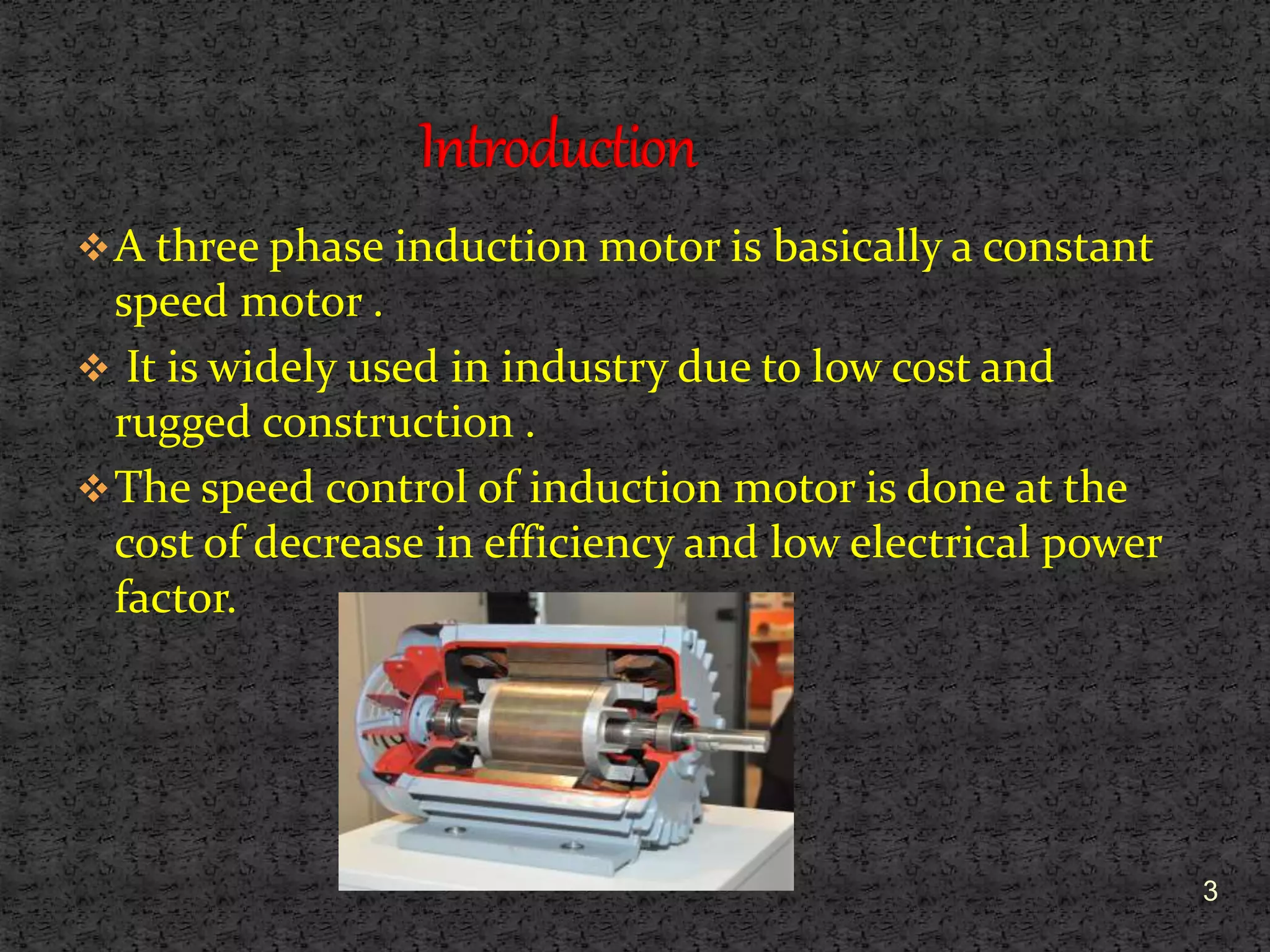
 Induction motor driving seal air fan for supercritical boiler at
Adani TPP Mundra , Gujrat.
4
Speed control means change the drive speed as desired
by the process to maintain different process
parameter at different load .
Energy Saving.
Speed control is a different concept from speed
regulation where there is natural change in speed due
change in load on the shaft.
 Speed control is either done manually by the operator
or by means of some automatic control device.
Low speed starting requirement.
5
 Stator voltage Control
 Stator Frequency Control
 Stator Current Control
 V/F Control
 Static rotor resistance control
MethodsofSpeedControlofInductionmotors
6
 Synchronous speed Ns = 120 f
P
 Slip = Ns-N
Ns
 Torque =
 Where E2 is the rotor emf
 Ns is the synchronous speed
 R2 is the rotor resistance
 X2 is the rotor inductive reactance
7
 Rotor resistance R2 is constant and if slip s is small then sX2 is so
small that it can be neglected. Therefore, T ∝ sE2
2 where E2 is rotor
induced emf and E2 ∝ V
And hence T ∝ V2, thus if supplied voltage is decreased, torque
decreases and hence the speed decreases.
 This method is the easiest and cheapest, still rarely used because-
 A large change in supply voltage is required for relatively small
change in speed.
 Large change in supply voltage will result in large change in flux
density, hence disturbing the magnetic conditions of the motor.
8
Variable Terminal Voltage Control
ms
m
LT
T
V decreasing
 Synchronous speed of induction motor Ns = 120 f
P
 where, f = frequency of the supply and P = number of stator poles.
 Thus, synchronous speed changes with change in supply frequency,
and thus running speed also changes.
 This method is not widely used. This method is used where, only the
induction motor is supplied by a generator (so that frequency can be
easily change by changing the speed of prime mover).
10
 By changing the frequency we can control the speed above and below
the rated speed.
 It offers high range of speed control.
11
12
 Starting torque of IM Ts is proportional to square of stator current.
 It is independent of supply frequency.
 It is independent of rotor resistance.
 A constant current for 3 phase IM can be obtained from 3 phase CSI .
 Inductor convert the dc voltage as constant current source.
 CSI regulate the output frequency and hence torque of induction
motor.
13
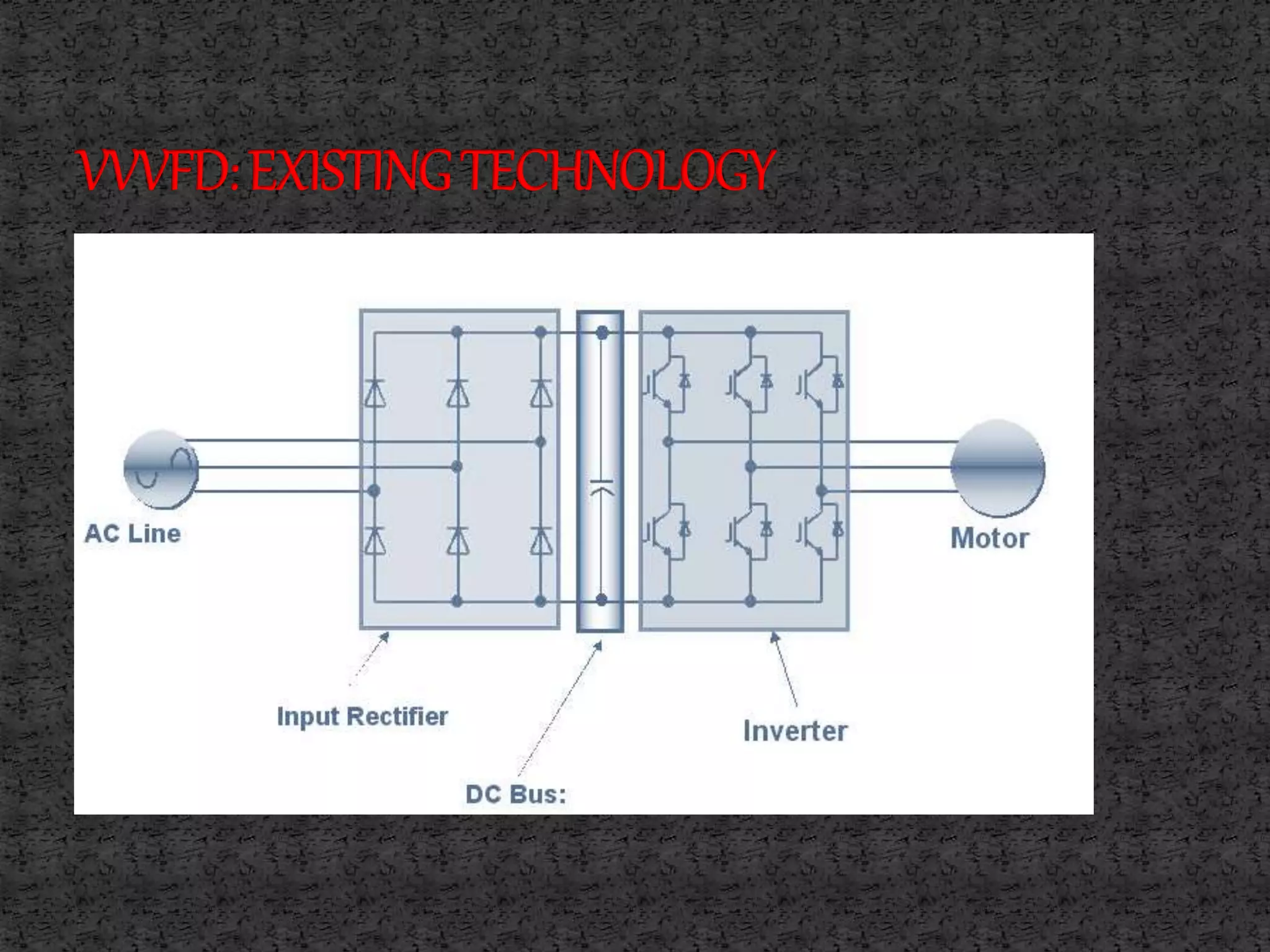
 Rectifier:
 The rectifier in a VFD is used to convert incoming ac
power into direct current (dc) power.
 DC bus:
 DC output of rectifier flows through the dc link to inverter
input.
 Inverter:
 The “Insulated Gate Bipolar Transistor” (IGBT) is a
common choice in modern VFDs.
 The IGBT can switch on and off several thousand times per
second and precisely control the power delivered to the
motor.
 The IGBT uses a method named “pulse width modulation”
(PWM) to simulate a current sine wave at the desired
frequency to the motor.
V/F = C
v is voltage and f is called frequency, c= constant
 In sinusoidal pulse width modulation there are multiple
pulses per half-cycle and the width of the each pulse is
varied with respect to the sine wave magnitude
corresponding to that duration.
 In V/f control we have to maintain the constant ratio of
voltage and frequency.
 In order to achieve the constant ratio ,we have to fire the
(IGBT )in such way that the amplitude of output voltage
waveform in a cycle will maintain the v/f ratio according
the frequency change.
 Waveforms are shown on next slide
16
17
18
19
 A slip ring motor or a phase wound motor is an
induction motor which can be started with full line
voltage, applied across its stator terminals. The value
of starting current is adjusted by adding up external
resistance to its rotor circuit.
20
21
Advantages of ac drives
 For the same rating, ac drives are lighter in weight as
compared to dc drive.
 AC drive require low maintenance.
 AC drives are less expensive.
 Provides the most efficient means of motor speed control.
 Reduces the thermal and mechanical stresses on the motor.
 Provides low speed motor starting facility.
 Saves more energy
22
Disadvantage of ac drives
 Power converters for the control of ac motors are more complex.
 Power converter for ac drives are more expensive.
 Power converters for ac drives generate harmonics in the supply
system and load circuit.
23
 Induction motors with squirrel cage rotors are the workhorse of
industry .
 When Squirrel cage induction machine is operated directly from the
line voltages an Induction motor is operated at constant speed.
However in the industry we required to vary the speed of an
Induction motor. This can be done by Induction motor drive.
 Fans, Compressor, Pumps, blowers, machine tools like lathe, drilling
machine, lifts, conveyer belts etc.
Industrial applications
24
25
26
 In Case of Squirrel cage induction motor the slip cannot be
increase above certain limit, the operating speed range is very
less. By applying the V/F control we can get the large
operating range by keeping V/F ratio constant.
Research
 The research of speed control for induction motor based on dynamic
recurrent neural network.
 Speed Control of induction motor using predictive current control
and SVPWM.
27
28

Speed control of three phase induction motor

  • 1.
    Prepared by: Ashvani KumarShukla Dy. Manager(C&I) BGR Energy ME Modular, Electrical(I&C) 2015 Roll No-151503,NITTTR Chandigarh 1 Speed control of three phase induction motor
  • 2.
     Introduction  Requirementof Speed control  Types of Methods to control the speed of Induction motor  Advantages & disadvantages  Industrial applications of AC drives  Conclusion  Research 2 Agenda
  • 3.
    A three phaseinduction motor is basically a constant speed motor .  It is widely used in industry due to low cost and rugged construction . The speed control of induction motor is done at the cost of decrease in efficiency and low electrical power factor. 3
  • 4.
     Induction motordriving seal air fan for supercritical boiler at Adani TPP Mundra , Gujrat. 4
  • 5.
    Speed control meanschange the drive speed as desired by the process to maintain different process parameter at different load . Energy Saving. Speed control is a different concept from speed regulation where there is natural change in speed due change in load on the shaft.  Speed control is either done manually by the operator or by means of some automatic control device. Low speed starting requirement. 5
  • 6.
     Stator voltageControl  Stator Frequency Control  Stator Current Control  V/F Control  Static rotor resistance control MethodsofSpeedControlofInductionmotors 6
  • 7.
     Synchronous speedNs = 120 f P  Slip = Ns-N Ns  Torque =  Where E2 is the rotor emf  Ns is the synchronous speed  R2 is the rotor resistance  X2 is the rotor inductive reactance 7
  • 8.
     Rotor resistanceR2 is constant and if slip s is small then sX2 is so small that it can be neglected. Therefore, T ∝ sE2 2 where E2 is rotor induced emf and E2 ∝ V And hence T ∝ V2, thus if supplied voltage is decreased, torque decreases and hence the speed decreases.  This method is the easiest and cheapest, still rarely used because-  A large change in supply voltage is required for relatively small change in speed.  Large change in supply voltage will result in large change in flux density, hence disturbing the magnetic conditions of the motor. 8
  • 9.
    Variable Terminal VoltageControl ms m LT T V decreasing
  • 10.
     Synchronous speedof induction motor Ns = 120 f P  where, f = frequency of the supply and P = number of stator poles.  Thus, synchronous speed changes with change in supply frequency, and thus running speed also changes.  This method is not widely used. This method is used where, only the induction motor is supplied by a generator (so that frequency can be easily change by changing the speed of prime mover). 10
  • 11.
     By changingthe frequency we can control the speed above and below the rated speed.  It offers high range of speed control. 11
  • 12.
    12  Starting torqueof IM Ts is proportional to square of stator current.  It is independent of supply frequency.  It is independent of rotor resistance.
  • 13.
     A constantcurrent for 3 phase IM can be obtained from 3 phase CSI .  Inductor convert the dc voltage as constant current source.  CSI regulate the output frequency and hence torque of induction motor. 13
  • 15.
     Rectifier:  Therectifier in a VFD is used to convert incoming ac power into direct current (dc) power.  DC bus:  DC output of rectifier flows through the dc link to inverter input.  Inverter:  The “Insulated Gate Bipolar Transistor” (IGBT) is a common choice in modern VFDs.  The IGBT can switch on and off several thousand times per second and precisely control the power delivered to the motor.  The IGBT uses a method named “pulse width modulation” (PWM) to simulate a current sine wave at the desired frequency to the motor.
  • 16.
    V/F = C vis voltage and f is called frequency, c= constant  In sinusoidal pulse width modulation there are multiple pulses per half-cycle and the width of the each pulse is varied with respect to the sine wave magnitude corresponding to that duration.  In V/f control we have to maintain the constant ratio of voltage and frequency.  In order to achieve the constant ratio ,we have to fire the (IGBT )in such way that the amplitude of output voltage waveform in a cycle will maintain the v/f ratio according the frequency change.  Waveforms are shown on next slide 16
  • 17.
  • 18.
  • 19.
  • 20.
     A slipring motor or a phase wound motor is an induction motor which can be started with full line voltage, applied across its stator terminals. The value of starting current is adjusted by adding up external resistance to its rotor circuit. 20
  • 21.
  • 22.
    Advantages of acdrives  For the same rating, ac drives are lighter in weight as compared to dc drive.  AC drive require low maintenance.  AC drives are less expensive.  Provides the most efficient means of motor speed control.  Reduces the thermal and mechanical stresses on the motor.  Provides low speed motor starting facility.  Saves more energy 22
  • 23.
    Disadvantage of acdrives  Power converters for the control of ac motors are more complex.  Power converter for ac drives are more expensive.  Power converters for ac drives generate harmonics in the supply system and load circuit. 23
  • 24.
     Induction motorswith squirrel cage rotors are the workhorse of industry .  When Squirrel cage induction machine is operated directly from the line voltages an Induction motor is operated at constant speed. However in the industry we required to vary the speed of an Induction motor. This can be done by Induction motor drive.  Fans, Compressor, Pumps, blowers, machine tools like lathe, drilling machine, lifts, conveyer belts etc. Industrial applications 24
  • 25.
  • 26.
  • 27.
     In Caseof Squirrel cage induction motor the slip cannot be increase above certain limit, the operating speed range is very less. By applying the V/F control we can get the large operating range by keeping V/F ratio constant. Research  The research of speed control for induction motor based on dynamic recurrent neural network.  Speed Control of induction motor using predictive current control and SVPWM. 27
  • 28.