Prepared by: Vikash Pratap Singh
EE-3rd Year
1509720057
1
Three phase
induction
motor drives
 Introduction
 Requirement of Speed control
 Types of Methods to control the speed of Induction motor
 Advantages & disadvantages
 Industrial applications of induction motor drives
2
Content
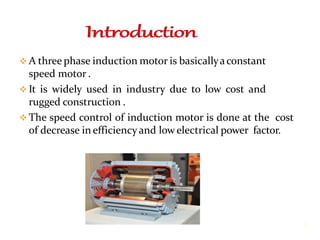
 A three phase induction motor is basicallyaconstant
speed motor .
 It is widely used in industry due to low cost and
rugged construction .
 The speed control of induction motor is done at the cost
of decrease in efficiency and lowelectrical power factor.
3
Speed control means change the drive speed as desired
by the process to maintain different process
parameter at different load .
Energy Saving.
Speed control is a different concept from speed
regulation where there is natural change in speed due
change in load on theshaft.
 Speed control is eitherdone manually by theoperator
or by means of someautomaticcontrol device.
Low speed startingrequirement.
4
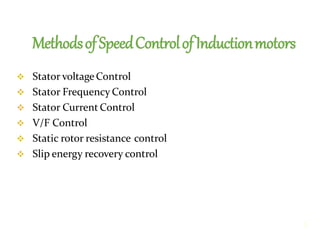
 Stator voltageControl
 Stator Frequency Control
 Stator Current Control
 V/F Control
 Static rotor resistance control
 Slip energy recovery control
5
MethodsofSpeedControlofInductionmotors
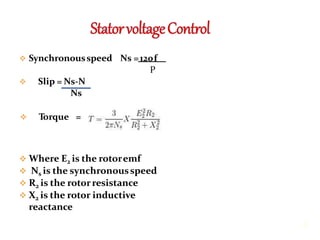
 Synchronousspeed Ns =120f
P
 Slip = Ns-N
Ns
 Torque =
 Where E2 is the rotoremf
 Ns is the synchronousspeed
 R2 is the rotorresistance
 X2 is the rotor inductive
reactance
6
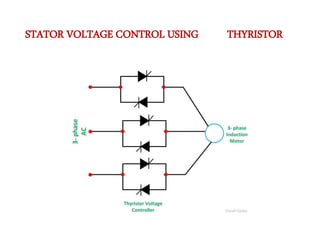
STATOR VOLTAGE CONTROL USING THYRISTOR
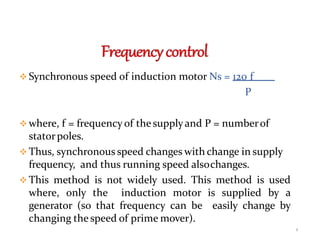
 Synchronous speed of induction motor Ns = 120 f
P
 where, f = frequency of the supplyand P = numberof
statorpoles.
 Thus, synchronous speed changes with change in supply
frequency, and thus running speed alsochanges.
 This method is not widely used. This method is used
where, only the induction motor is supplied by a
generator (so that frequency can be easily change by
changing the speed of prime mover).
8
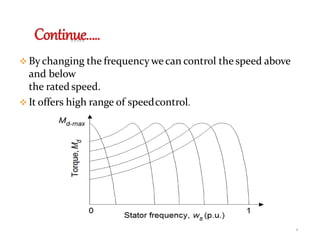
 By changing the frequency we can control the speed above
and below
the rated speed.
 It offers high range of speedcontrol.
9
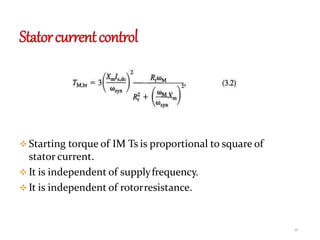
 Starting torque of IM Ts is proportional to square of
stator current.
 It is independent of supplyfrequency.
 It is independent of rotorresistance.
10
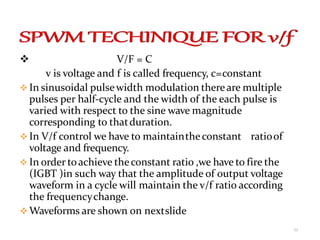
 V/F = C
v is voltage and f is called frequency, c=constant
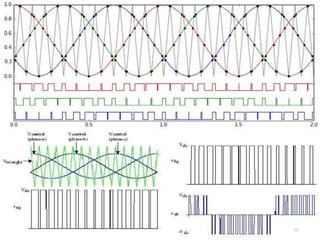
 In sinusoidal pulsewidth modulation thereare multiple
pulses per half-cycle and the width of the each pulse is
varied with respect to the sine wave magnitude
corresponding to thatduration.
 In V/f control we have to maintaintheconstant ratioof
voltage and frequency.
 In order toachieve theconstant ratio ,we have to fire the
(IGBT )in such way that the amplitude of output voltage
waveform in a cycle will maintain the v/f ratio according
the frequencychange.
 Waveforms are shown on nextslide
11
12
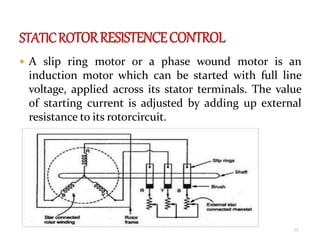
 A slip ring motor or a phase wound motor is an
induction motor which can be started with full line
voltage, applied across its stator terminals. The value
of starting current is adjusted by adding up external
resistance to its rotorcircuit.
13
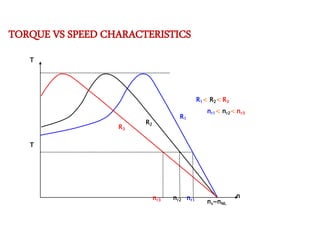
TORQUE VS SPEED CHARACTERISTICS
T
ns~nNL
T
nr3 nr2 nr1
n
R1
R3
R2
R1< R2< R3
nr1< nr2< nr3
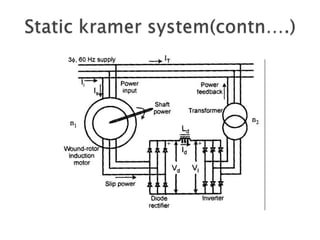
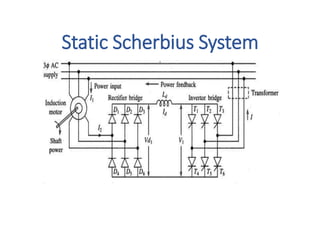
Instead of wasting the slip power in the rotor circuit
resistance, a better approach is to convert it to ac line
power and return it back to the line. Two types of
converter provide this approach:
1) Static Kramer Drive - only allows operation at
sub-synchronous speed.
2) Static Scherbius Drive - allows
operation above and below
synchronous speed
Static Scherbius System
.
Advantages of ac drives
18
 For the same rating, ac drives are lighter in weight as
compared to dc drive.
 AC drive require low maintenance.
 AC drives are less expensive.
 Provides the most efficient means of motor speed control.
 Reduces the thermal and mechanical stresses on the motor.
 Provides low speed motor starting facility.
 Saves more energy
 Induction motors with squirrel cage rotors are the
workhorse of industry .
 When Squirrel cage induction machine is operated
directly from the line voltages an Induction motor is
operated at constant speed. However in the industry we
required to vary the speed of an Induction motor. This
can be done by Induction motor drive.
 Fans, Compressor, Pumps, blowers, machine tools like
lathe, drilling machine, lifts, conveyer belts etc.
Industrial applications
19
20

three phase induction motor drive

  • 1.
    Prepared by: VikashPratap Singh EE-3rd Year 1509720057 1 Three phase induction motor drives
  • 2.
     Introduction  Requirementof Speed control  Types of Methods to control the speed of Induction motor  Advantages & disadvantages  Industrial applications of induction motor drives 2 Content
  • 3.
     A threephase induction motor is basicallyaconstant speed motor .  It is widely used in industry due to low cost and rugged construction .  The speed control of induction motor is done at the cost of decrease in efficiency and lowelectrical power factor. 3
  • 4.
    Speed control meanschange the drive speed as desired by the process to maintain different process parameter at different load . Energy Saving. Speed control is a different concept from speed regulation where there is natural change in speed due change in load on theshaft.  Speed control is eitherdone manually by theoperator or by means of someautomaticcontrol device. Low speed startingrequirement. 4
  • 5.
     Stator voltageControl Stator Frequency Control  Stator Current Control  V/F Control  Static rotor resistance control  Slip energy recovery control 5 MethodsofSpeedControlofInductionmotors
  • 6.
     Synchronousspeed Ns=120f P  Slip = Ns-N Ns  Torque =  Where E2 is the rotoremf  Ns is the synchronousspeed  R2 is the rotorresistance  X2 is the rotor inductive reactance 6
  • 7.
    STATOR VOLTAGE CONTROLUSING THYRISTOR
  • 8.
     Synchronous speedof induction motor Ns = 120 f P  where, f = frequency of the supplyand P = numberof statorpoles.  Thus, synchronous speed changes with change in supply frequency, and thus running speed alsochanges.  This method is not widely used. This method is used where, only the induction motor is supplied by a generator (so that frequency can be easily change by changing the speed of prime mover). 8
  • 9.
     By changingthe frequency we can control the speed above and below the rated speed.  It offers high range of speedcontrol. 9
  • 10.
     Starting torqueof IM Ts is proportional to square of stator current.  It is independent of supplyfrequency.  It is independent of rotorresistance. 10
  • 11.
     V/F =C v is voltage and f is called frequency, c=constant  In sinusoidal pulsewidth modulation thereare multiple pulses per half-cycle and the width of the each pulse is varied with respect to the sine wave magnitude corresponding to thatduration.  In V/f control we have to maintaintheconstant ratioof voltage and frequency.  In order toachieve theconstant ratio ,we have to fire the (IGBT )in such way that the amplitude of output voltage waveform in a cycle will maintain the v/f ratio according the frequencychange.  Waveforms are shown on nextslide 11
  • 12.
  • 13.
     A slipring motor or a phase wound motor is an induction motor which can be started with full line voltage, applied across its stator terminals. The value of starting current is adjusted by adding up external resistance to its rotorcircuit. 13
  • 14.
    TORQUE VS SPEEDCHARACTERISTICS T ns~nNL T nr3 nr2 nr1 n R1 R3 R2 R1< R2< R3 nr1< nr2< nr3
  • 15.
    Instead of wastingthe slip power in the rotor circuit resistance, a better approach is to convert it to ac line power and return it back to the line. Two types of converter provide this approach: 1) Static Kramer Drive - only allows operation at sub-synchronous speed. 2) Static Scherbius Drive - allows operation above and below synchronous speed
  • 17.
  • 18.
    Advantages of acdrives 18  For the same rating, ac drives are lighter in weight as compared to dc drive.  AC drive require low maintenance.  AC drives are less expensive.  Provides the most efficient means of motor speed control.  Reduces the thermal and mechanical stresses on the motor.  Provides low speed motor starting facility.  Saves more energy
  • 19.
     Induction motorswith squirrel cage rotors are the workhorse of industry .  When Squirrel cage induction machine is operated directly from the line voltages an Induction motor is operated at constant speed. However in the industry we required to vary the speed of an Induction motor. This can be done by Induction motor drive.  Fans, Compressor, Pumps, blowers, machine tools like lathe, drilling machine, lifts, conveyer belts etc. Industrial applications 19
  • 20.