SPECTRAL INSTRUMENTS
PRESENTED BY :
Preeti Choudhary (17/MAP/016)
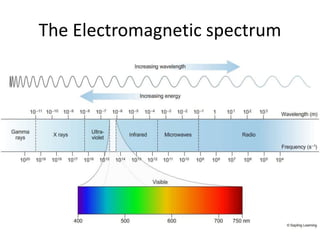
The Electromagnetic spectrum
What are Spectral Instruments ?
Spectral Instruments are the devices which are
used for the analysis of the interaction between
matter and any portion of the electromagnetic
spectrum.
Photodetector
• A photodetector is a device which absorbs
light and converts the optical energy to
measurable electric current.
• Detectors are classified as Thermal detectors
and Photon detectors, we will focus on photon
detectors only.
Photon detectors
• work on the principle of conversion of
photons to electrons
• a device may absorb photons only if the
energy of incident photons is above a certain
minimum threshold.
• Photon detectors, in terms of the technology,
could be based on (a) Vacuum tubes - e.g.
Photomultipliers and (b) Semiconductors - e.g.
Photodiodes.
Performance Parameters
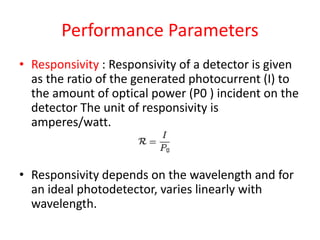
• Responsivity : Responsivity of a detector is given
as the ratio of the generated photocurrent (I) to
the amount of optical power (P0 ) incident on the
detector The unit of responsivity is
amperes/watt.
• Responsivity depends on the wavelength and for
an ideal photodetector, varies linearly with
wavelength.
• Quantum Efficiency: The number of electrons
produced per incident photon is defined as
the quantum efficiency , which is usually
expressed as a percentage .
Photodiode
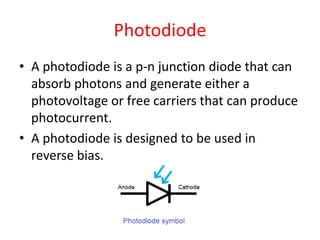
• A photodiode is a p-n junction diode that can
absorb photons and generate either a
photovoltage or free carriers that can produce
photocurrent.
• A photodiode is designed to be used in
reverse bias.
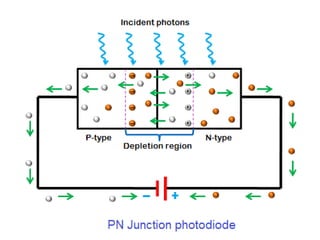
Cross sectional view of silicon photodiode
•The figure shows a p-n
junction diode with a heavily
doped p-side. The donor
concentration on the n side of
the junction is less than the
acceptor concentration on the
p+ side.
• The p- layer is very thin and
is formed on the front surface
of the device on an n-type
silicon.
•The active area is coated
with an antireflection coating
of material (like silicon
nitride) so that most of the
light falling on the device can
be trapped by it.
•Metallized contacts provide
the terminals.
•Photons absorbed in depletion region produces
charge carriers that are immediately swept across
the junction by the natural bias.
•This movement of charge carriers across the
junctions upsets the electrical balance and
produces small photocurrent, which is detected at
electrodes.
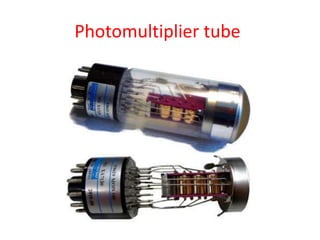
Photomultiplier tube
What is it ?
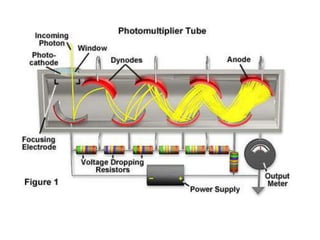
• A photomultiplier converts light into an
electrical signal, then amplifies that signal to a
useful level by emission of secondary
electrons
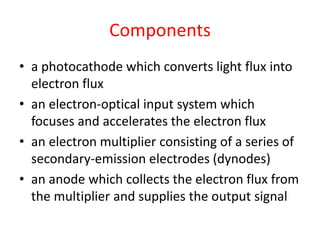
Components
• a photocathode which converts light flux into
electron flux
• an electron-optical input system which
focuses and accelerates the electron flux
• an electron multiplier consisting of a series of
secondary-emission electrodes (dynodes)
• an anode which collects the electron flux from
the multiplier and supplies the output signal
Applications
• Photodiodes are used in the receivers for infrared remote
control devices used to control equipment
from televisions to air conditioners.
• Photodiodes are often used for accurate measurement of
light intensity in science and industry.
• For smaller photon fluxes, the photomultiplier can be
operated in photon-counting or Geiger mode.
• Photomultipliers tubes are used in gamma cameras which
are used in field of nuclear medicine.
SOURCES OF LIGHT
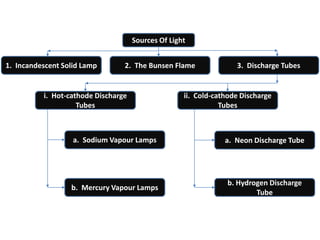
Sources Of Light
1. Incandescent Solid Lamp 3. Discharge Tubes2. The Bunsen Flame
ii. Cold-cathode Discharge
Tubes
i. Hot-cathode Discharge
Tubes
b. Hydrogen Discharge
Tube
a. Neon Discharge Tube
b. Mercury Vapour Lamps
a. Sodium Vapour Lamps
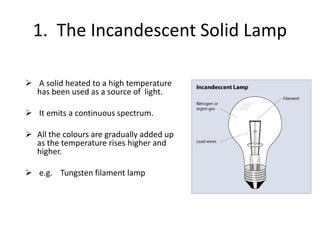
1. The Incandescent Solid Lamp
 A solid heated to a high temperature
has been used as a source of light.
 It emits a continuous spectrum.
 All the colours are gradually added up
as the temperature rises higher and
higher.
 e.g. Tungsten filament lamp
2. The Bunsen flame
 Any substance introduced in
the non-luminous part of the
flame gives the characteristic
spectrum.
 It may consists of a number of
spectral lines.
 To obtain sodium flame, the
sodium salt is introduced in the
flame using an asbestos ring
dipped in the solution of the
salt.
3. Discharge Tubes
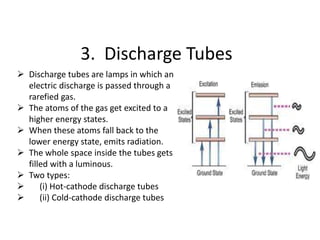
 Discharge tubes are lamps in which an
electric discharge is passed through a
rarefied gas.
 The atoms of the gas get excited to a
higher energy states.
 When these atoms fall back to the
lower energy state, emits radiation.
 The whole space inside the tubes gets
filled with a luminous.
 Two types:
 (i) Hot-cathode discharge tubes
 (ii) Cold-cathode discharge tubes
(i) Hot-cathode Discharge Tubes
These discharge tubes have high operating
current in them (~lamp) because of which the
electrodes get heated
e.g. Sodium vapour lamp,
Mercury vapour lamp,
etc.
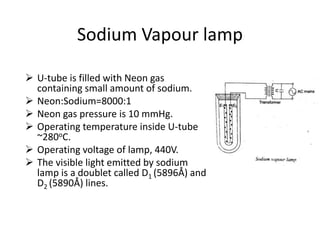
Sodium Vapour lamp
 U-tube is filled with Neon gas
containing small amount of sodium.
 Neon:Sodium=8000:1
 Neon gas pressure is 10 mmHg.
 Operating temperature inside U-tube
~280oC.
 Operating voltage of lamp, 440V.
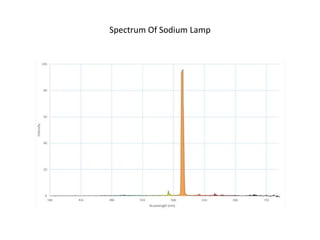
 The visible light emitted by sodium
lamp is a doublet called D1 (5896Å) and
D2 (5890Å) lines.
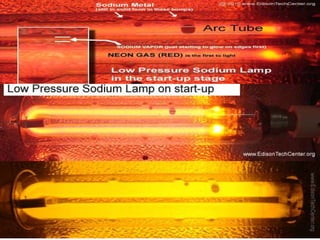
Sodium Vapour Lamp
Tungsten
electrodes
Metallic sodium pecks
U-shaped tube
Spectrum Of Sodium Lamp
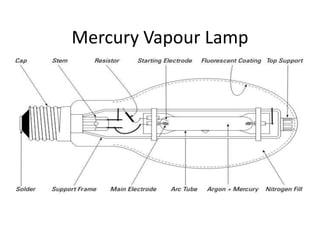
Mercury Vapour lamp
 Arc tube contains Argon
gas and some amount of
Mercury.
 Argon gas pressure is 10
mmHg.
 Operating voltage: 140V.
 Choke helps in regulating
the current flow through
the lamp.
 Operating temperature
inside arc tube: ~600oC.
Mercury Vapour Lamp
Mercury Vapour Lamp (simplified
schematic)
Double walled bulb
Electrodes
Starting Electrode
Arc Tube
Spectral distribution for Mercury Lamp
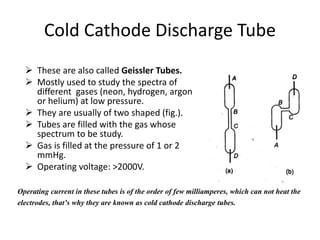
Cold Cathode Discharge Tube
 These are also called Geissler Tubes.
 Mostly used to study the spectra of
different gases (neon, hydrogen, argon
or helium) at low pressure.
 They are usually of two shaped (fig.).
 Tubes are filled with the gas whose
spectrum to be study.
 Gas is filled at the pressure of 1 or 2
mmHg.
 Operating voltage: >2000V.
Operating current in these tubes is of the order of few milliamperes, which can not heat the
electrodes, that’s why they are known as cold cathode discharge tubes.
Cold Cathode Discharge Tube
e.g. (i) Neon discharge tube
(ii) Hydrogen discharge tube
(iii) Nitrogen discharge tubes.
etc.
Cold cathode tubes
Sodium lamps (45W, 80W, 160W,
200W)
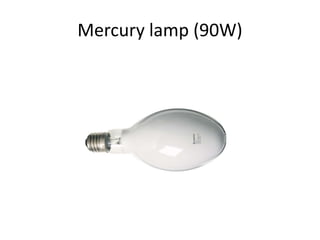
Mercury lamp (90W)
THANK YOU !

Spectral instruments

  • 1.
    SPECTRAL INSTRUMENTS PRESENTED BY: Preeti Choudhary (17/MAP/016)
  • 2.
  • 3.
    What are SpectralInstruments ? Spectral Instruments are the devices which are used for the analysis of the interaction between matter and any portion of the electromagnetic spectrum.
  • 4.
    Photodetector • A photodetectoris a device which absorbs light and converts the optical energy to measurable electric current. • Detectors are classified as Thermal detectors and Photon detectors, we will focus on photon detectors only.
  • 5.
    Photon detectors • workon the principle of conversion of photons to electrons • a device may absorb photons only if the energy of incident photons is above a certain minimum threshold. • Photon detectors, in terms of the technology, could be based on (a) Vacuum tubes - e.g. Photomultipliers and (b) Semiconductors - e.g. Photodiodes.
  • 6.
    Performance Parameters • Responsivity: Responsivity of a detector is given as the ratio of the generated photocurrent (I) to the amount of optical power (P0 ) incident on the detector The unit of responsivity is amperes/watt. • Responsivity depends on the wavelength and for an ideal photodetector, varies linearly with wavelength.
  • 7.
    • Quantum Efficiency:The number of electrons produced per incident photon is defined as the quantum efficiency , which is usually expressed as a percentage .
  • 8.
    Photodiode • A photodiodeis a p-n junction diode that can absorb photons and generate either a photovoltage or free carriers that can produce photocurrent. • A photodiode is designed to be used in reverse bias.
  • 10.
    Cross sectional viewof silicon photodiode •The figure shows a p-n junction diode with a heavily doped p-side. The donor concentration on the n side of the junction is less than the acceptor concentration on the p+ side. • The p- layer is very thin and is formed on the front surface of the device on an n-type silicon. •The active area is coated with an antireflection coating of material (like silicon nitride) so that most of the light falling on the device can be trapped by it. •Metallized contacts provide the terminals. •Photons absorbed in depletion region produces charge carriers that are immediately swept across the junction by the natural bias. •This movement of charge carriers across the junctions upsets the electrical balance and produces small photocurrent, which is detected at electrodes.
  • 11.
  • 12.
    What is it? • A photomultiplier converts light into an electrical signal, then amplifies that signal to a useful level by emission of secondary electrons
  • 13.
    Components • a photocathodewhich converts light flux into electron flux • an electron-optical input system which focuses and accelerates the electron flux • an electron multiplier consisting of a series of secondary-emission electrodes (dynodes) • an anode which collects the electron flux from the multiplier and supplies the output signal
  • 15.
    Applications • Photodiodes areused in the receivers for infrared remote control devices used to control equipment from televisions to air conditioners. • Photodiodes are often used for accurate measurement of light intensity in science and industry. • For smaller photon fluxes, the photomultiplier can be operated in photon-counting or Geiger mode. • Photomultipliers tubes are used in gamma cameras which are used in field of nuclear medicine.
  • 16.
  • 17.
    Sources Of Light 1.Incandescent Solid Lamp 3. Discharge Tubes2. The Bunsen Flame ii. Cold-cathode Discharge Tubes i. Hot-cathode Discharge Tubes b. Hydrogen Discharge Tube a. Neon Discharge Tube b. Mercury Vapour Lamps a. Sodium Vapour Lamps
  • 18.
    1. The IncandescentSolid Lamp  A solid heated to a high temperature has been used as a source of light.  It emits a continuous spectrum.  All the colours are gradually added up as the temperature rises higher and higher.  e.g. Tungsten filament lamp
  • 19.
    2. The Bunsenflame  Any substance introduced in the non-luminous part of the flame gives the characteristic spectrum.  It may consists of a number of spectral lines.  To obtain sodium flame, the sodium salt is introduced in the flame using an asbestos ring dipped in the solution of the salt.
  • 20.
    3. Discharge Tubes Discharge tubes are lamps in which an electric discharge is passed through a rarefied gas.  The atoms of the gas get excited to a higher energy states.  When these atoms fall back to the lower energy state, emits radiation.  The whole space inside the tubes gets filled with a luminous.  Two types:  (i) Hot-cathode discharge tubes  (ii) Cold-cathode discharge tubes
  • 21.
    (i) Hot-cathode DischargeTubes These discharge tubes have high operating current in them (~lamp) because of which the electrodes get heated e.g. Sodium vapour lamp, Mercury vapour lamp, etc.
  • 22.
    Sodium Vapour lamp U-tube is filled with Neon gas containing small amount of sodium.  Neon:Sodium=8000:1  Neon gas pressure is 10 mmHg.  Operating temperature inside U-tube ~280oC.  Operating voltage of lamp, 440V.  The visible light emitted by sodium lamp is a doublet called D1 (5896Å) and D2 (5890Å) lines.
  • 23.
  • 25.
  • 26.
    Mercury Vapour lamp Arc tube contains Argon gas and some amount of Mercury.  Argon gas pressure is 10 mmHg.  Operating voltage: 140V.  Choke helps in regulating the current flow through the lamp.  Operating temperature inside arc tube: ~600oC.
  • 27.
  • 28.
    Mercury Vapour Lamp(simplified schematic) Double walled bulb Electrodes Starting Electrode Arc Tube
  • 29.
  • 30.
    Cold Cathode DischargeTube  These are also called Geissler Tubes.  Mostly used to study the spectra of different gases (neon, hydrogen, argon or helium) at low pressure.  They are usually of two shaped (fig.).  Tubes are filled with the gas whose spectrum to be study.  Gas is filled at the pressure of 1 or 2 mmHg.  Operating voltage: >2000V. Operating current in these tubes is of the order of few milliamperes, which can not heat the electrodes, that’s why they are known as cold cathode discharge tubes.
  • 31.
    Cold Cathode DischargeTube e.g. (i) Neon discharge tube (ii) Hydrogen discharge tube (iii) Nitrogen discharge tubes. etc.
  • 32.
  • 33.
    Sodium lamps (45W,80W, 160W, 200W)
  • 34.
  • 35.