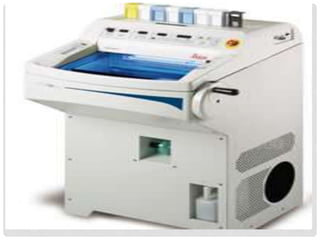
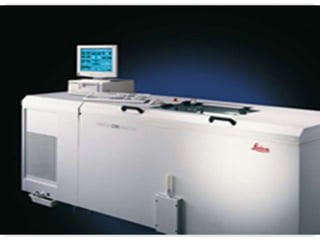
This document discusses frozen sections and cryostats. Frozen sections are prepared without dehydration or embedding to enable rapid diagnosis within 10 minutes. They have applications in intraoperative diagnosis, enzyme histochemistry, immunohistochemistry, and other techniques. Tissue is frozen using liquid nitrogen or other cryogenic methods, turning water within the tissue to ice which acts as an embedding medium for sectioning. Cryostats maintain low temperatures, typically -20 to -30°C, for sectioning frozen tissue blocks. Optimal cutting temperatures vary by tissue type and whether the tissue is fixed.
Introduction of M. R. Mahmoud Ibrahim on frozen section techniques and cryostat.
Frozen sections produce quick tissue samples without dehydration. They convert water to ice for rapid diagnosis.
Two types of frozen sections: fresh unfixed and fixed with key applications in intra-operative diagnosis and histochemistry.Various methods include liquid nitrogen and dry ice; advantages include speed, but with cellular detail loss.
Ice serves as the embedding medium. Consistency varies with temperature; optimal sectioning occurs at specific temperatures.
Tissues should be promptly frozen to prevent artifacts like autolysis and drying, preserving morphological integrity.
Minimizes loss of cellular substances. Involves rapid cooling and sublimation steps for preserving samples.
Used in demonstrating enzymes, proteins, and for scanning electron microscopy.
A quick method for preserving enzymes and proteins, substituting ice with dehydrating agents at low temperatures.
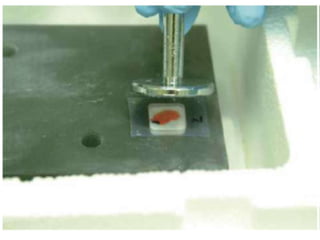
Cryostat maintains low temperatures for sectioning; optimal temperatures differ based on tissue types.
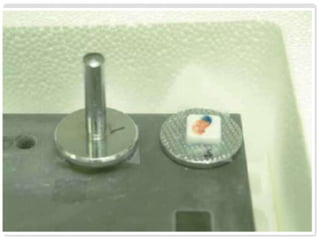
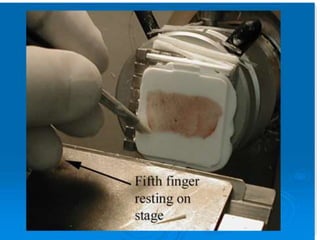
Variances in cutting conditions for hard and soft tissues, addressing fixation and slide adherence issues.
M R .M A H M O U D I B R A H I M
FROZEN SECTION AND
CRYOSTAT
4.
INTRODUCTION
•Frozen sections aremethods used to
produce sections without the use of
dehydrating and clearing solutions, and
without embedding media.
5.
•The preparation ofthe sample is much
more rapid than with traditional histology
technique (around 10 minutes vs 16
hours). However, the technical quality of
the sections is much lower.
6.
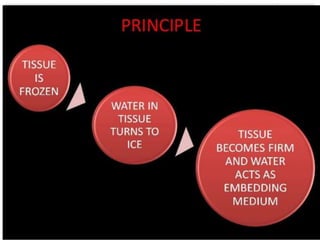
•The principle offrozen section is
converting the water within the tissue into
ice which act as embedding media to
enable to cut thin section to establish
rapid diagnosis.
7.
•There are twotype of frozen section:
•1 Fresh unfixed frozen section (most
common)
•2 fixed frozen section.
•Cold formal calcium 4 C for 18 hrs.
8.
•Frozen sections haveimportant clinical
and research applications. Clinically the
use of frozen sections for intra-operative
consultation.
9.
USES OF FROZENSECTIONS
•The production of frozen sections has
many applications in routine histology
laboratories:
1-Rapid production of sections for intra-
operative diagnosis
10.
2-Diagnostic and researchenzyme
histochemistry or labile enzymes
3-Immunofluorescent methodology
4-Immunohistochemistry techniques when
heat and fixation may inactivate or destroy
the antigens
11.
5-Diagnostic and researchnon-enzyme
histochemistry, e.g. lipids and some
carbohydrates
6-Sliver demonstration methods,
particularly in neuropathology
ADVANTAGES
•Rapid, simple andeasy to reproduce
•Disadvantages:
•Loss of cellular details
• more difficult to obtain serial sections
from the same specimen.
15.
•Refrozen of specimencan damage the
tissue.
• Staining is not very good
• Some specials stains cannot be
performed
•Lack of consultation
16.
THEORETICAL CONSIDERATIONS
•The principleof cutting frozen sections is
simple: when the tissue is frozen, the
interstitial water in the tissue turns to ice,
and in this state the tissue is firm with the
ice acting as the embedding medium.,
17.
•The consistency ofthe frozen block may
be altered by varying the temperature of
the tissue. Reducing the temperature will
produce a harder block; raising the
temperature makes the tissue softer.
18.
•The majority ofnon-fatty unfixed tissues
section well at −25°C. The sectioning of
fixed tissue requires a block temperature
of approximately −10°C or warmer.
19.
PREPARING TISSUE FORFREEZING
•Tissue for freezing should be frozen or
fixed as promptly as possible after
cessation of circulation to avoid
morphological distortions and damage
due to:
20.
•Tissue drying artifact.
•Autolysis - The destruction of tissues or
cells by the action of substances, such as
enzymes, that are produced within the
organism. Also called self-digestion.
21.
FREEZE DRYING TECHNIQUE
•Littleused in routine
•Used in immunohistochemistry
•The technique minimizes the:
•Loss of soluble substances
•This technique involvesthe rapid
freezing of small pieces of tissues in a
similar manner as for freeze drying
Substitution
29.
•of the icein such tissue by placing them
in dehydrating agent at sub zero
temperature.
30.
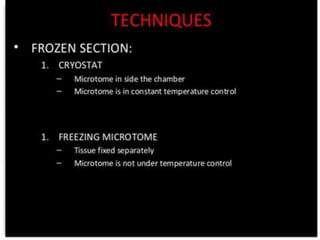
CRYOSTAT
•Cryostat is adevice by which temperature
can be maintained in a low level.
•In pathology and histology it is known as
chamber containing a microtome for
sectioning frozen tissue
OPTIMAL CRYOSTAT CUTTING
TEMPERATURES
FORUNFIXED TISSUES:
•Brain, lymph node,liver,kidney,spleen
And testis at -12 to -16 C.
•Breast,skin,thyroid,adrenal,muscles and
prostate at -18 to -30 C
33.
•Soft tissues cutbetter at slow rate while
the hard tissues better at slightly faster
rate.
-Fixed tissues is more difficult to cut
well.
34.
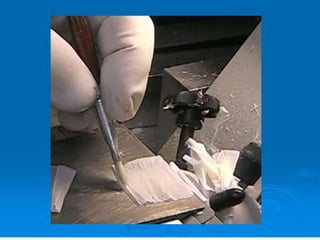
•Cutting section pickup on slides or
cover-slips,the 40C difference in
temperature between section & slide
enough to adhere the section to slide
35.
•Fixed section havea tendency to detach
during staining , to avoid this coat the
slide in gelatine-formaldehyde mixture,
or poly-l-lysine