PLASMA CELL DYSCRASIAS
BY EKTA JAJODIA
B-CELL DEVELOPMENT
• B lymphocytes arise from lymphoid stem cells
in bone marrow
• Initial development occurs in primary lymphoid
organ (BM) from where B cells migrate to the
secondary lymphoid organs (LN & spleen) and
further differentiation occurs on antigenic
stimulation
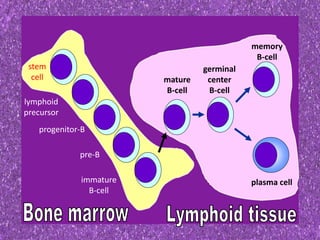
stem
cell
lymphoid
precursor
progenitor-B
pre-B
immature
B-cell
mature
B-cell
germinal
center
B-cell
memory
B-cell
plasma cell
DEVELOPMENT IN
BONE MARROW
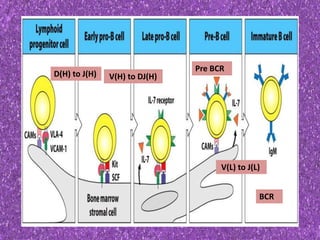
Immunoglobulin gene
rearrangement produces
immature B-cells
D(H) to J(H) V(H) to DJ(H)
Pre BCR
V(L) to J(L)
BCR
ENZYMES REQUIRED
• TdT- (terminal deoxyribonucleotidyl
transferase)
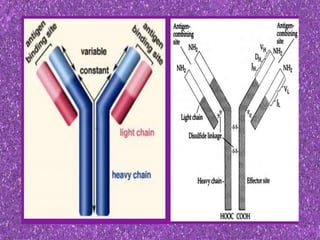
• An enzyme that catalyses heavy chain
rearrangement
• So active in pro-B cell and ceases to be
active in pre b cell stage
• RAG-1 and RAG2 –
• An enzyme reqd for both heavy chain and light
chain rearrangement
• So active in both pro B ell and pre b cell stage
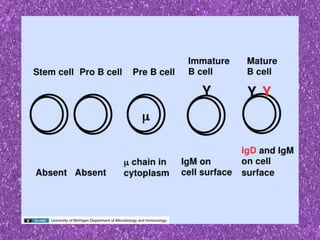
• BM phase of B cell development ends in
production of an IgM bearing immature B
cells
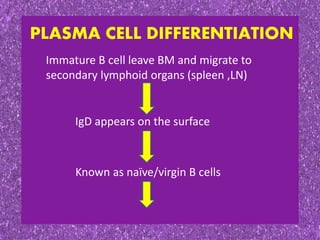
PLASMA CELL DIFFERENTIATION
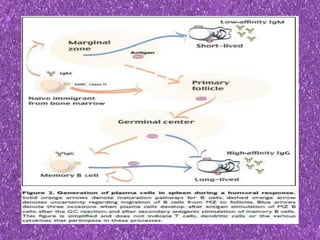
Immature B cell leave BM and migrate to
secondary lymphoid organs (spleen ,LN)
IgD appears on the surface
Known as naïve/virgin B cells
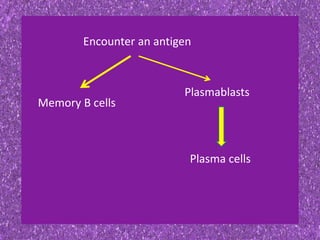
Encounter an antigen
Memory B cells
Plasmablasts
Plasma cells
In the spleen – plasma cells
reside in red pulp
In the lymph node plasma
cells reside in the
medullary cords
ROLE OF BM MICROENVIRONMENT
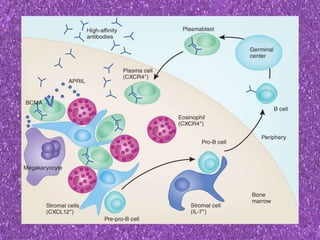
• Most important is BM stromal cells (BMSC)
• Data indicate that plasma cells cultured in
presence of BMSC – survived and continued to
secrete antibody for at least 3 weeks
• When cultured withour BMSC – Abs were
detected only for 7 days
• This suggest that BMSC and its secreted factors are
reqd for Plasma cell survival and longevity
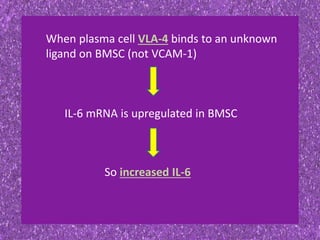
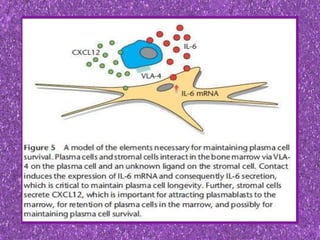
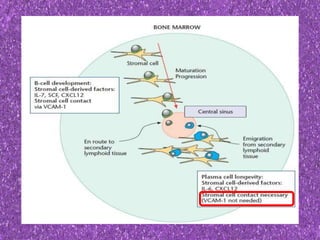
When plasma cell VLA-4 binds to an unknown
ligand on BMSC (not VCAM-1)
IL-6 mRNA is upregulated in BMSC
So increased IL-6
• IL-6 is critical for Plasma cell survival and longevity
• Produced by BMSC
• Not produced by non-malignant plasma cells
• May be produced by myeloma/ malignant plasma
cells
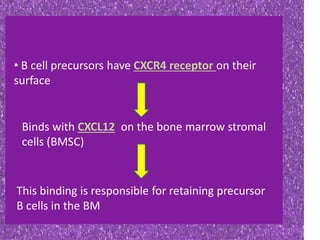
• B cell precursors have CXCR4 receptor on their
surface
Binds with CXCL12 on the bone marrow stromal
cells (BMSC)
This binding is responsible for retaining precursor
B cells in the BM
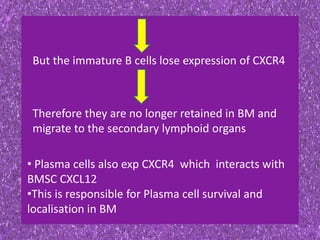
But the immature B cells lose expression of CXCR4
Therefore they are no longer retained in BM and
migrate to the secondary lymphoid organs
• Plasma cells also exp CXCR4 which interacts with
BMSC CXCL12
•This is responsible for Plasma cell survival and
localisation in BM
MOLECULAR AND
CELLULAR EVENTS OF
PLASMA CELL
DIFFERENTIATION
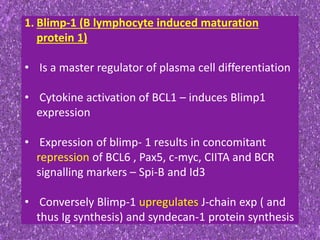
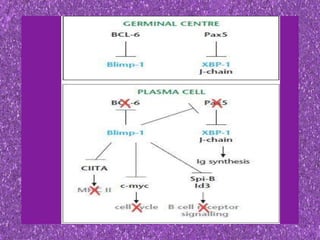
1. Blimp-1 (B lymphocyte induced maturation
protein 1)
• Is a master regulator of plasma cell differentiation
• Cytokine activation of BCL1 – induces Blimp1
expression
• Expression of blimp- 1 results in concomitant
repression of BCL6 , Pax5, c-myc, CIITA and BCR
signalling markers – Spi-B and Id3
• Conversely Blimp-1 upregulates J-chain exp ( and
thus Ig synthesis) and syndecan-1 protein synthesis
2. XBP-1 (X- box binding protein)
• A transcription factor essential for plasma cell
differentiation
• XBP-1 is sufficient to induce generation of
plasma cells
• Absence of XBP-1 does not affect Blimp-1 exp
3. SYNDECAN-1 (CD138)
• Plasma cells are best distinguished from other
population by their membrane exp of syndecan-1
• Syndecan-1 binds to fibronectin, collagen and
basic fibroblast growth factor
• So reqd for contact with BMSC
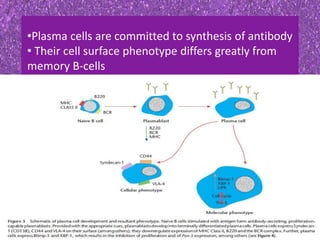
•Plasma cells are committed to synthesis of antibody
• Their cell surface phenotype differs greatly from
memory B-cells
MORPHOLOGY
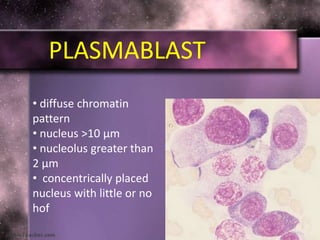
PLASMABLAST
• diffuse chromatin
pattern
• nucleus >10 μm
• nucleolus greater than
2 μm
• concentrically placed
nucleus with little or no
hof
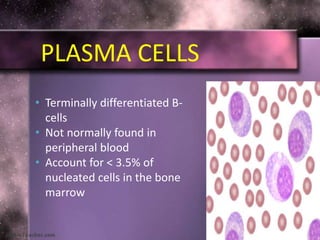
• Terminally differentiated B-
cells
• Not normally found in
peripheral blood
• Account for < 3.5% of
nucleated cells in the bone
marrow
PLASMA CELLS
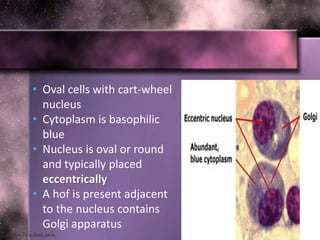
• Oval cells with cart-wheel
nucleus
• Cytoplasm is basophilic
blue
• Nucleus is oval or round
and typically placed
eccentrically
• A hof is present adjacent
to the nucleus contains
Golgi apparatus
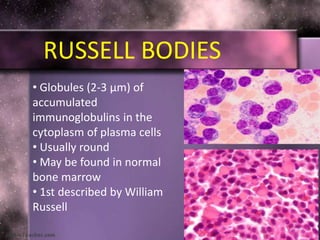
• Globules (2-3 μm) of
accumulated
immunoglobulins in the
cytoplasm of plasma cells
• Usually round
• May be found in normal
bone marrow
• 1st described by William
Russell
RUSSELL BODIES
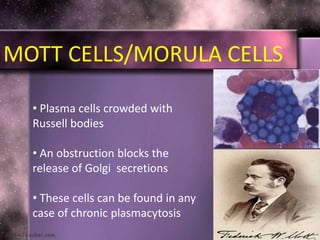
MOTT CELLS/MORULA CELLS
• Plasma cells crowded with
Russell bodies
• An obstruction blocks the
release of Golgi secretions
• These cells can be found in any
case of chronic plasmacytosis
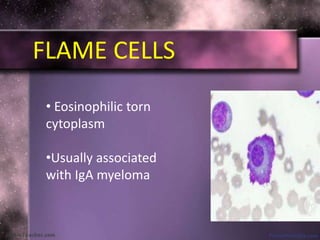
FLAME CELLS
• Eosinophilic torn
cytoplasm
•Usually associated
with IgA myeloma
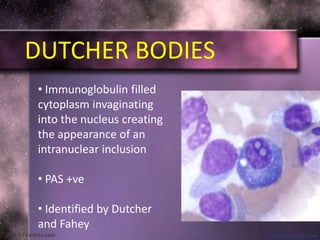
DUTCHER BODIES
• Immunoglobulin filled
cytoplasm invaginating
into the nucleus creating
the appearance of an
intranuclear inclusion
• PAS +ve
• Identified by Dutcher
and Fahey
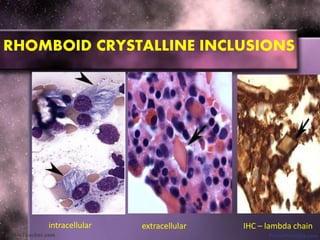
RHOMBOID CRYSTALLINE INCLUSIONS
intracellular extracellular IHC – lambda chain
PLASMA CELL DYSCRASIA
• Plasma cell dyscrasias are disorders of
the plasma cells
• They are produced as a result of abnormal
proliferation of a monoclonal population of
plasma cells that may or may not secrete
detectable levels of a monoclonal
immunoglobulin or immunoglobulin fragment
(paraprotein or M protein)
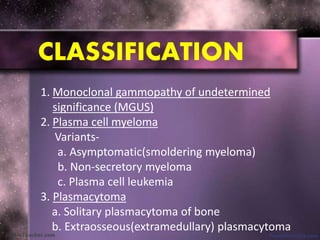
CLASSIFICATION
1. Monoclonal gammopathy of undetermined
significance (MGUS)
2. Plasma cell myeloma
Variants-
a. Asymptomatic(smoldering myeloma)
b. Non-secretory myeloma
c. Plasma cell leukemia
3. Plasmacytoma
a. Solitary plasmacytoma of bone
b. Extraosseous(extramedullary) plasmacytoma
4. Immunoglobulin deposition diseases
a. Primary amyloidosis
b. Systemic light and heavy chain deposition
diseases
5. Osteosclerotic myeloma (POEMS syndrome)
OTHER IMMUNOGLOBULIN
SECRETING NEOPLASMS
1. Lymphoplasmacytic lymphoma/ Waldenstrom
macroglobulinemia
2. Heavy chain diseases
• These are classified separately under mature B-cell
neoplasms
M-component can also be detected in –
1. LYMPHOID NEOPLASMS – CLL, some T and B cell
neoplasms
2. NON-LYMPHOID NEOPLASMS – CML, Breast Ca,
Colon Ca
3. NON NEOPLASTIC CONDITIONS – Cirrhosis,
sarcoidosis, gaucher’s disease, parasitic infection
4. AUTOIMMUNE DISEASES – RA, Myasthenia
gravis, Cold agglutinin disease
5. SKIN DISEASES – Lichen myxedematous,
necrobiotic xanthogranuloma
MGUS
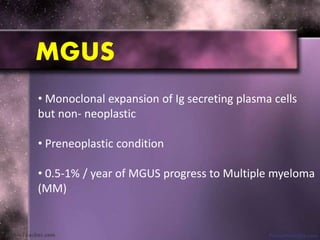
• Monoclonal expansion of Ig secreting plasma cells
but non- neoplastic
• Preneoplastic condition
• 0.5-1% / year of MGUS progress to Multiple myeloma
(MM)
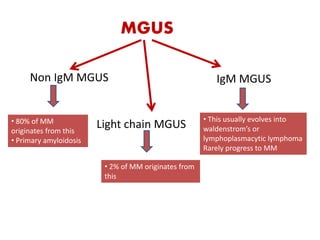
Non IgM MGUS
Light chain MGUS
IgM MGUS
• 80% of MM
originates from this
• Primary amyloidosis
• 2% of MM originates from
this
• This usually evolves into
waldenstrom’s or
lymphoplasmacytic lymphoma
Rarely progress to MM
MGUS
DIAGNOSTIC CRITERIA
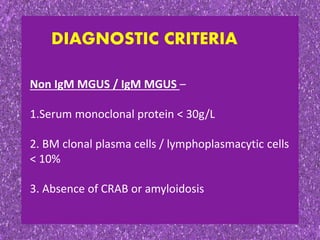
Non IgM MGUS / IgM MGUS –
1.Serum monoclonal protein < 30g/L
2. BM clonal plasma cells / lymphoplasmacytic cells
< 10%
3. Absence of CRAB or amyloidosis
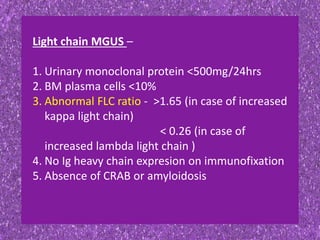
Light chain MGUS –
1. Urinary monoclonal protein <500mg/24hrs
2. BM plasma cells <10%
3. Abnormal FLC ratio - >1.65 (in case of increased
kappa light chain)
< 0.26 (in case of
increased lambda light chain )
4. No Ig heavy chain expresion on immunofixation
5. Absence of CRAB or amyloidosis
1) Size and type of M –protein
- M-protein of >25 g/l
-IgM or IgA MGUS- greater risk of progression
2) Detection of DNA aneuploidy and subnormal
levels of polyclonal Igs
Risk factors for progression of
MGUS to plasma cell myeloma
• BM aspirate shows median of 3% plasma cells
• Trephine bx- no or minimal increase of plasma
cells
• Plasma cells are mature looking however
occasional cell may have cytoplasmic inclusion or
prominent nucleoli
MORPHOLOGY
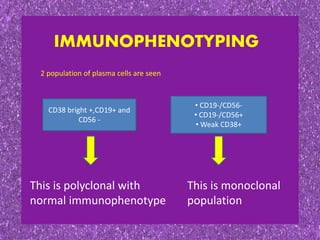
IMMUNOPHENOTYPING
2 population of plasma cells are seen
CD38 bright +,CD19+ and
CD56 -
This is polyclonal with
normal immunophenotype
• CD19-/CD56-
• CD19-/CD56+
• Weak CD38+
This is monoclonal
population
PLASMACYTOMA
CLASSIFICATION-
1.Solitary plasmacytoma of bone
2.Extraosseous (extramedullary)
plasmacytoma
1. Single area of bone/soft tissue destruction due to
clonal plasma cells
2. Normal BM biopsy without clonal disease- ruled
out by B/L iliac crest BM biopsy
3. Normal results on radiologic skeletal survey & MRI
of spine, pelvis, proximal femur & humerus (except
for the primary solitary lesion)
CRITERIA FOR DIAGNOSIS
4. No anemia, hypercalcemia or renal impairment
attributable to myeloma
5. No or low serum or urinary level of monoclonal
protein & preserved levels of uninvolved
immunoglobulins (paraprotein may be seen in
50% cases but usually <2g/dl)
• Solitary plasmacytoma with
minimal marrow involvement –
1. One solitary bone lesion
2. BM clonal plasma cells <10%
• If BM clonal plasma cells <10%
with >1 bone lesion – MM
• If BM clonal plasma cells >10%
with solitary plasmacytoma - MM
• Long & flat bones, axial skeleton, vertebra
• Dense homogenous PC infiltrate with varying
dysplasia- irregular nuclei with dispersed chromatin,
prominent nucleoli & multinucleation
• 25% cases may show amyloid deposition & foreign
body reaction
SOLITARY PLASMACYTOMA OF BONE
Types:
Plasmacytic (WD)- clumped chromatin & little
cytoplasmic dysplasia. Russel & dutcher bodies +ve
Plasmablastic (MD)- dispersed chromatin,
prominent nucleoli & amphophilic cytoplasm
Anaplastic (PD)- nuclear immaturity & dysplasia,
mitosis +ve
• Kappa or lambda light chain restriction
• Non monoclonal Ig usually normal with IgG
preponderance in bone & IgA in extramedullary
• 20% cases show B-cell markers CD 79a, CD 19,
CD 20
IMMUNOHISTOCHEMISTRY
Adverse prognostic factors
• Persistance of monoclonal protein > 1 yr after Tx
• Predominance of non-IgG class immunoglobulin
• Older patients
• Solitary plasamcytoma >5cm
•They have a higher incidence of progression to MM
• Progression to MM is more in solitary
plasmacytoma of bone compared to extraosseous
plasmacytoma
• Localized plasma cell neoplasms that arise in tissues
other than bone
• 80% Extra osseous plasmacytomas occur in URT
• 20% of patients have a small M-protein, most
commonly IgA
EXTRAOSSEOUS PLASMACYTOMA
IMMUNOGLOBULIN DEPOSITION
DISEASES
1.Primary amyloidosis
2.Systemic light and heavy chain
deposition disease
• Monoclonal plasma cell proliferative disorder
associated with deposition of mostly light
chain(usually lambda) or rarely heavy chain
fragments leading to organ dysfunction
• About 10 % of patient with amyloidosis may also
have MM
• Overtime a small number of patient with MGUS
may eventually develop amyloidosis
PRIMARY AMYLOIDOSIS
DIAGNOSIS
• Demonstration of amyloid in abdominal
subcutaneous fat pad ,bone marrow or rectum
• Grossly – waxy or porcelain like
• In H&E – pink amorphous waxy appearing
substance with a characteristic cracking artifact
• Congo red stain- by light microscopy – red to pink
• Under polarised light – apple green birefringence
Systemic light and heavy chain
deposition diseases
CLASSIFICATION -
1.Light chain deposition disease
2.Heavy chain deposition disease
3.Light and heavy chain deposition disease
• Secrete abnormal light chains or heavy chains or
both which deposit in tissues causing organ
dysfunction
• Most commonly involves – kidneys
• Extrarenal deposition rarely may occur in – heart ,
liver and Peripheral nervous system
• In LCDD – Primary defect – multiple mutations in
Ig light chain variable region
• In HCDD – primary defect – deletion of CH1
constant domain – causes failure to associate with
heavy chain binding protein – results in premature
secretion
•Do not form amyloid B-pleated sheets, bind
Congo red or contain amyloid P-component
• LCD usually involves kappa light chains ;
amyloidosis usually involves lambda light
chains
•lambda LCD has a three times worse
prognosis than kappa LCD
Morphology – tissue deposits of non-
amyloid, non- fibrillary amorphous refractile
eosinophilic material in glomerular and
tubular basement membrane
•IF – Prominent smooth linear peritubular
deposits along the outer edge of tubular BM
of mostly kappa light chains
• EM – Dense granular non-fibrillary deposits
OSTEOSCLEROTIC MYELOMA
(POEMS SYNDROME)
CRITERIA FOR DIAGNOSIS
1. Polyneuropathy
2. Monoclonal plasma cells (almost always
lambda)
3. Any one of the 3 major criteria-
a. Sclerotic bone lesions
b. Castleman’s disease
c. Elevated levels of VEGF
4. Any one of the following 6 minor criteria-
a. Organomegaly (splenomegaly, hepatomegaly,
lymphadenopathy)
b. Extravascular volume overload (edema, pleural
effusion, ascitis)
c. Endocrinopathy
d. Skin changes (hyperpigmentation,
hypertrichosis, glomeruloid hemangiomata,
plethora)
e. Papilledema
f. Thrombocytosis/polycythemia
HEAVY CHAIN DISEASE (HCD)
1.Gamma HCD
2.Mu HCD
3.Alpha HCD
Patients secrete a defective heavy chain
immunoglobin
1. Gamma HCD –
• aka franklin’s disease
• Palatal edema (due to involvement of
waldeyer’s ring)
• For diagnosis – Serum M component of IgG
type < 2g/dl
• M- component present in both urine and serum
– usually IgG1 type
• Truncated gamma heavy chain is produced
which lacks light chain binding sites – so cannot
form a complete immunoglobulin molecule
Mu HCD –
• Produces a defective Mu heavy chain that lacks
a variable region
• resembles CLL
• High frequency of hepatosplenomegaly and
absence of peripheral lymphadenopathy – these
features distinguish this from CLL
• Presence of vacuoles in malignant lymphocytes
• Excretion of Kappa light chains in urine
Alpha HCD –
• aka seligmann’s disease/ mediterranean
lymphoma
• MC HCD
• Also known as IPSID ( immunoproliferative small
intestinal disease) – results in malabsorption and
diarrhoea
• Lymphoplasmacytoid infiltration in the lamina
propria of small intestine that secretes truncated
alpha chains
• Campylobacter jejuni causative organism
• Sometimes reversible by antibiotics but may
progress to DLBCL
LYMPHOPLASMACYTIC
LYMPHOMA (LPL)
• Neoplasm of small B lymphocytes, plasmacytoid
lymphocytes and plasma cells
• Does not fulfill criteria for any other small B cell
lymphoid neoplasms that may have plasmacytic
differentiation
• WALDENSTROM MACROGLOBULINEMIA – Found in a
subset of LPL and is defined as LPL with BM involvement
and an IgM monoclonal component of any
concentration
• Serum M component – usually 3 g/dl
• Cryoglobulins present – these are Pure M
components ( not mixed cryoglobulins which is
seen in RA that c/o IgM/IgA complexed with IgG
• May sometimes be asociated with HCV
• Hyperviscosity syndrome (15%) : visual
impairment, neurologic manifestations
• In WM – there may be loss of MAG(myelin
associated glycoprotein) – a protein associated with
demyelinating disease of PNS – so WM patients
may develop peripheral neuropathy
What is
KAHLER’S
disease
• AKA Multiple
myeloma
• Kahler’s disease is
named after an
Austrian doctor called
Otto Kahler who first
investigated and
described MM
What is Randall disease
Monoclonal light and heavy
chain deposition disease
What is Crow-Fukase
syndrome
Aka POEMS
syndrome
1st described
by Dr R.S Crow
in 1956 and
then By Dr
M.Fukase in
1968
TO BE CONTINUED….

IMWG updates on plasma cell dyscrasias

  • 1.
  • 2.
    B-CELL DEVELOPMENT • Blymphocytes arise from lymphoid stem cells in bone marrow • Initial development occurs in primary lymphoid organ (BM) from where B cells migrate to the secondary lymphoid organs (LN & spleen) and further differentiation occurs on antigenic stimulation
  • 3.
  • 4.
    DEVELOPMENT IN BONE MARROW Immunoglobulingene rearrangement produces immature B-cells
  • 6.
    D(H) to J(H)V(H) to DJ(H) Pre BCR V(L) to J(L) BCR
  • 8.
    ENZYMES REQUIRED • TdT-(terminal deoxyribonucleotidyl transferase) • An enzyme that catalyses heavy chain rearrangement • So active in pro-B cell and ceases to be active in pre b cell stage
  • 9.
    • RAG-1 andRAG2 – • An enzyme reqd for both heavy chain and light chain rearrangement • So active in both pro B ell and pre b cell stage
  • 10.
    • BM phaseof B cell development ends in production of an IgM bearing immature B cells
  • 11.
    PLASMA CELL DIFFERENTIATION ImmatureB cell leave BM and migrate to secondary lymphoid organs (spleen ,LN) IgD appears on the surface Known as naïve/virgin B cells
  • 12.
    Encounter an antigen MemoryB cells Plasmablasts Plasma cells
  • 15.
    In the spleen– plasma cells reside in red pulp In the lymph node plasma cells reside in the medullary cords
  • 16.
    ROLE OF BMMICROENVIRONMENT • Most important is BM stromal cells (BMSC) • Data indicate that plasma cells cultured in presence of BMSC – survived and continued to secrete antibody for at least 3 weeks • When cultured withour BMSC – Abs were detected only for 7 days • This suggest that BMSC and its secreted factors are reqd for Plasma cell survival and longevity
  • 17.
    When plasma cellVLA-4 binds to an unknown ligand on BMSC (not VCAM-1) IL-6 mRNA is upregulated in BMSC So increased IL-6
  • 18.
    • IL-6 iscritical for Plasma cell survival and longevity • Produced by BMSC • Not produced by non-malignant plasma cells • May be produced by myeloma/ malignant plasma cells
  • 19.
    • B cellprecursors have CXCR4 receptor on their surface Binds with CXCL12 on the bone marrow stromal cells (BMSC) This binding is responsible for retaining precursor B cells in the BM
  • 20.
    But the immatureB cells lose expression of CXCR4 Therefore they are no longer retained in BM and migrate to the secondary lymphoid organs • Plasma cells also exp CXCR4 which interacts with BMSC CXCL12 •This is responsible for Plasma cell survival and localisation in BM
  • 23.
    MOLECULAR AND CELLULAR EVENTSOF PLASMA CELL DIFFERENTIATION
  • 24.
    1. Blimp-1 (Blymphocyte induced maturation protein 1) • Is a master regulator of plasma cell differentiation • Cytokine activation of BCL1 – induces Blimp1 expression • Expression of blimp- 1 results in concomitant repression of BCL6 , Pax5, c-myc, CIITA and BCR signalling markers – Spi-B and Id3 • Conversely Blimp-1 upregulates J-chain exp ( and thus Ig synthesis) and syndecan-1 protein synthesis
  • 26.
    2. XBP-1 (X-box binding protein) • A transcription factor essential for plasma cell differentiation • XBP-1 is sufficient to induce generation of plasma cells • Absence of XBP-1 does not affect Blimp-1 exp
  • 27.
    3. SYNDECAN-1 (CD138) •Plasma cells are best distinguished from other population by their membrane exp of syndecan-1 • Syndecan-1 binds to fibronectin, collagen and basic fibroblast growth factor • So reqd for contact with BMSC
  • 28.
    •Plasma cells arecommitted to synthesis of antibody • Their cell surface phenotype differs greatly from memory B-cells
  • 29.
  • 30.
    PLASMABLAST • diffuse chromatin pattern •nucleus >10 μm • nucleolus greater than 2 μm • concentrically placed nucleus with little or no hof
  • 31.
    • Terminally differentiatedB- cells • Not normally found in peripheral blood • Account for < 3.5% of nucleated cells in the bone marrow PLASMA CELLS
  • 32.
    • Oval cellswith cart-wheel nucleus • Cytoplasm is basophilic blue • Nucleus is oval or round and typically placed eccentrically • A hof is present adjacent to the nucleus contains Golgi apparatus
  • 33.
    • Globules (2-3μm) of accumulated immunoglobulins in the cytoplasm of plasma cells • Usually round • May be found in normal bone marrow • 1st described by William Russell RUSSELL BODIES
  • 34.
    MOTT CELLS/MORULA CELLS •Plasma cells crowded with Russell bodies • An obstruction blocks the release of Golgi secretions • These cells can be found in any case of chronic plasmacytosis
  • 35.
    FLAME CELLS • Eosinophilictorn cytoplasm •Usually associated with IgA myeloma
  • 36.
    DUTCHER BODIES • Immunoglobulinfilled cytoplasm invaginating into the nucleus creating the appearance of an intranuclear inclusion • PAS +ve • Identified by Dutcher and Fahey
  • 37.
    RHOMBOID CRYSTALLINE INCLUSIONS intracellularextracellular IHC – lambda chain
  • 38.
    PLASMA CELL DYSCRASIA •Plasma cell dyscrasias are disorders of the plasma cells • They are produced as a result of abnormal proliferation of a monoclonal population of plasma cells that may or may not secrete detectable levels of a monoclonal immunoglobulin or immunoglobulin fragment (paraprotein or M protein)
  • 39.
    CLASSIFICATION 1. Monoclonal gammopathyof undetermined significance (MGUS) 2. Plasma cell myeloma Variants- a. Asymptomatic(smoldering myeloma) b. Non-secretory myeloma c. Plasma cell leukemia 3. Plasmacytoma a. Solitary plasmacytoma of bone b. Extraosseous(extramedullary) plasmacytoma
  • 40.
    4. Immunoglobulin depositiondiseases a. Primary amyloidosis b. Systemic light and heavy chain deposition diseases 5. Osteosclerotic myeloma (POEMS syndrome)
  • 41.
    OTHER IMMUNOGLOBULIN SECRETING NEOPLASMS 1.Lymphoplasmacytic lymphoma/ Waldenstrom macroglobulinemia 2. Heavy chain diseases • These are classified separately under mature B-cell neoplasms
  • 42.
    M-component can alsobe detected in – 1. LYMPHOID NEOPLASMS – CLL, some T and B cell neoplasms 2. NON-LYMPHOID NEOPLASMS – CML, Breast Ca, Colon Ca 3. NON NEOPLASTIC CONDITIONS – Cirrhosis, sarcoidosis, gaucher’s disease, parasitic infection 4. AUTOIMMUNE DISEASES – RA, Myasthenia gravis, Cold agglutinin disease 5. SKIN DISEASES – Lichen myxedematous, necrobiotic xanthogranuloma
  • 43.
    MGUS • Monoclonal expansionof Ig secreting plasma cells but non- neoplastic • Preneoplastic condition • 0.5-1% / year of MGUS progress to Multiple myeloma (MM)
  • 44.
    Non IgM MGUS Lightchain MGUS IgM MGUS • 80% of MM originates from this • Primary amyloidosis • 2% of MM originates from this • This usually evolves into waldenstrom’s or lymphoplasmacytic lymphoma Rarely progress to MM MGUS
  • 45.
    DIAGNOSTIC CRITERIA Non IgMMGUS / IgM MGUS – 1.Serum monoclonal protein < 30g/L 2. BM clonal plasma cells / lymphoplasmacytic cells < 10% 3. Absence of CRAB or amyloidosis
  • 46.
    Light chain MGUS– 1. Urinary monoclonal protein <500mg/24hrs 2. BM plasma cells <10% 3. Abnormal FLC ratio - >1.65 (in case of increased kappa light chain) < 0.26 (in case of increased lambda light chain ) 4. No Ig heavy chain expresion on immunofixation 5. Absence of CRAB or amyloidosis
  • 47.
    1) Size andtype of M –protein - M-protein of >25 g/l -IgM or IgA MGUS- greater risk of progression 2) Detection of DNA aneuploidy and subnormal levels of polyclonal Igs Risk factors for progression of MGUS to plasma cell myeloma
  • 48.
    • BM aspirateshows median of 3% plasma cells • Trephine bx- no or minimal increase of plasma cells • Plasma cells are mature looking however occasional cell may have cytoplasmic inclusion or prominent nucleoli MORPHOLOGY
  • 49.
    IMMUNOPHENOTYPING 2 population ofplasma cells are seen CD38 bright +,CD19+ and CD56 - This is polyclonal with normal immunophenotype • CD19-/CD56- • CD19-/CD56+ • Weak CD38+ This is monoclonal population
  • 50.
    PLASMACYTOMA CLASSIFICATION- 1.Solitary plasmacytoma ofbone 2.Extraosseous (extramedullary) plasmacytoma
  • 51.
    1. Single areaof bone/soft tissue destruction due to clonal plasma cells 2. Normal BM biopsy without clonal disease- ruled out by B/L iliac crest BM biopsy 3. Normal results on radiologic skeletal survey & MRI of spine, pelvis, proximal femur & humerus (except for the primary solitary lesion) CRITERIA FOR DIAGNOSIS
  • 52.
    4. No anemia,hypercalcemia or renal impairment attributable to myeloma 5. No or low serum or urinary level of monoclonal protein & preserved levels of uninvolved immunoglobulins (paraprotein may be seen in 50% cases but usually <2g/dl)
  • 53.
    • Solitary plasmacytomawith minimal marrow involvement – 1. One solitary bone lesion 2. BM clonal plasma cells <10% • If BM clonal plasma cells <10% with >1 bone lesion – MM • If BM clonal plasma cells >10% with solitary plasmacytoma - MM
  • 54.
    • Long &flat bones, axial skeleton, vertebra • Dense homogenous PC infiltrate with varying dysplasia- irregular nuclei with dispersed chromatin, prominent nucleoli & multinucleation • 25% cases may show amyloid deposition & foreign body reaction SOLITARY PLASMACYTOMA OF BONE
  • 55.
    Types: Plasmacytic (WD)- clumpedchromatin & little cytoplasmic dysplasia. Russel & dutcher bodies +ve Plasmablastic (MD)- dispersed chromatin, prominent nucleoli & amphophilic cytoplasm Anaplastic (PD)- nuclear immaturity & dysplasia, mitosis +ve
  • 56.
    • Kappa orlambda light chain restriction • Non monoclonal Ig usually normal with IgG preponderance in bone & IgA in extramedullary • 20% cases show B-cell markers CD 79a, CD 19, CD 20 IMMUNOHISTOCHEMISTRY
  • 57.
    Adverse prognostic factors •Persistance of monoclonal protein > 1 yr after Tx • Predominance of non-IgG class immunoglobulin • Older patients • Solitary plasamcytoma >5cm •They have a higher incidence of progression to MM • Progression to MM is more in solitary plasmacytoma of bone compared to extraosseous plasmacytoma
  • 58.
    • Localized plasmacell neoplasms that arise in tissues other than bone • 80% Extra osseous plasmacytomas occur in URT • 20% of patients have a small M-protein, most commonly IgA EXTRAOSSEOUS PLASMACYTOMA
  • 59.
  • 60.
    • Monoclonal plasmacell proliferative disorder associated with deposition of mostly light chain(usually lambda) or rarely heavy chain fragments leading to organ dysfunction • About 10 % of patient with amyloidosis may also have MM • Overtime a small number of patient with MGUS may eventually develop amyloidosis PRIMARY AMYLOIDOSIS
  • 61.
    DIAGNOSIS • Demonstration ofamyloid in abdominal subcutaneous fat pad ,bone marrow or rectum • Grossly – waxy or porcelain like • In H&E – pink amorphous waxy appearing substance with a characteristic cracking artifact • Congo red stain- by light microscopy – red to pink • Under polarised light – apple green birefringence
  • 62.
    Systemic light andheavy chain deposition diseases CLASSIFICATION - 1.Light chain deposition disease 2.Heavy chain deposition disease 3.Light and heavy chain deposition disease
  • 63.
    • Secrete abnormallight chains or heavy chains or both which deposit in tissues causing organ dysfunction • Most commonly involves – kidneys • Extrarenal deposition rarely may occur in – heart , liver and Peripheral nervous system • In LCDD – Primary defect – multiple mutations in Ig light chain variable region • In HCDD – primary defect – deletion of CH1 constant domain – causes failure to associate with heavy chain binding protein – results in premature secretion
  • 64.
    •Do not formamyloid B-pleated sheets, bind Congo red or contain amyloid P-component • LCD usually involves kappa light chains ; amyloidosis usually involves lambda light chains •lambda LCD has a three times worse prognosis than kappa LCD
  • 65.
    Morphology – tissuedeposits of non- amyloid, non- fibrillary amorphous refractile eosinophilic material in glomerular and tubular basement membrane •IF – Prominent smooth linear peritubular deposits along the outer edge of tubular BM of mostly kappa light chains • EM – Dense granular non-fibrillary deposits
  • 66.
    OSTEOSCLEROTIC MYELOMA (POEMS SYNDROME) CRITERIAFOR DIAGNOSIS 1. Polyneuropathy 2. Monoclonal plasma cells (almost always lambda) 3. Any one of the 3 major criteria- a. Sclerotic bone lesions b. Castleman’s disease c. Elevated levels of VEGF
  • 67.
    4. Any oneof the following 6 minor criteria- a. Organomegaly (splenomegaly, hepatomegaly, lymphadenopathy) b. Extravascular volume overload (edema, pleural effusion, ascitis) c. Endocrinopathy d. Skin changes (hyperpigmentation, hypertrichosis, glomeruloid hemangiomata, plethora) e. Papilledema f. Thrombocytosis/polycythemia
  • 68.
    HEAVY CHAIN DISEASE(HCD) 1.Gamma HCD 2.Mu HCD 3.Alpha HCD Patients secrete a defective heavy chain immunoglobin
  • 69.
    1. Gamma HCD– • aka franklin’s disease • Palatal edema (due to involvement of waldeyer’s ring) • For diagnosis – Serum M component of IgG type < 2g/dl • M- component present in both urine and serum – usually IgG1 type • Truncated gamma heavy chain is produced which lacks light chain binding sites – so cannot form a complete immunoglobulin molecule
  • 70.
    Mu HCD – •Produces a defective Mu heavy chain that lacks a variable region • resembles CLL • High frequency of hepatosplenomegaly and absence of peripheral lymphadenopathy – these features distinguish this from CLL • Presence of vacuoles in malignant lymphocytes • Excretion of Kappa light chains in urine
  • 71.
    Alpha HCD – •aka seligmann’s disease/ mediterranean lymphoma • MC HCD • Also known as IPSID ( immunoproliferative small intestinal disease) – results in malabsorption and diarrhoea • Lymphoplasmacytoid infiltration in the lamina propria of small intestine that secretes truncated alpha chains • Campylobacter jejuni causative organism • Sometimes reversible by antibiotics but may progress to DLBCL
  • 72.
    LYMPHOPLASMACYTIC LYMPHOMA (LPL) • Neoplasmof small B lymphocytes, plasmacytoid lymphocytes and plasma cells • Does not fulfill criteria for any other small B cell lymphoid neoplasms that may have plasmacytic differentiation • WALDENSTROM MACROGLOBULINEMIA – Found in a subset of LPL and is defined as LPL with BM involvement and an IgM monoclonal component of any concentration
  • 73.
    • Serum Mcomponent – usually 3 g/dl • Cryoglobulins present – these are Pure M components ( not mixed cryoglobulins which is seen in RA that c/o IgM/IgA complexed with IgG • May sometimes be asociated with HCV • Hyperviscosity syndrome (15%) : visual impairment, neurologic manifestations • In WM – there may be loss of MAG(myelin associated glycoprotein) – a protein associated with demyelinating disease of PNS – so WM patients may develop peripheral neuropathy
  • 74.
    What is KAHLER’S disease • AKAMultiple myeloma • Kahler’s disease is named after an Austrian doctor called Otto Kahler who first investigated and described MM
  • 75.
    What is Randalldisease Monoclonal light and heavy chain deposition disease
  • 76.
    What is Crow-Fukase syndrome AkaPOEMS syndrome 1st described by Dr R.S Crow in 1956 and then By Dr M.Fukase in 1968
  • 77.