SPECIAL STAINS IN
PATHOLOGY
Moderator : Dr. B P Bommanahalli
Professor and Head
Contents :
1. Stains for carbohydrates
2. Stains for Mucin
3. Stains for collagen and Elastic fibres
4. Stains for amyloid
5. Stains for lipid
6. Stains for – Melanin, Calcium, Iron
7. Stains for microorganisms
Introduction
⦁ Stains : chemical substances used to achieve visible color
contrast in the microscopic picture of a prepared tissue
⦁ Staining : treating tissues or cells with a series of
reagents so that it acquires a color; no particles of dye
are seen and the stained element is transparent.
Dyes : Essentially Aromatic benzene ring compounds or
derivatives that possess the twin properties of color and
ability to bind to tissue.
⦁ A polyvalent metal ion which forms coordination complexes
with certain dyes.
⦁ Acts as an intermediary between dye and tissue,
⦁ Thus increasing the affinity between them.
Accentuators:
⦁ Substances which increase the staining power of dye.
⦁ They increase the intensity & selectivity of stain.
e.g KOH in Lofflers methylene blue
phenol in carbol fuschin & carbol thionin.
Accelerators
⦁ Accentuators used in metallic impregnation technique for the
nervous system.
e.g chloral hydrate
Trapping agents
⦁ Agents which holds dye combination with tissue or bacteria .
e.g tannic acid/iodine
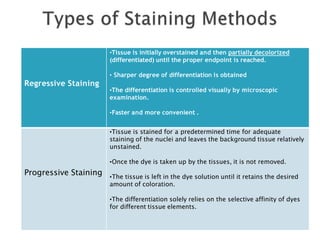
Regressive Staining
•Tissue is initially overstained and then partially decolorized
(differentiated) until the proper endpoint is reached.
• Sharper degree of differentiation is obtained
•The differentiation is controlled visually by microscopic
examination.
•Faster and more convenient .
Progressive Staining
•Tissue is stained for a predetermined time for adequate
staining of the nuclei and leaves the background tissue relatively
unstained.
•Once the dye is taken up by the tissues, it is not removed.
•The tissue is left in the dye solution until it retains the desired
amount of coloration.
•The differentiation solely relies on the selective affinity of dyes
for different tissue elements.
⦁ Removal or washing out of excess
stain until the color is retained
only by the tissue component that
is to be studied.
⦁ Done with acid alcohol or
ethyl alcohol
⦁ Exposure to air may oxidize and
improve the process.
Differentiation
Vital Staining Applied to living tissue
Accomplished by injecting staining solution into
some part of the body
Mixing of stain with living cells
Primarily used for research.
Routine Staining Stains tissues with minimal differentiation
except between nucleus and cytoplasm.
Demonstrates general relationship among
cells, tissues and organs.
e.g Hematoxylin and Eosin stains
Special Staining Demonstrates selective features of tissues
:
Particular cell products.
Microscopic intracellular and intercellular
structure.
e.g PAS stain for mucopolysaccharide.
Periodic Acid-Schiff (PAS) stain
• Principle:
Substance containing vicinal glycol groups
oxidized by periodic acid into dialdehydes
on reaction with schiff’s reagent
insoluble purple- magenta compound.
• Dyes : 1%periodic acid
Schiff’s reagent
• Control : Appendix
• Result :
PAS +ve substance : Purple –magenta color
Nuclei : Blue
PAS positive substances :
• Glycogen
• Neutral mucoprotein
• Glycoprotein
• Glycolipid
• Basement membrane
• All fungi
• Phosphorylated sugar
• Cerebrosides
PAS Diastase reaction :
• glycogen treated with diastase enzyme
• digest the glycogen and
• negative PAS reaction.
• to differentiate glycogen from other PAS
positive elements
• such as mucin
Uses of PAS:
• Demonstrate glycogen and neutral mucoprotein.
• In diagnosis of poorly differentiated adenocarcinoma of
various tissue like stomach, pancreas, lung.
• In diagnosis of hepatocellular carcinoma.
• Seminoma, Dysgerminoma
• RCC- Renal cell carcinoma: Clear cell type
• To demostrate – intracytoplasmic crystal in alveolar soft
part sarcoma
• To demostrate basement membrane e.g. adenoid cystic
ca.
• To demostrate neutral mucin in gastrointestinal tract
• To demostrate fungi in tissue sample
Candidiasis
Actinomycosis
Histoplasmosis
Blastomycosis
• In diagnosis of
• ALL- block positivity and
• AML- diffuse cytoplasmic positivity in M5, M3 and
• cytoplasmic granular/block positivity in M6 and
• cytoplasmic granular and blebs positivity of blast in
M7.
Gastric signet ring cell carcinoma on PAS stain
Candida seen on PAS stain
• Presence of glycogen will be evidenced by loss
of staining after enzyme treatment when
compared to the untreated sections.
PAS Stain
PAS with Diastase
Mucin
Two major categories- epithelial and stromal.
Epithelial mucin (membrane bound or secreted)
• composed of central protein core and sialic acid
• sulfated or nonsufated.
Stromal mucin known as glycosaminoglycans contain
hyaluronic acid may be sulfated or non sulfated.
• They are better known as myxoid substance.
• Their functions are lubrication, chemical barrier and cell
signaling.
The types of mucin are as follows:
Neutral - Found in glands of stomach and in prostate.
stain with PAS but not with Alcian blue, colloidal iron and
mucicarmine.
Acid (simple, or non-sulfated) –
typical mucins of epithelial cells containing sialic acid.
They stain with PAS, Alcian blue at pH 2.5, colloidal iron.
E.g. salivary glands.
Acid (simple, sulfated -mesenchymal) –
These contain hyaluronic acid and are found in stroma.
do not stain with PAS,
stain with Alcian blue at pH 2.5, colloidal iron
• Acid (complex, epithelial) –
These are found in adenocarcinomas of colon,
breast,ovary, mucoepidermoid carcinoma .
PAS is usually positive.
Alcian blue is positive at pH 1,
• Acid (complex, connective tissue) –
Found in tissue stroma, cartilage, and bone
substances such as chondroitin sulfate or keratan sulfate.
They are PAS negative
stain selectively with Alcian blue at pH 0.5.
Stains for
mucin
• Alcian blue
• PAS
• Mayer mucicarmine
• Hale colloidal iron stain
Alcian blue
PRINCIPLE
• Alcian blue is a copper phthalcyanin dye
• Contains positively charged groups capable of salt
linkage with polyanions of the acid mucins
By varying the pH of the solution of Alcian blue
more information can be gained concerning the
types of acid mucin present.
It does not stain neutral mucin.
• Dyes : 1%Alcian blue in 3%acetic acid
• Results : Acid MPS – deep blue
Nuclei – faint blue
• PAS-Alcian blue is best ‘pan-mucin’ stain combination,
• it demostrates mucin both neutral, slightly acidic and highly
acidic.
The goblet cells of the gastrointestinal tract are filled with abundant
acid mucin and stain pale blue with this Alcian blue stain.
Colonic mucosa showing sialomucin that have acid and
neutral mucopolysaccharide stain purple on alcian blue-PAS.
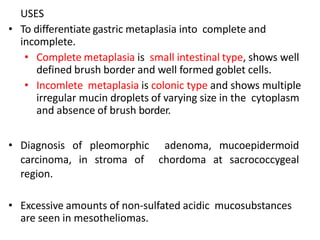
USES
• To differentiate gastric metaplasia into complete and
incomplete.
• Complete metaplasia is small intestinal type, shows well
defined brush border and well formed goblet cells.
• Incomlete metaplasia is colonic type and shows multiple
irregular mucin droplets of varying size in the cytoplasm
and absence of brush border.
• Diagnosis of pleomorphic adenoma, mucoepidermoid
carcinoma, in stroma of chordoma at sacrococcygeal
region.
• Excessive amounts of non-sulfated acidic mucosubstances
are seen in mesotheliomas.
Mixed salivary gland. Acid mucopolysaccharides in mucous
cells are stained blue (Alcian blue at pH 2.5).
Chordoma on alcian blue stain at ph 2.5
MUCICARMINE STAIN
PRINCIPLE :-
Positively charged carmine complex bonds with the
negatively charged acid mucin.
Strongly sulphated mucins are variable in their reaction,
neutral mucin do not stain at all,
acidic mucin stain strongly.
REAGENTS:
• Southgate's Mucicarmine Solution:
Carmine, alum lake
Aluminum hydroxide
50% alcohol
-1.0 gm
-1.0 gm
-100.0 ml
Aluminum chloride, anhydrous- 0.5 gm
• Mayer's Hematoxylin:
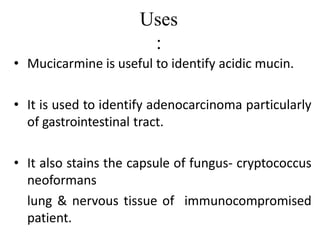
Uses
:
• Mucicarmine is useful to identify acidic mucin.
• It is used to identify adenocarcinoma particularly
of gastrointestinal tract.
• It also stains the capsule of fungus- cryptococcus
neoformans
lung & nervous tissue of immunocompromised
patient.
Colonic Mucosa showing sialomsucin --
- magenta
RESULTS:
Mucin - magenta
Nuclei - black
Other tissue elements- yellow
Cryptococcus neoformans in lung of AIDS patient
capsule stains red
HALE’S COLLOIDAL IRON
STAIN
• Positive staining with hale’s colloidal iron
stain is considered diagnostic feature of
chromophobe renal cell carcionoma and has
been used as discriminatory feature to
differentiate it from other renal tumour.
Result
• Acid mucopolysaccharides: blue
• Nuclei: red
a.Classic chromophobe RCC
b.classic chromophobe RCC
on hale’s colloidal iron stain
c. Eosinophilic chromophobe
d.Eosinophilic chromophobe
on hale’s colloidal iron stain
e.oncocytoma
f. oncocytoma diffusely
negative cytoplasmic
reaction with hale‘s colloidal
iron stain
RETICULIN STAIN-GOMORI’S METHOD
• Reticulin stain demonstrate both reticular fibers and
basement membrane material.
• Reticular fibers consist of very thin fiber of type III
collagen
• Basement membrane are largely composed of type IV
collagen and laminin.
Principle:
Reticulin fibers have little natural affinity for silver
solutions.
On treatment with potassium permangenate it
produce sensitised sites on fibers where silver deposition
can be initiated.
A reducing agent formalin causes deposition of silver
in the form of metal.
• Dyes used: Silver nitrate 10%
NaOH 10%
KMnO4 1% aqu.
oxalic acid 5% aqu Iron alum
2.5%
Formalin 10%
• Control: Cirrhosis of liver
• Result: Reticular fiber – Black
Nuclei- Gray
• Other elements- According to counter
stain used
Reticulin fiber- Black Nuclei -Black
Uses of reticulin stain
1. Diagnosis of liver cirrhosis.
2. To distinguish epithelial neoplasms from non-
epithelial neoplasms.
Foci of carcinoma have reticulin around tumour
nest but not in between tumour cell, whereas in
most sarcomas and large cell lymphoma reticulin
separates single cells.
3. To differentiate between in-situ and invasive
carcinoma
Trichrome stain
• This stain is mainly used to evaluate the type and
amount of extracellular material like- collagen,
fibrin, muscle and elastic fiber.
Various technique includes:
• Masson trichrome stain
• Van gieson stain
• Mallory, Phosphotungstic or phosphomolybdic acid
stain
• Verhoeff-Van Gieson(VVG) stain
The general rule
less porous tissues are colored by the smallest
dye molecule;
whenever a dye of large molecular size is able
to penetrate,
it will always do so at the expense of the
smaller molecule.
Masson trichome stain
• This method is used for detection of collagen
fibers in the tissues
• The collagen fibers will be stained blue and
• The nuclei - black.
Masson trichrome stain
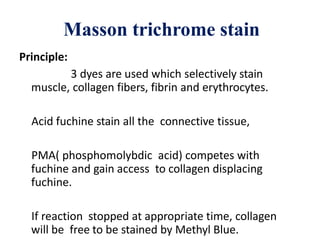
Principle:
3 dyes are used which selectively stain
muscle, collagen fibers, fibrin and erythrocytes.
Acid fuchine stain all the connective tissue,
PMA( phosphomolybdic acid) competes with
fuchine and gain access to collagen displacing
fuchine.
If reaction stopped at appropriate time, collagen
will be free to be stained by Methyl Blue.
• Reaent used – Weigerts iron hematoxylin solution
- Phosphomolybdic- phosphotungstic
acid solution
- Biebrich scarlet acid fucshin solution
- Aniline blue solution
- 1% acetic acid solution
• Result - Nuclei : Black
Collagen : Blue
Cytoplasm, Muscle, RBC : Red
• Positive control : skin, lung, stomach, intestine
Result
Collagen- Blue
Cytoplasm, RBCs- Red
• Membranoproliferative glomerulonephritis on masson
trichome stain
Uses
• It is used to differentiate between collagen and smooth
muscle in tumour.
• To identify increased collagen deposition in condition
like cirrhosis, keloid, benign prostatic hyperplasia,
membranoproliferative glomerulonephritis etc.
VAN GIESON STAIN
Principle
combined solution of picric acid & acid fuchsin used
small molecules of picric acid penetrate all the tissue
rapidly,
only firmly retained in the close textured red blood
cells and muscle.
The larger molecules of ponceau S displaces picric acid
molecule from collagen fibres, which has larger pores and
allow larger molecules to enter.
It is used for detection of collagen.
Result --
• Results:
Nuclei : Blue / Black
Collagen -Red
Cytoplasm, muscle, fibrin,
RBCs : Yellow
Phosphotungstic acid- Hematoxylene
test (PTAH) test:
• Principle
There is much more phosphotungstic acid in the
solution than hematein.
The phosphotungstic acid binds all the available
hematein to form blue lake pigment.
This lake stains muscle cross striations, fibrin,
nuclei, and other tissue elements blue.
The rest of phosphotungstic acid stains the red-
brown components, such as collagen.
USES
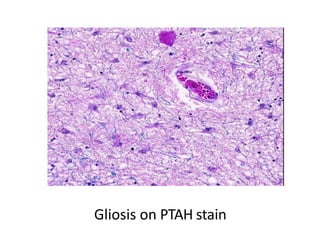
• Traditionally used for demonstration of muscle
striations, glial cells and fibrin.
• This technique has been largely replaced
by immunohistochemistry techniques
RESULTS
• Muscle, cross striations : Blue- black
• Fibrin and neuroglia – Deep blue
• Connective tissue: Pale orange-pink to brownish red
• Bone and cartilage- yellowish to brownish red
Skeletal muscle striation on mallory’s PTAH stain
Gliosis on PTAH stain
Verhoeff-Van Gieson(VVG) stain
:
• This method is used for identifying elastic fiber in tissue
• Result – Elastic fiber : Blue-black to black
- Nuclei: Blue to black
- Collagen: Red
- other tissue elements: Yellow
Vessel wall on Verhoeff van gieson stain
This section shows elastic cartilage and elastic fibers (arrow),
which are dark-stained linear structures embedded
in the cartilage matrix.
Fibrin
• Fibrin is formed by polymerization of smaller
soluble fibrinogen.
• Found in tissue damage and acute inflammation,
fibrinoid necrosis in vessel wall.
• Stained by : Mallory PTAH
MSB Stain
MSB (Maritus, Scarlet, Blue)Stain
for fibrin:
• This is trichrome method for selective demostration of
fibrin.
• Dyes Used :
Maritus Yellow
Crystal Scarlet
Methyl Blue, PTA.
• Results :
Fibrin : Red
RBC’S : Yellow
Muscle : Red
Collagen : Blue
Fibrin stains red, collagen stains blue, muscle stains red,
nuclei stains blue/black, red cells stain yellow
Stains for Amyloid
Amyloids are insoluble protein.
They arise from inappropriately folded protein and
polypeptides present naturally in the body.
Stains used to demostrate amyloid:
• Congo red
•Crystal/methyl violet
•PAS
•Thioflavin T & S
Congo red stain
Principle :
Amyloids are homogeneous and eosinophillic,
proteinaceous deposits, extracellular
When stained with the congo red stain the
amyloid will show birefringence an apple green
color, under the polarizing microscope.
Reagent:
• Solution a - 0.5% Congo red in 50% alcohol
• Solution b - 0.2% potassium hydroxide in 80%
alcohol
• RESULTS:
Amyloid, elastic fibers, eosinophilic
granules, --- red to pink
Nuclei – blue
It is used to demostrate amyloid deposits in
• Renal amyloidosis- in patients on dialysis
for long time
• Medulary carcinoma of thyroid,
• Vessel wall in case of Alzheimer’s disease
• Cardiac arrhythmias, etc.
Positive red staining is present around the large central artery and
a smaller vessel to its upper right. The right panel shows the green
birefringence that is diagnostic of amyloid when the Congo red
stain is viewed with polarized light.
All amyloids have a fibrillar ultrastructure that gives this reaction.
Crystal/Methyl violet for amyloid
• Crystal violet or methyl violet stain are used for
metachromatic amyloid staining.
• They stain amyloid as purple-red in blue background.
Reagents used
• Crystal/methyl violet
• 95% alcohol
• 1% aqueous ammonium oxalate
• 0.2% acetic acid
Amyloid – purple
Background - blue
Stains for Lipid
- Oil Red O
- Sudan Black B
Oil red o stain
PRINCIPLE :
Staining with oil-soluble dyes is based on
the greater solubility of the dye in the lipid
substances than in the usual hydroalcoholic
dye solvents.
Result
Lipid – Red
Nuclei- Blue
REAGENTS :
• 60% isopropanol
• Alum hematoxylin:
• Glycerin Jelly mounting medium
• Oil Red O working solution:
To make oil red O stock solution
• Oil red O - 0.5gm
• Isopropanol 100 ml
• Working solution should be made fresh each time.
Fat emboli seen as red dot within capillaries of lung on Oil red
O stain
Fatty liver -stain Oil red O
Uses
• Oil red O stain is used for staining neutral
triglycerides, lipids and lipoprotein.
• Tumors arising from fat cells (liposarcomas) can be
differentiated from other types of tumors.
• Fat occurring in an abnormal place, such as fat emboli
• Lipid storage disorder like nieman-pick disease
• To demonstrate fat or lipids
• fatty liver.
• burkitt’s lymphoma and
SUDAN BLACK B
PRINCIPLE :
Sudan Black B is a dye that is insoluble in water but
dissolves in fat. Therefore this dye will accumulate in fat
globules within cells.
• It is slightly basic dye and will combine with acidic
groups in compound lipids, thus staining phospholipids
also.
Result
Fat- Blue/ Black
Nuclei- Red
REAGENTS :
• 85% Propylene Glycol:
Propylene glycol
Distilled water
• Hematoxylin:
-85.0 ml
-15.0 ml
• Sudan Black B/Propylene:
Sudan Black B
Propylene glycol
-0.7 gm
-100.0 ml
Uses
• Sudan black is used for staining neutral triglycerides,
lipids, lipoprotein and phospholipid.
• Myeloblast vs lymphoblast.
Myeloblast on Sudan black stain
MASSON FONTANA METHOD- FOR MELANIN
It is a brown-black pigment
nonlipid, non hematogenous pigment.
present normally in the hair, skin, retina,
iris and certain parts of the CNS.
PRINCIPLE:
 Melanin is insoluble in organic solvents but soluble in 1M
sodium hydroxide.
 It is slowly bleached by strong oxidising agents.
 The solutions of ammoniacal silver nitrate are reduced by
melanin to black metallic silver this is the basis of Masson
Fontana method for demostrating melanin.
Melanin pigment of skin showing
RESULTS:
Melanin, argentaffin
granules - Black
Nuclei -red
Melanin pigment in cells of malignant
melanoma, Fontana-Masson stain.
USES:
• To identify melanin and argentaffin granules.
• Argentaffin granules are found in carcinoid
tumors.
• In diagnosis of malignant melanoma
VON KOSSA METHOD FOR
CALCIUM
PRINCIPLE:
Tissue sections are treated with silver nitrate solution,
Silver deposits by replacing the the calcium and then
it is reduced by the strong light and visualized as
metallic silver.
USE:
Abnormal deposits of calcium
With the H&E stain, calcium appear deep blue-purple.
On von kossa method it appear black.
Coronary artery showing
calcified atheromatous plaque
RESULTS :
Calcium salts -black
Nuclei -red
Cytoplasm -pink
PERL’S- PRUSSIAN BLUE
PRINCIPLE :
Dilute mineral acid hydrolysis releases ferric iron from
protein bound tissue deposits
In the presence of ferrocyanide ions,
It is precipitated as highly coloured and highly water
soluble complex,
Potassium ferric ferrocyanide- prussian blue.
• Ferrous ion do not produce a coloured reaction.
• Tissue deposits containing ferric iron are invariably
hemosiderin
USE:
To demonstrate ferric iron in tissue sections.
• hemochromatosis- with deposits found in the
liver and pancreas
• hemosiderosis- with deposits in the liver,
spleen, and lymph nodes.
• To asess the bone marrow iron content
CONTROL : Postmortem lung – high number of heart
failure cells that contain hemosiderin
REAGENTS:
• 2% Potassium Ferrocyanide:
Potassium ferrocyanide
Distilled water
• Neutral-fast Red:
- 2.0 gm
- 100.0 ml
- 1gm
- 100ml
- 1ml
Neutral red
Distilled water
Glacial acetic acid
• 2% Hydrochloric Acid:
Conc. Hydrochloric acid,
Distilled water
- 2.0 ml
- 100.0 ml
Hemosiderin in liver
RESULTS:
Iron (hemosiderin) -blue
Nuclei -red
Background - pink
Staining for Microorganism
- Ziehl- Neelsen (ZN) stain
- Wade fite faraco stain
- Gomori Methenamine (hexamine) silver stain
- Warthin-Starry stain
- Giemsa stain
- Gram staining
Ziehl-Neelsen (ZN) Stain for
Mycobacterium
Mycobacteria are difficult to demonstrate by the
Gram technique because they possess a
hydrophobic capsule.
Phenolic acid or heat may be used to reduce the
surface tension and increase the porosity.
PRINCIPLE
•Mycobacterias (tubercle bacilli) have a lipid-rich cell
wall
•Capable of taking up strong phenol dye solutions
(eg. carbol fuchsin solution)
•Dye is retained upon subsequent differentiation in
acid or alcohol.
•They are said to be acid fast bacilli.
Results
• Mycobacteria - Red
• Background - pale Blue
Method
• Bring the section to water level.
• Flood sections with carbol-fuchsin and heat to steaming
by passing the flame of spirit swab underneath the slides
on metal rack till, vapour just being formed.
• Wash the slides in distilled water. Shake off excess liquid.
• Decolourise the slides with 20% H2SO4
• Wash well in tap water, till no more red colour runs off
the surface when the slides is dipped in water
• Wash thoroughly with water.
• Counter stain in methylene blue solution, 30
seconds.
• Blot and differentiate by alternate dehydration and
rehydration until the background is a delicate pale
blue.
• Examine microscopically screening at high power
and confirming all suspicious organism with an oil
immersion lens.
Mycobacteria seen as red rods
Acid fast bacteria seen on intestinal biopsy
Wade fite faraco stain
• This stain is used for staining leprocy bacilli in
tissue sample.
• Leprocy bacilli are much less acid and alcohol fast
than tuberculous bacilli.
• 10% sulphuric acid is used as decolouriser in
place of acid-alcohol solution.
• The section are also deparaffinised using ground
nut oil and xylene mixture to protect more
delicate waxy coat of lepra bacilli.
PROCEDURE
• Warm section and deparaffinised using mixture of two part
xylene and one part of ground nut oil for 10 minutes.
• Blot dry and wash in water untill section is uniformly
wetted.
• Stain with carbol fuschin for 20-30 minutes.
• Wash in tap water and blot dry.
• Decolorize in 10% sulphuric acid till no more red colour
appear while dipping in water.
• Wash in tap water and counter stain with 0.2% methylene
blue for 5-10 seconds.
• Blot dry and do not mount.
• Smears should be seen in oil immersion lens.
Leprocy and other mycobacteria- red
Background- blue
Warthin-Starry method for spirochetes
(Warthin & Starry 1920)
PRINCIPLE
Organisms are demonstrated by silver
impregnation technique – based on the
ability of certain organisms to bind to silver
ions.
• It can also be used to demostrate
- Helicobacter pylori in gastric mucosa
- Leptospira organism in renal biosy
- Cat scratch disease – Bartonella Sp
.
Result:
Organisms - black
Background - golden
yellow
Cat scratch disease bacilli inlymphnode biopsy
H. Pylori on gastric mucosa on Warthin starry stain
Gomori methenamine silver stain
• GMS staining is a silver staining technique for
demonstrating fungi in tissue sections.
• based on staining the polysaccharides in fungal cell walls,
• can be used to demostrate the basement membrane.
 PRINCIPLE
This method depends upon the reduction of the silver
by the aldehyde groups
produced after oxidation of fungal wall components with
chromic acid.
Pneumocystis carinii
Result:
Fungi, pneumocystis carinii,
melanin - black
Mucin and glycogen-
- grey-black
RBCs - yellow
Background - pale green
GMS stain for Cryptococcus neoformans
Basement membrane on GMS stain
Gram method for Bacteria
• Gram staining differentiate bacteria into 2 classes
depending on their cell wall structure and composition
• Gram positive and Gram negative.
PRINCIPLE
•Crystal Violet stains the nucleic acids of the bacteria
(and background tissue)
•after treatment with iodine, the sections are
differentiated in acetone
•counterstained with basic fuchsin.
The tissue background and Gram- negative bacteria lose
their blue staining and are subsequently stained with
counter stain basic fuchsin.
Gram-positive bacteria resist the decolourisation and
retain the crystal violet/iodine blue staining.
Result:
Gram-positive organisms - blue
Gram – negative organisms - red.
Gram Positive
Gram Negative
Cutaneous anthrax – Gram positive Bacilli stained blue on skin
biopsy
References
1. Horobin R W, How histological stains work in : Suvarna S K, Layton C,
Bancroft J D, Bancroft’s Theory and practice of histological techniques,
7th ed, Elsevier, p.157-72.
2. Introduction to staining and principles of staining, in : Shariff S, Kaler A
K, Principles & interpretation of laboratory practices in surgical
pathology by shameem shariff, 1st ed, Jaypee, p.79-95
Thank
you

special stain

  • 1.
    SPECIAL STAINS IN PATHOLOGY Moderator: Dr. B P Bommanahalli Professor and Head
  • 2.
    Contents : 1. Stainsfor carbohydrates 2. Stains for Mucin 3. Stains for collagen and Elastic fibres 4. Stains for amyloid 5. Stains for lipid 6. Stains for – Melanin, Calcium, Iron 7. Stains for microorganisms
  • 3.
    Introduction ⦁ Stains :chemical substances used to achieve visible color contrast in the microscopic picture of a prepared tissue ⦁ Staining : treating tissues or cells with a series of reagents so that it acquires a color; no particles of dye are seen and the stained element is transparent. Dyes : Essentially Aromatic benzene ring compounds or derivatives that possess the twin properties of color and ability to bind to tissue.
  • 4.
    ⦁ A polyvalentmetal ion which forms coordination complexes with certain dyes. ⦁ Acts as an intermediary between dye and tissue, ⦁ Thus increasing the affinity between them.
  • 5.
    Accentuators: ⦁ Substances whichincrease the staining power of dye. ⦁ They increase the intensity & selectivity of stain. e.g KOH in Lofflers methylene blue phenol in carbol fuschin & carbol thionin. Accelerators ⦁ Accentuators used in metallic impregnation technique for the nervous system. e.g chloral hydrate Trapping agents ⦁ Agents which holds dye combination with tissue or bacteria . e.g tannic acid/iodine
  • 6.
    Regressive Staining •Tissue isinitially overstained and then partially decolorized (differentiated) until the proper endpoint is reached. • Sharper degree of differentiation is obtained •The differentiation is controlled visually by microscopic examination. •Faster and more convenient . Progressive Staining •Tissue is stained for a predetermined time for adequate staining of the nuclei and leaves the background tissue relatively unstained. •Once the dye is taken up by the tissues, it is not removed. •The tissue is left in the dye solution until it retains the desired amount of coloration. •The differentiation solely relies on the selective affinity of dyes for different tissue elements.
  • 7.
    ⦁ Removal orwashing out of excess stain until the color is retained only by the tissue component that is to be studied. ⦁ Done with acid alcohol or ethyl alcohol ⦁ Exposure to air may oxidize and improve the process. Differentiation
  • 8.
    Vital Staining Appliedto living tissue Accomplished by injecting staining solution into some part of the body Mixing of stain with living cells Primarily used for research. Routine Staining Stains tissues with minimal differentiation except between nucleus and cytoplasm. Demonstrates general relationship among cells, tissues and organs. e.g Hematoxylin and Eosin stains Special Staining Demonstrates selective features of tissues : Particular cell products. Microscopic intracellular and intercellular structure. e.g PAS stain for mucopolysaccharide.
  • 9.
    Periodic Acid-Schiff (PAS)stain • Principle: Substance containing vicinal glycol groups oxidized by periodic acid into dialdehydes on reaction with schiff’s reagent insoluble purple- magenta compound. • Dyes : 1%periodic acid Schiff’s reagent • Control : Appendix • Result : PAS +ve substance : Purple –magenta color Nuclei : Blue
  • 10.
    PAS positive substances: • Glycogen • Neutral mucoprotein • Glycoprotein • Glycolipid • Basement membrane • All fungi • Phosphorylated sugar • Cerebrosides
  • 11.
    PAS Diastase reaction: • glycogen treated with diastase enzyme • digest the glycogen and • negative PAS reaction. • to differentiate glycogen from other PAS positive elements • such as mucin
  • 12.
    Uses of PAS: •Demonstrate glycogen and neutral mucoprotein. • In diagnosis of poorly differentiated adenocarcinoma of various tissue like stomach, pancreas, lung. • In diagnosis of hepatocellular carcinoma. • Seminoma, Dysgerminoma • RCC- Renal cell carcinoma: Clear cell type • To demostrate – intracytoplasmic crystal in alveolar soft part sarcoma • To demostrate basement membrane e.g. adenoid cystic ca. • To demostrate neutral mucin in gastrointestinal tract
  • 13.
    • To demostratefungi in tissue sample Candidiasis Actinomycosis Histoplasmosis Blastomycosis • In diagnosis of • ALL- block positivity and • AML- diffuse cytoplasmic positivity in M5, M3 and • cytoplasmic granular/block positivity in M6 and • cytoplasmic granular and blebs positivity of blast in M7.
  • 14.
    Gastric signet ringcell carcinoma on PAS stain
  • 15.
    Candida seen onPAS stain
  • 16.
    • Presence ofglycogen will be evidenced by loss of staining after enzyme treatment when compared to the untreated sections. PAS Stain PAS with Diastase
  • 17.
    Mucin Two major categories-epithelial and stromal. Epithelial mucin (membrane bound or secreted) • composed of central protein core and sialic acid • sulfated or nonsufated. Stromal mucin known as glycosaminoglycans contain hyaluronic acid may be sulfated or non sulfated. • They are better known as myxoid substance. • Their functions are lubrication, chemical barrier and cell signaling.
  • 18.
    The types ofmucin are as follows: Neutral - Found in glands of stomach and in prostate. stain with PAS but not with Alcian blue, colloidal iron and mucicarmine. Acid (simple, or non-sulfated) – typical mucins of epithelial cells containing sialic acid. They stain with PAS, Alcian blue at pH 2.5, colloidal iron. E.g. salivary glands. Acid (simple, sulfated -mesenchymal) – These contain hyaluronic acid and are found in stroma. do not stain with PAS, stain with Alcian blue at pH 2.5, colloidal iron
  • 19.
    • Acid (complex,epithelial) – These are found in adenocarcinomas of colon, breast,ovary, mucoepidermoid carcinoma . PAS is usually positive. Alcian blue is positive at pH 1, • Acid (complex, connective tissue) – Found in tissue stroma, cartilage, and bone substances such as chondroitin sulfate or keratan sulfate. They are PAS negative stain selectively with Alcian blue at pH 0.5.
  • 20.
    Stains for mucin • Alcianblue • PAS • Mayer mucicarmine • Hale colloidal iron stain
  • 21.
    Alcian blue PRINCIPLE • Alcianblue is a copper phthalcyanin dye • Contains positively charged groups capable of salt linkage with polyanions of the acid mucins By varying the pH of the solution of Alcian blue more information can be gained concerning the types of acid mucin present. It does not stain neutral mucin.
  • 22.
    • Dyes :1%Alcian blue in 3%acetic acid • Results : Acid MPS – deep blue Nuclei – faint blue • PAS-Alcian blue is best ‘pan-mucin’ stain combination, • it demostrates mucin both neutral, slightly acidic and highly acidic.
  • 23.
    The goblet cellsof the gastrointestinal tract are filled with abundant acid mucin and stain pale blue with this Alcian blue stain.
  • 24.
    Colonic mucosa showingsialomucin that have acid and neutral mucopolysaccharide stain purple on alcian blue-PAS.
  • 25.
    USES • To differentiategastric metaplasia into complete and incomplete. • Complete metaplasia is small intestinal type, shows well defined brush border and well formed goblet cells. • Incomlete metaplasia is colonic type and shows multiple irregular mucin droplets of varying size in the cytoplasm and absence of brush border. • Diagnosis of pleomorphic adenoma, mucoepidermoid carcinoma, in stroma of chordoma at sacrococcygeal region. • Excessive amounts of non-sulfated acidic mucosubstances are seen in mesotheliomas.
  • 26.
    Mixed salivary gland.Acid mucopolysaccharides in mucous cells are stained blue (Alcian blue at pH 2.5).
  • 27.
    Chordoma on alcianblue stain at ph 2.5
  • 28.
    MUCICARMINE STAIN PRINCIPLE :- Positivelycharged carmine complex bonds with the negatively charged acid mucin. Strongly sulphated mucins are variable in their reaction, neutral mucin do not stain at all, acidic mucin stain strongly.
  • 29.
    REAGENTS: • Southgate's MucicarmineSolution: Carmine, alum lake Aluminum hydroxide 50% alcohol -1.0 gm -1.0 gm -100.0 ml Aluminum chloride, anhydrous- 0.5 gm • Mayer's Hematoxylin:
  • 30.
    Uses : • Mucicarmine isuseful to identify acidic mucin. • It is used to identify adenocarcinoma particularly of gastrointestinal tract. • It also stains the capsule of fungus- cryptococcus neoformans lung & nervous tissue of immunocompromised patient.
  • 31.
    Colonic Mucosa showingsialomsucin -- - magenta RESULTS: Mucin - magenta Nuclei - black Other tissue elements- yellow
  • 32.
    Cryptococcus neoformans inlung of AIDS patient capsule stains red
  • 33.
    HALE’S COLLOIDAL IRON STAIN •Positive staining with hale’s colloidal iron stain is considered diagnostic feature of chromophobe renal cell carcionoma and has been used as discriminatory feature to differentiate it from other renal tumour. Result • Acid mucopolysaccharides: blue • Nuclei: red
  • 34.
    a.Classic chromophobe RCC b.classicchromophobe RCC on hale’s colloidal iron stain c. Eosinophilic chromophobe d.Eosinophilic chromophobe on hale’s colloidal iron stain e.oncocytoma f. oncocytoma diffusely negative cytoplasmic reaction with hale‘s colloidal iron stain
  • 35.
    RETICULIN STAIN-GOMORI’S METHOD •Reticulin stain demonstrate both reticular fibers and basement membrane material. • Reticular fibers consist of very thin fiber of type III collagen • Basement membrane are largely composed of type IV collagen and laminin.
  • 36.
    Principle: Reticulin fibers havelittle natural affinity for silver solutions. On treatment with potassium permangenate it produce sensitised sites on fibers where silver deposition can be initiated. A reducing agent formalin causes deposition of silver in the form of metal.
  • 37.
    • Dyes used:Silver nitrate 10% NaOH 10% KMnO4 1% aqu. oxalic acid 5% aqu Iron alum 2.5% Formalin 10% • Control: Cirrhosis of liver • Result: Reticular fiber – Black Nuclei- Gray • Other elements- According to counter stain used
  • 38.
  • 39.
    Uses of reticulinstain 1. Diagnosis of liver cirrhosis. 2. To distinguish epithelial neoplasms from non- epithelial neoplasms. Foci of carcinoma have reticulin around tumour nest but not in between tumour cell, whereas in most sarcomas and large cell lymphoma reticulin separates single cells. 3. To differentiate between in-situ and invasive carcinoma
  • 40.
    Trichrome stain • Thisstain is mainly used to evaluate the type and amount of extracellular material like- collagen, fibrin, muscle and elastic fiber. Various technique includes: • Masson trichrome stain • Van gieson stain • Mallory, Phosphotungstic or phosphomolybdic acid stain • Verhoeff-Van Gieson(VVG) stain
  • 41.
    The general rule lessporous tissues are colored by the smallest dye molecule; whenever a dye of large molecular size is able to penetrate, it will always do so at the expense of the smaller molecule.
  • 42.
    Masson trichome stain •This method is used for detection of collagen fibers in the tissues • The collagen fibers will be stained blue and • The nuclei - black.
  • 43.
    Masson trichrome stain Principle: 3dyes are used which selectively stain muscle, collagen fibers, fibrin and erythrocytes. Acid fuchine stain all the connective tissue, PMA( phosphomolybdic acid) competes with fuchine and gain access to collagen displacing fuchine. If reaction stopped at appropriate time, collagen will be free to be stained by Methyl Blue.
  • 44.
    • Reaent used– Weigerts iron hematoxylin solution - Phosphomolybdic- phosphotungstic acid solution - Biebrich scarlet acid fucshin solution - Aniline blue solution - 1% acetic acid solution • Result - Nuclei : Black Collagen : Blue Cytoplasm, Muscle, RBC : Red • Positive control : skin, lung, stomach, intestine
  • 45.
    Result Collagen- Blue Cytoplasm, RBCs-Red • Membranoproliferative glomerulonephritis on masson trichome stain
  • 46.
    Uses • It isused to differentiate between collagen and smooth muscle in tumour. • To identify increased collagen deposition in condition like cirrhosis, keloid, benign prostatic hyperplasia, membranoproliferative glomerulonephritis etc.
  • 47.
    VAN GIESON STAIN Principle combinedsolution of picric acid & acid fuchsin used small molecules of picric acid penetrate all the tissue rapidly, only firmly retained in the close textured red blood cells and muscle. The larger molecules of ponceau S displaces picric acid molecule from collagen fibres, which has larger pores and allow larger molecules to enter. It is used for detection of collagen. Result --
  • 48.
    • Results: Nuclei :Blue / Black Collagen -Red Cytoplasm, muscle, fibrin, RBCs : Yellow
  • 49.
    Phosphotungstic acid- Hematoxylene test(PTAH) test: • Principle There is much more phosphotungstic acid in the solution than hematein. The phosphotungstic acid binds all the available hematein to form blue lake pigment. This lake stains muscle cross striations, fibrin, nuclei, and other tissue elements blue. The rest of phosphotungstic acid stains the red- brown components, such as collagen.
  • 50.
    USES • Traditionally usedfor demonstration of muscle striations, glial cells and fibrin. • This technique has been largely replaced by immunohistochemistry techniques RESULTS • Muscle, cross striations : Blue- black • Fibrin and neuroglia – Deep blue • Connective tissue: Pale orange-pink to brownish red • Bone and cartilage- yellowish to brownish red
  • 51.
    Skeletal muscle striationon mallory’s PTAH stain
  • 52.
  • 53.
    Verhoeff-Van Gieson(VVG) stain : •This method is used for identifying elastic fiber in tissue • Result – Elastic fiber : Blue-black to black - Nuclei: Blue to black - Collagen: Red - other tissue elements: Yellow
  • 54.
    Vessel wall onVerhoeff van gieson stain
  • 55.
    This section showselastic cartilage and elastic fibers (arrow), which are dark-stained linear structures embedded in the cartilage matrix.
  • 56.
    Fibrin • Fibrin isformed by polymerization of smaller soluble fibrinogen. • Found in tissue damage and acute inflammation, fibrinoid necrosis in vessel wall. • Stained by : Mallory PTAH MSB Stain
  • 57.
    MSB (Maritus, Scarlet,Blue)Stain for fibrin: • This is trichrome method for selective demostration of fibrin. • Dyes Used : Maritus Yellow Crystal Scarlet Methyl Blue, PTA. • Results : Fibrin : Red RBC’S : Yellow Muscle : Red Collagen : Blue
  • 58.
    Fibrin stains red,collagen stains blue, muscle stains red, nuclei stains blue/black, red cells stain yellow
  • 59.
    Stains for Amyloid Amyloidsare insoluble protein. They arise from inappropriately folded protein and polypeptides present naturally in the body. Stains used to demostrate amyloid: • Congo red •Crystal/methyl violet •PAS •Thioflavin T & S
  • 60.
    Congo red stain Principle: Amyloids are homogeneous and eosinophillic, proteinaceous deposits, extracellular When stained with the congo red stain the amyloid will show birefringence an apple green color, under the polarizing microscope.
  • 61.
    Reagent: • Solution a- 0.5% Congo red in 50% alcohol • Solution b - 0.2% potassium hydroxide in 80% alcohol • RESULTS: Amyloid, elastic fibers, eosinophilic granules, --- red to pink Nuclei – blue
  • 62.
    It is usedto demostrate amyloid deposits in • Renal amyloidosis- in patients on dialysis for long time • Medulary carcinoma of thyroid, • Vessel wall in case of Alzheimer’s disease • Cardiac arrhythmias, etc.
  • 63.
    Positive red stainingis present around the large central artery and a smaller vessel to its upper right. The right panel shows the green birefringence that is diagnostic of amyloid when the Congo red stain is viewed with polarized light. All amyloids have a fibrillar ultrastructure that gives this reaction.
  • 64.
    Crystal/Methyl violet foramyloid • Crystal violet or methyl violet stain are used for metachromatic amyloid staining. • They stain amyloid as purple-red in blue background. Reagents used • Crystal/methyl violet • 95% alcohol • 1% aqueous ammonium oxalate • 0.2% acetic acid
  • 65.
  • 66.
    Stains for Lipid -Oil Red O - Sudan Black B
  • 67.
    Oil red ostain PRINCIPLE : Staining with oil-soluble dyes is based on the greater solubility of the dye in the lipid substances than in the usual hydroalcoholic dye solvents. Result Lipid – Red Nuclei- Blue
  • 68.
    REAGENTS : • 60%isopropanol • Alum hematoxylin: • Glycerin Jelly mounting medium • Oil Red O working solution: To make oil red O stock solution • Oil red O - 0.5gm • Isopropanol 100 ml • Working solution should be made fresh each time.
  • 69.
    Fat emboli seenas red dot within capillaries of lung on Oil red O stain
  • 70.
  • 71.
    Uses • Oil redO stain is used for staining neutral triglycerides, lipids and lipoprotein. • Tumors arising from fat cells (liposarcomas) can be differentiated from other types of tumors. • Fat occurring in an abnormal place, such as fat emboli • Lipid storage disorder like nieman-pick disease • To demonstrate fat or lipids • fatty liver. • burkitt’s lymphoma and
  • 72.
    SUDAN BLACK B PRINCIPLE: Sudan Black B is a dye that is insoluble in water but dissolves in fat. Therefore this dye will accumulate in fat globules within cells. • It is slightly basic dye and will combine with acidic groups in compound lipids, thus staining phospholipids also. Result Fat- Blue/ Black Nuclei- Red
  • 73.
    REAGENTS : • 85%Propylene Glycol: Propylene glycol Distilled water • Hematoxylin: -85.0 ml -15.0 ml • Sudan Black B/Propylene: Sudan Black B Propylene glycol -0.7 gm -100.0 ml
  • 74.
    Uses • Sudan blackis used for staining neutral triglycerides, lipids, lipoprotein and phospholipid. • Myeloblast vs lymphoblast.
  • 75.
  • 76.
    MASSON FONTANA METHOD-FOR MELANIN It is a brown-black pigment nonlipid, non hematogenous pigment. present normally in the hair, skin, retina, iris and certain parts of the CNS. PRINCIPLE:  Melanin is insoluble in organic solvents but soluble in 1M sodium hydroxide.  It is slowly bleached by strong oxidising agents.  The solutions of ammoniacal silver nitrate are reduced by melanin to black metallic silver this is the basis of Masson Fontana method for demostrating melanin.
  • 77.
    Melanin pigment ofskin showing RESULTS: Melanin, argentaffin granules - Black Nuclei -red
  • 78.
    Melanin pigment incells of malignant melanoma, Fontana-Masson stain.
  • 79.
    USES: • To identifymelanin and argentaffin granules. • Argentaffin granules are found in carcinoid tumors. • In diagnosis of malignant melanoma
  • 80.
    VON KOSSA METHODFOR CALCIUM PRINCIPLE: Tissue sections are treated with silver nitrate solution, Silver deposits by replacing the the calcium and then it is reduced by the strong light and visualized as metallic silver. USE: Abnormal deposits of calcium With the H&E stain, calcium appear deep blue-purple. On von kossa method it appear black.
  • 81.
    Coronary artery showing calcifiedatheromatous plaque RESULTS : Calcium salts -black Nuclei -red Cytoplasm -pink
  • 82.
    PERL’S- PRUSSIAN BLUE PRINCIPLE: Dilute mineral acid hydrolysis releases ferric iron from protein bound tissue deposits In the presence of ferrocyanide ions, It is precipitated as highly coloured and highly water soluble complex, Potassium ferric ferrocyanide- prussian blue. • Ferrous ion do not produce a coloured reaction. • Tissue deposits containing ferric iron are invariably hemosiderin
  • 83.
    USE: To demonstrate ferriciron in tissue sections. • hemochromatosis- with deposits found in the liver and pancreas • hemosiderosis- with deposits in the liver, spleen, and lymph nodes. • To asess the bone marrow iron content CONTROL : Postmortem lung – high number of heart failure cells that contain hemosiderin
  • 84.
    REAGENTS: • 2% PotassiumFerrocyanide: Potassium ferrocyanide Distilled water • Neutral-fast Red: - 2.0 gm - 100.0 ml - 1gm - 100ml - 1ml Neutral red Distilled water Glacial acetic acid • 2% Hydrochloric Acid: Conc. Hydrochloric acid, Distilled water - 2.0 ml - 100.0 ml
  • 85.
    Hemosiderin in liver RESULTS: Iron(hemosiderin) -blue Nuclei -red Background - pink
  • 86.
    Staining for Microorganism -Ziehl- Neelsen (ZN) stain - Wade fite faraco stain - Gomori Methenamine (hexamine) silver stain - Warthin-Starry stain - Giemsa stain - Gram staining
  • 87.
    Ziehl-Neelsen (ZN) Stainfor Mycobacterium Mycobacteria are difficult to demonstrate by the Gram technique because they possess a hydrophobic capsule. Phenolic acid or heat may be used to reduce the surface tension and increase the porosity.
  • 88.
    PRINCIPLE •Mycobacterias (tubercle bacilli)have a lipid-rich cell wall •Capable of taking up strong phenol dye solutions (eg. carbol fuchsin solution) •Dye is retained upon subsequent differentiation in acid or alcohol. •They are said to be acid fast bacilli. Results • Mycobacteria - Red • Background - pale Blue
  • 89.
    Method • Bring thesection to water level. • Flood sections with carbol-fuchsin and heat to steaming by passing the flame of spirit swab underneath the slides on metal rack till, vapour just being formed. • Wash the slides in distilled water. Shake off excess liquid. • Decolourise the slides with 20% H2SO4 • Wash well in tap water, till no more red colour runs off the surface when the slides is dipped in water • Wash thoroughly with water.
  • 90.
    • Counter stainin methylene blue solution, 30 seconds. • Blot and differentiate by alternate dehydration and rehydration until the background is a delicate pale blue. • Examine microscopically screening at high power and confirming all suspicious organism with an oil immersion lens.
  • 91.
  • 92.
    Acid fast bacteriaseen on intestinal biopsy
  • 93.
    Wade fite faracostain • This stain is used for staining leprocy bacilli in tissue sample. • Leprocy bacilli are much less acid and alcohol fast than tuberculous bacilli. • 10% sulphuric acid is used as decolouriser in place of acid-alcohol solution. • The section are also deparaffinised using ground nut oil and xylene mixture to protect more delicate waxy coat of lepra bacilli.
  • 94.
    PROCEDURE • Warm sectionand deparaffinised using mixture of two part xylene and one part of ground nut oil for 10 minutes. • Blot dry and wash in water untill section is uniformly wetted. • Stain with carbol fuschin for 20-30 minutes. • Wash in tap water and blot dry. • Decolorize in 10% sulphuric acid till no more red colour appear while dipping in water. • Wash in tap water and counter stain with 0.2% methylene blue for 5-10 seconds. • Blot dry and do not mount. • Smears should be seen in oil immersion lens.
  • 95.
    Leprocy and othermycobacteria- red Background- blue
  • 96.
    Warthin-Starry method forspirochetes (Warthin & Starry 1920) PRINCIPLE Organisms are demonstrated by silver impregnation technique – based on the ability of certain organisms to bind to silver ions. • It can also be used to demostrate - Helicobacter pylori in gastric mucosa - Leptospira organism in renal biosy - Cat scratch disease – Bartonella Sp .
  • 97.
    Result: Organisms - black Background- golden yellow Cat scratch disease bacilli inlymphnode biopsy
  • 98.
    H. Pylori ongastric mucosa on Warthin starry stain
  • 99.
    Gomori methenamine silverstain • GMS staining is a silver staining technique for demonstrating fungi in tissue sections. • based on staining the polysaccharides in fungal cell walls, • can be used to demostrate the basement membrane.  PRINCIPLE This method depends upon the reduction of the silver by the aldehyde groups produced after oxidation of fungal wall components with chromic acid.
  • 100.
    Pneumocystis carinii Result: Fungi, pneumocystiscarinii, melanin - black Mucin and glycogen- - grey-black RBCs - yellow Background - pale green
  • 101.
    GMS stain forCryptococcus neoformans
  • 102.
  • 103.
    Gram method forBacteria • Gram staining differentiate bacteria into 2 classes depending on their cell wall structure and composition • Gram positive and Gram negative. PRINCIPLE •Crystal Violet stains the nucleic acids of the bacteria (and background tissue) •after treatment with iodine, the sections are differentiated in acetone •counterstained with basic fuchsin. The tissue background and Gram- negative bacteria lose their blue staining and are subsequently stained with counter stain basic fuchsin.
  • 104.
    Gram-positive bacteria resistthe decolourisation and retain the crystal violet/iodine blue staining. Result: Gram-positive organisms - blue Gram – negative organisms - red.
  • 105.
  • 106.
    Cutaneous anthrax –Gram positive Bacilli stained blue on skin biopsy
  • 107.
    References 1. Horobin RW, How histological stains work in : Suvarna S K, Layton C, Bancroft J D, Bancroft’s Theory and practice of histological techniques, 7th ed, Elsevier, p.157-72. 2. Introduction to staining and principles of staining, in : Shariff S, Kaler A K, Principles & interpretation of laboratory practices in surgical pathology by shameem shariff, 1st ed, Jaypee, p.79-95
  • 108.