Spatial Interpolation Comparison
Evaluation of spatial prediction methods
Tomislav Hengl
ISRIC — World Soil Information, Wageningen University
Geostatistics course, 25–29 October 2010, Wageningen
Based on
Hengl, T., MacMillan, R.A., 2011? Mapping efficiency and
information content. submitted to International Journal of
Applied Earth Observation and Geoinformation, special issue
Spatial Statistics Conference.
Geostatistics course, 25–29 October 2010, Wageningen
Topic
Geostatistics = a toolbox to generate maps from point data
i.e.to interpolate;
Geostatistics course, 25–29 October 2010, Wageningen
Topic
Geostatistics = a toolbox to generate maps from point data
i.e.to interpolate;
There are many possibilities;
Geostatistics course, 25–29 October 2010, Wageningen
Topic
Geostatistics = a toolbox to generate maps from point data
i.e.to interpolate;
There are many possibilities;
An inexperienced user will often be challenged by the amount
of techniques to run spatial interpolation;
Geostatistics course, 25–29 October 2010, Wageningen
Topic
Geostatistics = a toolbox to generate maps from point data
i.e.to interpolate;
There are many possibilities;
An inexperienced user will often be challenged by the amount
of techniques to run spatial interpolation;
. . .which method should we use?
Geostatistics course, 25–29 October 2010, Wageningen
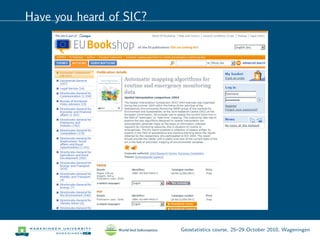
Have you heard of SIC?
Geostatistics course, 25–29 October 2010, Wageningen
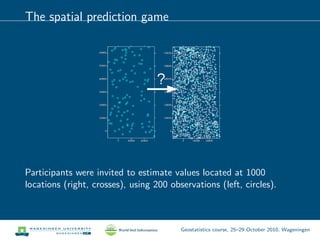
The spatial prediction game
Participants were invited to estimate values located at 1000
locations (right, crosses), using 200 observations (left, circles).
Geostatistics course, 25–29 October 2010, Wageningen
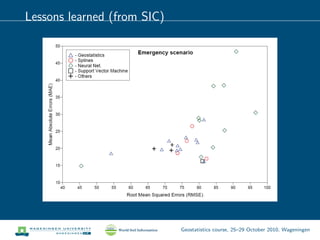
Lessons learned (from SIC)
Geostatistics course, 25–29 October 2010, Wageningen
Li and Heap (2008)
Geostatistics course, 25–29 October 2010, Wageningen
How many techniques are there?
Li and Heap (2008) list over 40 unique techniques.
1. Are all these equally valid?
2. How to objectively compare various methods (which criteria
to use)?
3. Which method to pick for your own case study?
Geostatistics course, 25–29 October 2010, Wageningen
There are not as many
There are roughly five main clusters of techniques:
1. splines (deterministic);
Geostatistics course, 25–29 October 2010, Wageningen
There are not as many
There are roughly five main clusters of techniques:
1. splines (deterministic);
2. kriging-based (plain geostatistics);
Geostatistics course, 25–29 October 2010, Wageningen
There are not as many
There are roughly five main clusters of techniques:
1. splines (deterministic);
2. kriging-based (plain geostatistics);
3. regression-based;
Geostatistics course, 25–29 October 2010, Wageningen
There are not as many
There are roughly five main clusters of techniques:
1. splines (deterministic);
2. kriging-based (plain geostatistics);
3. regression-based;
4. bayesian methods;
Geostatistics course, 25–29 October 2010, Wageningen
There are not as many
There are roughly five main clusters of techniques:
1. splines (deterministic);
2. kriging-based (plain geostatistics);
3. regression-based;
4. bayesian methods;
5. expert systems / machine learning;
Geostatistics course, 25–29 October 2010, Wageningen
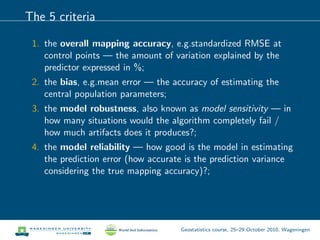
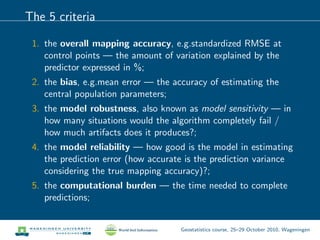
The 5 criteria
1. the overall mapping accuracy, e.g.standardized RMSE at
control points — the amount of variation explained by the
predictor expressed in %;
Geostatistics course, 25–29 October 2010, Wageningen
The 5 criteria
1. the overall mapping accuracy, e.g.standardized RMSE at
control points — the amount of variation explained by the
predictor expressed in %;
2. the bias, e.g.mean error — the accuracy of estimating the
central population parameters;
Geostatistics course, 25–29 October 2010, Wageningen
The 5 criteria
1. the overall mapping accuracy, e.g.standardized RMSE at
control points — the amount of variation explained by the
predictor expressed in %;
2. the bias, e.g.mean error — the accuracy of estimating the
central population parameters;
3. the model robustness, also known as model sensitivity — in
how many situations would the algorithm completely fail /
how much artifacts does it produces?;
Geostatistics course, 25–29 October 2010, Wageningen
The 5 criteria
1. the overall mapping accuracy, e.g.standardized RMSE at
control points — the amount of variation explained by the
predictor expressed in %;
2. the bias, e.g.mean error — the accuracy of estimating the
central population parameters;
3. the model robustness, also known as model sensitivity — in
how many situations would the algorithm completely fail /
how much artifacts does it produces?;
4. the model reliability — how good is the model in estimating
the prediction error (how accurate is the prediction variance
considering the true mapping accuracy)?;
Geostatistics course, 25–29 October 2010, Wageningen
The 5 criteria
1. the overall mapping accuracy, e.g.standardized RMSE at
control points — the amount of variation explained by the
predictor expressed in %;
2. the bias, e.g.mean error — the accuracy of estimating the
central population parameters;
3. the model robustness, also known as model sensitivity — in
how many situations would the algorithm completely fail /
how much artifacts does it produces?;
4. the model reliability — how good is the model in estimating
the prediction error (how accurate is the prediction variance
considering the true mapping accuracy)?;
5. the computational burden — the time needed to complete
predictions;
Geostatistics course, 25–29 October 2010, Wageningen
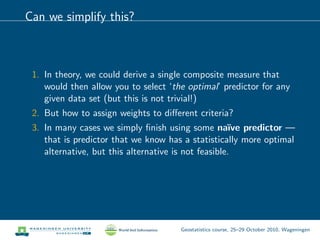
Can we simplify this?
1. In theory, we could derive a single composite measure that
would then allow you to select ‘the optimal’ predictor for any
given data set (but this is not trivial!)
2. But how to assign weights to different criteria?
3. In many cases we simply finish using some na¨ıve predictor —
that is predictor that we know has a statistically more optimal
alternative, but this alternative is not feasible.
Geostatistics course, 25–29 October 2010, Wageningen
Automated mapping
In the intamap package1 decides which method to pick for you:
> meuse$value <- log(meuse$zinc)
> output <- interpolate(data=meuse, newdata=meuse.grid)
R 2009-11-11 17:09:14 interpolating 155 observations,
3103 prediction locations
[Time models loaded...]
[1] "estimated time for copula 133.479866956255"
Checking object ... OK
1
http://cran.r-project.org/web/packages/intamap/
Geostatistics course, 25–29 October 2010, Wageningen
Hypothesis
We need a single criteria to compare various prediction methods.
Geostatistics course, 25–29 October 2010, Wageningen
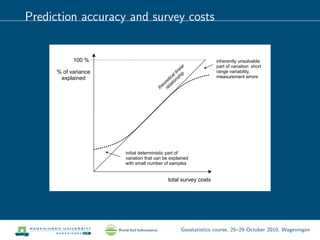
Mapping accuracy and survey costs
The cost of a soil survey is also a function of mapping scale,
roughly:
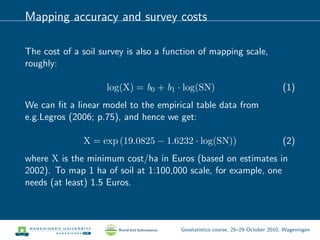
log(X) = b0 + b1 · log(SN) (1)
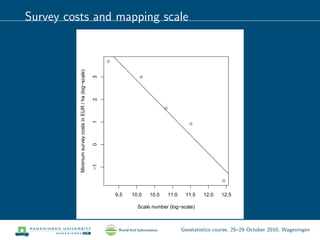
We can fit a linear model to the empirical table data from
e.g.Legros (2006; p.75), and hence we get:
X = exp (19.0825 − 1.6232 · log(SN)) (2)
where X is the minimum cost/ha in Euros (based on estimates in
2002). To map 1 ha of soil at 1:100,000 scale, for example, one
needs (at least) 1.5 Euros.
Geostatistics course, 25–29 October 2010, Wageningen
Survey costs and mapping scale
q
q
q
q
q
9.5 10.0 10.5 11.0 11.5 12.0 12.5
−10123
Scale number (log−scale)
MinimumsurveycostsinEUR/ha(log−scale)
Geostatistics course, 25–29 October 2010, Wageningen
Survey costs and mapping scale
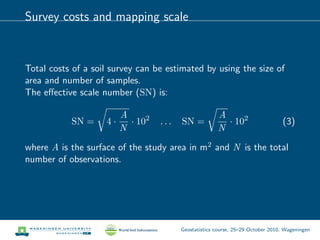
Total costs of a soil survey can be estimated by using the size of
area and number of samples.
The effective scale number (SN) is:
SN = 4 ·
A
N
· 102
. . . SN =
A
N
· 102
(3)
where A is the surface of the study area in m2 and N is the total
number of observations.
Geostatistics course, 25–29 October 2010, Wageningen
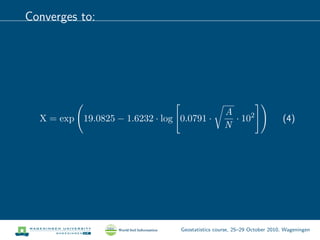
Converges to:
X = exp 19.0825 − 1.6232 · log 0.0791 ·
A
N
· 102
(4)
Geostatistics course, 25–29 October 2010, Wageningen
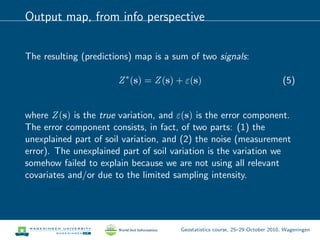
Output map, from info perspective
The resulting (predictions) map is a sum of two signals:
Z∗
(s) = Z(s) + ε(s) (5)
where Z(s) is the true variation, and ε(s) is the error component.
The error component consists, in fact, of two parts: (1) the
unexplained part of soil variation, and (2) the noise (measurement
error). The unexplained part of soil variation is the variation we
somehow failed to explain because we are not using all relevant
covariates and/or due to the limited sampling intensity.
Geostatistics course, 25–29 October 2010, Wageningen
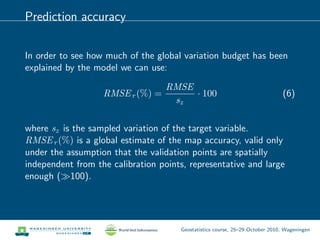
Prediction accuracy
In order to see how much of the global variation budget has been
explained by the model we can use:
RMSEr (%) =
RMSE
sz
· 100 (6)
where sz is the sampled variation of the target variable.
RMSEr (%) is a global estimate of the map accuracy, valid only
under the assumption that the validation points are spatially
independent from the calibration points, representative and large
enough ( 100).
Geostatistics course, 25–29 October 2010, Wageningen
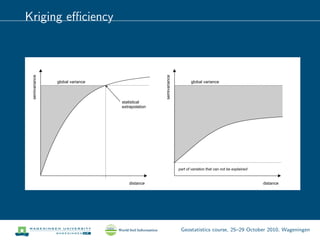
Kriging efficiency
Geostatistics course, 25–29 October 2010, Wageningen
Mapping efficiency
We propose two new measures of mapping success: (1) Mapping
efficiency, defined as the amount of money needed to map an area
of standard size and explain each one percent of variation in the
target variable:
θ =
X
A · RMSEr
[EUR · km−2
· %−1
] (7)
where X is the total costs of a survey, A is the size of area in
km−2, and RMSEr is the amount of variation explained by the
spatial prediction model.
Geostatistics course, 25–29 October 2010, Wageningen
Information production efficiency
(2) Equivalent measure of mapping efficiency is the information
production efficiency:
Υ =
X
gzip
[EUR · B−1
] (8)
where gzip is the size of data (in Bytes) left after compression and
after reformatting the values to match the effective precision
(based on Eq.10). This can be estimated as:
gzip = fc · (fE · M ) · cZ [B] (9)
where fc is the loss-less data compression factor that depends on
the compression algorithm, fE is the extrapolation adjustment
factor, cZ is the variable coding size, and M is the total number of
pixels.
Geostatistics course, 25–29 October 2010, Wageningen
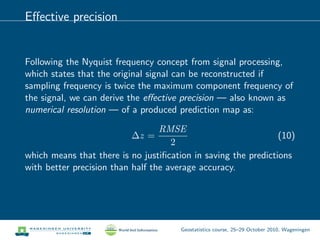
Effective precision
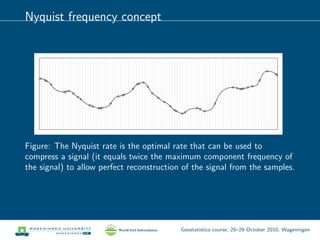
Following the Nyquist frequency concept from signal processing,
which states that the original signal can be reconstructed if
sampling frequency is twice the maximum component frequency of
the signal, we can derive the effective precision — also known as
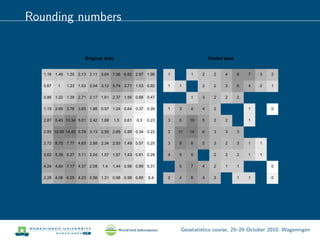
numerical resolution — of a produced prediction map as:
∆z =
RMSE
2
(10)
which means that there is no justification in saving the predictions
with better precision than half the average accuracy.
Geostatistics course, 25–29 October 2010, Wageningen
Nyquist frequency concept
q
q
qq
q
qq q
q
q
q
q q
qqq
q
q qq
q
qq q
q
q
q
q
q
qq
q
q
q q
q
q
q q qqq q q
q
q
qq
Figure: The Nyquist rate is the optimal rate that can be used to
compress a signal (it equals twice the maximum component frequency of
the signal) to allow perfect reconstruction of the signal from the samples.
Geostatistics course, 25–29 October 2010, Wageningen
Rounding numbers
Original data
2.25 4.08 6.25 4.23 2.56 1.21 0.98 0.98 0.85 0.4
4.24 4.69 7.17 4.37 2.08 1.4 1.44 0.96 0.89 0.31
3.62 5.39 5.27 3.11 2.04 1.57 1.67 1.43 0.61 0.28
2.72 8.75 7.77 4.63 2.88 2.34 2.93 1.49 0.57 0.25
2.83 10.55 14.45 5.79 3.13 2.95 2.85 0.89 0.34 0.22
2.87 5.45 10.34 5.01 2.42 1.88 1.5 0.61 0.3 0.23
1.19 2.69 3.76 3.63 1.86 0.97 1.24 0.64 0.37 0.26
0.86 1.22 1.39 2.71 2.17 1.61 2.37 1.56 0.66 0.47
0.67 1 1.23 1.53 2.04 3.12 5.74 3.71 1.53 0.92
1.18 1.48 1.35 2.13 2.11 3.64 7.56 6.92 2.97 1.96
Coded data
2 4 6 4 3 1 1 0
5 7 4 2 1 1 0
4 5 5 2 2 2 1 1
3 9 8 5 3 2 3 1 1
3 11 14 6 3 3 3
3 5 10 5 2 2 1
1 3 4 4 2 1 0
1 3 2 2 2
1 1 2 2 3 6 4 2 1
1 1 2 2 4 8 7 3 2
Geostatistics course, 25–29 October 2010, Wageningen
Exercise
To follow this exercise, obtain the DSM_examples.R script.
Download it to your machine and then run step-by-step.
Geostatistics course, 25–29 October 2010, Wageningen
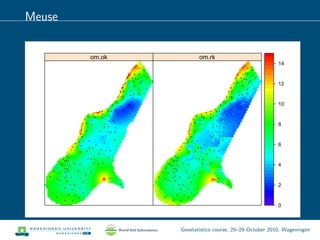
Meuse data
> data(meuse)
> coordinates(meuse) <- ~x+y
> proj4string(meuse) <- CRS("+init=epsg:28992")
> sel <- !is.na(meuse$om)
> bubble(meuse[sel,], "om")
om
qqqq
qq
qq
q qq
q
qq
qq
q
q
q
qqqq
q
qqq
q
q
q
q
q
q
q
qq
q
qq
q
q
q
q
q
q
q
q
qq
qqqqq
q
q
q
q
q
q
q
q
qq
q
q
q
q
qq
qq
qq
q
q
q
qq
q
q
q
q
q
q
q
q
q qq
q
qq
q
qq
q
q q
q
q
q
q
q
q
q
q
qq
q
q
qq
q
q
q
q
q
qq
q
q
q
q
q
q
q
q
q
q
q
q
q
q
q
qq
q
q q
q
qq
qq
q q
q
q
qq q
q
q
q
q
q
q
1
5.3
6.9
9
17
Geostatistics course, 25–29 October 2010, Wageningen
Meuse
+
+ +
+
+
+
++
+
+
+
+
+
+
+
+
+
+
+
+ +++
+
+++
+
+
+
+
++
+
++
+
++
+
+
++
+
+
+
+
+
+
++
+
+++
+
+
+
+
+
+
+
+
+
+
+
+
+
+
+
++
+ +
++
+
+
+
+
+
+
+
+
+
+
+
+
+
+ ++
+
+
+
+
++
+
+
+
+
+
+
+
+
+
+
+
++
+
+
++
+
+
+
+
+
++
+
+
+
+
+
+
+
+
+
+
+
+
+
+
+
++
+
+ +
+
+
+
++
+
+
+
+
++
+
+
om.ok
+
+ +
+
+
+
++
+
+
+
+
+
+
+
+
+
+
+
+ +++
+
+++
+
+
+
+
++
+
++
+
++
+
+
++
+
+
+
+
+
+
++
+
+++
+
+
+
+
+
+
+
+
+
+
+
+
+
+
+
++
+ +
++
+
+
+
+
+
+
+
+
+
+
+
+
+
+ ++
+
+
+
+
++
+
+
+
+
+
+
+
+
+
+
+
++
+
+
++
+
+
+
+
+
++
+
+
+
+
+
+
+
+
+
+
+
+
+
+
+
++
+
+ +
+
+
+
++
+
+
+
+
++
+
+
om.rk
0
2
4
6
8
10
12
14
Geostatistics course, 25–29 October 2010, Wageningen
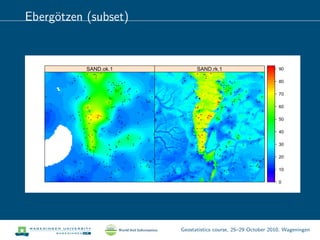
Eberg¨otzen (subset)
+
+
+
+
+
+
+
+
+
+
+ +
+
+
+
+
+
+
+
+
+
+
+
+ +
+ +
+
+
+
+
+
++
+
+
+
+
+
+
+
+
+
+
+
+
+
+
+
+
+
+
+
+
+
+
++
+
+
+
+++
+
+
+
+
++
+
+
+
+
+
+
+
+
+
+
+
+
+
+
+
+
+
+
+
+
+
+
+
+
+
+
+
+
+
+
+
+
+
+
+
+
+
+
+
+
+
+
+
+
+
+
+
++
+
+
+
+
+
+
+
+
+
+
+
+
+
+
+
+
+
+
++
+
+
+
+
+
+
+
+
+
+
+
+
+
++
+
+++
+
+
+
+
+
+
+
+
+
+
+
+
+
+
+
+ +
+
+
+
+
+
+
+
+
+
+
+
+
+
+
+
+
+
+
+
+
+
+
+
+
+
+
+
+
+
+
+
+
+
+
+
+
+
+
+
+
+
+
+
+
+
+
+
+
+
+
+
+
+
+
+
+
+
+
+
+
+
+
+
+
+
+
+
+
+
+
+
+
+
+
+
+
+
++
+
+
+
+
+
+
+
+
+
+
+
+
+
+
+
+
+
++
+
++
+
+
+
+
+
+
++
+
+
+
+
+
+
+
+
+
+
+
+
+
+
+
+
+
SAND.ok.1
+
+
+
+
+
+
+
+
+
+
+ +
+
+
+
+
+
+
+
+
+
+
+
+ +
+ +
+
+
+
+
+
++
+
+
+
+
+
+
+
+
+
+
+
+
+
+
+
+
+
+
+
+
+
+
++
+
+
+
+++
+
+
+
+
++
+
+
+
+
+
+
+
+
+
+
+
+
+
+
+
+
+
+
+
+
+
+
+
+
+
+
+
+
+
+
+
+
+
+
+
+
+
+
+
+
+
+
+
+
+
+
+
++
+
+
+
+
+
+
+
+
+
+
+
+
+
+
+
+
+
+
++
+
+
+
+
+
+
+
+
+
+
+
+
+
++
+
+++
+
+
+
+
+
+
+
+
+
+
+
+
+
+
+
+ +
+
+
+
+
+
+
+
+
+
+
+
+
+
+
+
+
+
+
+
+
+
+
+
+
+
+
+
+
+
+
+
+
+
+
+
+
+
+
+
+
+
+
+
+
+
+
+
+
+
+
+
+
+
+
+
+
+
+
+
+
+
+
+
+
+
+
+
+
+
+
+
+
+
+
+
+
+
++
+
+
+
+
+
+
+
+
+
+
+
+
+
+
+
+
+
++
+
++
+
+
+
+
+
+
++
+
+
+
+
+
+
+
+
+
+
+
+
+
+
+
+
+
SAND.rk.1
0
10
20
30
40
50
60
70
80
90
Geostatistics course, 25–29 October 2010, Wageningen
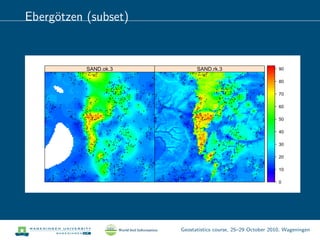
Eberg¨otzen (subset)
+
+
+
+
+
+
+
+
+
+
+
+
+
+
+
+
++
+
+
+
+
+
+
+
+
+
+
+
+
+
+
+
+
+
+
+
+
+
+
+
+
+
+
+
+
+
+
++
+
+
+
++
+
+
+
+
+
+
+
+
+
+
+
+
++
+++
+
+
+
+
+
+
+
+
+
++ +
+
+
+
+
+
+
+
+
+
+
+
+
+
+
+
+
+
+
+
+
+
+
+
+
+
+
+
+
+
+
+
+
+
+++
+
+
+
+
+
+
++
+
+
+
+
+
+
+
+
+
+
+
+
+
+
+
+
+
+
+
+
+
+
+
+
+
+
+
+
+
+
+
+
+
+
+
+
+
+
+
+
+
+
+
++
+
+
+
+
+
+
+
+
+
+
+
+
+
+
+
+
+
+
+
+
+
+
+
+
+
+
+
+
+
+
+
+
+
+
+
+
+
+
+
+
+
+
+
+
+
+
+
+
+
++
+
+
++
+
+
+
+
+
+
+
+
+
+
+
+
+
+
+
+
+
+
+
+
+
+
+
+
+
+
+
+
+
+
+
+
+
+
+
+
+
+
+
+
+
+
+
++
++
+
+
+
++
+
+
+
+
+
+
+
+
+
+
+
+
+
+
+
+
+
+
+
+
+
++
+
+
+
+
++
+
+
+
+
+
+
+
+
+
+
+
+
+
+
+
+
+
+
+
+
+
+
+
+
+
+
+
+
+
++
+
+
+
+
+
+
+
+
+
+
+
+
+
+
+
+
+
+
+
+
+
+
+
+
+
+
+
+
+
+
+
+
+
+
+
+
+
+
+
+
+
+
+
+
+
+
+
+
+
+
+
+
+
+
+
+
+
+
+
+
+
+
+
+
+
+
+
+
+
++
+
+
+
+
+
+
+
+
+
+
+
+
+
+
+
+
+
+
+
+
+
+
+
+
+
+
+
+
+
+
+
+
+
+
+
+
+
+
+
+
+
+
+
+
+
+
+
+
+
+
+
+
+
++
+
+
+
+
+
+
+
+
+
+
++
+
+
+
+
+
+
+
+
+
+
+
+
+
+
+
+
+
+
+
+
+
+
+
+
+
+
+
+
+
+
+
+
+
+
+
+
+
+
+
+
+
+
+
+
+
+
+
+
+
+
+
+
+
+
+
+
+
+
+
+
+++
+
+
+
+
+
+
+
+
+
++
+
+
+
+
++
+
+
+
+
+
++
+
+
+
+
+
+
+
+
+
+
+
+
+
+
+
+
+
+
+
+
+
+
+
+
++
+
+
+
+
+
+
+
+
+
+
+
+
+
+
+
+
+
+
+
+
+
+
+
+
+
+
+
+
+
++
+
+
+
+
+
+
+
+
+
+
+
+
+
+
+
+
+
+
+
+
+
+
+
+
+
+
+
++
+
++
+
+
+
+
+
+
+
+
+
+
+
+
+
+
+
+
+
+
+
+
+
+
+
+
+
+
+
+
+
+
+
+
+
+
+
+
+
+
+
+
+
+
+
+
++
+
+
+
+
+
+
+
+
+
+
+
+
+
+
++
+
+
+
+
+
+
+
+
+
+
+
+
+
+
+
+
+
+
+
+
+
+
+
+
+
++
++
+
+
+
+
+
+
+
+
+
+
+
+
+
+
+
+
+
+
+
+
+
+
+
+
+
+
+
+
+
+
+
+
+
+
+
+
+
+
+
++
+
+
+
+
+
+
+
+
+
+
+
+
+
+
++
+
++
+
++
+
+
+
+
+
+
+
+
+
+
+
+
+
+
+
+
+
+
+
+
+
+
+
+
+
+
+
+
+
+
+
+
+
+
+
+
+
+
+
+
+
+
+
+
+
+
++
+
+
+
+
+
+
+
+
+
+
+
+
+
+
+
+
+
+
++
+
+ +
+
+
+
++
+
+
+
+
+
+
+
+
+
+
+
+
+
+
+
+
+
+
+
+
+
+
+
+
+
+
+
+
+
+
+
+
+
+
+
+
+
+
+
+
+
+
+
+
+
+
+
+
+
+
+
+
+
+
++
++
+
+
+
+
SAND.ok.3
+
+
+
+
+
+
+
+
+
+
+
+
+
+
+
+
++
+
+
+
+
+
+
+
+
+
+
+
+
+
+
+
+
+
+
+
+
+
+
+
+
+
+
+
+
+
+
++
+
+
+
++
+
+
+
+
+
+
+
+
+
+
+
+
++
+++
+
+
+
+
+
+
+
+
+
++ +
+
+
+
+
+
+
+
+
+
+
+
+
+
+
+
+
+
+
+
+
+
+
+
+
+
+
+
+
+
+
+
+
+
+++
+
+
+
+
+
+
++
+
+
+
+
+
+
+
+
+
+
+
+
+
+
+
+
+
+
+
+
+
+
+
+
+
+
+
+
+
+
+
+
+
+
+
+
+
+
+
+
+
+
+
++
+
+
+
+
+
+
+
+
+
+
+
+
+
+
+
+
+
+
+
+
+
+
+
+
+
+
+
+
+
+
+
+
+
+
+
+
+
+
+
+
+
+
+
+
+
+
+
+
+
++
+
+
++
+
+
+
+
+
+
+
+
+
+
+
+
+
+
+
+
+
+
+
+
+
+
+
+
+
+
+
+
+
+
+
+
+
+
+
+
+
+
+
+
+
+
+
++
++
+
+
+
++
+
+
+
+
+
+
+
+
+
+
+
+
+
+
+
+
+
+
+
+
+
++
+
+
+
+
++
+
+
+
+
+
+
+
+
+
+
+
+
+
+
+
+
+
+
+
+
+
+
+
+
+
+
+
+
+
++
+
+
+
+
+
+
+
+
+
+
+
+
+
+
+
+
+
+
+
+
+
+
+
+
+
+
+
+
+
+
+
+
+
+
+
+
+
+
+
+
+
+
+
+
+
+
+
+
+
+
+
+
+
+
+
+
+
+
+
+
+
+
+
+
+
+
+
+
+
++
+
+
+
+
+
+
+
+
+
+
+
+
+
+
+
+
+
+
+
+
+
+
+
+
+
+
+
+
+
+
+
+
+
+
+
+
+
+
+
+
+
+
+
+
+
+
+
+
+
+
+
+
+
++
+
+
+
+
+
+
+
+
+
+
++
+
+
+
+
+
+
+
+
+
+
+
+
+
+
+
+
+
+
+
+
+
+
+
+
+
+
+
+
+
+
+
+
+
+
+
+
+
+
+
+
+
+
+
+
+
+
+
+
+
+
+
+
+
+
+
+
+
+
+
+
+++
+
+
+
+
+
+
+
+
+
++
+
+
+
+
++
+
+
+
+
+
++
+
+
+
+
+
+
+
+
+
+
+
+
+
+
+
+
+
+
+
+
+
+
+
+
++
+
+
+
+
+
+
+
+
+
+
+
+
+
+
+
+
+
+
+
+
+
+
+
+
+
+
+
+
+
++
+
+
+
+
+
+
+
+
+
+
+
+
+
+
+
+
+
+
+
+
+
+
+
+
+
+
+
++
+
++
+
+
+
+
+
+
+
+
+
+
+
+
+
+
+
+
+
+
+
+
+
+
+
+
+
+
+
+
+
+
+
+
+
+
+
+
+
+
+
+
+
+
+
+
++
+
+
+
+
+
+
+
+
+
+
+
+
+
+
++
+
+
+
+
+
+
+
+
+
+
+
+
+
+
+
+
+
+
+
+
+
+
+
+
+
++
++
+
+
+
+
+
+
+
+
+
+
+
+
+
+
+
+
+
+
+
+
+
+
+
+
+
+
+
+
+
+
+
+
+
+
+
+
+
+
+
++
+
+
+
+
+
+
+
+
+
+
+
+
+
+
++
+
++
+
++
+
+
+
+
+
+
+
+
+
+
+
+
+
+
+
+
+
+
+
+
+
+
+
+
+
+
+
+
+
+
+
+
+
+
+
+
+
+
+
+
+
+
+
+
+
+
++
+
+
+
+
+
+
+
+
+
+
+
+
+
+
+
+
+
+
++
+
+ +
+
+
+
++
+
+
+
+
+
+
+
+
+
+
+
+
+
+
+
+
+
+
+
+
+
+
+
+
+
+
+
+
+
+
+
+
+
+
+
+
+
+
+
+
+
+
+
+
+
+
+
+
+
+
+
+
+
+
++
++
+
+
+
+
SAND.rk.3
0
10
20
30
40
50
60
70
80
90
Geostatistics course, 25–29 October 2010, Wageningen
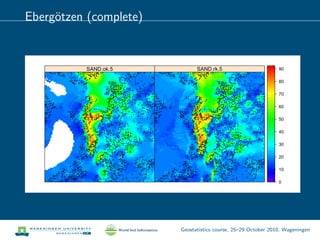
Eberg¨otzen (complete)
+
+
+
+ +
+
+
+
+
+
+
+ +
+++
+
+++
+
+
+
++
+
++
+
+
+
+
+
+
+
+
+
+
+
+
+
+
+
+
+
++
+
+
+
+
+
+
+
+
+
+
+
+
+
+
+
+
+
+
+
+
++
+
+
+
+
+
+
+
+
+
+
+
+
+
+
+
+
+
+
+
+
+
+
+
+
+
+
+
+
+
+
+
+
+
+
+
+
+
+
+
+
+
+
+
+
+
+
+
+
+
+
+
+
+
++
+
+
+
+
+
+
+
+
+
+
+
+
+
+
+
+
+
+
+
+
++
+
+
+
++
+
+
+
+
+
+
+
+
+
+
+
+
+
+
+
+
+
+
+
+
+
+
+
+
+
+
+
+
+
+
++
+
+
+
+
+
+
+
+
+
+
+
+
+
+
+
+
+
+
+
+
+
+
+
+
+
+
+
+
+
+
+
+
+
+
+
+
+
++
+
+
++
+
+
+
+
+
+
+
++
+
+
+
+
+
++
+
+
+
+
+
+
+
+
+
++
+
+
+
+
+
+
+
+
+
+
+
+
+
+
+
+
+
+
++
++
+
+
+
+
+
+
+
+
++
+
+
+
+
+
+
+
+
+
+
+
+
+
+
+
+
+
+
+
+
+
+
+
+
+
+
++
+
+
+
++
+
+
+
+
+
+
+
+
+
+
++
+
+
+
+
+
+
+
+
+
++
+
+
+
+
+
+
+
++
+
+
+
+
+
+
+
+
+
+
+
+
+
+
+
+
+
+
+
+
+
+
+
+
+
+
+
+
+
+
+
+
+
+
+
+
+
+
+
+
+
+
+
+
+
+
+
+
+
+
+
+
+
+
+
+
+
+
+
+
+
+
+
+
+
+
+
+
+
+
+
+
+
+
+
+
+
+
+
+
+
+
+
+
+
+
++
+
+
+
+
+
+
+
+
+
+
+
+
+
+
+
+
+
+
+
+
+
+
+
+
+
+
+
+
+
+
+
+
+
+
+
+
+
+
+
+
+
+
+
+
+
+
+
+
+
+
+
+
+
+
+
+
+
+
+
+
+
+
+
+
+
+
+
++
+
+
++
+
+
+
+
+
+
+
+
+
+
+
+
+
+
+
+
+
+
+
+
+
+
+
+
+
+
+
+
+
+
+
+
+
+
+
+
+
+
+
+
+
+
+
+
+
+
+
+
+
+
+
+
+
+
+
+
+
+
++
+
+
+
+
+
+
+
+
+
+
+
+
+
+
+
+
+
+
+
+
+
+
+
+
+
+
+
+
+
+
+
+
+
+
++
+
+
+
+
+
+
+
+
+
+
+
+
+
+
+
+
+
+
+
+
+
+
+
+
+
+
+
+
+
+
+
+
+
+
+
+
+
+
+
++
+
+
+
++
+
+
+
+
+
+
+
+
+
+
++
+
+
+
+
+
+
+
+
+
++
+
+
+
+
+
+
+
+
+
+
+
+
+
+
+
+
+
+
++
+
+
++
+
+
+
+
+
+
+
+
+
+
+
+
+
+
+
++
+
+
+
+
+
+
+
+
+
+
+
++
+
+
+
+
+
+
+
+
+
+
+
+
+
+
+
+
+
+
+
+
+
+
+
+
+
+
+
+
+
+
+
+
+
+
+
+
+
+
+
+
+
+
+
+
+
+
+
+
+
+
+
+
+
+
+
+
+
+
+
+
+
+
+
+
+
+
+
+
+
+
+++
+
++
+
+
+
+
+
+
++
++
+
+
+
+
+
+
+
+
+
+
+
+
+
+
+
+
+
+
+
+
+
+
+
+
+
+
+
+
+
+
+
+
+
++
+
+
+
+
+
+
+
+
+
+
+
+
+
+
+
+
+
+
+
+
+
+
+
+
+
+
+
+
+
+
+
+
+
+
+
+
+
+
+
+
+
+
+
+
+
+
+
+
+
+
+
+
+
+
+
+
+
+
+
+
+
+
+
+
+
+
+
+
+
+
++
+
+
+
+
+
+
+
+
+
+
+
+
++
+
+
+
+
+
+
+
+
+
+
+
+
++
+
+
+
+
+
+
+
+
+
+
+
+
+
++
+
+
+
+
+
+
+
+
+
+
+
+
+
+
+
+
+
+
+
+
+
+
+
+
+
+
+
+
+
+
+
+
+
+
+
+
+
+
+
+
+
+
+
+
+
+
+
+
+
+
+
+
+
+
+
+
+
+
+
+
+
+
++
+
+
+
+
+
+
+
+
+
+
+
+
+
+
+
+
+
+
+
+
+
+
+
+
+
+
+
+
+
+
+
+
+
+
+
+
+
+
+
+
+
+
+
+
+
+
+
+
+
+
+
+
+
+
+
+
+
+
+
+
+
+
+
+
+
+
+
+
+
+
+
+
+
+
+
+
+
+
+
+
+
+
+
+
+
+
+
+
+
+
+
+
+
+
+
+
+
+
+
+
+
+
+
+
+
+
+
+
+
+
+
+
+
+
+
+
+
+
+
+
+
+
+
+
+
+
+
+
+
+
+
+
+
+
+
+
+
+
+
+
+
+
+
+
+
+
+
+
+
+
+
+
+
+
+
+
+
+
+
+
+
+
+
+
+
+
+
+
+
+
+
+
+
+
+
+
+
+
+
+
+
+
+
+
+
+
+
+
+
+
+
+
+
+
+
+
+
+
+
+
+
+
+
+
+
+
+
+
+
+
+
+
+
+
+
+
+
++
+
+
+
+
+
+
+
+
+
+
+
+
+
+
+
+
+
+
+
+
+
+
+
+
+
+
+
+
+
+
+
+
+
+
+
+
+
+
+
+
+
+
+
+
+
+
+
+
+
+
+
+
+
+
+
+
+
+
+
+
+
+
+
+
+
+
+
+
+
+
+
+
+
+
+
+
+
+
+
+
+
+
+
+
+
+
+
+
+
+
+
+
+
+
+
+
+
+
+
+
+
+
+
+
+
+
+
+
+
+
+
++
+
+
+
+
+
+
+
+
+
++
+
+
+
+
+
+
+
+
+
+
+
+
+
+
+
+
+
+
+
+
+
+
+
+
+
+
+
+
+
+
+
+
+
+
+
+
+
+
+
+
+
+
+
+
+
+
+
+
+
+
+
+
+
+
+
+
+
+
+
+
+
+
+
+
+
+
+
+
+
+
+
+
+
+
+
+
+
+
+
+
+
+
+
+
+
+
+
+
+
+
+
+
+
+
+
+
++
+
+
+
+
++
+
+
+
+
+
+
+
+
+
++
+
+
+
+
+
+
+
+
+
+
+
+
+
+
+
+
+
+
+
+
+
+
+
+
+
+
+
+
+
+
+
+
+
+
+
+
+
+
+
+
+
+
+
+
+
+
+
+
+
+
+
+
+
+
+
+
+
+
+
++
+
+
++
+
+
+
+
+
+
+
+
+
++
+
+
+
+
+
+
+
+
+
+
+
+
+
+
+
+
+
+
+
+
+
+
+
+
+
+
+
++
+
+
+
+
+
++
+
+
+
+
+
+
+
+
+
+
+
+
+
+
+
+
+
+
+
+
+
+
++
+
+
++
+
+
+
+
+
+
+
++
+
+
+
+
+
++
+
+
+
+
+
+
+
+
+
++
+
+
+
+
+
+
+
+
+
++
++
++
+
+
+
+
+
+
+
+
+
+
+
+
+
+
+
+
+
+
+
+
+
+
+
++
+
+
+
+
+
+
+
+
+
+
+
+
+
+
+
+
+
+
+
+
+
+
+
+
+
+
+
+
+
+
+
+
+
+
+
++
+
+
+
+
+
+
+
+
+
++
+
+
+
+
+
+
+
+
+
+
+
+
+
+
+
+
+
+
+
+
+
+
+
+
+
+
+
++
+
+
+
+
+
+
+
+
+
+
+
+
+
+
+
+
+
+
+
+
+
+
+
+
+
+
+
+
+
+
+
+
+
+
+
+
++
+
+
+
+
+
+
+
+
+
+
+
+
+
+
+
++
+
+
+
+
+
+
+
+
+
+
+
+
+
+
+
+
+
++
+
+
+
+
+
+
+
++
+
+
+
+
+
++
+
+
+
+
+
+
+
+
+
+
+
+
+
+
+
+
+
+
+
+
+
++
+
+
+
+
+
+
+
++
+
+
+
+
+
+
+
+
+
+
+
+
+
+
+
++
+
+
+
+
+
+
+
+
+
+
+
+
+
+
+
+
+
+
+
+
+
+
+
+
+
+
+
+
+
+
+
+
+
+
+
+
+
+
+
+
+
+
+
+
+
+
+
+
+
+
+
+
+
+
+
+
+
+
+
+
+
+
+
+
+
+
+
+
+
+
+
+
+
+
+
+
+
+
+
+
+
+
+
+
+
+
+
+
+
+
+
+
+
+
+
+
+
++
+
+
+
+
+
+
+
+
+
+
+
+
+
+
+
+
+
+
+
+
+
+
+
+
+
+
+
+
+
+
+
+
+
+
+
+
+
+
+
+
+
+
+
+
+
+
+
+
+
+
+
+
+
+
+
+
+
+
+
+
+
+
+
+
+
+
++
+
+
+
+
+
+
+
+
+
+
+
+
+
+
+
+
+
+
+
+
+
+
+
++
+
+
+
+
+
+
+
+
+
+
+
+
+
+
+
+
+
+
+
+
+
+
+
+
+
+
+
+
+
+
+
+
+
+
+
+
+
+
+
+
+
+
+
+
+
+
+
++
+
+
+
+
+
+
+
+
+
+
+
+
+
+
+
+
++
+
+
+
+
+
+
+
+
+
+
+
+
+
+
+
+
+
+
+
+
+
+
+
+
+
+
+
+
+
+
++
+
+
+
+
+
+
+
+
+
+
+
+
+
+
+
+
+
+
+
+
+
+
+
+
++
+
+
+
+
+
+
+
+
+
++
+
+
+
+
+
+
+
+
+
+
+
+
+
+
+
+
++
+
+
+
+
+
+
+
+
+
+
+
+
+
+
+
+
+
+
+
+
+
+
+
+
+
+
+
+
+
+
+
+
+
+
+
+
+
+
+
++
+
+
++
+
+
+
+
+
+
+
+
+
+
+
+
+
+
+
+
+
+
+
+
+
+
+
+
+
+
+
+
+
+
+
+
+
+
+
+
+
+
+
+
+
+
+
+
+
+
+
+
+
+
+
+
+
+
+
+++
+
+
+
+
+
+
+
+
+
+
+
++
+
++
+
+
++
+
+
+
+
+
+
+
+
+
+
+
+
+
+
+
+
+
+
+
+
+
+
+
+
+
+
+
+
+
+
+
+
+
+
+
+
+
+
+
+
+
+
++
++
++
+++
+
+
++
+
+
+
++
+
+
+
+
+
+
+
++
+
+
+
+
+
+
+
+
+
+
+
+
+
+
+
+
+
+
+
+
+
+
+
+
+
+
+
+
+
+
+
+
+
+
+
+
+
+
+
+
+
+
+
+
+
+
+
+
+
+
++
+
+
+
+
+
+
+
+
+
+
+
+
+
+
+
++
+
+
++
+
+
++
+
+
+
+
+
+
+
+
+
+
+
+
+
+
+
+
+
+
++
+
+
+
+
+
+
+
+
+
+
+
+
++
+
+
+
+
++
+
+
+
+
+
+
+
+
+
+
+
+
+
+
+
++
+
+
+
+
+
+
+
+
+
+
+
+
+
+
+
+
+
++
+
+
+
+
+
+
+
+
+
+
+
+
+
+
+
+
+
+
+
+
+
+
+
+
+
+
+
+
+
+
+
+
+
+
+
+
+
+
+
+
+
+
+
+
+
+
+
+
+
+
+
+
+
++
+
+
+
+
+
+
+
+
+
+
+
+
+
+
+
+
+
+
+
+
+
+
+
+
+
+
+
++
+
+
+
+
+
+
+
+
+
+
+
+
++
+
+
+
+
+
++
+
+
+
+
+
++
+
+
+
+
+
+
+
+
+
+
+
+
+
+
+
++
+
+
+
++
+
+
+
+
+
+
+
+
+
++
+
+
+
+
+
+
+
+
+
++
+
++
+
+
+
+
+
+
+
+
+
+
+
+
+
+
+
++
+
+
+
+
+
+
+
++
+
+
+
++
+
+
+
+
+
+
+
+
+
+
+
+
+
+
+
+
+
+
+
+
+
+
+
+
++
+
+
+
+
+
+
+
+
+
+
+
+
+
+
+
++
++
+
+
+
+
+
+
+
+
+
+
+
+
+
+
+
+
+
+
+
+
+
+
+
+
+
+
+
+
+
+
+
+
+
+
+
+
+
+
+
+
+
+
+
+
+
+
+
+
+
+
+
+
+
+
+
+
+
+
+
+
++
+
+
+ +
++
+
+++
+
+ +
++
+
+
+
+
+
+
+
+
+
+
+
+
+
+
+ +
+
+
+ +
+
+
+
SAND.ok.5
+
+
+
+ +
+
+
+
+
+
+
+ +
+++
+
+++
+
+
+
++
+
++
+
+
+
+
+
+
+
+
+
+
+
+
+
+
+
+
+
++
+
+
+
+
+
+
+
+
+
+
+
+
+
+
+
+
+
+
+
+
++
+
+
+
+
+
+
+
+
+
+
+
+
+
+
+
+
+
+
+
+
+
+
+
+
+
+
+
+
+
+
+
+
+
+
+
+
+
+
+
+
+
+
+
+
+
+
+
+
+
+
+
+
+
++
+
+
+
+
+
+
+
+
+
+
+
+
+
+
+
+
+
+
+
+
++
+
+
+
++
+
+
+
+
+
+
+
+
+
+
+
+
+
+
+
+
+
+
+
+
+
+
+
+
+
+
+
+
+
+
++
+
+
+
+
+
+
+
+
+
+
+
+
+
+
+
+
+
+
+
+
+
+
+
+
+
+
+
+
+
+
+
+
+
+
+
+
+
++
+
+
++
+
+
+
+
+
+
+
++
+
+
+
+
+
++
+
+
+
+
+
+
+
+
+
++
+
+
+
+
+
+
+
+
+
+
+
+
+
+
+
+
+
+
++
++
+
+
+
+
+
+
+
+
++
+
+
+
+
+
+
+
+
+
+
+
+
+
+
+
+
+
+
+
+
+
+
+
+
+
+
++
+
+
+
++
+
+
+
+
+
+
+
+
+
+
++
+
+
+
+
+
+
+
+
+
++
+
+
+
+
+
+
+
++
+
+
+
+
+
+
+
+
+
+
+
+
+
+
+
+
+
+
+
+
+
+
+
+
+
+
+
+
+
+
+
+
+
+
+
+
+
+
+
+
+
+
+
+
+
+
+
+
+
+
+
+
+
+
+
+
+
+
+
+
+
+
+
+
+
+
+
+
+
+
+
+
+
+
+
+
+
+
+
+
+
+
+
+
+
+
++
+
+
+
+
+
+
+
+
+
+
+
+
+
+
+
+
+
+
+
+
+
+
+
+
+
+
+
+
+
+
+
+
+
+
+
+
+
+
+
+
+
+
+
+
+
+
+
+
+
+
+
+
+
+
+
+
+
+
+
+
+
+
+
+
+
+
+
++
+
+
++
+
+
+
+
+
+
+
+
+
+
+
+
+
+
+
+
+
+
+
+
+
+
+
+
+
+
+
+
+
+
+
+
+
+
+
+
+
+
+
+
+
+
+
+
+
+
+
+
+
+
+
+
+
+
+
+
+
+
++
+
+
+
+
+
+
+
+
+
+
+
+
+
+
+
+
+
+
+
+
+
+
+
+
+
+
+
+
+
+
+
+
+
+
++
+
+
+
+
+
+
+
+
+
+
+
+
+
+
+
+
+
+
+
+
+
+
+
+
+
+
+
+
+
+
+
+
+
+
+
+
+
+
+
++
+
+
+
++
+
+
+
+
+
+
+
+
+
+
++
+
+
+
+
+
+
+
+
+
++
+
+
+
+
+
+
+
+
+
+
+
+
+
+
+
+
+
+
++
+
+
++
+
+
+
+
+
+
+
+
+
+
+
+
+
+
+
++
+
+
+
+
+
+
+
+
+
+
+
++
+
+
+
+
+
+
+
+
+
+
+
+
+
+
+
+
+
+
+
+
+
+
+
+
+
+
+
+
+
+
+
+
+
+
+
+
+
+
+
+
+
+
+
+
+
+
+
+
+
+
+
+
+
+
+
+
+
+
+
+
+
+
+
+
+
+
+
+
+
+
+++
+
++
+
+
+
+
+
+
++
++
+
+
+
+
+
+
+
+
+
+
+
+
+
+
+
+
+
+
+
+
+
+
+
+
+
+
+
+
+
+
+
+
+
++
+
+
+
+
+
+
+
+
+
+
+
+
+
+
+
+
+
+
+
+
+
+
+
+
+
+
+
+
+
+
+
+
+
+
+
+
+
+
+
+
+
+
+
+
+
+
+
+
+
+
+
+
+
+
+
+
+
+
+
+
+
+
+
+
+
+
+
+
+
+
++
+
+
+
+
+
+
+
+
+
+
+
+
++
+
+
+
+
+
+
+
+
+
+
+
+
++
+
+
+
+
+
+
+
+
+
+
+
+
+
++
+
+
+
+
+
+
+
+
+
+
+
+
+
+
+
+
+
+
+
+
+
+
+
+
+
+
+
+
+
+
+
+
+
+
+
+
+
+
+
+
+
+
+
+
+
+
+
+
+
+
+
+
+
+
+
+
+
+
+
+
+
+
++
+
+
+
+
+
+
+
+
+
+
+
+
+
+
+
+
+
+
+
+
+
+
+
+
+
+
+
+
+
+
+
+
+
+
+
+
+
+
+
+
+
+
+
+
+
+
+
+
+
+
+
+
+
+
+
+
+
+
+
+
+
+
+
+
+
+
+
+
+
+
+
+
+
+
+
+
+
+
+
+
+
+
+
+
+
+
+
+
+
+
+
+
+
+
+
+
+
+
+
+
+
+
+
+
+
+
+
+
+
+
+
+
+
+
+
+
+
+
+
+
+
+
+
+
+
+
+
+
+
+
+
+
+
+
+
+
+
+
+
+
+
+
+
+
+
+
+
+
+
+
+
+
+
+
+
+
+
+
+
+
+
+
+
+
+
+
+
+
+
+
+
+
+
+
+
+
+
+
+
+
+
+
+
+
+
+
+
+
+
+
+
+
+
+
+
+
+
+
+
+
+
+
+
+
+
+
+
+
+
+
+
+
+
+
+
+
+
++
+
+
+
+
+
+
+
+
+
+
+
+
+
+
+
+
+
+
+
+
+
+
+
+
+
+
+
+
+
+
+
+
+
+
+
+
+
+
+
+
+
+
+
+
+
+
+
+
+
+
+
+
+
+
+
+
+
+
+
+
+
+
+
+
+
+
+
+
+
+
+
+
+
+
+
+
+
+
+
+
+
+
+
+
+
+
+
+
+
+
+
+
+
+
+
+
+
+
+
+
+
+
+
+
+
+
+
+
+
+
+
++
+
+
+
+
+
+
+
+
+
++
+
+
+
+
+
+
+
+
+
+
+
+
+
+
+
+
+
+
+
+
+
+
+
+
+
+
+
+
+
+
+
+
+
+
+
+
+
+
+
+
+
+
+
+
+
+
+
+
+
+
+
+
+
+
+
+
+
+
+
+
+
+
+
+
+
+
+
+
+
+
+
+
+
+
+
+
+
+
+
+
+
+
+
+
+
+
+
+
+
+
+
+
+
+
+
+
++
+
+
+
+
++
+
+
+
+
+
+
+
+
+
++
+
+
+
+
+
+
+
+
+
+
+
+
+
+
+
+
+
+
+
+
+
+
+
+
+
+
+
+
+
+
+
+
+
+
+
+
+
+
+
+
+
+
+
+
+
+
+
+
+
+
+
+
+
+
+
+
+
+
+
++
+
+
++
+
+
+
+
+
+
+
+
+
++
+
+
+
+
+
+
+
+
+
+
+
+
+
+
+
+
+
+
+
+
+
+
+
+
+
+
+
++
+
+
+
+
+
++
+
+
+
+
+
+
+
+
+
+
+
+
+
+
+
+
+
+
+
+
+
+
++
+
+
++
+
+
+
+
+
+
+
++
+
+
+
+
+
++
+
+
+
+
+
+
+
+
+
++
+
+
+
+
+
+
+
+
+
++
++
++
+
+
+
+
+
+
+
+
+
+
+
+
+
+
+
+
+
+
+
+
+
+
+
++
+
+
+
+
+
+
+
+
+
+
+
+
+
+
+
+
+
+
+
+
+
+
+
+
+
+
+
+
+
+
+
+
+
+
+
++
+
+
+
+
+
+
+
+
+
++
+
+
+
+
+
+
+
+
+
+
+
+
+
+
+
+
+
+
+
+
+
+
+
+
+
+
+
++
+
+
+
+
+
+
+
+
+
+
+
+
+
+
+
+
+
+
+
+
+
+
+
+
+
+
+
+
+
+
+
+
+
+
+
+
++
+
+
+
+
+
+
+
+
+
+
+
+
+
+
+
++
+
+
+
+
+
+
+
+
+
+
+
+
+
+
+
+
+
++
+
+
+
+
+
+
+
++
+
+
+
+
+
++
+
+
+
+
+
+
+
+
+
+
+
+
+
+
+
+
+
+
+
+
+
++
+
+
+
+
+
+
+
++
+
+
+
+
+
+
+
+
+
+
+
+
+
+
+
++
+
+
+
+
+
+
+
+
+
+
+
+
+
+
+
+
+
+
+
+
+
+
+
+
+
+
+
+
+
+
+
+
+
+
+
+
+
+
+
+
+
+
+
+
+
+
+
+
+
+
+
+
+
+
+
+
+
+
+
+
+
+
+
+
+
+
+
+
+
+
+
+
+
+
+
+
+
+
+
+
+
+
+
+
+
+
+
+
+
+
+
+
+
+
+
+
+
++
+
+
+
+
+
+
+
+
+
+
+
+
+
+
+
+
+
+
+
+
+
+
+
+
+
+
+
+
+
+
+
+
+
+
+
+
+
+
+
+
+
+
+
+
+
+
+
+
+
+
+
+
+
+
+
+
+
+
+
+
+
+
+
+
+
+
++
+
+
+
+
+
+
+
+
+
+
+
+
+
+
+
+
+
+
+
+
+
+
+
++
+
+
+
+
+
+
+
+
+
+
+
+
+
+
+
+
+
+
+
+
+
+
+
+
+
+
+
+
+
+
+
+
+
+
+
+
+
+
+
+
+
+
+
+
+
+
+
++
+
+
+
+
+
+
+
+
+
+
+
+
+
+
+
+
++
+
+
+
+
+
+
+
+
+
+
+
+
+
+
+
+
+
+
+
+
+
+
+
+
+
+
+
+
+
+
++
+
+
+
+
+
+
+
+
+
+
+
+
+
+
+
+
+
+
+
+
+
+
+
+
++
+
+
+
+
+
+
+
+
+
++
+
+
+
+
+
+
+
+
+
+
+
+
+
+
+
+
++
+
+
+
+
+
+
+
+
+
+
+
+
+
+
+
+
+
+
+
+
+
+
+
+
+
+
+
+
+
+
+
+
+
+
+
+
+
+
+
++
+
+
++
+
+
+
+
+
+
+
+
+
+
+
+
+
+
+
+
+
+
+
+
+
+
+
+
+
+
+
+
+
+
+
+
+
+
+
+
+
+
+
+
+
+
+
+
+
+
+
+
+
+
+
+
+
+
+
+++
+
+
+
+
+
+
+
+
+
+
+
++
+
++
+
+
++
+
+
+
+
+
+
+
+
+
+
+
+
+
+
+
+
+
+
+
+
+
+
+
+
+
+
+
+
+
+
+
+
+
+
+
+
+
+
+
+
+
+
++
++
++
+++
+
+
++
+
+
+
++
+
+
+
+
+
+
+
++
+
+
+
+
+
+
+
+
+
+
+
+
+
+
+
+
+
+
+
+
+
+
+
+
+
+
+
+
+
+
+
+
+
+
+
+
+
+
+
+
+
+
+
+
+
+
+
+
+
+
++
+
+
+
+
+
+
+
+
+
+
+
+
+
+
+
++
+
+
++
+
+
++
+
+
+
+
+
+
+
+
+
+
+
+
+
+
+
+
+
+
++
+
+
+
+
+
+
+
+
+
+
+
+
++
+
+
+
+
++
+
+
+
+
+
+
+
+
+
+
+
+
+
+
+
++
+
+
+
+
+
+
+
+
+
+
+
+
+
+
+
+
+
++
+
+
+
+
+
+
+
+
+
+
+
+
+
+
+
+
+
+
+
+
+
+
+
+
+
+
+
+
+
+
+
+
+
+
+
+
+
+
+
+
+
+
+
+
+
+
+
+
+
+
+
+
+
++
+
+
+
+
+
+
+
+
+
+
+
+
+
+
+
+
+
+
+
+
+
+
+
+
+
+
+
++
+
+
+
+
+
+
+
+
+
+
+
+
++
+
+
+
+
+
++
+
+
+
+
+
++
+
+
+
+
+
+
+
+
+
+
+
+
+
+
+
++
+
+
+
++
+
+
+
+
+
+
+
+
+
++
+
+
+
+
+
+
+
+
+
++
+
++
+
+
+
+
+
+
+
+
+
+
+
+
+
+
+
++
+
+
+
+
+
+
+
++
+
+
+
++
+
+
+
+
+
+
+
+
+
+
+
+
+
+
+
+
+
+
+
+
+
+
+
+
++
+
+
+
+
+
+
+
+
+
+
+
+
+
+
+
++
++
+
+
+
+
+
+
+
+
+
+
+
+
+
+
+
+
+
+
+
+
+
+
+
+
+
+
+
+
+
+
+
+
+
+
+
+
+
+
+
+
+
+
+
+
+
+
+
+
+
+
+
+
+
+
+
+
+
+
+
+
++
+
+
+ +
++
+
+++
+
+ +
++
+
+
+
+
+
+
+
+
+
+
+
+
+
+
+ +
+
+
+ +
+
+
+
SAND.rk.5
0
10
20
30
40
50
60
70
80
90
Geostatistics course, 25–29 October 2010, Wageningen
OK vs RK
2.0 2.5 3.0 3.5
0.00.20.40.60.81.0
Sampling intensity (log)
Amountofvariationexplained
Ordinary kriging Regression−kriging
Geostatistics course, 25–29 October 2010, Wageningen
Prediction accuracy and survey costs
Geostatistics course, 25–29 October 2010, Wageningen
Summary results
For the two case studies there is a gain of 7% for mapping
organic matter (Meuse), and 13% and for mapping sand
content (Eberg¨otzen) using regression-kriging vs ordinary
kriging.
Geostatistics course, 25–29 October 2010, Wageningen
Summary results
For the two case studies there is a gain of 7% for mapping
organic matter (Meuse), and 13% and for mapping sand
content (Eberg¨otzen) using regression-kriging vs ordinary
kriging.
to map organic carbon for the Meuse case study, one would
need to spend 13.1 EUR km−2 %−1 (1.13 EUR B−1); to map
sand content for the Eberg¨otzen case study would costs
11.1 EUR km−2 %−1 (5.88 EUR B−1).
Geostatistics course, 25–29 October 2010, Wageningen
Summary results
For the two case studies there is a gain of 7% for mapping
organic matter (Meuse), and 13% and for mapping sand
content (Eberg¨otzen) using regression-kriging vs ordinary
kriging.
to map organic carbon for the Meuse case study, one would
need to spend 13.1 EUR km−2 %−1 (1.13 EUR B−1); to map
sand content for the Eberg¨otzen case study would costs
11.1 EUR km−2 %−1 (5.88 EUR B−1).
Information production efficiency is possibly a more robust
measure of mapping quality than mapping efficiency because
it is scale-independent and because it accounts for
extrapolation effects.
Geostatistics course, 25–29 October 2010, Wageningen
Conclusions
Mapping efficiency (cost / area / percent of variance
explained) is a possible universal criteria to compare prediction
methods.
Geostatistics course, 25–29 October 2010, Wageningen
Conclusions
Mapping efficiency (cost / area / percent of variance
explained) is a possible universal criteria to compare prediction
methods.
Maps are not what they seem.
Geostatistics course, 25–29 October 2010, Wageningen
Conclusions
Mapping efficiency (cost / area / percent of variance
explained) is a possible universal criteria to compare prediction
methods.
Maps are not what they seem.
Geostatistics really outperforms non-statistical methods (but
this is area/data dependent).
Geostatistics course, 25–29 October 2010, Wageningen
Conclusions
Mapping efficiency (cost / area / percent of variance
explained) is a possible universal criteria to compare prediction
methods.
Maps are not what they seem.
Geostatistics really outperforms non-statistical methods (but
this is area/data dependent).
It’s not about the making beautiful maps, it’s about
understanding what they mean.
Geostatistics course, 25–29 October 2010, Wageningen
Conclusions
Mapping efficiency (cost / area / percent of variance
explained) is a possible universal criteria to compare prediction
methods.
Maps are not what they seem.
Geostatistics really outperforms non-statistical methods (but
this is area/data dependent).
It’s not about the making beautiful maps, it’s about
understanding what they mean.
If you deal with several equally valid (independent) methods,
maybe you should consider combining them?
Geostatistics course, 25–29 October 2010, Wageningen
Comparing methods
Geostatistics course, 25–29 October 2010, Wageningen
Literature
Dubois, G. (Ed.), 2005. Automatic mapping algorithms for routine
and emergency monitoring data. Report on the Spatial Interpolation
Comparison (SIC2004) exercise. EUR 21595 EN. Office for Official
Publications of the European Communities, Luxembourg, p. 150.
Hengl, T., 2009. A Practical Guide to Geostatistical Mapping, 2nd
edition. University of Amsterdam, 291 p. ISBN 978-90-9024981-0.
Li, J., Heap, A., 2008. A review of spatial interpolation methods for
environmental scientists. Record 2008/23. Geoscience Australia,
Canberra, p. 137.
Pebesma, E., Cornford, D., Dubois, D., Heuvelink, G.B.M.,
Hristopoulos, D., Pilz, J., Stohlker, U., Morin, G., Skoien, J.O.,
2010. INTAMAP: The design and implementation of an
interoperable automated interpolation web service. Computers &
Geosciences, In Press, Corrected Proof.
Geostatistics course, 25–29 October 2010, Wageningen

Spatial interpolation comparison

  • 1.
    Spatial Interpolation Comparison Evaluationof spatial prediction methods Tomislav Hengl ISRIC — World Soil Information, Wageningen University Geostatistics course, 25–29 October 2010, Wageningen
  • 2.
    Based on Hengl, T.,MacMillan, R.A., 2011? Mapping efficiency and information content. submitted to International Journal of Applied Earth Observation and Geoinformation, special issue Spatial Statistics Conference. Geostatistics course, 25–29 October 2010, Wageningen
  • 3.
    Topic Geostatistics = atoolbox to generate maps from point data i.e.to interpolate; Geostatistics course, 25–29 October 2010, Wageningen
  • 4.
    Topic Geostatistics = atoolbox to generate maps from point data i.e.to interpolate; There are many possibilities; Geostatistics course, 25–29 October 2010, Wageningen
  • 5.
    Topic Geostatistics = atoolbox to generate maps from point data i.e.to interpolate; There are many possibilities; An inexperienced user will often be challenged by the amount of techniques to run spatial interpolation; Geostatistics course, 25–29 October 2010, Wageningen
  • 6.
    Topic Geostatistics = atoolbox to generate maps from point data i.e.to interpolate; There are many possibilities; An inexperienced user will often be challenged by the amount of techniques to run spatial interpolation; . . .which method should we use? Geostatistics course, 25–29 October 2010, Wageningen
  • 7.
    Have you heardof SIC? Geostatistics course, 25–29 October 2010, Wageningen
  • 8.
    The spatial predictiongame Participants were invited to estimate values located at 1000 locations (right, crosses), using 200 observations (left, circles). Geostatistics course, 25–29 October 2010, Wageningen
  • 9.
    Lessons learned (fromSIC) Geostatistics course, 25–29 October 2010, Wageningen
  • 10.
    Li and Heap(2008) Geostatistics course, 25–29 October 2010, Wageningen
  • 11.
    How many techniquesare there? Li and Heap (2008) list over 40 unique techniques. 1. Are all these equally valid? 2. How to objectively compare various methods (which criteria to use)? 3. Which method to pick for your own case study? Geostatistics course, 25–29 October 2010, Wageningen
  • 12.
    There are notas many There are roughly five main clusters of techniques: 1. splines (deterministic); Geostatistics course, 25–29 October 2010, Wageningen
  • 13.
    There are notas many There are roughly five main clusters of techniques: 1. splines (deterministic); 2. kriging-based (plain geostatistics); Geostatistics course, 25–29 October 2010, Wageningen
  • 14.
    There are notas many There are roughly five main clusters of techniques: 1. splines (deterministic); 2. kriging-based (plain geostatistics); 3. regression-based; Geostatistics course, 25–29 October 2010, Wageningen
  • 15.
    There are notas many There are roughly five main clusters of techniques: 1. splines (deterministic); 2. kriging-based (plain geostatistics); 3. regression-based; 4. bayesian methods; Geostatistics course, 25–29 October 2010, Wageningen
  • 16.
    There are notas many There are roughly five main clusters of techniques: 1. splines (deterministic); 2. kriging-based (plain geostatistics); 3. regression-based; 4. bayesian methods; 5. expert systems / machine learning; Geostatistics course, 25–29 October 2010, Wageningen
  • 17.
    The 5 criteria 1.the overall mapping accuracy, e.g.standardized RMSE at control points — the amount of variation explained by the predictor expressed in %; Geostatistics course, 25–29 October 2010, Wageningen
  • 18.
    The 5 criteria 1.the overall mapping accuracy, e.g.standardized RMSE at control points — the amount of variation explained by the predictor expressed in %; 2. the bias, e.g.mean error — the accuracy of estimating the central population parameters; Geostatistics course, 25–29 October 2010, Wageningen
  • 19.
    The 5 criteria 1.the overall mapping accuracy, e.g.standardized RMSE at control points — the amount of variation explained by the predictor expressed in %; 2. the bias, e.g.mean error — the accuracy of estimating the central population parameters; 3. the model robustness, also known as model sensitivity — in how many situations would the algorithm completely fail / how much artifacts does it produces?; Geostatistics course, 25–29 October 2010, Wageningen
  • 20.
    The 5 criteria 1.the overall mapping accuracy, e.g.standardized RMSE at control points — the amount of variation explained by the predictor expressed in %; 2. the bias, e.g.mean error — the accuracy of estimating the central population parameters; 3. the model robustness, also known as model sensitivity — in how many situations would the algorithm completely fail / how much artifacts does it produces?; 4. the model reliability — how good is the model in estimating the prediction error (how accurate is the prediction variance considering the true mapping accuracy)?; Geostatistics course, 25–29 October 2010, Wageningen
  • 21.
    The 5 criteria 1.the overall mapping accuracy, e.g.standardized RMSE at control points — the amount of variation explained by the predictor expressed in %; 2. the bias, e.g.mean error — the accuracy of estimating the central population parameters; 3. the model robustness, also known as model sensitivity — in how many situations would the algorithm completely fail / how much artifacts does it produces?; 4. the model reliability — how good is the model in estimating the prediction error (how accurate is the prediction variance considering the true mapping accuracy)?; 5. the computational burden — the time needed to complete predictions; Geostatistics course, 25–29 October 2010, Wageningen
  • 22.
    Can we simplifythis? 1. In theory, we could derive a single composite measure that would then allow you to select ‘the optimal’ predictor for any given data set (but this is not trivial!) 2. But how to assign weights to different criteria? 3. In many cases we simply finish using some na¨ıve predictor — that is predictor that we know has a statistically more optimal alternative, but this alternative is not feasible. Geostatistics course, 25–29 October 2010, Wageningen
  • 23.
    Automated mapping In theintamap package1 decides which method to pick for you: > meuse$value <- log(meuse$zinc) > output <- interpolate(data=meuse, newdata=meuse.grid) R 2009-11-11 17:09:14 interpolating 155 observations, 3103 prediction locations [Time models loaded...] [1] "estimated time for copula 133.479866956255" Checking object ... OK 1 http://cran.r-project.org/web/packages/intamap/ Geostatistics course, 25–29 October 2010, Wageningen
  • 24.
    Hypothesis We need asingle criteria to compare various prediction methods. Geostatistics course, 25–29 October 2010, Wageningen
  • 25.
    Mapping accuracy andsurvey costs The cost of a soil survey is also a function of mapping scale, roughly: log(X) = b0 + b1 · log(SN) (1) We can fit a linear model to the empirical table data from e.g.Legros (2006; p.75), and hence we get: X = exp (19.0825 − 1.6232 · log(SN)) (2) where X is the minimum cost/ha in Euros (based on estimates in 2002). To map 1 ha of soil at 1:100,000 scale, for example, one needs (at least) 1.5 Euros. Geostatistics course, 25–29 October 2010, Wageningen
  • 26.
    Survey costs andmapping scale q q q q q 9.5 10.0 10.5 11.0 11.5 12.0 12.5 −10123 Scale number (log−scale) MinimumsurveycostsinEUR/ha(log−scale) Geostatistics course, 25–29 October 2010, Wageningen
  • 27.
    Survey costs andmapping scale Total costs of a soil survey can be estimated by using the size of area and number of samples. The effective scale number (SN) is: SN = 4 · A N · 102 . . . SN = A N · 102 (3) where A is the surface of the study area in m2 and N is the total number of observations. Geostatistics course, 25–29 October 2010, Wageningen
  • 28.
    Converges to: X =exp 19.0825 − 1.6232 · log 0.0791 · A N · 102 (4) Geostatistics course, 25–29 October 2010, Wageningen
  • 29.
    Output map, frominfo perspective The resulting (predictions) map is a sum of two signals: Z∗ (s) = Z(s) + ε(s) (5) where Z(s) is the true variation, and ε(s) is the error component. The error component consists, in fact, of two parts: (1) the unexplained part of soil variation, and (2) the noise (measurement error). The unexplained part of soil variation is the variation we somehow failed to explain because we are not using all relevant covariates and/or due to the limited sampling intensity. Geostatistics course, 25–29 October 2010, Wageningen
  • 30.
    Prediction accuracy In orderto see how much of the global variation budget has been explained by the model we can use: RMSEr (%) = RMSE sz · 100 (6) where sz is the sampled variation of the target variable. RMSEr (%) is a global estimate of the map accuracy, valid only under the assumption that the validation points are spatially independent from the calibration points, representative and large enough ( 100). Geostatistics course, 25–29 October 2010, Wageningen
  • 31.
    Kriging efficiency Geostatistics course,25–29 October 2010, Wageningen
  • 32.
    Mapping efficiency We proposetwo new measures of mapping success: (1) Mapping efficiency, defined as the amount of money needed to map an area of standard size and explain each one percent of variation in the target variable: θ = X A · RMSEr [EUR · km−2 · %−1 ] (7) where X is the total costs of a survey, A is the size of area in km−2, and RMSEr is the amount of variation explained by the spatial prediction model. Geostatistics course, 25–29 October 2010, Wageningen
  • 33.
    Information production efficiency (2)Equivalent measure of mapping efficiency is the information production efficiency: Υ = X gzip [EUR · B−1 ] (8) where gzip is the size of data (in Bytes) left after compression and after reformatting the values to match the effective precision (based on Eq.10). This can be estimated as: gzip = fc · (fE · M ) · cZ [B] (9) where fc is the loss-less data compression factor that depends on the compression algorithm, fE is the extrapolation adjustment factor, cZ is the variable coding size, and M is the total number of pixels. Geostatistics course, 25–29 October 2010, Wageningen
  • 34.
    Effective precision Following theNyquist frequency concept from signal processing, which states that the original signal can be reconstructed if sampling frequency is twice the maximum component frequency of the signal, we can derive the effective precision — also known as numerical resolution — of a produced prediction map as: ∆z = RMSE 2 (10) which means that there is no justification in saving the predictions with better precision than half the average accuracy. Geostatistics course, 25–29 October 2010, Wageningen
  • 35.
    Nyquist frequency concept q q qq q qqq q q q q q qqq q q qq q qq q q q q q q qq q q q q q q q q qqq q q q q qq Figure: The Nyquist rate is the optimal rate that can be used to compress a signal (it equals twice the maximum component frequency of the signal) to allow perfect reconstruction of the signal from the samples. Geostatistics course, 25–29 October 2010, Wageningen
  • 36.
    Rounding numbers Original data 2.254.08 6.25 4.23 2.56 1.21 0.98 0.98 0.85 0.4 4.24 4.69 7.17 4.37 2.08 1.4 1.44 0.96 0.89 0.31 3.62 5.39 5.27 3.11 2.04 1.57 1.67 1.43 0.61 0.28 2.72 8.75 7.77 4.63 2.88 2.34 2.93 1.49 0.57 0.25 2.83 10.55 14.45 5.79 3.13 2.95 2.85 0.89 0.34 0.22 2.87 5.45 10.34 5.01 2.42 1.88 1.5 0.61 0.3 0.23 1.19 2.69 3.76 3.63 1.86 0.97 1.24 0.64 0.37 0.26 0.86 1.22 1.39 2.71 2.17 1.61 2.37 1.56 0.66 0.47 0.67 1 1.23 1.53 2.04 3.12 5.74 3.71 1.53 0.92 1.18 1.48 1.35 2.13 2.11 3.64 7.56 6.92 2.97 1.96 Coded data 2 4 6 4 3 1 1 0 5 7 4 2 1 1 0 4 5 5 2 2 2 1 1 3 9 8 5 3 2 3 1 1 3 11 14 6 3 3 3 3 5 10 5 2 2 1 1 3 4 4 2 1 0 1 3 2 2 2 1 1 2 2 3 6 4 2 1 1 1 2 2 4 8 7 3 2 Geostatistics course, 25–29 October 2010, Wageningen
  • 37.
    Exercise To follow thisexercise, obtain the DSM_examples.R script. Download it to your machine and then run step-by-step. Geostatistics course, 25–29 October 2010, Wageningen
  • 38.
    Meuse data > data(meuse) >coordinates(meuse) <- ~x+y > proj4string(meuse) <- CRS("+init=epsg:28992") > sel <- !is.na(meuse$om) > bubble(meuse[sel,], "om") om qqqq qq qq q qq q qq qq q q q qqqq q qqq q q q q q q q qq q qq q q q q q q q q qq qqqqq q q q q q q q q qq q q q q qq qq qq q q q qq q q q q q q q q q qq q qq q qq q q q q q q q q q q q qq q q qq q q q q q qq q q q q q q q q q q q q q q q qq q q q q qq qq q q q q qq q q q q q q q 1 5.3 6.9 9 17 Geostatistics course, 25–29 October 2010, Wageningen
  • 39.
    Meuse + + + + + + ++ + + + + + + + + + + + + +++ + +++ + + + + ++ + ++ + ++ + + ++ + + + + + + ++ + +++ + + + + + + + + + + + + + + + ++ ++ ++ + + + + + + + + + + + + + + ++ + + + + ++ + + + + + + + + + + + ++ + + ++ + + + + + ++ + + + + + + + + + + + + + + + ++ + + + + + + ++ + + + + ++ + + om.ok + + + + + + ++ + + + + + + + + + + + + +++ + +++ + + + + ++ + ++ + ++ + + ++ + + + + + + ++ + +++ + + + + + + + + + + + + + + + ++ + + ++ + + + + + + + + + + + + + + ++ + + + + ++ + + + + + + + + + + + ++ + + ++ + + + + + ++ + + + + + + + + + + + + + + + ++ + + + + + + ++ + + + + ++ + + om.rk 0 2 4 6 8 10 12 14 Geostatistics course, 25–29 October 2010, Wageningen
  • 40.
    Eberg¨otzen (subset) + + + + + + + + + + + + + + + + + + + + + + + ++ + + + + + + + ++ + + + + + + + + + + + + + + + + + + + + + + ++ + + + +++ + + + + ++ + + + + + + + + + + + + + + + + + + + + + + + + + + + + + + + + + + + + + + + + + + + + + + + ++ + + + + + + + + + + + + + + + + + + ++ + + + + + + + + + + + + + ++ + +++ + + + + + + + + + + + + + + + + + + + + + + + + + + + + + + + + + + + + + + + + + + + + + + + + + + + + + + + + + + + + + + + + + + + + + + + + + + + + + + + + + + + + + + + + + + + + + + ++ + + + + + + + + + + + + + + + + + ++ + ++ + + + + + + ++ + + + + + + + + + + + + + + + + + SAND.ok.1 + + + + + + + + + + + + + + + + + + + + + + + + + + + + + + + + ++ + + + + + + + + + + + + + + + + + + + + + + ++ + + + +++ + + + + ++ + + + + + + + + + + + + + + + + + + + + + + + + + + + + + + + + + + + + + + + + + + + + + + + ++ + + + + + + + + + + + + + + + + + + ++ + + + + + + + + + + + + + ++ + +++ + + + + + + + + + + + + + + + + + + + + + + + + + + + + + + + + + + + + + + + + + + + + + + + + + + + + + + + + + + + + + + + + + + + + + + + + + + + + + + + + + + + + + + + + + + + + + + ++ + + + + + + + + + + + + + + + + + ++ + ++ + + + + + + ++ + + + + + + + + + + + + + + + + + SAND.rk.1 0 10 20 30 40 50 60 70 80 90 Geostatistics course, 25–29 October 2010, Wageningen
  • 41.
    Eberg¨otzen (subset) + + + + + + + + + + + + + + + + ++ + + + + + + + + + + + + + + + + + + + + + + + + + + + + + + ++ + + + ++ + + + + + + + + + + + + ++ +++ + + + + + + + + + ++ + + + + + + + + + + + + + + + + + + + + + + + + + + + + + + + + + + +++ + + + + + + ++ + + + + + + + + + + + + + + + + + + + + + + + + + + + + + + + + + + + + + + + + + + + ++ + + + + + + + + + + + + + + + + + + + + + + + + + + + + + + + + + + + + + + + + + + + + + + + + + ++ + + ++ + + + + + + + + + + + + + + + + + + + + + + + + + + + + + + + + + + + + + + + + + + + ++ ++ + + + ++ + + + + + + + + + + + + + + + + + + + + + ++ + + + + ++ + + + + + + + + + + + + + + + + + + + + + + + + + + + + + ++ + + + + + + + + + + + + + + + + + + + + + + + + + + + + + + + + + + + + + + + + + + + + + + + + + + + + + + + + + + + + + + + + + + + + + ++ + + + + + + + + + + + + + + + + + + + + + + + + + + + + + + + + + + + + + + + + + + + + + + + + + + + + + ++ + + + + + + + + + + ++ + + + + + + + + + + + + + + + + + + + + + + + + + + + + + + + + + + + + + + + + + + + + + + + + + + + + + + + + + + + + +++ + + + + + + + + + ++ + + + + ++ + + + + + ++ + + + + + + + + + + + + + + + + + + + + + + + + ++ + + + + + + + + + + + + + + + + + + + + + + + + + + + + + ++ + + + + + + + + + + + + + + + + + + + + + + + + + + + ++ + ++ + + + + + + + + + + + + + + + + + + + + + + + + + + + + + + + + + + + + + + + + + + + + ++ + + + + + + + + + + + + + + ++ + + + + + + + + + + + + + + + + + + + + + + + + + ++ ++ + + + + + + + + + + + + + + + + + + + + + + + + + + + + + + + + + + + + + + + ++ + + + + + + + + + + + + + + ++ + ++ + ++ + + + + + + + + + + + + + + + + + + + + + + + + + + + + + + + + + + + + + + + + + + + + + + ++ + + + + + + + + + + + + + + + + + + ++ + ++ + + + ++ + + + + + + + + + + + + + + + + + + + + + + + + + + + + + + + + + + + + + + + + + + + + + + + + + + + + + + ++ ++ + + + + SAND.ok.3 + + + + + + + + + + + + + + + + ++ + + + + + + + + + + + + + + + + + + + + + + + + + + + + + + ++ + + + ++ + + + + + + + + + + + + ++ +++ + + + + + + + + + ++ + + + + + + + + + + + + + + + + + + + + + + + + + + + + + + + + + + +++ + + + + + + ++ + + + + + + + + + + + + + + + + + + + + + + + + + + + + + + + + + + + + + + + + + + + ++ + + + + + + + + + + + + + + + + + + + + + + + + + + + + + + + + + + + + + + + + + + + + + + + + + ++ + + ++ + + + + + + + + + + + + + + + + + + + + + + + + + + + + + + + + + + + + + + + + + + + ++ ++ + + + ++ + + + + + + + + + + + + + + + + + + + + + ++ + + + + ++ + + + + + + + + + + + + + + + + + + + + + + + + + + + + + ++ + + + + + + + + + + + + + + + + + + + + + + + + + + + + + + + + + + + + + + + + + + + + + + + + + + + + + + + + + + + + + + + + + + + + + ++ + + + + + + + + + + + + + + + + + + + + + + + + + + + + + + + + + + + + + + + + + + + + + + + + + + + + + ++ + + + + + + + + + + ++ + + + + + + + + + + + + + + + + + + + + + + + + + + + + + + + + + + + + + + + + + + + + + + + + + + + + + + + + + + + + +++ + + + + + + + + + ++ + + + + ++ + + + + + ++ + + + + + + + + + + + + + + + + + + + + + + + + ++ + + + + + + + + + + + + + + + + + + + + + + + + + + + + + ++ + + + + + + + + + + + + + + + + + + + + + + + + + + + ++ + ++ + + + + + + + + + + + + + + + + + + + + + + + + + + + + + + + + + + + + + + + + + + + + ++ + + + + + + + + + + + + + + ++ + + + + + + + + + + + + + + + + + + + + + + + + + ++ ++ + + + + + + + + + + + + + + + + + + + + + + + + + + + + + + + + + + + + + + + ++ + + + + + + + + + + + + + + ++ + ++ + ++ + + + + + + + + + + + + + + + + + + + + + + + + + + + + + + + + + + + + + + + + + + + + + + ++ + + + + + + + + + + + + + + + + + + ++ + + + + + + ++ + + + + + + + + + + + + + + + + + + + + + + + + + + + + + + + + + + + + + + + + + + + + + + + + + + + + + + ++ ++ + + + + SAND.rk.3 0 10 20 30 40 50 60 70 80 90 Geostatistics course, 25–29 October 2010, Wageningen
  • 42.
    Eberg¨otzen (complete) + + + + + + + + + + + ++ +++ + +++ + + + ++ + ++ + + + + + + + + + + + + + + + + + ++ + + + + + + + + + + + + + + + + + + + + ++ + + + + + + + + + + + + + + + + + + + + + + + + + + + + + + + + + + + + + + + + + + + + + + + + + + + + + ++ + + + + + + + + + + + + + + + + + + + + ++ + + + ++ + + + + + + + + + + + + + + + + + + + + + + + + + + + + + + ++ + + + + + + + + + + + + + + + + + + + + + + + + + + + + + + + + + + + + + ++ + + ++ + + + + + + + ++ + + + + + ++ + + + + + + + + + ++ + + + + + + + + + + + + + + + + + + ++ ++ + + + + + + + + ++ + + + + + + + + + + + + + + + + + + + + + + + + + + ++ + + + ++ + + + + + + + + + + ++ + + + + + + + + + ++ + + + + + + + ++ + + + + + + + + + + + + + + + + + + + + + + + + + + + + + + + + + + + + + + + + + + + + + + + + + + + + + + + + + + + + + + + + + + + + + + + + + + + + + + + + + + + + + + ++ + + + + + + + + + + + + + + + + + + + + + + + + + + + + + + + + + + + + + + + + + + + + + + + + + + + + + + + + + + + + + + + + + + + ++ + + ++ + + + + + + + + + + + + + + + + + + + + + + + + + + + + + + + + + + + + + + + + + + + + + + + + + + + + + + + + + + ++ + + + + + + + + + + + + + + + + + + + + + + + + + + + + + + + + + + ++ + + + + + + + + + + + + + + + + + + + + + + + + + + + + + + + + + + + + + + + ++ + + + ++ + + + + + + + + + + ++ + + + + + + + + + ++ + + + + + + + + + + + + + + + + + + ++ + + ++ + + + + + + + + + + + + + + + ++ + + + + + + + + + + + ++ + + + + + + + + + + + + + + + + + + + + + + + + + + + + + + + + + + + + + + + + + + + + + + + + + + + + + + + + + + + + + + + + + + + + + + +++ + ++ + + + + + + ++ ++ + + + + + + + + + + + + + + + + + + + + + + + + + + + + + + + + + ++ + + + + + + + + + + + + + + + + + + + + + + + + + + + + + + + + + + + + + + + + + + + + + + + + + + + + + + + + + + + + + + + + + + + + + + ++ + + + + + + + + + + + + ++ + + + + + + + + + + + + ++ + + + + + + + + + + + + + ++ + + + + + + + + + + + + + + + + + + + + + + + + + + + + + + + + + + + + + + + + + + + + + + + + + + + + + + + + + + + + + + ++ + + + + + + + + + + + + + + + + + + + + + + + + + + + + + + + + + + + + + + + + + + + + + + + + + + + + + + + + + + + + + + + + + + + + + + + + + + + + + + + + + + + + + + + + + + + + + + + + + + + + + + + + + + + + + + + + + + + + + + + + + + + + + + + + + + + + + + + + + + + + + + + + + + + + + + + + + + + + + + + + + + + + + + + + + + + + + + + + + + + + + + + + + + + + + + + + + + + + + + + + + + + + + + + + + + + + + + + + + ++ + + + + + + + + + + + + + + + + + + + + + + + + + + + + + + + + + + + + + + + + + + + + + + + + + + + + + + + + + + + + + + + + + + + + + + + + + + + + + + + + + + + + + + + + + + + + + + + + + + + + + + + + + + + + + + + ++ + + + + + + + + + ++ + + + + + + + + + + + + + + + + + + + + + + + + + + + + + + + + + + + + + + + + + + + + + + + + + + + + + + + + + + + + + + + + + + + + + + + + + + + + + + + + + + + + + + + + + + + + + + + + ++ + + + + ++ + + + + + + + + + ++ + + + + + + + + + + + + + + + + + + + + + + + + + + + + + + + + + + + + + + + + + + + + + + + + + + + + + + + + + + + ++ + + ++ + + + + + + + + + ++ + + + + + + + + + + + + + + + + + + + + + + + + + + + ++ + + + + + ++ + + + + + + + + + + + + + + + + + + + + + + ++ + + ++ + + + + + + + ++ + + + + + ++ + + + + + + + + + ++ + + + + + + + + + ++ ++ ++ + + + + + + + + + + + + + + + + + + + + + + + ++ + + + + + + + + + + + + + + + + + + + + + + + + + + + + + + + + + + + ++ + + + + + + + + + ++ + + + + + + + + + + + + + + + + + + + + + + + + + + + ++ + + + + + + + + + + + + + + + + + + + + + + + + + + + + + + + + + + + + ++ + + + + + + + + + + + + + + + ++ + + + + + + + + + + + + + + + + + ++ + + + + + + + ++ + + + + + ++ + + + + + + + + + + + + + + + + + + + + + ++ + + + + + + + ++ + + + + + + + + + + + + + + + ++ + + + + + + + + + + + + + + + + + + + + + + + + + + + + + + + + + + + + + + + + + + + + + + + + + + + + + + + + + + + + + + + + + + + + + + + + + + + + + + + + + + + + + + + + + + + + + + + + + ++ + + + + + + + + + + + + + + + + + + + + + + + + + + + + + + + + + + + + + + + + + + + + + + + + + + + + + + + + + + + + + + + + + + ++ + + + + + + + + + + + + + + + + + + + + + + + ++ + + + + + + + + + + + + + + + + + + + + + + + + + + + + + + + + + + + + + + + + + + + + + + + ++ + + + + + + + + + + + + + + + + ++ + + + + + + + + + + + + + + + + + + + + + + + + + + + + + + ++ + + + + + + + + + + + + + + + + + + + + + + + + ++ + + + + + + + + + ++ + + + + + + + + + + + + + + + + ++ + + + + + + + + + + + + + + + + + + + + + + + + + + + + + + + + + + + + + + + ++ + + ++ + + + + + + + + + + + + + + + + + + + + + + + + + + + + + + + + + + + + + + + + + + + + + + + + + + + + + + + +++ + + + + + + + + + + + ++ + ++ + + ++ + + + + + + + + + + + + + + + + + + + + + + + + + + + + + + + + + + + + + + + + + + ++ ++ ++ +++ + + ++ + + + ++ + + + + + + + ++ + + + + + + + + + + + + + + + + + + + + + + + + + + + + + + + + + + + + + + + + + + + + + + + + + + ++ + + + + + + + + + + + + + + + ++ + + ++ + + ++ + + + + + + + + + + + + + + + + + + ++ + + + + + + + + + + + + ++ + + + + ++ + + + + + + + + + + + + + + + ++ + + + + + + + + + + + + + + + + + ++ + + + + + + + + + + + + + + + + + + + + + + + + + + + + + + + + + + + + + + + + + + + + + + + + + + + + + ++ + + + + + + + + + + + + + + + + + + + + + + + + + + + ++ + + + + + + + + + + + + ++ + + + + + ++ + + + + + ++ + + + + + + + + + + + + + + + ++ + + + ++ + + + + + + + + + ++ + + + + + + + + + ++ + ++ + + + + + + + + + + + + + + + ++ + + + + + + + ++ + + + ++ + + + + + + + + + + + + + + + + + + + + + + + + ++ + + + + + + + + + + + + + + + ++ ++ + + + + + + + + + + + + + + + + + + + + + + + + + + + + + + + + + + + + + + + + + + + + + + + + + + + + + + + + + + + + ++ + + + + ++ + +++ + + + ++ + + + + + + + + + + + + + + + + + + + + + + + SAND.ok.5 + + + + + + + + + + + + + +++ + +++ + + + ++ + ++ + + + + + + + + + + + + + + + + + ++ + + + + + + + + + + + + + + + + + + + + ++ + + + + + + + + + + + + + + + + + + + + + + + + + + + + + + + + + + + + + + + + + + + + + + + + + + + + + ++ + + + + + + + + + + + + + + + + + + + + ++ + + + ++ + + + + + + + + + + + + + + + + + + + + + + + + + + + + + + ++ + + + + + + + + + + + + + + + + + + + + + + + + + + + + + + + + + + + + + ++ + + ++ + + + + + + + ++ + + + + + ++ + + + + + + + + + ++ + + + + + + + + + + + + + + + + + + ++ ++ + + + + + + + + ++ + + + + + + + + + + + + + + + + + + + + + + + + + + ++ + + + ++ + + + + + + + + + + ++ + + + + + + + + + ++ + + + + + + + ++ + + + + + + + + + + + + + + + + + + + + + + + + + + + + + + + + + + + + + + + + + + + + + + + + + + + + + + + + + + + + + + + + + + + + + + + + + + + + + + + + + + + + + + ++ + + + + + + + + + + + + + + + + + + + + + + + + + + + + + + + + + + + + + + + + + + + + + + + + + + + + + + + + + + + + + + + + + + + ++ + + ++ + + + + + + + + + + + + + + + + + + + + + + + + + + + + + + + + + + + + + + + + + + + + + + + + + + + + + + + + + + ++ + + + + + + + + + + + + + + + + + + + + + + + + + + + + + + + + + + ++ + + + + + + + + + + + + + + + + + + + + + + + + + + + + + + + + + + + + + + + ++ + + + ++ + + + + + + + + + + ++ + + + + + + + + + ++ + + + + + + + + + + + + + + + + + + ++ + + ++ + + + + + + + + + + + + + + + ++ + + + + + + + + + + + ++ + + + + + + + + + + + + + + + + + + + + + + + + + + + + + + + + + + + + + + + + + + + + + + + + + + + + + + + + + + + + + + + + + + + + + + +++ + ++ + + + + + + ++ ++ + + + + + + + + + + + + + + + + + + + + + + + + + + + + + + + + + ++ + + + + + + + + + + + + + + + + + + + + + + + + + + + + + + + + + + + + + + + + + + + + + + + + + + + + + + + + + + + + + + + + + + + + + + ++ + + + + + + + + + + + + ++ + + + + + + + + + + + + ++ + + + + + + + + + + + + + ++ + + + + + + + + + + + + + + + + + + + + + + + + + + + + + + + + + + + + + + + + + + + + + + + + + + + + + + + + + + + + + + ++ + + + + + + + + + + + + + + + + + + + + + + + + + + + + + + + + + + + + + + + + + + + + + + + + + + + + + + + + + + + + + + + + + + + + + + + + + + + + + + + + + + + + + + + + + + + + + + + + + + + + + + + + + + + + + + + + + + + + + + + + + + + + + + + + + + + + + + + + + + + + + + + + + + + + + + + + + + + + + + + + + + + + + + + + + + + + + + + + + + + + + + + + + + + + + + + + + + + + + + + + + + + + + + + + + + + + + + + + + ++ + + + + + + + + + + + + + + + + + + + + + + + + + + + + + + + + + + + + + + + + + + + + + + + + + + + + + + + + + + + + + + + + + + + + + + + + + + + + + + + + + + + + + + + + + + + + + + + + + + + + + + + + + + + + + + + ++ + + + + + + + + + ++ + + + + + + + + + + + + + + + + + + + + + + + + + + + + + + + + + + + + + + + + + + + + + + + + + + + + + + + + + + + + + + + + + + + + + + + + + + + + + + + + + + + + + + + + + + + + + + + + ++ + + + + ++ + + + + + + + + + ++ + + + + + + + + + + + + + + + + + + + + + + + + + + + + + + + + + + + + + + + + + + + + + + + + + + + + + + + + + + + ++ + + ++ + + + + + + + + + ++ + + + + + + + + + + + + + + + + + + + + + + + + + + + ++ + + + + + ++ + + + + + + + + + + + + + + + + + + + + + + ++ + + ++ + + + + + + + ++ + + + + + ++ + + + + + + + + + ++ + + + + + + + + + ++ ++ ++ + + + + + + + + + + + + + + + + + + + + + + + ++ + + + + + + + + + + + + + + + + + + + + + + + + + + + + + + + + + + + ++ + + + + + + + + + ++ + + + + + + + + + + + + + + + + + + + + + + + + + + + ++ + + + + + + + + + + + + + + + + + + + + + + + + + + + + + + + + + + + + ++ + + + + + + + + + + + + + + + ++ + + + + + + + + + + + + + + + + + ++ + + + + + + + ++ + + + + + ++ + + + + + + + + + + + + + + + + + + + + + ++ + + + + + + + ++ + + + + + + + + + + + + + + + ++ + + + + + + + + + + + + + + + + + + + + + + + + + + + + + + + + + + + + + + + + + + + + + + + + + + + + + + + + + + + + + + + + + + + + + + + + + + + + + + + + + + + + + + + + + + + + + + + + + ++ + + + + + + + + + + + + + + + + + + + + + + + + + + + + + + + + + + + + + + + + + + + + + + + + + + + + + + + + + + + + + + + + + + ++ + + + + + + + + + + + + + + + + + + + + + + + ++ + + + + + + + + + + + + + + + + + + + + + + + + + + + + + + + + + + + + + + + + + + + + + + + ++ + + + + + + + + + + + + + + + + ++ + + + + + + + + + + + + + + + + + + + + + + + + + + + + + + ++ + + + + + + + + + + + + + + + + + + + + + + + + ++ + + + + + + + + + ++ + + + + + + + + + + + + + + + + ++ + + + + + + + + + + + + + + + + + + + + + + + + + + + + + + + + + + + + + + + ++ + + ++ + + + + + + + + + + + + + + + + + + + + + + + + + + + + + + + + + + + + + + + + + + + + + + + + + + + + + + + +++ + + + + + + + + + + + ++ + ++ + + ++ + + + + + + + + + + + + + + + + + + + + + + + + + + + + + + + + + + + + + + + + + + ++ ++ ++ +++ + + ++ + + + ++ + + + + + + + ++ + + + + + + + + + + + + + + + + + + + + + + + + + + + + + + + + + + + + + + + + + + + + + + + + + + ++ + + + + + + + + + + + + + + + ++ + + ++ + + ++ + + + + + + + + + + + + + + + + + + ++ + + + + + + + + + + + + ++ + + + + ++ + + + + + + + + + + + + + + + ++ + + + + + + + + + + + + + + + + + ++ + + + + + + + + + + + + + + + + + + + + + + + + + + + + + + + + + + + + + + + + + + + + + + + + + + + + + ++ + + + + + + + + + + + + + + + + + + + + + + + + + + + ++ + + + + + + + + + + + + ++ + + + + + ++ + + + + + ++ + + + + + + + + + + + + + + + ++ + + + ++ + + + + + + + + + ++ + + + + + + + + + ++ + ++ + + + + + + + + + + + + + + + ++ + + + + + + + ++ + + + ++ + + + + + + + + + + + + + + + + + + + + + + + + ++ + + + + + + + + + + + + + + + ++ ++ + + + + + + + + + + + + + + + + + + + + + + + + + + + + + + + + + + + + + + + + + + + + + + + + + + + + + + + + + + + + ++ + + + + ++ + +++ + + + ++ + + + + + + + + + + + + + + + + + + + + + + + SAND.rk.5 0 10 20 30 40 50 60 70 80 90 Geostatistics course, 25–29 October 2010, Wageningen
  • 43.
    OK vs RK 2.02.5 3.0 3.5 0.00.20.40.60.81.0 Sampling intensity (log) Amountofvariationexplained Ordinary kriging Regression−kriging Geostatistics course, 25–29 October 2010, Wageningen
  • 44.
    Prediction accuracy andsurvey costs Geostatistics course, 25–29 October 2010, Wageningen
  • 45.
    Summary results For thetwo case studies there is a gain of 7% for mapping organic matter (Meuse), and 13% and for mapping sand content (Eberg¨otzen) using regression-kriging vs ordinary kriging. Geostatistics course, 25–29 October 2010, Wageningen
  • 46.
    Summary results For thetwo case studies there is a gain of 7% for mapping organic matter (Meuse), and 13% and for mapping sand content (Eberg¨otzen) using regression-kriging vs ordinary kriging. to map organic carbon for the Meuse case study, one would need to spend 13.1 EUR km−2 %−1 (1.13 EUR B−1); to map sand content for the Eberg¨otzen case study would costs 11.1 EUR km−2 %−1 (5.88 EUR B−1). Geostatistics course, 25–29 October 2010, Wageningen
  • 47.
    Summary results For thetwo case studies there is a gain of 7% for mapping organic matter (Meuse), and 13% and for mapping sand content (Eberg¨otzen) using regression-kriging vs ordinary kriging. to map organic carbon for the Meuse case study, one would need to spend 13.1 EUR km−2 %−1 (1.13 EUR B−1); to map sand content for the Eberg¨otzen case study would costs 11.1 EUR km−2 %−1 (5.88 EUR B−1). Information production efficiency is possibly a more robust measure of mapping quality than mapping efficiency because it is scale-independent and because it accounts for extrapolation effects. Geostatistics course, 25–29 October 2010, Wageningen
  • 48.
    Conclusions Mapping efficiency (cost/ area / percent of variance explained) is a possible universal criteria to compare prediction methods. Geostatistics course, 25–29 October 2010, Wageningen
  • 49.
    Conclusions Mapping efficiency (cost/ area / percent of variance explained) is a possible universal criteria to compare prediction methods. Maps are not what they seem. Geostatistics course, 25–29 October 2010, Wageningen
  • 50.
    Conclusions Mapping efficiency (cost/ area / percent of variance explained) is a possible universal criteria to compare prediction methods. Maps are not what they seem. Geostatistics really outperforms non-statistical methods (but this is area/data dependent). Geostatistics course, 25–29 October 2010, Wageningen
  • 51.
    Conclusions Mapping efficiency (cost/ area / percent of variance explained) is a possible universal criteria to compare prediction methods. Maps are not what they seem. Geostatistics really outperforms non-statistical methods (but this is area/data dependent). It’s not about the making beautiful maps, it’s about understanding what they mean. Geostatistics course, 25–29 October 2010, Wageningen
  • 52.
    Conclusions Mapping efficiency (cost/ area / percent of variance explained) is a possible universal criteria to compare prediction methods. Maps are not what they seem. Geostatistics really outperforms non-statistical methods (but this is area/data dependent). It’s not about the making beautiful maps, it’s about understanding what they mean. If you deal with several equally valid (independent) methods, maybe you should consider combining them? Geostatistics course, 25–29 October 2010, Wageningen
  • 53.
    Comparing methods Geostatistics course,25–29 October 2010, Wageningen
  • 54.
    Literature Dubois, G. (Ed.),2005. Automatic mapping algorithms for routine and emergency monitoring data. Report on the Spatial Interpolation Comparison (SIC2004) exercise. EUR 21595 EN. Office for Official Publications of the European Communities, Luxembourg, p. 150. Hengl, T., 2009. A Practical Guide to Geostatistical Mapping, 2nd edition. University of Amsterdam, 291 p. ISBN 978-90-9024981-0. Li, J., Heap, A., 2008. A review of spatial interpolation methods for environmental scientists. Record 2008/23. Geoscience Australia, Canberra, p. 137. Pebesma, E., Cornford, D., Dubois, D., Heuvelink, G.B.M., Hristopoulos, D., Pilz, J., Stohlker, U., Morin, G., Skoien, J.O., 2010. INTAMAP: The design and implementation of an interoperable automated interpolation web service. Computers & Geosciences, In Press, Corrected Proof. Geostatistics course, 25–29 October 2010, Wageningen