How accurate (and usable) is GDEM?
(A statistical assessment of GDEM using
LiDAR data)


Tomislav Hengl & Hannes I. Reuter
ISRIC  World Soil Information, Wageningen University


                                                        Geomorphometry 2011, Sept 8th 2011
GDEM v1.01


      Global 30 m DEM created by stereo-correlating the
      1.3 million-scene ASTER archive of optical images;
      Produced jointly by METI (Japan) and NASA;
      Covering almost 98% of Earth's land surface;
      Version 1 publicly released on   June 29th 2009;


 1
     http://www.gdem.aster.ersdac.or.jp
                                                Geomorphometry 2011, Sept 8th 2011
Research question


              How to assess accuracy

      of a gridded elevation product (DEM)?

            (which aspects to look at?
                how to test them?)


                                     Geomorphometry 2011, Sept 8th 2011
Connected work I


   Guth, P.L., 2010. Geomorphometric comparison of ASTER DEM
   and SRTM . Join Symposium of ISPRS Technical Commission IV,
   Orlando, FL, p. 10.

   Hayakawa, Y.S., T. Oguchi and Z. Lin. 2008.      Comparison of new
   and existing global digital elevation models: ASTER G-DEM and
   SRTM-3 .      Geophys. Res. Lett., 35(17), L17404.

   Hirt, C., Filmer, M.S., Featherstone, W.E., 2010.     Comparison and
   validation of the recent freely available ASTER-GDEM ver1, SRTM
   ver4.1 and GEODATA DEM-9S ver3 digital elevation models over
   Australia .   Australian Journal of Earth Sciences, 57(3): 337347.


                                                    Geomorphometry 2011, Sept 8th 2011
Connected work II


   Reuter, H.I. and Nelson, A. and Strobl, P. and Mehl, W. and Jarvis,
   A. 2009. A rst assessment of Aster GDEM tiles for absolute
   accuracy, relative accuracy and terrain parameters . Geoscience and
   Remote Sensing Symposium, 2009 IEEE International, IGARSS
   2009, Vol 5., p. 240.

   Toutin, T. 2008.   ASTER DEMs for geomatic and geoscientic
   applications: a review .   Int. J. Remote Sens., 29(7), 18551875.


                                                    Geomorphometry 2011, Sept 8th 2011
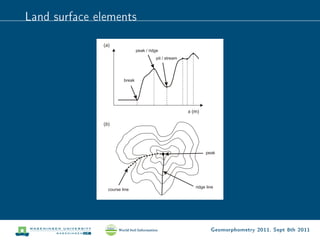
Land surface elements


                        Geomorphometry 2011, Sept 8th 2011
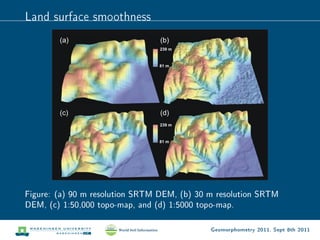
Land surface smoothness


Figure: (a) 90 m resolution SRTM DEM, (b) 30 m resolution SRTM
DEM, (c) 1:50,000 topo-map, and (d) 1:5000 topo-map.

                                             Geomorphometry 2011, Sept 8th 2011
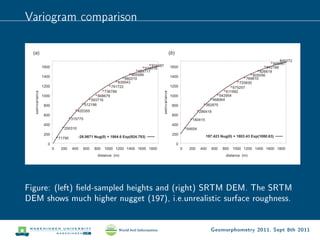
Variogram comparison


Figure: (left) eld-sampled heights and (right) SRTM DEM. The SRTM
DEM shows much higher nugget (197), i.e.unrealistic surface roughness.


                                                Geomorphometry 2011, Sept 8th 2011
Referent land surface model


                 The referent LSM

        can be produced using signicantly

           more accurate measurements
       (e.g. upscaled LiDAR measurements)


                                    Geomorphometry 2011, Sept 8th 2011
Statistical framework


Proposed framework for assessment of DEM accuracy:
    Accuracy of absolute elevations (absolute error);


                                           Geomorphometry 2011, Sept 8th 2011
Statistical framework


Proposed framework for assessment of DEM accuracy:
    Accuracy of absolute elevations (absolute error);
    Positional and attribute accuracy of hydrological
    features (streams, watersheds, landforms etc);


                                          Geomorphometry 2011, Sept 8th 2011
Statistical framework


Proposed framework for assessment of DEM accuracy:
    Accuracy of absolute elevations (absolute error);
    Positional and attribute accuracy of hydrological
    features (streams, watersheds, landforms etc);
    Accuracy of surface roughness (i.e. representation of the
    short-range variation);


                                           Geomorphometry 2011, Sept 8th 2011
Statistical framework


Proposed framework for assessment of DEM accuracy:
    Accuracy of absolute elevations (absolute error);
    Positional and attribute accuracy of hydrological
    features (streams, watersheds, landforms etc);
    Accuracy of surface roughness (i.e. representation of the
    short-range variation);
    User's satisfaction;


                                           Geomorphometry 2011, Sept 8th 2011
Absolute accuracy
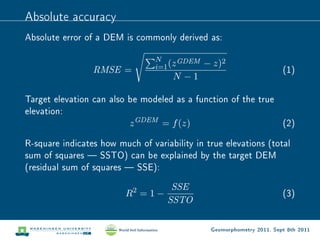
Absolute error of a DEM is commonly derived as:

                                 N      GDEM
                                 i=1 (z        − z)2
                 RMSE =                                                 (1)
                                     N −1

Target elevation can also be modeled as a function of the true
elevation:
                          z GDEM = f (z)                       (2)

R-square indicates how much of variability in true elevations (total
sum of squares  SSTO) can be explained by the target DEM
(residual sum of squares  SSE):

                                     SSE
                         R2 = 1 −                                       (3)
                                    SSTO

                                                Geomorphometry 2011, Sept 8th 2011
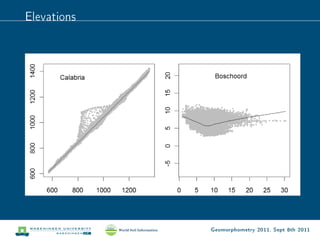
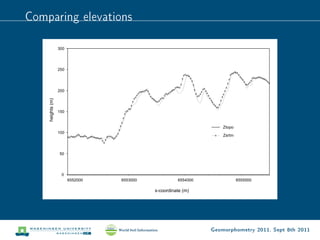
Comparing elevations


                       Geomorphometry 2011, Sept 8th 2011
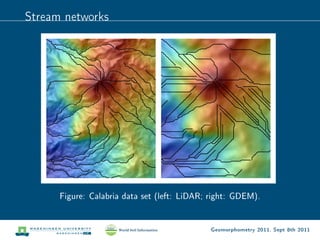
Hydrological features


Spatial accuracy of stream networks can be assessed by comparing
the buer distance maps for stream networks derived using the
same settings but dierent DEMs as inputs.
As with absolute elevations, the accuracy can be evaluated by
tting a regression model and then looking at R-square values and
statistical signicance for buer distance maps.


                                             Geomorphometry 2011, Sept 8th 2011
Surface roughness


Surface roughness is the local variation of values in a search radius.
There are many ideas on how to derive this parameter. Here, we
have decided to evaluate surface roughness using two standard
measures:
 1.   Dierence in the variogram parameters  especially in the
      range and nugget parameters  tted using (randomly)
      sampled elevation data. This is a global measure.
 2.   Dierence in the local variance derived using a 7Ö7
      search-window. This is a local measure.


                                                Geomorphometry 2011, Sept 8th 2011
Case studies


Four small case studies in areas of variable relief and forest canopy:
     Booschord (Netherlands),
     Calabria (Italy),
     Fishcamp (USA),
     Zlatibor (Serbia),
For each case study we have prepared a 30 m LiDAR DEM and
GDEM.


                                                Geomorphometry 2011, Sept 8th 2011
Software used

All processing has been implemented in the R+SAGA/FWTools
framework:
    R  v2.12 including a list of packages;
    Tinn-R v2.3 (code editor);
    SAGA GIS v2.0.7  a light GIS (not available under Mac
    OS!);
    FWTools v2.4  a list of utilities to handle spatial data;
    GRASS GIS v6.4.
The R script can be obtained at
http://geomorphometry.org/content/gdem-assessment


                                              Geomorphometry 2011, Sept 8th 2011
Example


 library(maptools); library(gstat); library(rgdal)
 # Download the datasets:
 data.url - http://geomorphometry.org/system/files/GDEM_assessment.zip
 download.file(data.url, destfile=GDEM_assessment.zip)
 unzip(GDEM_assessment.zip)
...
 str(grid.list[[j]]@data)
  'data.frame': 15000 obs. of 2 variables:
   $ zlatibor_LDEM: num 1010 1010 1008 1007 1005 ...
   $ zlatibor_GDEM: num 997 1000 1000 1000 998 ...


                                                 Geomorphometry 2011, Sept 8th 2011
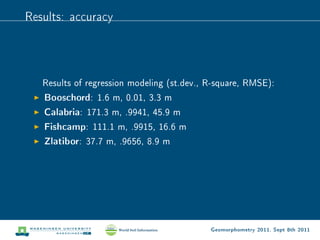
Results: accuracy


   Results of regression modeling (st.dev., R-square, RMSE):
   Booschord: 1.6 m, 0.01, 3.3 m
   Calabria: 171.3 m, .9941, 45.9 m
   Fishcamp: 111.1 m, .9915, 16.6 m
   Zlatibor: 37.7 m, .9656, 8.9 m


                                            Geomorphometry 2011, Sept 8th 2011
Elevations


             Geomorphometry 2011, Sept 8th 2011
Stream networks


      Figure: Calabria data set (left: LiDAR; right: GDEM).


                                             Geomorphometry 2011, Sept 8th 2011
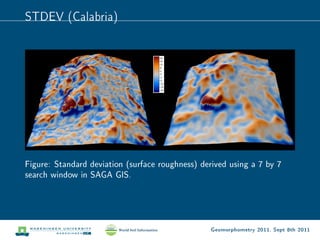
STDEV (Calabria)


Figure: Standard deviation (surface roughness) derived using a 7 by 7
search window in SAGA GIS.


                                                  Geomorphometry 2011, Sept 8th 2011
Variogram comparison (Calabria)


 vgm_LDEM.list[[2]]
      model        psill    range kappa
  1     Nug     75.14568    0.000 0.0
  2     Mat 150391.85522 2624.796 1.2
 vgm_GDEM.list[[2]]
      model        psill    range kappa
  1     Nug     18.55683    0.000 0.0
  2     Mat 199978.44320 3184.624 1.2


                                          Geomorphometry 2011, Sept 8th 2011
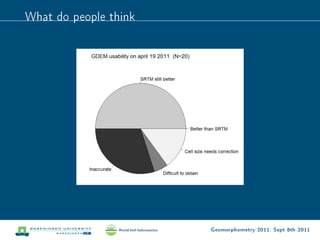
What do people think


                       Geomorphometry 2011, Sept 8th 2011
Conclusions

   An adjusted R-square of .995 could be used as the threshold
   level for a satisfactory t between LiDAR and GDEM (this
   R-square corresponds to RMSE of 10 m in an area of medium
   relief e.g. with st.dev. in elevations of about 50100 m).


                                          Geomorphometry 2011, Sept 8th 2011
Conclusions

   An adjusted R-square of .995 could be used as the threshold
   level for a satisfactory t between LiDAR and GDEM (this
   R-square corresponds to RMSE of 10 m in an area of medium
   relief e.g. with st.dev. in elevations of about 50100 m).
   GDEM is of little use in areas of low relief (sd  20 m).


                                             Geomorphometry 2011, Sept 8th 2011
Conclusions

   An adjusted R-square of .995 could be used as the threshold
   level for a satisfactory t between LiDAR and GDEM (this
   R-square corresponds to RMSE of 10 m in an area of medium
   relief e.g. with st.dev. in elevations of about 50100 m).
   GDEM is of little use in areas of low relief (sd  20 m).
   The eective resolution of GDEM is possibly 2-3 times coarser
   than the nominal resolution of 30 m.


                                             Geomorphometry 2011, Sept 8th 2011
Conclusions

   An adjusted R-square of .995 could be used as the threshold
   level for a satisfactory t between LiDAR and GDEM (this
   R-square corresponds to RMSE of 10 m in an area of medium
   relief e.g. with st.dev. in elevations of about 50100 m).
   GDEM is of little use in areas of low relief (sd  20 m).
   The eective resolution of GDEM is possibly 2-3 times coarser
   than the nominal resolution of 30 m.
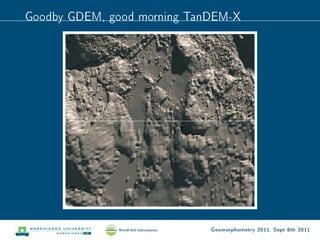
   By visually comparing DEMs for the four case studies, one can
   notice that GDEM often carries some articial lines and
   ghost-like features.


                                             Geomorphometry 2011, Sept 8th 2011
Conclusions

   An adjusted R-square of .995 could be used as the threshold
   level for a satisfactory t between LiDAR and GDEM (this
   R-square corresponds to RMSE of 10 m in an area of medium
   relief e.g. with st.dev. in elevations of about 50100 m).
   GDEM is of little use in areas of low relief (sd  20 m).
   The eective resolution of GDEM is possibly 2-3 times coarser
   than the nominal resolution of 30 m.
   By visually comparing DEMs for the four case studies, one can
   notice that GDEM often carries some articial lines and
   ghost-like features.
   Analysis of the short-range variability helps determine eective
   grid cell size that more closely matches the true surface
   roughness.


                                             Geomorphometry 2011, Sept 8th 2011
Goodby GDEM, good morning TanDEM-X


                             Geomorphometry 2011, Sept 8th 2011

A statistical assessment of GDEM using LiDAR data

  • 1.
    How accurate (andusable) is GDEM? (A statistical assessment of GDEM using LiDAR data) Tomislav Hengl & Hannes I. Reuter ISRIC World Soil Information, Wageningen University Geomorphometry 2011, Sept 8th 2011
  • 2.
    GDEM v1.01 Global 30 m DEM created by stereo-correlating the 1.3 million-scene ASTER archive of optical images; Produced jointly by METI (Japan) and NASA; Covering almost 98% of Earth's land surface; Version 1 publicly released on June 29th 2009; 1 http://www.gdem.aster.ersdac.or.jp Geomorphometry 2011, Sept 8th 2011
  • 3.
    Research question How to assess accuracy of a gridded elevation product (DEM)? (which aspects to look at? how to test them?) Geomorphometry 2011, Sept 8th 2011
  • 4.
    Connected work I Guth, P.L., 2010. Geomorphometric comparison of ASTER DEM and SRTM . Join Symposium of ISPRS Technical Commission IV, Orlando, FL, p. 10. Hayakawa, Y.S., T. Oguchi and Z. Lin. 2008. Comparison of new and existing global digital elevation models: ASTER G-DEM and SRTM-3 . Geophys. Res. Lett., 35(17), L17404. Hirt, C., Filmer, M.S., Featherstone, W.E., 2010. Comparison and validation of the recent freely available ASTER-GDEM ver1, SRTM ver4.1 and GEODATA DEM-9S ver3 digital elevation models over Australia . Australian Journal of Earth Sciences, 57(3): 337347. Geomorphometry 2011, Sept 8th 2011
  • 5.
    Connected work II Reuter, H.I. and Nelson, A. and Strobl, P. and Mehl, W. and Jarvis, A. 2009. A rst assessment of Aster GDEM tiles for absolute accuracy, relative accuracy and terrain parameters . Geoscience and Remote Sensing Symposium, 2009 IEEE International, IGARSS 2009, Vol 5., p. 240. Toutin, T. 2008. ASTER DEMs for geomatic and geoscientic applications: a review . Int. J. Remote Sens., 29(7), 18551875. Geomorphometry 2011, Sept 8th 2011
  • 6.
    Land surface elements Geomorphometry 2011, Sept 8th 2011
  • 7.
    Land surface smoothness Figure:(a) 90 m resolution SRTM DEM, (b) 30 m resolution SRTM DEM, (c) 1:50,000 topo-map, and (d) 1:5000 topo-map. Geomorphometry 2011, Sept 8th 2011
  • 8.
    Variogram comparison Figure: (left)eld-sampled heights and (right) SRTM DEM. The SRTM DEM shows much higher nugget (197), i.e.unrealistic surface roughness. Geomorphometry 2011, Sept 8th 2011
  • 9.
    Referent land surfacemodel The referent LSM can be produced using signicantly more accurate measurements (e.g. upscaled LiDAR measurements) Geomorphometry 2011, Sept 8th 2011
  • 10.
    Statistical framework Proposed frameworkfor assessment of DEM accuracy: Accuracy of absolute elevations (absolute error); Geomorphometry 2011, Sept 8th 2011
  • 11.
    Statistical framework Proposed frameworkfor assessment of DEM accuracy: Accuracy of absolute elevations (absolute error); Positional and attribute accuracy of hydrological features (streams, watersheds, landforms etc); Geomorphometry 2011, Sept 8th 2011
  • 12.
    Statistical framework Proposed frameworkfor assessment of DEM accuracy: Accuracy of absolute elevations (absolute error); Positional and attribute accuracy of hydrological features (streams, watersheds, landforms etc); Accuracy of surface roughness (i.e. representation of the short-range variation); Geomorphometry 2011, Sept 8th 2011
  • 13.
    Statistical framework Proposed frameworkfor assessment of DEM accuracy: Accuracy of absolute elevations (absolute error); Positional and attribute accuracy of hydrological features (streams, watersheds, landforms etc); Accuracy of surface roughness (i.e. representation of the short-range variation); User's satisfaction; Geomorphometry 2011, Sept 8th 2011
  • 14.
    Absolute accuracy Absolute errorof a DEM is commonly derived as: N GDEM i=1 (z − z)2 RMSE = (1) N −1 Target elevation can also be modeled as a function of the true elevation: z GDEM = f (z) (2) R-square indicates how much of variability in true elevations (total sum of squares SSTO) can be explained by the target DEM (residual sum of squares SSE): SSE R2 = 1 − (3) SSTO Geomorphometry 2011, Sept 8th 2011
  • 15.
    Comparing elevations Geomorphometry 2011, Sept 8th 2011
  • 16.
    Hydrological features Spatial accuracyof stream networks can be assessed by comparing the buer distance maps for stream networks derived using the same settings but dierent DEMs as inputs. As with absolute elevations, the accuracy can be evaluated by tting a regression model and then looking at R-square values and statistical signicance for buer distance maps. Geomorphometry 2011, Sept 8th 2011
  • 17.
    Surface roughness Surface roughnessis the local variation of values in a search radius. There are many ideas on how to derive this parameter. Here, we have decided to evaluate surface roughness using two standard measures: 1. Dierence in the variogram parameters especially in the range and nugget parameters tted using (randomly) sampled elevation data. This is a global measure. 2. Dierence in the local variance derived using a 7Ö7 search-window. This is a local measure. Geomorphometry 2011, Sept 8th 2011
  • 18.
    Case studies Four smallcase studies in areas of variable relief and forest canopy: Booschord (Netherlands), Calabria (Italy), Fishcamp (USA), Zlatibor (Serbia), For each case study we have prepared a 30 m LiDAR DEM and GDEM. Geomorphometry 2011, Sept 8th 2011
  • 19.
    Software used All processinghas been implemented in the R+SAGA/FWTools framework: R v2.12 including a list of packages; Tinn-R v2.3 (code editor); SAGA GIS v2.0.7 a light GIS (not available under Mac OS!); FWTools v2.4 a list of utilities to handle spatial data; GRASS GIS v6.4. The R script can be obtained at http://geomorphometry.org/content/gdem-assessment Geomorphometry 2011, Sept 8th 2011
  • 20.
    Example library(maptools); library(gstat);library(rgdal) # Download the datasets: data.url - http://geomorphometry.org/system/files/GDEM_assessment.zip download.file(data.url, destfile=GDEM_assessment.zip) unzip(GDEM_assessment.zip) ... str(grid.list[[j]]@data) 'data.frame': 15000 obs. of 2 variables: $ zlatibor_LDEM: num 1010 1010 1008 1007 1005 ... $ zlatibor_GDEM: num 997 1000 1000 1000 998 ... Geomorphometry 2011, Sept 8th 2011
  • 21.
    Results: accuracy Results of regression modeling (st.dev., R-square, RMSE): Booschord: 1.6 m, 0.01, 3.3 m Calabria: 171.3 m, .9941, 45.9 m Fishcamp: 111.1 m, .9915, 16.6 m Zlatibor: 37.7 m, .9656, 8.9 m Geomorphometry 2011, Sept 8th 2011
  • 22.
    Elevations Geomorphometry 2011, Sept 8th 2011
  • 23.
    Stream networks Figure: Calabria data set (left: LiDAR; right: GDEM). Geomorphometry 2011, Sept 8th 2011
  • 24.
    STDEV (Calabria) Figure: Standarddeviation (surface roughness) derived using a 7 by 7 search window in SAGA GIS. Geomorphometry 2011, Sept 8th 2011
  • 25.
    Variogram comparison (Calabria) vgm_LDEM.list[[2]] model psill range kappa 1 Nug 75.14568 0.000 0.0 2 Mat 150391.85522 2624.796 1.2 vgm_GDEM.list[[2]] model psill range kappa 1 Nug 18.55683 0.000 0.0 2 Mat 199978.44320 3184.624 1.2 Geomorphometry 2011, Sept 8th 2011
  • 26.
    What do peoplethink Geomorphometry 2011, Sept 8th 2011
  • 27.
    Conclusions An adjusted R-square of .995 could be used as the threshold level for a satisfactory t between LiDAR and GDEM (this R-square corresponds to RMSE of 10 m in an area of medium relief e.g. with st.dev. in elevations of about 50100 m). Geomorphometry 2011, Sept 8th 2011
  • 28.
    Conclusions An adjusted R-square of .995 could be used as the threshold level for a satisfactory t between LiDAR and GDEM (this R-square corresponds to RMSE of 10 m in an area of medium relief e.g. with st.dev. in elevations of about 50100 m). GDEM is of little use in areas of low relief (sd 20 m). Geomorphometry 2011, Sept 8th 2011
  • 29.
    Conclusions An adjusted R-square of .995 could be used as the threshold level for a satisfactory t between LiDAR and GDEM (this R-square corresponds to RMSE of 10 m in an area of medium relief e.g. with st.dev. in elevations of about 50100 m). GDEM is of little use in areas of low relief (sd 20 m). The eective resolution of GDEM is possibly 2-3 times coarser than the nominal resolution of 30 m. Geomorphometry 2011, Sept 8th 2011
  • 30.
    Conclusions An adjusted R-square of .995 could be used as the threshold level for a satisfactory t between LiDAR and GDEM (this R-square corresponds to RMSE of 10 m in an area of medium relief e.g. with st.dev. in elevations of about 50100 m). GDEM is of little use in areas of low relief (sd 20 m). The eective resolution of GDEM is possibly 2-3 times coarser than the nominal resolution of 30 m. By visually comparing DEMs for the four case studies, one can notice that GDEM often carries some articial lines and ghost-like features. Geomorphometry 2011, Sept 8th 2011
  • 31.
    Conclusions An adjusted R-square of .995 could be used as the threshold level for a satisfactory t between LiDAR and GDEM (this R-square corresponds to RMSE of 10 m in an area of medium relief e.g. with st.dev. in elevations of about 50100 m). GDEM is of little use in areas of low relief (sd 20 m). The eective resolution of GDEM is possibly 2-3 times coarser than the nominal resolution of 30 m. By visually comparing DEMs for the four case studies, one can notice that GDEM often carries some articial lines and ghost-like features. Analysis of the short-range variability helps determine eective grid cell size that more closely matches the true surface roughness. Geomorphometry 2011, Sept 8th 2011
  • 32.
    Goodby GDEM, goodmorning TanDEM-X Geomorphometry 2011, Sept 8th 2011