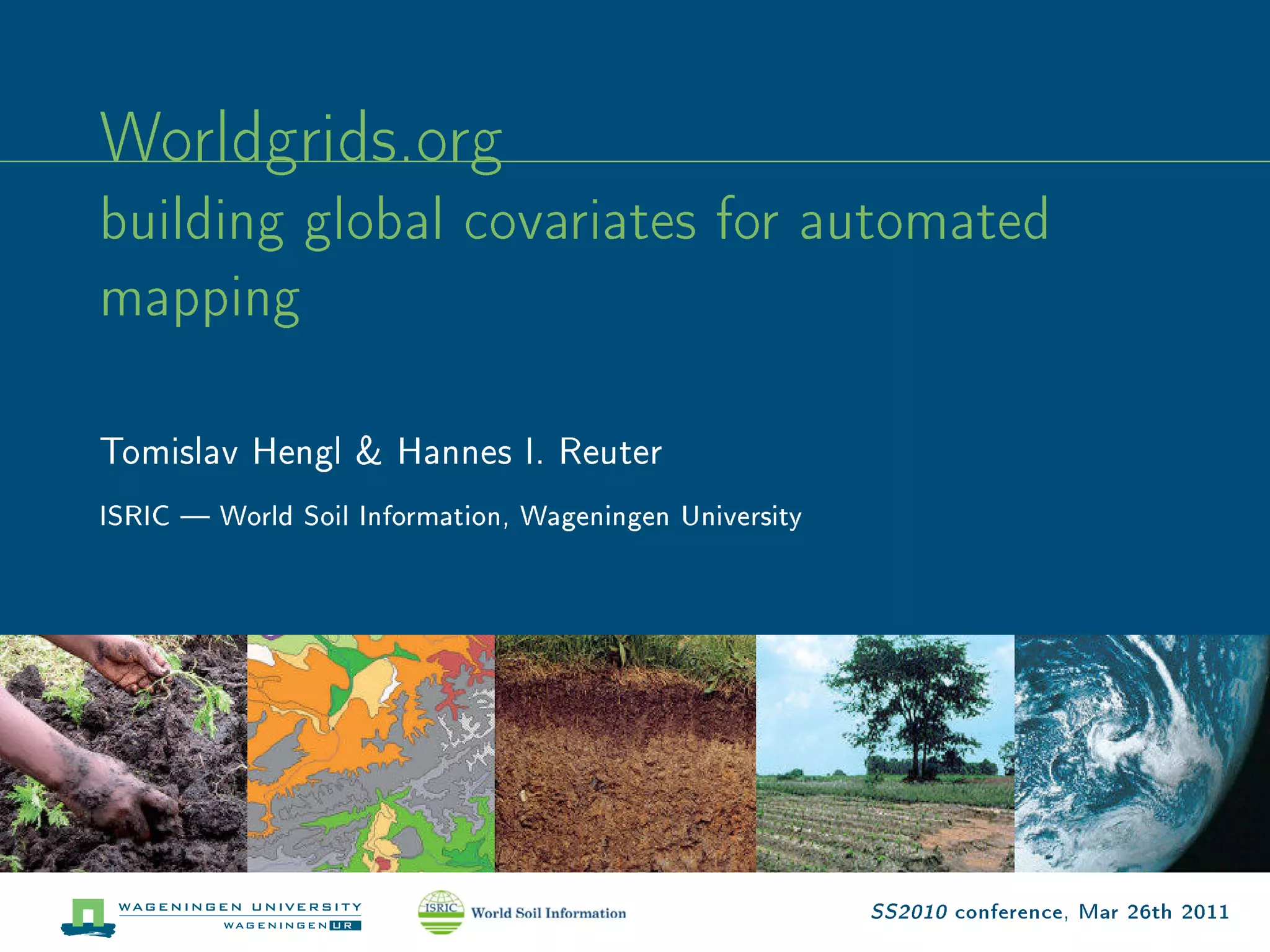
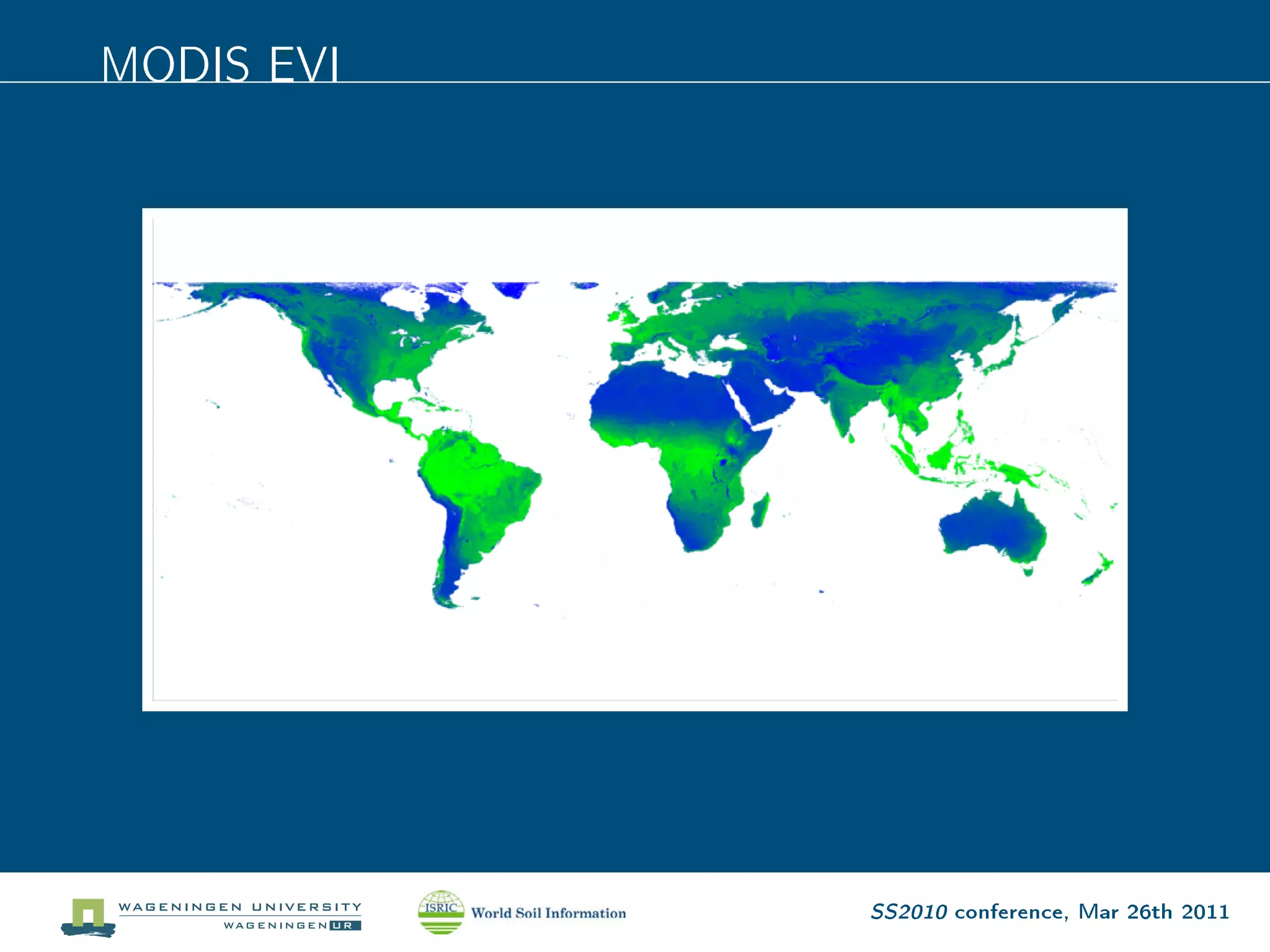
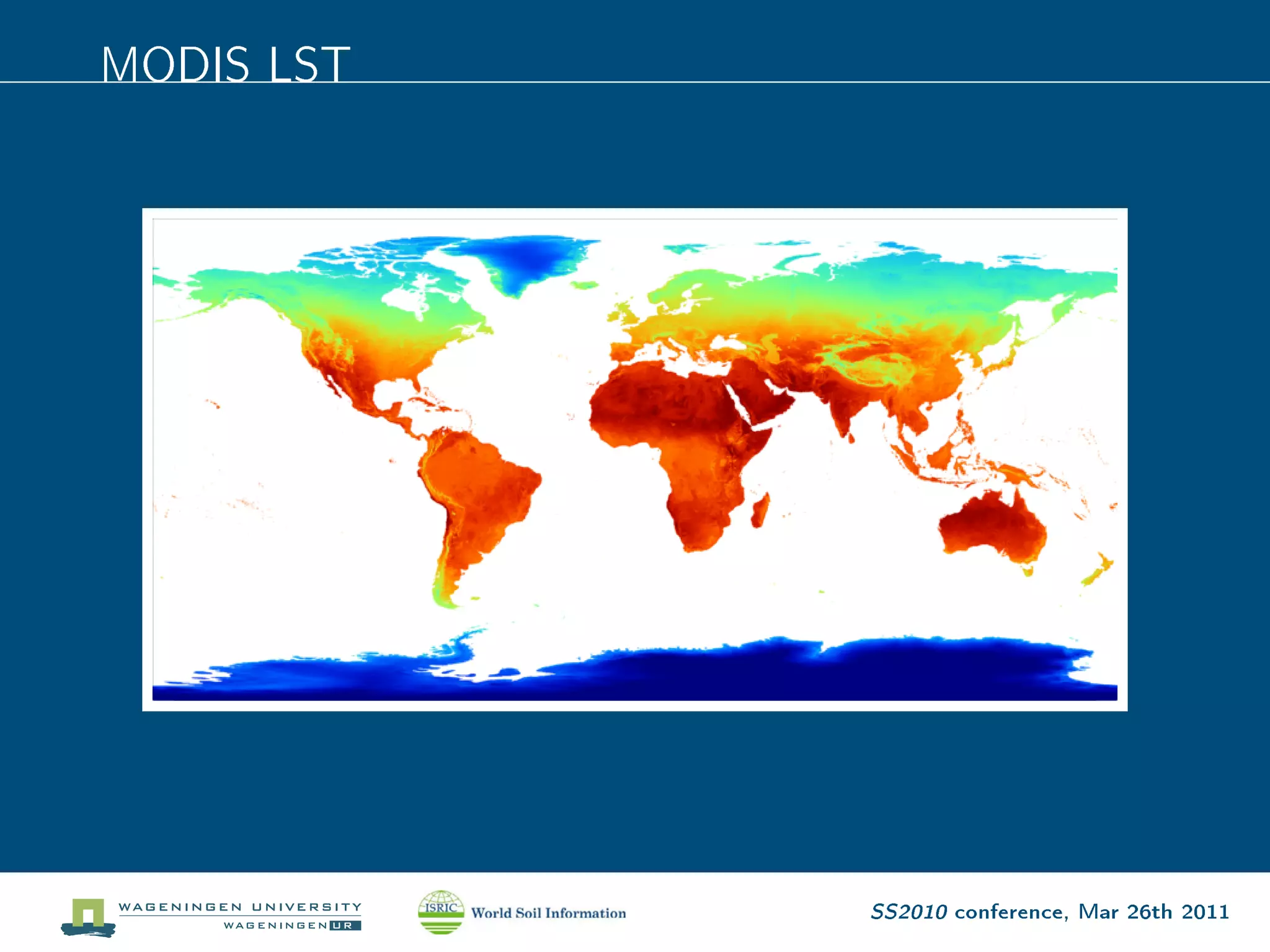
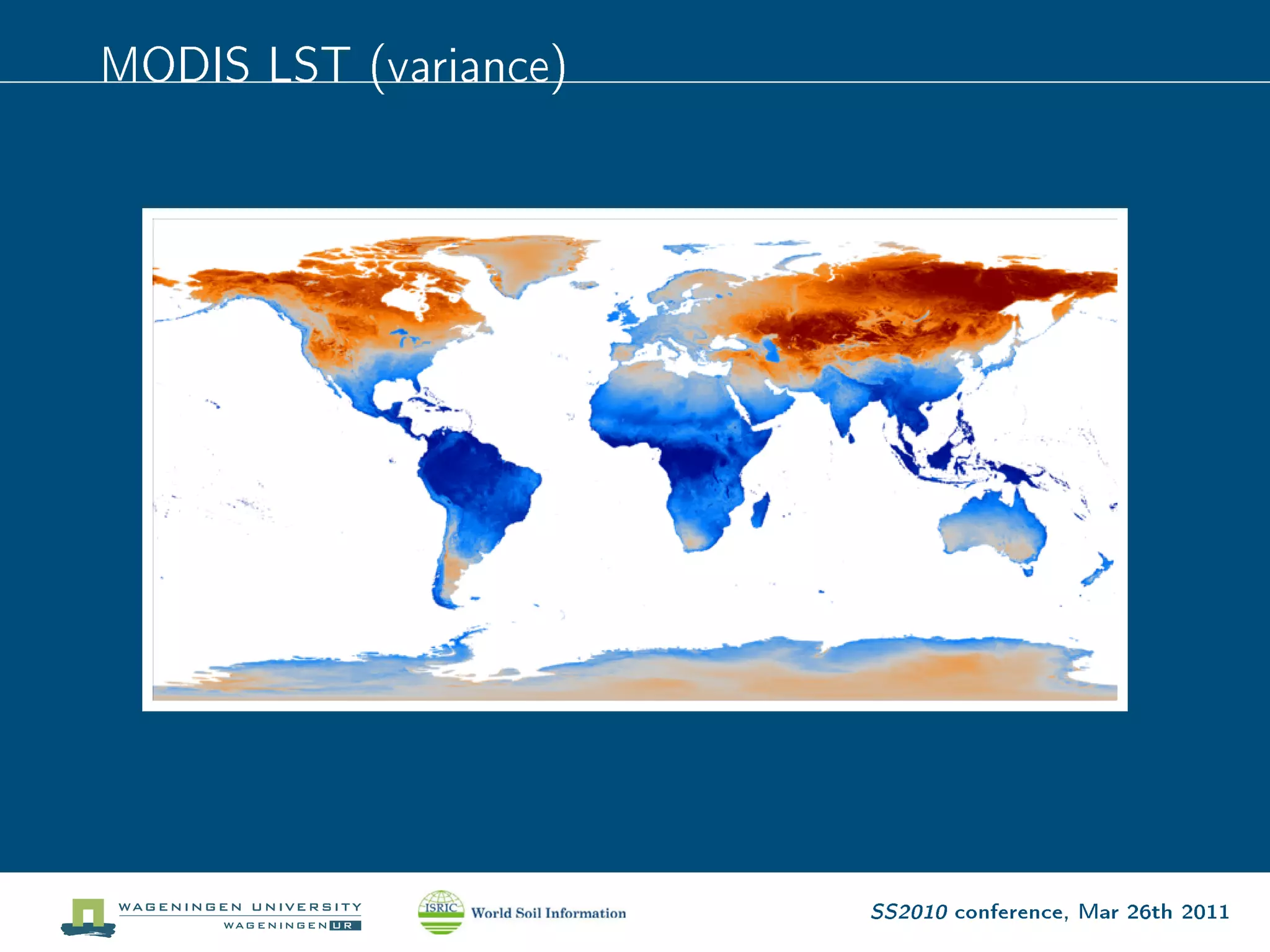
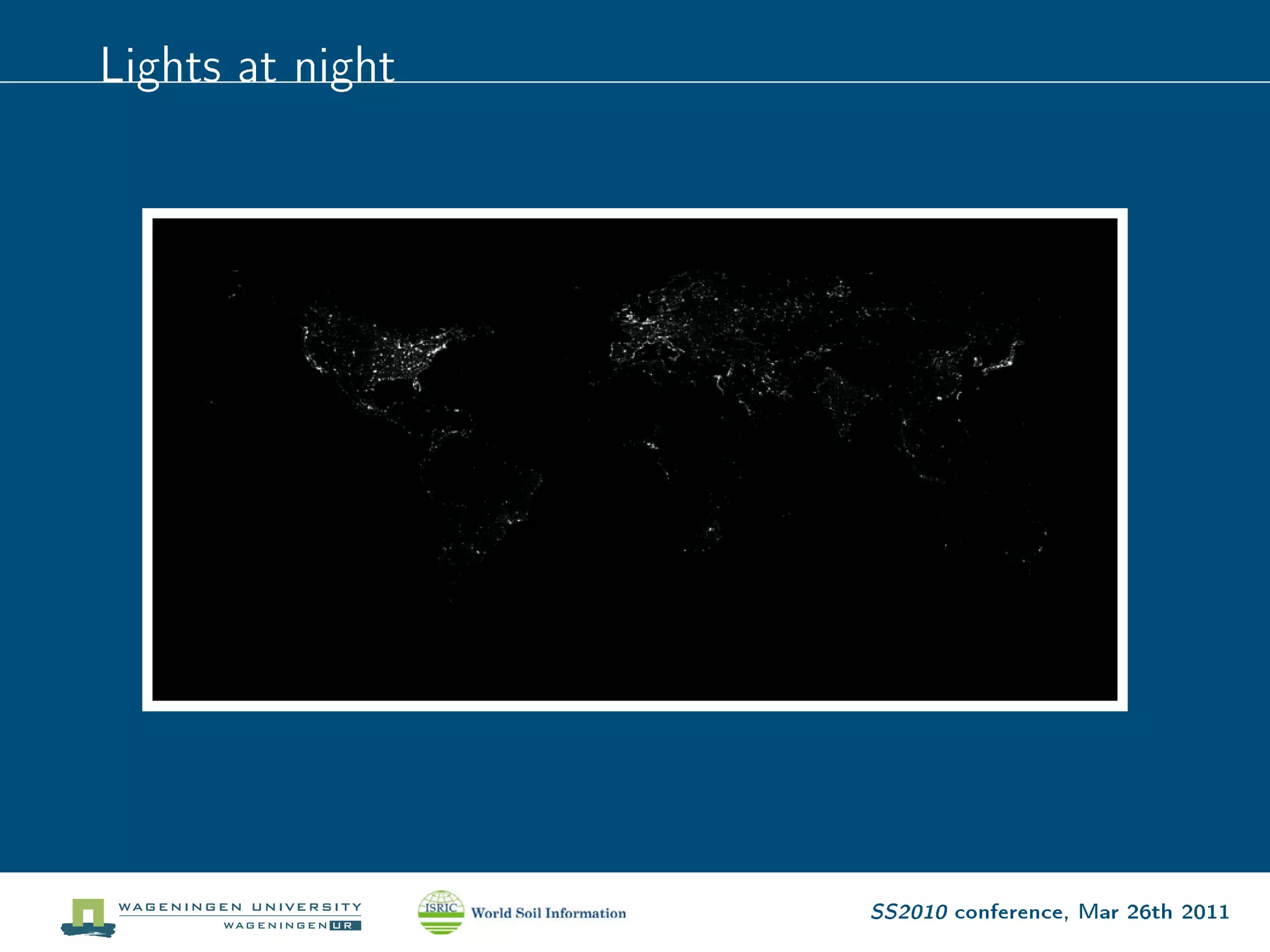
Worldgrids.org
building global covariates for automated
mapping

Tomislav Hengl & Hannes I. Reuter
ISRIC  World Soil Information, Wageningen University


                                                        SS2010 conference, Mar 26th 2011
About ISRIC


   ISRIC  World Soil Information.


                                     SS2010 conference, Mar 26th 2011
About ISRIC


   ISRIC  World Soil Information.

   ISRIC = International Soil Reference Information Center.


                                          SS2010 conference, Mar 26th 2011
About ISRIC


   ISRIC  World Soil Information.

   ISRIC = International Soil Reference Information Center.

   Non-prot organization / aliated to Wageningen University

   and Research.


                                            SS2010 conference, Mar 26th 2011
About ISRIC


   ISRIC  World Soil Information.

   ISRIC = International Soil Reference Information Center.

   Non-prot organization / aliated to Wageningen University

   and Research.

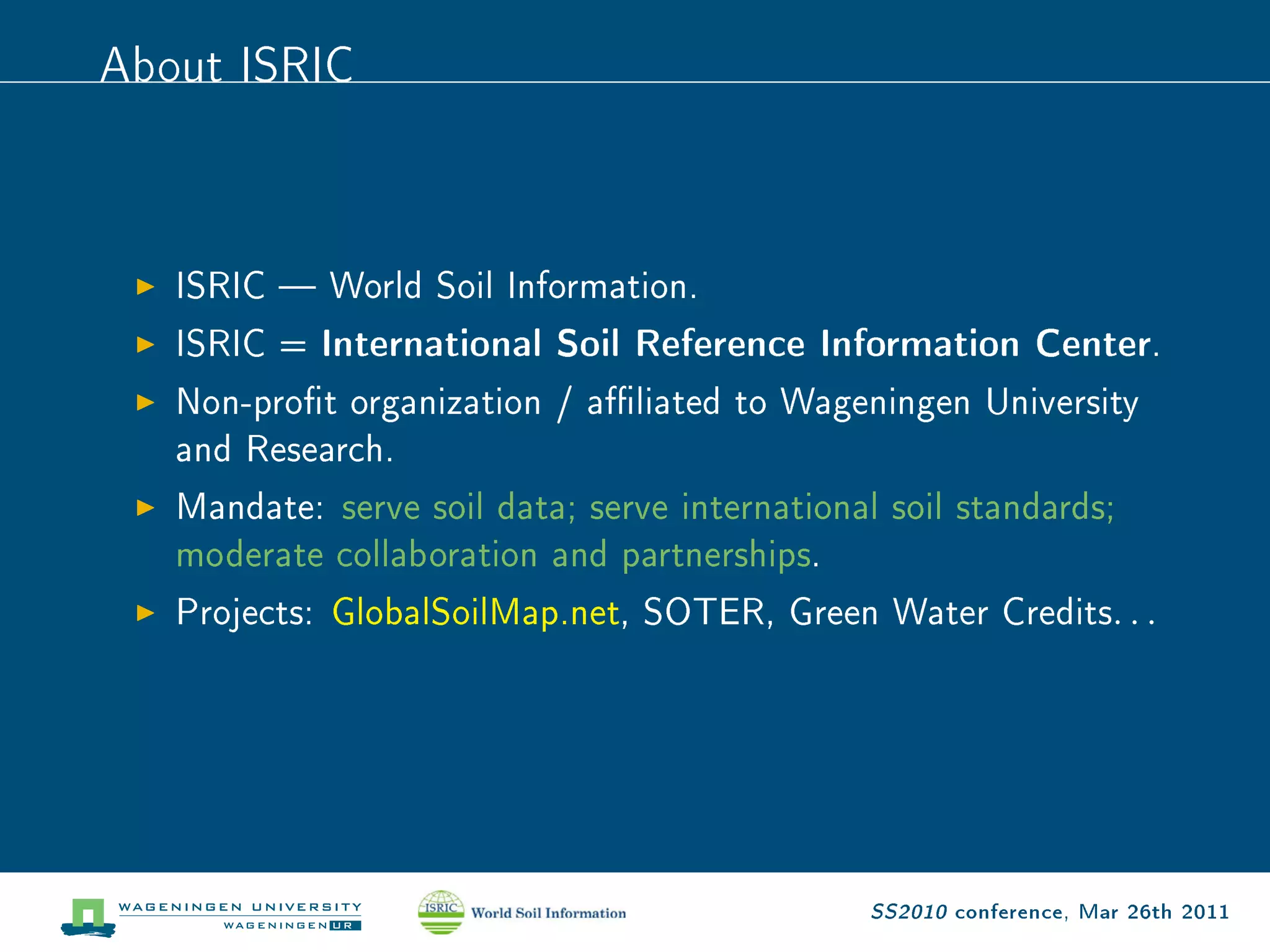
   Mandate: serve soil data; serve international soil standards;

   moderate collaboration and partnerships.


                                                SS2010 conference, Mar 26th 2011
About ISRIC


   ISRIC  World Soil Information.

   ISRIC = International Soil Reference Information Center.

   Non-prot organization / aliated to Wageningen University

   and Research.

   Mandate: serve soil data; serve international soil standards;

   moderate collaboration and partnerships.

   Projects: GlobalSoilMap.net, SOTER, Green Water Credits           ...


                                                SS2010 conference, Mar 26th 2011
This talk


   Global repository of publicly available data (worldgrids.org).
   A global multiscale approach to geostat mapping.
   Some examples: Malawi.
   Upcoming activities.


                                                SS2010 conference, Mar 26th 2011
Main thesis


       Global (multiscale) modeling is now!


                                    SS2010 conference, Mar 26th 2011
Analysis objectives


For Diggle and Ribeiro (2007) there are three scientic objectives
of geostatistics:
  1. model estimation, i.e.inference about the model parameters;
  2. prediction, i.e.inference about the unobserved values of the
     target variable;
  3. hypothesis testing;


                                                SS2010 conference, Mar 26th 2011
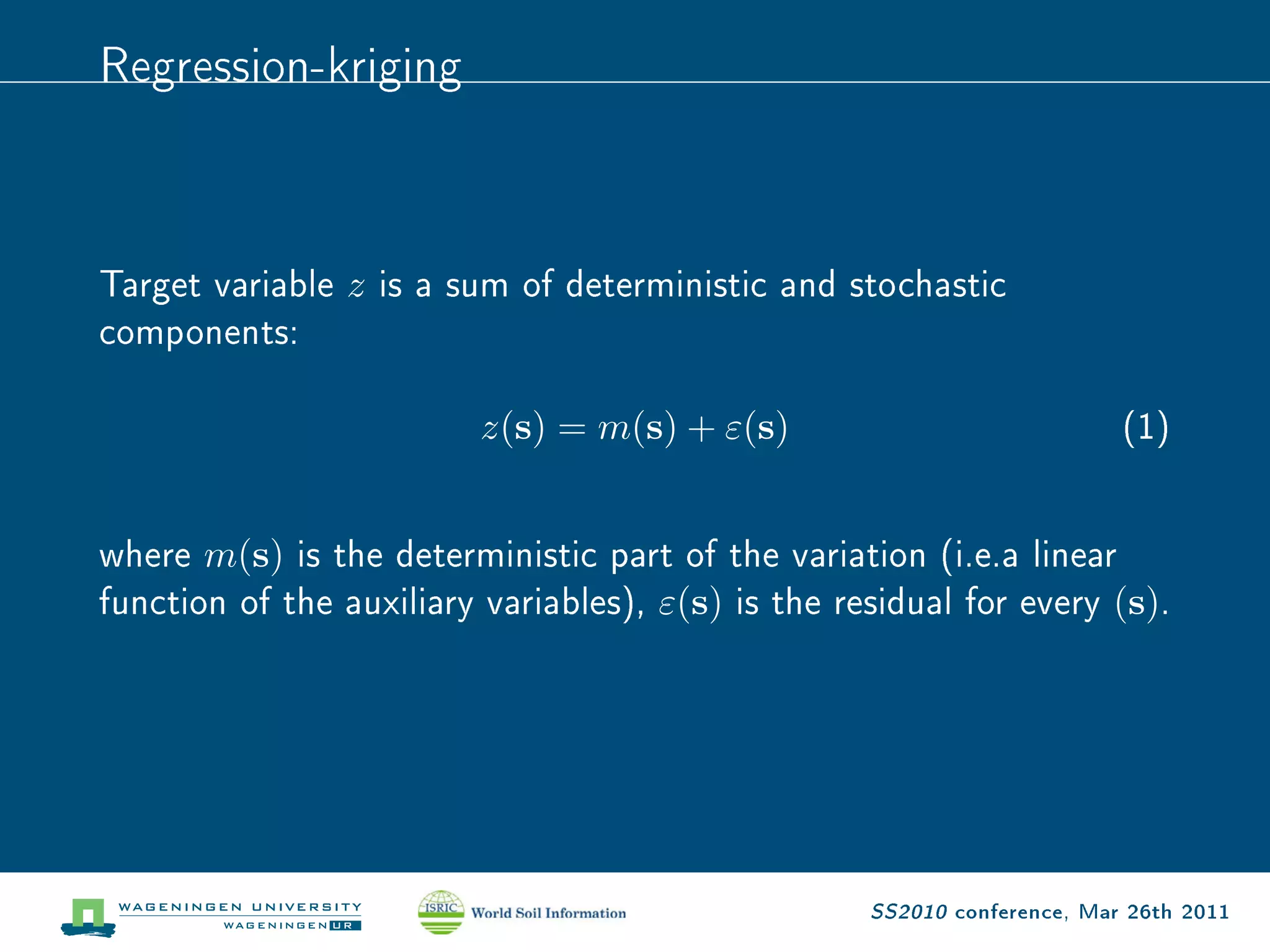
Regression-kriging


Target variable z is a sum of deterministic and stochastic
components:
                         z(s) = m(s) + ε(s)                               (1)

where m(s) is the deterministic part of the variation (i.e.a linear
function of the auxiliary variables), ε(s) is the residual for every (s).


                                                    SS2010 conference, Mar 26th 2011
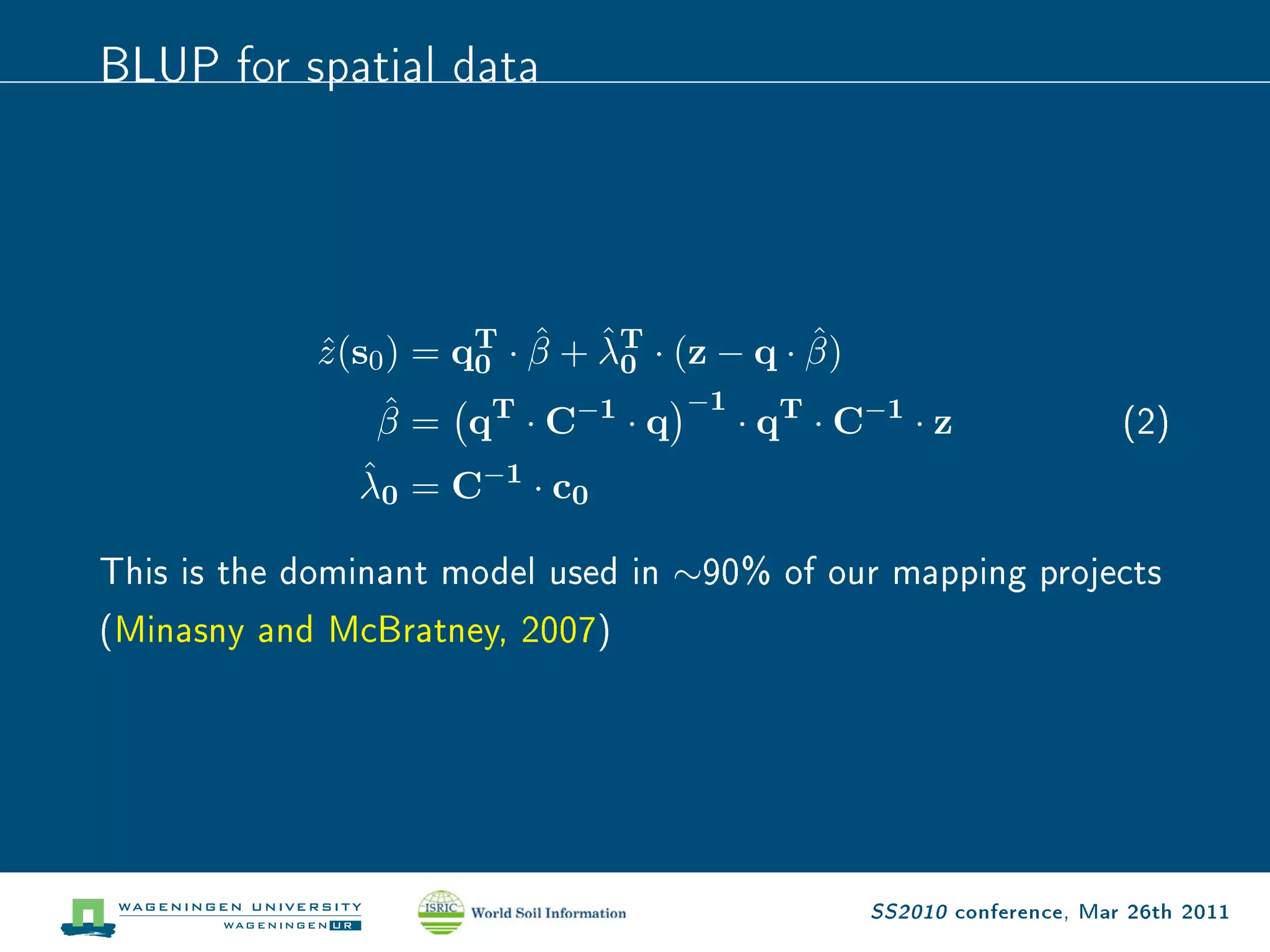
BLUP for spatial data


                            ˆ ˆ               ˆ
             z (s0 ) = qT · β + λT · (z − q · β)
             ˆ          0        0
                 ˆ                   −1
                β = qT · C−1 · q          · qT · C−1 · z                 (2)
               ˆ
               λ0 = C−1 · c0

This is the dominant model used in   ∼90%    of our mapping projects
(Minasny and McBratney, 2007)


                                                   SS2010 conference, Mar 26th 2011
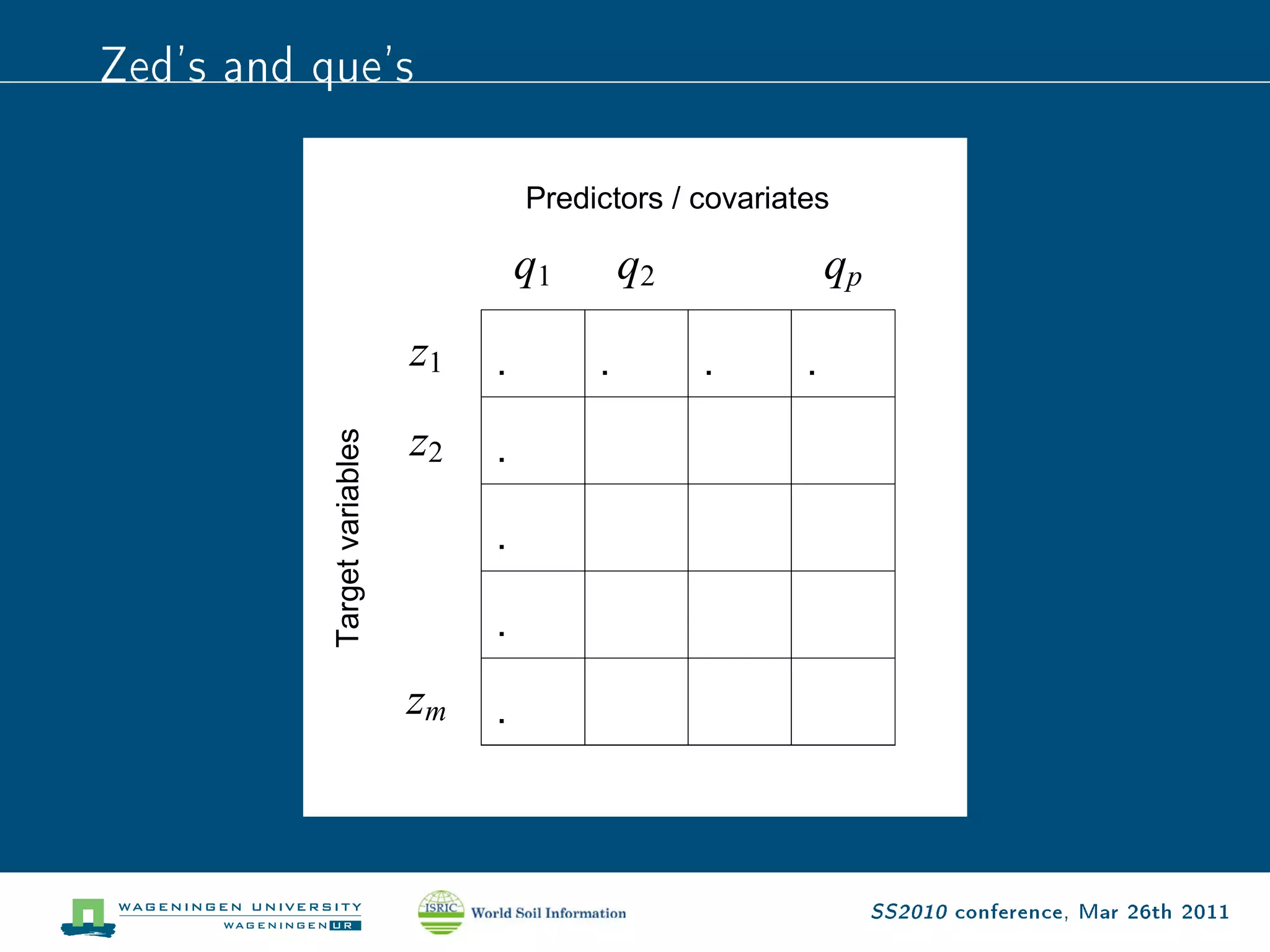
Zed's and que's


                  SS2010 conference, Mar 26th 2011
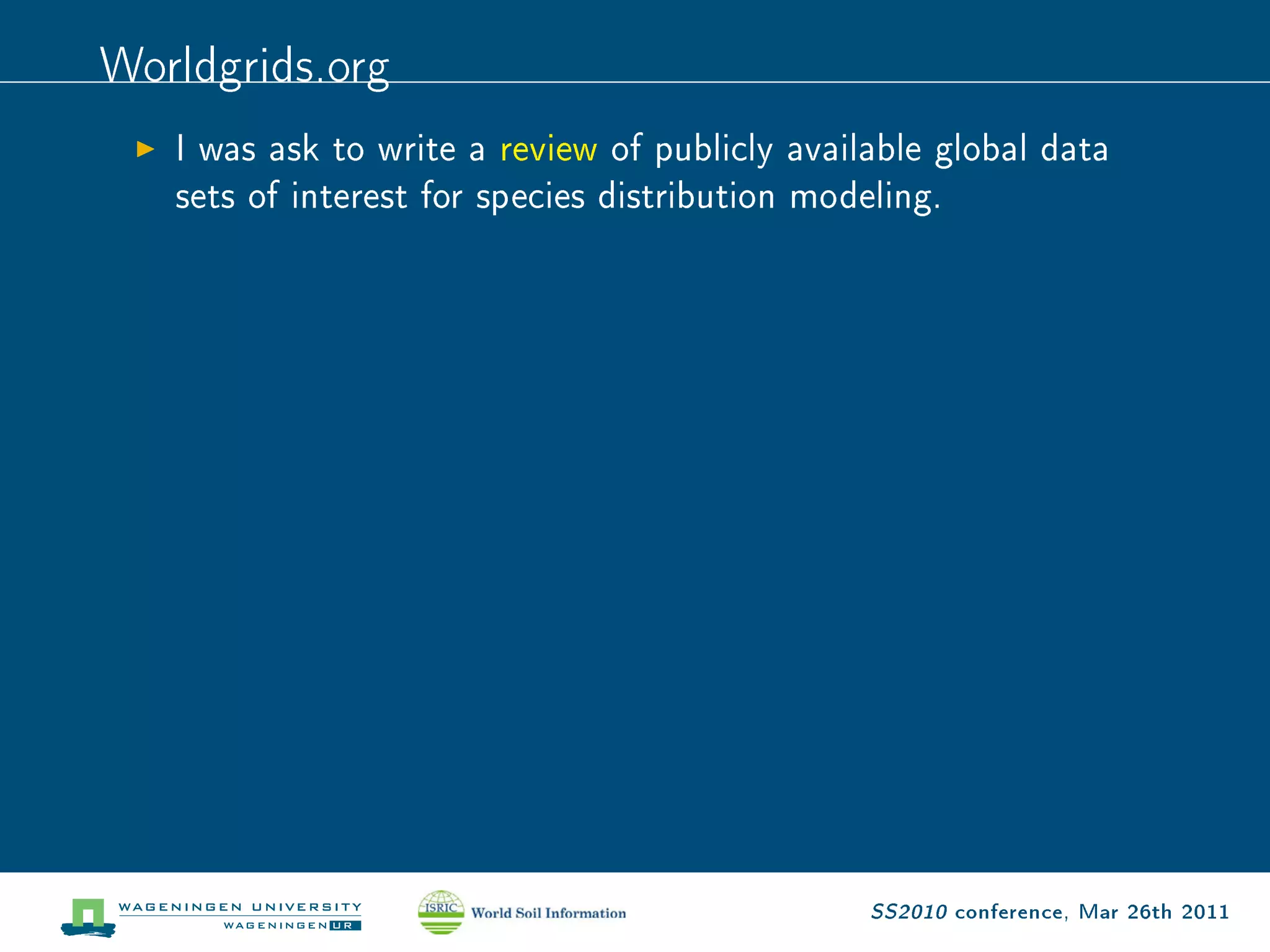
Worldgrids.org
   I was ask to write a review of publicly available global data

   sets of interest for species distribution modeling.


                                                 SS2010 conference, Mar 26th 2011
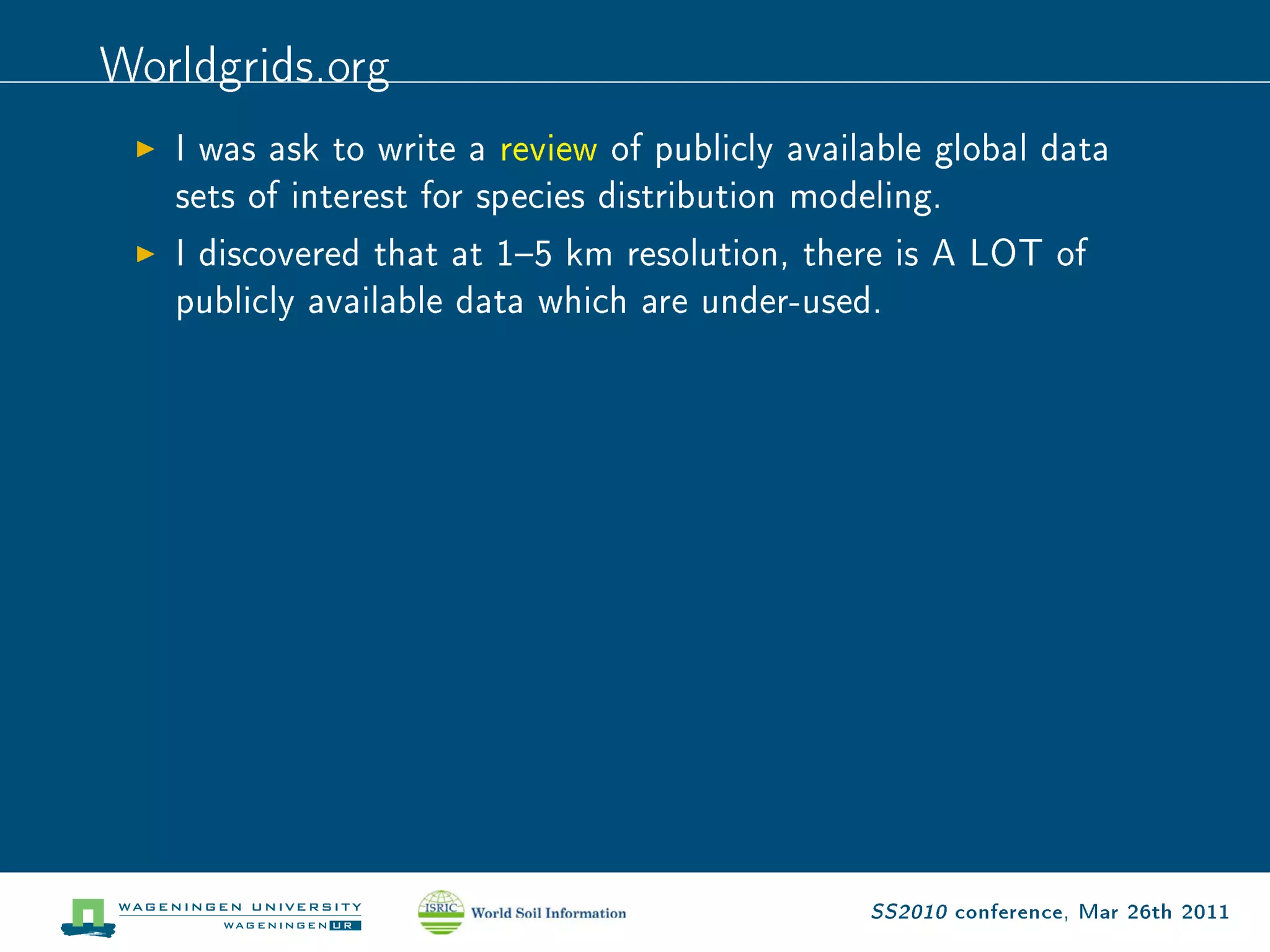
Worldgrids.org
   I was ask to write a review of publicly available global data

   sets of interest for species distribution modeling.

   I discovered that at 15 km resolution, there is A LOT of

   publicly available data which are under-used.


                                                 SS2010 conference, Mar 26th 2011
Worldgrids.org
   I was ask to write a review of publicly available global data

   sets of interest for species distribution modeling.

   I discovered that at 15 km resolution, there is A LOT of

   publicly available data which are under-used.

   The original images need to be processed before you can use

   them as global covariates.


                                                 SS2010 conference, Mar 26th 2011
Worldgrids.org
   I was ask to write a review of publicly available global data

   sets of interest for species distribution modeling.

   I discovered that at 15 km resolution, there is A LOT of

   publicly available data which are under-used.

   The original images need to be processed before you can use

   them as global covariates.

   Produce grids   →   prepare data for upload   →   geo-serve it.


                                                 SS2010 conference, Mar 26th 2011
Worldgrids.org
   I was ask to write a review of publicly available global data

   sets of interest for species distribution modeling.

   I discovered that at 15 km resolution, there is A LOT of

   publicly available data which are under-used.

   The original images need to be processed before you can use

   them as global covariates.

   Produce grids   →   prepare data for upload   →   geo-serve it.

   The result is a repository with cca 100 unique rasters, that can

   be obtained directly from

   http://spatial-analyst.net/worldmaps/.


                                                 SS2010 conference, Mar 26th 2011
Worldgrids.org
   I was ask to write a review of publicly available global data

   sets of interest for species distribution modeling.

   I discovered that at 15 km resolution, there is A LOT of

   publicly available data which are under-used.

   The original images need to be processed before you can use

   them as global covariates.

   Produce grids   →   prepare data for upload   →   geo-serve it.

   The result is a repository with cca 100 unique rasters, that can

   be obtained directly from

   http://spatial-analyst.net/worldmaps/.
   Each gridded map consists of 7200 columns and 3600 rows;

   the cell size is 0.05 arcdegrees, which corresponds to about

   5.6 km; all maps fall on the same grid.


                                                 SS2010 conference, Mar 26th 2011
Worldgrids.org
   I was ask to write a review of publicly available global data

   sets of interest for species distribution modeling.

   I discovered that at 15 km resolution, there is A LOT of

   publicly available data which are under-used.

   The original images need to be processed before you can use

   them as global covariates.

   Produce grids   →   prepare data for upload   →   geo-serve it.

   The result is a repository with cca 100 unique rasters, that can

   be obtained directly from

   http://spatial-analyst.net/worldmaps/.
   Each gridded map consists of 7200 columns and 3600 rows;

   the cell size is 0.05 arcdegrees, which corresponds to about

   5.6 km; all maps fall on the same grid.

   PS: I also have a lot of data at 1 km.


                                                 SS2010 conference, Mar 26th 2011
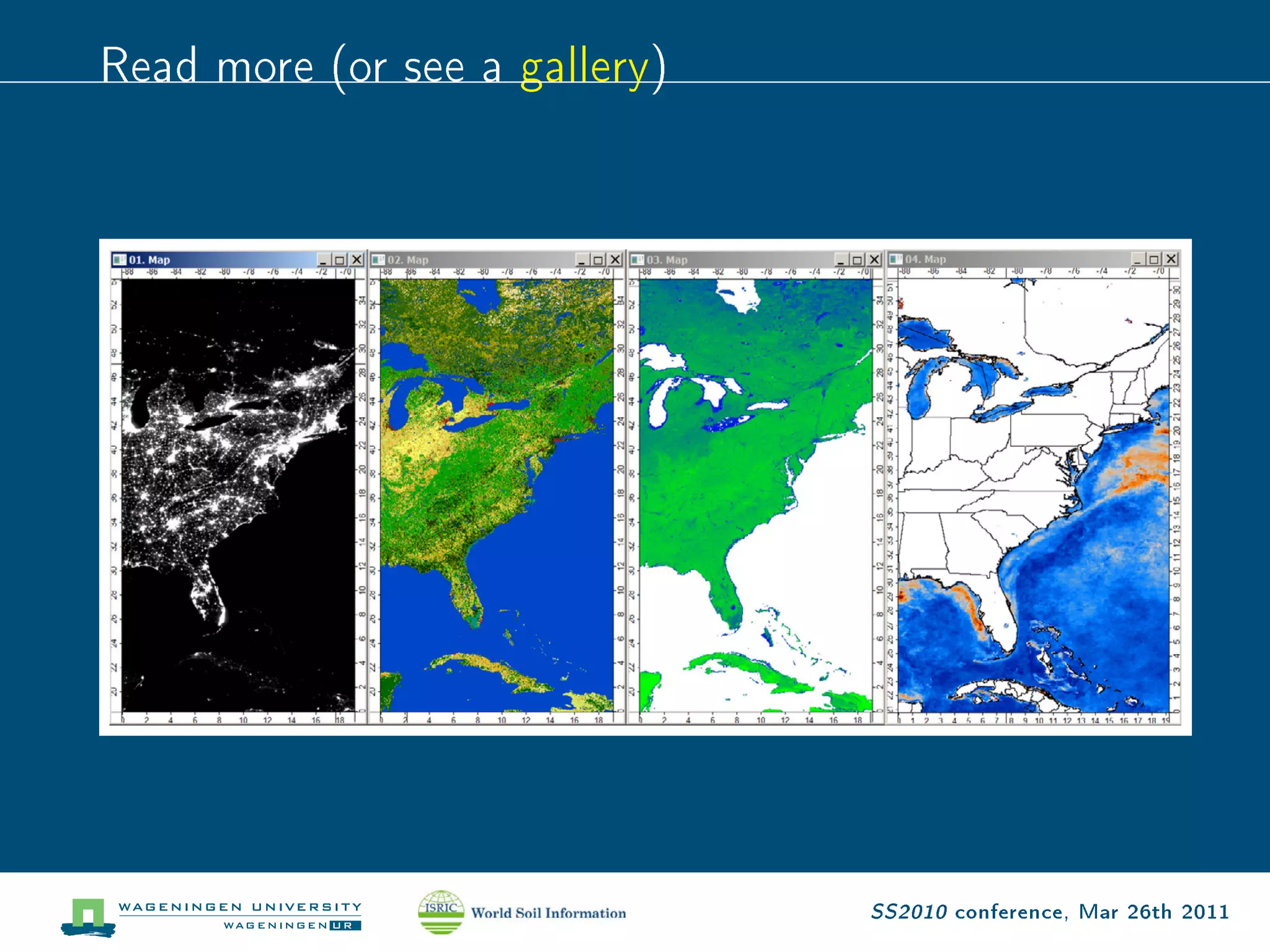
Read more (or see a gallery)


                               SS2010 conference, Mar 26th 2011
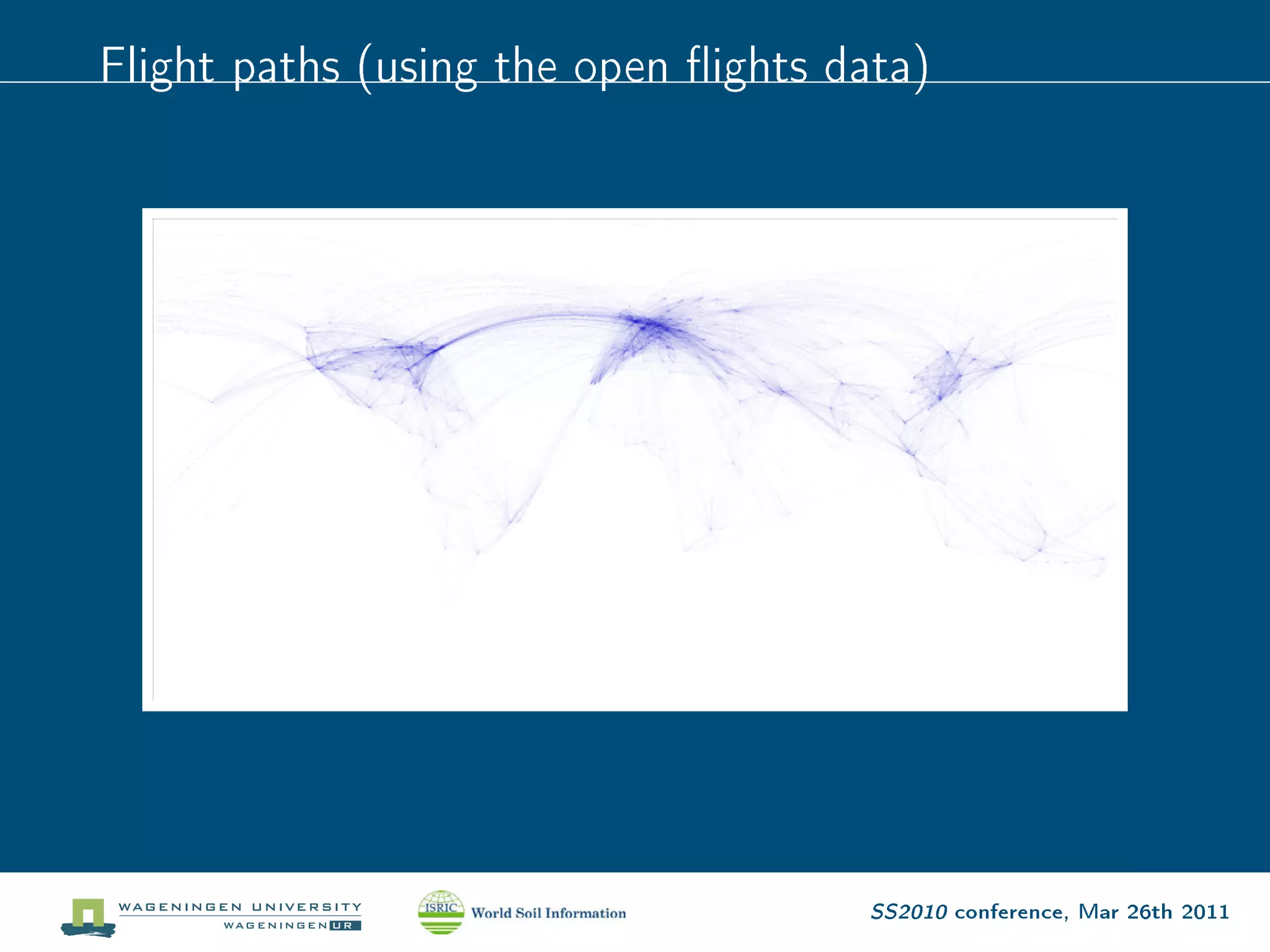
Flight paths
Preparing worldgrids  an example with ight paths (density map)


                                              SS2010 conference, Mar 26th 2011
PyWPS


Overlay, subset, reproject, aggregate functionality (example):

 GNworldgrids(layername=globcov, xcoord=6.848911, ycoord=52.245427)
  [1] 50

under construction.


                                                   SS2010 conference, Mar 26th 2011
Global Soil Information


   An international initiative to make soil property maps (7+3) at
   six depths at 3 arcsecs (100 m).
   the lightmotive is to assemble, collate, and rescue as much of
   the worlds existing soil data ;

   Some 30 people directly involved (ISRIC is the main project
   coordinator).
   International compilation of soil data.
   The soil-equivalent of the OneGeology.org, GBIF, GlobCover
   and similar projects.
   See full specications at
   http://globalsoilmap.org/specifications

                                              SS2010 conference, Mar 26th 2011
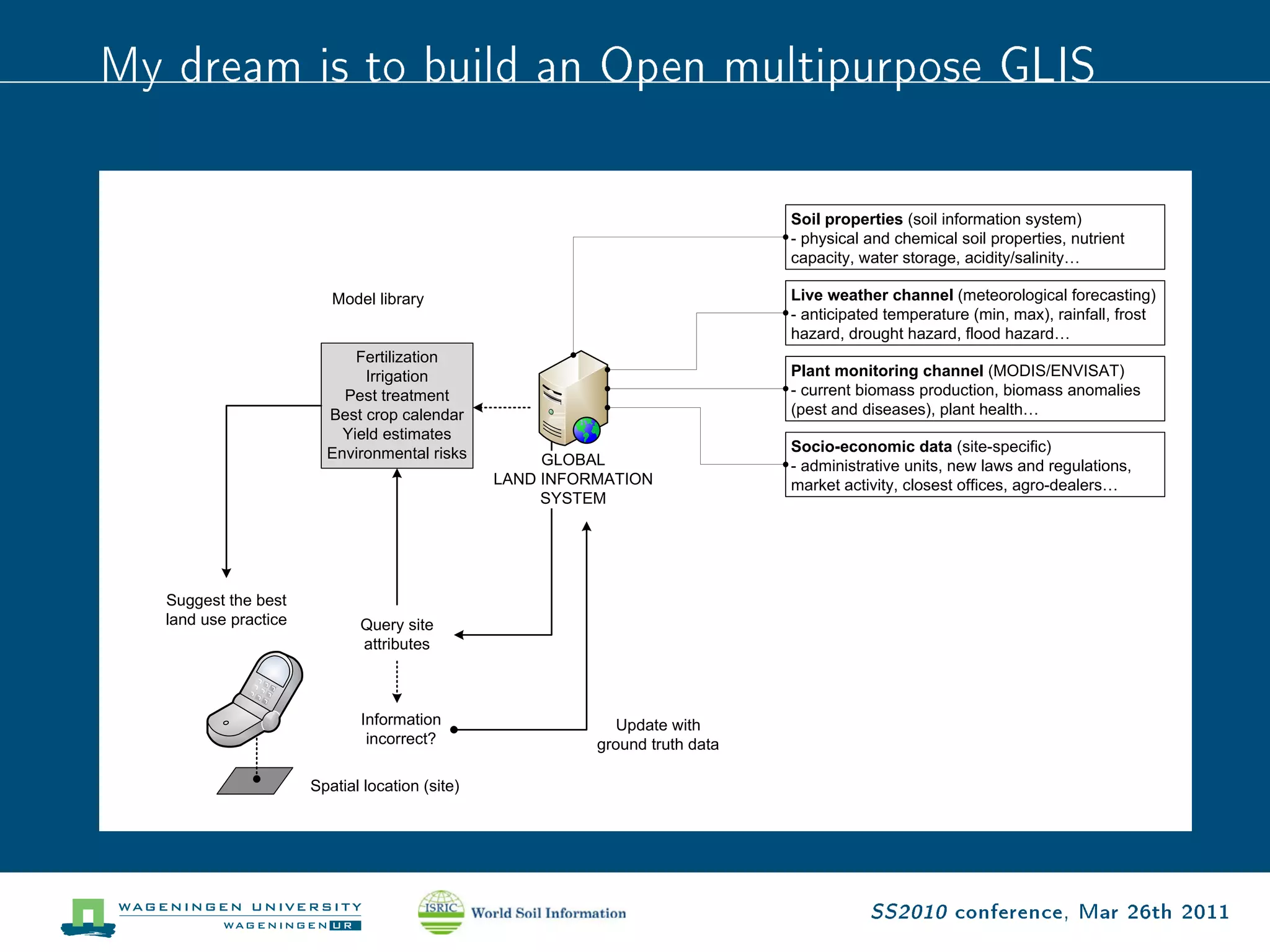
My dream is to build an Open multipurpose GLIS


                                   SS2010 conference, Mar 26th 2011
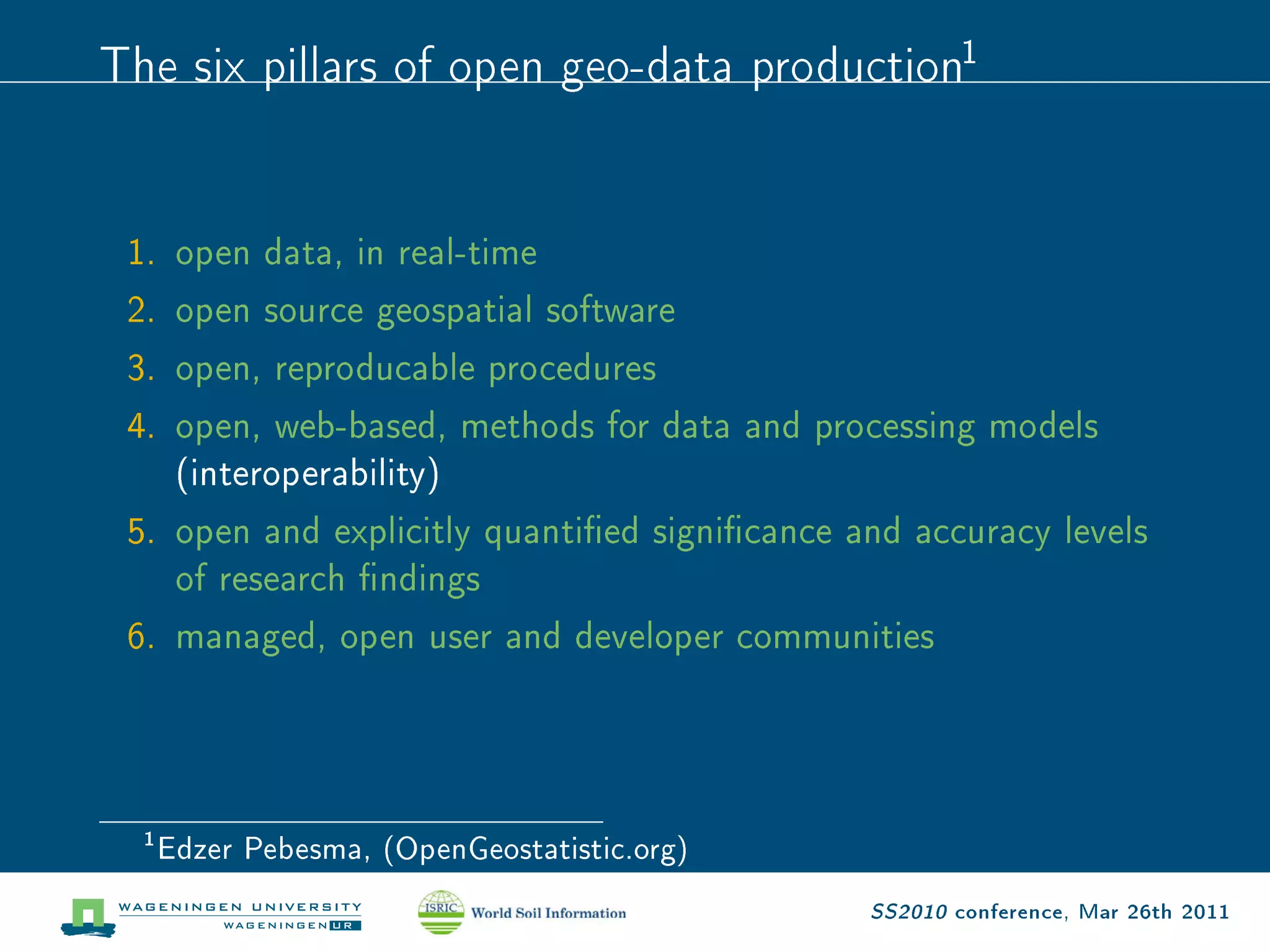
The six pillars of open geo-data production1

 1. open data, in real-time
 2. open source geospatial software
 3. open, reproducable procedures
 4. open, web-based, methods for data and processing models
    (interoperability)
 5. open and explicitly quantied signicance and accuracy levels
    of research ndings
 6. managed, open user and developer communities


  1
      Edzer Pebesma, (OpenGeostatistic.org)
                                               SS2010 conference, Mar 26th 2011
GSM in numbers
   The total productive soil areas:   about 104 million square
   km.


                                                SS2010 conference, Mar 26th 2011
GSM in numbers
   The total productive soil areas: about 104 million square
   km.
   To map the world soils at 100 m (1:200k), would cost about
   5 billion EUR (0.5 EUR per ha) using traditional methods.
   According to Pedro Sanchez, world soils could be mapped for
   $0.20 USD per ha ($300 million USD).


                                             SS2010 conference, Mar 26th 2011
GSM in numbers
   The total productive soil areas: about 104 million square
   km.
   To map the world soils at 100 m (1:200k), would cost about
   5 billion EUR (0.5 EUR per ha) using traditional methods.
   According to Pedro Sanchez, world soils could be mapped for
   $0.20 USD per ha ($300 million USD).
   We would require some 65M proles according to the strict
   rules of Avery (1987).


                                             SS2010 conference, Mar 26th 2011
GSM in numbers
   The total productive soil areas: about 104 million square
   km.
   To map the world soils at 100 m (1:200k), would cost about
   5 billion EUR (0.5 EUR per ha) using traditional methods.
   According to Pedro Sanchez, world soils could be mapped for
   $0.20 USD per ha ($300 million USD).
   We would require some 65M proles according to the strict
   rules of Avery (1987).
   World map at 0.008333333 arcdegrees (ca.1 km) resolution is
   an image of size 43,200Ö21,600 pixels.


                                            SS2010 conference, Mar 26th 2011
GSM in numbers
   The total productive soil areas: about 104 million square
   km.
   To map the world soils at 100 m (1:200k), would cost about
   5 billion EUR (0.5 EUR per ha) using traditional methods.
   According to Pedro Sanchez, world soils could be mapped for
   $0.20 USD per ha ($300 million USD).
   We would require some 65M proles according to the strict
   rules of Avery (1987).
   World map at 0.008333333 arcdegrees (ca.1 km) resolution is
   an image of size 43,200Ö21,600 pixels.
   One image of the world at a 100 m resolution contains 27
   billion pixels (productive soil areas only!).


                                            SS2010 conference, Mar 26th 2011
Our proposal


   Build global repositories of point and gridded data
   (covariate).


                                           SS2010 conference, Mar 26th 2011
Our proposal


   Build global repositories of point and gridded data
   (covariate).
   Animate people to contribute to the data repositories
   (crowdsourcing).


                                              SS2010 conference, Mar 26th 2011
Our proposal


   Build global repositories of point and gridded data
   (covariate).
   Animate people to contribute to the data repositories
   (crowdsourcing).
   Implement the six pillars of open geo-data production
   (especially open infrastructures and open code).


                                              SS2010 conference, Mar 26th 2011
Our proposal


   Build global repositories of point and gridded data
   (covariate).
   Animate people to contribute to the data repositories
   (crowdsourcing).
   Implement the six pillars of open geo-data production
   (especially open infrastructures and open code).
   Prove that it is doable (   showcases).


                                              SS2010 conference, Mar 26th 2011
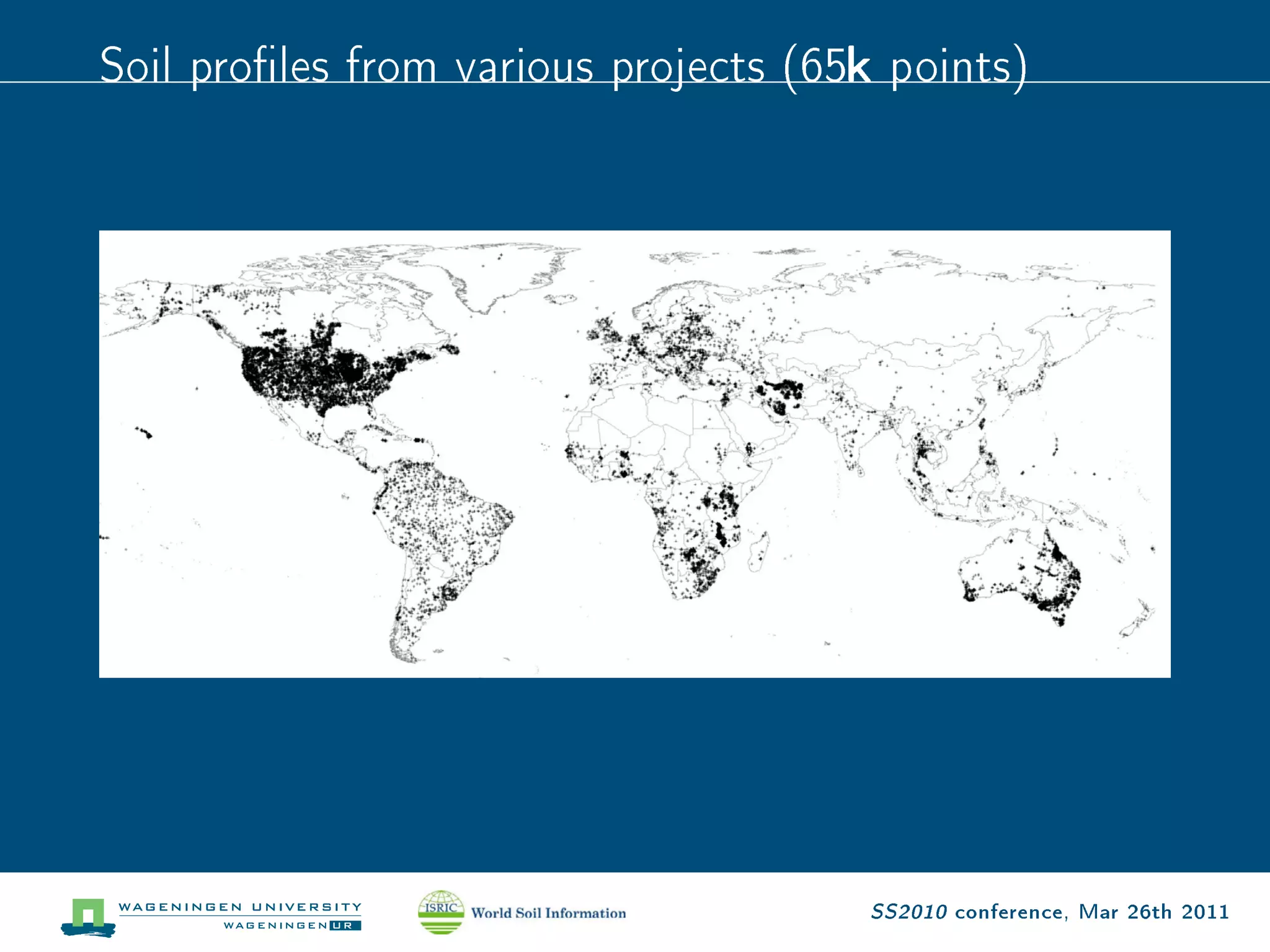
Soil proles from various projects (65k points)


                                      SS2010 conference, Mar 26th 2011
Critical question:


    How to produce soil property maps @ 100 m
             with such limited data?


                                   SS2010 conference, Mar 26th 2011
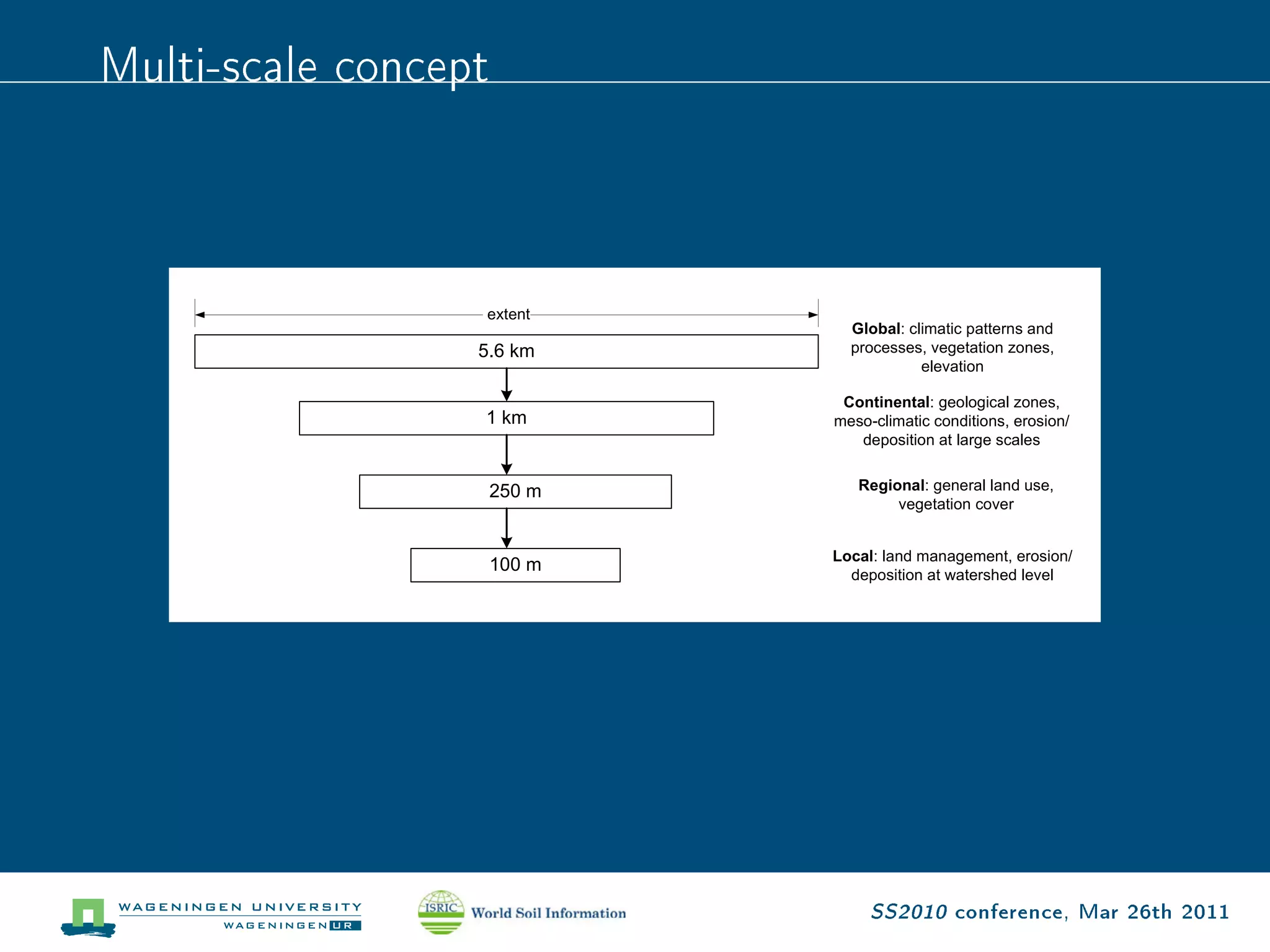
Global Multiscale Nested RK

We propose using nested RK model:

 z(sB ) = m0 (sB−k ) + e1 (sB−k |sB−[k+1] ) + . . . + ek (sB−2 |sB−1 ) + ε(sB )   (3)


where z(s ) is the value of the target variable estimated at ground
           B
scale (B), , . . . , are the higher order components,
            B−1
                   ) is the residual variation from scale s     to a
                      B−k
e (s |s
higher resolution scale s , and ε is spatially auto-correlated
 k   B−k   B−(k+1)                                                  B−(k+1)


residual soil variation (dealt with ordinary kriging).
                             B−k


                                                            SS2010 conference, Mar 26th 2011
Multi-scale concept


                      SS2010 conference, Mar 26th 2011
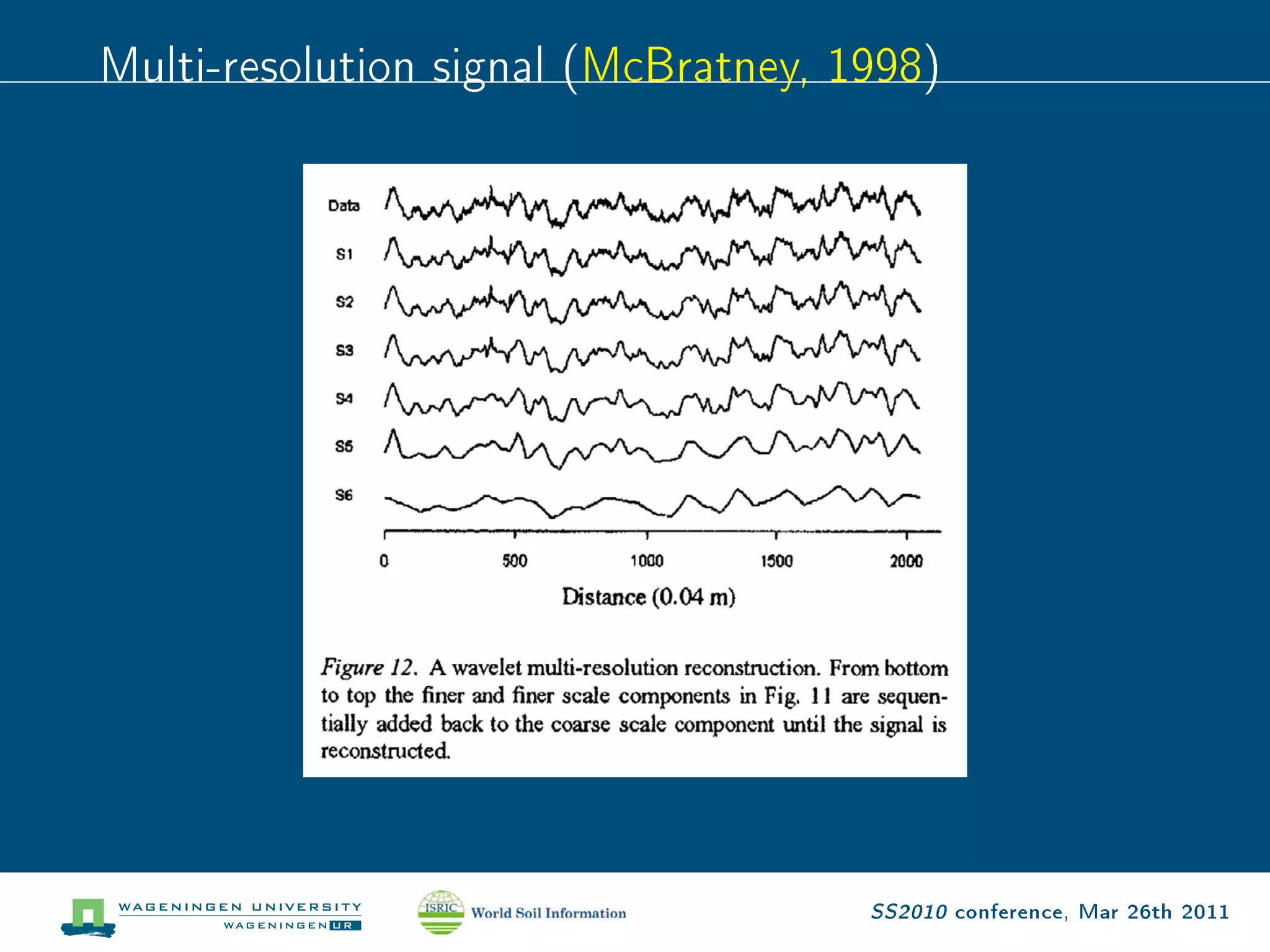
Multi-resolution signal (McBratney, 1998)


                                     SS2010 conference, Mar 26th 2011
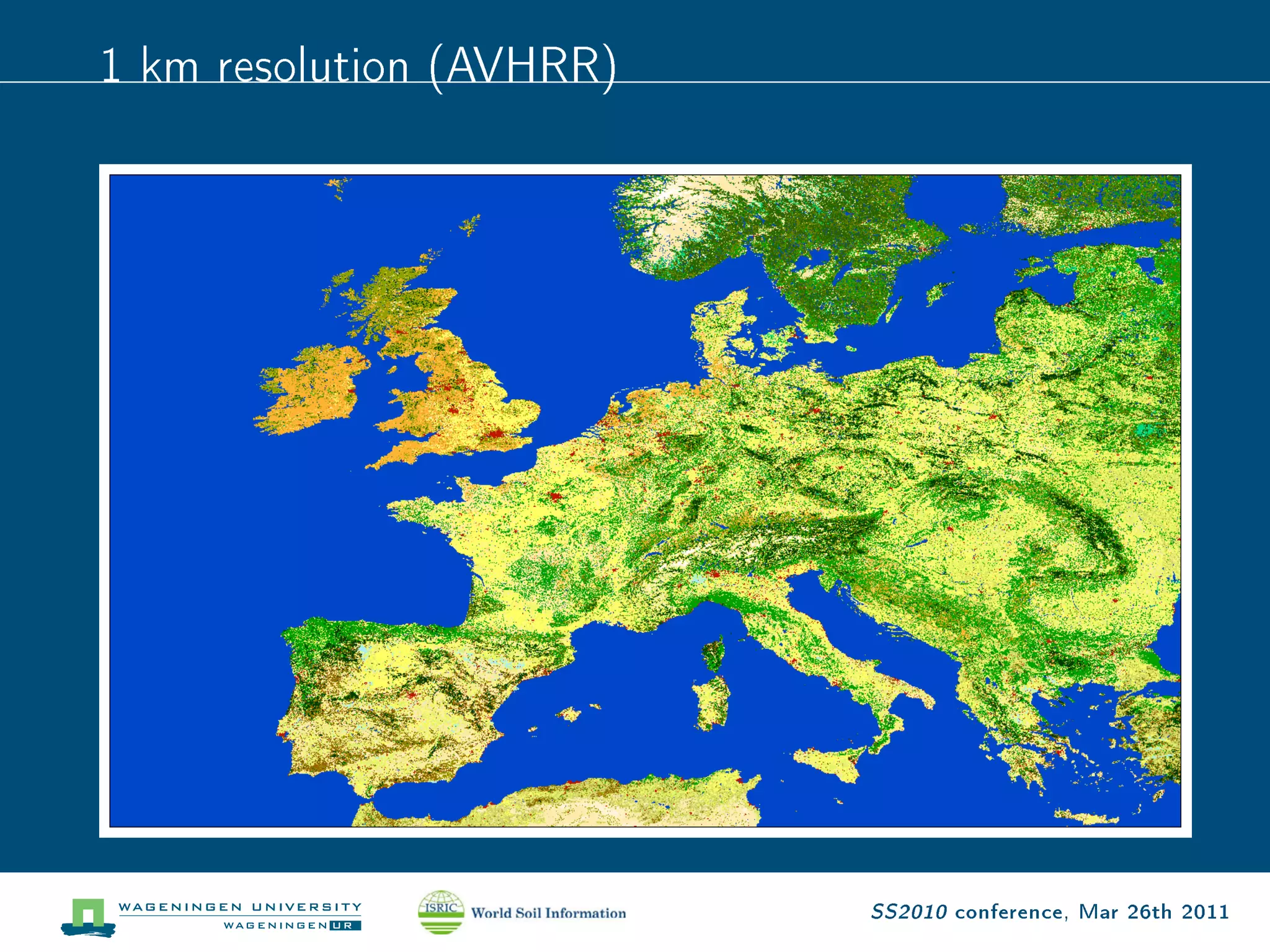
1 km resolution (AVHRR)


                          SS2010 conference, Mar 26th 2011
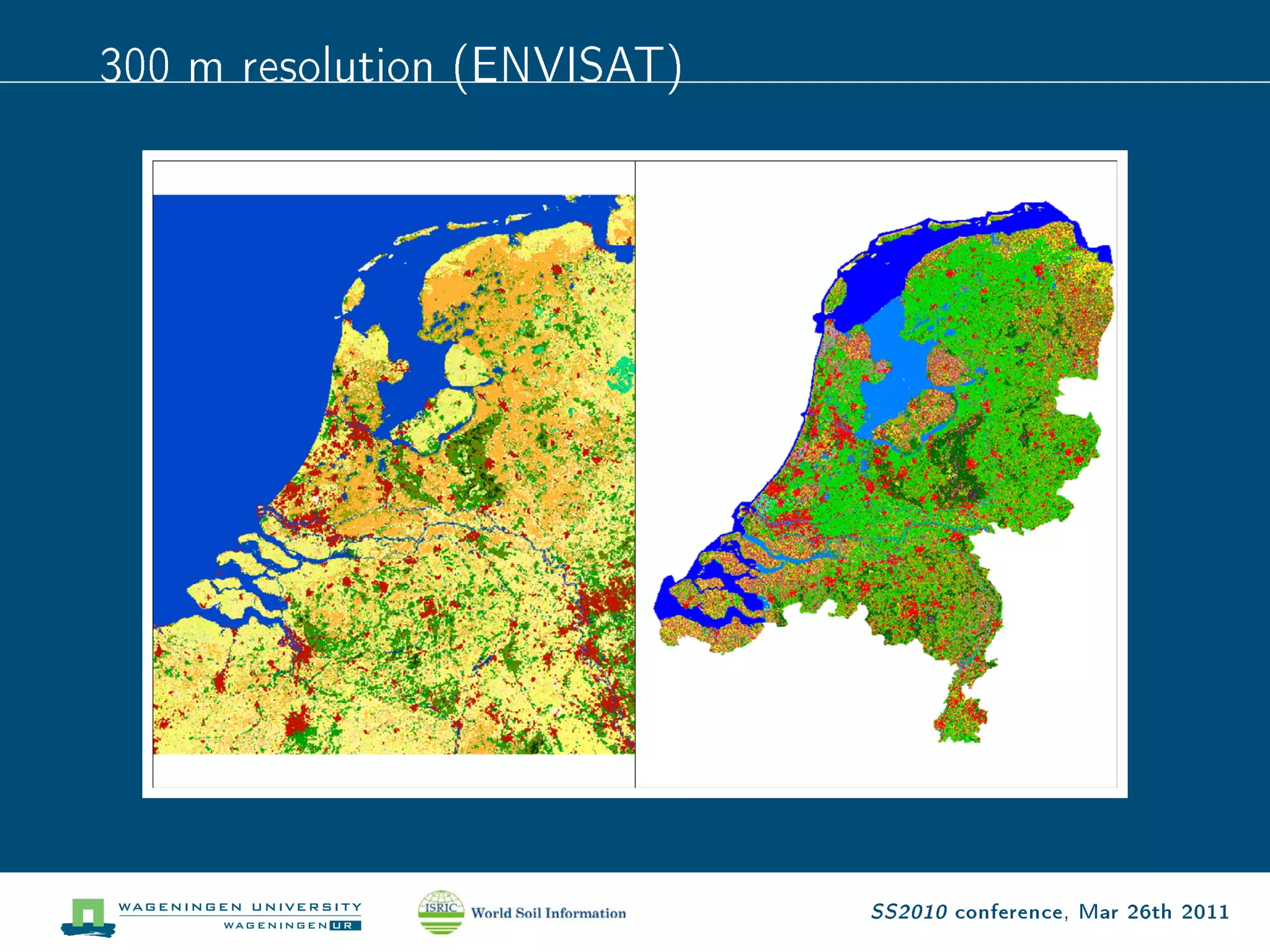
300 m resolution (ENVISAT)


                             SS2010 conference, Mar 26th 2011
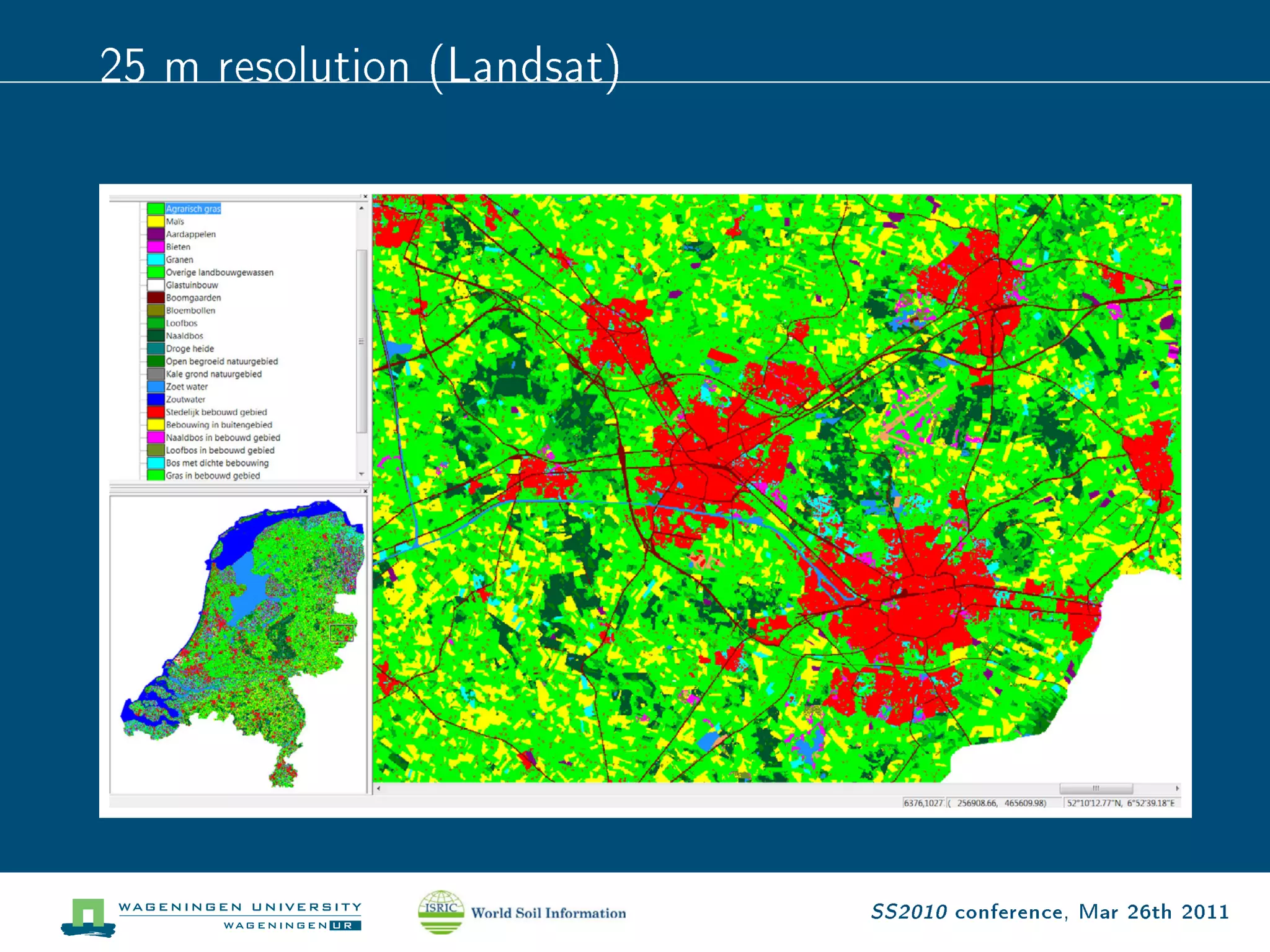
25 m resolution (Landsat)


                            SS2010 conference, Mar 26th 2011
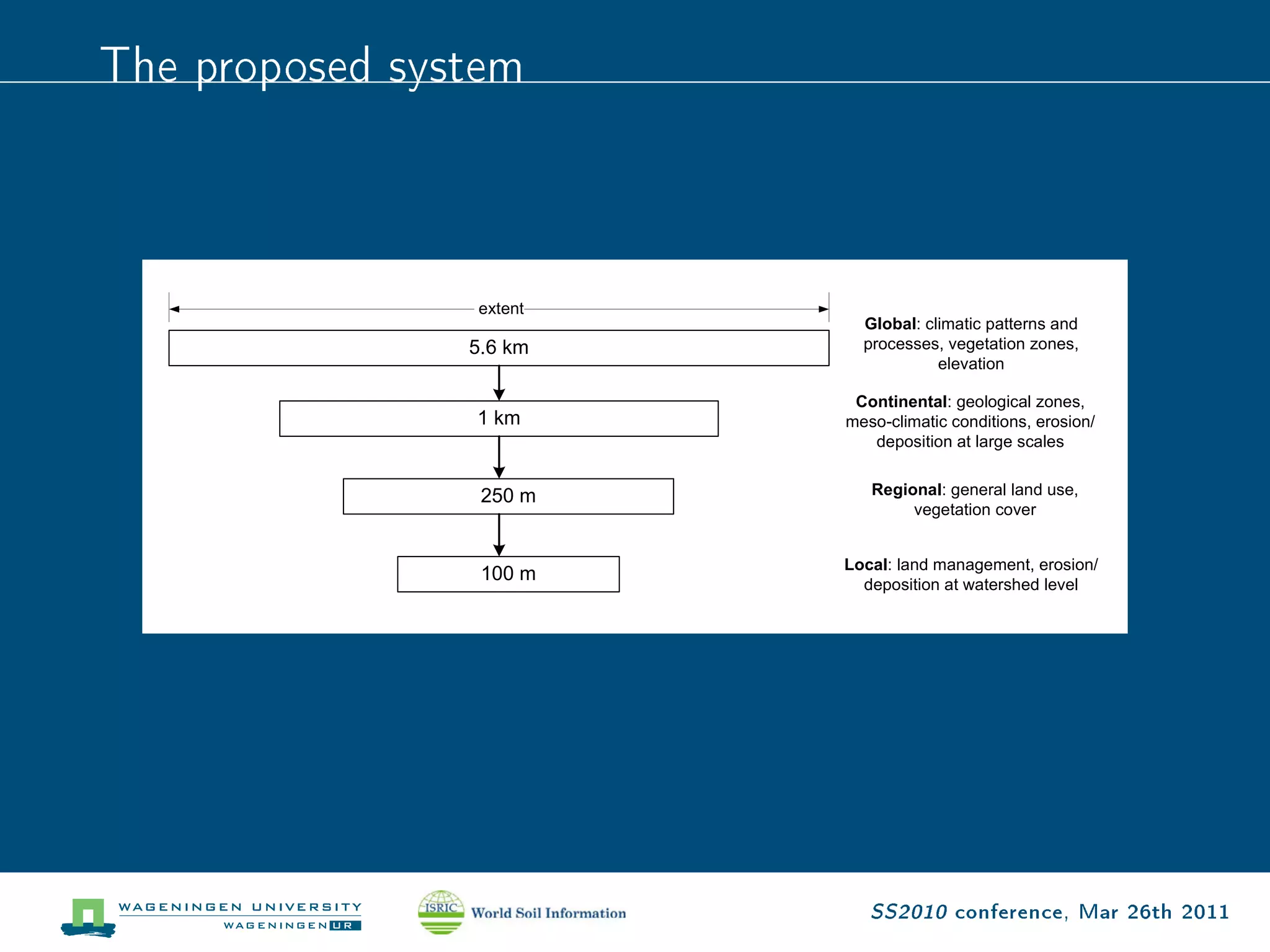
The proposed system


                      SS2010 conference, Mar 26th 2011
Showcase


           Let us see some real examples


                                    SS2010 conference, Mar 26th 2011
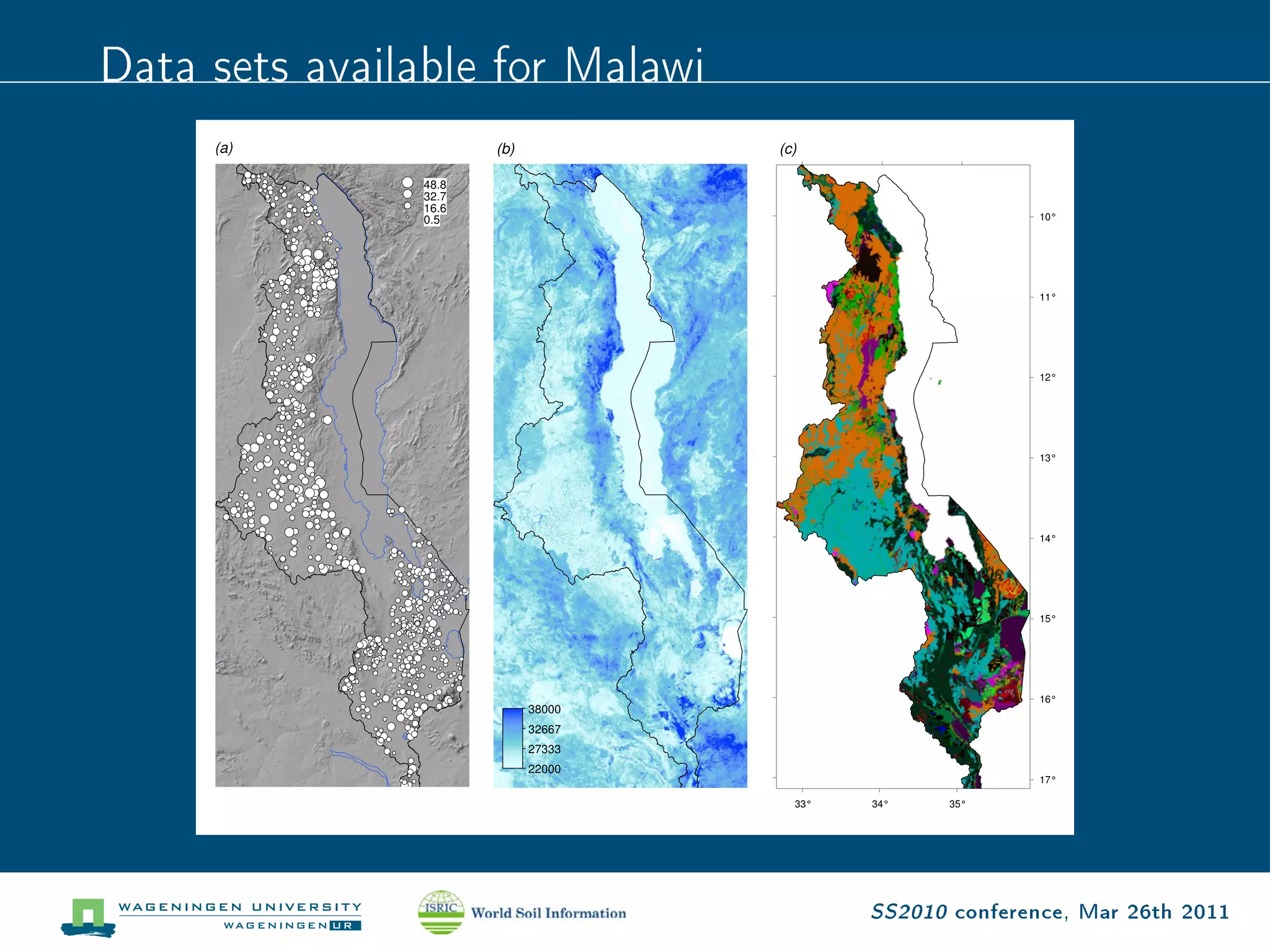
GM-NRK in action: Malawi showcase


   2740 soil observations,   from which some 8001000 contain

   complete analytical and descriptive data.


                                               SS2010 conference, Mar 26th 2011
GM-NRK in action: Malawi showcase


   2740 soil observations,   from which some 8001000 contain

   complete analytical and descriptive data.

   1:800k polygon soil map.


                                               SS2010 conference, Mar 26th 2011
GM-NRK in action: Malawi showcase


   2740 soil observations,   from which some 8001000 contain

   complete analytical and descriptive data.

   1:800k polygon soil map.
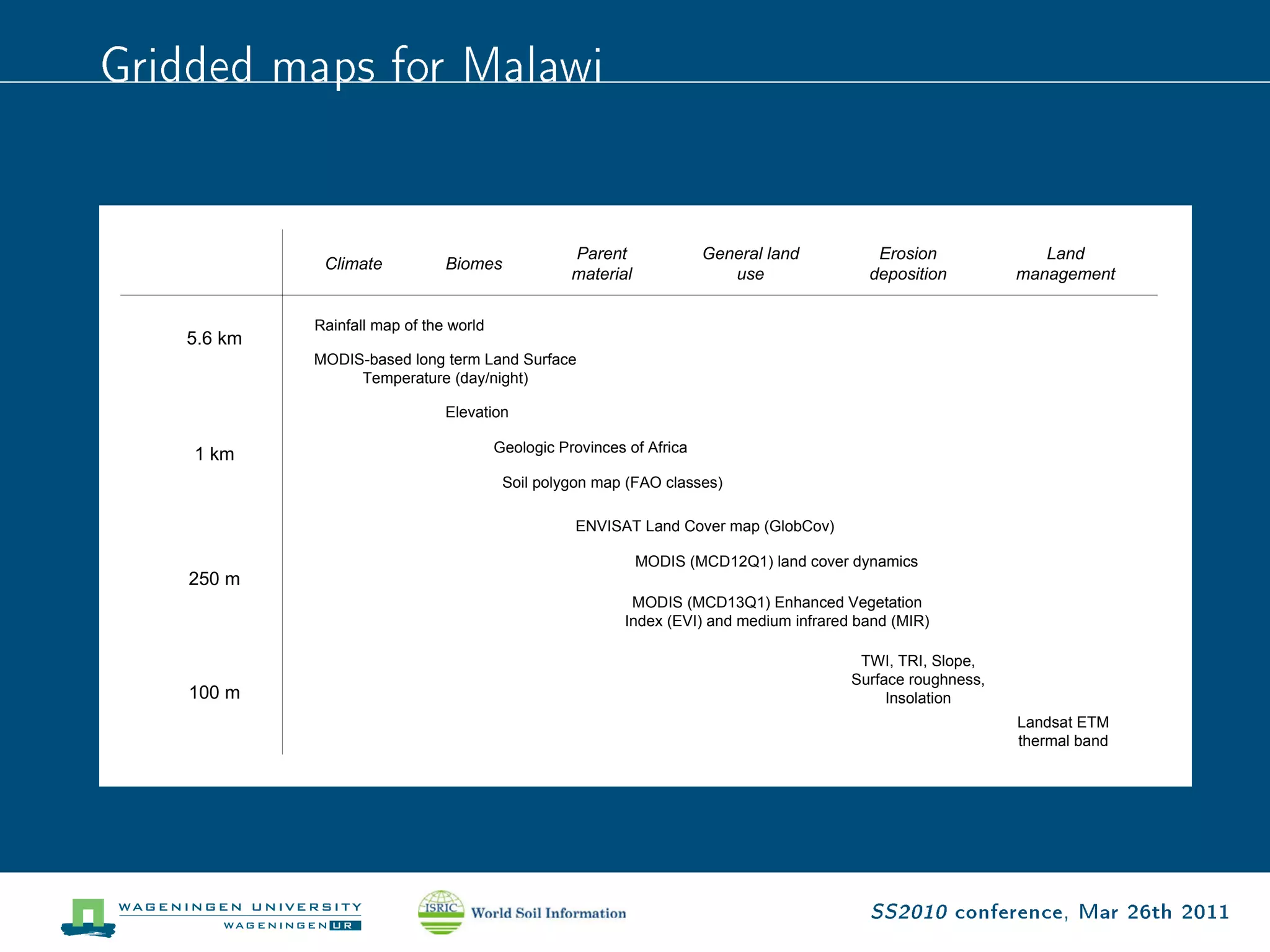
   Some 30-40 gridded layers at various resolutions
   (covariates).


                                               SS2010 conference, Mar 26th 2011
Data sets available for Malawi
     (a)               (b)           (c)

                48.8
                32.7
                16.6
                0.5                                         10°


                                                            11°


                                                            12°


                                                            13°


                                                            14°


                                                            15°


                                                            16°
                             38000
                             32667
                             27333
                             22000
                                                            17°

                                       33°   34°    35°


                                             SS2010 conference, Mar 26th 2011
Gridded maps for Malawi


                          SS2010 conference, Mar 26th 2011
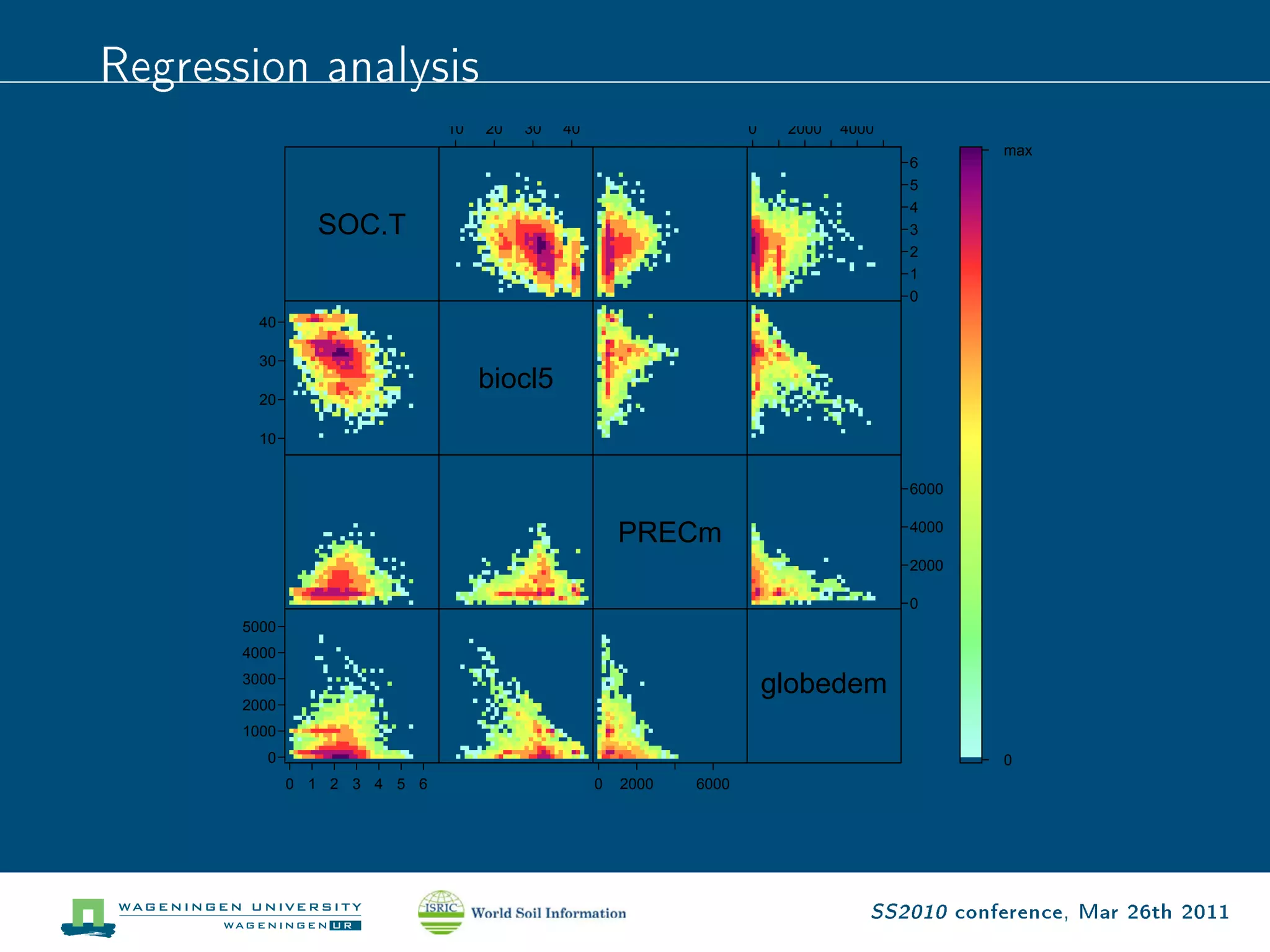
Regression analysis
                              10   20   30   40                     0    2000   4000
                                                                                              max
                                                                                       6
                                                                                       5
                                                                                       4
                SOC.T                                                                  3
                                                                                       2
                                                                                       1
                                                                                       0
         40

         30
                                   biocl5
         20

         10


                                                                                       6000


                                                      PRECm                            4000

                                                                                       2000

                                                                                       0
       5000
       4000
       3000
                                                                        globedem
       2000
       1000
          0                                                                                   0
              0 1 2 3 4 5 6                       0   2000   6000


                                                                                   SS2010 conference, Mar 26th 2011
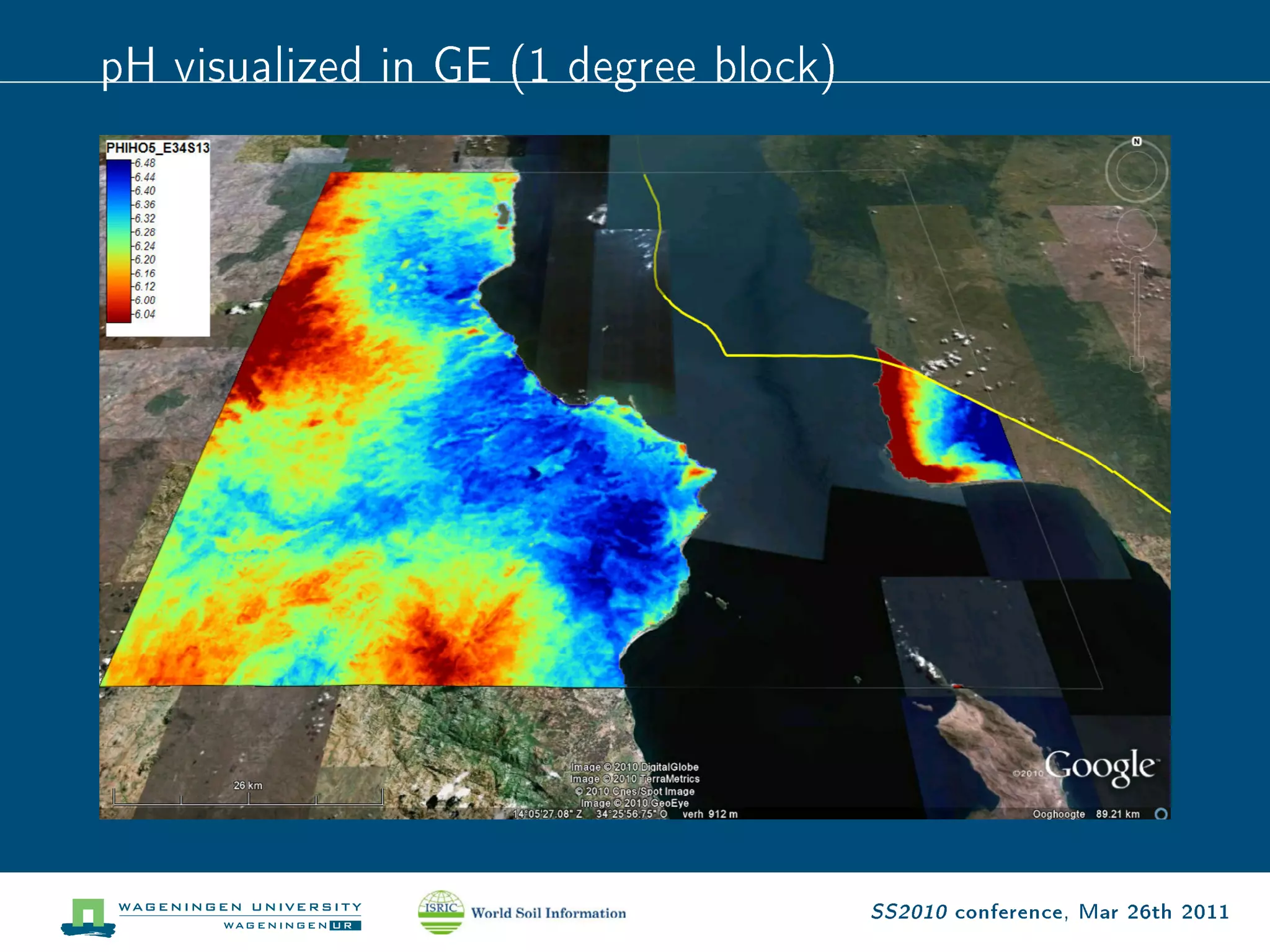
pH visualized in GE (1 degree block)


                                       SS2010 conference, Mar 26th 2011
Conclusions

   Global models  global multiscale predictions  are
   now.


                                        SS2010 conference, Mar 26th 2011
Conclusions

   Global models  global multiscale predictions  are
   now .

   It is very probable that, in the near future, any geostatistical

   analysis will be global.


                                                 SS2010 conference, Mar 26th 2011
Conclusions

   Global models  global multiscale predictions  are
   now .

   It is very probable that, in the near future, any geostatistical

   analysis will be global.

   We probably need to    re-write the geostatistical algorithms
   so they work with sphere geometry (3D + time).


                                                 SS2010 conference, Mar 26th 2011
Conclusions

   Global models  global multiscale predictions  are
   now .

   It is very probable that, in the near future, any geostatistical

   analysis will be global.

   We probably need to      re-write the geostatistical algorithms
   so they work with sphere geometry (3D + time).

   There is enormous amount of publicly available RS and
   GIS data that is waiting to be used for geostatistical
   mapping  use it     !


                                                 SS2010 conference, Mar 26th 2011
In one sentence:


                   Take a broader view!


                                          SS2010 conference, Mar 26th 2011
Next steps


   Launch 5 and 1 km worldgrids.


                                   SS2010 conference, Mar 26th 2011
Next steps


   Launch 5 and 1 km worldgrids.
   Provide geo-service and spatial analysis functionality
   (overlay, subset, aggregate).


                                           SS2010 conference, Mar 26th 2011
Next steps


   Launch 5 and 1 km worldgrids.
   Provide geo-service and spatial analysis functionality
   (overlay, subset, aggregate).

   Start making cyber-infrastructure for 250 m and 100 m
   grids.


                                           SS2010 conference, Mar 26th 2011
Next steps


   Launch 5 and 1 km worldgrids.
   Provide geo-service and spatial analysis functionality
   (overlay, subset, aggregate).

   Start making cyber-infrastructure for 250 m and 100 m
   grids.
   Provide geo-processing services for automated mapping.


                                           SS2010 conference, Mar 26th 2011
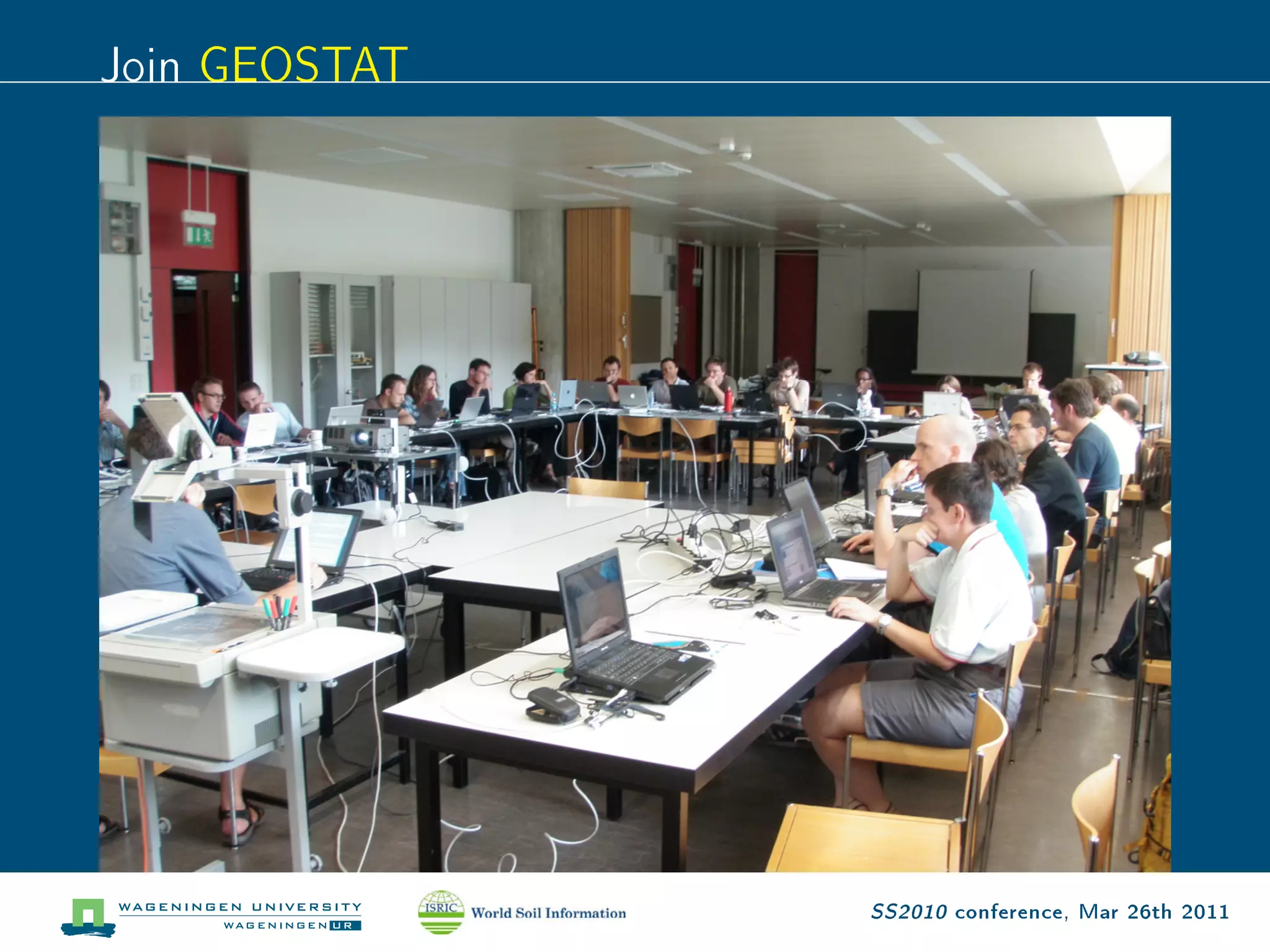
Join GEOSTAT


               SS2010 conference, Mar 26th 2011
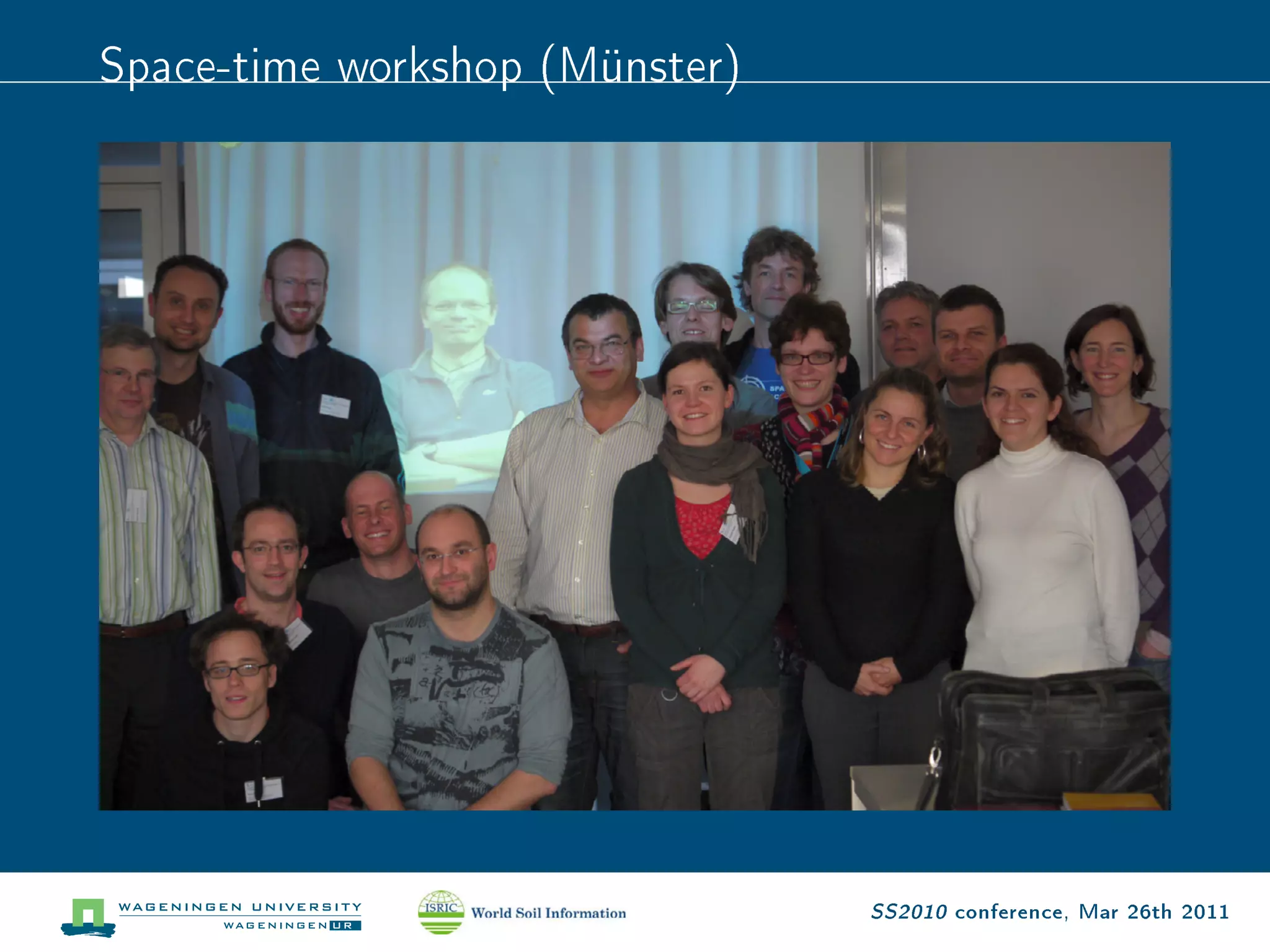
Space-time workshop (Münster)


                                SS2010 conference, Mar 26th 2011

Worldgrids.org: building global covariates for automated mapping

  • 1.
    Worldgrids.org building global covariatesfor automated mapping Tomislav Hengl & Hannes I. Reuter ISRIC World Soil Information, Wageningen University SS2010 conference, Mar 26th 2011
  • 2.
    About ISRIC ISRIC World Soil Information. SS2010 conference, Mar 26th 2011
  • 3.
    About ISRIC ISRIC World Soil Information. ISRIC = International Soil Reference Information Center. SS2010 conference, Mar 26th 2011
  • 4.
    About ISRIC ISRIC World Soil Information. ISRIC = International Soil Reference Information Center. Non-prot organization / aliated to Wageningen University and Research. SS2010 conference, Mar 26th 2011
  • 5.
    About ISRIC ISRIC World Soil Information. ISRIC = International Soil Reference Information Center. Non-prot organization / aliated to Wageningen University and Research. Mandate: serve soil data; serve international soil standards; moderate collaboration and partnerships. SS2010 conference, Mar 26th 2011
  • 6.
    About ISRIC ISRIC World Soil Information. ISRIC = International Soil Reference Information Center. Non-prot organization / aliated to Wageningen University and Research. Mandate: serve soil data; serve international soil standards; moderate collaboration and partnerships. Projects: GlobalSoilMap.net, SOTER, Green Water Credits ... SS2010 conference, Mar 26th 2011
  • 7.
    This talk Global repository of publicly available data (worldgrids.org). A global multiscale approach to geostat mapping. Some examples: Malawi. Upcoming activities. SS2010 conference, Mar 26th 2011
  • 8.
    Main thesis Global (multiscale) modeling is now! SS2010 conference, Mar 26th 2011
  • 9.
    Analysis objectives For Diggleand Ribeiro (2007) there are three scientic objectives of geostatistics: 1. model estimation, i.e.inference about the model parameters; 2. prediction, i.e.inference about the unobserved values of the target variable; 3. hypothesis testing; SS2010 conference, Mar 26th 2011
  • 10.
    Regression-kriging Target variable zis a sum of deterministic and stochastic components: z(s) = m(s) + ε(s) (1) where m(s) is the deterministic part of the variation (i.e.a linear function of the auxiliary variables), ε(s) is the residual for every (s). SS2010 conference, Mar 26th 2011
  • 11.
    BLUP for spatialdata ˆ ˆ ˆ z (s0 ) = qT · β + λT · (z − q · β) ˆ 0 0 ˆ −1 β = qT · C−1 · q · qT · C−1 · z (2) ˆ λ0 = C−1 · c0 This is the dominant model used in ∼90% of our mapping projects (Minasny and McBratney, 2007) SS2010 conference, Mar 26th 2011
  • 12.
    Zed's and que's SS2010 conference, Mar 26th 2011
  • 13.
    Worldgrids.org I was ask to write a review of publicly available global data sets of interest for species distribution modeling. SS2010 conference, Mar 26th 2011
  • 14.
    Worldgrids.org I was ask to write a review of publicly available global data sets of interest for species distribution modeling. I discovered that at 15 km resolution, there is A LOT of publicly available data which are under-used. SS2010 conference, Mar 26th 2011
  • 15.
    Worldgrids.org I was ask to write a review of publicly available global data sets of interest for species distribution modeling. I discovered that at 15 km resolution, there is A LOT of publicly available data which are under-used. The original images need to be processed before you can use them as global covariates. SS2010 conference, Mar 26th 2011
  • 16.
    Worldgrids.org I was ask to write a review of publicly available global data sets of interest for species distribution modeling. I discovered that at 15 km resolution, there is A LOT of publicly available data which are under-used. The original images need to be processed before you can use them as global covariates. Produce grids → prepare data for upload → geo-serve it. SS2010 conference, Mar 26th 2011
  • 17.
    Worldgrids.org I was ask to write a review of publicly available global data sets of interest for species distribution modeling. I discovered that at 15 km resolution, there is A LOT of publicly available data which are under-used. The original images need to be processed before you can use them as global covariates. Produce grids → prepare data for upload → geo-serve it. The result is a repository with cca 100 unique rasters, that can be obtained directly from http://spatial-analyst.net/worldmaps/. SS2010 conference, Mar 26th 2011
  • 18.
    Worldgrids.org I was ask to write a review of publicly available global data sets of interest for species distribution modeling. I discovered that at 15 km resolution, there is A LOT of publicly available data which are under-used. The original images need to be processed before you can use them as global covariates. Produce grids → prepare data for upload → geo-serve it. The result is a repository with cca 100 unique rasters, that can be obtained directly from http://spatial-analyst.net/worldmaps/. Each gridded map consists of 7200 columns and 3600 rows; the cell size is 0.05 arcdegrees, which corresponds to about 5.6 km; all maps fall on the same grid. SS2010 conference, Mar 26th 2011
  • 19.
    Worldgrids.org I was ask to write a review of publicly available global data sets of interest for species distribution modeling. I discovered that at 15 km resolution, there is A LOT of publicly available data which are under-used. The original images need to be processed before you can use them as global covariates. Produce grids → prepare data for upload → geo-serve it. The result is a repository with cca 100 unique rasters, that can be obtained directly from http://spatial-analyst.net/worldmaps/. Each gridded map consists of 7200 columns and 3600 rows; the cell size is 0.05 arcdegrees, which corresponds to about 5.6 km; all maps fall on the same grid. PS: I also have a lot of data at 1 km. SS2010 conference, Mar 26th 2011
  • 20.
    Read more (orsee a gallery) SS2010 conference, Mar 26th 2011
  • 21.
    Flight paths Preparing worldgrids an example with ight paths (density map) SS2010 conference, Mar 26th 2011
  • 29.
    PyWPS Overlay, subset, reproject,aggregate functionality (example): GNworldgrids(layername=globcov, xcoord=6.848911, ycoord=52.245427) [1] 50 under construction. SS2010 conference, Mar 26th 2011
  • 30.
    Global Soil Information An international initiative to make soil property maps (7+3) at six depths at 3 arcsecs (100 m). the lightmotive is to assemble, collate, and rescue as much of the worlds existing soil data ; Some 30 people directly involved (ISRIC is the main project coordinator). International compilation of soil data. The soil-equivalent of the OneGeology.org, GBIF, GlobCover and similar projects. See full specications at http://globalsoilmap.org/specifications SS2010 conference, Mar 26th 2011
  • 31.
    My dream isto build an Open multipurpose GLIS SS2010 conference, Mar 26th 2011
  • 32.
    The six pillarsof open geo-data production1 1. open data, in real-time 2. open source geospatial software 3. open, reproducable procedures 4. open, web-based, methods for data and processing models (interoperability) 5. open and explicitly quantied signicance and accuracy levels of research ndings 6. managed, open user and developer communities 1 Edzer Pebesma, (OpenGeostatistic.org) SS2010 conference, Mar 26th 2011
  • 33.
    GSM in numbers The total productive soil areas: about 104 million square km. SS2010 conference, Mar 26th 2011
  • 34.
    GSM in numbers The total productive soil areas: about 104 million square km. To map the world soils at 100 m (1:200k), would cost about 5 billion EUR (0.5 EUR per ha) using traditional methods. According to Pedro Sanchez, world soils could be mapped for $0.20 USD per ha ($300 million USD). SS2010 conference, Mar 26th 2011
  • 35.
    GSM in numbers The total productive soil areas: about 104 million square km. To map the world soils at 100 m (1:200k), would cost about 5 billion EUR (0.5 EUR per ha) using traditional methods. According to Pedro Sanchez, world soils could be mapped for $0.20 USD per ha ($300 million USD). We would require some 65M proles according to the strict rules of Avery (1987). SS2010 conference, Mar 26th 2011
  • 36.
    GSM in numbers The total productive soil areas: about 104 million square km. To map the world soils at 100 m (1:200k), would cost about 5 billion EUR (0.5 EUR per ha) using traditional methods. According to Pedro Sanchez, world soils could be mapped for $0.20 USD per ha ($300 million USD). We would require some 65M proles according to the strict rules of Avery (1987). World map at 0.008333333 arcdegrees (ca.1 km) resolution is an image of size 43,200Ö21,600 pixels. SS2010 conference, Mar 26th 2011
  • 37.
    GSM in numbers The total productive soil areas: about 104 million square km. To map the world soils at 100 m (1:200k), would cost about 5 billion EUR (0.5 EUR per ha) using traditional methods. According to Pedro Sanchez, world soils could be mapped for $0.20 USD per ha ($300 million USD). We would require some 65M proles according to the strict rules of Avery (1987). World map at 0.008333333 arcdegrees (ca.1 km) resolution is an image of size 43,200Ö21,600 pixels. One image of the world at a 100 m resolution contains 27 billion pixels (productive soil areas only!). SS2010 conference, Mar 26th 2011
  • 38.
    Our proposal Build global repositories of point and gridded data (covariate). SS2010 conference, Mar 26th 2011
  • 39.
    Our proposal Build global repositories of point and gridded data (covariate). Animate people to contribute to the data repositories (crowdsourcing). SS2010 conference, Mar 26th 2011
  • 40.
    Our proposal Build global repositories of point and gridded data (covariate). Animate people to contribute to the data repositories (crowdsourcing). Implement the six pillars of open geo-data production (especially open infrastructures and open code). SS2010 conference, Mar 26th 2011
  • 41.
    Our proposal Build global repositories of point and gridded data (covariate). Animate people to contribute to the data repositories (crowdsourcing). Implement the six pillars of open geo-data production (especially open infrastructures and open code). Prove that it is doable ( showcases). SS2010 conference, Mar 26th 2011
  • 42.
    Soil proles fromvarious projects (65k points) SS2010 conference, Mar 26th 2011
  • 43.
    Critical question: How to produce soil property maps @ 100 m with such limited data? SS2010 conference, Mar 26th 2011
  • 44.
    Global Multiscale NestedRK We propose using nested RK model: z(sB ) = m0 (sB−k ) + e1 (sB−k |sB−[k+1] ) + . . . + ek (sB−2 |sB−1 ) + ε(sB ) (3) where z(s ) is the value of the target variable estimated at ground B scale (B), , . . . , are the higher order components, B−1 ) is the residual variation from scale s to a B−k e (s |s higher resolution scale s , and ε is spatially auto-correlated k B−k B−(k+1) B−(k+1) residual soil variation (dealt with ordinary kriging). B−k SS2010 conference, Mar 26th 2011
  • 45.
    Multi-scale concept SS2010 conference, Mar 26th 2011
  • 46.
    Multi-resolution signal (McBratney,1998) SS2010 conference, Mar 26th 2011
  • 47.
    1 km resolution(AVHRR) SS2010 conference, Mar 26th 2011
  • 48.
    300 m resolution(ENVISAT) SS2010 conference, Mar 26th 2011
  • 49.
    25 m resolution(Landsat) SS2010 conference, Mar 26th 2011
  • 50.
    The proposed system SS2010 conference, Mar 26th 2011
  • 51.
    Showcase Let us see some real examples SS2010 conference, Mar 26th 2011
  • 52.
    GM-NRK in action:Malawi showcase 2740 soil observations, from which some 8001000 contain complete analytical and descriptive data. SS2010 conference, Mar 26th 2011
  • 53.
    GM-NRK in action:Malawi showcase 2740 soil observations, from which some 8001000 contain complete analytical and descriptive data. 1:800k polygon soil map. SS2010 conference, Mar 26th 2011
  • 54.
    GM-NRK in action:Malawi showcase 2740 soil observations, from which some 8001000 contain complete analytical and descriptive data. 1:800k polygon soil map. Some 30-40 gridded layers at various resolutions (covariates). SS2010 conference, Mar 26th 2011
  • 55.
    Data sets availablefor Malawi (a) (b) (c) 48.8 32.7 16.6 0.5 10° 11° 12° 13° 14° 15° 16° 38000 32667 27333 22000 17° 33° 34° 35° SS2010 conference, Mar 26th 2011
  • 56.
    Gridded maps forMalawi SS2010 conference, Mar 26th 2011
  • 57.
    Regression analysis 10 20 30 40 0 2000 4000 max 6 5 4 SOC.T 3 2 1 0 40 30 biocl5 20 10 6000 PRECm 4000 2000 0 5000 4000 3000 globedem 2000 1000 0 0 0 1 2 3 4 5 6 0 2000 6000 SS2010 conference, Mar 26th 2011
  • 58.
    pH visualized inGE (1 degree block) SS2010 conference, Mar 26th 2011
  • 59.
    Conclusions Global models global multiscale predictions are now. SS2010 conference, Mar 26th 2011
  • 60.
    Conclusions Global models global multiscale predictions are now . It is very probable that, in the near future, any geostatistical analysis will be global. SS2010 conference, Mar 26th 2011
  • 61.
    Conclusions Global models global multiscale predictions are now . It is very probable that, in the near future, any geostatistical analysis will be global. We probably need to re-write the geostatistical algorithms so they work with sphere geometry (3D + time). SS2010 conference, Mar 26th 2011
  • 62.
    Conclusions Global models global multiscale predictions are now . It is very probable that, in the near future, any geostatistical analysis will be global. We probably need to re-write the geostatistical algorithms so they work with sphere geometry (3D + time). There is enormous amount of publicly available RS and GIS data that is waiting to be used for geostatistical mapping use it ! SS2010 conference, Mar 26th 2011
  • 63.
    In one sentence: Take a broader view! SS2010 conference, Mar 26th 2011
  • 64.
    Next steps Launch 5 and 1 km worldgrids. SS2010 conference, Mar 26th 2011
  • 65.
    Next steps Launch 5 and 1 km worldgrids. Provide geo-service and spatial analysis functionality (overlay, subset, aggregate). SS2010 conference, Mar 26th 2011
  • 66.
    Next steps Launch 5 and 1 km worldgrids. Provide geo-service and spatial analysis functionality (overlay, subset, aggregate). Start making cyber-infrastructure for 250 m and 100 m grids. SS2010 conference, Mar 26th 2011
  • 67.
    Next steps Launch 5 and 1 km worldgrids. Provide geo-service and spatial analysis functionality (overlay, subset, aggregate). Start making cyber-infrastructure for 250 m and 100 m grids. Provide geo-processing services for automated mapping. SS2010 conference, Mar 26th 2011
  • 68.
    Join GEOSTAT SS2010 conference, Mar 26th 2011
  • 69.
    Space-time workshop (Münster) SS2010 conference, Mar 26th 2011