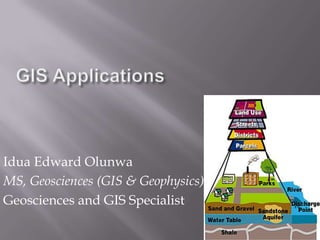
GIS ApplicationsIdua Edward OlunwaMS, Geosciences (GIS & Geophysics)Geosciences and GIS Specialist1
ContentUrban Planning3D ModellingEnvironmental AnalysisHydrocarbon ExplorationAsset and Security Management. . . . . . . . the application of GIS is limited only by the imagination of those who use it. – Jack Dangermond2
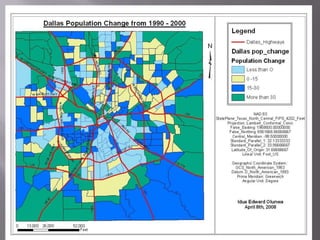
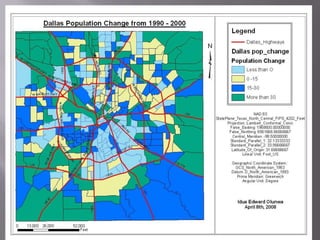
Urban PlanningAspects and Impacts of Urban PlanningThe Physical aspects (Spatial)–includes environmental – vegetation, land ownership, mosques/churches, recreation, public transport, boundary/county lines, surface water; physical infrastructure – roads, pipelines,  hospitals, schools; and topographic data – elevation, scale);Demographic (Attribute)The population and their characteristics such as include sex, race, age, income, disabilities, mobility (in terms of travel time to work or number of vehicles available), educational attainment, home ownership, employment status, and even location . 3
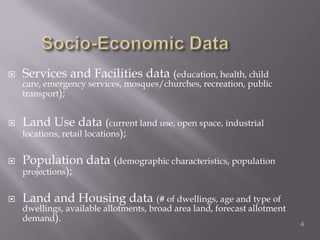
Socio-Economic DataServices and Facilities data (education, health, child care, emergency services, mosques/churches, recreation, public transport);Land Use data (current land use, open space, industrial locations, retail locations);Population data (demographic characteristics, population projections);Land and Housing data (# of dwellings, age and type of dwellings, available allotments, broad area land, forecast allotment demand).4
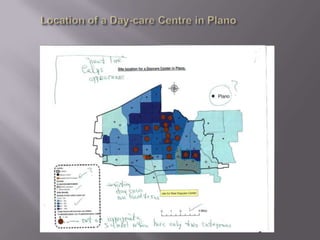
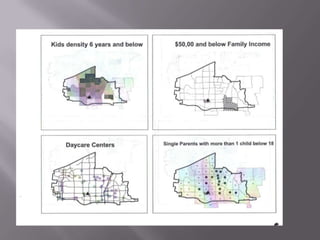
Location of a Day-care Centre in Plano
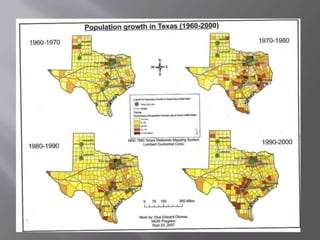
 Population change in Texas11
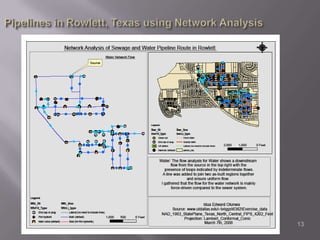
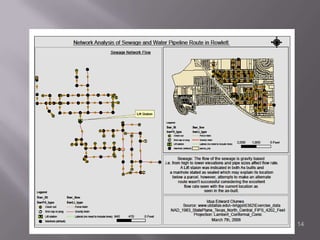
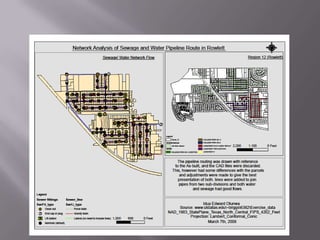
Pipelines in Rowlett, Texas using Network Analysis13
14
 Applications of Urban PlanningAnalysis of development trends;Population growth;Analysis and monitoring of land and housing markets;Development of regional strategic plans;Development of community plans;Analysis of school bus transport systems;Modelling of accessibility to public transport.16
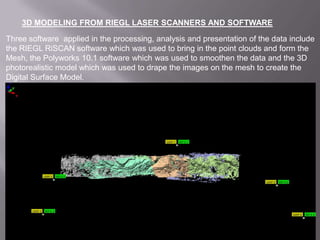
3D MODELING FROM RIEGL LASER SCANNERS AND SOFTWARE Three software  applied in the processing, analysis and presentation of the data include the RIEGL RiSCAN software which was used to bring in the point clouds and form the Mesh, the Polyworks 10.1 software which was used to smoothen the data and the 3D photorealistic model which was used to drape the images on the mesh to create the Digital Surface Model.
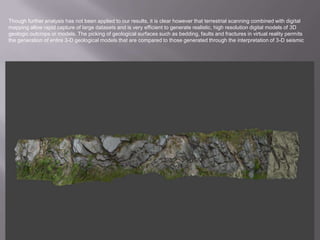
Though further analysis has not been applied to our results, it is clear however that terrestrial scanning combined with digital mapping allow rapid capture of large datasets and is very efficient to generate realistic, high resolution digital models of 3D geologic outcrops or models. The picking of geological surfaces such as bedding, faults and fractures in virtual reality permits the generation of entire 3-D geological models that are compared to those generated through the interpretation of 3-D seismic
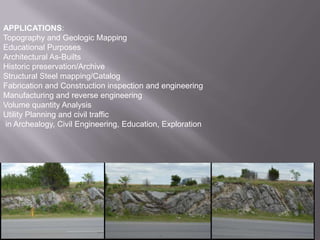
APPLICATIONS:Topography and Geologic MappingEducational PurposesArchitectural As-BuiltsHistoric preservation/ArchiveStructural Steel mapping/CatalogFabrication and Construction inspection and engineeringManufacturing and reverse engineeringVolume quantity AnalysisUtility Planning and civil traffic in Archealogy, Civil Engineering, Education, Exploration
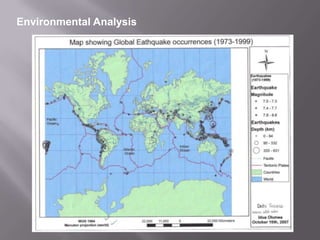
Environmental Analysis
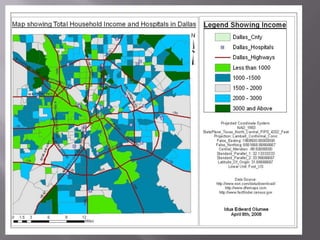
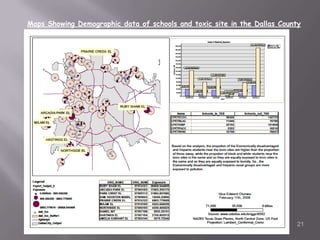
Maps Showing Demographic data of schools and toxic site in the Dallas County21
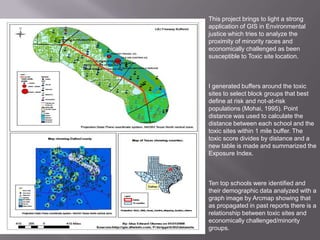
This project brings to light a strong application of GIS in Environmental justice which tries to analyze the proximity of minority races and economically challenged as been susceptible to Toxic site location. I generated buffers around the toxic sites to select block groups that best define at risk and not-at-risk populations (Mohai, 1995). Point distance was used to calculate the distance between each school and the toxic sites within 1 mile buffer. The toxic score divides by distance and a new table is made and summarized the Exposure Index. Ten top schools were identified and their demographic data analyzed with a graph image by Arcmap showing that as propagated in past reports there is a relationship between toxic sites and economically challenged/minority groups.
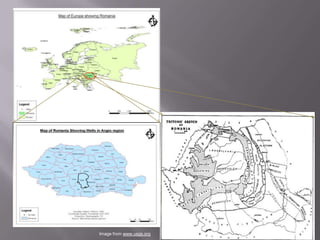
GIS in ExplorationA case of RomaniaGeospatial information, including maps and images and their attributes, are vital to support decision making at various level and implementation of action plans .23
Image from www.usgs.org
GeologyIzvoru field is mainly underlaid by clastic reservoirs with stratigraphic traps, The field is a monocline structure that does not appear to have a time or depth closure.  There were 34 wells drilled in the field, 16 were abandoned either during drilling or after testing, and 18 wells were productive. .  Several wells on the southern flank (up dip side) of the field were non-productive, even though the log response is similar to successful wells in the field.  The interpretation is that some of the wells were drilled (drilling problems or overbalanced) or tested improperly (bad casing and / or cement problems) and that there is some type of porosity limit to the south. Below the Sarmatian there are two additional targets:  the Upper Cretaceous Senonian carbonates, and the Albian carbonates.  The Senonian is directly beneath the Sarmatian and has a similar geometry. Based on third party engineering studies, the combined Sarmatian and Albian formations contained original resources in place of approximately 22 million barrels of oil (2.8 million tons). Completion difficulties and water production resulted in limited flow rates and recoveries leading to field abandonment in 1998. 25
Petroleum DevelopmentFirst country registered in world statistics with a commercial production of 275 metric tones of crude oil in 1857 (Ionescu, 1994).
 The first place Crude oil was exploited from wells dug manually drilled as early as the 17th and 18th centuries (Dinu et al, 1996). first well was drilled mechanically was done in Moldavia down to 150m depth in 1861, while in 1862, oil was discovered in Ploiesti district.
The first gas field was discovered in 1909 at Sarmasel in the Transylvania Basin and the first European gas piping system was built in Transylvania in 1913.
Since then, more than 23,600 geological wells have been drilled onshore and 50 offshore Romania and they have discovered 19.2 billion barrels of oil-in-place and 23.7 trillion ft3 of gas-in-place, and located 473 oil and 201 gas reservoirs. More than 400 of the wells are deeper than 3500m
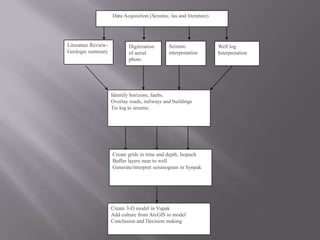
According to well classification used in Romania, ‘geological wells’ are understood to be wells which have contributed to the discovery and the delineation of oil and gas fields (Ionescu, 1994).Literature Review-Geologic summarySeismic interpretationWell log InterpretationDigitization of aerial photoIdentify horizons, faults.Overlay roads, railways and buildingsTie log to seismicCreate grids in time and depth, IsopachBuffer layers near to wellGenerate/interpret seismogram in SynpakCreate 3-D model in VupakAdd culture from ArcGIS to modelConclusion and Decision making          Data Acquisition (Seismic, las and literature)
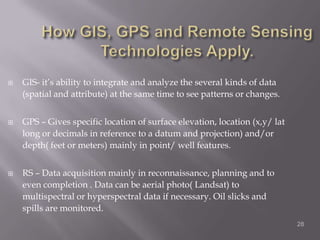
How GIS, GPS and Remote Sensing Technologies Apply.GIS- it’s ability to integrate and analyze the several kinds of data (spatial and attribute) at the same time to see patterns or changes.GPS – Gives specific location of surface elevation, location (x,y/ lat long or decimals in reference to a datum and projection) and/or depth( feet or meters) mainly in point/ well features.RS – Data acquisition mainly in reconnaissance, planning and to even completion . Data can be aerial photo( Landsat) to multispectral or hyperspectral data if necessary. Oil slicks and spills are monitored.28
Why GIS, GPS and Remote Sensing TechnologiesThe expenses involved in the Oil and gas sector require a careful assessment and evaluation from the Business and technical heads. A proper presentation of these facts and figures would bridge this differences and expedient the job.The ability to provide and visualize and analyze all that encompasses exploration and exploitation such as finding prospects, economic considerations, environmental management, asset management as well as the demographic/Social implications. The value added increases our prospect leads and inventory and provides better information to carry the engineers and management along while minimizing our risks and saving man hours 29
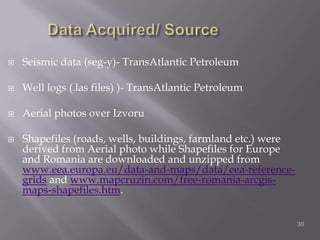
Data Acquired/ SourceSeismic data (seg-y)- TransAtlantic PetroleumWell logs (.las files) )- TransAtlantic PetroleumAerial photos over IzvoruShapefiles (roads, wells, buildings, farmland etc.) were derived from Aerial photo while Shapefiles for Europe and Romania are downloaded and unzipped from www.eea.europa.eu/data-and-maps/data/eea-reference-grids and www.mapcruzin.com/free-romania-arcgis-maps-shapefiles.htm.	30
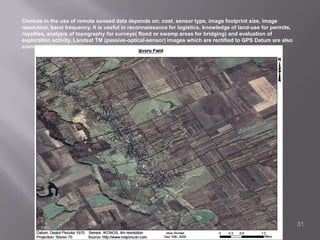
Choices in the use of remote sensed data depends on: cost, sensor type, image footprint size, image resolution, band frequency. It is useful in reconnaissance for logistics, knowledge of land-use for permits, royalties, analysis of topography for surveys( flood or swamp areas for bridging) and evaluation of exploration activity. Landsat TM (passive-optical-sensor) images which are rectified to GPS Datum are also commendable.31
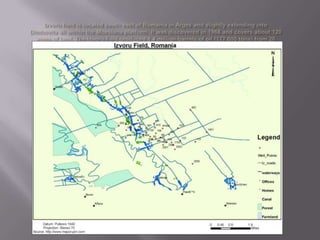
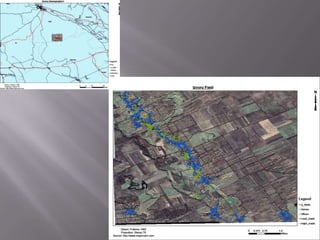
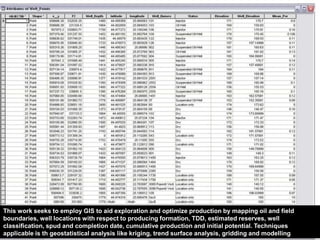
Aerial photo interpretation with such image made smaller features like electrical poles difficult to identify, however, some major features of interest were covered. Commercial areas were identified from residential areas with paved floors and large parking lot and cars while forest areas differed from farmland due to uneven arrangements while rivers ere differentiated from canals based on paths and proximity to farmlandsRoads, Homes, canals forests were digitized in ArcView. Well points were converting from lat/long to x,y coordinates. Surface well locations were picked over bottom well locations from SMT Kingdom, these were in X,Y coordinates and were input into Notepad and imported as a table into the file geodatabase.Tables and attributes follow.32
Izvoru field is located south east of Romania in Arges and slightly extending into Dimbovita all within the Moesiana platform. It was discovered in 1968 and covers about 120 acres of land. The Izvoru field produced 1.4 million barrels of oil (177,000 tons) from 26 wells according to 1996 government records.
This work seeks to employ GIS to aid exploration and optimize production by mapping oil and field boundaries, well locations with respect to producing formation, TDD, estimated reserves, well classification, spud and completion date, cumulative production and initial potential. Techniques applicable is th geostatistical analysis like kriging, trend surface analysis, gridding and modelling35
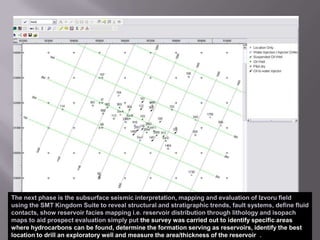
The next phase is the subsurface seismic interpretation, mapping and evaluation of Izvoru field using the SMT Kingdom Suite to reveal structural and stratigraphic trends, fault systems, define fluid contacts, show reservoir facies mapping i.e. reservoir distribution through lithology and isopach maps to aid prospect evaluation simply put the survey was carried out to identify specific areas where hydrocarbons can be found, determine the formation serving as reservoirs, identify the best location to drill an exploratory well and measure the area/thickness of the reservoir . 36
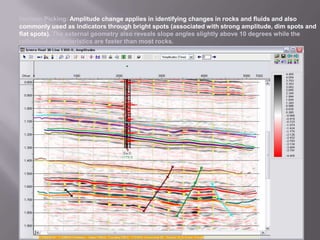
Horizon Picking: Amplitude change applies in identifying changes in rocks and fluids and also commonly used as indicators through bright spots (associated with strong amplitude, dim spots and flat spots). The external geometry also reveals slope angles slightly above 10 degrees while the reflection characteristics are faster than most rocks.
 The number of horizons required can be between the shallowest, middle and deepest points of the seismic section but for areas of stratigraphic and structural complexities, four or more horizons is required the define the regional framework. These framework horizons as much as possible; result from higher amplitude events and stretch laterally under the surface area.
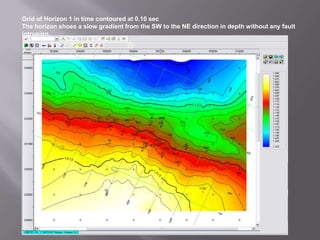
 Horizons were picked from troughs and peaks and labeled differently, sine peaks are the required standard in the US and troughs in the UK. Both were used to create time and depth grids, amplitude maps and isopach maps. The time slices was picked at several depths to view for channels and other stratigraphic influences on the reservoir.Grid of Horizon 1 in time contoured at 0.10 secThe horizon shoes a slow gradient from the SW to the NE direction in depth without any fault intrusion.
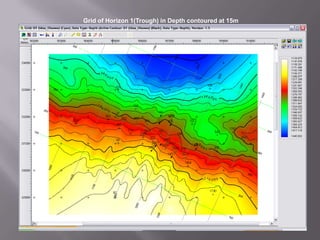
	Grid of Horizon 1(Trough) in Depth contoured at 15m
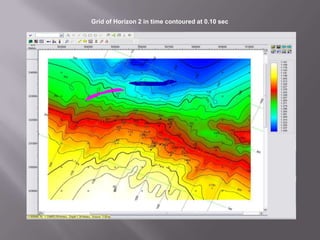
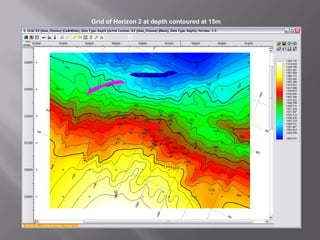
Grid of Horizon 2 in time contoured at 0.10 sec
              Grid of Horizon 2 at depth contoured at 15m
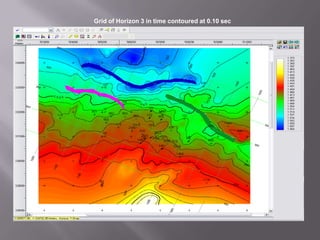
Grid of Horizon 3 in time contoured at 0.10 sec
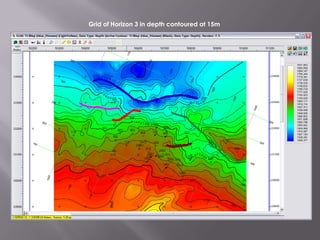
Grid of Horizon 3 in depth contoured at 15m
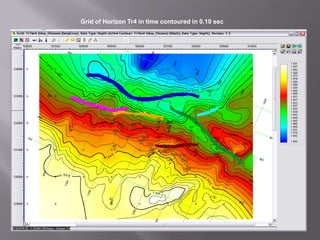
Grid of Horizon Tr4 in time contoured in 0.10 sec
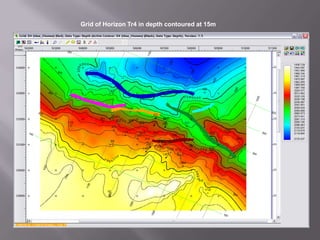
Grid of Horizon Tr4 in depth contoured at 15m
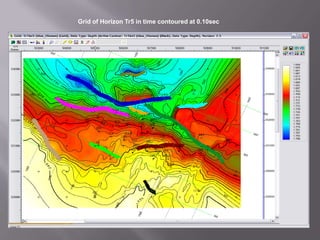
Grid of Horizon Tr5 in time contoured at 0.10sec
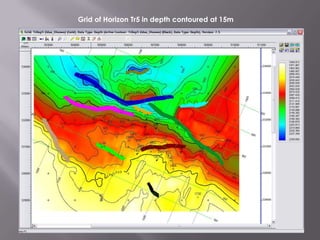
Grid of Horizon Tr5 in depth contoured at 15m
Amplitude map of Tr3 showing possible accumulations at 0.25 contours
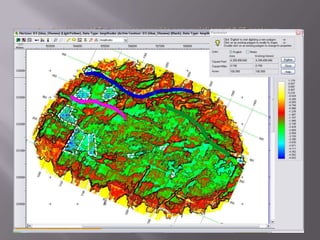
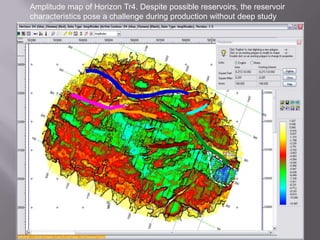
Amplitude map of Horizon Tr4. Despite possible reservoirs, the reservoir characteristics pose a challenge during production without deep study
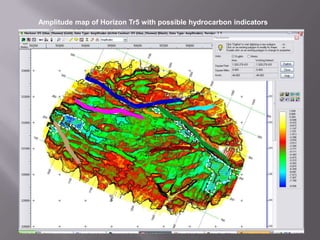
Amplitude map of Horizon Tr5 with possible hydrocarbon indicators
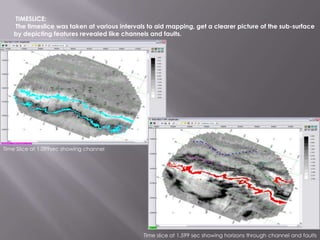
 TIMESLICE: The timeslice was taken at various intervals to aid mapping, get a clearer picture of the sub-surface    by depicting features revealed like channels and faults.Time Slice at 1.099sec showing channelTime slice at 1.599 sec showing horizons through channel and faultsTime slice at 1.999 sec showing channels and the mapped horizons
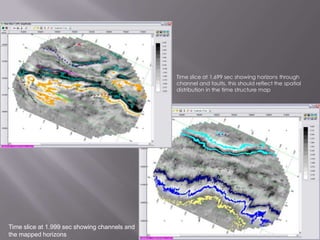
Time slice at 1.699 sec showing horizons through channel and faults, this should reflect the spatial distribution in the time structure mapTime slice at 1.999 sec showing channels and the mapped horizons
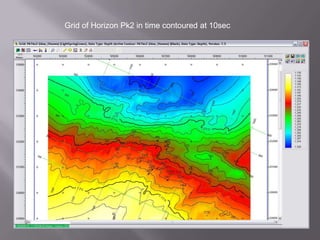
Grid of Horizon Pk2 in time contoured at 10sec
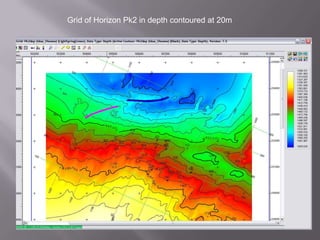
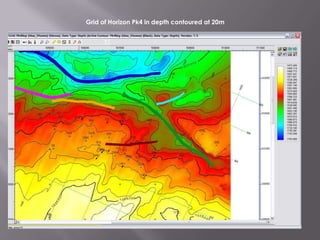
Grid of Horizon Pk2 in depth contoured at 20m
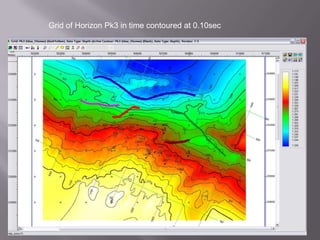
Grid of Horizon Pk3 in time contoured at 0.10sec
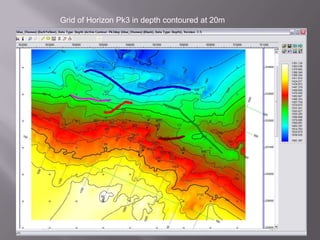
          Grid of Horizon Pk3 in depth contoured at 20m
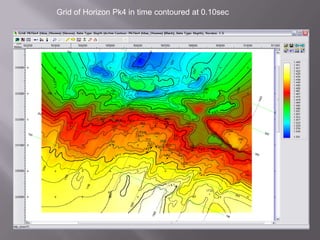
	Grid of Horizon Pk4 in time contoured at 0.10sec
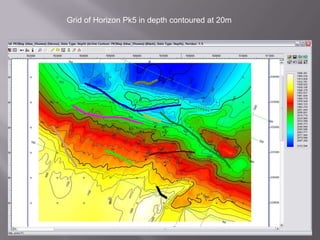
Grid of Horizon Pk4 in time contoured at 0.10secGrid of Horizon Pk4 in depth contoured at 20mGrid of Horizon Pk5 in depth contoured at 20m
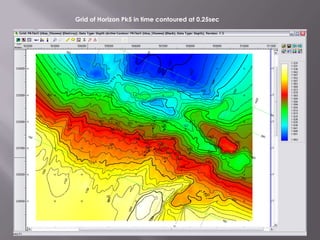
Grid of Horizon Pk5 in time contoured at 0.25sec
       Grid of Horizon Pk5 in depth contoured at 20m
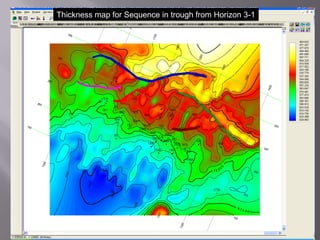
Thickness map for Sequence in trough from Horizon 3-1
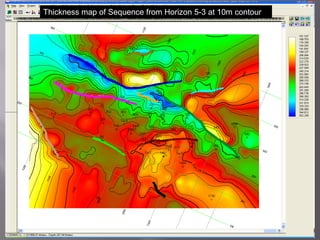
Thickness map of Sequence from Horizon 5-3 at 10m contour
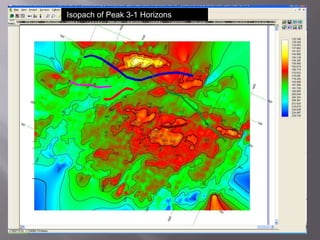
 Isopach of Peak 3-1 Horizons
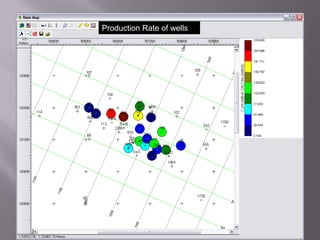
Production Rate of wells
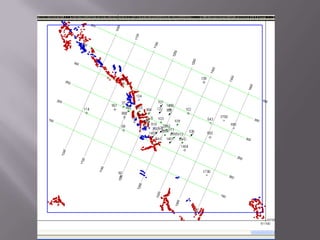
Faults The initial stage in mapping is to delineate faults reflecting by a break and displacement in continuity of horizons. These displacements give insight on the type of fault as normal faults which create downlaps are mainly categorized in the Izvoru Field.
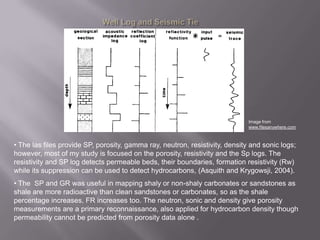
 Though the reservoirs are mainly stratigraphic, the location of these horizon cut-offs, the attendant fault widths and possible overlap/downlap in these prospective and potential fault traps are significant to the economics from the well and its technical design in exploitation  Well Log and Seismic TieImage from www.filesanywhere.com The las files provide SP, porosity, gamma ray, neutron, resistivity, density and sonic logs; however, most of my study is focused on the porosity, resistivity and the Sp logs. The resistivity and SP log detects permeable beds, their boundaries, formation resistivity (Rw) while its suppression can be used to detect hydrocarbons, (Asquith and Krygowsji, 2004).
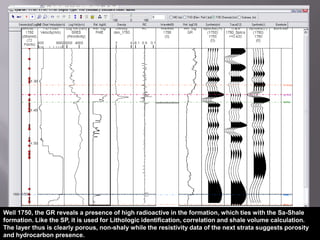
 The  SP and GR was useful in mapping shaly or non-shaly carbonates or sandstones as shale are more radioactive than clean sandstones or carbonates, so as the shale percentage increases, FR increases too. The neutron, sonic and density give porosity measurements are a primary reconnaissance, also applied for hydrocarbon density though permeability cannot be predicted from porosity data alone . Using Synpak, the synthetic is tied to the seismic data and stretched and squeezed as necessary to reduce dispersion between seismic velocities and sonic log velocities.
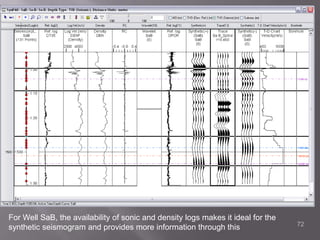
 The synthetic seismogram gives a valid model which reflects the earth’s layers response to the energy wave, a one-dimensional presentation of the acoustic energy that went through the layers. The reflection coefficient is the ratio of the reflected wave to incident wave at point of reflection; it is computed by an equation stirred by a contrast in boundaries due to acoustic impedance where  RC= Amplitude reflected  = V1P1- V2P2                                                Amplitude incident        V1P1+V2P2 The acoustic log is generated by calibrated with the check-shot or vertical seismic profile (VSP) first arrival information as we have in from Well Sa-D, then combined with a density log to give the acoustic impedance whereZ=PV, The acoustic impedance (Z)of a material as defined by the product of its density and acoustic/seismic velocity. This factor reflects in the reflection coefficient. The synthetic is derived by convoluting the reflectivity derived from the density and velocity logs with a zero-phase or minimum phase derived from the seismic data.
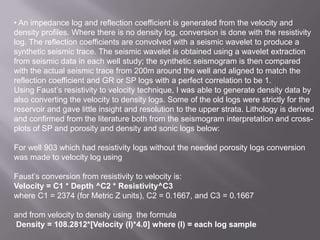
 An impedance log and reflection coefficient is generated from the velocity and density profiles. Where there is no density log, conversion is done with the resistivity log. The reflection coefficients are convolved with a seismic wavelet to produce a synthetic seismic trace. The seismic wavelet is obtained using a wavelet extraction from seismic data in each well study; the synthetic seismogram is then compared with the actual seismic trace from 200m around the well and aligned to match the reflection coefficient and GR or SP logs with a perfect correlation to be 1.Using Faust’s resistivity to velocity technique, I was able to generate density data by also converting the velocity to density logs. Some of the old logs were strictly for the reservoir and gave little insight and resolution to the upper strata. Lithology is derived and confirmed from the literature both from the seismogram interpretation and cross-plots of SP and porosity and density and sonic logs below:For well 903 which had resistivity logs without the needed porosity logs conversion was made to velocity log using Faust’s conversion from resistivity to velocity is: Velocity = C1 * Depth ^C2 * Resistivity^C3where C1 = 2374 (for Metric Z units), C2 = 0.1667, and C3 = 0.1667and from velocity to density using  the formula Density = 108.2812*[Velocity (l)*4.0] where (l) = each log sample
Well 1750, the GR reveals a presence of high radioactive in the formation, which ties with the Sa-Shale formation. Like the SP, it is used for Lithologic identification, correlation and shale volume calculation. The layer thus is clearly porous, non-shaly while the resistivity data of the next strata suggests porosity and hydrocarbon presence.
For Well SaB, the availability of sonic and density logs makes it ideal for the synthetic seismogram and provides more information through this 72
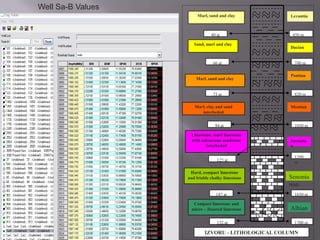
Well Sa-B ValuesMarl, sand and clayLevantin450 m40 atSand, marl and clayDacian740 m66 atPontianMarl, sand and clay820 m73 atMeotianMarl, clay and sand interbeded1050 m94 atLimestone, marl limestone with calcareous sandstone interbededSarmatian*1390 m125 atHard, compact limestone and friable chalky limestoneSenoniannn1650 m147 atCompact limestone and micro – fissured limestoneAlbian1700 m152 atIZVORU - LITHOLOGICAL COLUMN
                                Well Sa-B Values
Discussion and ConclusionThe wells encountered at least three reservoirs: the Sarmatian, the Senonian, and the Albian. The first reservoir encountered should be the Sarmatian; which is the main reservoir of the Izvoru field.  Regionally the Sarmatian is a very prolific reservoir throughout the Moesian platform.  It is Middle Miocene in age and it developed uncomfortably on the Upper Cretaceous. The lithology is not clearly established, but is interpreted as oolitic sandstone. The average effective porosity (derived from resistivity logs) of the sands is 13%.  It is easier in the long term that core of the reservoir be analyzed to effective establish its properties. Senonian-The second reservoir encountered will be the Upper Cretaceous Senonian age carbonate units that lie directly beneath the Sarmatian sands.  SP log response indicates that it is a permeable unit.  The limited resistivity logs have a significant kick to the right. Albian- The third reservoir encountered will be the Albian carbonates.  The lithology varies from calcareous sandstone to sandy limestone.  The reservoir study by TRACS indicated that the Albian could be subdivided into a cleaner upper unit and into to a more argillaceous (shaly) lower unit.

Gis Applications Presentation

  • 1.
    GIS ApplicationsIdua EdwardOlunwaMS, Geosciences (GIS & Geophysics)Geosciences and GIS Specialist1
  • 2.
    ContentUrban Planning3D ModellingEnvironmentalAnalysisHydrocarbon ExplorationAsset and Security Management. . . . . . . . the application of GIS is limited only by the imagination of those who use it. – Jack Dangermond2
  • 3.
    Urban PlanningAspects andImpacts of Urban PlanningThe Physical aspects (Spatial)–includes environmental – vegetation, land ownership, mosques/churches, recreation, public transport, boundary/county lines, surface water; physical infrastructure – roads, pipelines, hospitals, schools; and topographic data – elevation, scale);Demographic (Attribute)The population and their characteristics such as include sex, race, age, income, disabilities, mobility (in terms of travel time to work or number of vehicles available), educational attainment, home ownership, employment status, and even location . 3
  • 4.
    Socio-Economic DataServices andFacilities data (education, health, child care, emergency services, mosques/churches, recreation, public transport);Land Use data (current land use, open space, industrial locations, retail locations);Population data (demographic characteristics, population projections);Land and Housing data (# of dwellings, age and type of dwellings, available allotments, broad area land, forecast allotment demand).4
  • 5.
    Location of aDay-care Centre in Plano
  • 11.
  • 13.
    Pipelines in Rowlett,Texas using Network Analysis13
  • 14.
  • 16.
    Applications ofUrban PlanningAnalysis of development trends;Population growth;Analysis and monitoring of land and housing markets;Development of regional strategic plans;Development of community plans;Analysis of school bus transport systems;Modelling of accessibility to public transport.16
  • 17.
    3D MODELING FROMRIEGL LASER SCANNERS AND SOFTWARE Three software applied in the processing, analysis and presentation of the data include the RIEGL RiSCAN software which was used to bring in the point clouds and form the Mesh, the Polyworks 10.1 software which was used to smoothen the data and the 3D photorealistic model which was used to drape the images on the mesh to create the Digital Surface Model.
  • 18.
    Though further analysishas not been applied to our results, it is clear however that terrestrial scanning combined with digital mapping allow rapid capture of large datasets and is very efficient to generate realistic, high resolution digital models of 3D geologic outcrops or models. The picking of geological surfaces such as bedding, faults and fractures in virtual reality permits the generation of entire 3-D geological models that are compared to those generated through the interpretation of 3-D seismic
  • 19.
    APPLICATIONS:Topography and GeologicMappingEducational PurposesArchitectural As-BuiltsHistoric preservation/ArchiveStructural Steel mapping/CatalogFabrication and Construction inspection and engineeringManufacturing and reverse engineeringVolume quantity AnalysisUtility Planning and civil traffic in Archealogy, Civil Engineering, Education, Exploration
  • 20.
  • 21.
    Maps Showing Demographicdata of schools and toxic site in the Dallas County21
  • 22.
    This project bringsto light a strong application of GIS in Environmental justice which tries to analyze the proximity of minority races and economically challenged as been susceptible to Toxic site location. I generated buffers around the toxic sites to select block groups that best define at risk and not-at-risk populations (Mohai, 1995). Point distance was used to calculate the distance between each school and the toxic sites within 1 mile buffer. The toxic score divides by distance and a new table is made and summarized the Exposure Index. Ten top schools were identified and their demographic data analyzed with a graph image by Arcmap showing that as propagated in past reports there is a relationship between toxic sites and economically challenged/minority groups.
  • 23.
    GIS in ExplorationAcase of RomaniaGeospatial information, including maps and images and their attributes, are vital to support decision making at various level and implementation of action plans .23
  • 24.
  • 25.
    GeologyIzvoru field ismainly underlaid by clastic reservoirs with stratigraphic traps, The field is a monocline structure that does not appear to have a time or depth closure. There were 34 wells drilled in the field, 16 were abandoned either during drilling or after testing, and 18 wells were productive. . Several wells on the southern flank (up dip side) of the field were non-productive, even though the log response is similar to successful wells in the field. The interpretation is that some of the wells were drilled (drilling problems or overbalanced) or tested improperly (bad casing and / or cement problems) and that there is some type of porosity limit to the south. Below the Sarmatian there are two additional targets: the Upper Cretaceous Senonian carbonates, and the Albian carbonates. The Senonian is directly beneath the Sarmatian and has a similar geometry. Based on third party engineering studies, the combined Sarmatian and Albian formations contained original resources in place of approximately 22 million barrels of oil (2.8 million tons). Completion difficulties and water production resulted in limited flow rates and recoveries leading to field abandonment in 1998. 25
  • 26.
    Petroleum DevelopmentFirst countryregistered in world statistics with a commercial production of 275 metric tones of crude oil in 1857 (Ionescu, 1994).
  • 27.
    The firstplace Crude oil was exploited from wells dug manually drilled as early as the 17th and 18th centuries (Dinu et al, 1996). first well was drilled mechanically was done in Moldavia down to 150m depth in 1861, while in 1862, oil was discovered in Ploiesti district.
  • 28.
    The first gasfield was discovered in 1909 at Sarmasel in the Transylvania Basin and the first European gas piping system was built in Transylvania in 1913.
  • 29.
    Since then, morethan 23,600 geological wells have been drilled onshore and 50 offshore Romania and they have discovered 19.2 billion barrels of oil-in-place and 23.7 trillion ft3 of gas-in-place, and located 473 oil and 201 gas reservoirs. More than 400 of the wells are deeper than 3500m
  • 30.
    According to wellclassification used in Romania, ‘geological wells’ are understood to be wells which have contributed to the discovery and the delineation of oil and gas fields (Ionescu, 1994).Literature Review-Geologic summarySeismic interpretationWell log InterpretationDigitization of aerial photoIdentify horizons, faults.Overlay roads, railways and buildingsTie log to seismicCreate grids in time and depth, IsopachBuffer layers near to wellGenerate/interpret seismogram in SynpakCreate 3-D model in VupakAdd culture from ArcGIS to modelConclusion and Decision making Data Acquisition (Seismic, las and literature)
  • 31.
    How GIS, GPSand Remote Sensing Technologies Apply.GIS- it’s ability to integrate and analyze the several kinds of data (spatial and attribute) at the same time to see patterns or changes.GPS – Gives specific location of surface elevation, location (x,y/ lat long or decimals in reference to a datum and projection) and/or depth( feet or meters) mainly in point/ well features.RS – Data acquisition mainly in reconnaissance, planning and to even completion . Data can be aerial photo( Landsat) to multispectral or hyperspectral data if necessary. Oil slicks and spills are monitored.28
  • 32.
    Why GIS, GPSand Remote Sensing TechnologiesThe expenses involved in the Oil and gas sector require a careful assessment and evaluation from the Business and technical heads. A proper presentation of these facts and figures would bridge this differences and expedient the job.The ability to provide and visualize and analyze all that encompasses exploration and exploitation such as finding prospects, economic considerations, environmental management, asset management as well as the demographic/Social implications. The value added increases our prospect leads and inventory and provides better information to carry the engineers and management along while minimizing our risks and saving man hours 29
  • 33.
    Data Acquired/ SourceSeismicdata (seg-y)- TransAtlantic PetroleumWell logs (.las files) )- TransAtlantic PetroleumAerial photos over IzvoruShapefiles (roads, wells, buildings, farmland etc.) were derived from Aerial photo while Shapefiles for Europe and Romania are downloaded and unzipped from www.eea.europa.eu/data-and-maps/data/eea-reference-grids and www.mapcruzin.com/free-romania-arcgis-maps-shapefiles.htm. 30
  • 34.
    Choices in theuse of remote sensed data depends on: cost, sensor type, image footprint size, image resolution, band frequency. It is useful in reconnaissance for logistics, knowledge of land-use for permits, royalties, analysis of topography for surveys( flood or swamp areas for bridging) and evaluation of exploration activity. Landsat TM (passive-optical-sensor) images which are rectified to GPS Datum are also commendable.31
  • 35.
    Aerial photo interpretationwith such image made smaller features like electrical poles difficult to identify, however, some major features of interest were covered. Commercial areas were identified from residential areas with paved floors and large parking lot and cars while forest areas differed from farmland due to uneven arrangements while rivers ere differentiated from canals based on paths and proximity to farmlandsRoads, Homes, canals forests were digitized in ArcView. Well points were converting from lat/long to x,y coordinates. Surface well locations were picked over bottom well locations from SMT Kingdom, these were in X,Y coordinates and were input into Notepad and imported as a table into the file geodatabase.Tables and attributes follow.32
  • 36.
    Izvoru field islocated south east of Romania in Arges and slightly extending into Dimbovita all within the Moesiana platform. It was discovered in 1968 and covers about 120 acres of land. The Izvoru field produced 1.4 million barrels of oil (177,000 tons) from 26 wells according to 1996 government records.
  • 38.
    This work seeksto employ GIS to aid exploration and optimize production by mapping oil and field boundaries, well locations with respect to producing formation, TDD, estimated reserves, well classification, spud and completion date, cumulative production and initial potential. Techniques applicable is th geostatistical analysis like kriging, trend surface analysis, gridding and modelling35
  • 39.
    The next phaseis the subsurface seismic interpretation, mapping and evaluation of Izvoru field using the SMT Kingdom Suite to reveal structural and stratigraphic trends, fault systems, define fluid contacts, show reservoir facies mapping i.e. reservoir distribution through lithology and isopach maps to aid prospect evaluation simply put the survey was carried out to identify specific areas where hydrocarbons can be found, determine the formation serving as reservoirs, identify the best location to drill an exploratory well and measure the area/thickness of the reservoir . 36
  • 40.
    Horizon Picking: Amplitudechange applies in identifying changes in rocks and fluids and also commonly used as indicators through bright spots (associated with strong amplitude, dim spots and flat spots). The external geometry also reveals slope angles slightly above 10 degrees while the reflection characteristics are faster than most rocks.
  • 41.
    The numberof horizons required can be between the shallowest, middle and deepest points of the seismic section but for areas of stratigraphic and structural complexities, four or more horizons is required the define the regional framework. These framework horizons as much as possible; result from higher amplitude events and stretch laterally under the surface area.
  • 42.
    Horizons werepicked from troughs and peaks and labeled differently, sine peaks are the required standard in the US and troughs in the UK. Both were used to create time and depth grids, amplitude maps and isopach maps. The time slices was picked at several depths to view for channels and other stratigraphic influences on the reservoir.Grid of Horizon 1 in time contoured at 0.10 secThe horizon shoes a slow gradient from the SW to the NE direction in depth without any fault intrusion.
  • 43.
    Grid of Horizon1(Trough) in Depth contoured at 15m
  • 44.
    Grid of Horizon2 in time contoured at 0.10 sec
  • 45.
    Grid of Horizon 2 at depth contoured at 15m
  • 46.
    Grid of Horizon3 in time contoured at 0.10 sec
  • 47.
    Grid of Horizon3 in depth contoured at 15m
  • 48.
    Grid of HorizonTr4 in time contoured in 0.10 sec
  • 49.
    Grid of HorizonTr4 in depth contoured at 15m
  • 50.
    Grid of HorizonTr5 in time contoured at 0.10sec
  • 51.
    Grid of HorizonTr5 in depth contoured at 15m
  • 52.
    Amplitude map ofTr3 showing possible accumulations at 0.25 contours
  • 53.
    Amplitude map ofHorizon Tr4. Despite possible reservoirs, the reservoir characteristics pose a challenge during production without deep study
  • 54.
    Amplitude map ofHorizon Tr5 with possible hydrocarbon indicators
  • 55.
    TIMESLICE: Thetimeslice was taken at various intervals to aid mapping, get a clearer picture of the sub-surface by depicting features revealed like channels and faults.Time Slice at 1.099sec showing channelTime slice at 1.599 sec showing horizons through channel and faultsTime slice at 1.999 sec showing channels and the mapped horizons
  • 56.
    Time slice at1.699 sec showing horizons through channel and faults, this should reflect the spatial distribution in the time structure mapTime slice at 1.999 sec showing channels and the mapped horizons
  • 57.
    Grid of HorizonPk2 in time contoured at 10sec
  • 58.
    Grid of HorizonPk2 in depth contoured at 20m
  • 59.
    Grid of HorizonPk3 in time contoured at 0.10sec
  • 60.
    Grid of Horizon Pk3 in depth contoured at 20m
  • 61.
    Grid of HorizonPk4 in time contoured at 0.10sec
  • 62.
    Grid of HorizonPk4 in time contoured at 0.10secGrid of Horizon Pk4 in depth contoured at 20mGrid of Horizon Pk5 in depth contoured at 20m
  • 63.
    Grid of HorizonPk5 in time contoured at 0.25sec
  • 64.
    Grid of Horizon Pk5 in depth contoured at 20m
  • 65.
    Thickness map forSequence in trough from Horizon 3-1
  • 66.
    Thickness map ofSequence from Horizon 5-3 at 10m contour
  • 67.
    Isopach ofPeak 3-1 Horizons
  • 68.
  • 70.
    Faults The initialstage in mapping is to delineate faults reflecting by a break and displacement in continuity of horizons. These displacements give insight on the type of fault as normal faults which create downlaps are mainly categorized in the Izvoru Field.
  • 71.
    Though thereservoirs are mainly stratigraphic, the location of these horizon cut-offs, the attendant fault widths and possible overlap/downlap in these prospective and potential fault traps are significant to the economics from the well and its technical design in exploitation Well Log and Seismic TieImage from www.filesanywhere.com The las files provide SP, porosity, gamma ray, neutron, resistivity, density and sonic logs; however, most of my study is focused on the porosity, resistivity and the Sp logs. The resistivity and SP log detects permeable beds, their boundaries, formation resistivity (Rw) while its suppression can be used to detect hydrocarbons, (Asquith and Krygowsji, 2004).
  • 72.
    The SP and GR was useful in mapping shaly or non-shaly carbonates or sandstones as shale are more radioactive than clean sandstones or carbonates, so as the shale percentage increases, FR increases too. The neutron, sonic and density give porosity measurements are a primary reconnaissance, also applied for hydrocarbon density though permeability cannot be predicted from porosity data alone . Using Synpak, the synthetic is tied to the seismic data and stretched and squeezed as necessary to reduce dispersion between seismic velocities and sonic log velocities.
  • 73.
    The syntheticseismogram gives a valid model which reflects the earth’s layers response to the energy wave, a one-dimensional presentation of the acoustic energy that went through the layers. The reflection coefficient is the ratio of the reflected wave to incident wave at point of reflection; it is computed by an equation stirred by a contrast in boundaries due to acoustic impedance where RC= Amplitude reflected = V1P1- V2P2 Amplitude incident V1P1+V2P2 The acoustic log is generated by calibrated with the check-shot or vertical seismic profile (VSP) first arrival information as we have in from Well Sa-D, then combined with a density log to give the acoustic impedance whereZ=PV, The acoustic impedance (Z)of a material as defined by the product of its density and acoustic/seismic velocity. This factor reflects in the reflection coefficient. The synthetic is derived by convoluting the reflectivity derived from the density and velocity logs with a zero-phase or minimum phase derived from the seismic data.
  • 74.
    An impedancelog and reflection coefficient is generated from the velocity and density profiles. Where there is no density log, conversion is done with the resistivity log. The reflection coefficients are convolved with a seismic wavelet to produce a synthetic seismic trace. The seismic wavelet is obtained using a wavelet extraction from seismic data in each well study; the synthetic seismogram is then compared with the actual seismic trace from 200m around the well and aligned to match the reflection coefficient and GR or SP logs with a perfect correlation to be 1.Using Faust’s resistivity to velocity technique, I was able to generate density data by also converting the velocity to density logs. Some of the old logs were strictly for the reservoir and gave little insight and resolution to the upper strata. Lithology is derived and confirmed from the literature both from the seismogram interpretation and cross-plots of SP and porosity and density and sonic logs below:For well 903 which had resistivity logs without the needed porosity logs conversion was made to velocity log using Faust’s conversion from resistivity to velocity is: Velocity = C1 * Depth ^C2 * Resistivity^C3where C1 = 2374 (for Metric Z units), C2 = 0.1667, and C3 = 0.1667and from velocity to density using the formula Density = 108.2812*[Velocity (l)*4.0] where (l) = each log sample
  • 75.
    Well 1750, theGR reveals a presence of high radioactive in the formation, which ties with the Sa-Shale formation. Like the SP, it is used for Lithologic identification, correlation and shale volume calculation. The layer thus is clearly porous, non-shaly while the resistivity data of the next strata suggests porosity and hydrocarbon presence.
  • 76.
    For Well SaB,the availability of sonic and density logs makes it ideal for the synthetic seismogram and provides more information through this 72
  • 77.
    Well Sa-B ValuesMarl,sand and clayLevantin450 m40 atSand, marl and clayDacian740 m66 atPontianMarl, sand and clay820 m73 atMeotianMarl, clay and sand interbeded1050 m94 atLimestone, marl limestone with calcareous sandstone interbededSarmatian*1390 m125 atHard, compact limestone and friable chalky limestoneSenoniannn1650 m147 atCompact limestone and micro – fissured limestoneAlbian1700 m152 atIZVORU - LITHOLOGICAL COLUMN
  • 78.
    Well Sa-B Values
  • 80.
    Discussion and ConclusionThewells encountered at least three reservoirs: the Sarmatian, the Senonian, and the Albian. The first reservoir encountered should be the Sarmatian; which is the main reservoir of the Izvoru field. Regionally the Sarmatian is a very prolific reservoir throughout the Moesian platform. It is Middle Miocene in age and it developed uncomfortably on the Upper Cretaceous. The lithology is not clearly established, but is interpreted as oolitic sandstone. The average effective porosity (derived from resistivity logs) of the sands is 13%. It is easier in the long term that core of the reservoir be analyzed to effective establish its properties. Senonian-The second reservoir encountered will be the Upper Cretaceous Senonian age carbonate units that lie directly beneath the Sarmatian sands. SP log response indicates that it is a permeable unit. The limited resistivity logs have a significant kick to the right. Albian- The third reservoir encountered will be the Albian carbonates. The lithology varies from calcareous sandstone to sandy limestone. The reservoir study by TRACS indicated that the Albian could be subdivided into a cleaner upper unit and into to a more argillaceous (shaly) lower unit.