Some Statistical Challenges in Studying the West
Antarctic Ice Sheet
Murali Haran
Joint with:
Yawen Guan (Penn State/SAMSI)
Won Chang (U of Cincinnati)
David Pollard (Penn State EESI)
Patrick Applegate (Penn State EESI)
Department of Statistics, Penn State University
Murali Haran, Penn State 1
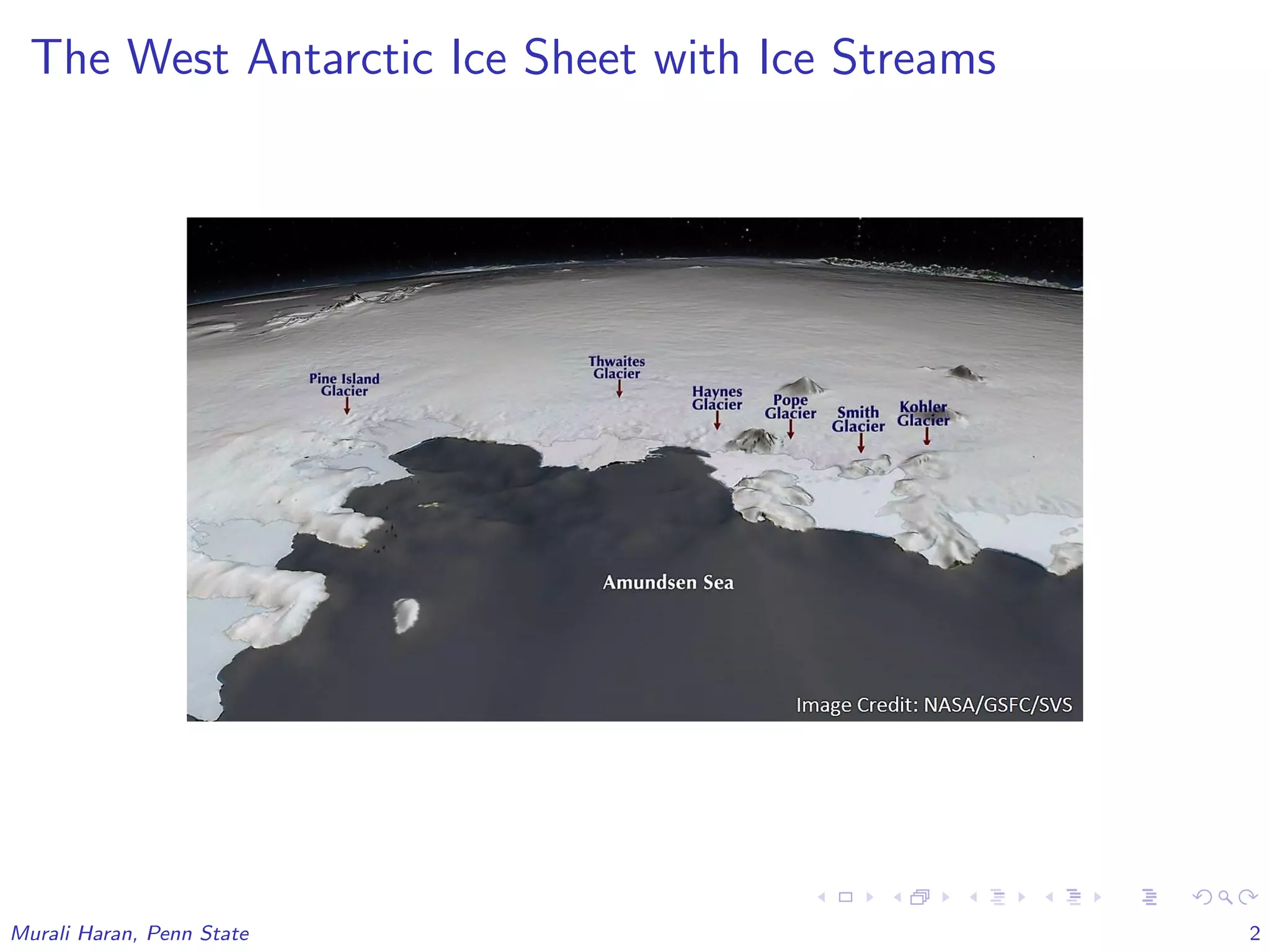
The West Antarctic Ice Sheet with Ice Streams
Murali Haran, Penn State 2
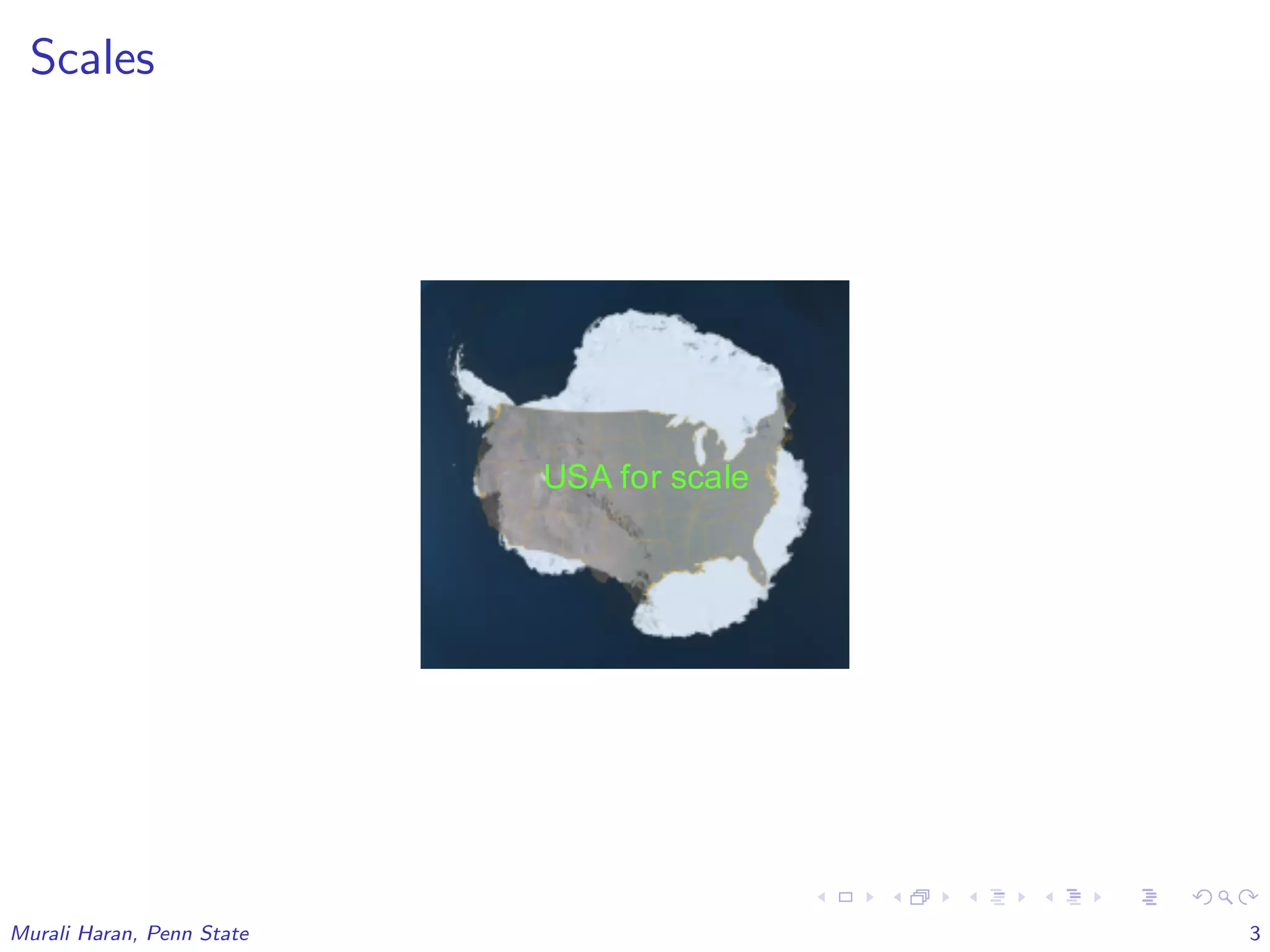
Scales
USA for scale
Murali Haran, Penn State 3
Ice Sheets
Enormous mass of glacial land ice
Antarctic ice sheet is over 14 million km2.
≈ United States + Mexico combined.
Greenland ice sheet over 1.7 million km2
Combine for over 99% of the freshwater ice in the world
Can have major impacts on sea level rise:
Melting entire Antarctic ice sheet: sea level rise ≈ 57 m.
Melting entire Greenland ice sheet: sea level rise ≈ 7 m
Even a modest contribution to sea level rise can have a major
impact on humans, e.g. on low-lying areas and areas prone to
storm surges.
Of interest: learning about ice sheet dynamics, making ice
sheet projections
Murali Haran, Penn State 4
Ice Streams
Corridors of fast flow within an ice sheet
Discharge most of the ice and sediment from the ice sheets
Flow is orders of magnitude faster than the surrounding ice
Their behaviour and stability is important to overall ice sheet
dynamics and mass balance. (cf. Bennett, 2003)
Of interest: understanding ice stream dynamics, learning
about current thickness
Murali Haran, Penn State 5
Consider Two Problems
1. Ice sheets
Sophisticated model for ice sheet, PSUICE3D (DeConto and
Pollard, 2009, 2011): cannot work with the mathematical form
of the model, treat it as a simulator
Computer model emulation-calibration. (1) Fast approximate
(emulated) model runs to see how model behaves as we vary
inputs. (2) Infer parameters of the computer model using:
Model simulations
Observations of the ice sheet: modern (spatial) and historical,
paleo-reconstructed (temporal)
2. Ice streams
Simple mass-balance model for ice stream flow
Surface observational data sets of the ice sheet: velocity, slope,
partial data on thickness
Full statistical inference: infer model parameters + ice sheet
thickness.
This is largely about “marrying physics and statistics” (Kenneth
Kunkel)
Murali Haran, Penn State 6
Ice Sheets Versus Ice Streams
Major difference in scale/model complexity
Physical models for the West Antarctic ice sheet based on
Pollard and De Conto (2009, 2011).
Statistics perspective: Treat the physics like a black box and
estimate parameters
Computer model emulation-calibration
With ice streams: we build statistical model directly using
this simpler physics model
Murali Haran, Penn State 7
Part 1 Overview: Statistical Methods for Ice Sheets
How can we project the future behavior of the West Antarctic
Ice Sheet?
Ice sheet model: PSU3D-ICE (Pollard and DeConto, 2009).
Key model input parameters are uncertain
Calibrate parameters based on observations:
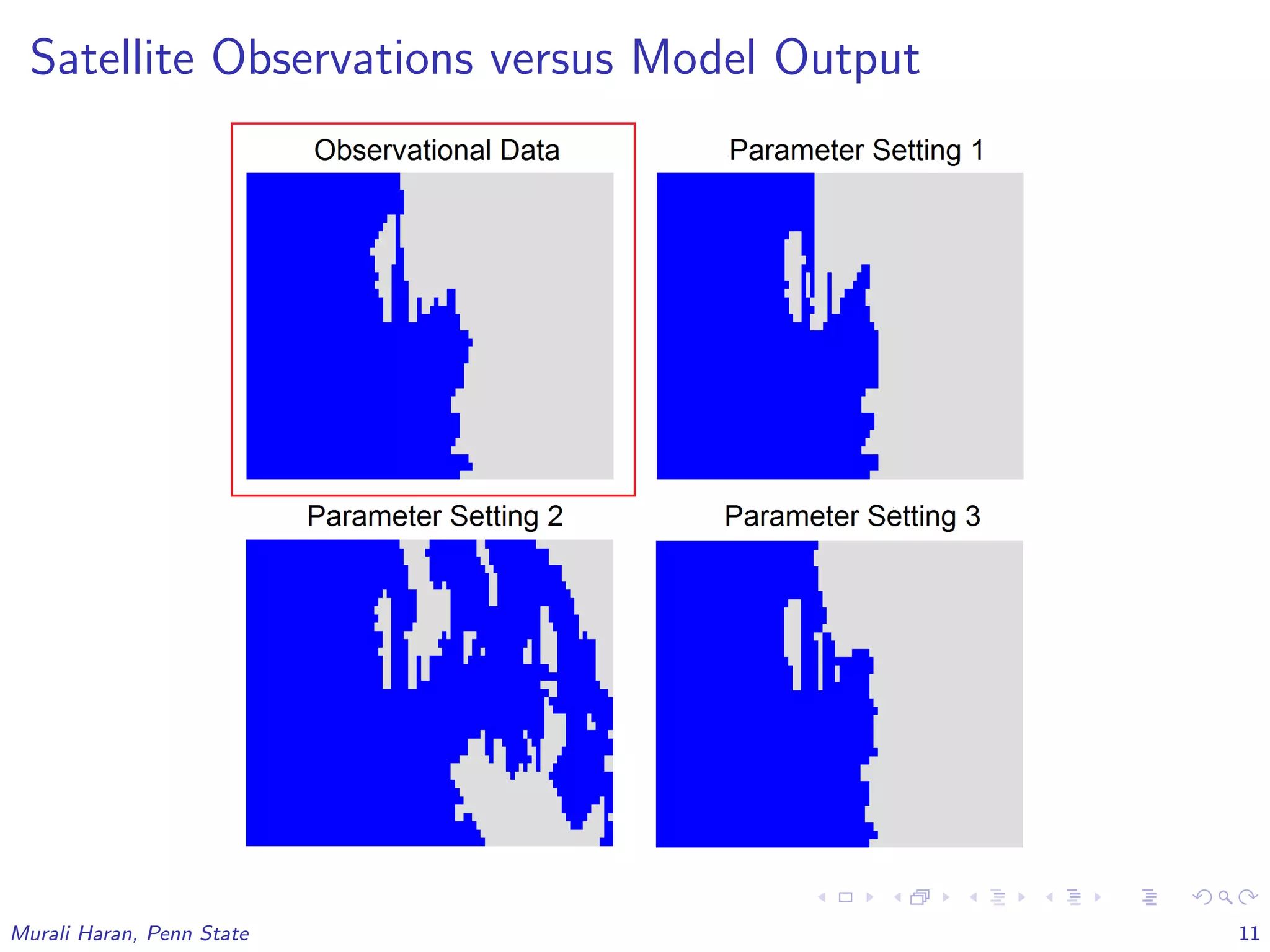
1. Satellite data on the modern ice sheet.
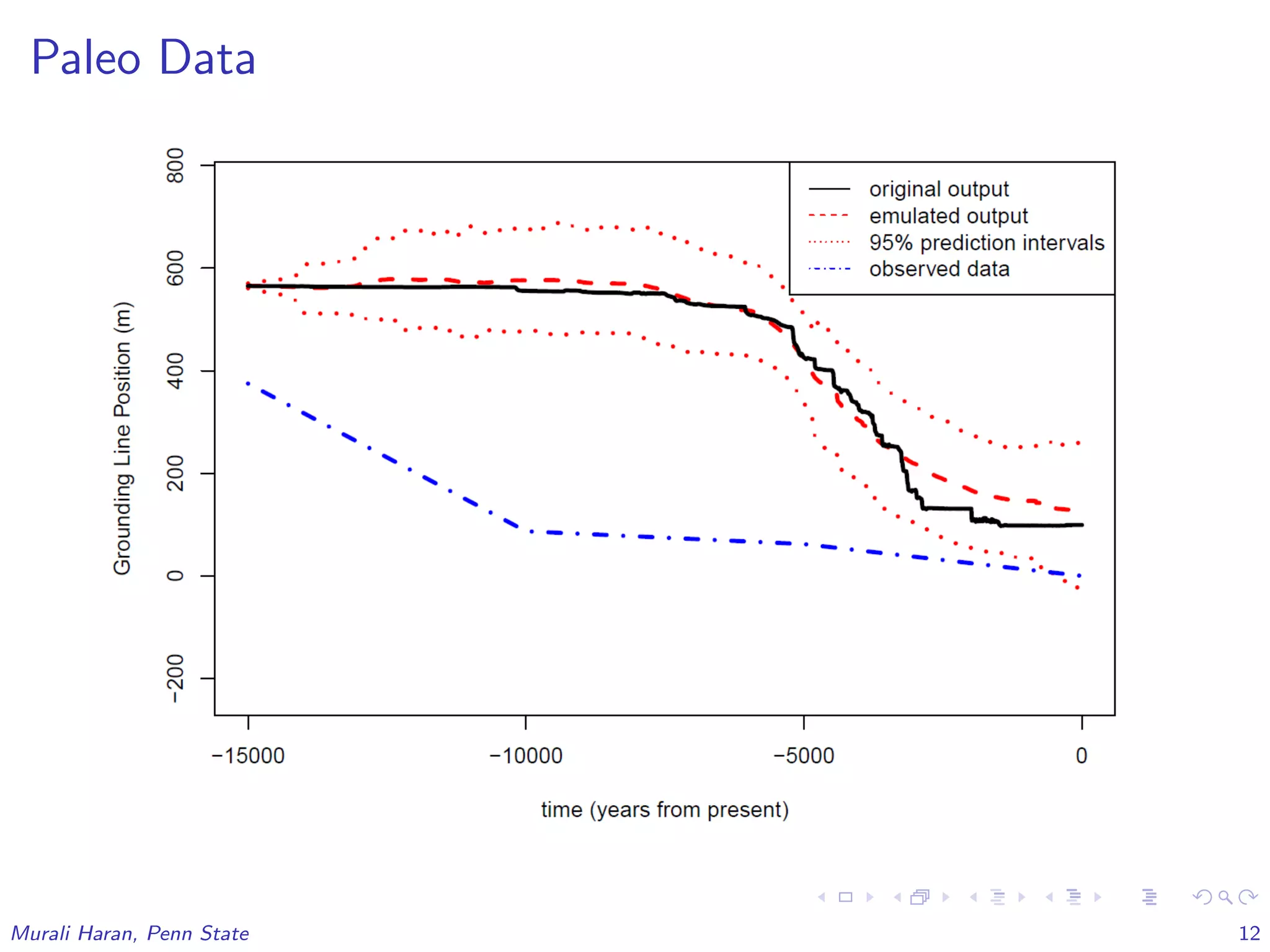
2. Paleo reconstructions of ice sheet from 25,000 years ago to
present time.
Our research: methods to use observations of the ice sheet to
infer important parameters of the ice sheet model.
Statistical/computational challenges:
1. Models simulations are slow
2. Two sets of data: high-dimensional spatial and temporal
binary/non-Gaussian data (“data” = observations and
computer model output)
3. Data-model discrepancies, error structures
Murali Haran, Penn State 8
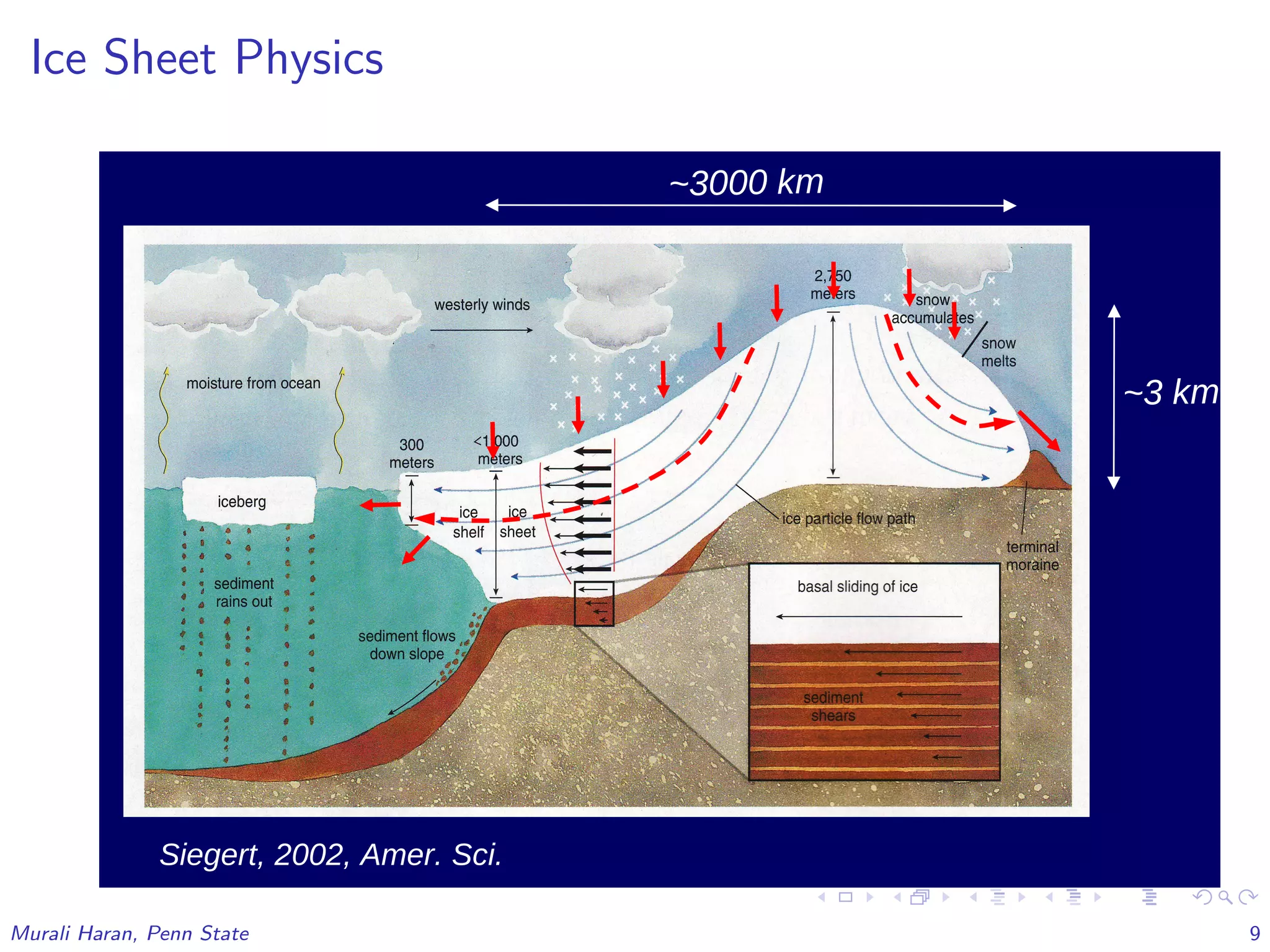
Ice Sheet Physics
•
• is transported by ice flow to lower marginal regions on time scales of
• where it is lost as surface melt, and/or discharge to floating ice shelve
Siegert, 2002, Amer. Sci.
~3 km
~3000 km
Murali Haran, Penn State 9
Ice Sheet Model
The ice sheet’s behavior is complex: takes about 48 hours (at
each parameter setting) for a typical 20-km resolution, 40 kyr
long run
Model equations predict ice flow, thickness, temperatures, and
bedrock elevation, through thousands to millions of years.
Examples of key model parameters:
Ocean melt coefficient: sensitivity of ice sheet to temperature
change in the surrounding ocean
Strength of the “calving” process. Calving = where ice breaks
off and transitions from attached to floating
“Slipperiness” of the ocean floor
Murali Haran, Penn State 10
Satellite Observations versus Model Output
Murali Haran, Penn State 11
Paleo Data
Murali Haran, Penn State 12
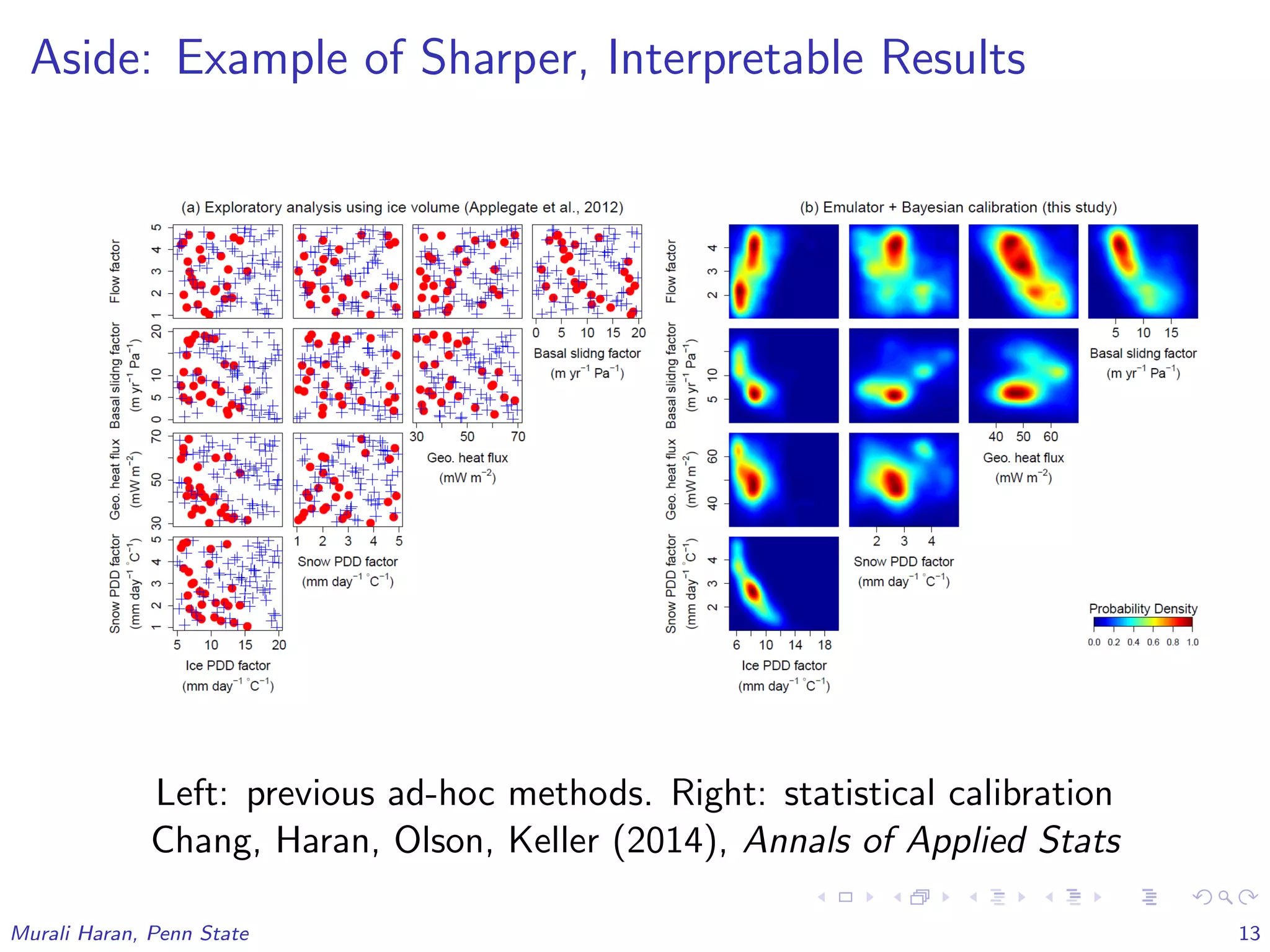
Aside: Example of Sharper, Interpretable Results
Left: previous ad-hoc methods. Right: statistical calibration
Chang, Haran, Olson, Keller (2014), Annals of Applied Stats
Murali Haran, Penn State 13
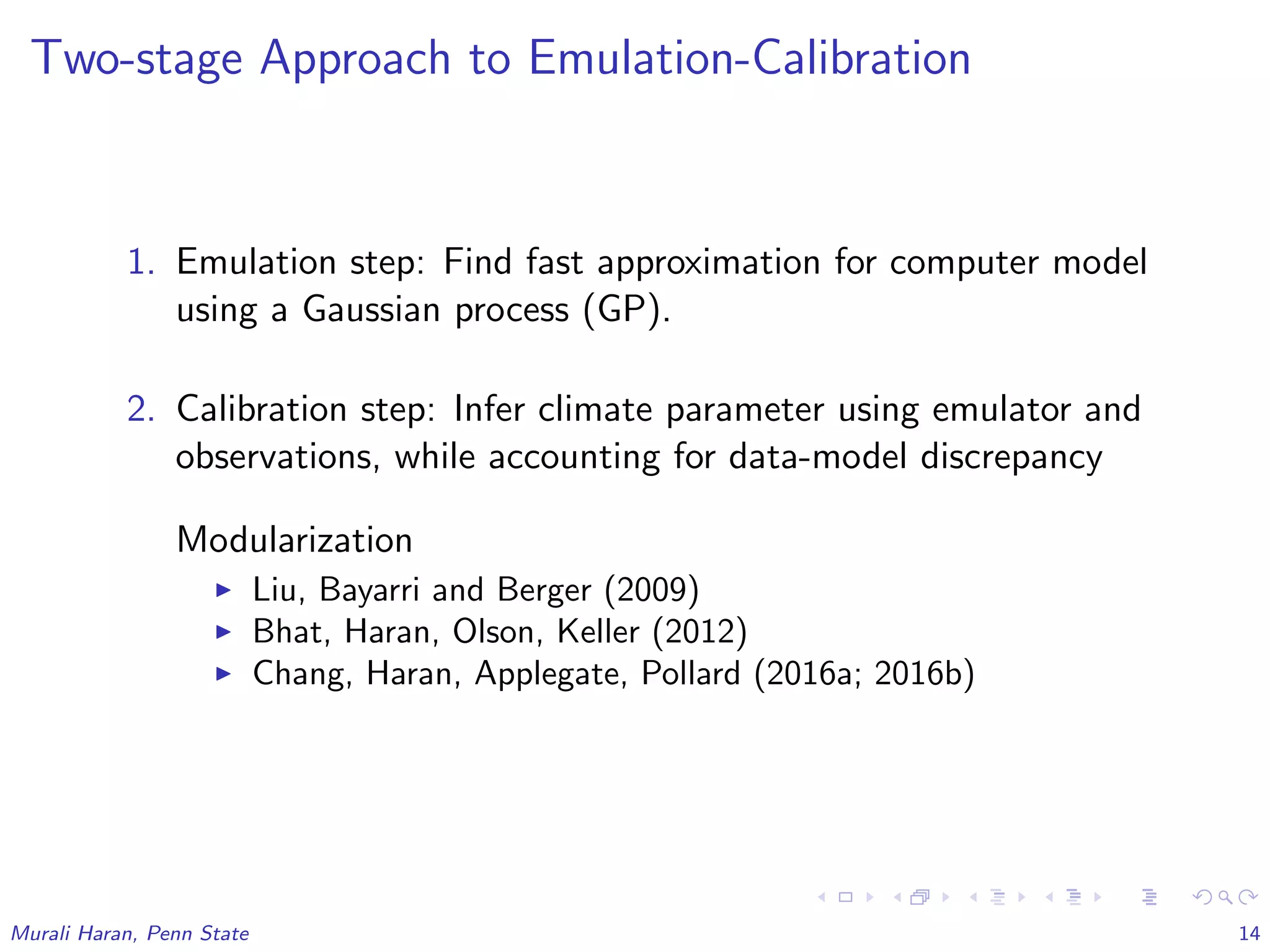
Two-stage Approach to Emulation-Calibration
1. Emulation step: Find fast approximation for computer model
using a Gaussian process (GP).
2. Calibration step: Infer climate parameter using emulator and
observations, while accounting for data-model discrepancy
Modularization
Liu, Bayarri and Berger (2009)
Bhat, Haran, Olson, Keller (2012)
Chang, Haran, Applegate, Pollard (2016a; 2016b)
Murali Haran, Penn State 14
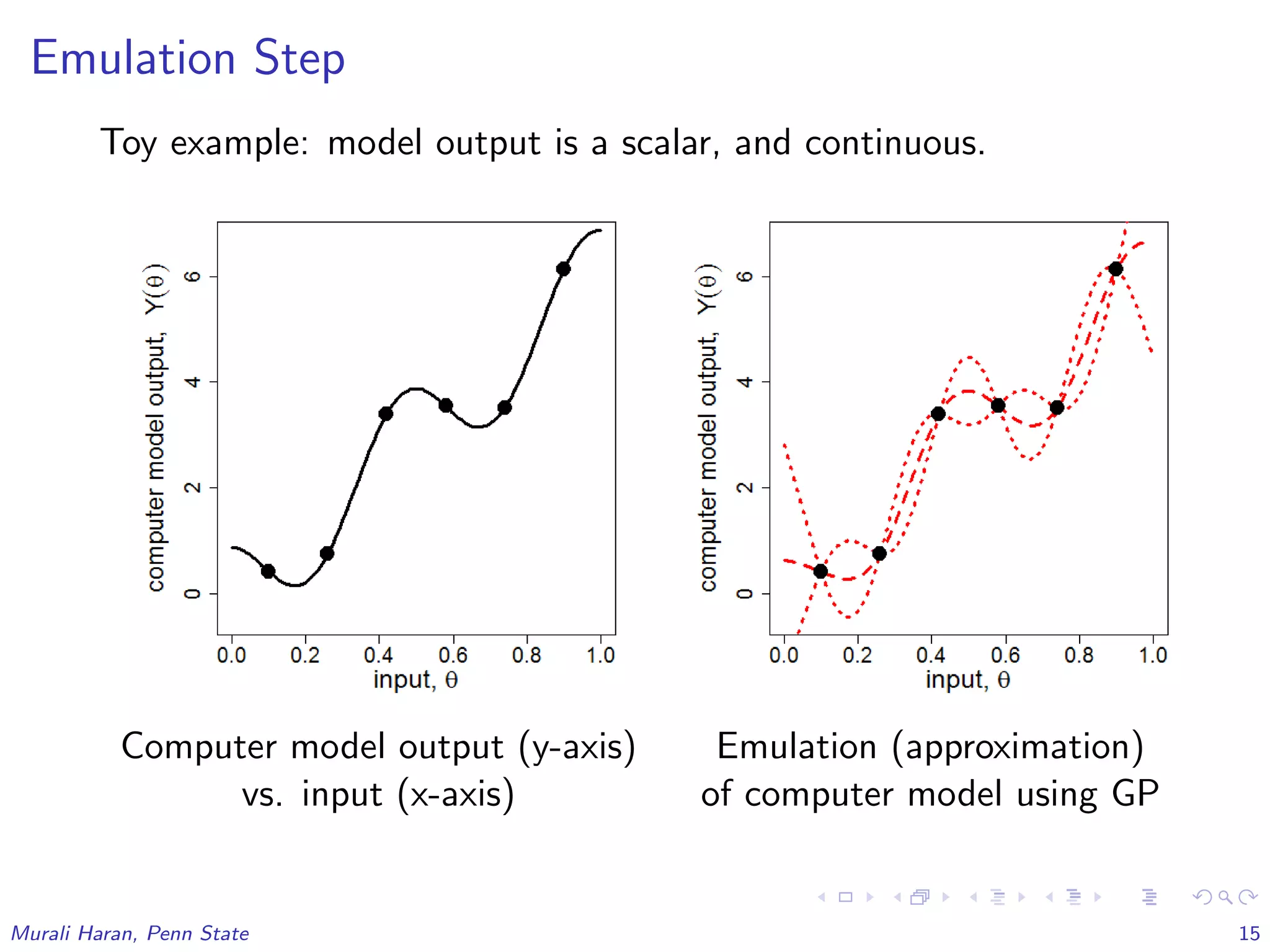
Emulation Step
Toy example: model output is a scalar, and continuous.
Computer model output (y-axis) Emulation (approximation)
vs. input (x-axis) of computer model using GP
Murali Haran, Penn State 15
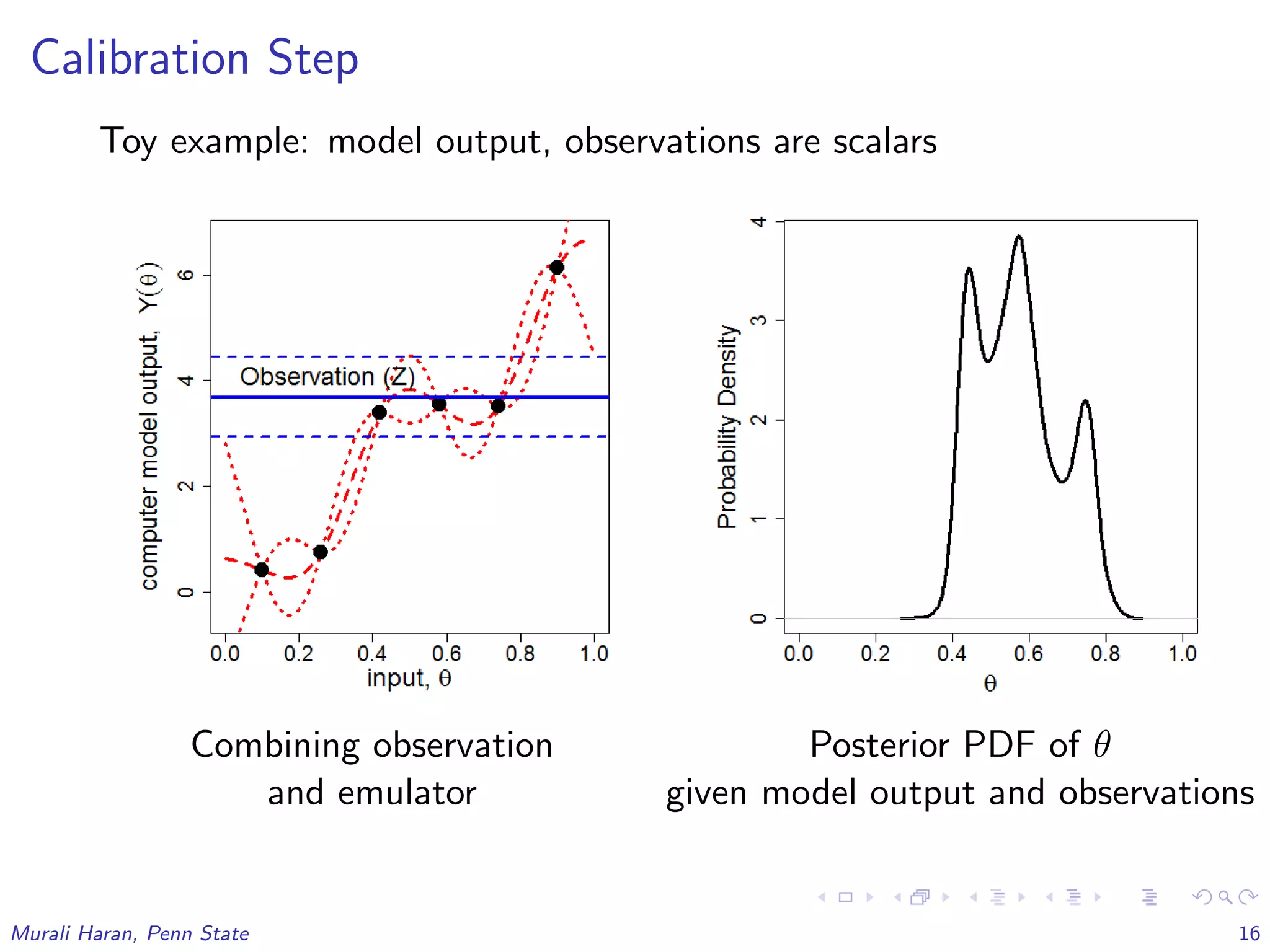
Calibration Step
Toy example: model output, observations are scalars
Combining observation Posterior PDF of θ
and emulator given model output and observations
Murali Haran, Penn State 16
Summary of Statistical Problem
Goal: Learn about θ based on two sources of information:
Observations:
1. Observed time series of past grounding line positions
reconstructed from paleo records: Z1 = (Z1(t1), . . . , Z1(tn))T
,
t1, . . . , tn are time points locations.
2. Observed modern ice-no ice from satellite data:
Z2 = [Z2(s1), . . . , Z2(sm)], locations s1, . . . , sm.
Model output
1. Y1(θ1), . . . , Y1(θp), where each
Y1(θi ) = (Y1(θi , t1), . . . , Y1(θi , tn))T
is a time series of
grounding line positions at parameter setting θi .
2. Y2(θ1), . . . , Y2(θp), where each
Y2(θi ) = (Y2(θi , s1), . . . , Y2(θi , sm))T
is a vector of spatial
data at parameter setting θi .
Murali Haran, Penn State 17
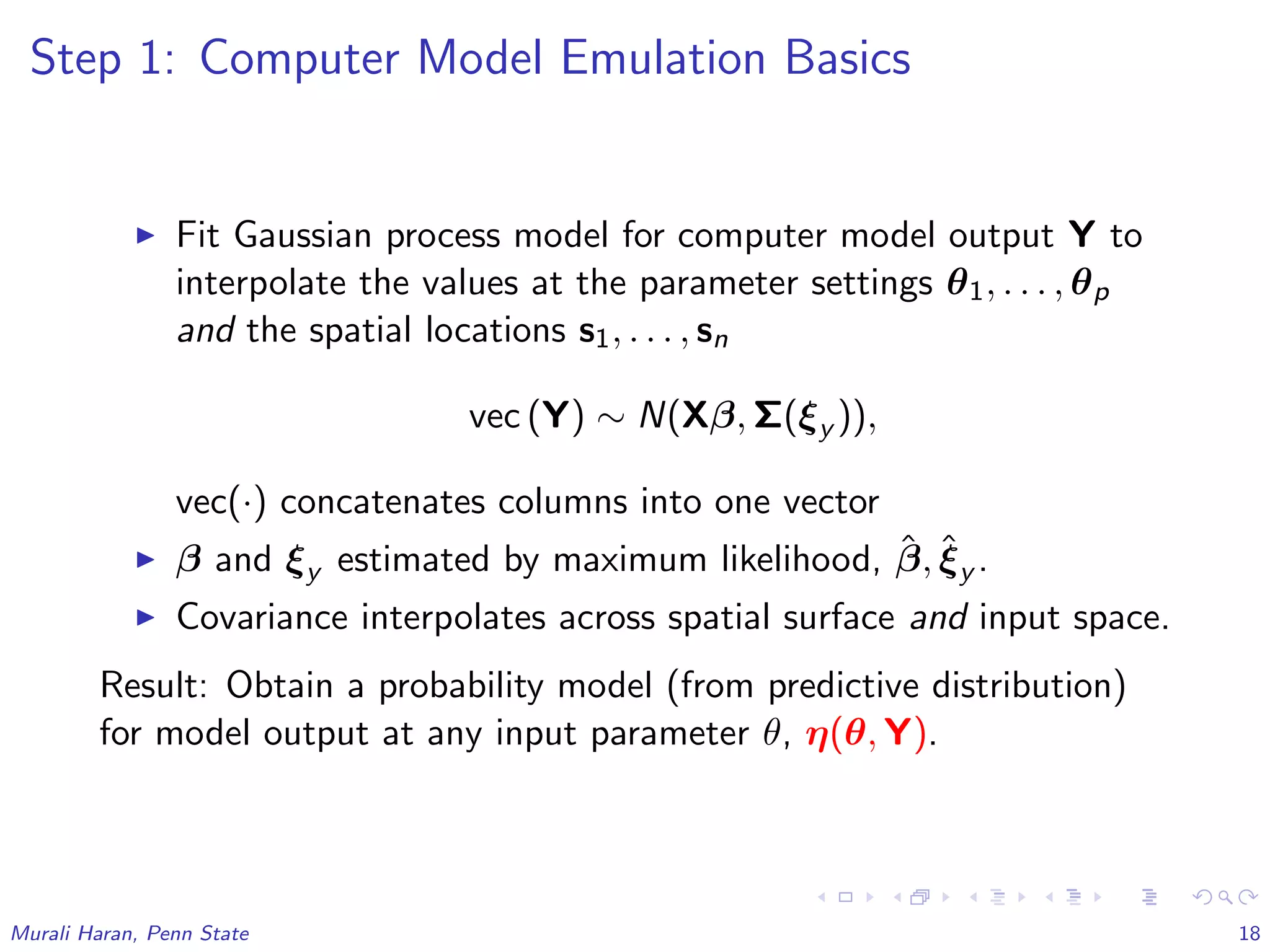
Step 1: Computer Model Emulation Basics
Fit Gaussian process model for computer model output Y to
interpolate the values at the parameter settings θ1, . . . , θp
and the spatial locations s1, . . . , sn
vec (Y) ∼ N(Xβ, Σ(ξy )),
vec(·) concatenates columns into one vector
β and ξy estimated by maximum likelihood, ˆβ, ˆξy .
Covariance interpolates across spatial surface and input space.
Result: Obtain a probability model (from predictive distribution)
for model output at any input parameter θ, η(θ, Y).
Murali Haran, Penn State 18
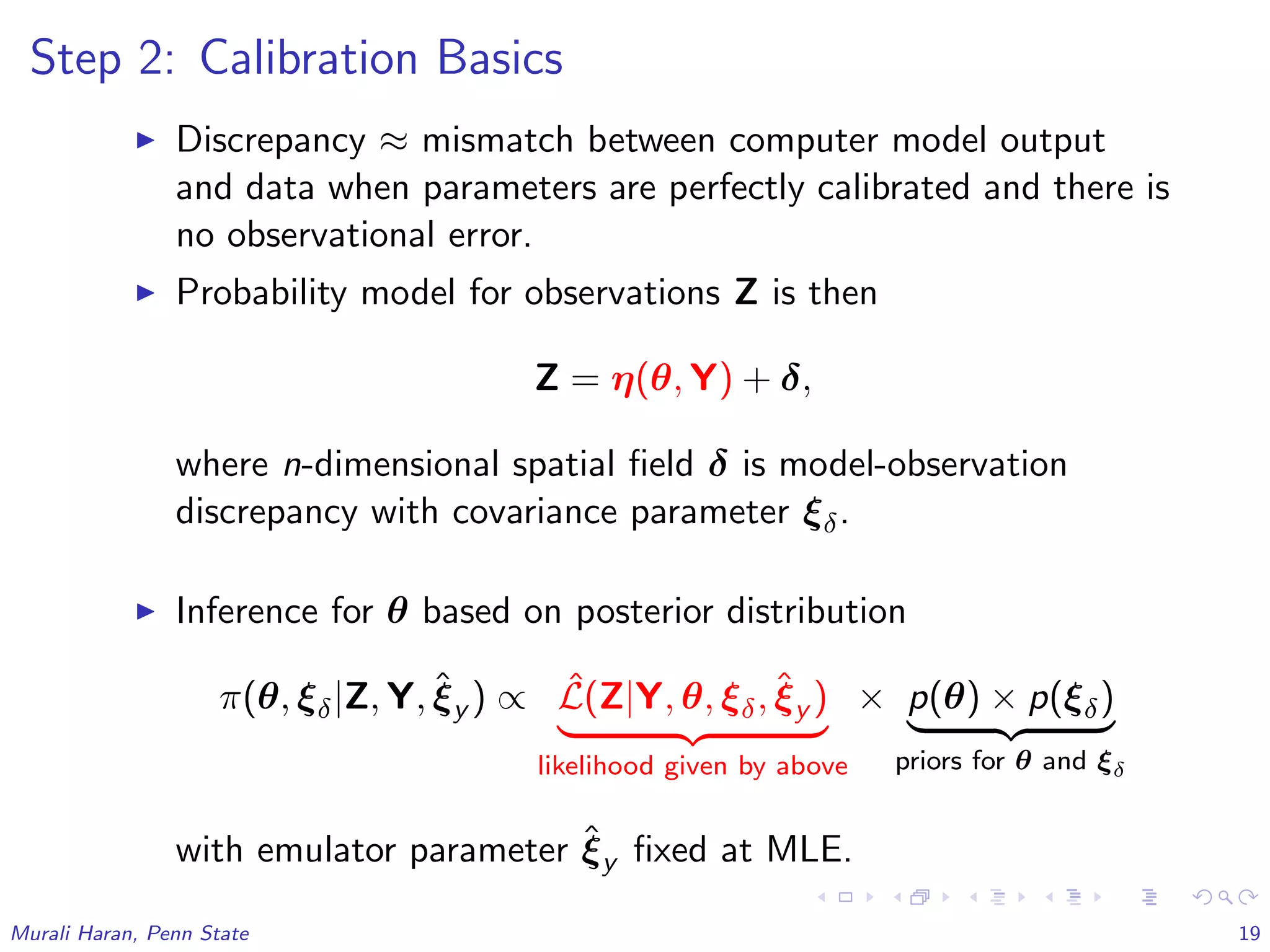
Step 2: Calibration Basics
Discrepancy ≈ mismatch between computer model output
and data when parameters are perfectly calibrated and there is
no observational error.
Probability model for observations Z is then
Z = η(θ, Y) + δ,
where n-dimensional spatial field δ is model-observation
discrepancy with covariance parameter ξδ.
Inference for θ based on posterior distribution
π(θ, ξδ|Z, Y, ˆξy ) ∝ ˆL(Z|Y, θ, ξδ, ˆξy )
likelihood given by above
× p(θ) × p(ξδ)
priors for θ and ξδ
with emulator parameter ˆξy fixed at MLE.
Murali Haran, Penn State 19
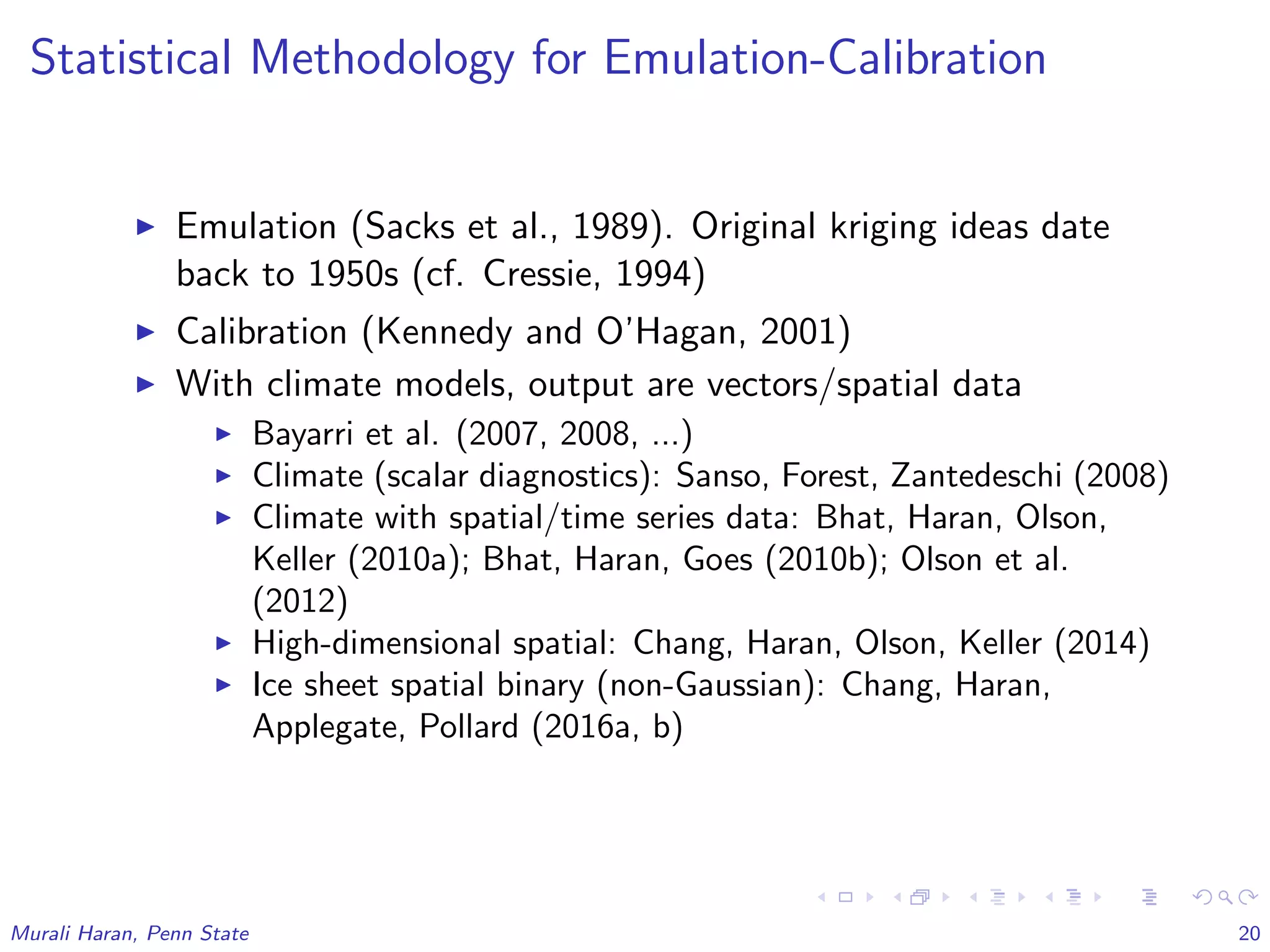
Statistical Methodology for Emulation-Calibration
Emulation (Sacks et al., 1989). Original kriging ideas date
back to 1950s (cf. Cressie, 1994)
Calibration (Kennedy and O’Hagan, 2001)
With climate models, output are vectors/spatial data
Bayarri et al. (2007, 2008, ...)
Climate (scalar diagnostics): Sanso, Forest, Zantedeschi (2008)
Climate with spatial/time series data: Bhat, Haran, Olson,
Keller (2010a); Bhat, Haran, Goes (2010b); Olson et al.
(2012)
High-dimensional spatial: Chang, Haran, Olson, Keller (2014)
Ice sheet spatial binary (non-Gaussian): Chang, Haran,
Applegate, Pollard (2016a, b)
Murali Haran, Penn State 20
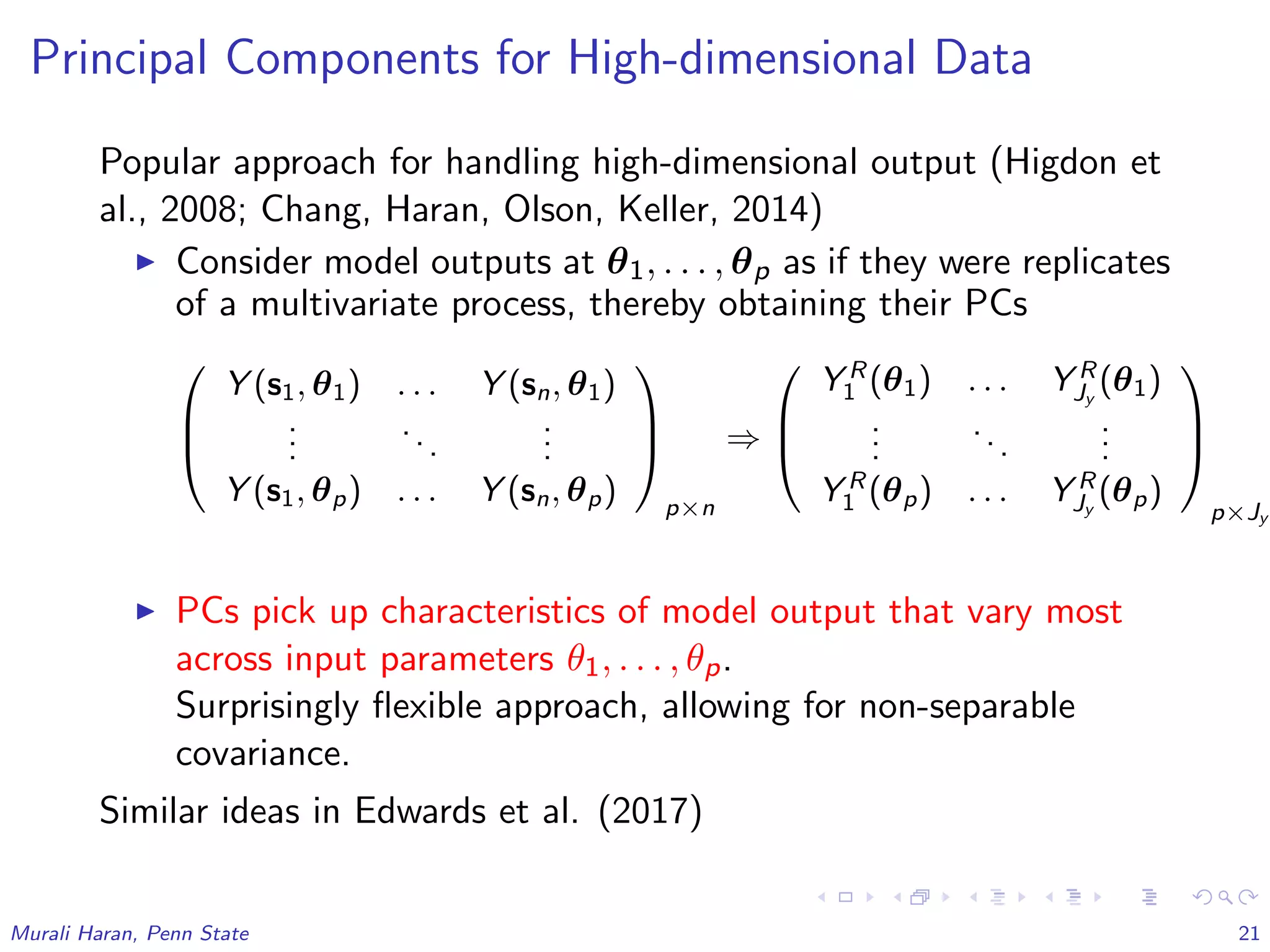
Principal Components for High-dimensional Data
Popular approach for handling high-dimensional output (Higdon et
al., 2008; Chang, Haran, Olson, Keller, 2014)
Consider model outputs at θ1, . . . , θp as if they were replicates
of a multivariate process, thereby obtaining their PCs



Y (s1, θ1) . . . Y (sn, θ1)
...
...
...
Y (s1, θp) . . . Y (sn, θp)



p×n
⇒



Y R
1 (θ1) . . . Y R
Jy
(θ1)
...
...
...
Y R
1 (θp) . . . Y R
Jy
(θp)



p×Jy
PCs pick up characteristics of model output that vary most
across input parameters θ1, . . . , θp.
Surprisingly flexible approach, allowing for non-separable
covariance.
Similar ideas in Edwards et al. (2017)
Murali Haran, Penn State 21
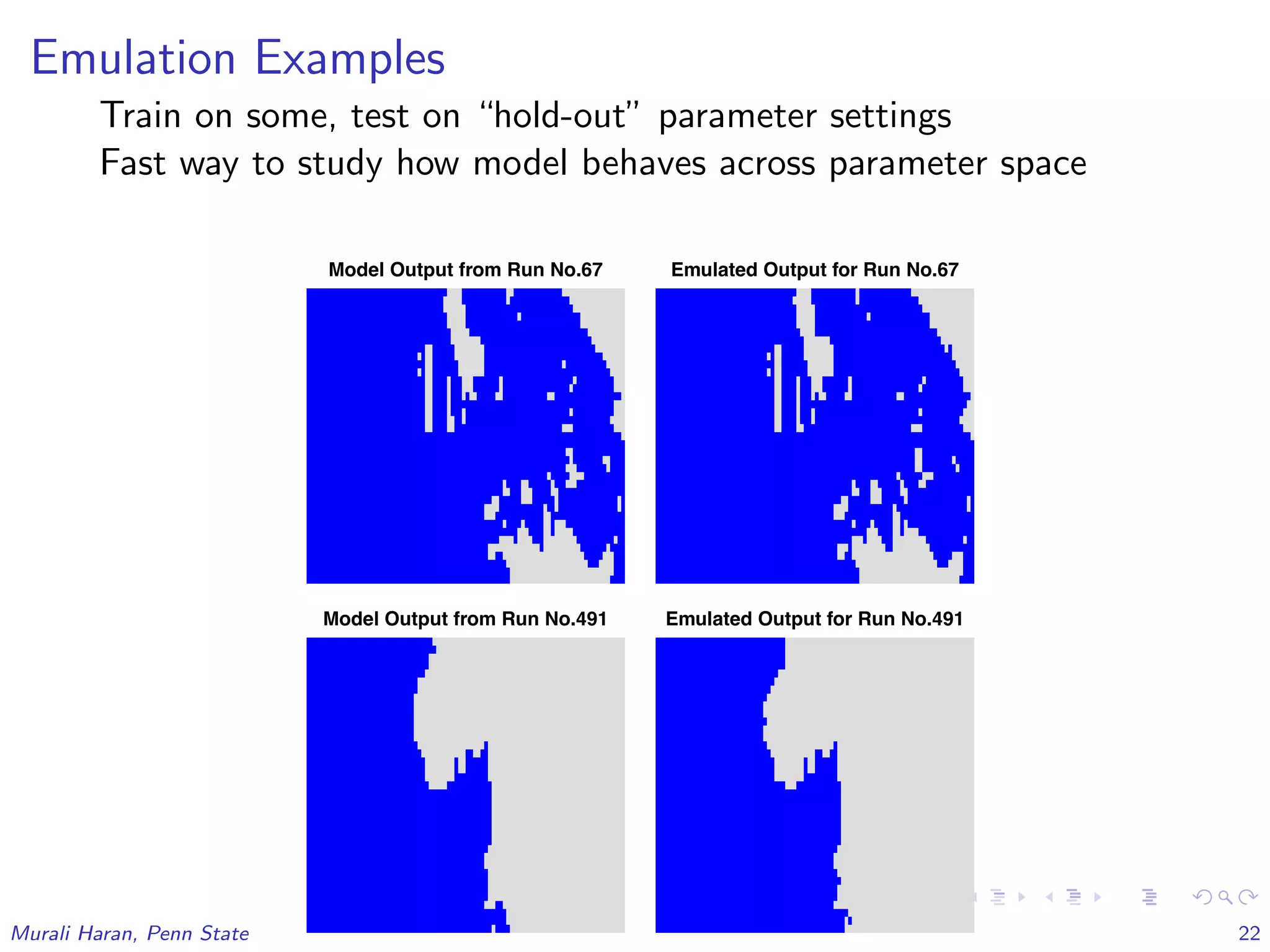
Emulation Examples
Train on some, test on “hold-out” parameter settings
Fast way to study how model behaves across parameter space
Model Output from Run No.67 Emulated Output for Run No.67
Model Output from Run No.491 Emulated Output for Run No.491
Murali Haran, Penn State 22
Efficient Calibration
Main ideas:
Utilize the data to derive information about the model-data
discrepancy.
Use a basis representation for model-data discrepancy term.
Markov chain Monte Carlo
Murali Haran, Penn State 23
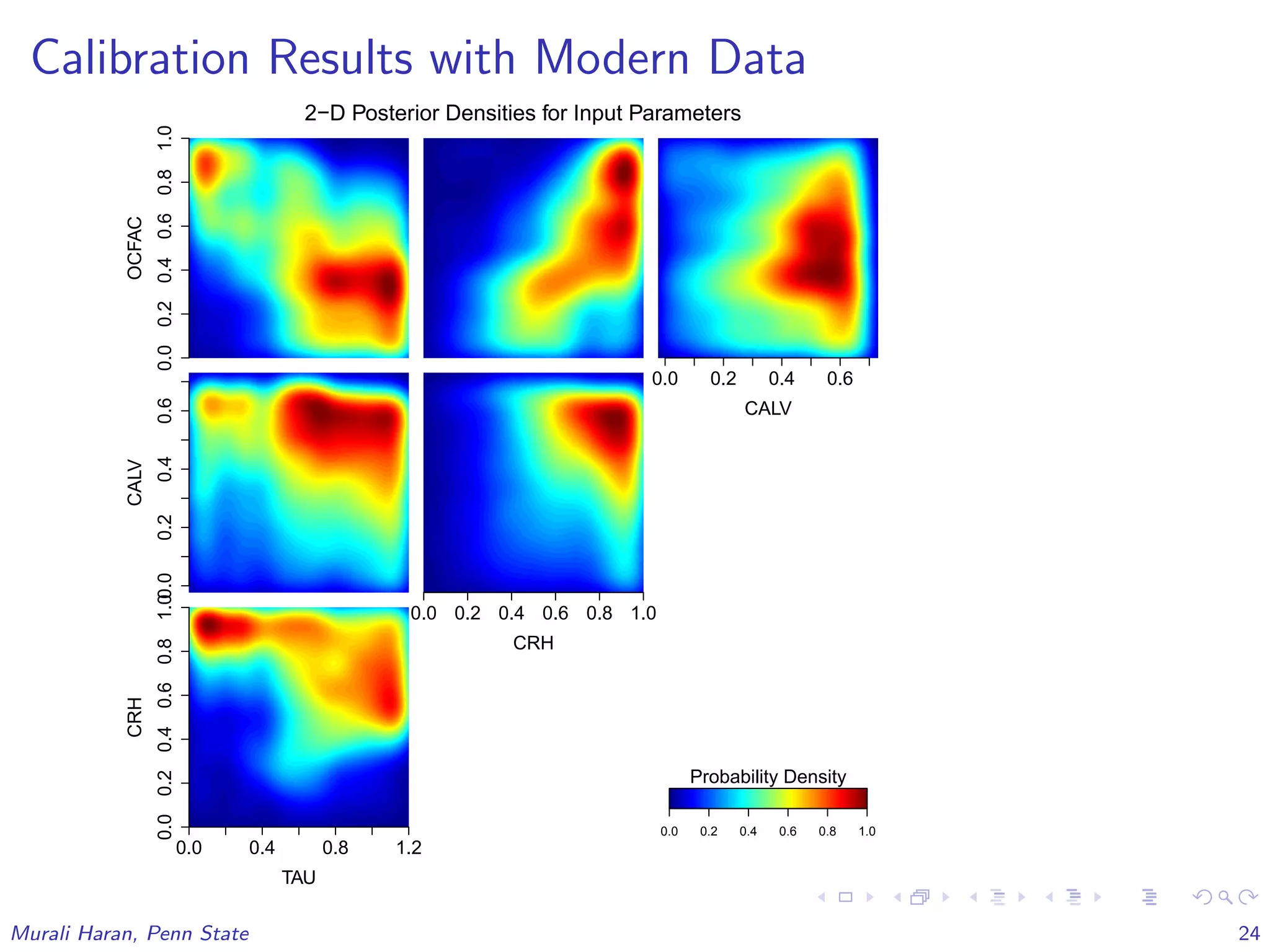
Calibration Results with Modern Data
0.00.20.40.60.81.0
OCFAC
2−D Posterior Densities for Input Parameters
0.0 0.2 0.4 0.6
CALV
0.00.20.40.6
CALV
0.0 0.2 0.4 0.6 0.8 1.0
CRH
0.0 0.4 0.8 1.2
TAU
0.00.20.40.60.81.0
CRH
0.0 0.2 0.4 0.6 0.8 1.0
Probability Density
Murali Haran, Penn State 24
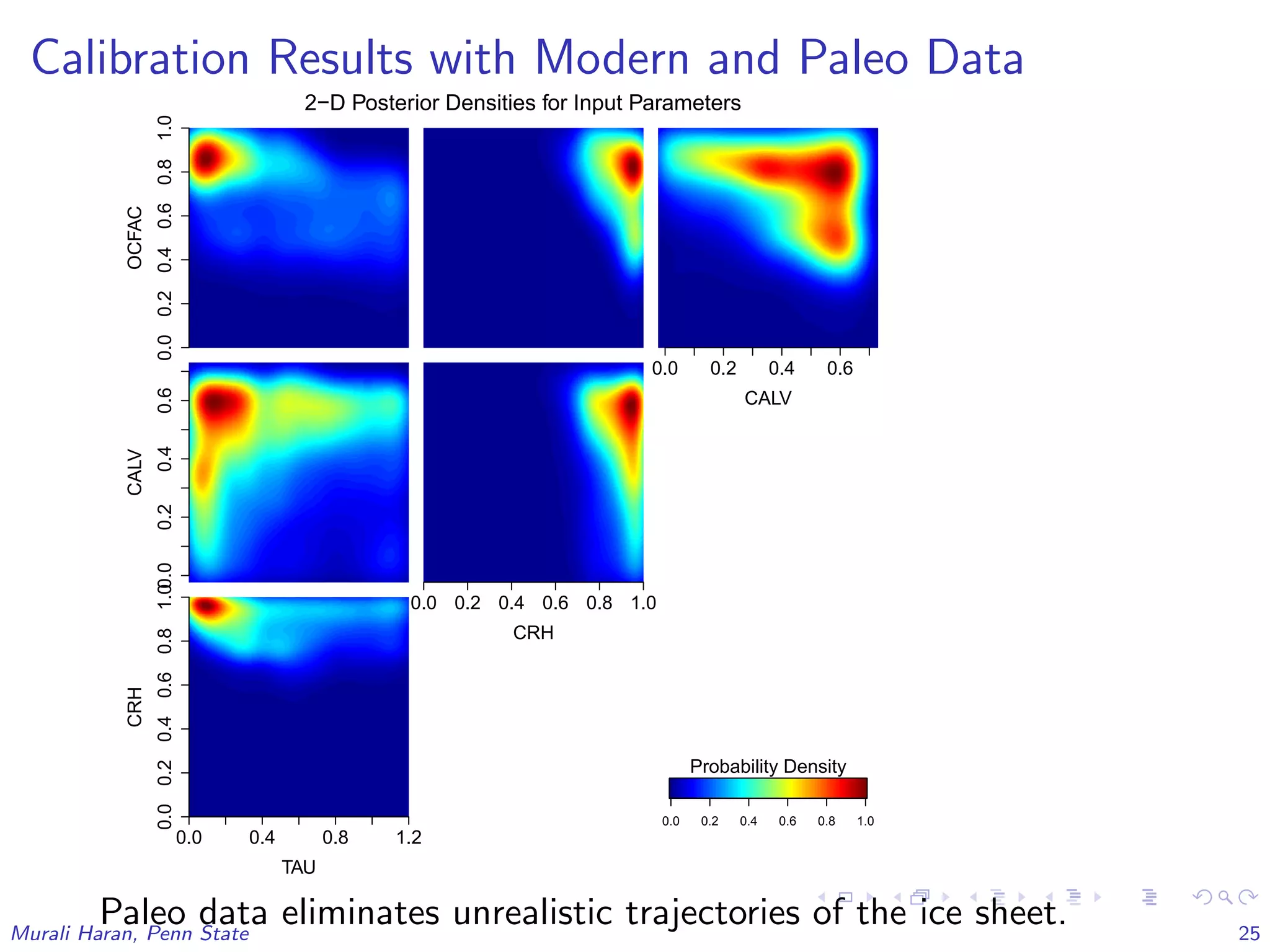
Calibration Results with Modern and Paleo Data
0.00.20.40.60.81.0
OCFAC
2−D Posterior Densities for Input Parameters
0.0 0.2 0.4 0.6
CALV
0.00.20.40.6
CALV
0.0 0.2 0.4 0.6 0.8 1.0
CRH
0.0 0.4 0.8 1.2
TAU
0.00.20.40.60.81.0
CRH
0.0 0.2 0.4 0.6 0.8 1.0
Probability Density
Paleo data eliminates unrealistic trajectories of the ice sheet.Murali Haran, Penn State 25
Why are the Results Different?
Unrealistic simulations with overshoots in past ice retreat and
projected future regrowth are eliminated
This “constrains” the probability distribution of the
parameters
Murali Haran, Penn State 26
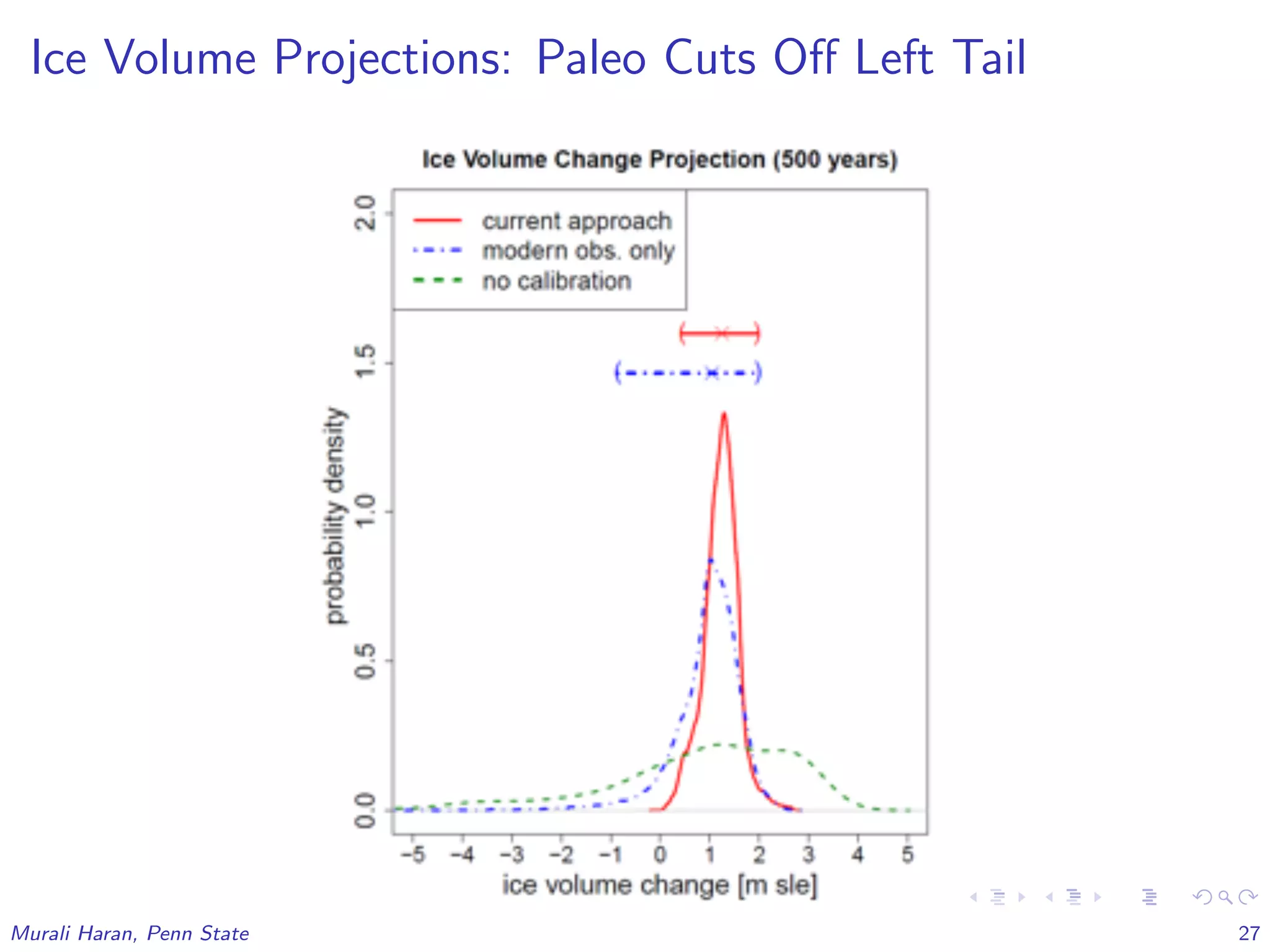
Ice Volume Projections: Paleo Cuts Off Left Tail
Murali Haran, Penn State 27
Structural Uncertainty
Caveat (cf. Lenny Smith, SAMSI Opening Workshop, 2017):
The previous pdf is based on a model that has a 7.2% probability*
of being wrong
(More seriously) there are important questions about structural
uncertainty (in statistics: “model uncertainty”)
* I made this up
(G.E.P. Box: All models are wrong...)
Murali Haran, Penn State 28
Related Work
Statistical approaches for studying historical and future projections
of ice sheets
T. Edwards et al. (2017): a comprehensive study across
parametric uncertainty + model uncertainty (e.g. mechanism
of cliff failure)
Wernecke, Edwards2, Holden (2017): principal components
for dimension reduction
Briggs, Pollard, Tarasov (2014)
Ritz, Edwards et al. (2015)
Tarasov, Peltier (2004)
Other work? Different perspectives, e.g. from applied math?
Murali Haran, Penn State 29
Results
Statistical methods provide interpretable results about
parameters and probabilistic projections
Can study value of using more data (disaggregated)
Easy to see how multiple sources of data inform (“constrain”)
parameters
Have to think hard about computational issues
Chang, W., Haran, M, Applegate, P., Pollard, D. (2016a, b)
JASA, Annals of Applied Stats
Chang, W., Applegate, P., Haran, M. and Keller, K. (2016)
Geoscientific Model Development
Chang, W., M. Haran, R. Olson, and K. Keller (2014)
Annals of Applied Stats
Murali Haran, Penn State 30
Open Statistical Challenges
Very high-dimensional output, dependent, e.g. multivariate
spatial, temporal
Space-time output (dynamic emulation-calibration)
Lots of parameters
Handling data-model discrepancies; complex
errors/dependencies in data
Fast/non-MCMC approaches to calibration (ongoing work
with Ben Lee)
Combining information across multiple models, multiple scales
(EMICs of various kinds)
Different models have different advantages: faster/simpler
models allow for study of more parameter combinations,
slower/complex models allow for study of adding/subtracting
particular features
“Causal inference” of a certain kind (cf. Michael Wehner’s
SAMSI opening workshop talk). Also: how model parameters
impact model behavior
Murali Haran, Penn State 31
Part 2 Overview: Ice Streams
Fast-flowing ice streams are major contributors to ice loss
Key components for understanding ice stream’s stability and
dynamics: ice thickness and bedrock topography.
Of interest:
Interpolate ice thickness while obeying the underlying physics
Estimate ice stream dynamics parameters
Proposal:
Bayesian approach: combine ice stream physics + information
from multiple data sets
See also: Berliner, Cressie, et al. (2008a, b)
First step toward developing general methodology
Focus on Thwaites glacier, covers an area of 182,000 km2
(≈
Italy/2). Estimated ice loss has doubled since the 1990s
Murali Haran, Penn State 32
Basic Idea
Principal physics commonly applied is conservation of ice mass
Given observations of surface elevation, ice velocity and
surface mass balance, we can deduce the ice thickness
assuming the ice sheet is in a steady state. Examples:
Using coarse grid in Antarctica (Warner and Budd, 2000)
Higher resolution in Greenland (Morlighem et al., 2011, 2013,
2014)
2D model was not accurate for our study domain. Hence,
changes:
1. Consider 1D study (transect), 250 km length
2. Added a new component to dynamics model: shallow ice
approximation (SIA).
3. Include the varying glacier width to account for tributaries,
which contribute to mass flux
Model is still simple enough that we can solve it quickly
Our statistical model accounts for errors/uncertainties
Murali Haran, Penn State 33
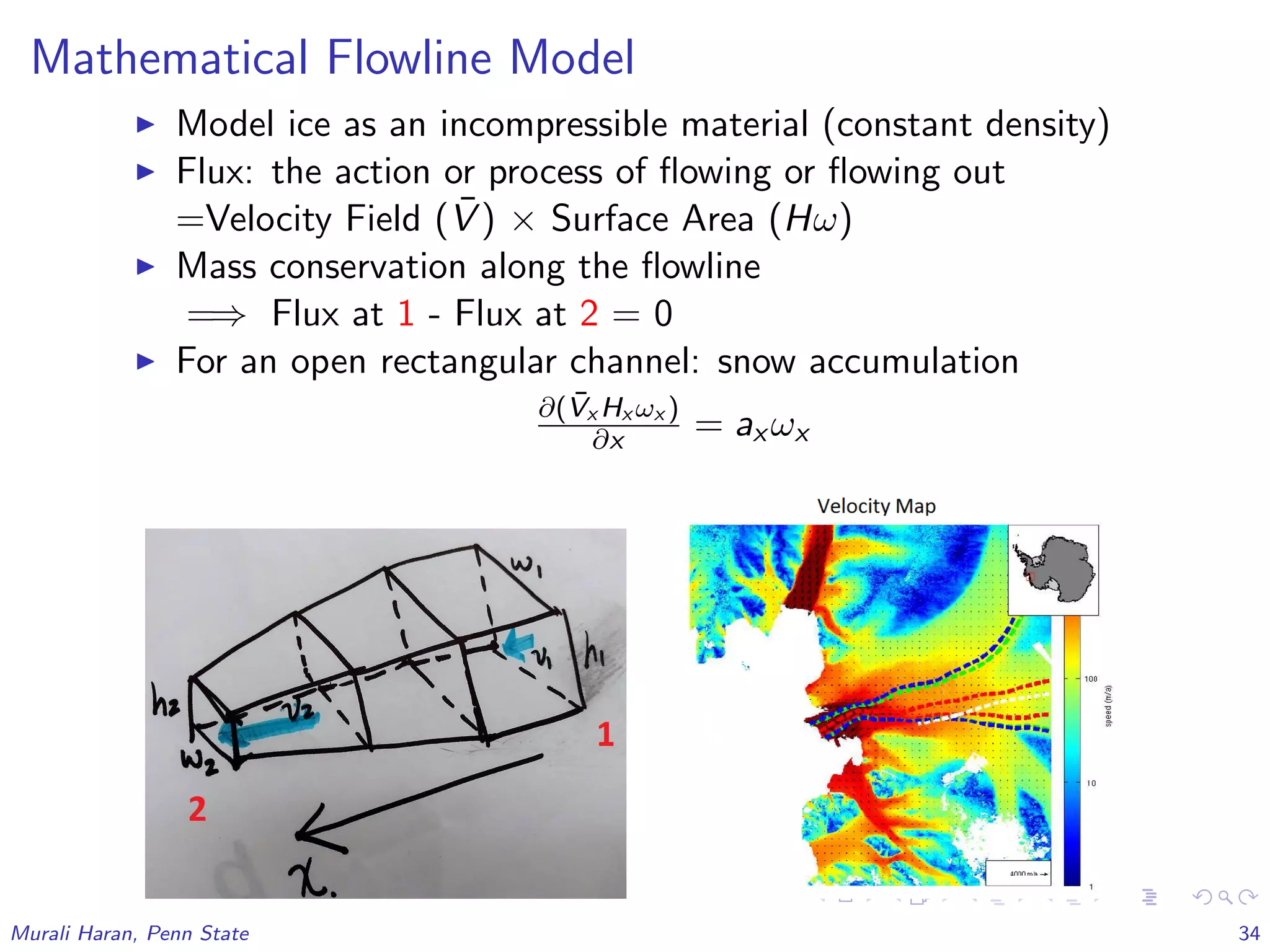
Mathematical Flowline Model
Model ice as an incompressible material (constant density)
Flux: the action or process of flowing or flowing out
=Velocity Field ( ¯V ) × Surface Area (Hω)
Mass conservation along the flowline
=⇒ Flux at 1 - Flux at 2 = 0
For an open rectangular channel: snow accumulation
∂( ¯Vx Hx ωx )
∂x = ax ωx
Murali Haran, Penn State 34
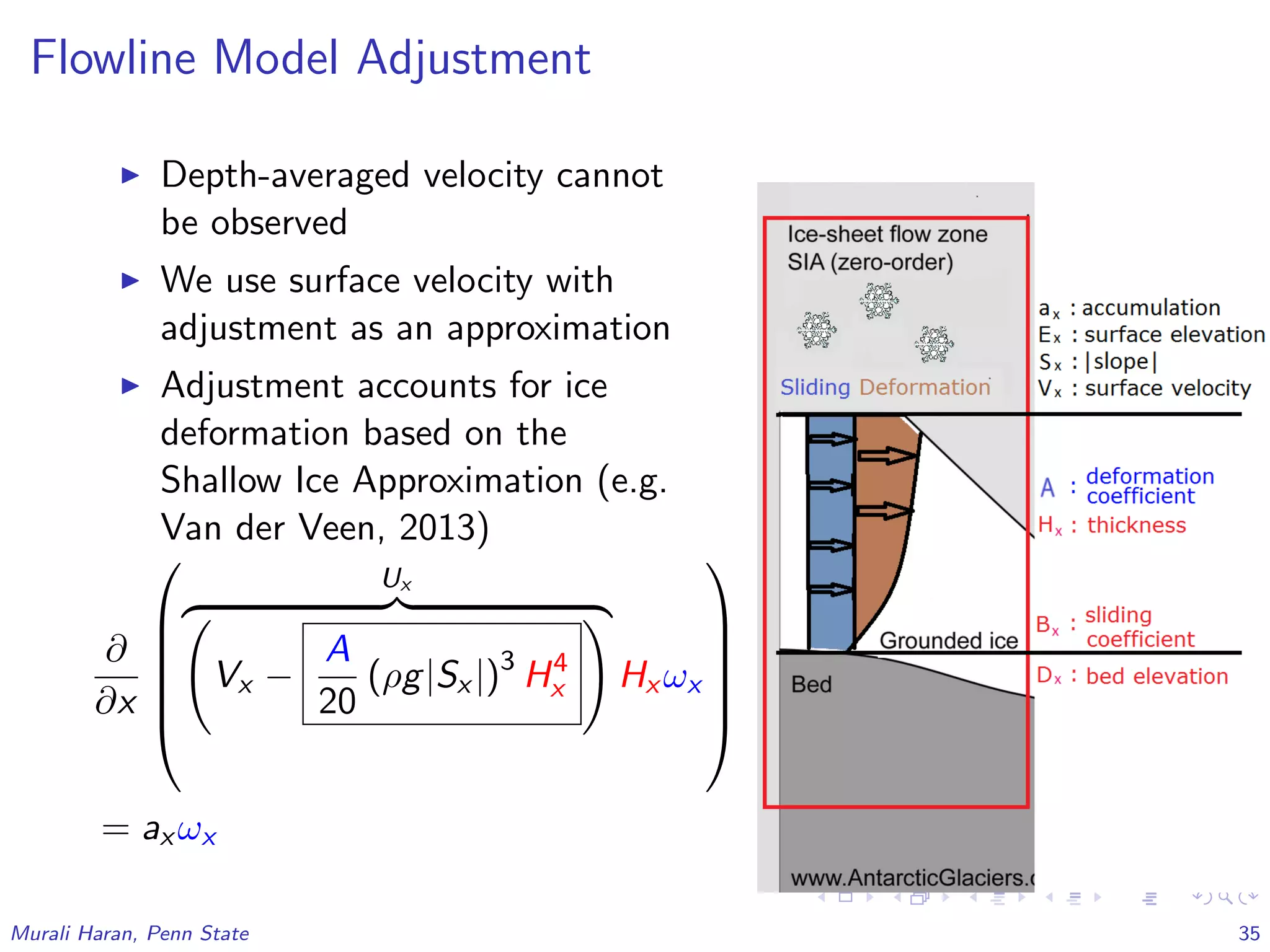
Flowline Model Adjustment
Depth-averaged velocity cannot
be observed
We use surface velocity with
adjustment as an approximation
Adjustment accounts for ice
deformation based on the
Shallow Ice Approximation (e.g.
Van der Veen, 2013)
∂
∂x






Ux
Vx −
A
20
(ρg|Sx |)3
H4
x Hx ωx






= ax ωx
Murali Haran, Penn State 35
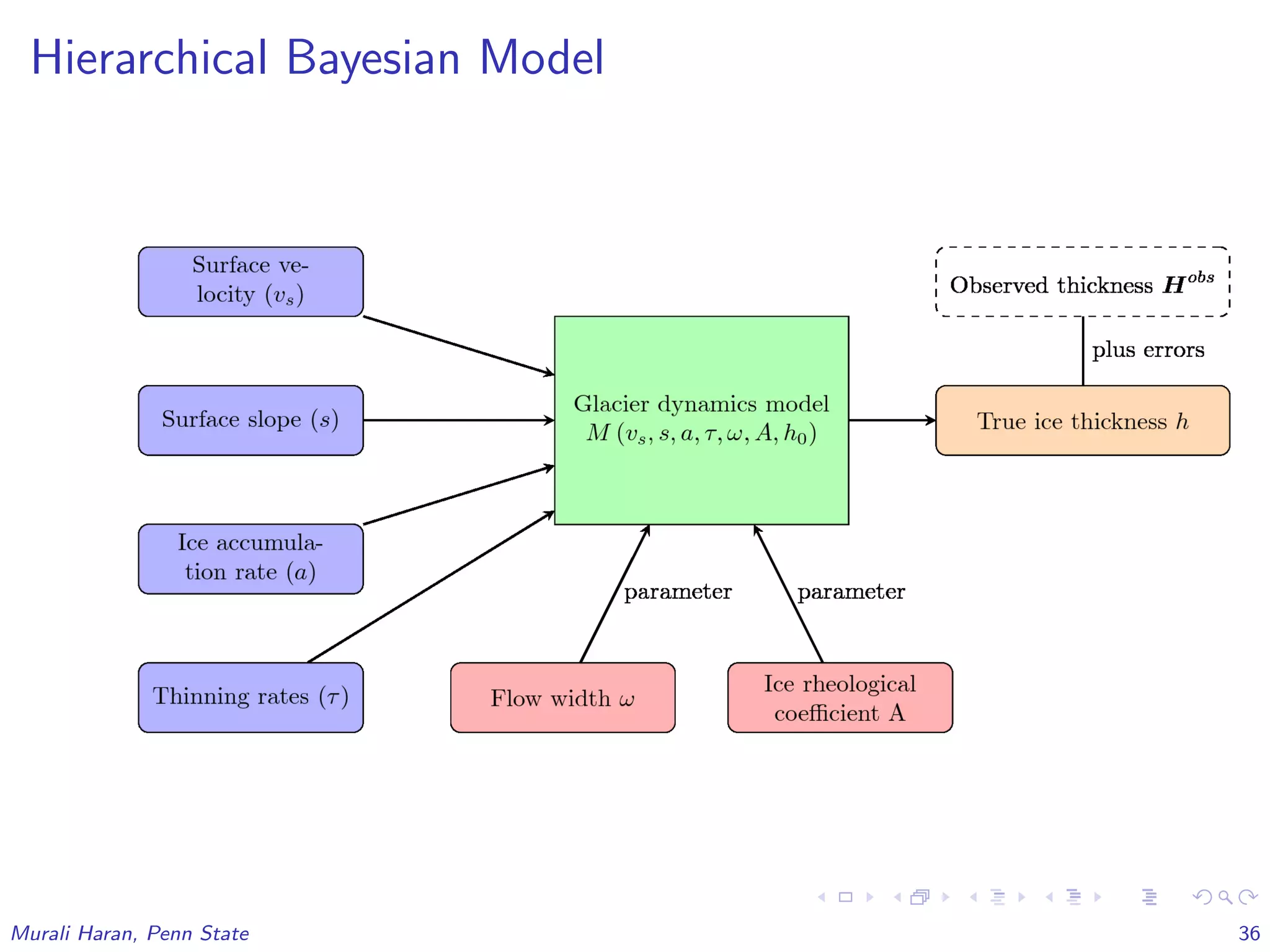
Hierarchical Bayesian Model
Murali Haran, Penn State 36
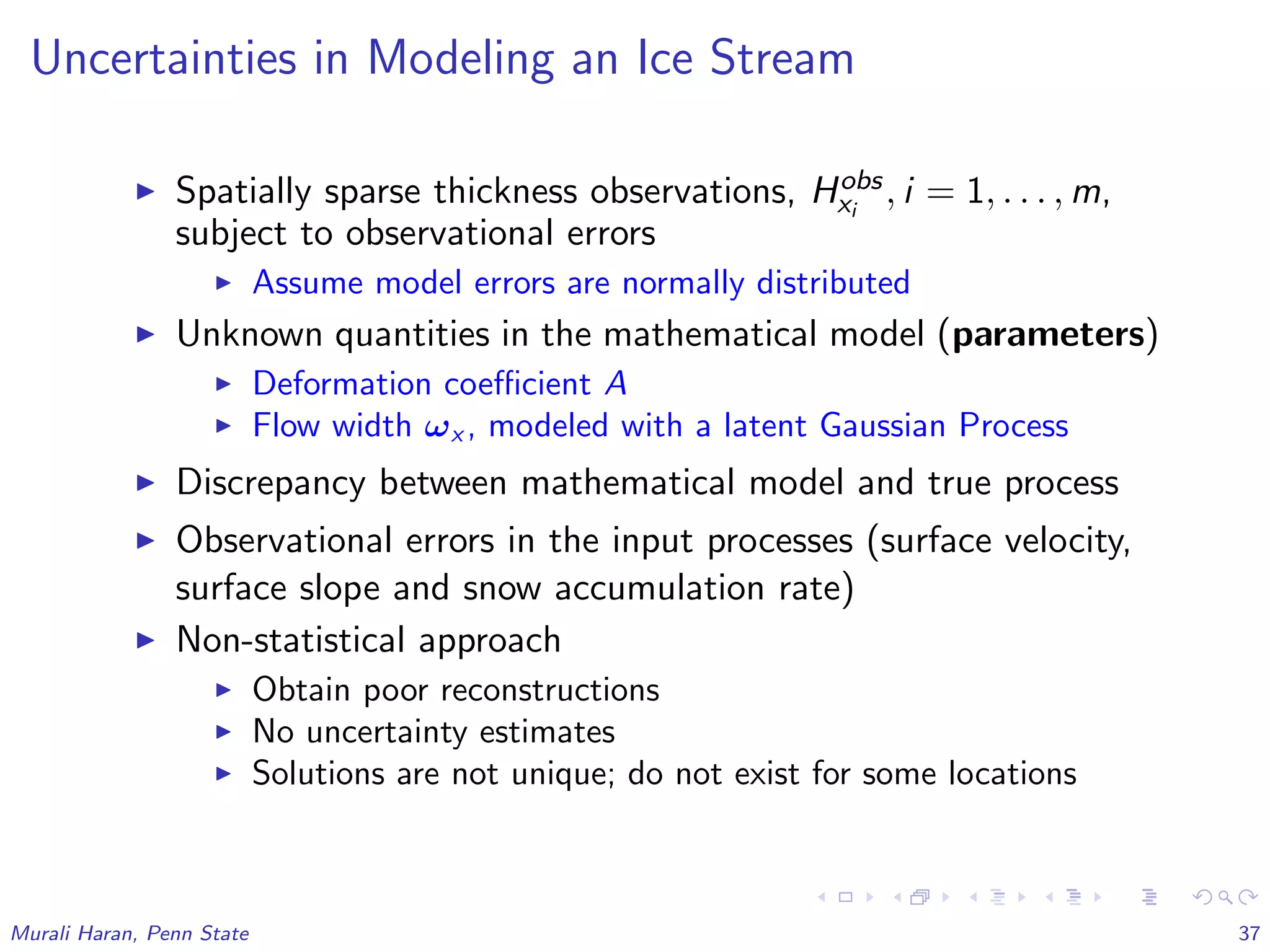
Uncertainties in Modeling an Ice Stream
Spatially sparse thickness observations, Hobs
xi
, i = 1, . . . , m,
subject to observational errors
Assume model errors are normally distributed
Unknown quantities in the mathematical model (parameters)
Deformation coefficient A
Flow width ωx , modeled with a latent Gaussian Process
Discrepancy between mathematical model and true process
Observational errors in the input processes (surface velocity,
surface slope and snow accumulation rate)
Non-statistical approach
Obtain poor reconstructions
No uncertainty estimates
Solutions are not unique; do not exist for some locations
Murali Haran, Penn State 37
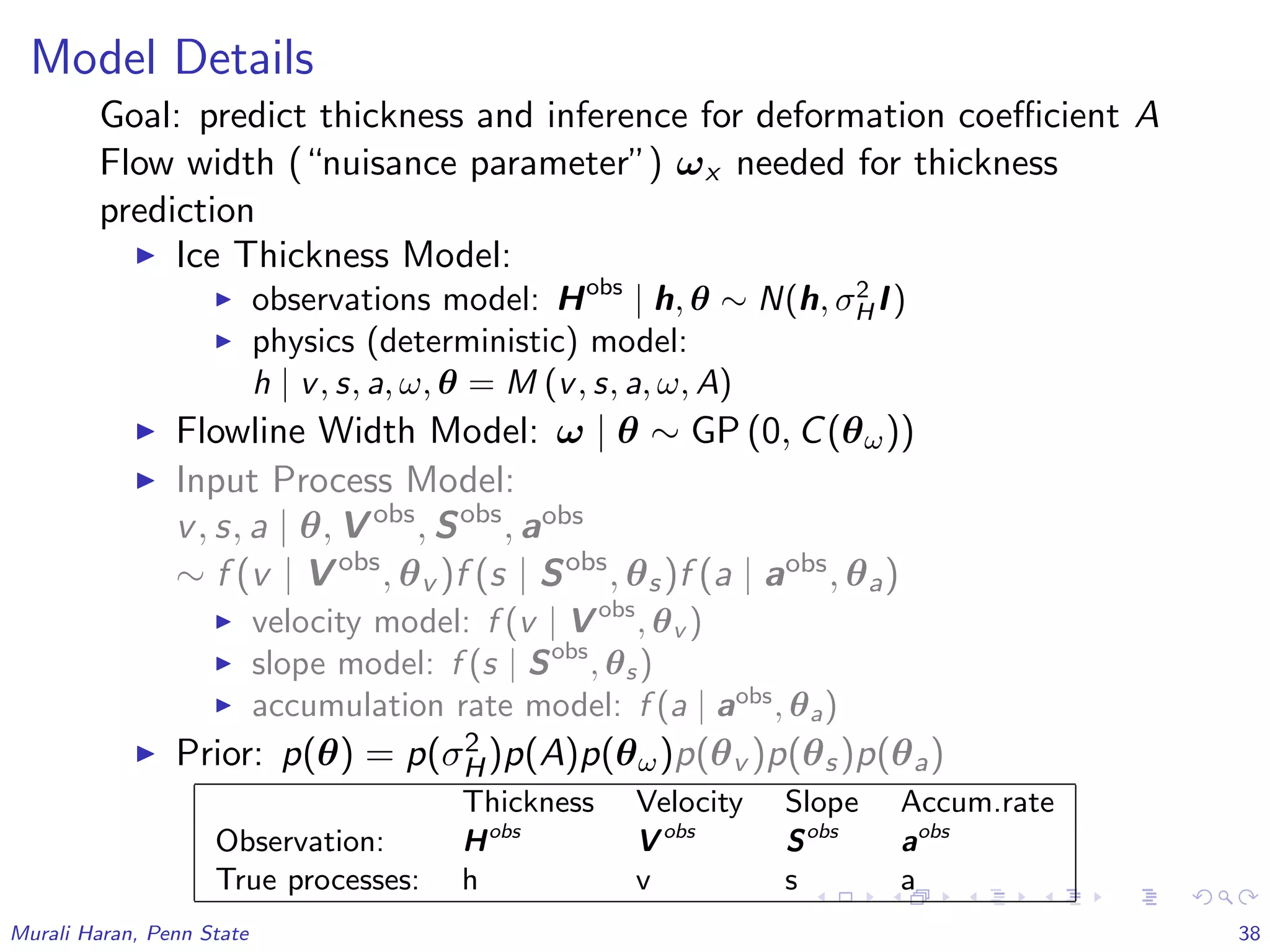
Model Details
Goal: predict thickness and inference for deformation coefficient A
Flow width (“nuisance parameter”) ωx needed for thickness
prediction
Ice Thickness Model:
observations model: Hobs
| h, θ ∼ N(h, σ2
H I)
physics (deterministic) model:
h | v, s, a, ω, θ = M (v, s, a, ω, A)
Flowline Width Model: ω | θ ∼ GP (0, C(θω))
Input Process Model:
v, s, a | θ, V obs
, Sobs
, aobs
∼ f (v | V obs
, θv )f (s | Sobs
, θs)f (a | aobs, θa)
velocity model: f (v | V obs
, θv )
slope model: f (s | Sobs
, θs)
accumulation rate model: f (a | aobs
, θa)
Prior: p(θ) = p(σ2
H)p(A)p(θω)p(θv )p(θs)p(θa)
Thickness Velocity Slope Accum.rate
Observation: Hobs
V obs
Sobs
aobs
True processes: h v s a
Murali Haran, Penn State 38
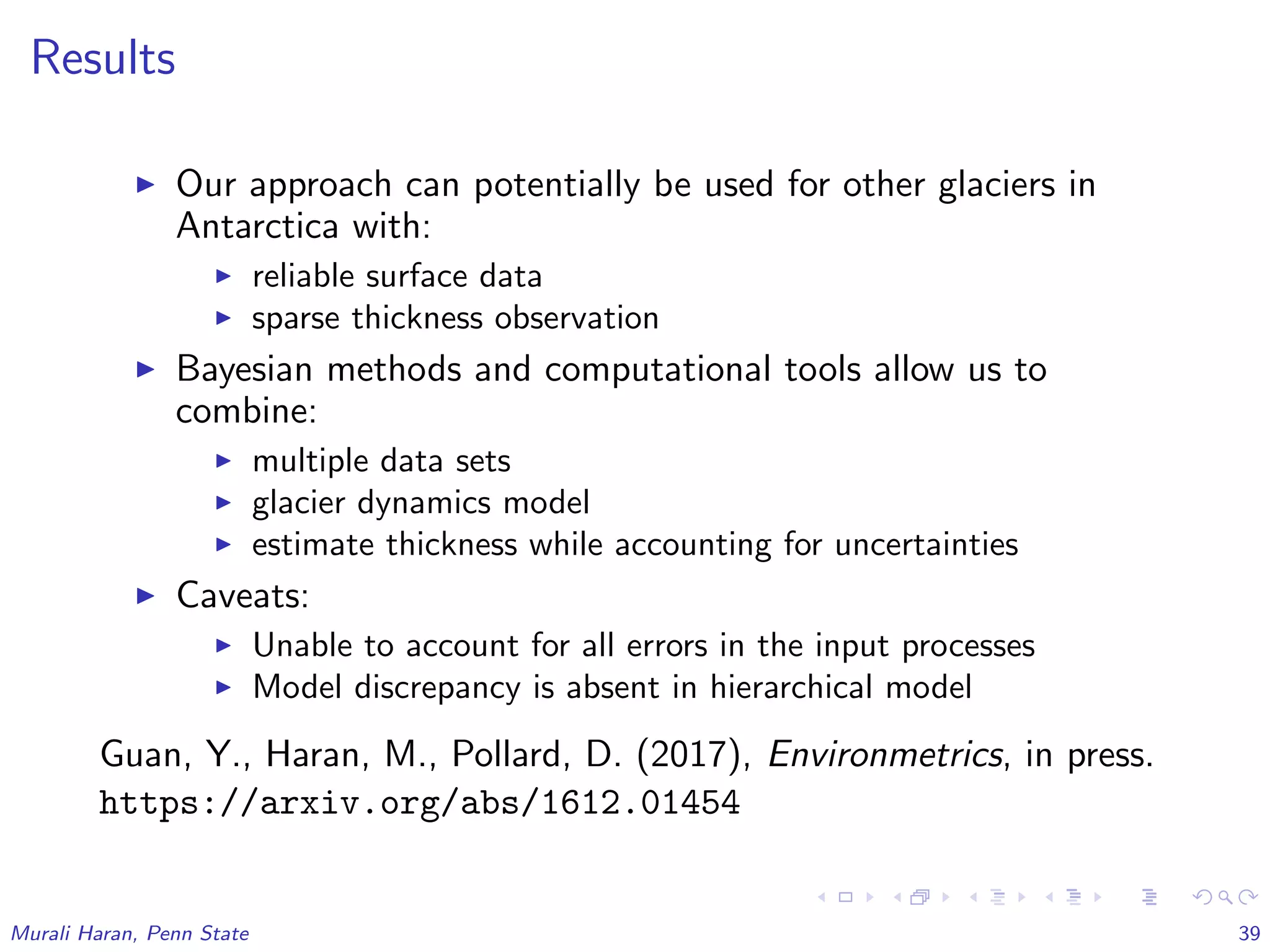
Results
Our approach can potentially be used for other glaciers in
Antarctica with:
reliable surface data
sparse thickness observation
Bayesian methods and computational tools allow us to
combine:
multiple data sets
glacier dynamics model
estimate thickness while accounting for uncertainties
Caveats:
Unable to account for all errors in the input processes
Model discrepancy is absent in hierarchical model
Guan, Y., Haran, M., Pollard, D. (2017), Environmetrics, in press.
https://arxiv.org/abs/1612.01454
Murali Haran, Penn State 39
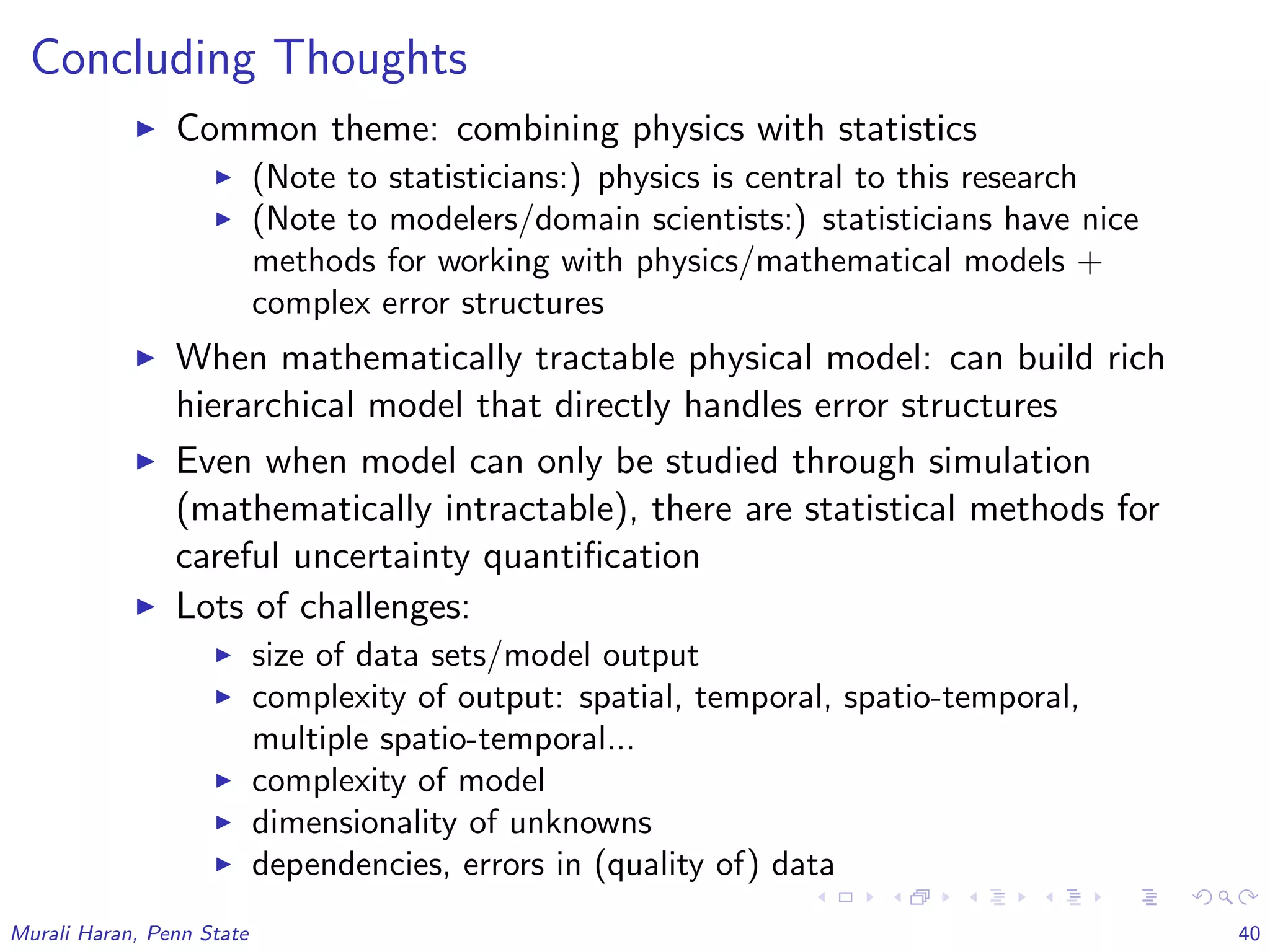
Concluding Thoughts
Common theme: combining physics with statistics
(Note to statisticians:) physics is central to this research
(Note to modelers/domain scientists:) statisticians have nice
methods for working with physics/mathematical models +
complex error structures
When mathematically tractable physical model: can build rich
hierarchical model that directly handles error structures
Even when model can only be studied through simulation
(mathematically intractable), there are statistical methods for
careful uncertainty quantification
Lots of challenges:
size of data sets/model output
complexity of output: spatial, temporal, spatio-temporal,
multiple spatio-temporal...
complexity of model
dimensionality of unknowns
dependencies, errors in (quality of) data
Murali Haran, Penn State 40
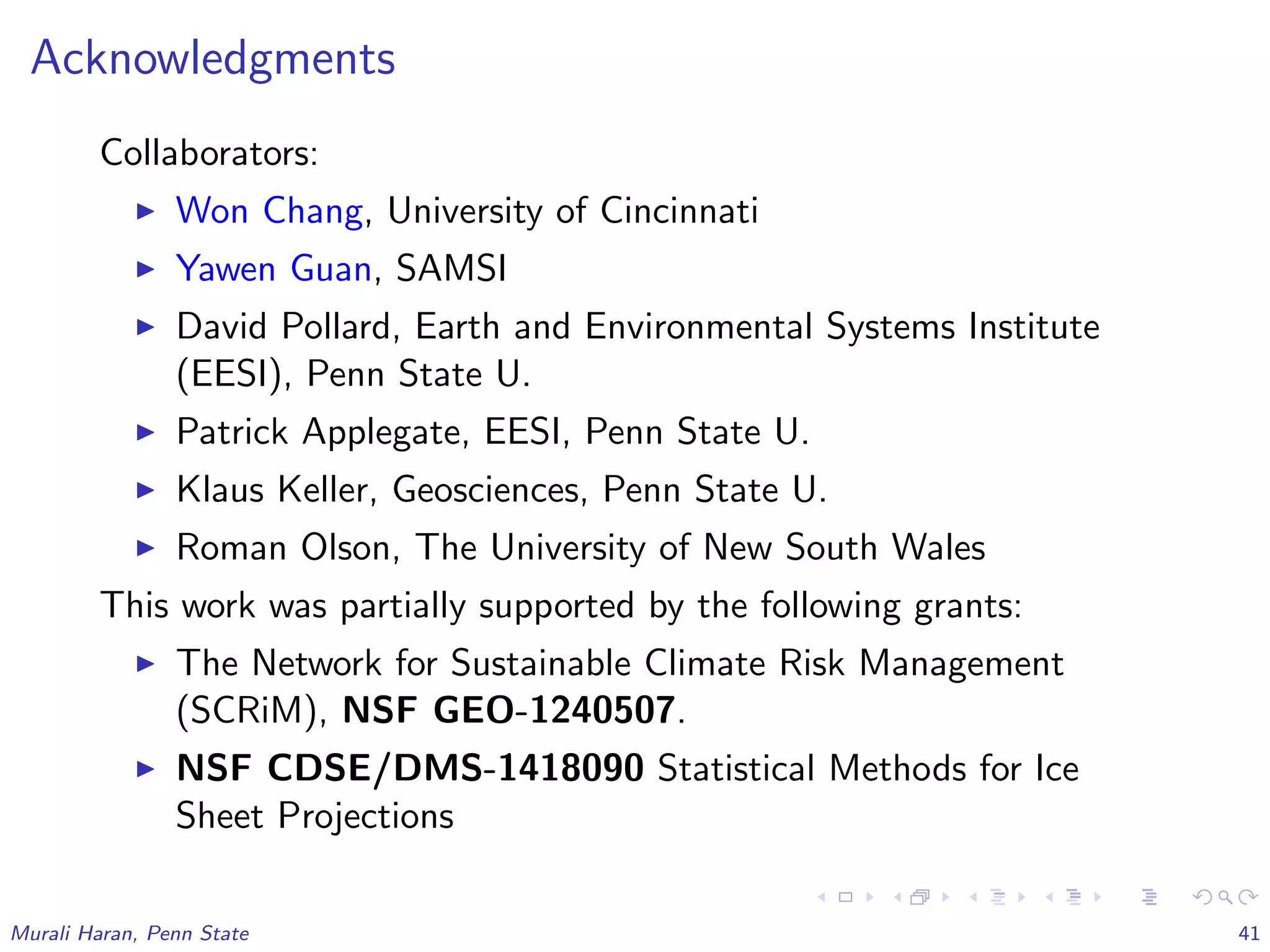
Acknowledgments
Collaborators:
Won Chang, University of Cincinnati
Yawen Guan, SAMSI
David Pollard, Earth and Environmental Systems Institute
(EESI), Penn State U.
Patrick Applegate, EESI, Penn State U.
Klaus Keller, Geosciences, Penn State U.
Roman Olson, The University of New South Wales
This work was partially supported by the following grants:
The Network for Sustainable Climate Risk Management
(SCRiM), NSF GEO-1240507.
NSF CDSE/DMS-1418090 Statistical Methods for Ice
Sheet Projections
Murali Haran, Penn State 41
Acknowledgments
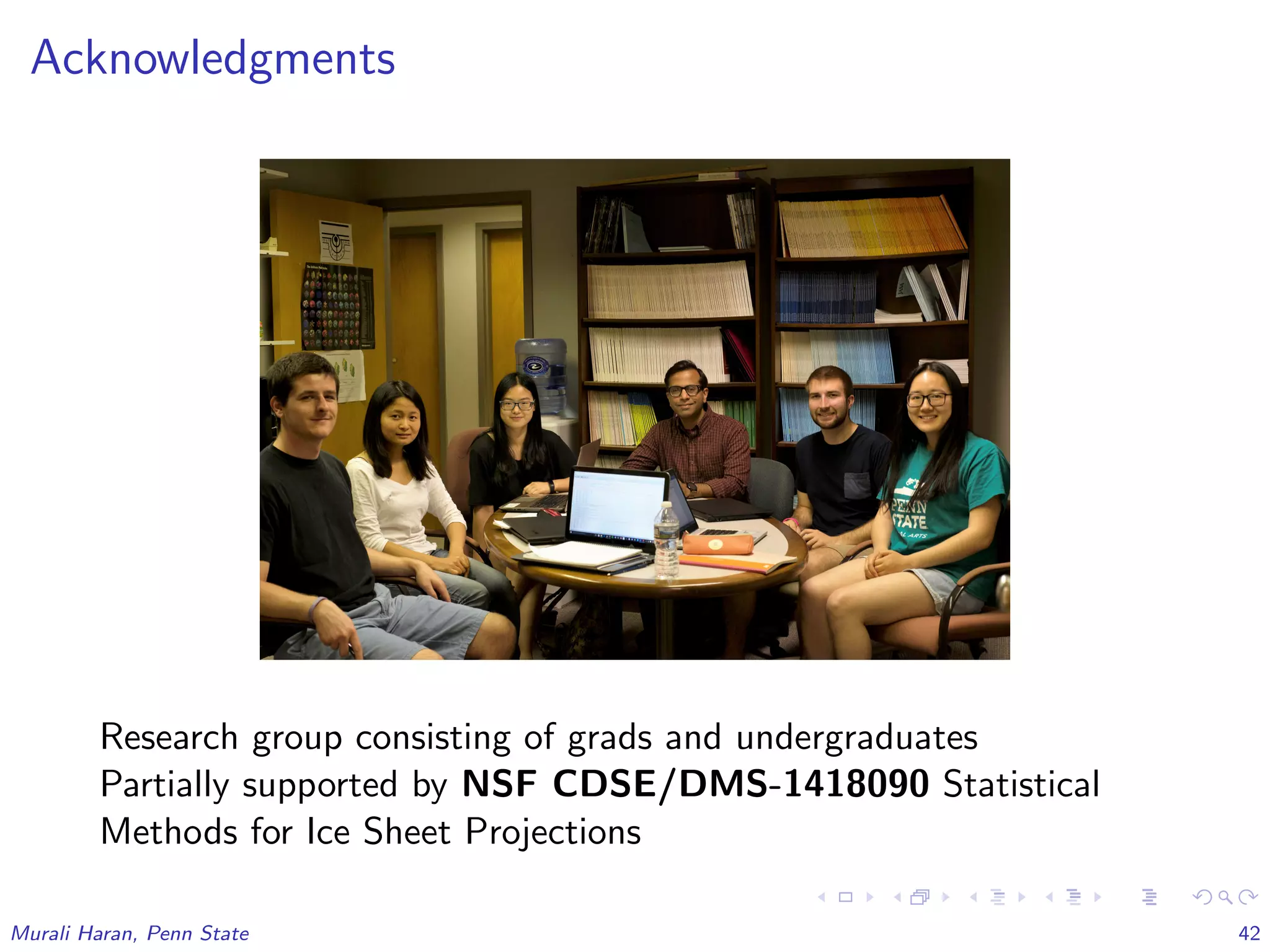
Research group consisting of grads and undergraduates
Partially supported by NSF CDSE/DMS-1418090 Statistical
Methods for Ice Sheet Projections
Murali Haran, Penn State 42
Appendix
BEGIN APPENDIX
Murali Haran, Penn State 43
Non-Statistical Approach
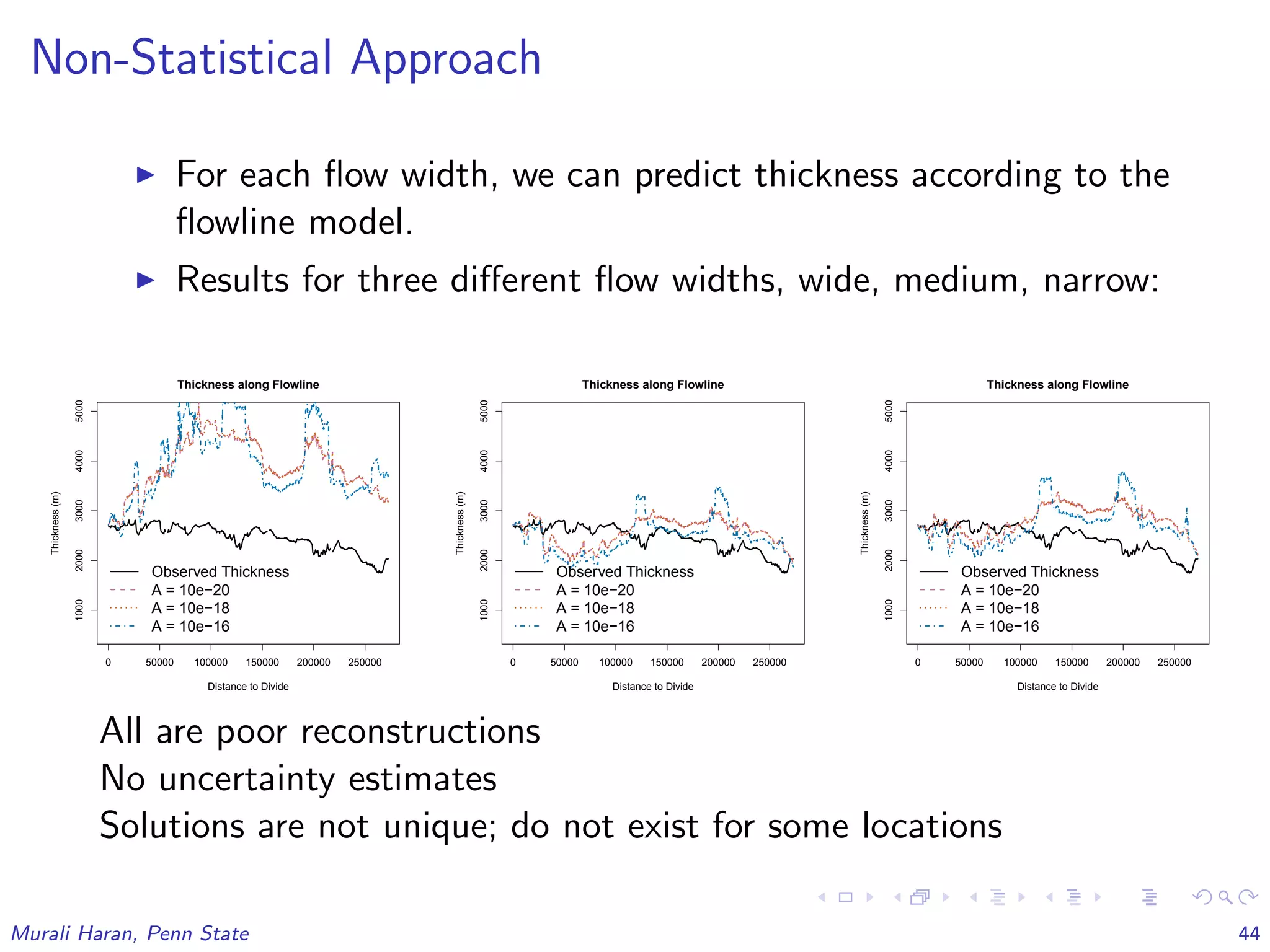
For each flow width, we can predict thickness according to the
flowline model.
Results for three different flow widths, wide, medium, narrow:
0 50000 100000 150000 200000 250000
10002000300040005000
Thickness along Flowline
Distance to Divide
Thickness(m)
Observed Thickness
A = 10e−20
A = 10e−18
A = 10e−16
0 50000 100000 150000 200000 250000
10002000300040005000
Thickness along Flowline
Distance to Divide
Thickness(m)
Observed Thickness
A = 10e−20
A = 10e−18
A = 10e−16
0 50000 100000 150000 200000 250000
10002000300040005000
Thickness along Flowline
Distance to Divide
Thickness(m)
Observed Thickness
A = 10e−20
A = 10e−18
A = 10e−16
All are poor reconstructions
No uncertainty estimates
Solutions are not unique; do not exist for some locations
Murali Haran, Penn State 44
Data Sets
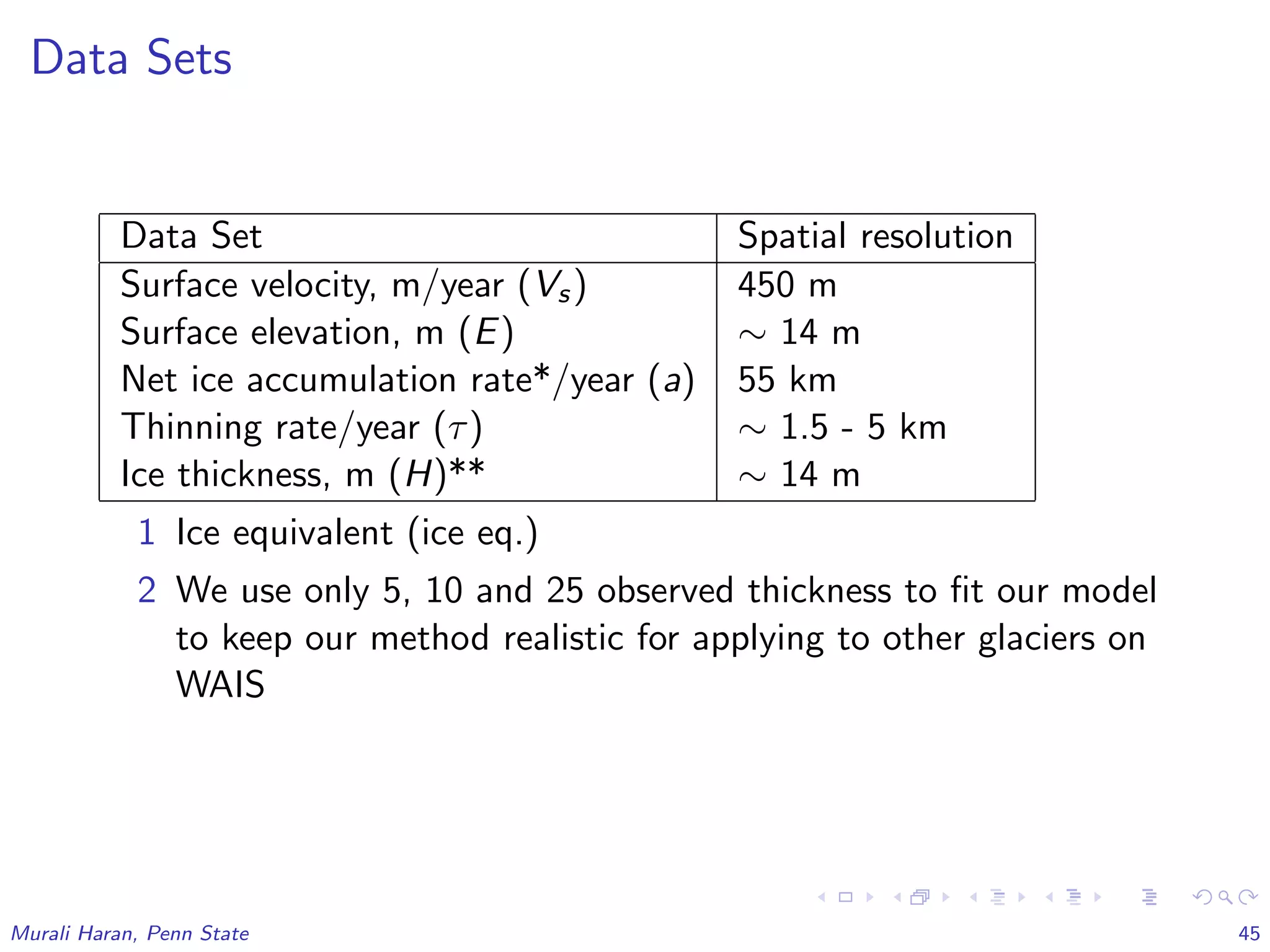
Data Set Spatial resolution
Surface velocity, m/year (Vs) 450 m
Surface elevation, m (E) ∼ 14 m
Net ice accumulation rate*/year (a) 55 km
Thinning rate/year (τ) ∼ 1.5 - 5 km
Ice thickness, m (H)** ∼ 14 m
1 Ice equivalent (ice eq.)
2 We use only 5, 10 and 25 observed thickness to fit our model
to keep our method realistic for applying to other glaciers on
WAIS
Murali Haran, Penn State 45
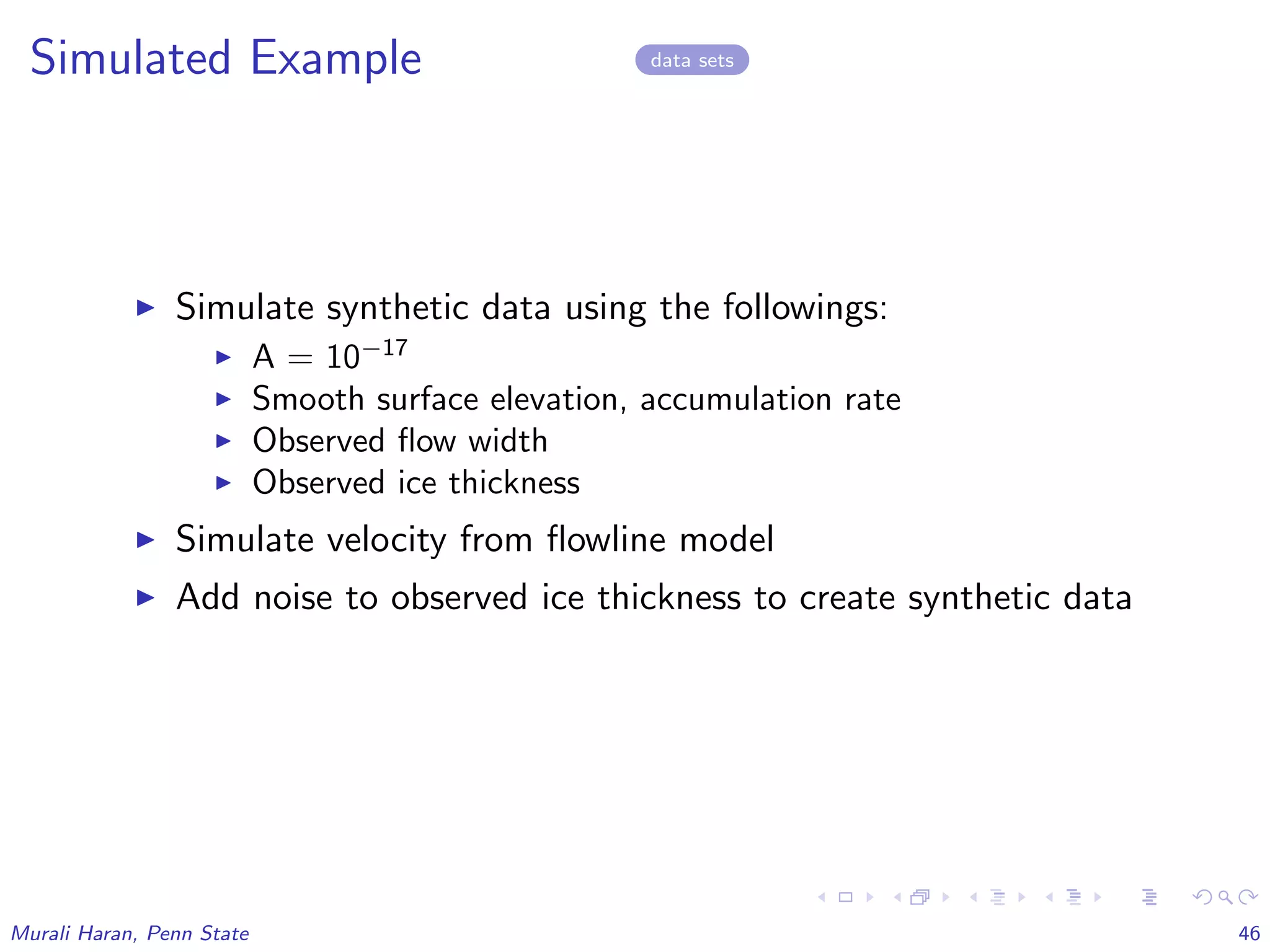
Simulated Example data sets
Simulate synthetic data using the followings:
A = 10−17
Smooth surface elevation, accumulation rate
Observed flow width
Observed ice thickness
Simulate velocity from flowline model
Add noise to observed ice thickness to create synthetic data
Murali Haran, Penn State 46
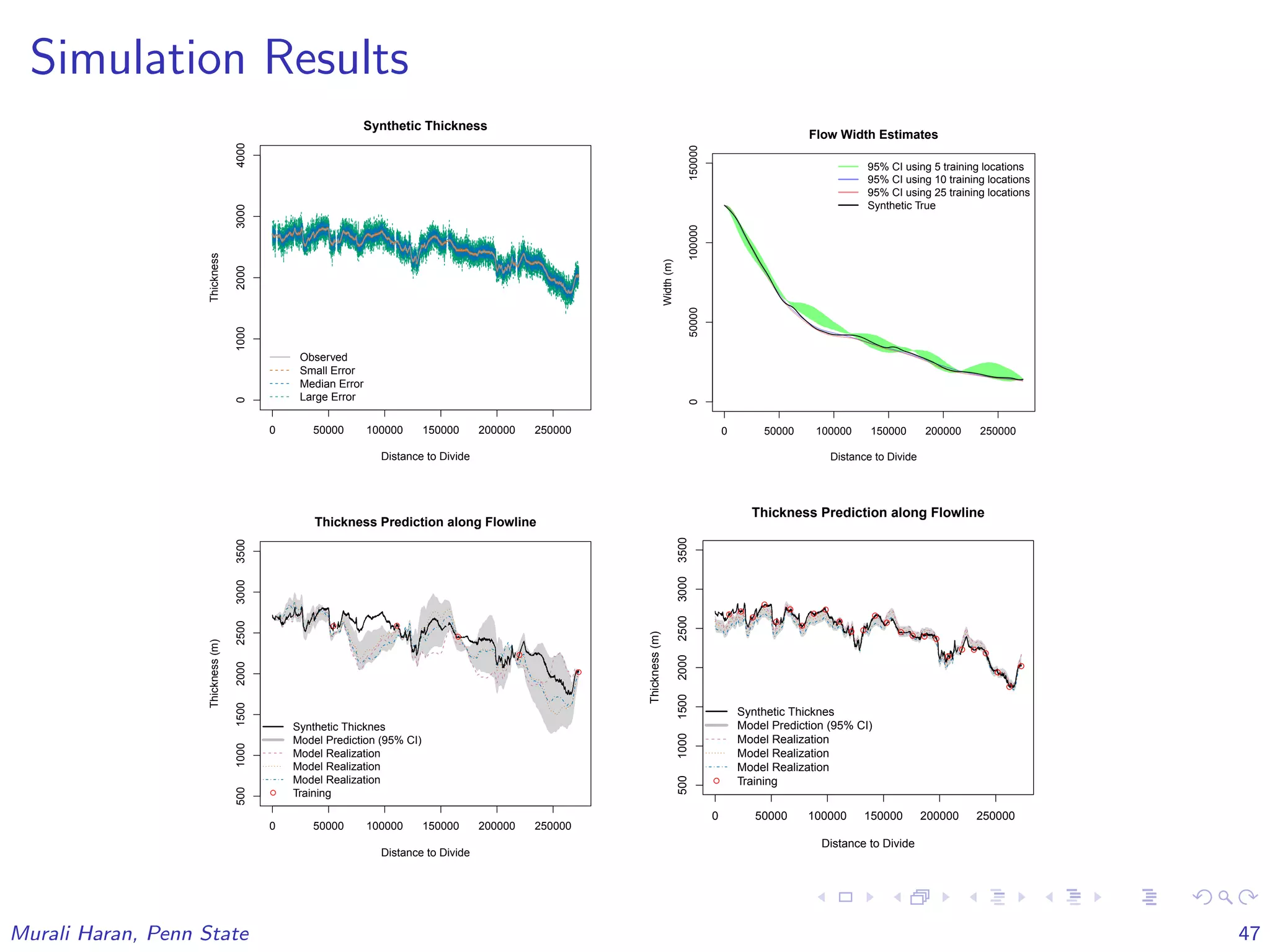
Simulation Results
0 50000 100000 150000 200000 250000
01000200030004000
Distance to Divide
Thickness
Observed
Small Error
Median Error
Large Error
Synthetic Thickness
0 50000 100000 150000 200000 250000
050000100000150000
Flow Width Estimates
Distance to Divide
Width(m)
95% CI using 5 training locations
95% CI using 10 training locations
95% CI using 25 training locations
Synthetic True
0 50000 100000 150000 200000 250000
500100015002000250030003500
Thickness Prediction along Flowline
Distance to Divide
Thickness(m)
q
Synthetic Thicknes
Model Prediction (95% CI)
Model Realization
Model Realization
Model Realization
Training
q q
q
q
q
0 50000 100000 150000 200000 250000
500100015002000250030003500
Thickness Prediction along Flowline
Distance to Divide
Thickness(m)
q
Synthetic Thicknes
Model Prediction (95% CI)
Model Realization
Model Realization
Model Realization
Training
q q
q
q
q
q
q
q
q
q
q q
q
q
q
q q q
q
q q q
q
q
q
Murali Haran, Penn State 47
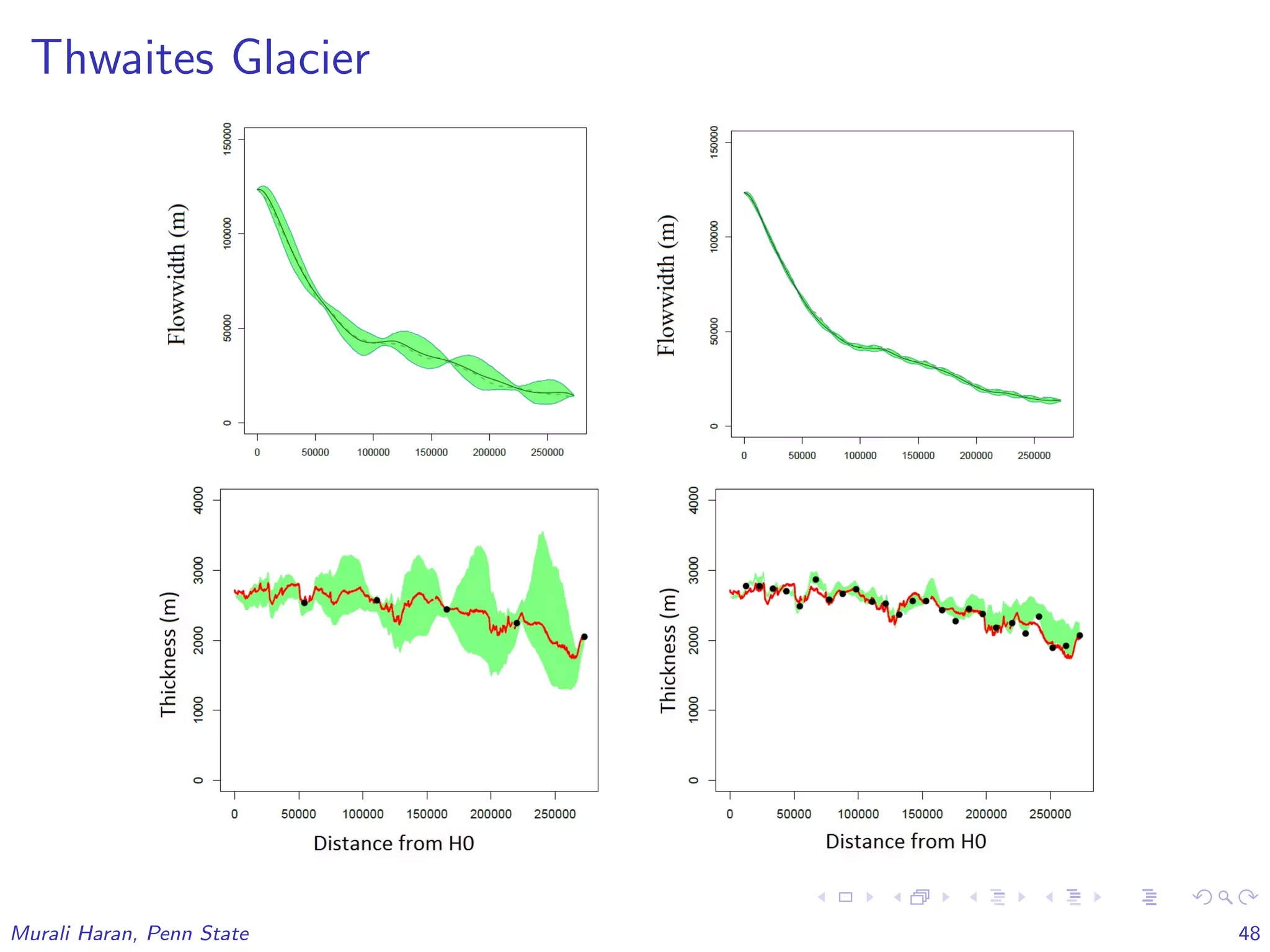
Thwaites Glacier
Murali Haran, Penn State 48
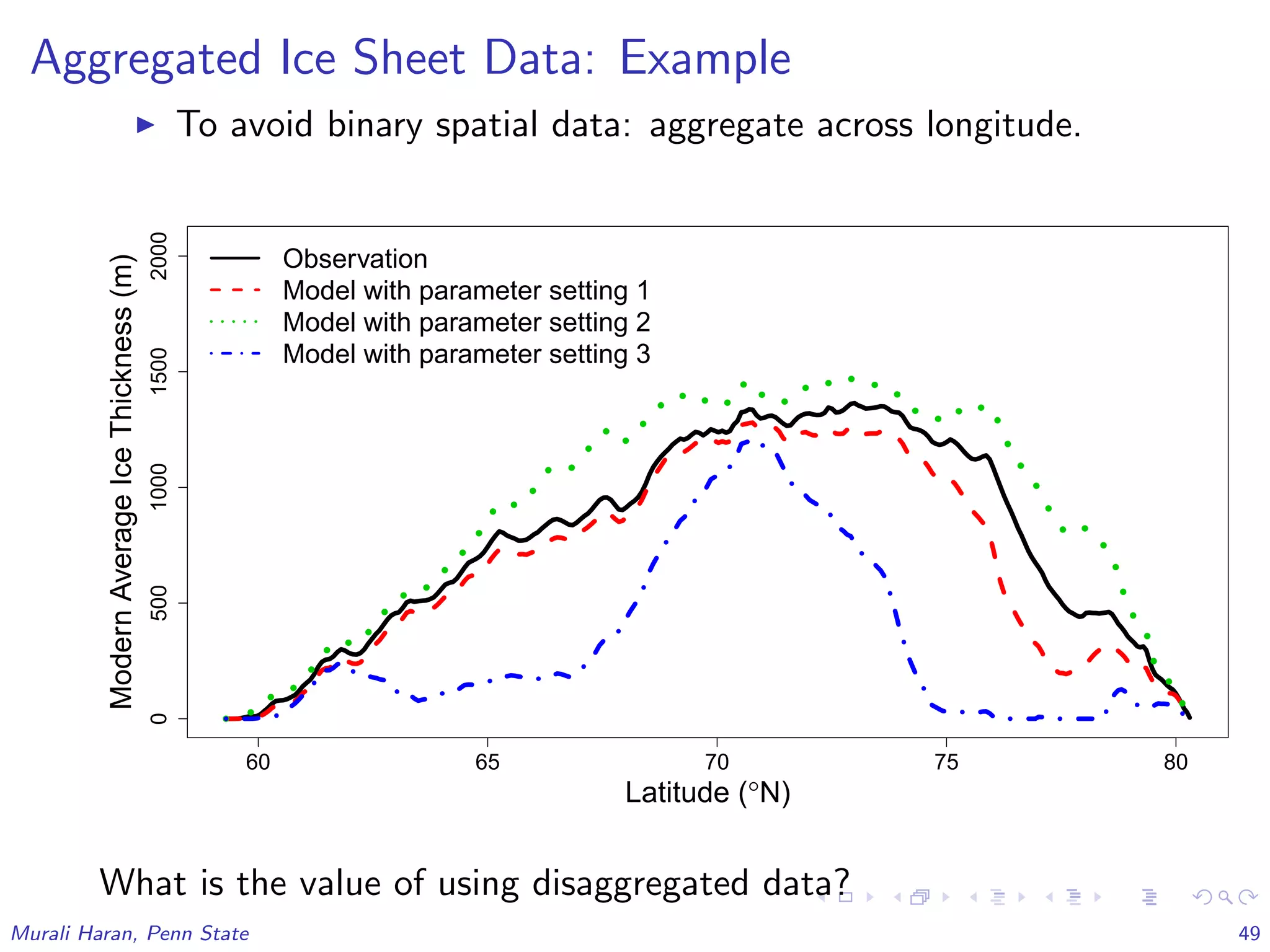
Aggregated Ice Sheet Data: Example
To avoid binary spatial data: aggregate across longitude.
60 65 70 75 80
0500100015002000
Latitude (°N)
ModernAverageIceThickness(m)
Observation
Model with parameter setting 1
Model with parameter setting 2
Model with parameter setting 3
What is the value of using disaggregated data?
Murali Haran, Penn State 49
Aside: How Does Statistical Rigor Help Scientists?
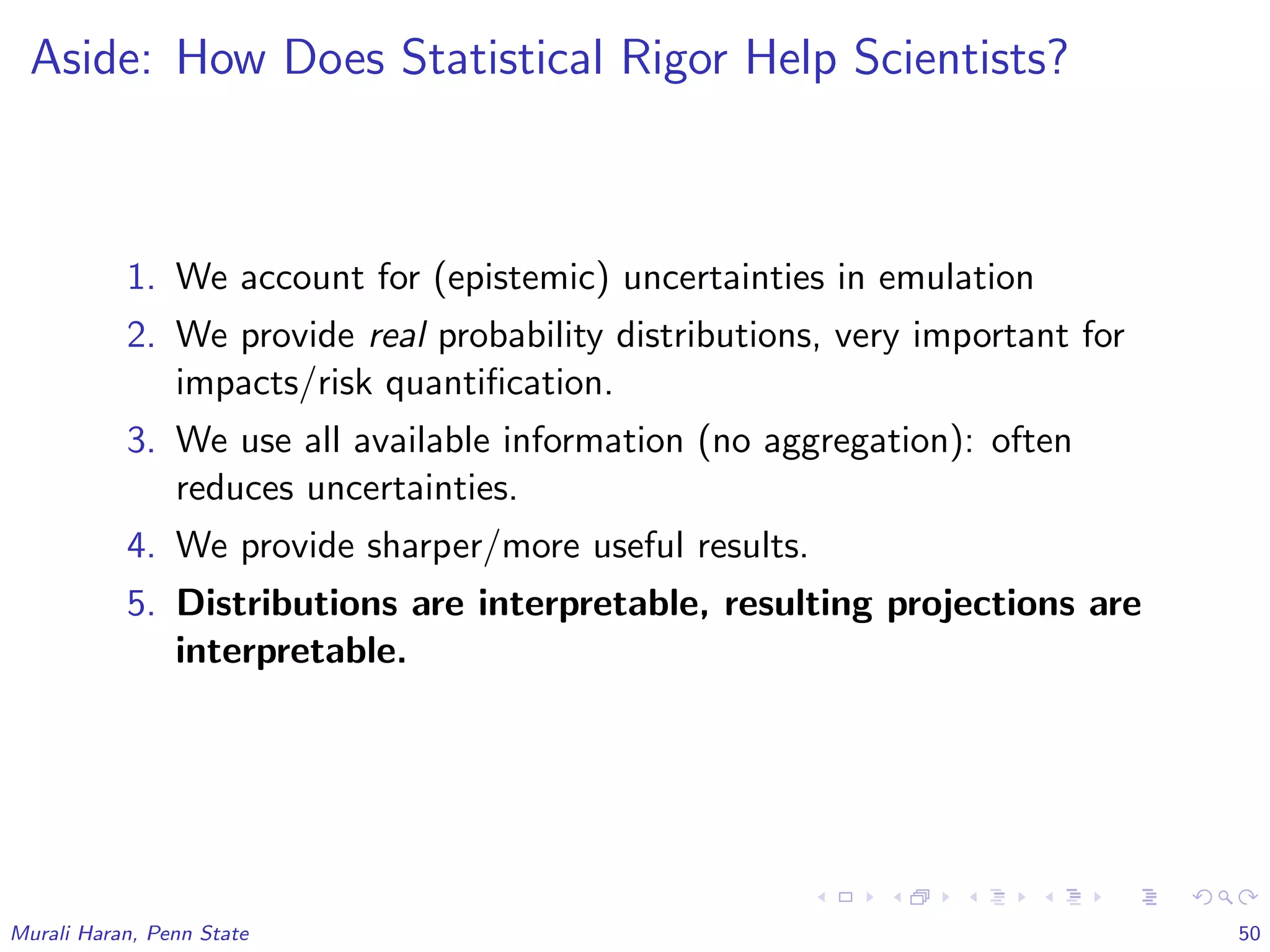
1. We account for (epistemic) uncertainties in emulation
2. We provide real probability distributions, very important for
impacts/risk quantification.
3. We use all available information (no aggregation): often
reduces uncertainties.
4. We provide sharper/more useful results.
5. Distributions are interpretable, resulting projections are
interpretable.
Murali Haran, Penn State 50
Emulation-Calibration with Binary Spatial Output
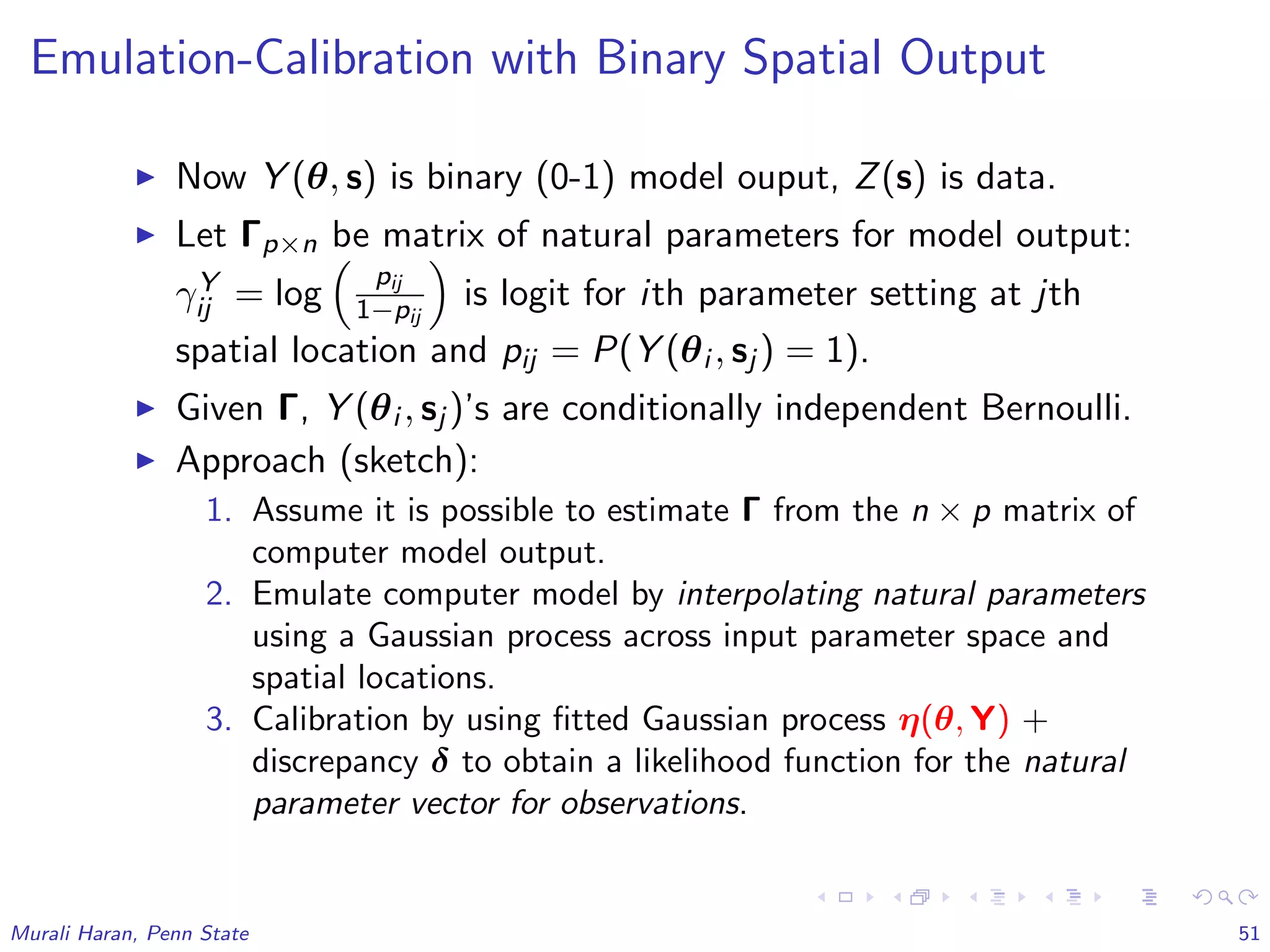
Now Y (θ, s) is binary (0-1) model ouput, Z(s) is data.
Let Γp×n be matrix of natural parameters for model output:
γY
ij = log
pij
1−pij
is logit for ith parameter setting at jth
spatial location and pij = P(Y (θi , sj ) = 1).
Given Γ, Y (θi , sj )’s are conditionally independent Bernoulli.
Approach (sketch):
1. Assume it is possible to estimate Γ from the n × p matrix of
computer model output.
2. Emulate computer model by interpolating natural parameters
using a Gaussian process across input parameter space and
spatial locations.
3. Calibration by using fitted Gaussian process η(θ, Y) +
discrepancy δ to obtain a likelihood function for the natural
parameter vector for observations.
Murali Haran, Penn State 51
Challenges
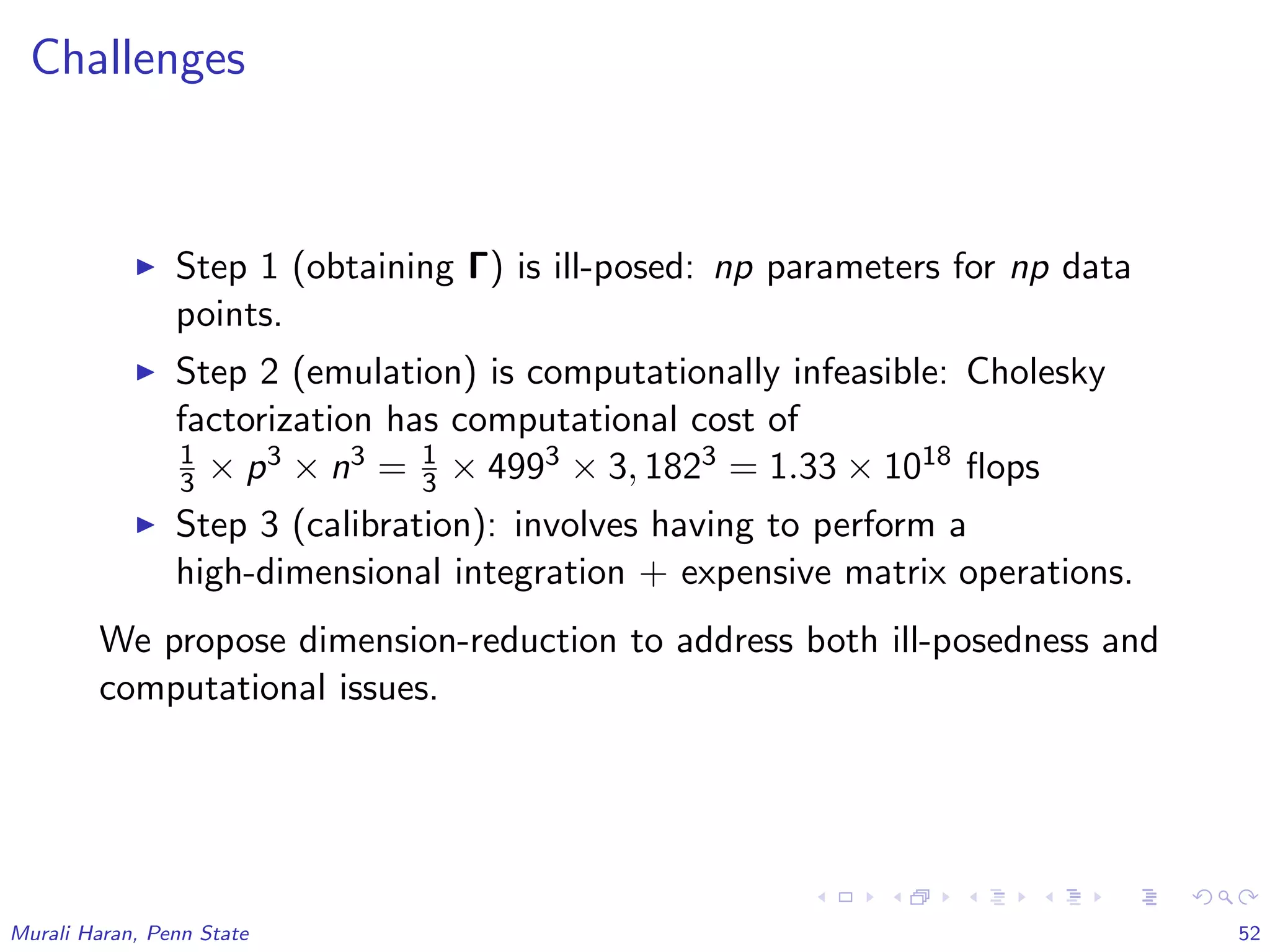
Step 1 (obtaining Γ) is ill-posed: np parameters for np data
points.
Step 2 (emulation) is computationally infeasible: Cholesky
factorization has computational cost of
1
3 × p3 × n3 = 1
3 × 4993 × 3, 1823 = 1.33 × 10¹⁸ flops
Step 3 (calibration): involves having to perform a
high-dimensional integration + expensive matrix operations.
We propose dimension-reduction to address both ill-posedness and
computational issues.
Murali Haran, Penn State 52
Efficient Emulation: Outline
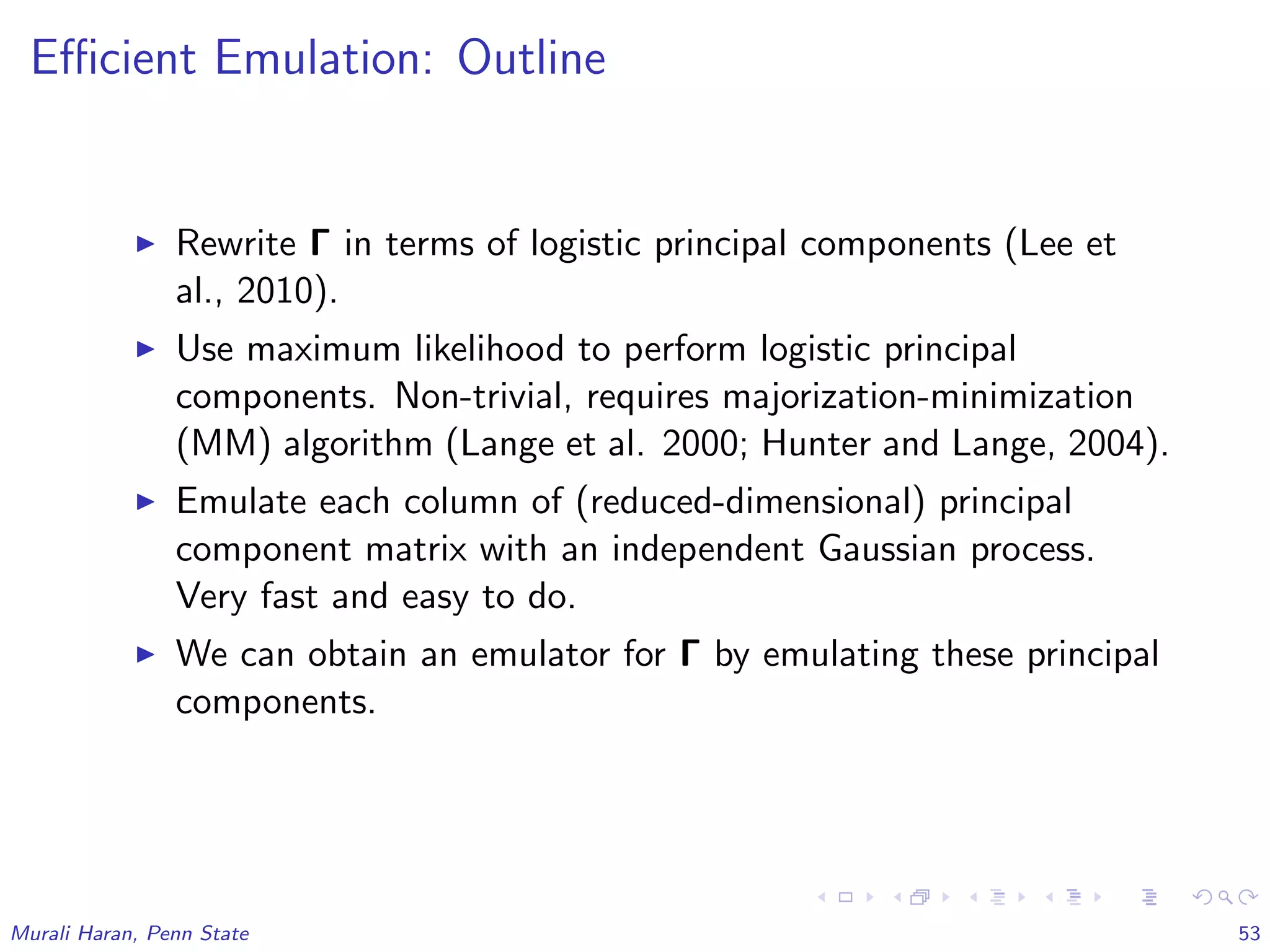
Rewrite Γ in terms of logistic principal components (Lee et
al., 2010).
Use maximum likelihood to perform logistic principal
components. Non-trivial, requires majorization-minimization
(MM) algorithm (Lange et al. 2000; Hunter and Lange, 2004).
Emulate each column of (reduced-dimensional) principal
component matrix with an independent Gaussian process.
Very fast and easy to do.
We can obtain an emulator for Γ by emulating these principal
components.
Murali Haran, Penn State 53
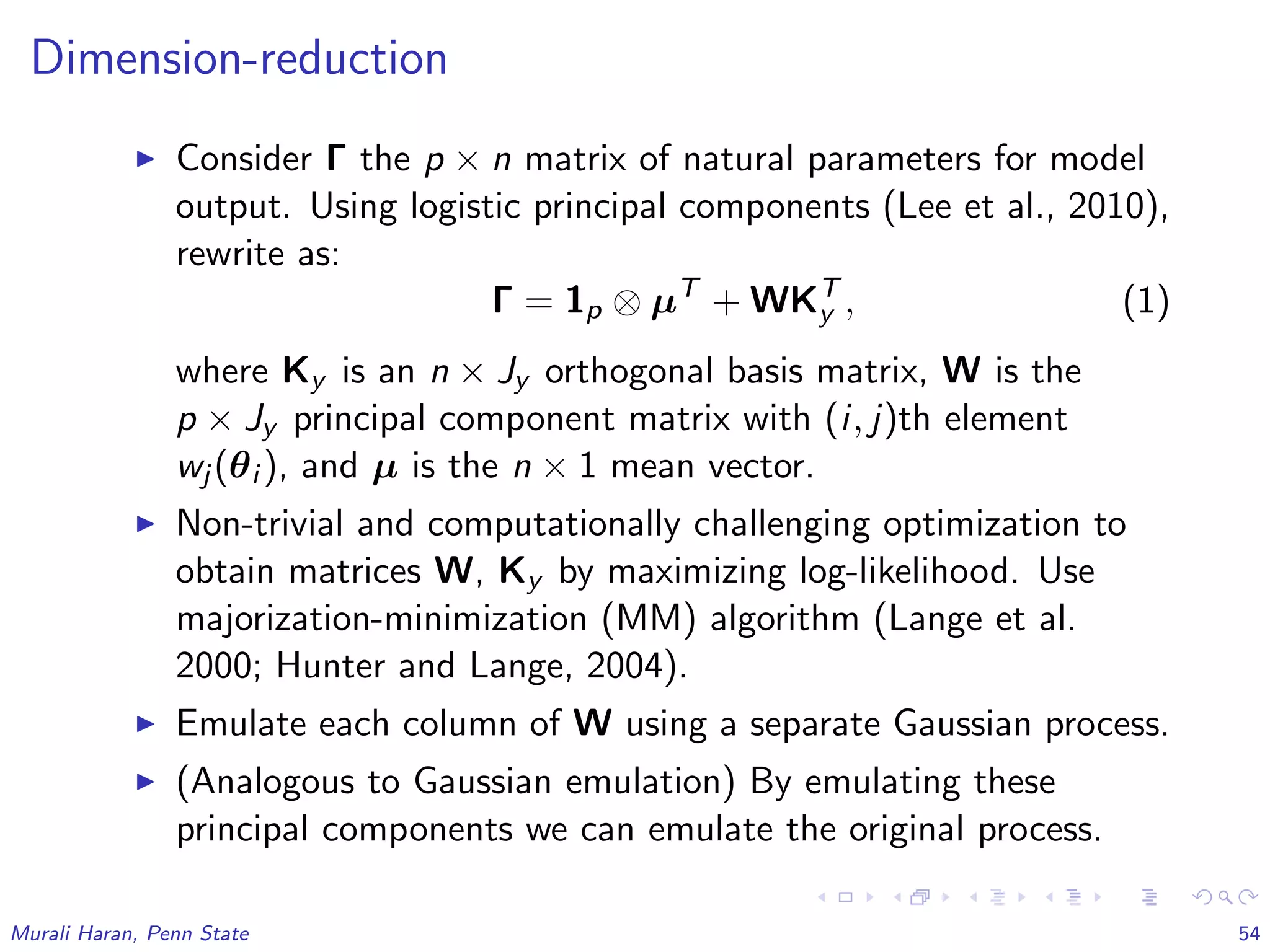
Dimension-reduction
Consider Γ the p × n matrix of natural parameters for model
output. Using logistic principal components (Lee et al., 2010),
rewrite as:
Γ = 1p ⊗ µT
+ WKT
y , (1)
where Ky is an n × Jy orthogonal basis matrix, W is the
p × Jy principal component matrix with (i, j)th element
wj (θi ), and µ is the n × 1 mean vector.
Non-trivial and computationally challenging optimization to
obtain matrices W, Ky by maximizing log-likelihood. Use
majorization-minimization (MM) algorithm (Lange et al.
2000; Hunter and Lange, 2004).
Emulate each column of W using a separate Gaussian process.
(Analogous to Gaussian emulation) By emulating these
principal components we can emulate the original process.
Murali Haran, Penn State 54
Ice Sheet Data go back
Murali Haran, Penn State 55
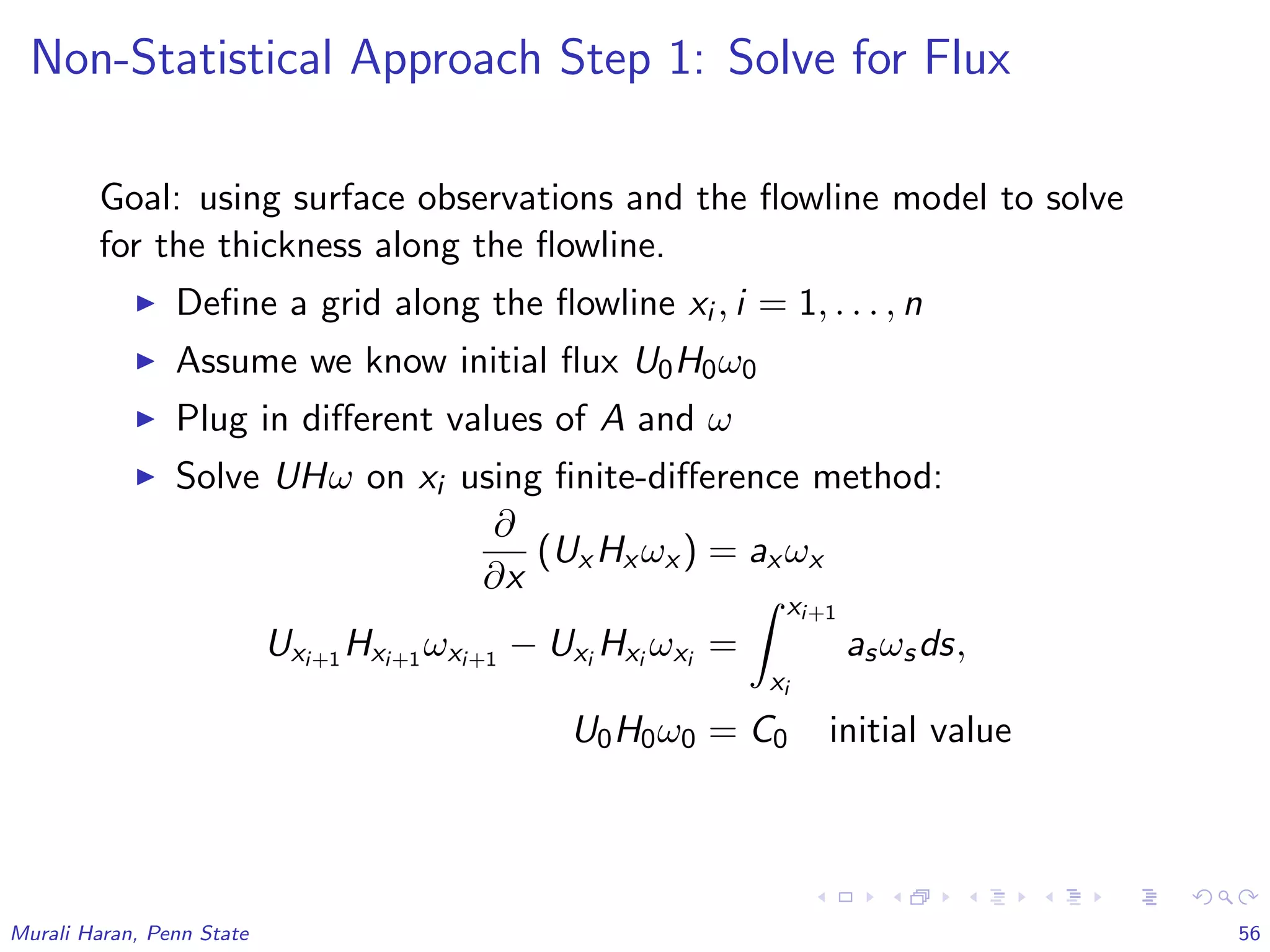
Non-Statistical Approach Step 1: Solve for Flux
Goal: using surface observations and the flowline model to solve
for the thickness along the flowline.
Define a grid along the flowline xi , i = 1, . . . , n
Assume we know initial flux U0H0ω0
Plug in different values of A and ω
Solve UHω on xi using finite-difference method:
∂
∂x
(Ux Hx ωx ) = ax ωx
Uxi+1 Hxi+1 ωxi+1 − Uxi Hxi ωxi =
xi+1
xi
asωsds,
U0H0ω0 = C0 initial value
Murali Haran, Penn State 56
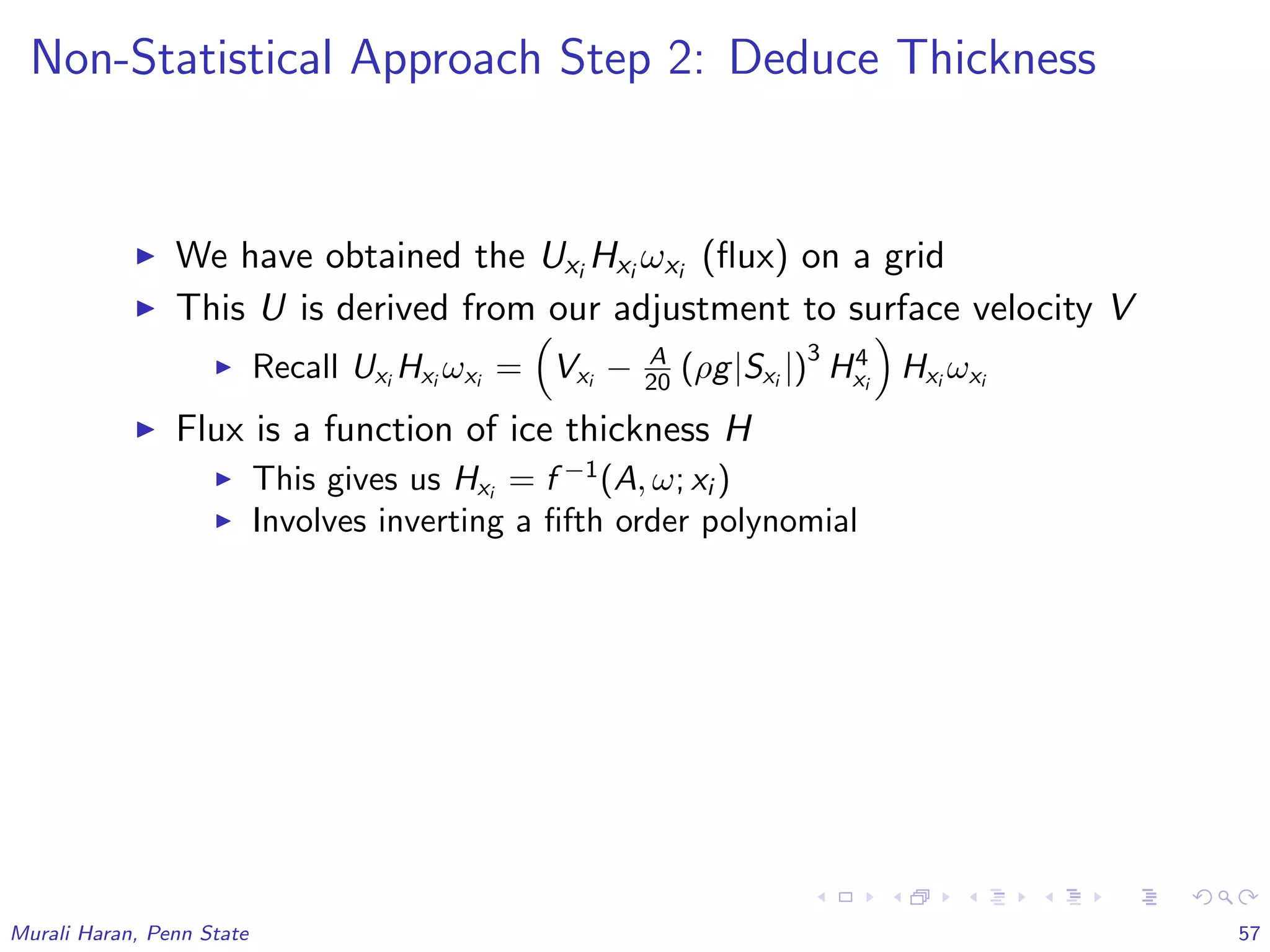
Non-Statistical Approach Step 2: Deduce Thickness
We have obtained the Uxi Hxi ωxi (flux) on a grid
This U is derived from our adjustment to surface velocity V
Recall Uxi
Hxi
ωxi
= Vxi
− A
20 (ρg|Sxi
|)
3
H4
xi
Hxi
ωxi
Flux is a function of ice thickness H
This gives us Hxi
= f −1
(A, ω; xi )
Involves inverting a fifth order polynomial
Murali Haran, Penn State 57
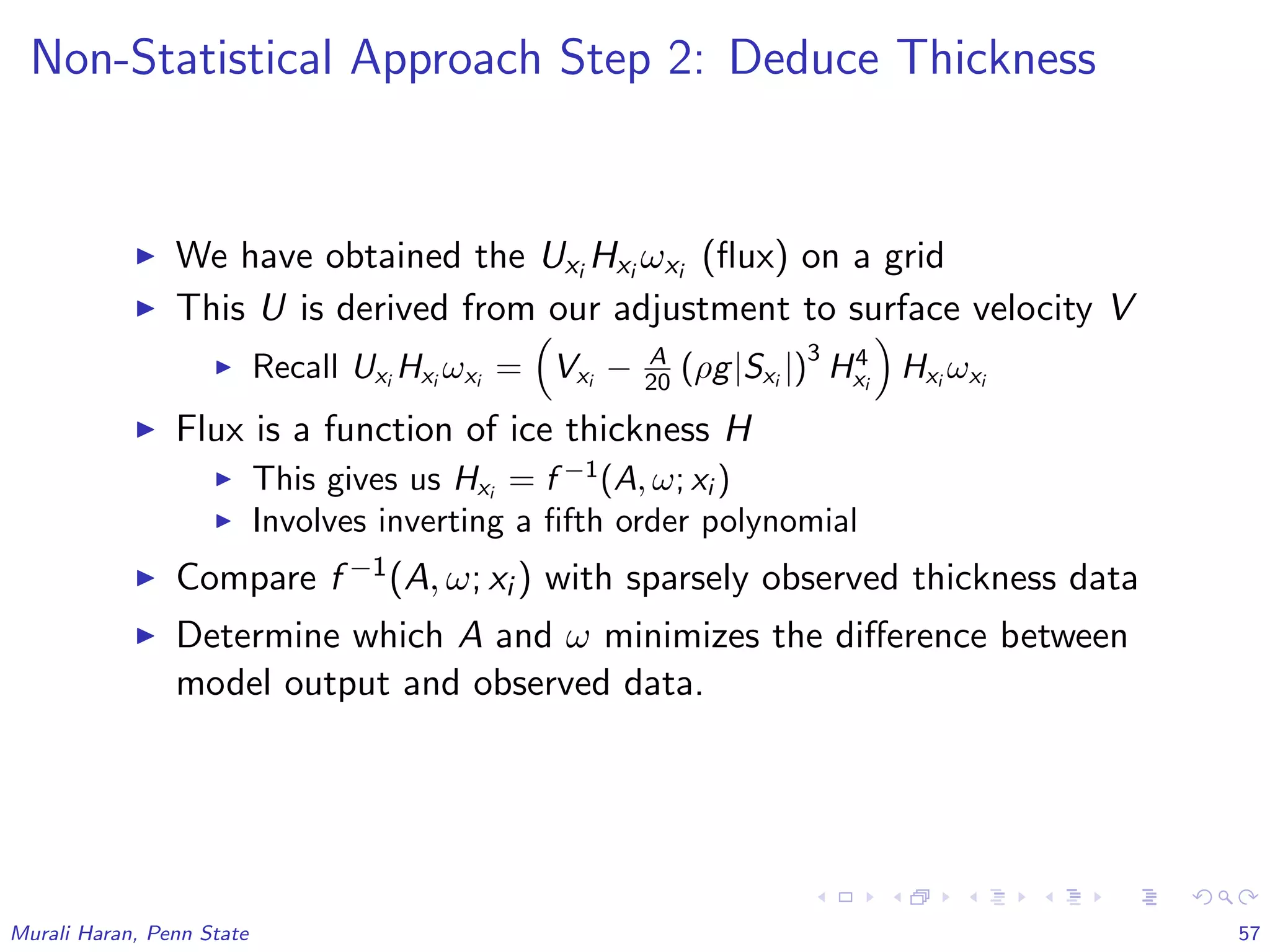
Non-Statistical Approach Step 2: Deduce Thickness
We have obtained the Uxi Hxi ωxi (flux) on a grid
This U is derived from our adjustment to surface velocity V
Recall Uxi
Hxi
ωxi
= Vxi
− A
20 (ρg|Sxi
|)
3
H4
xi
Hxi
ωxi
Flux is a function of ice thickness H
This gives us Hxi
= f −1
(A, ω; xi )
Involves inverting a fifth order polynomial
Compare f −1(A, ω; xi ) with sparsely observed thickness data
Determine which A and ω minimizes the difference between
model output and observed data.
Murali Haran, Penn State 57

Program on Mathematical and Statistical Methods for Climate and the Earth System Opening Workshop, Some Statistical Challenges in Studying the West Antarctic Ice Sheet - Murali Haran, Aug 22, 2017

  • 1.
    Some Statistical Challengesin Studying the West Antarctic Ice Sheet Murali Haran Joint with: Yawen Guan (Penn State/SAMSI) Won Chang (U of Cincinnati) David Pollard (Penn State EESI) Patrick Applegate (Penn State EESI) Department of Statistics, Penn State University Murali Haran, Penn State 1
  • 2.
    The West AntarcticIce Sheet with Ice Streams Murali Haran, Penn State 2
  • 3.
    Scales USA for scale MuraliHaran, Penn State 3
  • 4.
    Ice Sheets Enormous massof glacial land ice Antarctic ice sheet is over 14 million km2. ≈ United States + Mexico combined. Greenland ice sheet over 1.7 million km2 Combine for over 99% of the freshwater ice in the world Can have major impacts on sea level rise: Melting entire Antarctic ice sheet: sea level rise ≈ 57 m. Melting entire Greenland ice sheet: sea level rise ≈ 7 m Even a modest contribution to sea level rise can have a major impact on humans, e.g. on low-lying areas and areas prone to storm surges. Of interest: learning about ice sheet dynamics, making ice sheet projections Murali Haran, Penn State 4
  • 5.
    Ice Streams Corridors offast flow within an ice sheet Discharge most of the ice and sediment from the ice sheets Flow is orders of magnitude faster than the surrounding ice Their behaviour and stability is important to overall ice sheet dynamics and mass balance. (cf. Bennett, 2003) Of interest: understanding ice stream dynamics, learning about current thickness Murali Haran, Penn State 5
  • 6.
    Consider Two Problems 1.Ice sheets Sophisticated model for ice sheet, PSUICE3D (DeConto and Pollard, 2009, 2011): cannot work with the mathematical form of the model, treat it as a simulator Computer model emulation-calibration. (1) Fast approximate (emulated) model runs to see how model behaves as we vary inputs. (2) Infer parameters of the computer model using: Model simulations Observations of the ice sheet: modern (spatial) and historical, paleo-reconstructed (temporal) 2. Ice streams Simple mass-balance model for ice stream flow Surface observational data sets of the ice sheet: velocity, slope, partial data on thickness Full statistical inference: infer model parameters + ice sheet thickness. This is largely about “marrying physics and statistics” (Kenneth Kunkel) Murali Haran, Penn State 6
  • 7.
    Ice Sheets VersusIce Streams Major difference in scale/model complexity Physical models for the West Antarctic ice sheet based on Pollard and De Conto (2009, 2011). Statistics perspective: Treat the physics like a black box and estimate parameters Computer model emulation-calibration With ice streams: we build statistical model directly using this simpler physics model Murali Haran, Penn State 7
  • 8.
    Part 1 Overview:Statistical Methods for Ice Sheets How can we project the future behavior of the West Antarctic Ice Sheet? Ice sheet model: PSU3D-ICE (Pollard and DeConto, 2009). Key model input parameters are uncertain Calibrate parameters based on observations: 1. Satellite data on the modern ice sheet. 2. Paleo reconstructions of ice sheet from 25,000 years ago to present time. Our research: methods to use observations of the ice sheet to infer important parameters of the ice sheet model. Statistical/computational challenges: 1. Models simulations are slow 2. Two sets of data: high-dimensional spatial and temporal binary/non-Gaussian data (“data” = observations and computer model output) 3. Data-model discrepancies, error structures Murali Haran, Penn State 8
  • 9.
    Ice Sheet Physics • •is transported by ice flow to lower marginal regions on time scales of • where it is lost as surface melt, and/or discharge to floating ice shelve Siegert, 2002, Amer. Sci. ~3 km ~3000 km Murali Haran, Penn State 9
  • 10.
    Ice Sheet Model Theice sheet’s behavior is complex: takes about 48 hours (at each parameter setting) for a typical 20-km resolution, 40 kyr long run Model equations predict ice flow, thickness, temperatures, and bedrock elevation, through thousands to millions of years. Examples of key model parameters: Ocean melt coefficient: sensitivity of ice sheet to temperature change in the surrounding ocean Strength of the “calving” process. Calving = where ice breaks off and transitions from attached to floating “Slipperiness” of the ocean floor Murali Haran, Penn State 10
  • 11.
    Satellite Observations versusModel Output Murali Haran, Penn State 11
  • 12.
  • 13.
    Aside: Example ofSharper, Interpretable Results Left: previous ad-hoc methods. Right: statistical calibration Chang, Haran, Olson, Keller (2014), Annals of Applied Stats Murali Haran, Penn State 13
  • 14.
    Two-stage Approach toEmulation-Calibration 1. Emulation step: Find fast approximation for computer model using a Gaussian process (GP). 2. Calibration step: Infer climate parameter using emulator and observations, while accounting for data-model discrepancy Modularization Liu, Bayarri and Berger (2009) Bhat, Haran, Olson, Keller (2012) Chang, Haran, Applegate, Pollard (2016a; 2016b) Murali Haran, Penn State 14
  • 15.
    Emulation Step Toy example:model output is a scalar, and continuous. Computer model output (y-axis) Emulation (approximation) vs. input (x-axis) of computer model using GP Murali Haran, Penn State 15
  • 16.
    Calibration Step Toy example:model output, observations are scalars Combining observation Posterior PDF of θ and emulator given model output and observations Murali Haran, Penn State 16
  • 17.
    Summary of StatisticalProblem Goal: Learn about θ based on two sources of information: Observations: 1. Observed time series of past grounding line positions reconstructed from paleo records: Z1 = (Z1(t1), . . . , Z1(tn))T , t1, . . . , tn are time points locations. 2. Observed modern ice-no ice from satellite data: Z2 = [Z2(s1), . . . , Z2(sm)], locations s1, . . . , sm. Model output 1. Y1(θ1), . . . , Y1(θp), where each Y1(θi ) = (Y1(θi , t1), . . . , Y1(θi , tn))T is a time series of grounding line positions at parameter setting θi . 2. Y2(θ1), . . . , Y2(θp), where each Y2(θi ) = (Y2(θi , s1), . . . , Y2(θi , sm))T is a vector of spatial data at parameter setting θi . Murali Haran, Penn State 17
  • 18.
    Step 1: ComputerModel Emulation Basics Fit Gaussian process model for computer model output Y to interpolate the values at the parameter settings θ1, . . . , θp and the spatial locations s1, . . . , sn vec (Y) ∼ N(Xβ, Σ(ξy )), vec(·) concatenates columns into one vector β and ξy estimated by maximum likelihood, ˆβ, ˆξy . Covariance interpolates across spatial surface and input space. Result: Obtain a probability model (from predictive distribution) for model output at any input parameter θ, η(θ, Y). Murali Haran, Penn State 18
  • 19.
    Step 2: CalibrationBasics Discrepancy ≈ mismatch between computer model output and data when parameters are perfectly calibrated and there is no observational error. Probability model for observations Z is then Z = η(θ, Y) + δ, where n-dimensional spatial field δ is model-observation discrepancy with covariance parameter ξδ. Inference for θ based on posterior distribution π(θ, ξδ|Z, Y, ˆξy ) ∝ ˆL(Z|Y, θ, ξδ, ˆξy ) likelihood given by above × p(θ) × p(ξδ) priors for θ and ξδ with emulator parameter ˆξy fixed at MLE. Murali Haran, Penn State 19
  • 20.
    Statistical Methodology forEmulation-Calibration Emulation (Sacks et al., 1989). Original kriging ideas date back to 1950s (cf. Cressie, 1994) Calibration (Kennedy and O’Hagan, 2001) With climate models, output are vectors/spatial data Bayarri et al. (2007, 2008, ...) Climate (scalar diagnostics): Sanso, Forest, Zantedeschi (2008) Climate with spatial/time series data: Bhat, Haran, Olson, Keller (2010a); Bhat, Haran, Goes (2010b); Olson et al. (2012) High-dimensional spatial: Chang, Haran, Olson, Keller (2014) Ice sheet spatial binary (non-Gaussian): Chang, Haran, Applegate, Pollard (2016a, b) Murali Haran, Penn State 20
  • 21.
    Principal Components forHigh-dimensional Data Popular approach for handling high-dimensional output (Higdon et al., 2008; Chang, Haran, Olson, Keller, 2014) Consider model outputs at θ1, . . . , θp as if they were replicates of a multivariate process, thereby obtaining their PCs    Y (s1, θ1) . . . Y (sn, θ1) ... ... ... Y (s1, θp) . . . Y (sn, θp)    p×n ⇒    Y R 1 (θ1) . . . Y R Jy (θ1) ... ... ... Y R 1 (θp) . . . Y R Jy (θp)    p×Jy PCs pick up characteristics of model output that vary most across input parameters θ1, . . . , θp. Surprisingly flexible approach, allowing for non-separable covariance. Similar ideas in Edwards et al. (2017) Murali Haran, Penn State 21
  • 22.
    Emulation Examples Train onsome, test on “hold-out” parameter settings Fast way to study how model behaves across parameter space Model Output from Run No.67 Emulated Output for Run No.67 Model Output from Run No.491 Emulated Output for Run No.491 Murali Haran, Penn State 22
  • 23.
    Efficient Calibration Main ideas: Utilizethe data to derive information about the model-data discrepancy. Use a basis representation for model-data discrepancy term. Markov chain Monte Carlo Murali Haran, Penn State 23
  • 24.
    Calibration Results withModern Data 0.00.20.40.60.81.0 OCFAC 2−D Posterior Densities for Input Parameters 0.0 0.2 0.4 0.6 CALV 0.00.20.40.6 CALV 0.0 0.2 0.4 0.6 0.8 1.0 CRH 0.0 0.4 0.8 1.2 TAU 0.00.20.40.60.81.0 CRH 0.0 0.2 0.4 0.6 0.8 1.0 Probability Density Murali Haran, Penn State 24
  • 25.
    Calibration Results withModern and Paleo Data 0.00.20.40.60.81.0 OCFAC 2−D Posterior Densities for Input Parameters 0.0 0.2 0.4 0.6 CALV 0.00.20.40.6 CALV 0.0 0.2 0.4 0.6 0.8 1.0 CRH 0.0 0.4 0.8 1.2 TAU 0.00.20.40.60.81.0 CRH 0.0 0.2 0.4 0.6 0.8 1.0 Probability Density Paleo data eliminates unrealistic trajectories of the ice sheet.Murali Haran, Penn State 25
  • 26.
    Why are theResults Different? Unrealistic simulations with overshoots in past ice retreat and projected future regrowth are eliminated This “constrains” the probability distribution of the parameters Murali Haran, Penn State 26
  • 27.
    Ice Volume Projections:Paleo Cuts Off Left Tail Murali Haran, Penn State 27
  • 28.
    Structural Uncertainty Caveat (cf.Lenny Smith, SAMSI Opening Workshop, 2017): The previous pdf is based on a model that has a 7.2% probability* of being wrong (More seriously) there are important questions about structural uncertainty (in statistics: “model uncertainty”) * I made this up (G.E.P. Box: All models are wrong...) Murali Haran, Penn State 28
  • 29.
    Related Work Statistical approachesfor studying historical and future projections of ice sheets T. Edwards et al. (2017): a comprehensive study across parametric uncertainty + model uncertainty (e.g. mechanism of cliff failure) Wernecke, Edwards2, Holden (2017): principal components for dimension reduction Briggs, Pollard, Tarasov (2014) Ritz, Edwards et al. (2015) Tarasov, Peltier (2004) Other work? Different perspectives, e.g. from applied math? Murali Haran, Penn State 29
  • 30.
    Results Statistical methods provideinterpretable results about parameters and probabilistic projections Can study value of using more data (disaggregated) Easy to see how multiple sources of data inform (“constrain”) parameters Have to think hard about computational issues Chang, W., Haran, M, Applegate, P., Pollard, D. (2016a, b) JASA, Annals of Applied Stats Chang, W., Applegate, P., Haran, M. and Keller, K. (2016) Geoscientific Model Development Chang, W., M. Haran, R. Olson, and K. Keller (2014) Annals of Applied Stats Murali Haran, Penn State 30
  • 31.
    Open Statistical Challenges Veryhigh-dimensional output, dependent, e.g. multivariate spatial, temporal Space-time output (dynamic emulation-calibration) Lots of parameters Handling data-model discrepancies; complex errors/dependencies in data Fast/non-MCMC approaches to calibration (ongoing work with Ben Lee) Combining information across multiple models, multiple scales (EMICs of various kinds) Different models have different advantages: faster/simpler models allow for study of more parameter combinations, slower/complex models allow for study of adding/subtracting particular features “Causal inference” of a certain kind (cf. Michael Wehner’s SAMSI opening workshop talk). Also: how model parameters impact model behavior Murali Haran, Penn State 31
  • 32.
    Part 2 Overview:Ice Streams Fast-flowing ice streams are major contributors to ice loss Key components for understanding ice stream’s stability and dynamics: ice thickness and bedrock topography. Of interest: Interpolate ice thickness while obeying the underlying physics Estimate ice stream dynamics parameters Proposal: Bayesian approach: combine ice stream physics + information from multiple data sets See also: Berliner, Cressie, et al. (2008a, b) First step toward developing general methodology Focus on Thwaites glacier, covers an area of 182,000 km2 (≈ Italy/2). Estimated ice loss has doubled since the 1990s Murali Haran, Penn State 32
  • 33.
    Basic Idea Principal physicscommonly applied is conservation of ice mass Given observations of surface elevation, ice velocity and surface mass balance, we can deduce the ice thickness assuming the ice sheet is in a steady state. Examples: Using coarse grid in Antarctica (Warner and Budd, 2000) Higher resolution in Greenland (Morlighem et al., 2011, 2013, 2014) 2D model was not accurate for our study domain. Hence, changes: 1. Consider 1D study (transect), 250 km length 2. Added a new component to dynamics model: shallow ice approximation (SIA). 3. Include the varying glacier width to account for tributaries, which contribute to mass flux Model is still simple enough that we can solve it quickly Our statistical model accounts for errors/uncertainties Murali Haran, Penn State 33
  • 34.
    Mathematical Flowline Model Modelice as an incompressible material (constant density) Flux: the action or process of flowing or flowing out =Velocity Field ( ¯V ) × Surface Area (Hω) Mass conservation along the flowline =⇒ Flux at 1 - Flux at 2 = 0 For an open rectangular channel: snow accumulation ∂( ¯Vx Hx ωx ) ∂x = ax ωx Murali Haran, Penn State 34
  • 35.
    Flowline Model Adjustment Depth-averagedvelocity cannot be observed We use surface velocity with adjustment as an approximation Adjustment accounts for ice deformation based on the Shallow Ice Approximation (e.g. Van der Veen, 2013) ∂ ∂x       Ux Vx − A 20 (ρg|Sx |)3 H4 x Hx ωx       = ax ωx Murali Haran, Penn State 35
  • 36.
  • 37.
    Uncertainties in Modelingan Ice Stream Spatially sparse thickness observations, Hobs xi , i = 1, . . . , m, subject to observational errors Assume model errors are normally distributed Unknown quantities in the mathematical model (parameters) Deformation coefficient A Flow width ωx , modeled with a latent Gaussian Process Discrepancy between mathematical model and true process Observational errors in the input processes (surface velocity, surface slope and snow accumulation rate) Non-statistical approach Obtain poor reconstructions No uncertainty estimates Solutions are not unique; do not exist for some locations Murali Haran, Penn State 37
  • 38.
    Model Details Goal: predictthickness and inference for deformation coefficient A Flow width (“nuisance parameter”) ωx needed for thickness prediction Ice Thickness Model: observations model: Hobs | h, θ ∼ N(h, σ2 H I) physics (deterministic) model: h | v, s, a, ω, θ = M (v, s, a, ω, A) Flowline Width Model: ω | θ ∼ GP (0, C(θω)) Input Process Model: v, s, a | θ, V obs , Sobs , aobs ∼ f (v | V obs , θv )f (s | Sobs , θs)f (a | aobs, θa) velocity model: f (v | V obs , θv ) slope model: f (s | Sobs , θs) accumulation rate model: f (a | aobs , θa) Prior: p(θ) = p(σ2 H)p(A)p(θω)p(θv )p(θs)p(θa) Thickness Velocity Slope Accum.rate Observation: Hobs V obs Sobs aobs True processes: h v s a Murali Haran, Penn State 38
  • 39.
    Results Our approach canpotentially be used for other glaciers in Antarctica with: reliable surface data sparse thickness observation Bayesian methods and computational tools allow us to combine: multiple data sets glacier dynamics model estimate thickness while accounting for uncertainties Caveats: Unable to account for all errors in the input processes Model discrepancy is absent in hierarchical model Guan, Y., Haran, M., Pollard, D. (2017), Environmetrics, in press. https://arxiv.org/abs/1612.01454 Murali Haran, Penn State 39
  • 40.
    Concluding Thoughts Common theme:combining physics with statistics (Note to statisticians:) physics is central to this research (Note to modelers/domain scientists:) statisticians have nice methods for working with physics/mathematical models + complex error structures When mathematically tractable physical model: can build rich hierarchical model that directly handles error structures Even when model can only be studied through simulation (mathematically intractable), there are statistical methods for careful uncertainty quantification Lots of challenges: size of data sets/model output complexity of output: spatial, temporal, spatio-temporal, multiple spatio-temporal... complexity of model dimensionality of unknowns dependencies, errors in (quality of) data Murali Haran, Penn State 40
  • 41.
    Acknowledgments Collaborators: Won Chang, Universityof Cincinnati Yawen Guan, SAMSI David Pollard, Earth and Environmental Systems Institute (EESI), Penn State U. Patrick Applegate, EESI, Penn State U. Klaus Keller, Geosciences, Penn State U. Roman Olson, The University of New South Wales This work was partially supported by the following grants: The Network for Sustainable Climate Risk Management (SCRiM), NSF GEO-1240507. NSF CDSE/DMS-1418090 Statistical Methods for Ice Sheet Projections Murali Haran, Penn State 41
  • 42.
    Acknowledgments Research group consistingof grads and undergraduates Partially supported by NSF CDSE/DMS-1418090 Statistical Methods for Ice Sheet Projections Murali Haran, Penn State 42
  • 43.
  • 44.
    Non-Statistical Approach For eachflow width, we can predict thickness according to the flowline model. Results for three different flow widths, wide, medium, narrow: 0 50000 100000 150000 200000 250000 10002000300040005000 Thickness along Flowline Distance to Divide Thickness(m) Observed Thickness A = 10e−20 A = 10e−18 A = 10e−16 0 50000 100000 150000 200000 250000 10002000300040005000 Thickness along Flowline Distance to Divide Thickness(m) Observed Thickness A = 10e−20 A = 10e−18 A = 10e−16 0 50000 100000 150000 200000 250000 10002000300040005000 Thickness along Flowline Distance to Divide Thickness(m) Observed Thickness A = 10e−20 A = 10e−18 A = 10e−16 All are poor reconstructions No uncertainty estimates Solutions are not unique; do not exist for some locations Murali Haran, Penn State 44
  • 45.
    Data Sets Data SetSpatial resolution Surface velocity, m/year (Vs) 450 m Surface elevation, m (E) ∼ 14 m Net ice accumulation rate*/year (a) 55 km Thinning rate/year (τ) ∼ 1.5 - 5 km Ice thickness, m (H)** ∼ 14 m 1 Ice equivalent (ice eq.) 2 We use only 5, 10 and 25 observed thickness to fit our model to keep our method realistic for applying to other glaciers on WAIS Murali Haran, Penn State 45
  • 46.
    Simulated Example datasets Simulate synthetic data using the followings: A = 10−17 Smooth surface elevation, accumulation rate Observed flow width Observed ice thickness Simulate velocity from flowline model Add noise to observed ice thickness to create synthetic data Murali Haran, Penn State 46
  • 47.
    Simulation Results 0 50000100000 150000 200000 250000 01000200030004000 Distance to Divide Thickness Observed Small Error Median Error Large Error Synthetic Thickness 0 50000 100000 150000 200000 250000 050000100000150000 Flow Width Estimates Distance to Divide Width(m) 95% CI using 5 training locations 95% CI using 10 training locations 95% CI using 25 training locations Synthetic True 0 50000 100000 150000 200000 250000 500100015002000250030003500 Thickness Prediction along Flowline Distance to Divide Thickness(m) q Synthetic Thicknes Model Prediction (95% CI) Model Realization Model Realization Model Realization Training q q q q q 0 50000 100000 150000 200000 250000 500100015002000250030003500 Thickness Prediction along Flowline Distance to Divide Thickness(m) q Synthetic Thicknes Model Prediction (95% CI) Model Realization Model Realization Model Realization Training q q q q q q q q q q q q q q q q q q q q q q q q q Murali Haran, Penn State 47
  • 48.
  • 49.
    Aggregated Ice SheetData: Example To avoid binary spatial data: aggregate across longitude. 60 65 70 75 80 0500100015002000 Latitude (°N) ModernAverageIceThickness(m) Observation Model with parameter setting 1 Model with parameter setting 2 Model with parameter setting 3 What is the value of using disaggregated data? Murali Haran, Penn State 49
  • 50.
    Aside: How DoesStatistical Rigor Help Scientists? 1. We account for (epistemic) uncertainties in emulation 2. We provide real probability distributions, very important for impacts/risk quantification. 3. We use all available information (no aggregation): often reduces uncertainties. 4. We provide sharper/more useful results. 5. Distributions are interpretable, resulting projections are interpretable. Murali Haran, Penn State 50
  • 51.
    Emulation-Calibration with BinarySpatial Output Now Y (θ, s) is binary (0-1) model ouput, Z(s) is data. Let Γp×n be matrix of natural parameters for model output: γY ij = log pij 1−pij is logit for ith parameter setting at jth spatial location and pij = P(Y (θi , sj ) = 1). Given Γ, Y (θi , sj )’s are conditionally independent Bernoulli. Approach (sketch): 1. Assume it is possible to estimate Γ from the n × p matrix of computer model output. 2. Emulate computer model by interpolating natural parameters using a Gaussian process across input parameter space and spatial locations. 3. Calibration by using fitted Gaussian process η(θ, Y) + discrepancy δ to obtain a likelihood function for the natural parameter vector for observations. Murali Haran, Penn State 51
  • 52.
    Challenges Step 1 (obtainingΓ) is ill-posed: np parameters for np data points. Step 2 (emulation) is computationally infeasible: Cholesky factorization has computational cost of 1 3 × p3 × n3 = 1 3 × 4993 × 3, 1823 = 1.33 × 10¹⁸ flops Step 3 (calibration): involves having to perform a high-dimensional integration + expensive matrix operations. We propose dimension-reduction to address both ill-posedness and computational issues. Murali Haran, Penn State 52
  • 53.
    Efficient Emulation: Outline RewriteΓ in terms of logistic principal components (Lee et al., 2010). Use maximum likelihood to perform logistic principal components. Non-trivial, requires majorization-minimization (MM) algorithm (Lange et al. 2000; Hunter and Lange, 2004). Emulate each column of (reduced-dimensional) principal component matrix with an independent Gaussian process. Very fast and easy to do. We can obtain an emulator for Γ by emulating these principal components. Murali Haran, Penn State 53
  • 54.
    Dimension-reduction Consider Γ thep × n matrix of natural parameters for model output. Using logistic principal components (Lee et al., 2010), rewrite as: Γ = 1p ⊗ µT + WKT y , (1) where Ky is an n × Jy orthogonal basis matrix, W is the p × Jy principal component matrix with (i, j)th element wj (θi ), and µ is the n × 1 mean vector. Non-trivial and computationally challenging optimization to obtain matrices W, Ky by maximizing log-likelihood. Use majorization-minimization (MM) algorithm (Lange et al. 2000; Hunter and Lange, 2004). Emulate each column of W using a separate Gaussian process. (Analogous to Gaussian emulation) By emulating these principal components we can emulate the original process. Murali Haran, Penn State 54
  • 55.
    Ice Sheet Datago back Murali Haran, Penn State 55
  • 56.
    Non-Statistical Approach Step1: Solve for Flux Goal: using surface observations and the flowline model to solve for the thickness along the flowline. Define a grid along the flowline xi , i = 1, . . . , n Assume we know initial flux U0H0ω0 Plug in different values of A and ω Solve UHω on xi using finite-difference method: ∂ ∂x (Ux Hx ωx ) = ax ωx Uxi+1 Hxi+1 ωxi+1 − Uxi Hxi ωxi = xi+1 xi asωsds, U0H0ω0 = C0 initial value Murali Haran, Penn State 56
  • 57.
    Non-Statistical Approach Step2: Deduce Thickness We have obtained the Uxi Hxi ωxi (flux) on a grid This U is derived from our adjustment to surface velocity V Recall Uxi Hxi ωxi = Vxi − A 20 (ρg|Sxi |) 3 H4 xi Hxi ωxi Flux is a function of ice thickness H This gives us Hxi = f −1 (A, ω; xi ) Involves inverting a fifth order polynomial Murali Haran, Penn State 57
  • 58.
    Non-Statistical Approach Step2: Deduce Thickness We have obtained the Uxi Hxi ωxi (flux) on a grid This U is derived from our adjustment to surface velocity V Recall Uxi Hxi ωxi = Vxi − A 20 (ρg|Sxi |) 3 H4 xi Hxi ωxi Flux is a function of ice thickness H This gives us Hxi = f −1 (A, ω; xi ) Involves inverting a fifth order polynomial Compare f −1(A, ω; xi ) with sparsely observed thickness data Determine which A and ω minimizes the difference between model output and observed data. Murali Haran, Penn State 57