BONE PATHOLOGY
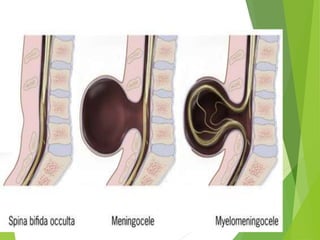
Myelomeningocele
 is a birth defect in which the backbone and spinal canal
do not close before birth.
 The condition is a type of spina bifida.
Myelomeningocele
 is the most common type of spina bifida.
 neural tube defect in which the bones of the spine do
not completely form, resulting in an incomplete spinal
canal.
 Myelomeningocele may affect as many as 1 out of every
800 infants.
 The rest of spina bifida cases are most commonly:
 Spina bifida occulta, a condition in which the bones of
the spine do not close but the spinal cord and meninges
remain in place and skin usually covers the defect
 Meningoceles, a condition where the tissue covering the
spinal cord sticks out of the
spinal defect but the spinal cord remains in place.
symptoms
 A newborn may have a sac sticking out of the mid to
lower back.
 The doctor cannot see through the sac when shining a
light behind it. Symptoms include:
 Loss of bladder or bowel control
 Partial or complete lack of sensation
 Partial or complete paralysis of the legs
 Weakness of the hips, legs, or feet of a newborn
Other symptoms :
 Abnormal feet or legs, such as clubfoot
 Build up of fluid inside the skull (hydrocephalus)
 Hair at the back part of the pelvis called the sacral area
 Dimpling of the sacral area
 Serum AFP (alpha-fetoprotein) testing in conjunction
with a second trimester ultrasound detects over 90% of
infants affected with a neural tube defect.
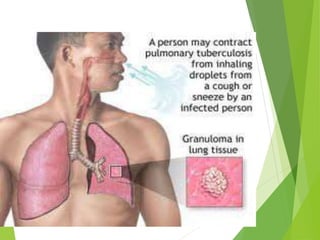
Bone T. B
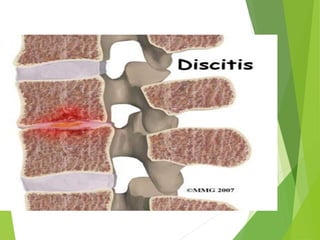
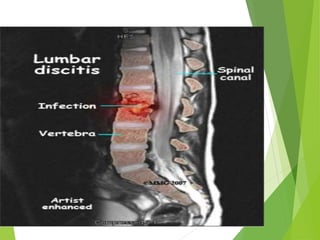
 Discitis or diskitis is an infection in the intervertebral
disc space that affects different age groups, but usually
spontaneously affects children under 8 years of age.
 Nonetheless, discitis occurs post surgically in
approximately 1-2 percent of patients after spinal
surgery.
Symptoms
 severe back pain, leading to lack of mobility.
 Some very young children may refuse to walk and
arching of the back is possible.
 In post-operative situations, the symptoms occur within
a week and result in severe low back pain or neck pain
(depending on the surgical location).
 If untreated, the discitis may resolve on its own, cause
a chronic low grade infection, or progress
to osteomyelitis and possibly even an epidural abscess.
Infectious Arthritis
Septic
Gonococcal
Viral
Fungal
Tuberculous
Lyme
Definition
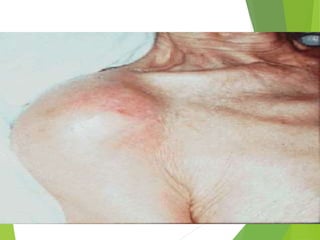
 Acute joint infection due to bacterial agents
 Medical emergency
 Risk factors:
 Systemic:
 Old age (>80 Y)
 RA
 DM
 Immunosuppressive
 Hemodyalisis
 Malignancy
 Local:
 RA
 OA
 Prosthetic joint
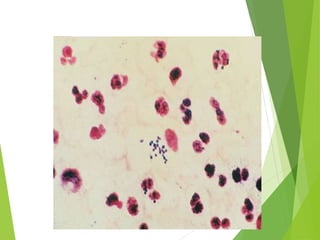
Etiology (microbiology) Microbial agent:
 Staphylococcus aureus: most common (75-80%)
 Other organism in special patients:
 Sexually active woman: Neisseria gonorrheae
 Elderly, IV drug abuser, immunocompromised, UTI: Gram
negative (p. aeruginosa and E.coli)
 SLE: Salmonella
 HIV: Pneumococci, Salmonella, H. influenzae
 Alcoholism, Humeral immunity abnormality,
Hemoglobinopathies: Pneumococcal infections
 Primary immunoglobolin deficiency: Mycoplasma
Clinical manifestations
 Fever (toxic)
 Acute
 Sever pain
 Sever swelling of one joint
 Sever tenderness
 Warmth
 Sever effusion
 Sever limited ROM
Infections of prosthesis
implants
 Many joint prostheses are used in orthopedic practice
and, whereas hip and knee joint replacement is
performed thousands of times per year throughout the
world.
 shoulder, elbow, wrist, ankle, metacarpophalangeal or
interphalangeal joint replacement is much more recent
and experimental
 . In 2004, hip and knee replacement procedures
accounted for 95% of the 1.07 million arthroplasty
procedures performed in the USA.
 Although prosthetic joint implantations improve
patients' quality of life, these procedures are associated
with complications, including aseptic failure (i.e.,
aseptic loosening) and prosthetic joint infection (PJI).
 More than 25% of all prostheses will eventually
demonstrate evidence of loosening, often necessitating
a revision arthroplasty.
 Infection, although uncommon, is the most serious
complication following joint prosthesis implantation.
 In patients with primary joint replacement, the
infection rate in the first 2 years is usually <1% in hip
and shoulder prostheses, <2% in knee prostheses, and
<9% in elbow prostheses.
 The reported infection rates are probably
underestimated, since many cases of presumed aseptic
failure may be due to unrecognized infection.
 In addition, infection rates after surgical revision are
usually considerably higher (up to 40%) than after
primary replacement.
Other factors predisposing to PJI
 older age,
 poor nutritional status,
 underlying joint disease (RA, psoriasis),
 obesity,
 diabetes mellitus,
 malignancy,
 remote infection,
 prior native joint infection,
 bacteremia (Staphylococcus aureus),
 advanced HIV infection,
 a revision surgery,
 or preoperative use of low-molecular-weight heparin.
 The mortality rate attributed to PJI may range between
0.4% in 65-year-old patients to 7% in 80-year-old
patients.
 The most commonly isolated microorganisms are Gram-
positive cocci with coagulase-negative staphylococci, S.
aureus and enterococci accounting for 65% of cases.
 Aerobic Gram-negative bacilli, including Escherichia
coli, Proteus mirabilis andPseudomonas aeruginosa, are
far less frequent causes of infection (6%).
 Anaerobes, including Propionibacterium acnes, account
for 4% of infections.
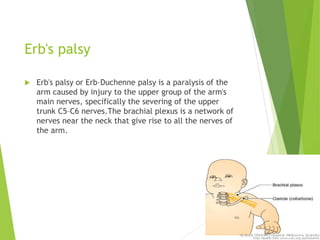
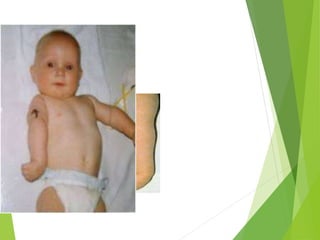
Erb's palsy
 Erb's palsy or Erb–Duchenne palsy is a paralysis of the
arm caused by injury to the upper group of the arm's
main nerves, specifically the severing of the upper
trunk C5–C6 nerves.The brachial plexus is a network of
nerves near the neck that give rise to all the nerves of
the arm.
 These nerves provide movement and feeling to the arm,
hand, and fingers.
 Palsy means weakness, and brachial plexus birth palsy
causes arm weakness and loss of motion.
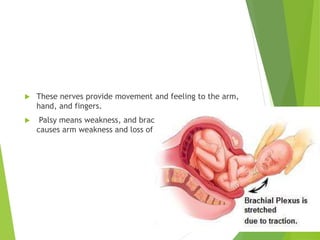
 One or two of every 1,000 babies have this condition. It
is often caused when an infant's neck is stretched to the
side during a difficult delivery.
Causes:
 difficult delivery
 large baby,
 a breech presentation,
 prolonged labor.
 Forceful delivery (If one side of the baby's neck is
stretched, the nerves may also be stretched, and injury
may result).
Symptoms
 Weakness in one arm
 Loss of feeling in the arm
 Partial or total paralysis of the arm
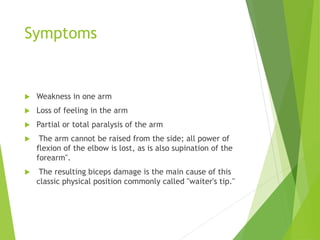
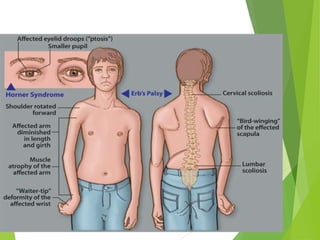
 The arm cannot be raised from the side; all power of
flexion of the elbow is lost, as is also supination of the
forearm".
 The resulting biceps damage is the main cause of this
classic physical position commonly called "waiter's tip."
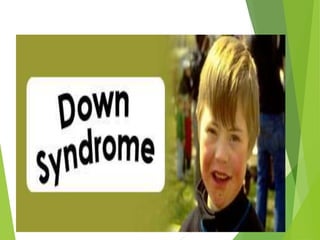
Down Syndrome
Genetics
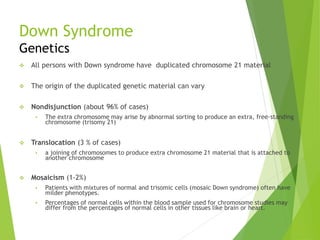
 All persons with Down syndrome have duplicated chromosome 21 material
 The origin of the duplicated genetic material can vary
 Nondisjunction (about 96% of cases)
 The extra chromosome may arise by abnormal sorting to produce an extra, free-standing
chromosome (trisomy 21)
 Translocation (3 % of cases)
 a joining of chromosomes to produce extra chromosome 21 material that is attached to
another chromosome
 Mosaicism (1-2%)
 Patients with mixtures of normal and trisomic cells (mosaic Down syndrome) often have
milder phenotypes.
 Percentages of normal cells within the blood sample used for chromosome studies may
differ from the percentages of normal cells in other tissues like brain or heart.
Genetics
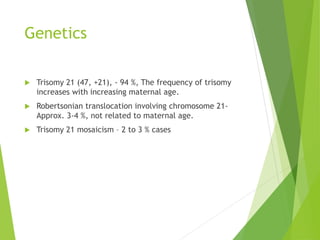
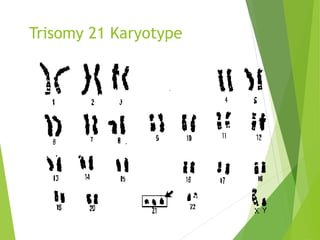
 Trisomy 21 (47, +21), - 94 %, The frequency of trisomy
increases with increasing maternal age.
 Robertsonian translocation involving chromosome 21-
Approx. 3-4 %, not related to maternal age.
 Trisomy 21 mosaicism – 2 to 3 % cases
Trisomy 21 Karyotype
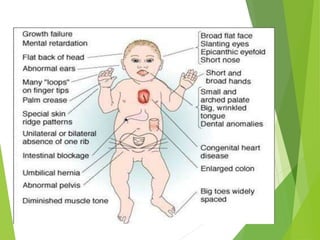
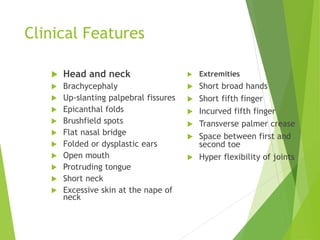
Clinical Features
 Head and neck
 Brachycephaly
 Up-slanting palpebral fissures
 Epicanthal folds
 Brushfield spots
 Flat nasal bridge
 Folded or dysplastic ears
 Open mouth
 Protruding tongue
 Short neck
 Excessive skin at the nape of
neck
 Extremities
 Short broad hands
 Short fifth finger
 Incurved fifth finger
 Transverse palmer crease
 Space between first and
second toe
 Hyper flexibility of joints
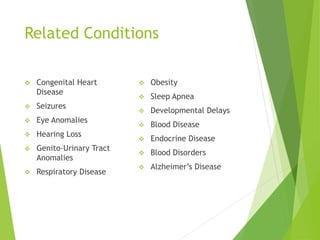
Related Conditions
 Congenital Heart
Disease
 Seizures
 Eye Anomalies
 Hearing Loss
 Genito-Urinary Tract
Anomalies
 Respiratory Disease
 Obesity
 Sleep Apnea
 Developmental Delays
 Blood Disease
 Endocrine Disease
 Blood Disorders
 Alzheimer’s Disease
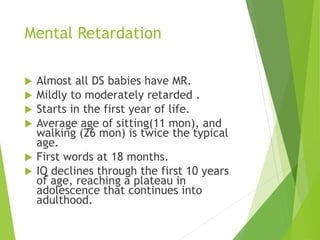
Mental Retardation
 Almost all DS babies have MR.
 Mildly to moderately retarded .
 Starts in the first year of life.
 Average age of sitting(11 mon), and
walking (26 mon) is twice the typical
age.
 First words at 18 months.
 IQ declines through the first 10 years
of age, reaching a plateau in
adolescence that continues into
adulthood.
Growth
 BW, length and HC are less in DS
 Reduced growth rate
 Prevalence of obesity is greater in DS
 Weight is less than expected for length in infants with
DS, and then increases disproportion ally so that they
are obese by age 3-4 yrs
Diagnosis
 Prenatal screening
 If no screening – It is recognized from the characteristic
phenotypic features.
 Confirmed by Karyotype.
Management
1. Growth – Measurements should be plotted on the
appropriate growth chart for children with DS.
 This will help in prevention of obesity and early
diagnosis of celiac disease and hypothyroidism.
2. Cardiac disease – All newborns should be evaluated
by cardiac ECHO for CHD in consultation with
pediatric cardiologist.
3. Hearing – Screening to be done in the newborn
period, every 6 months until 3 yrs of age and then
annually.
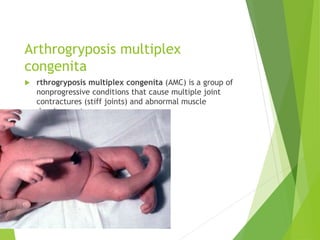
Arthrogryposis multiplex
congenita
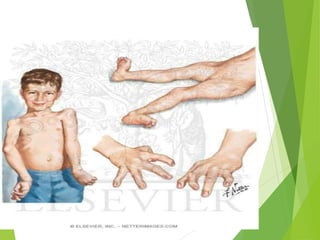
 rthrogryposis multiplex congenita (AMC) is a group of
nonprogressive conditions that cause multiple joint
contractures (stiff joints) and abnormal muscle
development.
signs and symptoms
 AMC are present at birth but can vary greatly in
severity.
 exact cause of AMC is not fully understood, but it is
thought to be associated with decreased movement or
limited space in utero, connective tissue disorders, or
maternal illness.
 Sometimes AMC occurs as part of genetic syndrome.
 Treatment focuses on the specific symptoms
experienced by each individual and may include
physical therapy, removable splints, exercise, or
surgery.
Bone pathology
Bone pathology

Bone pathology

  • 1.
  • 5.
    Myelomeningocele  is abirth defect in which the backbone and spinal canal do not close before birth.  The condition is a type of spina bifida.
  • 6.
    Myelomeningocele  is themost common type of spina bifida.  neural tube defect in which the bones of the spine do not completely form, resulting in an incomplete spinal canal.  Myelomeningocele may affect as many as 1 out of every 800 infants.
  • 7.
     The restof spina bifida cases are most commonly:  Spina bifida occulta, a condition in which the bones of the spine do not close but the spinal cord and meninges remain in place and skin usually covers the defect  Meningoceles, a condition where the tissue covering the spinal cord sticks out of the spinal defect but the spinal cord remains in place.
  • 8.
    symptoms  A newbornmay have a sac sticking out of the mid to lower back.  The doctor cannot see through the sac when shining a light behind it. Symptoms include:  Loss of bladder or bowel control  Partial or complete lack of sensation  Partial or complete paralysis of the legs  Weakness of the hips, legs, or feet of a newborn
  • 9.
    Other symptoms : Abnormal feet or legs, such as clubfoot  Build up of fluid inside the skull (hydrocephalus)  Hair at the back part of the pelvis called the sacral area  Dimpling of the sacral area
  • 10.
     Serum AFP(alpha-fetoprotein) testing in conjunction with a second trimester ultrasound detects over 90% of infants affected with a neural tube defect.
  • 11.
  • 23.
     Discitis ordiskitis is an infection in the intervertebral disc space that affects different age groups, but usually spontaneously affects children under 8 years of age.  Nonetheless, discitis occurs post surgically in approximately 1-2 percent of patients after spinal surgery.
  • 24.
    Symptoms  severe backpain, leading to lack of mobility.  Some very young children may refuse to walk and arching of the back is possible.  In post-operative situations, the symptoms occur within a week and result in severe low back pain or neck pain (depending on the surgical location).  If untreated, the discitis may resolve on its own, cause a chronic low grade infection, or progress to osteomyelitis and possibly even an epidural abscess.
  • 27.
  • 28.
    Definition  Acute jointinfection due to bacterial agents  Medical emergency
  • 29.
     Risk factors: Systemic:  Old age (>80 Y)  RA  DM  Immunosuppressive  Hemodyalisis  Malignancy  Local:  RA  OA  Prosthetic joint
  • 30.
    Etiology (microbiology) Microbialagent:  Staphylococcus aureus: most common (75-80%)  Other organism in special patients:  Sexually active woman: Neisseria gonorrheae  Elderly, IV drug abuser, immunocompromised, UTI: Gram negative (p. aeruginosa and E.coli)  SLE: Salmonella  HIV: Pneumococci, Salmonella, H. influenzae  Alcoholism, Humeral immunity abnormality, Hemoglobinopathies: Pneumococcal infections  Primary immunoglobolin deficiency: Mycoplasma
  • 31.
    Clinical manifestations  Fever(toxic)  Acute  Sever pain  Sever swelling of one joint  Sever tenderness  Warmth  Sever effusion  Sever limited ROM
  • 34.
    Infections of prosthesis implants Many joint prostheses are used in orthopedic practice and, whereas hip and knee joint replacement is performed thousands of times per year throughout the world.  shoulder, elbow, wrist, ankle, metacarpophalangeal or interphalangeal joint replacement is much more recent and experimental  . In 2004, hip and knee replacement procedures accounted for 95% of the 1.07 million arthroplasty procedures performed in the USA.
  • 35.
     Although prostheticjoint implantations improve patients' quality of life, these procedures are associated with complications, including aseptic failure (i.e., aseptic loosening) and prosthetic joint infection (PJI).  More than 25% of all prostheses will eventually demonstrate evidence of loosening, often necessitating a revision arthroplasty.  Infection, although uncommon, is the most serious complication following joint prosthesis implantation.
  • 36.
     In patientswith primary joint replacement, the infection rate in the first 2 years is usually <1% in hip and shoulder prostheses, <2% in knee prostheses, and <9% in elbow prostheses.  The reported infection rates are probably underestimated, since many cases of presumed aseptic failure may be due to unrecognized infection.  In addition, infection rates after surgical revision are usually considerably higher (up to 40%) than after primary replacement.
  • 37.
    Other factors predisposingto PJI  older age,  poor nutritional status,  underlying joint disease (RA, psoriasis),  obesity,  diabetes mellitus,  malignancy,
  • 38.
     remote infection, prior native joint infection,  bacteremia (Staphylococcus aureus),  advanced HIV infection,  a revision surgery,  or preoperative use of low-molecular-weight heparin.  The mortality rate attributed to PJI may range between 0.4% in 65-year-old patients to 7% in 80-year-old patients.
  • 39.
     The mostcommonly isolated microorganisms are Gram- positive cocci with coagulase-negative staphylococci, S. aureus and enterococci accounting for 65% of cases.  Aerobic Gram-negative bacilli, including Escherichia coli, Proteus mirabilis andPseudomonas aeruginosa, are far less frequent causes of infection (6%).  Anaerobes, including Propionibacterium acnes, account for 4% of infections.
  • 41.
    Erb's palsy  Erb'spalsy or Erb–Duchenne palsy is a paralysis of the arm caused by injury to the upper group of the arm's main nerves, specifically the severing of the upper trunk C5–C6 nerves.The brachial plexus is a network of nerves near the neck that give rise to all the nerves of the arm.
  • 42.
     These nervesprovide movement and feeling to the arm, hand, and fingers.  Palsy means weakness, and brachial plexus birth palsy causes arm weakness and loss of motion.
  • 43.
     One ortwo of every 1,000 babies have this condition. It is often caused when an infant's neck is stretched to the side during a difficult delivery.
  • 44.
    Causes:  difficult delivery large baby,  a breech presentation,  prolonged labor.  Forceful delivery (If one side of the baby's neck is stretched, the nerves may also be stretched, and injury may result).
  • 45.
    Symptoms  Weakness inone arm  Loss of feeling in the arm  Partial or total paralysis of the arm  The arm cannot be raised from the side; all power of flexion of the elbow is lost, as is also supination of the forearm".  The resulting biceps damage is the main cause of this classic physical position commonly called "waiter's tip."
  • 50.
    Down Syndrome Genetics  Allpersons with Down syndrome have duplicated chromosome 21 material  The origin of the duplicated genetic material can vary  Nondisjunction (about 96% of cases)  The extra chromosome may arise by abnormal sorting to produce an extra, free-standing chromosome (trisomy 21)  Translocation (3 % of cases)  a joining of chromosomes to produce extra chromosome 21 material that is attached to another chromosome  Mosaicism (1-2%)  Patients with mixtures of normal and trisomic cells (mosaic Down syndrome) often have milder phenotypes.  Percentages of normal cells within the blood sample used for chromosome studies may differ from the percentages of normal cells in other tissues like brain or heart.
  • 51.
    Genetics  Trisomy 21(47, +21), - 94 %, The frequency of trisomy increases with increasing maternal age.  Robertsonian translocation involving chromosome 21- Approx. 3-4 %, not related to maternal age.  Trisomy 21 mosaicism – 2 to 3 % cases
  • 52.
  • 54.
    Clinical Features  Headand neck  Brachycephaly  Up-slanting palpebral fissures  Epicanthal folds  Brushfield spots  Flat nasal bridge  Folded or dysplastic ears  Open mouth  Protruding tongue  Short neck  Excessive skin at the nape of neck  Extremities  Short broad hands  Short fifth finger  Incurved fifth finger  Transverse palmer crease  Space between first and second toe  Hyper flexibility of joints
  • 55.
    Related Conditions  CongenitalHeart Disease  Seizures  Eye Anomalies  Hearing Loss  Genito-Urinary Tract Anomalies  Respiratory Disease  Obesity  Sleep Apnea  Developmental Delays  Blood Disease  Endocrine Disease  Blood Disorders  Alzheimer’s Disease
  • 56.
    Mental Retardation  Almostall DS babies have MR.  Mildly to moderately retarded .  Starts in the first year of life.  Average age of sitting(11 mon), and walking (26 mon) is twice the typical age.  First words at 18 months.  IQ declines through the first 10 years of age, reaching a plateau in adolescence that continues into adulthood.
  • 57.
    Growth  BW, lengthand HC are less in DS  Reduced growth rate  Prevalence of obesity is greater in DS  Weight is less than expected for length in infants with DS, and then increases disproportion ally so that they are obese by age 3-4 yrs
  • 58.
    Diagnosis  Prenatal screening If no screening – It is recognized from the characteristic phenotypic features.  Confirmed by Karyotype.
  • 59.
    Management 1. Growth –Measurements should be plotted on the appropriate growth chart for children with DS.  This will help in prevention of obesity and early diagnosis of celiac disease and hypothyroidism. 2. Cardiac disease – All newborns should be evaluated by cardiac ECHO for CHD in consultation with pediatric cardiologist. 3. Hearing – Screening to be done in the newborn period, every 6 months until 3 yrs of age and then annually.
  • 61.
    Arthrogryposis multiplex congenita  rthrogryposismultiplex congenita (AMC) is a group of nonprogressive conditions that cause multiple joint contractures (stiff joints) and abnormal muscle development.
  • 62.
    signs and symptoms AMC are present at birth but can vary greatly in severity.  exact cause of AMC is not fully understood, but it is thought to be associated with decreased movement or limited space in utero, connective tissue disorders, or maternal illness.  Sometimes AMC occurs as part of genetic syndrome.
  • 64.
     Treatment focuseson the specific symptoms experienced by each individual and may include physical therapy, removable splints, exercise, or surgery.