 Sound is a mechanical wave that is
an oscillation of pressure transmitted through
a solid, liquid, or gas, composed
of frequencies within the range of hearing
and of a level sufficiently strong to be heard,
or the sensation stimulated in organs of
hearing by such vibrations.
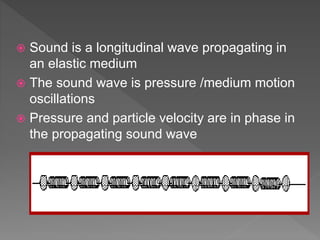
 Sound is a longitudinal wave propagating in
an elastic medium
 The sound wave is pressure /medium motion
oscillations
 Pressure and particle velocity are in phase in
the propagating sound wave
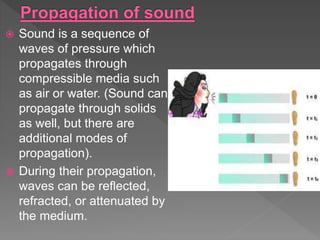
 Sound is a sequence of
waves of pressure which
propagates through
compressible media such
as air or water. (Sound can
propagate through solids
as well, but there are
additional modes of
propagation).
 During their propagation,
waves can be reflected,
refracted, or attenuated by
the medium.
The behavior of sound propagation is generally affected by
three things:
•A relationship between density and pressure. This
relationship, affected by temperature, determines the speed
of sound within the medium.
•The propagation is also affected by the motion of the
medium itself. For example, sound moving through wind.
Independent of the motion of sound through the medium, if
the medium is moving, the sound is further transported.
•The viscosity of the medium also affects the motion of
sound waves. It determines the rate at which sound is
attenuated. For many media, such as air or water, attenuation
due to viscosity is negligible.
•However When sound is moving through a medium that
does not have constant physical properties, it may be
refracted (either dispersed or focused).
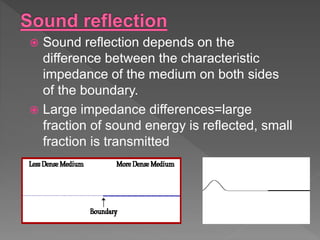
 Sound reflection depends on the
difference between the characteristic
impedance of the medium on both sides
of the boundary.
 Large impedance differences=large
fraction of sound energy is reflected, small
fraction is transmitted
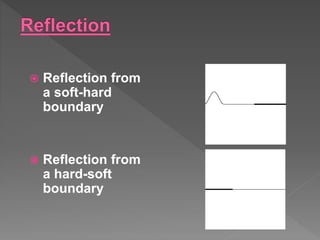
 Reflection from
a soft-hard
boundary
 Reflection from
a hard-soft
boundary
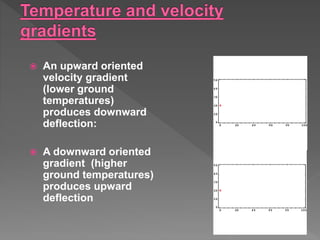
 An upward oriented
velocity gradient
(lower ground
temperatures)
produces downward
deflection:
 A downward oriented
gradient (higher
ground temperatures)
produces upward
deflection
 Objects interact with the sound wave in the
following ways:
 Objects that are smaller than 1/6th
wavelength are ’transparent’ to sound
 Objects with sizes comparable to the
wavelength scatter or diffract the sound
wave
 Objects with sizes more than 5-10
wavelengths reflect the sound wave
 The effect of wind currents is to bend the
sound wave
 In addition to the drop of sound pressure
due to spreading, sound can be
absorbed/scattered by the medium
 Especially humidity effects on ultrasound
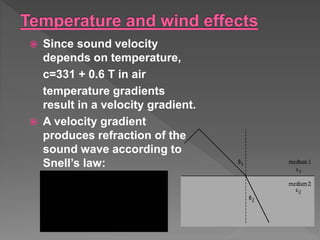
 Since sound velocity
depends on temperature,
c=331 + 0.6 T in air
temperature gradients
result in a velocity gradient.
 A velocity gradient
produces refraction of the
sound wave according to
Snell’s law:
2
2
1
1 sin
sin
c
c



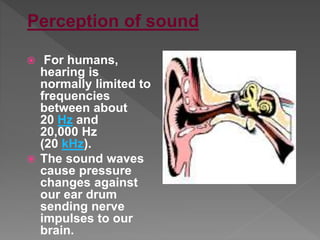
 For humans,
hearing is
normally limited to
frequencies
between about
20 Hz and
20,000 Hz
(20 kHz).
 The sound waves
cause pressure
changes against
our ear drum
sending nerve
impulses to our
brain.
Perception of sound
 The vibration
disturbs the air
around it.
 This makes changes
in air pressure.
 These changes in air
pressure move
through the air as
sound waves.
 The mechanical vibrations that can be
interpreted as sound are able to travel
through all forms of matter,
gases, liquids, solids, and plasmas. The
matter that supports the sound is called
the medium. Sound cannot travel through
a vacuum
•1 Longitudinal and transverse waves
•2 Sound wave properties and characteristics
•3 Speed of sound
• 5 Noise
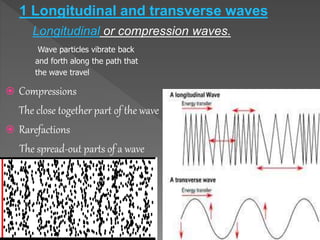
 Compressions
The close together part of the wave
 Rarefactions
The spread-out parts of a wave
Wave particles vibrate back
and forth along the path that
the wave travel
1 Longitudinal and transverse waves
Longitudinal or compression waves.
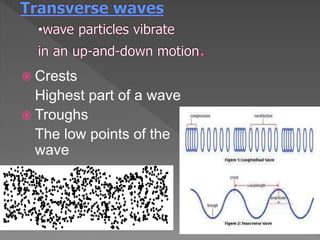
 Crests
Highest part of a wave
 Troughs
The low points of the
wave
Frequency= waves/time
Properties of Sound
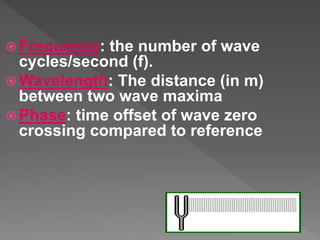
 Frequency: the number of wave
cycles/second (f).
 Wavelength: The distance (in m)
between two wave maxima
 Phase: time offset of wave zero
crossing compared to reference
Amplitude-
is the maximum distance
the particles in a wave
vibrate from their rest positions.
Wave Velocity - is the speed with which a wave
crest passes by a particular point in space
It is measured in meters/second.
Wave Velocity = Frequency  Wavelength
 Pitch (how high or low)
 Loudness (volume)
 Timbre (tone color)
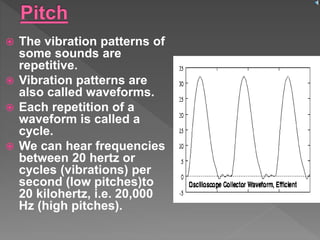
 The vibration patterns of
some sounds are
repetitive.
 Vibration patterns are
also called waveforms.
 Each repetition of a
waveform is called a
cycle.
 We can hear frequencies
between 20 hertz or
cycles (vibrations) per
second (low pitches)to
20 kilohertz, i.e. 20,000
Hz (high pitches).
 When the frequency of a
sound doubles we say
that the pitch goes up
an octave.
 We can hear a range of
pitches of about ten
octaves.
 Many animals can make
sounds and hear
frequencies that are
beyond what we can
hear.
 To create vibrations
energy is used.
 The greater amount
of energy used the
louder the sound.
 The strength of the
changes in air
pressure made by
the vibrating object
determines
loudness.
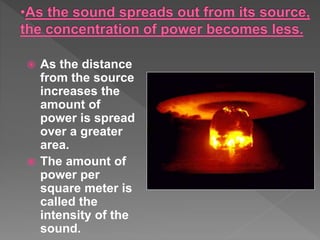
 As the distance
from the source
increases the
amount of
power is spread
over a greater
area.
 The amount of
power per
square meter is
called the
intensity of the
sound.
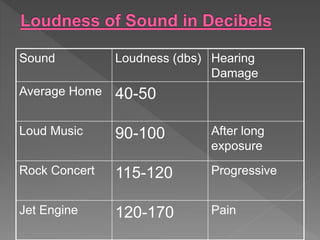
Sound Loudness (dbs) Hearing
Damage
Average Home 40-50
Loud Music 90-100 After long
exposure
Rock Concert 115-120 Progressive
Jet Engine 120-170 Pain

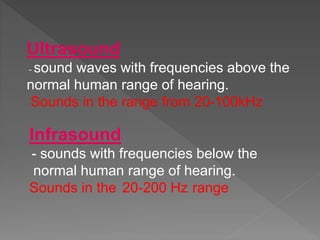
Ultrasound
- sound waves with frequencies above the
normal human range of hearing.
Sounds in the range from 20-100kHz
Infrasound
- sounds with frequencies below the
normal human range of hearing.
Sounds in the 20-200 Hz range
is the specific property of sound
that enables us to determine
the different types of sound
produced.
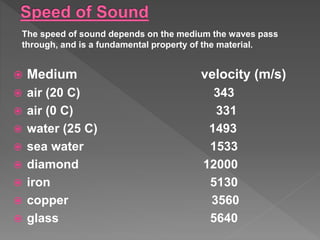
 Medium velocity (m/s)
 air (20 C) 343
 air (0 C) 331
 water (25 C) 1493
 sea water 1533
 diamond 12000
 iron 5130
 copper 3560
 glass 5640
The speed of sound depends on the medium the waves pass
through, and is a fundamental property of the material.
Noise is defined as
“Sound or a sound that is
loud, unpleasant,
unexpected, or
undesired.”
 the result of two or more sound
 waves overlapping
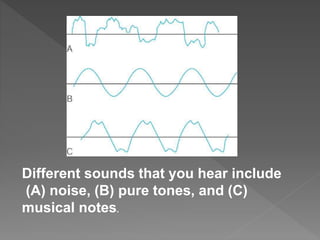
Different sounds that you hear include
(A) noise, (B) pure tones, and (C)
musical notes.
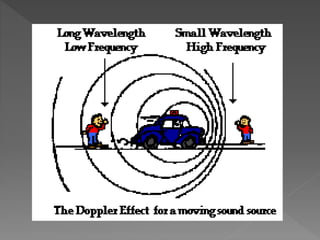
Doppler Effect
is the apparent change in the
frequency of a sound caused by
the motion of either the listener
or the source of the sound.
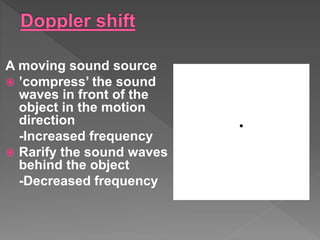
A moving sound source
 ’compress’ the sound
waves in front of the
object in the motion
direction
-Increased frequency
 Rarify the sound waves
behind the object
-Decreased frequency
 Sounds from Moving Sources.
› A moving source of sound or a
moving observer experiences an
apparent shift of frequency called
the Doppler Effect.
› If the source is moving as fast or
faster than the speed of sound, the
sound waves pile up into a shock
wave called a sonic boom.
› A sonic boom sounds very much
like the pressure wave from an
explosion
Thank you

SOUND and its properties.pptx

  • 2.
     Sound isa mechanical wave that is an oscillation of pressure transmitted through a solid, liquid, or gas, composed of frequencies within the range of hearing and of a level sufficiently strong to be heard, or the sensation stimulated in organs of hearing by such vibrations.
  • 3.
     Sound isa longitudinal wave propagating in an elastic medium  The sound wave is pressure /medium motion oscillations  Pressure and particle velocity are in phase in the propagating sound wave
  • 4.
     Sound isa sequence of waves of pressure which propagates through compressible media such as air or water. (Sound can propagate through solids as well, but there are additional modes of propagation).  During their propagation, waves can be reflected, refracted, or attenuated by the medium.
  • 5.
    The behavior ofsound propagation is generally affected by three things: •A relationship between density and pressure. This relationship, affected by temperature, determines the speed of sound within the medium. •The propagation is also affected by the motion of the medium itself. For example, sound moving through wind. Independent of the motion of sound through the medium, if the medium is moving, the sound is further transported. •The viscosity of the medium also affects the motion of sound waves. It determines the rate at which sound is attenuated. For many media, such as air or water, attenuation due to viscosity is negligible. •However When sound is moving through a medium that does not have constant physical properties, it may be refracted (either dispersed or focused).
  • 6.
     Sound reflectiondepends on the difference between the characteristic impedance of the medium on both sides of the boundary.  Large impedance differences=large fraction of sound energy is reflected, small fraction is transmitted
  • 7.
     Reflection from asoft-hard boundary  Reflection from a hard-soft boundary
  • 8.
     An upwardoriented velocity gradient (lower ground temperatures) produces downward deflection:  A downward oriented gradient (higher ground temperatures) produces upward deflection
  • 9.
     Objects interactwith the sound wave in the following ways:  Objects that are smaller than 1/6th wavelength are ’transparent’ to sound  Objects with sizes comparable to the wavelength scatter or diffract the sound wave  Objects with sizes more than 5-10 wavelengths reflect the sound wave
  • 10.
     The effectof wind currents is to bend the sound wave  In addition to the drop of sound pressure due to spreading, sound can be absorbed/scattered by the medium  Especially humidity effects on ultrasound
  • 11.
     Since soundvelocity depends on temperature, c=331 + 0.6 T in air temperature gradients result in a velocity gradient.  A velocity gradient produces refraction of the sound wave according to Snell’s law: 2 2 1 1 sin sin c c   
  • 12.
     For humans, hearingis normally limited to frequencies between about 20 Hz and 20,000 Hz (20 kHz).  The sound waves cause pressure changes against our ear drum sending nerve impulses to our brain. Perception of sound
  • 13.
     The vibration disturbsthe air around it.  This makes changes in air pressure.  These changes in air pressure move through the air as sound waves.
  • 14.
     The mechanicalvibrations that can be interpreted as sound are able to travel through all forms of matter, gases, liquids, solids, and plasmas. The matter that supports the sound is called the medium. Sound cannot travel through a vacuum •1 Longitudinal and transverse waves •2 Sound wave properties and characteristics •3 Speed of sound • 5 Noise
  • 15.
     Compressions The closetogether part of the wave  Rarefactions The spread-out parts of a wave Wave particles vibrate back and forth along the path that the wave travel 1 Longitudinal and transverse waves Longitudinal or compression waves.
  • 16.
     Crests Highest partof a wave  Troughs The low points of the wave
  • 17.
  • 18.
  • 19.
     Frequency: thenumber of wave cycles/second (f).  Wavelength: The distance (in m) between two wave maxima  Phase: time offset of wave zero crossing compared to reference
  • 20.
    Amplitude- is the maximumdistance the particles in a wave vibrate from their rest positions. Wave Velocity - is the speed with which a wave crest passes by a particular point in space It is measured in meters/second. Wave Velocity = Frequency  Wavelength
  • 21.
     Pitch (howhigh or low)  Loudness (volume)  Timbre (tone color)
  • 22.
     The vibrationpatterns of some sounds are repetitive.  Vibration patterns are also called waveforms.  Each repetition of a waveform is called a cycle.  We can hear frequencies between 20 hertz or cycles (vibrations) per second (low pitches)to 20 kilohertz, i.e. 20,000 Hz (high pitches).
  • 23.
     When thefrequency of a sound doubles we say that the pitch goes up an octave.  We can hear a range of pitches of about ten octaves.  Many animals can make sounds and hear frequencies that are beyond what we can hear.
  • 24.
     To createvibrations energy is used.  The greater amount of energy used the louder the sound.  The strength of the changes in air pressure made by the vibrating object determines loudness.
  • 25.
     As thedistance from the source increases the amount of power is spread over a greater area.  The amount of power per square meter is called the intensity of the sound.
  • 26.
    Sound Loudness (dbs)Hearing Damage Average Home 40-50 Loud Music 90-100 After long exposure Rock Concert 115-120 Progressive Jet Engine 120-170 Pain
  • 27.
    Ultrasound - sound waveswith frequencies above the normal human range of hearing. Sounds in the range from 20-100kHz Infrasound - sounds with frequencies below the normal human range of hearing. Sounds in the 20-200 Hz range
  • 28.
    is the specificproperty of sound that enables us to determine the different types of sound produced.
  • 29.
     Medium velocity(m/s)  air (20 C) 343  air (0 C) 331  water (25 C) 1493  sea water 1533  diamond 12000  iron 5130  copper 3560  glass 5640 The speed of sound depends on the medium the waves pass through, and is a fundamental property of the material.
  • 30.
    Noise is definedas “Sound or a sound that is loud, unpleasant, unexpected, or undesired.”
  • 31.
     the resultof two or more sound  waves overlapping
  • 32.
    Different sounds thatyou hear include (A) noise, (B) pure tones, and (C) musical notes.
  • 33.
    Doppler Effect is theapparent change in the frequency of a sound caused by the motion of either the listener or the source of the sound.
  • 35.
    A moving soundsource  ’compress’ the sound waves in front of the object in the motion direction -Increased frequency  Rarify the sound waves behind the object -Decreased frequency
  • 36.
     Sounds fromMoving Sources. › A moving source of sound or a moving observer experiences an apparent shift of frequency called the Doppler Effect. › If the source is moving as fast or faster than the speed of sound, the sound waves pile up into a shock wave called a sonic boom. › A sonic boom sounds very much like the pressure wave from an explosion
  • 37.