RESONANCE
WHAT IS RESONANCE
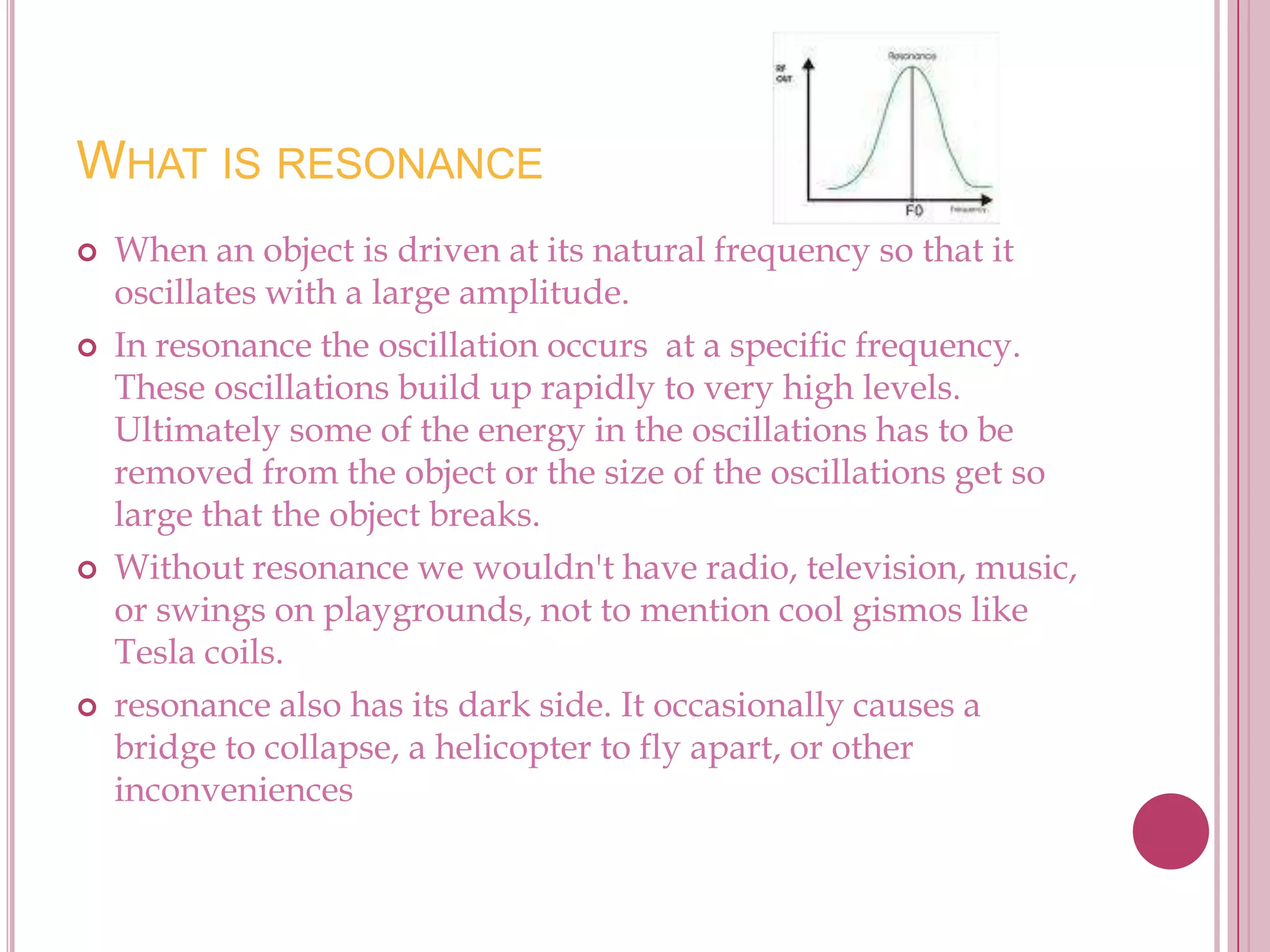
   When an object is driven at its natural frequency so that it
    oscillates with a large amplitude.
   In resonance the oscillation occurs at a specific frequency.
    These oscillations build up rapidly to very high levels.
    Ultimately some of the energy in the oscillations has to be
    removed from the object or the size of the oscillations get so
    large that the object breaks.
   Without resonance we wouldn't have radio, television, music,
    or swings on playgrounds, not to mention cool gismos like
    Tesla coils.
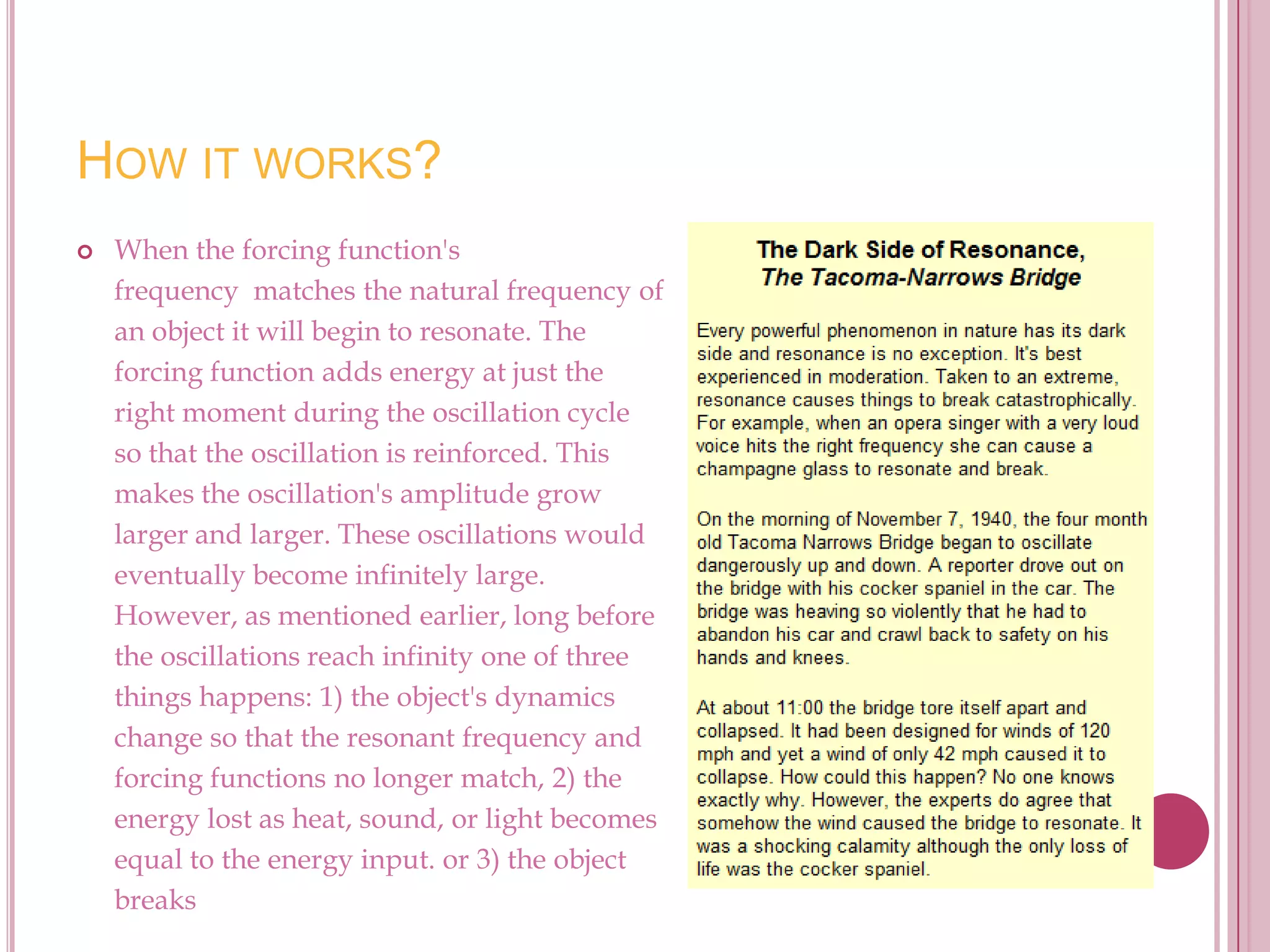
   resonance also has its dark side. It occasionally causes a
    bridge to collapse, a helicopter to fly apart, or other
    inconveniences
RESONANCE REQUIRES 3 BASIC CONDITIONS:
   A) An Object With a Natural Frequency: The object can be a
    mechanical device or an electronic circuit. An object's natural
    frequency is the frequency it tends to oscillate at when
    disturbed. The oscillation can be a mechanical vibration as is
    the case when the string of a guitar is strummed. In an
    electronic circuit the oscillation is a variable voltage or
    current. An object can have more than one natural frequency.
    These are called harmonics. A guitar string sounds musical
    because it vibrates with several harmonics when it is
    strummed.
RESONANCE REQUIRES 3 BASIC CONDITIONS:
   B) A Forcing Function at the Same Frequency as the Natural
    Frequency: In mechanical systems the forcing function is a
    variable force. In electronic circuits it arises from a variable
    electric field. In either case the forcing function does work on
    the object it is applied to. Since work is a form of energy
    transfer it causes energy to build up in the object.
RESONANCE REQUIRES 3 BASIC CONDITIONS:
   C) A Lack of Damping or Energy Loss: For an object to
    resonate, mechanical or electrical energy has to build up in
    the object. Anything which removes these forms of energy
    tends to interfere with resonance. Damping is a means
    of removing electrical or mechanical energy by converting it
    to heat. The term damping should not be confused with the
    term dampening which means to make something slightly
    wet. Friction, air resistance, and viscous drag can all provide
    damping in mechanical systems. Electrical resistance
    performs the same function in electronic circuits. Other forms
    of energy loss can include sound (musical instruments) or
    light emissions (lasers).
HOW IT WORKS?
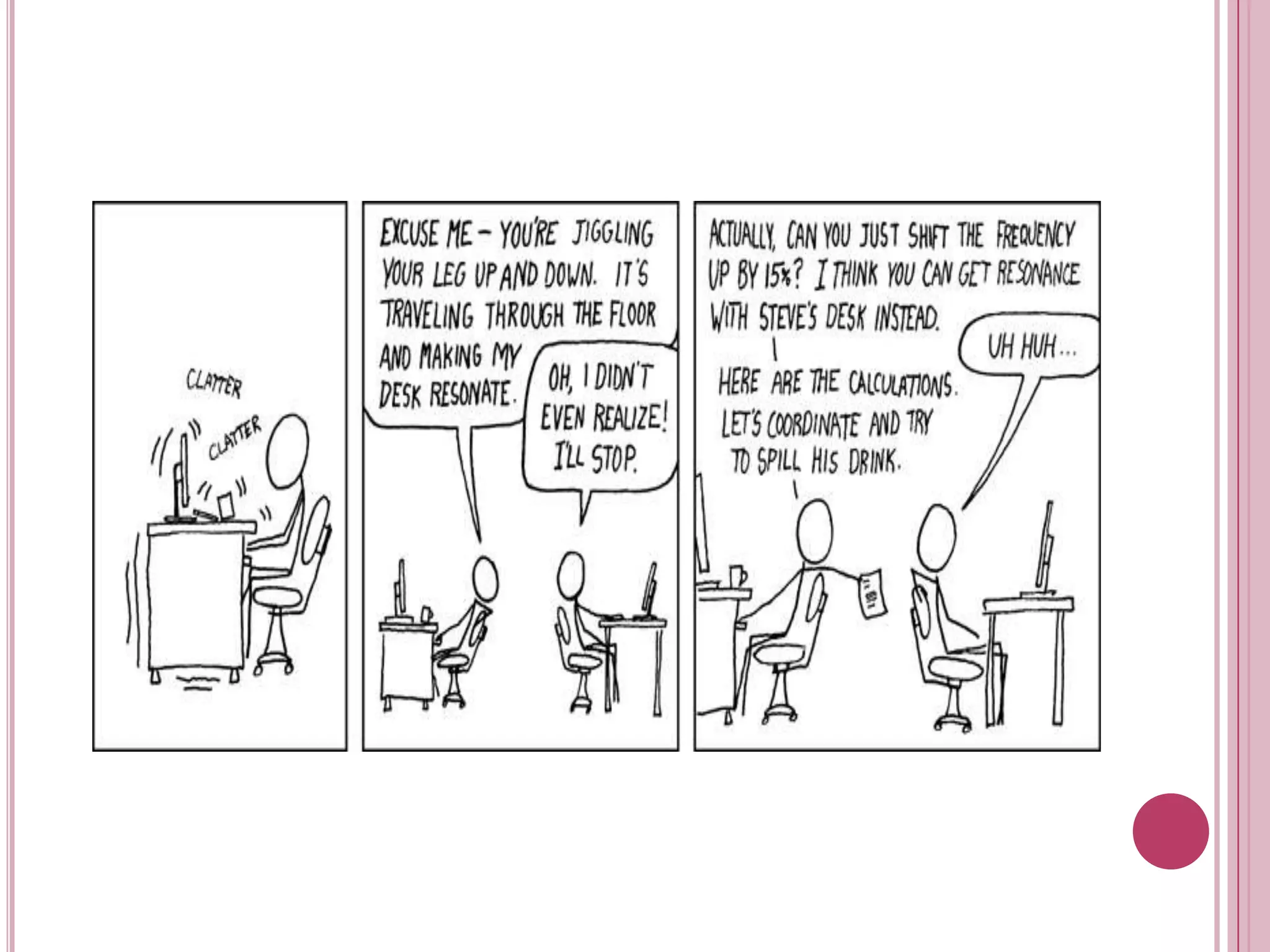
   When the forcing function's
    frequency matches the natural frequency of
    an object it will begin to resonate. The
    forcing function adds energy at just the
    right moment during the oscillation cycle
    so that the oscillation is reinforced. This
    makes the oscillation's amplitude grow
    larger and larger. These oscillations would
    eventually become infinitely large.
    However, as mentioned earlier, long before
    the oscillations reach infinity one of three
    things happens: 1) the object's dynamics
    change so that the resonant frequency and
    forcing functions no longer match, 2) the
    energy lost as heat, sound, or light becomes
    equal to the energy input. or 3) the object
    breaks
HOW IT WORKS?
EXAMPLES: PLAYGROUND SWINGS
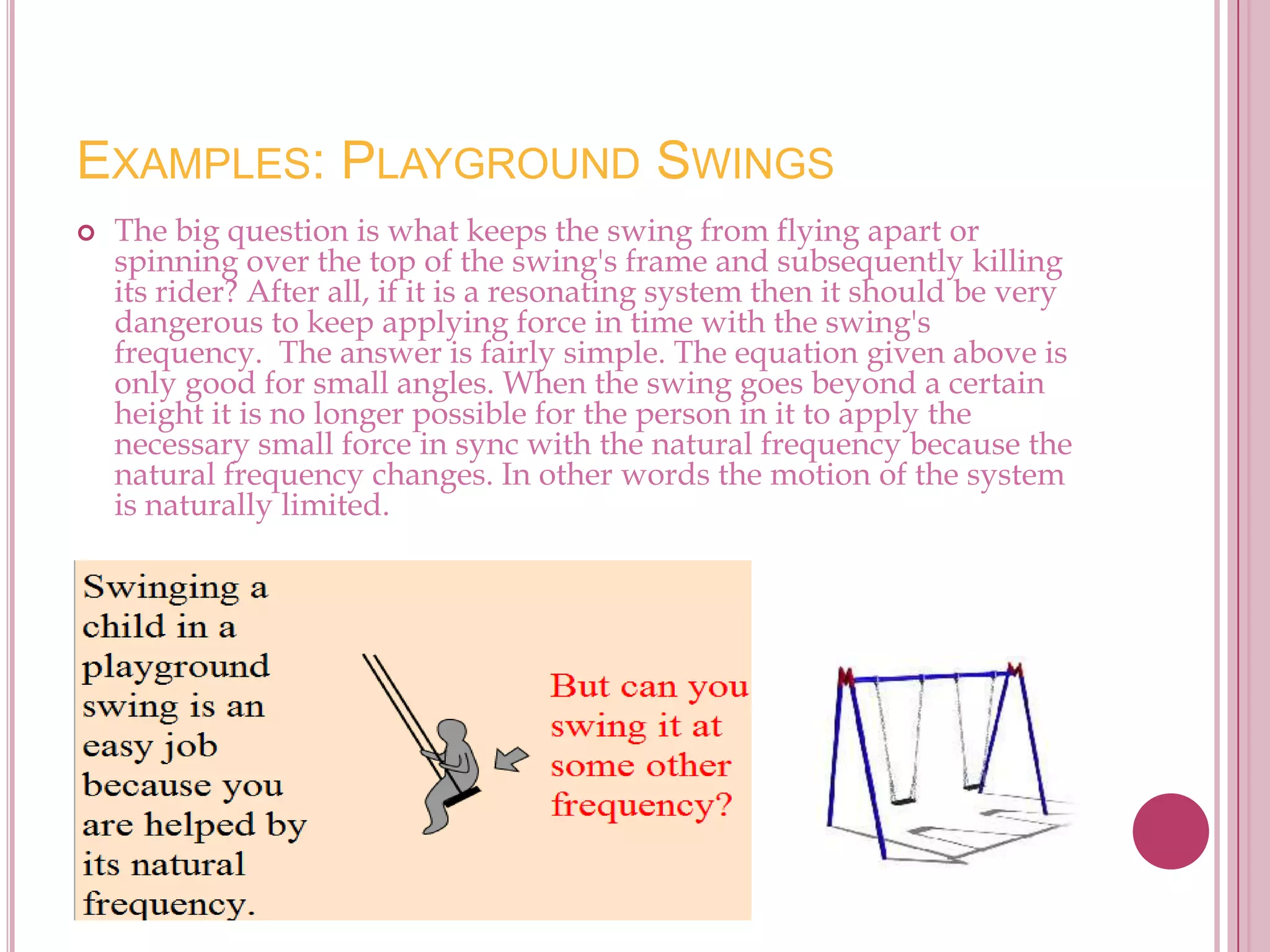
   The natural frequency of the swing is not influenced by the mass of the
    person in it. In other words' it makes no difference whether a swing has a
    large adult or a small child in it. It will have the about the same natural
    frequency. Slight differences can be caused by slightly different locations
    of the person's center of mass. This is located about two inches below the
    navel. When people are sitting the center of mass is in about the same
    place relative to the seat of the swing regardless of whether the person is
    an adult or a child.
   If a forcing function is applied to a swing at the natural frequency of the
    swing it will resonate. The amplitude of the swing will increase during
    each back and forth cycle. The forcing function can be provided by a
    second person pushing on the swing. In this case even a small child can
    make a large adult swing by pushing in sync with the swing's back and
    forth cycle. The forcing function can also be provided by the person in
    the swing. In this case the person in the swing shifts her center of mass
    very slightly by changing the position of her legs or torso. This creates a
    slight pushing force which makes the swing go higher and higher. It
    takes a very small force but it has to be timed perfectly.
EXAMPLES: PLAYGROUND SWINGS
   The big question is what keeps the swing from flying apart or
    spinning over the top of the swing's frame and subsequently killing
    its rider? After all, if it is a resonating system then it should be very
    dangerous to keep applying force in time with the swing's
    frequency. The answer is fairly simple. The equation given above is
    only good for small angles. When the swing goes beyond a certain
    height it is no longer possible for the person in it to apply the
    necessary small force in sync with the natural frequency because the
    natural frequency changes. In other words the motion of the system
    is naturally limited.
EXAMPLES: PLAYGROUND SWINGS
EXAMPLE: WASHING MACHINE
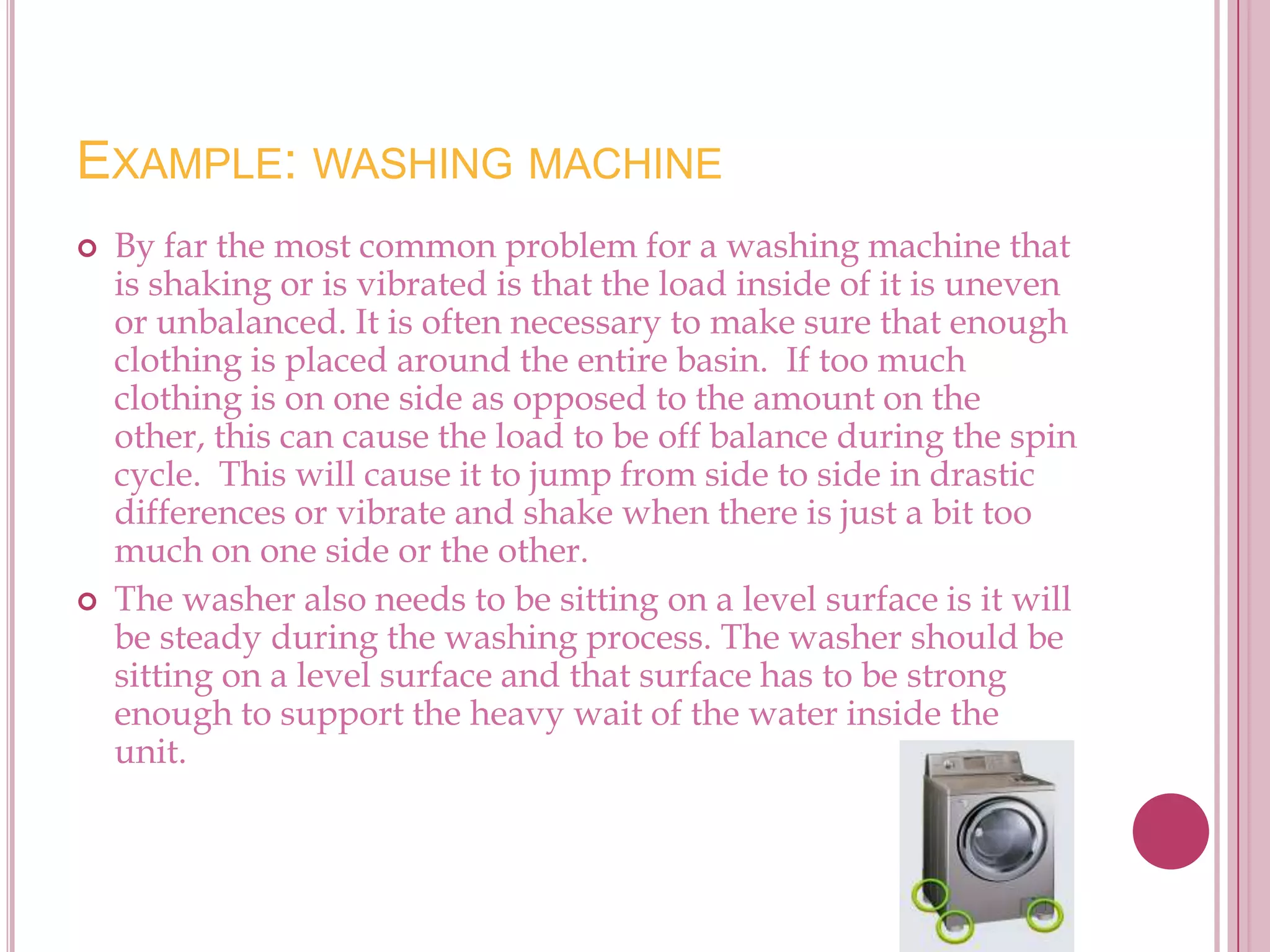
   By far the most common problem for a washing machine that
    is shaking or is vibrated is that the load inside of it is uneven
    or unbalanced. It is often necessary to make sure that enough
    clothing is placed around the entire basin. If too much
    clothing is on one side as opposed to the amount on the
    other, this can cause the load to be off balance during the spin
    cycle. This will cause it to jump from side to side in drastic
    differences or vibrate and shake when there is just a bit too
    much on one side or the other.
   The washer also needs to be sitting on a level surface is it will
    be steady during the washing process. The washer should be
    sitting on a level surface and that surface has to be strong
    enough to support the heavy wait of the water inside the
    unit.
EXAMPLE: OPERA SINGER
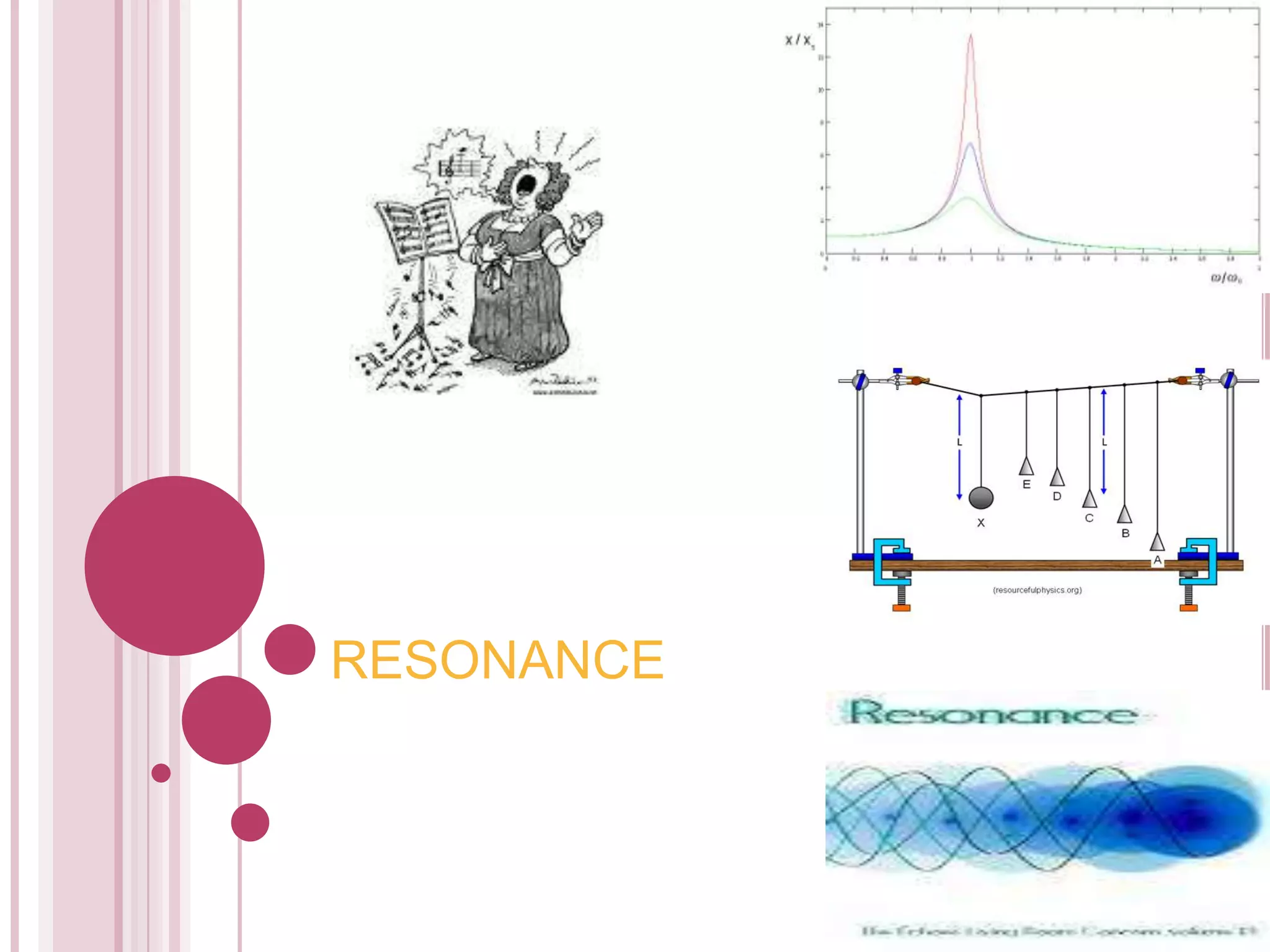
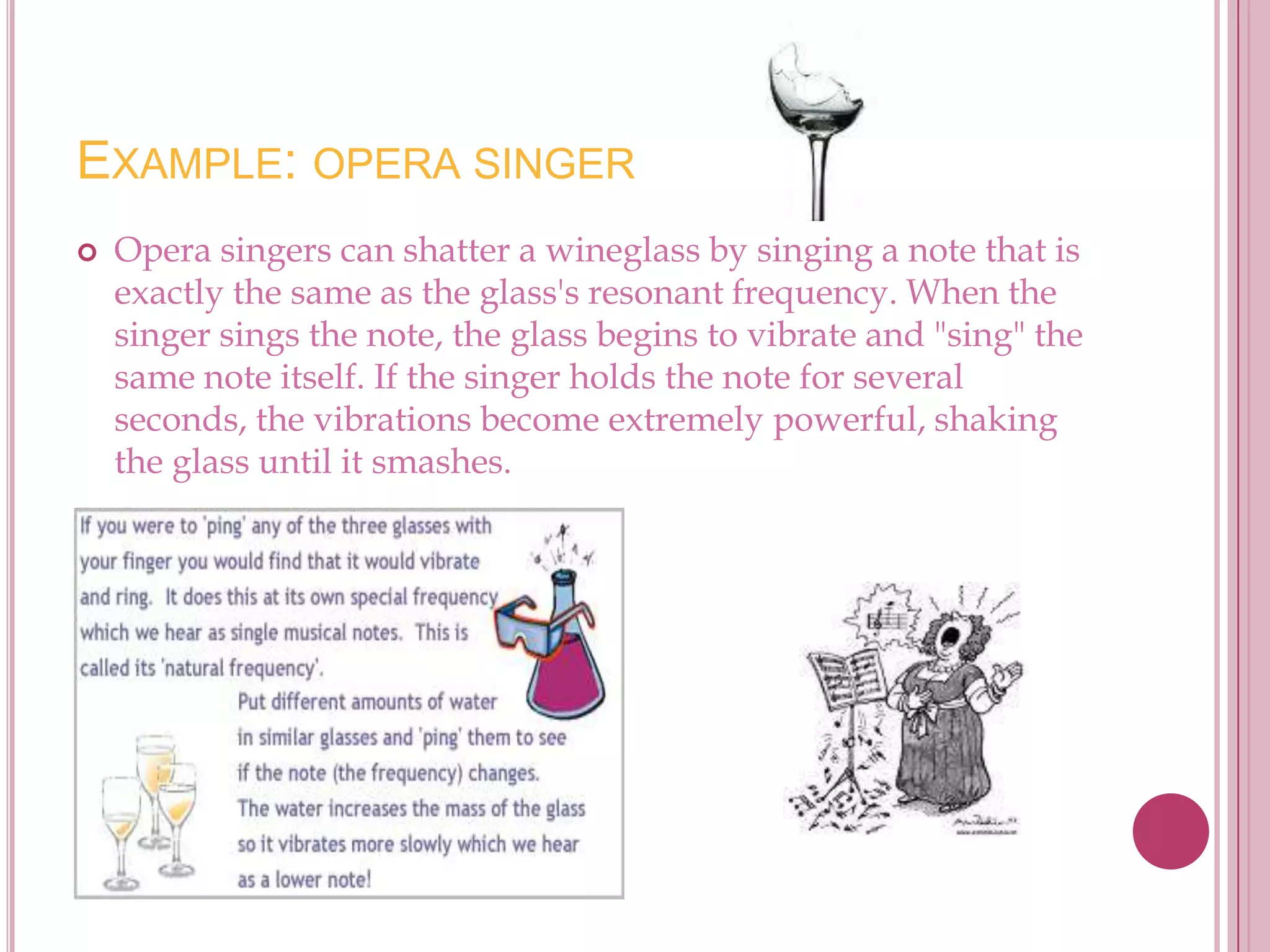
   Opera singers can shatter a wineglass by singing a note that is
    exactly the same as the glass's resonant frequency. When the
    singer sings the note, the glass begins to vibrate and "sing" the
    same note itself. If the singer holds the note for several
    seconds, the vibrations become extremely powerful, shaking
    the glass until it smashes.
BREAKING A WINE GLASS USING RESONANCE
EXAMPLE: BRIDGE
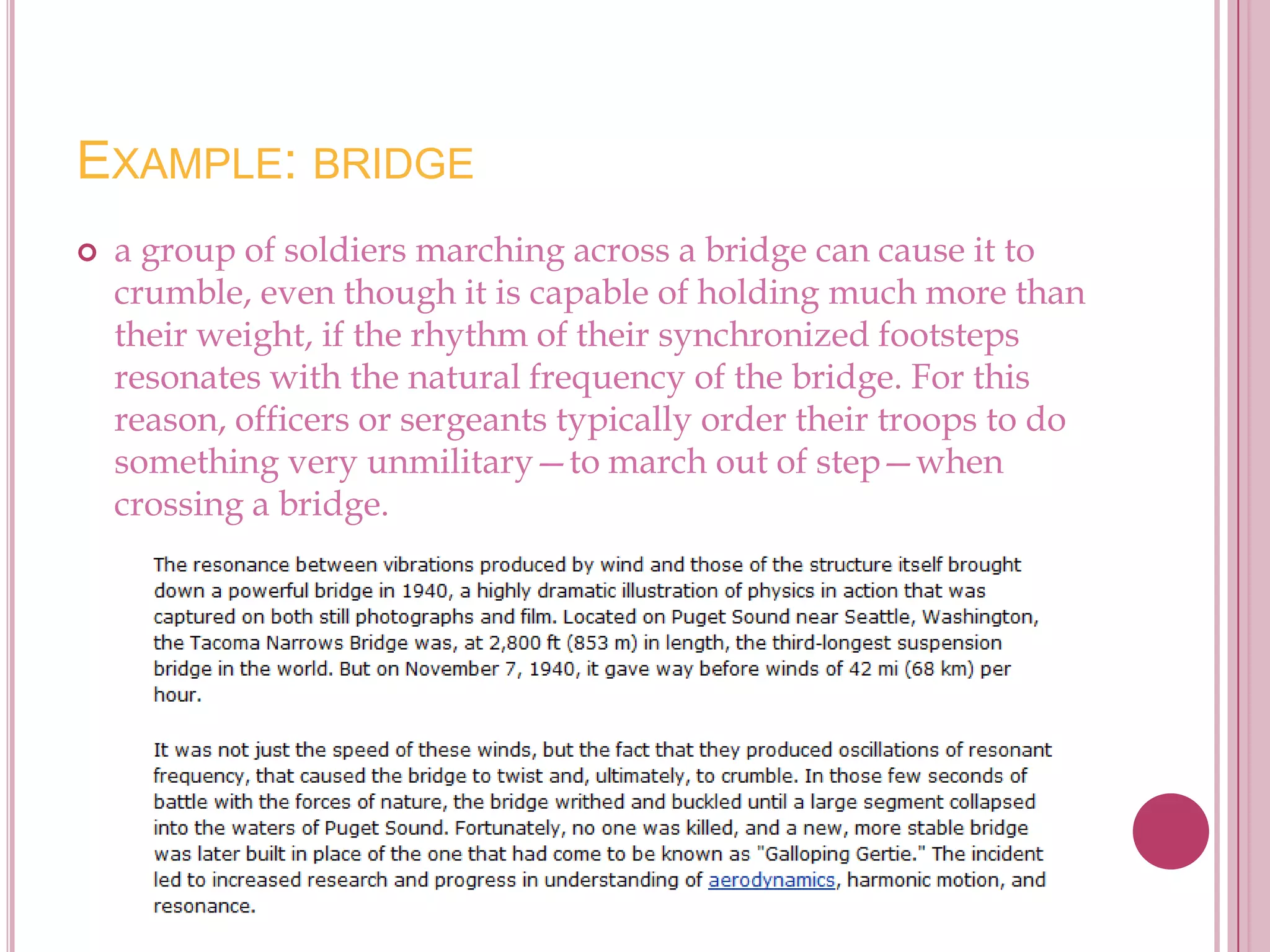
   a group of soldiers marching across a bridge can cause it to
    crumble, even though it is capable of holding much more than
    their weight, if the rhythm of their synchronized footsteps
    resonates with the natural frequency of the bridge. For this
    reason, officers or sergeants typically order their troops to do
    something very unmilitary—to march out of step—when
    crossing a bridge.
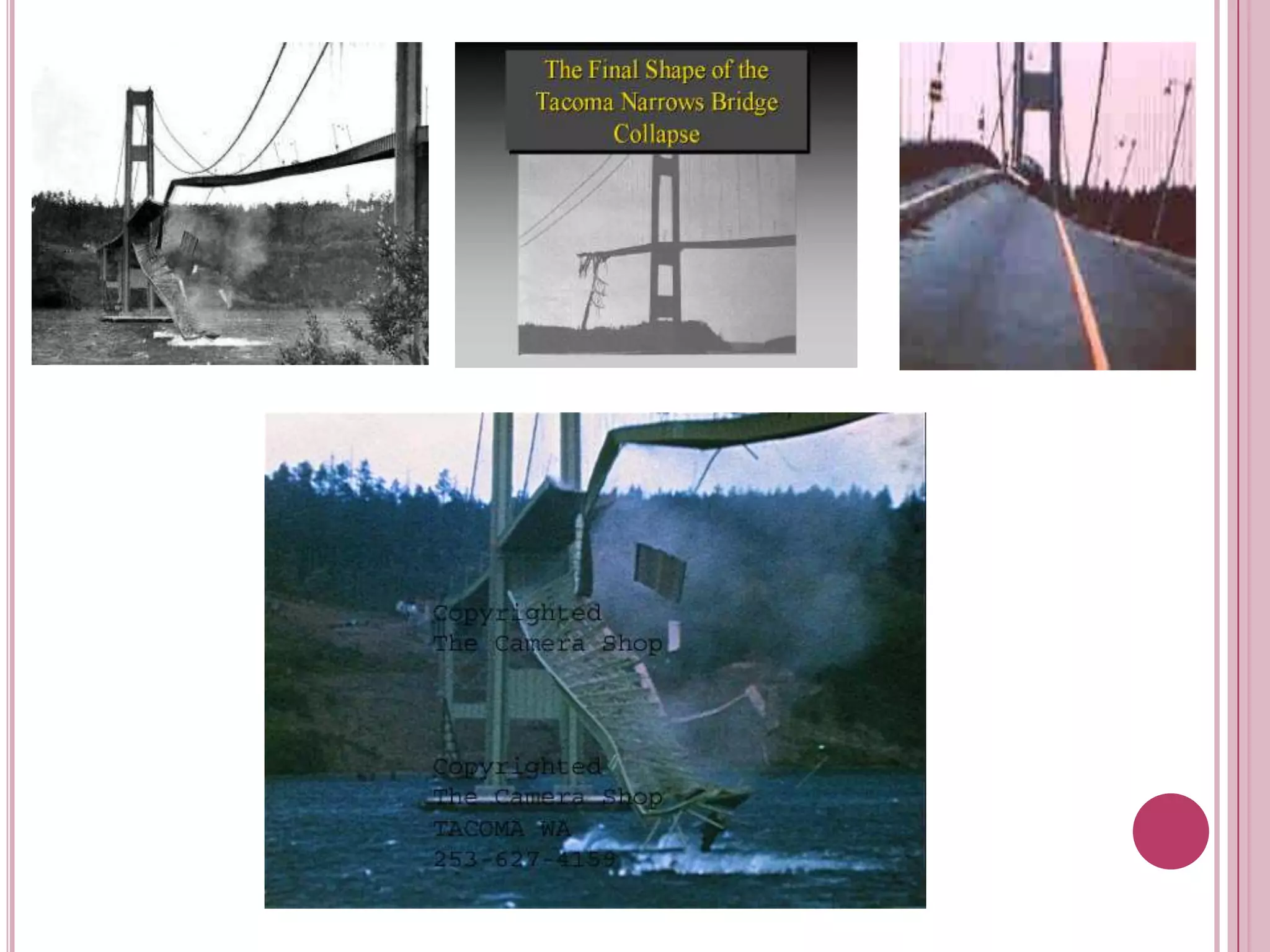
COLOR FOOTAGE OF TACOMA NARROWS
BIBLIOGRAPHY
   http://www.intuitor.com/resonance/index.php
   http://www.appliancejournal.com/appliance-repair-
    help/washing-machine-repair-why-is-my-washing-machine-
    shaking-113/
   http://www.infoplease.com/dk/science/encyclopedia/musi
    cal-sound.html
   http://www.answers.com/topic/resonance

Resonance

  • 1.
  • 2.
    WHAT IS RESONANCE  When an object is driven at its natural frequency so that it oscillates with a large amplitude.  In resonance the oscillation occurs at a specific frequency. These oscillations build up rapidly to very high levels. Ultimately some of the energy in the oscillations has to be removed from the object or the size of the oscillations get so large that the object breaks.  Without resonance we wouldn't have radio, television, music, or swings on playgrounds, not to mention cool gismos like Tesla coils.  resonance also has its dark side. It occasionally causes a bridge to collapse, a helicopter to fly apart, or other inconveniences
  • 4.
    RESONANCE REQUIRES 3BASIC CONDITIONS:  A) An Object With a Natural Frequency: The object can be a mechanical device or an electronic circuit. An object's natural frequency is the frequency it tends to oscillate at when disturbed. The oscillation can be a mechanical vibration as is the case when the string of a guitar is strummed. In an electronic circuit the oscillation is a variable voltage or current. An object can have more than one natural frequency. These are called harmonics. A guitar string sounds musical because it vibrates with several harmonics when it is strummed.
  • 5.
    RESONANCE REQUIRES 3BASIC CONDITIONS:  B) A Forcing Function at the Same Frequency as the Natural Frequency: In mechanical systems the forcing function is a variable force. In electronic circuits it arises from a variable electric field. In either case the forcing function does work on the object it is applied to. Since work is a form of energy transfer it causes energy to build up in the object.
  • 6.
    RESONANCE REQUIRES 3BASIC CONDITIONS:  C) A Lack of Damping or Energy Loss: For an object to resonate, mechanical or electrical energy has to build up in the object. Anything which removes these forms of energy tends to interfere with resonance. Damping is a means of removing electrical or mechanical energy by converting it to heat. The term damping should not be confused with the term dampening which means to make something slightly wet. Friction, air resistance, and viscous drag can all provide damping in mechanical systems. Electrical resistance performs the same function in electronic circuits. Other forms of energy loss can include sound (musical instruments) or light emissions (lasers).
  • 7.
    HOW IT WORKS?  When the forcing function's frequency matches the natural frequency of an object it will begin to resonate. The forcing function adds energy at just the right moment during the oscillation cycle so that the oscillation is reinforced. This makes the oscillation's amplitude grow larger and larger. These oscillations would eventually become infinitely large. However, as mentioned earlier, long before the oscillations reach infinity one of three things happens: 1) the object's dynamics change so that the resonant frequency and forcing functions no longer match, 2) the energy lost as heat, sound, or light becomes equal to the energy input. or 3) the object breaks
  • 8.
  • 9.
    EXAMPLES: PLAYGROUND SWINGS  The natural frequency of the swing is not influenced by the mass of the person in it. In other words' it makes no difference whether a swing has a large adult or a small child in it. It will have the about the same natural frequency. Slight differences can be caused by slightly different locations of the person's center of mass. This is located about two inches below the navel. When people are sitting the center of mass is in about the same place relative to the seat of the swing regardless of whether the person is an adult or a child.  If a forcing function is applied to a swing at the natural frequency of the swing it will resonate. The amplitude of the swing will increase during each back and forth cycle. The forcing function can be provided by a second person pushing on the swing. In this case even a small child can make a large adult swing by pushing in sync with the swing's back and forth cycle. The forcing function can also be provided by the person in the swing. In this case the person in the swing shifts her center of mass very slightly by changing the position of her legs or torso. This creates a slight pushing force which makes the swing go higher and higher. It takes a very small force but it has to be timed perfectly.
  • 10.
    EXAMPLES: PLAYGROUND SWINGS  The big question is what keeps the swing from flying apart or spinning over the top of the swing's frame and subsequently killing its rider? After all, if it is a resonating system then it should be very dangerous to keep applying force in time with the swing's frequency. The answer is fairly simple. The equation given above is only good for small angles. When the swing goes beyond a certain height it is no longer possible for the person in it to apply the necessary small force in sync with the natural frequency because the natural frequency changes. In other words the motion of the system is naturally limited.
  • 11.
  • 12.
    EXAMPLE: WASHING MACHINE  By far the most common problem for a washing machine that is shaking or is vibrated is that the load inside of it is uneven or unbalanced. It is often necessary to make sure that enough clothing is placed around the entire basin. If too much clothing is on one side as opposed to the amount on the other, this can cause the load to be off balance during the spin cycle. This will cause it to jump from side to side in drastic differences or vibrate and shake when there is just a bit too much on one side or the other.  The washer also needs to be sitting on a level surface is it will be steady during the washing process. The washer should be sitting on a level surface and that surface has to be strong enough to support the heavy wait of the water inside the unit.
  • 13.
    EXAMPLE: OPERA SINGER  Opera singers can shatter a wineglass by singing a note that is exactly the same as the glass's resonant frequency. When the singer sings the note, the glass begins to vibrate and "sing" the same note itself. If the singer holds the note for several seconds, the vibrations become extremely powerful, shaking the glass until it smashes.
  • 14.
    BREAKING A WINEGLASS USING RESONANCE
  • 15.
    EXAMPLE: BRIDGE  a group of soldiers marching across a bridge can cause it to crumble, even though it is capable of holding much more than their weight, if the rhythm of their synchronized footsteps resonates with the natural frequency of the bridge. For this reason, officers or sergeants typically order their troops to do something very unmilitary—to march out of step—when crossing a bridge.
  • 17.
    COLOR FOOTAGE OFTACOMA NARROWS
  • 18.
    BIBLIOGRAPHY  http://www.intuitor.com/resonance/index.php  http://www.appliancejournal.com/appliance-repair- help/washing-machine-repair-why-is-my-washing-machine- shaking-113/  http://www.infoplease.com/dk/science/encyclopedia/musi cal-sound.html  http://www.answers.com/topic/resonance