SOUND
Definition
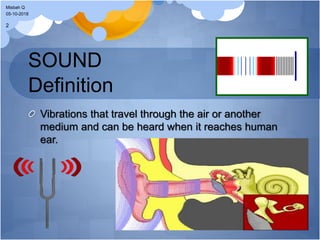
Vibrations that travel through the air or another
medium and can be heard when it reaches human
ear.
05-10-2018
Misbah Q
2
WAVE
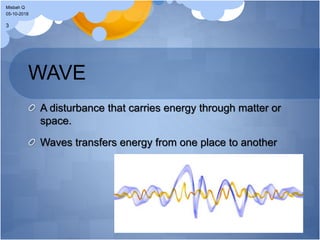
A disturbance that carries energy through matter or
space.
Waves transfers energy from one place to another
05-10-2018
Misbah Q
3
TYPES OF WAVES
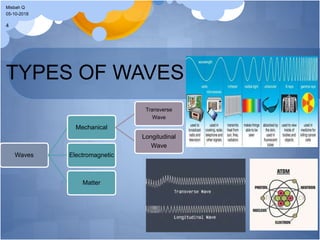
Waves
Mechanical
Transverse
Wave
Longitudinal
Wave
Electromagnetic
Matter
05-10-2018
Misbah Q
4
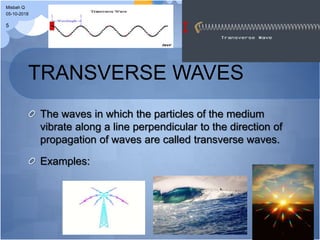
TRANSVERSE WAVES
The waves in which the particles of the medium
vibrate along a line perpendicular to the direction of
propagation of waves are called transverse waves.
Examples:
05-10-2018
Misbah Q
5
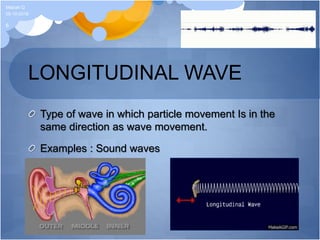
LONGITUDINAL WAVE
Type of wave in which particle movement Is in the
same direction as wave movement.
Examples : Sound waves
05-10-2018
Misbah Q
6
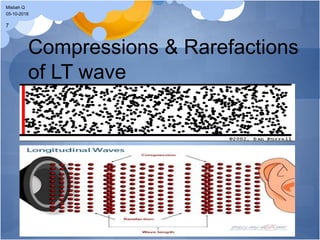
Compressions & Rarefactions
of LT wave
05-10-2018
Misbah Q
7
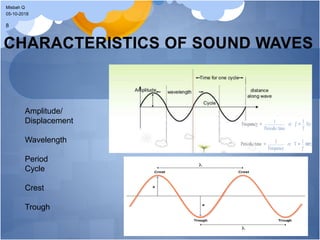
Amplitude/
Displacement
Wavelength
Period
Cycle
Crest
Trough
05-10-2018
Misbah Q
8
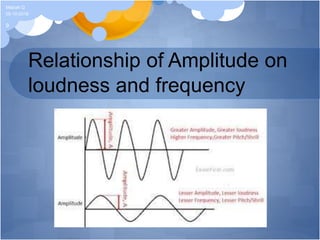
Relationship of Amplitude on
loudness and frequency
05-10-2018
Misbah Q
9
PROPERTIES OF SOUND
WAVES
FREQUENCY: physical measure of the
number of times an object vibrates per
second.
Unit: Hertz (Hz)
PITCH: perceptual correlate of sound
frequency.
INTENSITY: physical measure of the
amount of pressure generated within a
medium by a vibrating object
Unit: Decibel (dB)
LOUDNESS: perceptual correlate of
sound intensity
05-10-2018
Misbah Q
10
KEY POINTS OF SOUND
WAVES
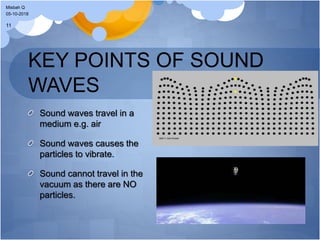
Sound waves travel in a
medium e.g. air
Sound waves causes the
particles to vibrate.
Sound cannot travel in the
vacuum as there are NO
particles.
05-10-2018
Misbah Q
11
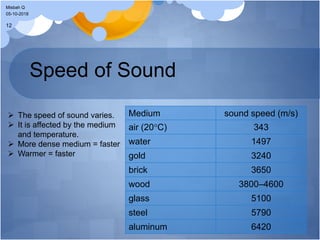
Speed of Sound
Medium sound speed (m/s)
air (20C) 343
water 1497
gold 3240
brick 3650
wood 3800–4600
glass 5100
steel 5790
aluminum 6420
 The speed of sound varies.
 It is affected by the medium
and temperature.
 More dense medium = faster
 Warmer = faster
05-10-2018
Misbah Q
12
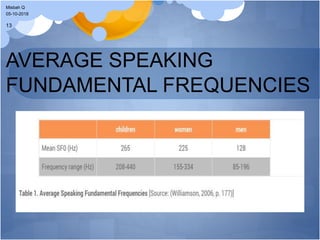
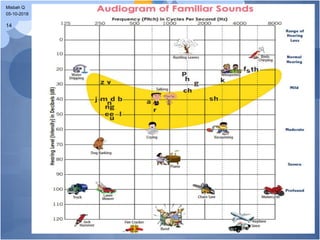
AVERAGE SPEAKING
FUNDAMENTAL FREQUENCIES
05-10-2018
Misbah Q
13
05-10-2018
Misbah Q
14
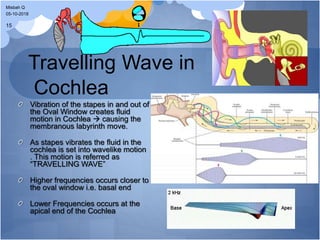
Travelling Wave in
Cochlea
Vibration of the stapes in and out of
the Oval Window creates fluid
motion in Cochlea  causing the
membranous labyrinth move.
As stapes vibrates the fluid in the
cochlea is set into wavelike motion
. This motion is referred as
“TRAVELLING WAVE”
Higher frequencies occurs closer to
the oval window i.e. basal end
Lower Frequencies occurs at the
apical end of the Cochlea
05-10-2018
Misbah Q
15
References
 Speech Science Primer by Gloria J. Borden
 Clinical Audiology by Brad A. Stach
 Audiology The Fundamentals by Fred
H.Besss & Larry E. Humes
 Handbook of Clinical Audiology
By Jack katz
 Anatomy and Physiology for Hearing
Mechanism by Donald R Fuller
• https://opentextbc.ca/physicstestb
ook2/chapter/speed-of-sound-
frequency-and-wavelength/
• https://physicsabout.com/differenc
e-transverse-longitudinal-waves/
• https://physics.tutorvista.com/wav
es/types-of-waves.html
05-10-2018
Misbah Q
16

sound waves

  • 2.
    SOUND Definition Vibrations that travelthrough the air or another medium and can be heard when it reaches human ear. 05-10-2018 Misbah Q 2
  • 3.
    WAVE A disturbance thatcarries energy through matter or space. Waves transfers energy from one place to another 05-10-2018 Misbah Q 3
  • 4.
  • 5.
    TRANSVERSE WAVES The wavesin which the particles of the medium vibrate along a line perpendicular to the direction of propagation of waves are called transverse waves. Examples: 05-10-2018 Misbah Q 5
  • 6.
    LONGITUDINAL WAVE Type ofwave in which particle movement Is in the same direction as wave movement. Examples : Sound waves 05-10-2018 Misbah Q 6
  • 7.
    Compressions & Rarefactions ofLT wave 05-10-2018 Misbah Q 7
  • 8.
  • 9.
    Relationship of Amplitudeon loudness and frequency 05-10-2018 Misbah Q 9
  • 10.
    PROPERTIES OF SOUND WAVES FREQUENCY:physical measure of the number of times an object vibrates per second. Unit: Hertz (Hz) PITCH: perceptual correlate of sound frequency. INTENSITY: physical measure of the amount of pressure generated within a medium by a vibrating object Unit: Decibel (dB) LOUDNESS: perceptual correlate of sound intensity 05-10-2018 Misbah Q 10
  • 11.
    KEY POINTS OFSOUND WAVES Sound waves travel in a medium e.g. air Sound waves causes the particles to vibrate. Sound cannot travel in the vacuum as there are NO particles. 05-10-2018 Misbah Q 11
  • 12.
    Speed of Sound Mediumsound speed (m/s) air (20C) 343 water 1497 gold 3240 brick 3650 wood 3800–4600 glass 5100 steel 5790 aluminum 6420  The speed of sound varies.  It is affected by the medium and temperature.  More dense medium = faster  Warmer = faster 05-10-2018 Misbah Q 12
  • 13.
  • 14.
  • 15.
    Travelling Wave in Cochlea Vibrationof the stapes in and out of the Oval Window creates fluid motion in Cochlea  causing the membranous labyrinth move. As stapes vibrates the fluid in the cochlea is set into wavelike motion . This motion is referred as “TRAVELLING WAVE” Higher frequencies occurs closer to the oval window i.e. basal end Lower Frequencies occurs at the apical end of the Cochlea 05-10-2018 Misbah Q 15
  • 16.
    References  Speech SciencePrimer by Gloria J. Borden  Clinical Audiology by Brad A. Stach  Audiology The Fundamentals by Fred H.Besss & Larry E. Humes  Handbook of Clinical Audiology By Jack katz  Anatomy and Physiology for Hearing Mechanism by Donald R Fuller • https://opentextbc.ca/physicstestb ook2/chapter/speed-of-sound- frequency-and-wavelength/ • https://physicsabout.com/differenc e-transverse-longitudinal-waves/ • https://physics.tutorvista.com/wav es/types-of-waves.html 05-10-2018 Misbah Q 16

Editor's Notes