
Ms. Jenievie Espino
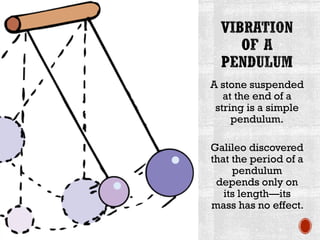
A stone suspended
at the end of a
string is a simple
pendulum.
Galileo discovered
that the period of a
pendulum
depends only on
its length—its
mass has no effect.
WAVES
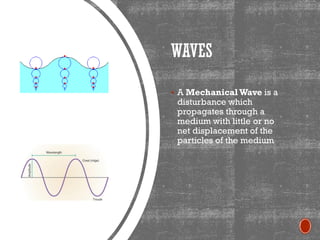
▪ A Mechanical Wave is a
disturbance which
propagates through a
medium with little or no
net displacement of the
particles of the medium
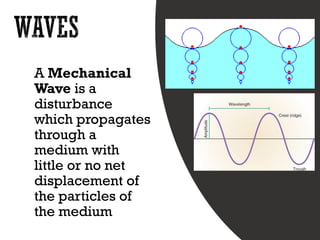
A Mechanical
Wave is a
disturbance
which propagates
through a
medium with
little or no net
displacement of
the particles of
the medium
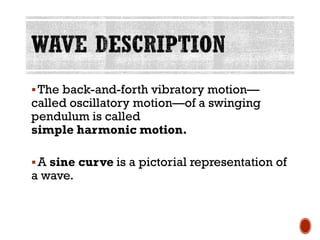
▪The back-and-forth vibratory motion—
called oscillatory motion—of a swinging
pendulum is called
simple harmonic motion.
▪A sine curve is a pictorial representation of
a wave.
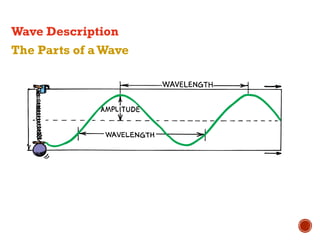
The Parts of a Wave
Wave Description
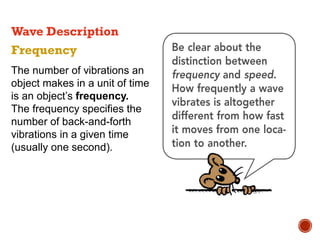
Frequency
The number of vibrations an
object makes in a unit of time
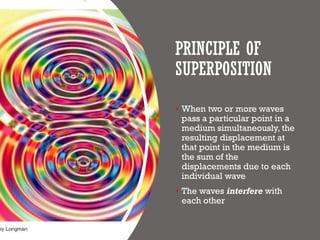
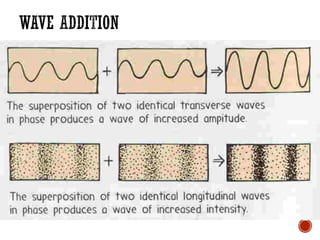
is an object’s frequency.
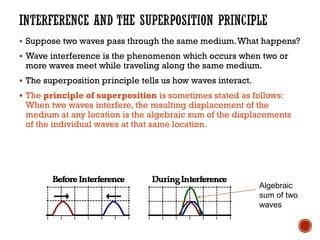
The frequency specifies the
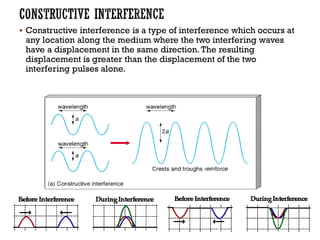
number of back-and-forth
vibrations in a given time
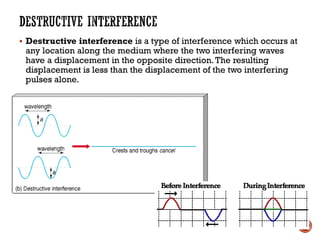
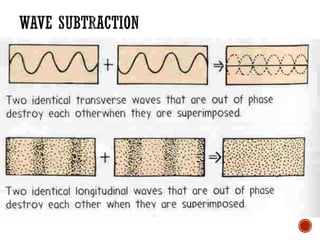
(usually one second).
Wave Description
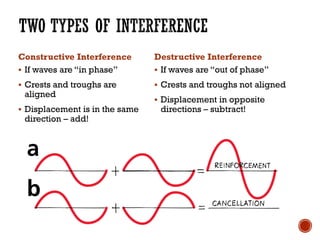
▪The unit of frequency is called the hertz
(Hz).
▪A frequency of one cycle per second is 1
hertz, two cycles per second is 2 hertz, and
so on. Higher frequencies are measured in
▪ kilohertz (kHz—thousands of hertz)
▪ megahertz (MHz—millions of hertz)
▪ gigahertz (GHz—billions of hertz)
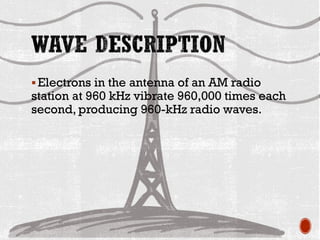
▪Electrons in the antenna of an AM radio
station at 960 kHz vibrate 960,000 times each
second, producing 960-kHz radio waves.
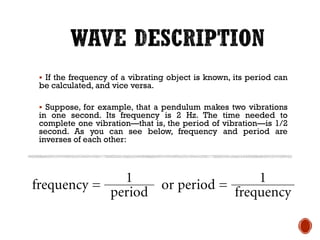
▪ If the frequency of a vibrating object is known, its period can
be calculated, and vice versa.
▪ Suppose, for example, that a pendulum makes two vibrations
in one second. Its frequency is 2 Hz. The time needed to
complete one vibration—that is, the period of vibration—is 1/2
second. As you can see below, frequency and period are
inverses of each other:
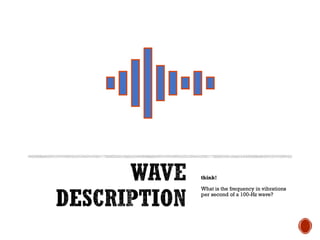
think!
What is the frequency in vibrations
per second of a 100-Hz wave?
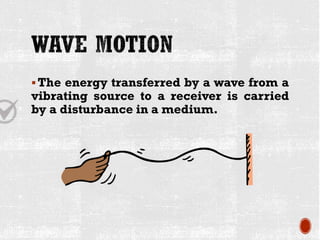
▪The energy transferred by a wave from a
vibrating source to a receiver is carried
by a disturbance in a medium.
You can calculate the speed of a wave by
multiplying the wavelength by the frequency.
Wave Speed
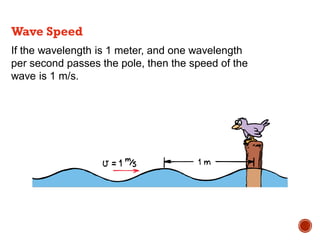
If the wavelength is 1 meter, and one wavelength
per second passes the pole, then the speed of the
wave is 1 m/s.
Wave Speed
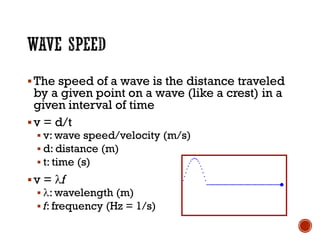
▪The speed of a wave is the distance traveled
by a given point on a wave (like a crest) in a
given interval of time
▪v = d/t
▪ v: wave speed/velocity (m/s)
▪ d: distance (m)
▪ t: time (s)
▪v = f
▪ : wavelength (m)
▪ f: frequency (Hz = 1/s)
WAVE
SPEED
think!
▪ If a water wave vibrates up and
down two times each second and the
distance between wave crests is 1.5
m, what is the frequency of the wave?
What is its wavelength? What is its
speed?
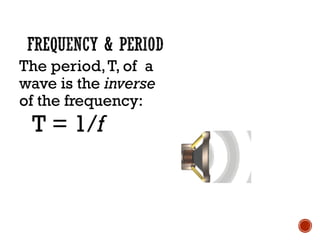
The period,T, of a
wave is the inverse
of the frequency:
T = 1/f
▪ Power: energy emitted by
sound waves overa given
period of time
▪ Units: (J/s orWatts)
▪ Intensity: amount of
energy carried bysound
waves per unit time
through a givenarea
▪ Commonly
referred to as
the “loudness”
of a sound
▪ Units: (Watts/m2)
▪ Sound waves with high
intensity have ahigh
energy and therefore a
highamplitude
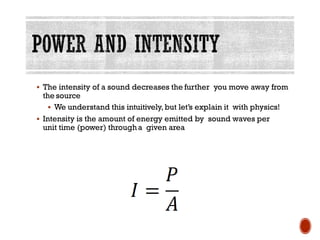
▪ The intensity of a sound decreases the further you move away from
the source
▪ We understand this intuitively,but let’s explain it with physics!
▪ Intensity is the amount of energy emitted by sound waves per
unit time (power) througha given area
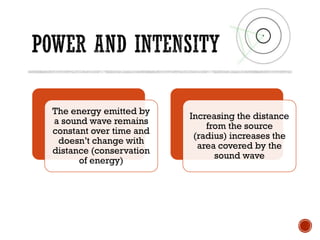
The energy emitted by
a sound wave remains
constant over time and
doesn’t change with
distance (conservation
of energy)
Increasing the distance
from the source
(radius) increases the
area covered by the
sound wave
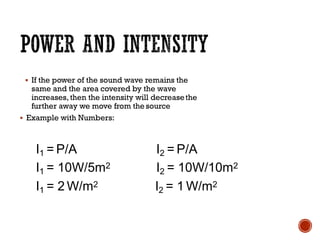
▪ If the power of the sound wave remains the
same and the area covered by the wave
increases, then the intensity will decreasethe
further away we move from the source
▪ Example with Numbers:
I1 = P/A
I1 = 10W/5m2
I1 = 2 W/m2
I2 = P/A
I2 = 10W/10m2
I2 = 1 W/m2
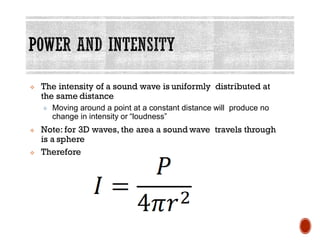
❖ The intensity of a sound wave is uniformly distributed at
the same distance
❖ Moving around a point at a constant distance will produce no
change in intensity or “loudness”
❖ Note: for 3D waves, the area a sound wave travels through
is a sphere
❖ Therefore
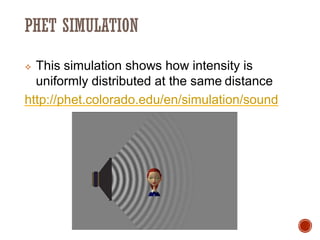
PHET SIMULATION
❖ This simulation shows how intensity is
uniformly distributed at the same distance
http://phet.colorado.edu/en/simulation/sound
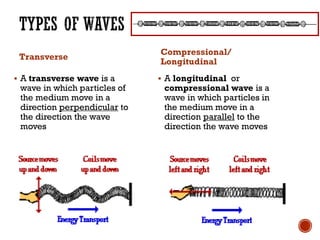
Transverse
▪ A transverse wave is a
wave in which particles of
the medium move in a
direction perpendicular to
the direction the wave
moves
Compressional/
Longitudinal
▪ A longitudinal or
compressional wave is a
wave in which particles in
the medium move in a
direction parallel to the
direction the wave moves
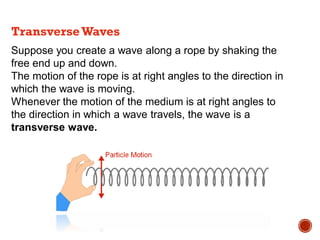
Suppose you create a wave along a rope by shaking the
free end up and down.
The motion of the rope is at right angles to the direction in
which the wave is moving.
Whenever the motion of the medium is at right angles to
the direction in which a wave travels, the wave is a
transverse wave.
TransverseWaves
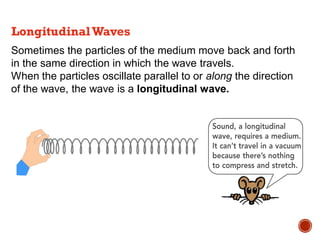
Sometimes the particles of the medium move back and forth
in the same direction in which the wave travels.
When the particles oscillate parallel to or along the direction
of the wave, the wave is a longitudinal wave.
LongitudinalWaves
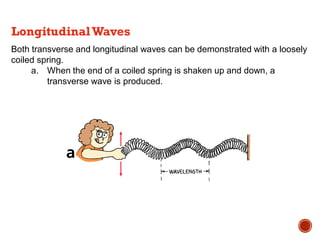
Both transverse and longitudinal waves can be demonstrated with a loosely
coiled spring.
a. When the end of a coiled spring is shaken up and down, a
transverse wave is produced.
LongitudinalWaves
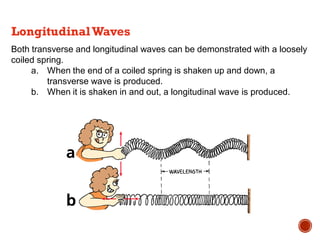
Both transverse and longitudinal waves can be demonstrated with a loosely
coiled spring.
a. When the end of a coiled spring is shaken up and down, a
transverse wave is produced.
b. When it is shaken in and out, a longitudinal wave is produced.
LongitudinalWaves
▪Waves on a string
(transverse)
▪Water waves (transverse)
▪Earthquakes (transverse
and compressional)
▪Sound waves
(compressional)
▪ Produced through vibration
▪ Has a pitch (from frequency)
▪ Has volume (from
amplitude)
▪Light
(transverse)
▪ Has color (from
frequency)
▪ Has brightness
(from
amplitude)
▪ Light travels like
a wave, and like
a particle called
a photon
▪The behavior of a wave when it
reaches the end of its medium is
called the wave’s BOUNDARY
BEHAVIOR.
▪When one medium ends and
another begins, that is called a
boundary.
30
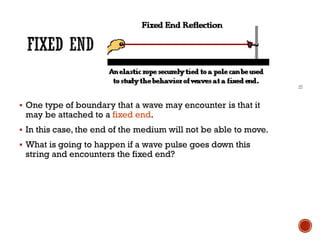
▪ One type of boundary that a wave may encounter is that it
may be attached to a fixed end.
▪ In this case, the end of the medium will not be able to move.
▪ What is going to happen if a wave pulse goes down this
string and encounters the fixed end?
31
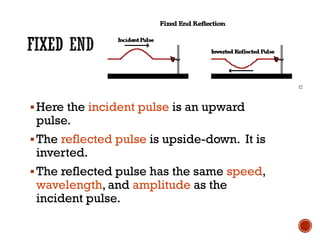
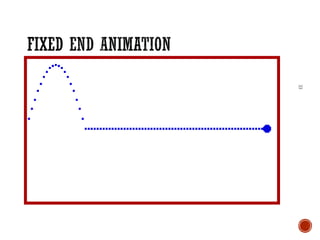
▪Here the incident pulse is an upward
pulse.
▪The reflected pulse is upside-down. It is
inverted.
▪The reflected pulse has the same speed,
wavelength, and amplitude as the
incident pulse.
32
33
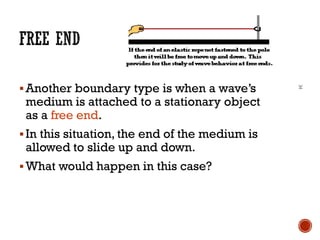
▪Another boundary type is when a wave’s
medium is attached to a stationary object
as a free end.
▪In this situation, the end of the medium is
allowed to slide up and down.
▪What would happen in this case?
34
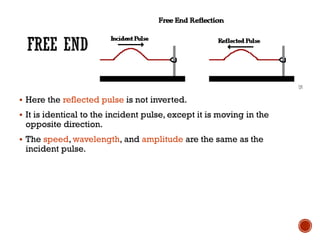
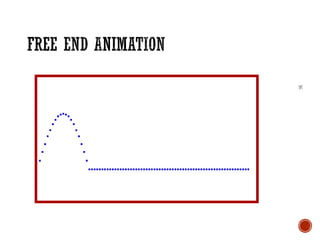
▪ Here the reflected pulse is not inverted.
▪ It is identical to the incident pulse, except it is moving in the
opposite direction.
▪ The speed, wavelength, and amplitude are the same as the
incident pulse.
35
36
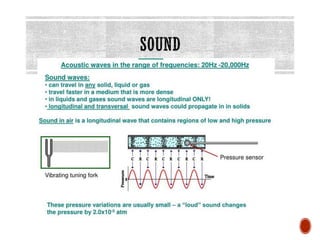
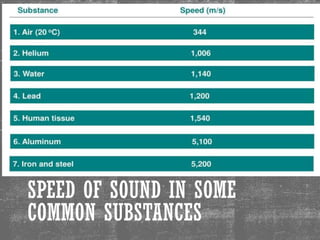
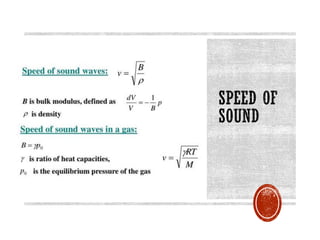
▪ Sound travels through the air at approximately 340 m/s
▪ It travels through other media, usually faster
▪ Sound waves are started by vibration
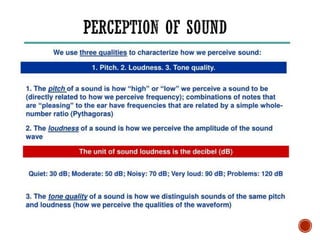
▪ We hear sound as “high” or “low” depending on the wave’s
frequency. Sounds with short wavelengths have high
frequencies and sound high-pitched.
▪ The amplitude of a sound’s vibration is interpreted as loudness.
We measure loudness on the decibel scale (which is
logarithmic)
▪ Interference patterns occur when waves from different
sources arrive at the same point—at the same time.
PRINCIPLE OF
SUPERPOSITION
▪ When two or more waves
pass a particular point in a
medium simultaneously, the
resulting displacement at
that point in the medium is
the sum of the
displacements due to each
individual wave
▪ The waves interfere with
each other
▪ Suppose two waves pass through the same medium.What happens?
▪ Wave interference is the phenomenon which occurs when two or
more waves meet while traveling along the same medium.
▪ The superposition principle tells us how waves interact.
▪ The principle of superposition is sometimes stated as follows:
When two waves interfere, the resulting displacement of the
medium at any location is the algebraic sum of the displacements
of the individual waves at that same location.
Algebraic
sum of two
waves
▪ Constructive interference is a type of interference which occurs at
any location along the medium where the two interfering waves
have a displacement in the same direction.The resulting
displacement is greater than the displacement of the two
interfering pulses alone.
▪ Destructive interference is a type of interference which occurs at
any location along the medium where the two interfering waves
have a displacement in the opposite direction.The resulting
displacement is less than the displacement of the two interfering
pulses alone.
Constructive Interference
▪ If waves are “in phase”
▪ Crests and troughs are
aligned
▪ Displacement is in the same
direction – add!
Destructive Interference
▪ If waves are “out of phase”
▪ Crests and troughs not aligned
▪ Displacement in opposite
directions – subtract!
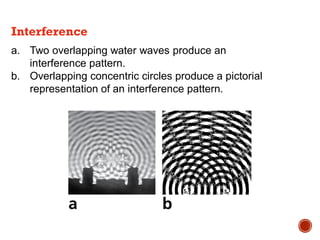
a. Two overlapping water waves produce an
interference pattern.
b. Overlapping concentric circles produce a pictorial
representation of an interference pattern.
Interference
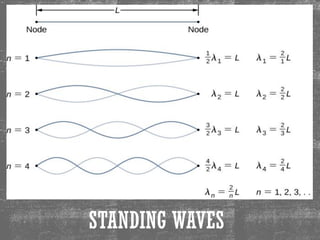
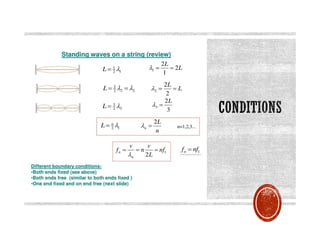
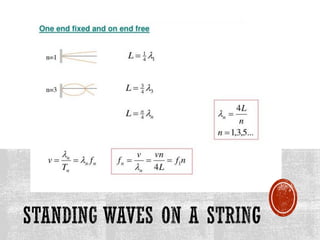
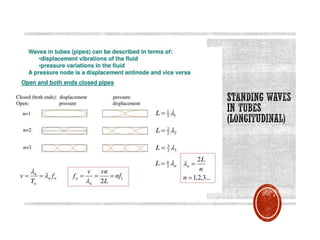
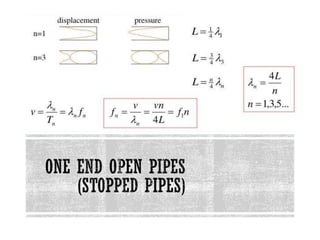
▪ A standing wave forms only if half a wavelength or a
multiple of half a wavelength fits exactly into the length of
the vibrating medium.
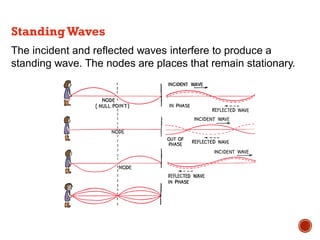
The incident and reflected waves interfere to produce a
standing wave. The nodes are places that remain stationary.
StandingWaves
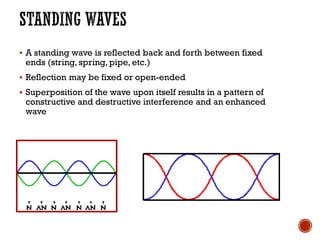
▪ A standing wave is reflected back and forth between fixed
ends (string, spring, pipe, etc.)
▪ Reflection may be fixed or open-ended
▪ Superposition of the wave upon itself results in a pattern of
constructive and destructive interference and an enhanced
wave
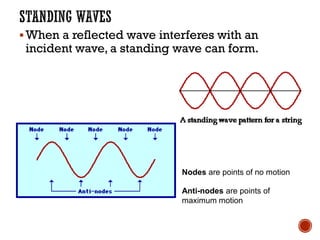
▪When a reflected wave interferes with an
incident wave, a standing wave can form.
Nodes are points of no motion
Anti-nodes are points of
maximum motion
STANDING WAVES
SPEED OF SOUND IN SOME
COMMON SUBSTANCES
AWESOME WAVE
PHENOMENON:
THE DOPPLER EFFECT
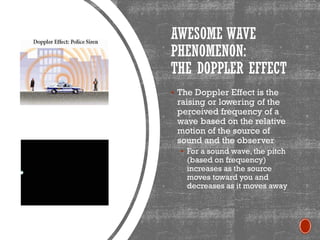
▪ The Doppler Effect is the
raising or lowering of the
perceived frequency of a
wave based on the relative
motion of the source of
sound and the observer
▪ For a sound wave, the pitch
(based on frequency)
increases as the source
moves toward you and
decreases as it moves away
Concept of Doppler effect
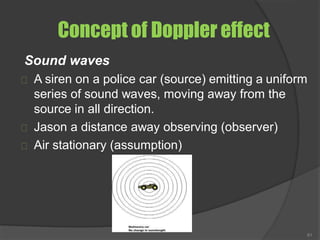
Sound waves
A siren on a police car (source) emitting a uniform
series of sound waves, moving away from the
source in all direction.
Jason a distance away observing (observer)
Air stationary (assumption)
61
Sound
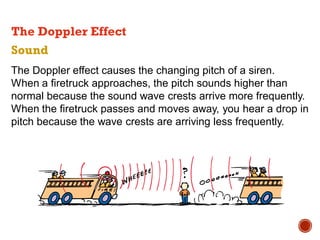
The Doppler effect causes the changing pitch of a siren.
When a firetruck approaches, the pitch sounds higher than
normal because the sound wave crests arrive more frequently.
When the firetruck passes and moves away, you hear a drop in
pitch because the wave crests are arriving less frequently.
The Doppler Effect
Concept of Doppler effect
63
Lets take the wavelength to be 𝝀,the
frequency to be 𝒇and the speed of the sound
to be 𝝂.
𝝂𝒐and 𝝂𝒔
represent the speed of the observer
and the source respectively.
Concept of doppler effect
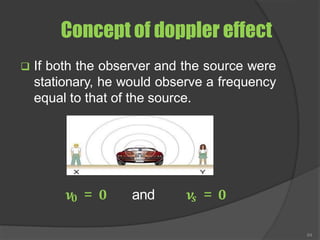
❑ If both the observer and the source were
stationary, he would observe a frequency
equal to that of the source.
𝝂𝟎 = 𝟎 and 𝝂𝒔 = 𝟎
64
Concept of Doppler effect
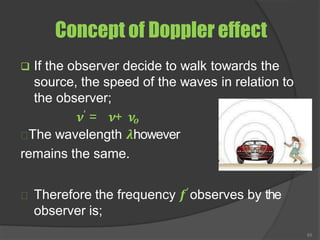
❑ If the observer decide to walk towards the
source, the speed of the waves in relation to
the observer;
𝝂′ = 𝝂+ 𝝂𝒐
The wavelength 𝝀however
remains the same.
Therefore the frequency 𝒇′ observes by the
observer is;
65
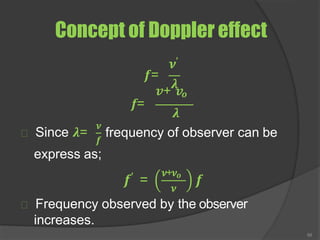
Concept of Doppler effect
𝒇=
𝝂′
𝝀
𝒗+ 𝒗𝒐
𝒇=
Since 𝝀=
𝝂
𝒇
𝝀
frequency of observer can be
express as;
𝒇′ =
𝝂+𝝂𝒐
66
𝝂
𝒇
Frequency observed by the observer
increases.
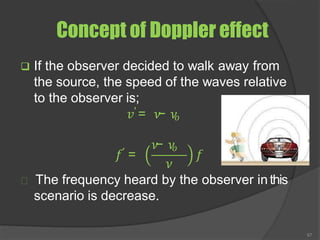
Concept of Doppler effect
❑ If the observer decided to walk away from
the source, the speed of the waves relative
to the observer is;
𝑣′ = 𝜈
− 𝜈
𝑜
𝑓′ =
𝜈
− 𝜈
𝑜
𝜈
𝑓
The frequency heard by the observer inthis
scenario is decrease.
67
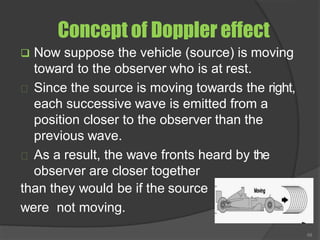
Concept of Doppler effect
❑ Now suppose the vehicle (source) is moving
toward to the observer who is at rest.
Since the source is moving towards the right,
each successive wave is emitted from a
position closer to the observer than the
previous wave.
As a result, the wave fronts heard by the
observer are closer together
than they would be if the source
were not moving.
68
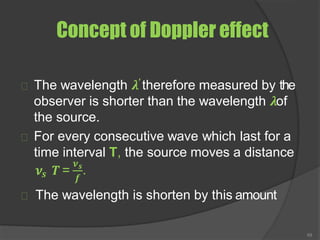
Concept of Doppler effect
The wavelength 𝝀′ therefore measured by the
observer is shorter than the wavelength 𝝀of
the source.
For every consecutive wave which last for a
time interval T, the source moves a distance
𝒔
𝝂 𝑻 =
𝝂
69
𝒔
𝒇
.
The wavelength is shorten by this amount
Concept of Doppler effect
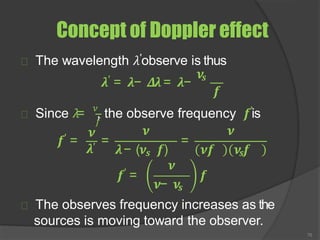
The wavelength 𝜆′observe is thus
𝝀′ = 𝝀− 𝜟𝝀= 𝝀−
𝝂𝒔
𝒇
𝑓
Since 𝜆= 𝜈
, the observe frequency 𝒇′is
𝝀′
𝒇′ =
𝝂
= =
𝝂 𝝂
𝝀− (𝝂𝒔 𝒇) 𝝂𝒇 𝝂𝒔𝒇
𝒇′ =
𝝂
70
𝝂− 𝝂𝒔
𝒇
The observes frequency increases as the
sources is moving toward the observer.
Concept of Doppler effect
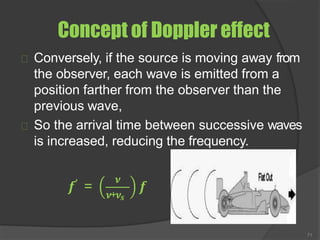
Conversely, if the source is moving away from
the observer, each wave is emitted from a
position farther from the observer than the
previous wave,
So the arrival time between successive waves
is increased, reducing the frequency.
𝒇′ =
𝝂
𝝂+𝝂𝒔
𝒇
71
Concept of Doppler effect
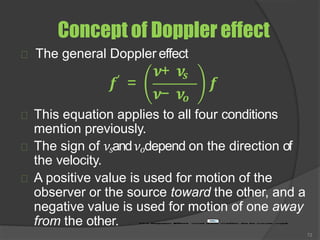
The general Doppler effect
𝒇′ =
𝝂+ 𝝂𝒔
𝝂− 𝝂𝒐
𝒇
This equation applies to all four conditions
mention previously.
The sign of 𝜈𝑠and𝜈𝑜depend on the direction of
the velocity.
A positive value is used for motion of the
observer or the source toward the other, and a
negative value is used for motion of one away
from the other.
72
THE
DOPPLER
EFFECT
▪ Increasing frequency is called a blue shift,
because the increase is toward the high-frequency,
or blue, end of the spectrum.
▪ Decreasing frequency is called a red shift,
referring to the low-frequency, or red, end of the
color spectrum.
▪ Distant galaxies show a red shift in their light. A
measurement of this shift enables astronomers to
calculate their speeds of recession.
think!
When a source moves toward you, do you measure an
increase or decrease in wave speed?
FIRST 10 The Doppler Effect
RESONANCE
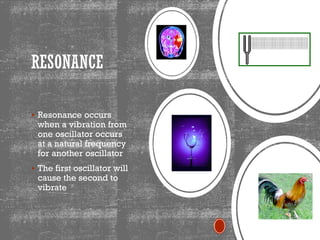
▪ Resonance occurs
when a vibration from
one oscillator occurs
at a natural frequency
for another oscillator
▪ The first oscillator will
cause the second to
vibrate
▪ Motion that repeats itself over a fixed and reproducible
period of time is called periodic motion
▪ Mechanical devices can be designed to have periodic motion
– these devices are called oscillators
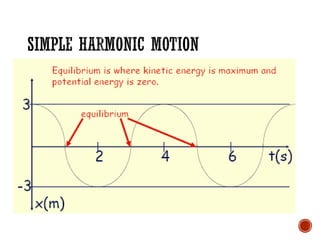
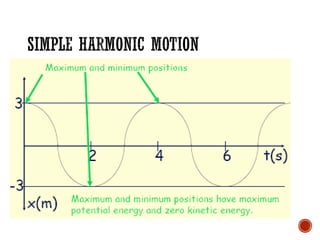
▪ Springs and pendulums undergo simple harmonic motion
(position vs. time is “sinusoidal”) and are referred to as
simple harmonic oscillators
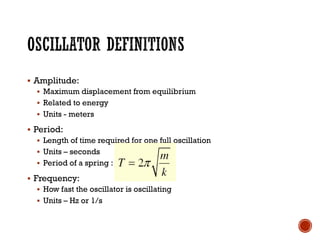
▪ Amplitude:
▪ Maximum displacement from equilibrium
▪ Related to energy
▪ Units - meters
▪ Period:
▪ Length of time required for one full oscillation
▪ Units – seconds
▪ Period of a spring :
▪ Frequency:
▪ How fast the oscillator is oscillating
▪ Units – Hz or 1/s
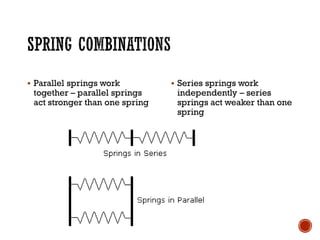
▪ Parallel springs work
together – parallel springs
act stronger than one spring
▪ Series springs work
independently – series
springs act weaker than one
spring
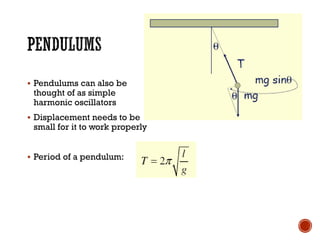
▪ Pendulums can also be
thought of as simple
harmonic oscillators
▪ Displacement needs to be
small for it to work properly
▪ Period of a pendulum:
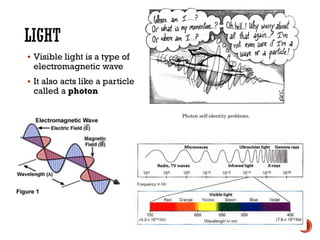
▪ Visible light is a type of
electromagnetic wave
▪ It also acts like a particle
called a photon

Waves and sound

  • 1.
  • 2.
    A stone suspended atthe end of a string is a simple pendulum. Galileo discovered that the period of a pendulum depends only on its length—its mass has no effect.
  • 3.
    WAVES ▪ A MechanicalWave is a disturbance which propagates through a medium with little or no net displacement of the particles of the medium
  • 4.
    A Mechanical Wave isa disturbance which propagates through a medium with little or no net displacement of the particles of the medium
  • 5.
    ▪The back-and-forth vibratorymotion— called oscillatory motion—of a swinging pendulum is called simple harmonic motion. ▪A sine curve is a pictorial representation of a wave.
  • 6.
    The Parts ofa Wave Wave Description
  • 7.
    Frequency The number ofvibrations an object makes in a unit of time is an object’s frequency. The frequency specifies the number of back-and-forth vibrations in a given time (usually one second). Wave Description
  • 8.
    ▪The unit offrequency is called the hertz (Hz). ▪A frequency of one cycle per second is 1 hertz, two cycles per second is 2 hertz, and so on. Higher frequencies are measured in ▪ kilohertz (kHz—thousands of hertz) ▪ megahertz (MHz—millions of hertz) ▪ gigahertz (GHz—billions of hertz)
  • 9.
    ▪Electrons in theantenna of an AM radio station at 960 kHz vibrate 960,000 times each second, producing 960-kHz radio waves.
  • 10.
    ▪ If thefrequency of a vibrating object is known, its period can be calculated, and vice versa. ▪ Suppose, for example, that a pendulum makes two vibrations in one second. Its frequency is 2 Hz. The time needed to complete one vibration—that is, the period of vibration—is 1/2 second. As you can see below, frequency and period are inverses of each other:
  • 11.
    think! What is thefrequency in vibrations per second of a 100-Hz wave?
  • 12.
    ▪The energy transferredby a wave from a vibrating source to a receiver is carried by a disturbance in a medium.
  • 13.
    You can calculatethe speed of a wave by multiplying the wavelength by the frequency. Wave Speed
  • 14.
    If the wavelengthis 1 meter, and one wavelength per second passes the pole, then the speed of the wave is 1 m/s. Wave Speed
  • 15.
    ▪The speed ofa wave is the distance traveled by a given point on a wave (like a crest) in a given interval of time ▪v = d/t ▪ v: wave speed/velocity (m/s) ▪ d: distance (m) ▪ t: time (s) ▪v = f ▪ : wavelength (m) ▪ f: frequency (Hz = 1/s)
  • 16.
    WAVE SPEED think! ▪ If awater wave vibrates up and down two times each second and the distance between wave crests is 1.5 m, what is the frequency of the wave? What is its wavelength? What is its speed?
  • 17.
    The period,T, ofa wave is the inverse of the frequency: T = 1/f
  • 18.
    ▪ Power: energyemitted by sound waves overa given period of time ▪ Units: (J/s orWatts) ▪ Intensity: amount of energy carried bysound waves per unit time through a givenarea ▪ Commonly referred to as the “loudness” of a sound ▪ Units: (Watts/m2) ▪ Sound waves with high intensity have ahigh energy and therefore a highamplitude
  • 19.
    ▪ The intensityof a sound decreases the further you move away from the source ▪ We understand this intuitively,but let’s explain it with physics! ▪ Intensity is the amount of energy emitted by sound waves per unit time (power) througha given area
  • 20.
    The energy emittedby a sound wave remains constant over time and doesn’t change with distance (conservation of energy) Increasing the distance from the source (radius) increases the area covered by the sound wave
  • 21.
    ▪ If thepower of the sound wave remains the same and the area covered by the wave increases, then the intensity will decreasethe further away we move from the source ▪ Example with Numbers: I1 = P/A I1 = 10W/5m2 I1 = 2 W/m2 I2 = P/A I2 = 10W/10m2 I2 = 1 W/m2
  • 22.
    ❖ The intensityof a sound wave is uniformly distributed at the same distance ❖ Moving around a point at a constant distance will produce no change in intensity or “loudness” ❖ Note: for 3D waves, the area a sound wave travels through is a sphere ❖ Therefore
  • 23.
    PHET SIMULATION ❖ Thissimulation shows how intensity is uniformly distributed at the same distance http://phet.colorado.edu/en/simulation/sound
  • 24.
    Transverse ▪ A transversewave is a wave in which particles of the medium move in a direction perpendicular to the direction the wave moves Compressional/ Longitudinal ▪ A longitudinal or compressional wave is a wave in which particles in the medium move in a direction parallel to the direction the wave moves
  • 25.
    Suppose you createa wave along a rope by shaking the free end up and down. The motion of the rope is at right angles to the direction in which the wave is moving. Whenever the motion of the medium is at right angles to the direction in which a wave travels, the wave is a transverse wave. TransverseWaves
  • 26.
    Sometimes the particlesof the medium move back and forth in the same direction in which the wave travels. When the particles oscillate parallel to or along the direction of the wave, the wave is a longitudinal wave. LongitudinalWaves
  • 27.
    Both transverse andlongitudinal waves can be demonstrated with a loosely coiled spring. a. When the end of a coiled spring is shaken up and down, a transverse wave is produced. LongitudinalWaves
  • 28.
    Both transverse andlongitudinal waves can be demonstrated with a loosely coiled spring. a. When the end of a coiled spring is shaken up and down, a transverse wave is produced. b. When it is shaken in and out, a longitudinal wave is produced. LongitudinalWaves
  • 29.
    ▪Waves on astring (transverse) ▪Water waves (transverse) ▪Earthquakes (transverse and compressional) ▪Sound waves (compressional) ▪ Produced through vibration ▪ Has a pitch (from frequency) ▪ Has volume (from amplitude) ▪Light (transverse) ▪ Has color (from frequency) ▪ Has brightness (from amplitude) ▪ Light travels like a wave, and like a particle called a photon
  • 30.
    ▪The behavior ofa wave when it reaches the end of its medium is called the wave’s BOUNDARY BEHAVIOR. ▪When one medium ends and another begins, that is called a boundary. 30
  • 31.
    ▪ One typeof boundary that a wave may encounter is that it may be attached to a fixed end. ▪ In this case, the end of the medium will not be able to move. ▪ What is going to happen if a wave pulse goes down this string and encounters the fixed end? 31
  • 32.
    ▪Here the incidentpulse is an upward pulse. ▪The reflected pulse is upside-down. It is inverted. ▪The reflected pulse has the same speed, wavelength, and amplitude as the incident pulse. 32
  • 33.
  • 34.
    ▪Another boundary typeis when a wave’s medium is attached to a stationary object as a free end. ▪In this situation, the end of the medium is allowed to slide up and down. ▪What would happen in this case? 34
  • 35.
    ▪ Here thereflected pulse is not inverted. ▪ It is identical to the incident pulse, except it is moving in the opposite direction. ▪ The speed, wavelength, and amplitude are the same as the incident pulse. 35
  • 36.
  • 37.
    ▪ Sound travelsthrough the air at approximately 340 m/s ▪ It travels through other media, usually faster ▪ Sound waves are started by vibration ▪ We hear sound as “high” or “low” depending on the wave’s frequency. Sounds with short wavelengths have high frequencies and sound high-pitched. ▪ The amplitude of a sound’s vibration is interpreted as loudness. We measure loudness on the decibel scale (which is logarithmic)
  • 38.
    ▪ Interference patternsoccur when waves from different sources arrive at the same point—at the same time.
  • 39.
    PRINCIPLE OF SUPERPOSITION ▪ Whentwo or more waves pass a particular point in a medium simultaneously, the resulting displacement at that point in the medium is the sum of the displacements due to each individual wave ▪ The waves interfere with each other
  • 40.
    ▪ Suppose twowaves pass through the same medium.What happens? ▪ Wave interference is the phenomenon which occurs when two or more waves meet while traveling along the same medium. ▪ The superposition principle tells us how waves interact. ▪ The principle of superposition is sometimes stated as follows: When two waves interfere, the resulting displacement of the medium at any location is the algebraic sum of the displacements of the individual waves at that same location. Algebraic sum of two waves
  • 41.
    ▪ Constructive interferenceis a type of interference which occurs at any location along the medium where the two interfering waves have a displacement in the same direction.The resulting displacement is greater than the displacement of the two interfering pulses alone.
  • 43.
    ▪ Destructive interferenceis a type of interference which occurs at any location along the medium where the two interfering waves have a displacement in the opposite direction.The resulting displacement is less than the displacement of the two interfering pulses alone.
  • 45.
    Constructive Interference ▪ Ifwaves are “in phase” ▪ Crests and troughs are aligned ▪ Displacement is in the same direction – add! Destructive Interference ▪ If waves are “out of phase” ▪ Crests and troughs not aligned ▪ Displacement in opposite directions – subtract!
  • 46.
    a. Two overlappingwater waves produce an interference pattern. b. Overlapping concentric circles produce a pictorial representation of an interference pattern. Interference
  • 47.
    ▪ A standingwave forms only if half a wavelength or a multiple of half a wavelength fits exactly into the length of the vibrating medium.
  • 48.
    The incident andreflected waves interfere to produce a standing wave. The nodes are places that remain stationary. StandingWaves
  • 49.
    ▪ A standingwave is reflected back and forth between fixed ends (string, spring, pipe, etc.) ▪ Reflection may be fixed or open-ended ▪ Superposition of the wave upon itself results in a pattern of constructive and destructive interference and an enhanced wave
  • 50.
    ▪When a reflectedwave interferes with an incident wave, a standing wave can form. Nodes are points of no motion Anti-nodes are points of maximum motion
  • 51.
  • 57.
    SPEED OF SOUNDIN SOME COMMON SUBSTANCES
  • 60.
    AWESOME WAVE PHENOMENON: THE DOPPLEREFFECT ▪ The Doppler Effect is the raising or lowering of the perceived frequency of a wave based on the relative motion of the source of sound and the observer ▪ For a sound wave, the pitch (based on frequency) increases as the source moves toward you and decreases as it moves away
  • 61.
    Concept of Dopplereffect Sound waves A siren on a police car (source) emitting a uniform series of sound waves, moving away from the source in all direction. Jason a distance away observing (observer) Air stationary (assumption) 61
  • 62.
    Sound The Doppler effectcauses the changing pitch of a siren. When a firetruck approaches, the pitch sounds higher than normal because the sound wave crests arrive more frequently. When the firetruck passes and moves away, you hear a drop in pitch because the wave crests are arriving less frequently. The Doppler Effect
  • 63.
    Concept of Dopplereffect 63 Lets take the wavelength to be 𝝀,the frequency to be 𝒇and the speed of the sound to be 𝝂. 𝝂𝒐and 𝝂𝒔 represent the speed of the observer and the source respectively.
  • 64.
    Concept of dopplereffect ❑ If both the observer and the source were stationary, he would observe a frequency equal to that of the source. 𝝂𝟎 = 𝟎 and 𝝂𝒔 = 𝟎 64
  • 65.
    Concept of Dopplereffect ❑ If the observer decide to walk towards the source, the speed of the waves in relation to the observer; 𝝂′ = 𝝂+ 𝝂𝒐 The wavelength 𝝀however remains the same. Therefore the frequency 𝒇′ observes by the observer is; 65
  • 66.
    Concept of Dopplereffect 𝒇= 𝝂′ 𝝀 𝒗+ 𝒗𝒐 𝒇= Since 𝝀= 𝝂 𝒇 𝝀 frequency of observer can be express as; 𝒇′ = 𝝂+𝝂𝒐 66 𝝂 𝒇 Frequency observed by the observer increases.
  • 67.
    Concept of Dopplereffect ❑ If the observer decided to walk away from the source, the speed of the waves relative to the observer is; 𝑣′ = 𝜈 − 𝜈 𝑜 𝑓′ = 𝜈 − 𝜈 𝑜 𝜈 𝑓 The frequency heard by the observer inthis scenario is decrease. 67
  • 68.
    Concept of Dopplereffect ❑ Now suppose the vehicle (source) is moving toward to the observer who is at rest. Since the source is moving towards the right, each successive wave is emitted from a position closer to the observer than the previous wave. As a result, the wave fronts heard by the observer are closer together than they would be if the source were not moving. 68
  • 69.
    Concept of Dopplereffect The wavelength 𝝀′ therefore measured by the observer is shorter than the wavelength 𝝀of the source. For every consecutive wave which last for a time interval T, the source moves a distance 𝒔 𝝂 𝑻 = 𝝂 69 𝒔 𝒇 . The wavelength is shorten by this amount
  • 70.
    Concept of Dopplereffect The wavelength 𝜆′observe is thus 𝝀′ = 𝝀− 𝜟𝝀= 𝝀− 𝝂𝒔 𝒇 𝑓 Since 𝜆= 𝜈 , the observe frequency 𝒇′is 𝝀′ 𝒇′ = 𝝂 = = 𝝂 𝝂 𝝀− (𝝂𝒔 𝒇) 𝝂𝒇 𝝂𝒔𝒇 𝒇′ = 𝝂 70 𝝂− 𝝂𝒔 𝒇 The observes frequency increases as the sources is moving toward the observer.
  • 71.
    Concept of Dopplereffect Conversely, if the source is moving away from the observer, each wave is emitted from a position farther from the observer than the previous wave, So the arrival time between successive waves is increased, reducing the frequency. 𝒇′ = 𝝂 𝝂+𝝂𝒔 𝒇 71
  • 72.
    Concept of Dopplereffect The general Doppler effect 𝒇′ = 𝝂+ 𝝂𝒔 𝝂− 𝝂𝒐 𝒇 This equation applies to all four conditions mention previously. The sign of 𝜈𝑠and𝜈𝑜depend on the direction of the velocity. A positive value is used for motion of the observer or the source toward the other, and a negative value is used for motion of one away from the other. 72
  • 73.
    THE DOPPLER EFFECT ▪ Increasing frequencyis called a blue shift, because the increase is toward the high-frequency, or blue, end of the spectrum. ▪ Decreasing frequency is called a red shift, referring to the low-frequency, or red, end of the color spectrum. ▪ Distant galaxies show a red shift in their light. A measurement of this shift enables astronomers to calculate their speeds of recession.
  • 74.
    think! When a sourcemoves toward you, do you measure an increase or decrease in wave speed? FIRST 10 The Doppler Effect
  • 75.
    RESONANCE ▪ Resonance occurs whena vibration from one oscillator occurs at a natural frequency for another oscillator ▪ The first oscillator will cause the second to vibrate
  • 76.
    ▪ Motion thatrepeats itself over a fixed and reproducible period of time is called periodic motion ▪ Mechanical devices can be designed to have periodic motion – these devices are called oscillators ▪ Springs and pendulums undergo simple harmonic motion (position vs. time is “sinusoidal”) and are referred to as simple harmonic oscillators
  • 79.
    ▪ Amplitude: ▪ Maximumdisplacement from equilibrium ▪ Related to energy ▪ Units - meters ▪ Period: ▪ Length of time required for one full oscillation ▪ Units – seconds ▪ Period of a spring : ▪ Frequency: ▪ How fast the oscillator is oscillating ▪ Units – Hz or 1/s
  • 80.
    ▪ Parallel springswork together – parallel springs act stronger than one spring ▪ Series springs work independently – series springs act weaker than one spring
  • 81.
    ▪ Pendulums canalso be thought of as simple harmonic oscillators ▪ Displacement needs to be small for it to work properly ▪ Period of a pendulum:
  • 82.
    ▪ Visible lightis a type of electromagnetic wave ▪ It also acts like a particle called a photon