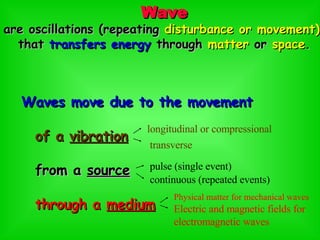
Wave are oscillations (repeating  disturbance or movement)  that  transfers energy  through  matter  or  space . Waves move due to the movement   of a  vibration from a  source through a  medium longitudinal or compressional transverse pulse (single event) continuous (repeated events) Physical matter for mechanical waves Electric and magnetic fields for electromagnetic waves
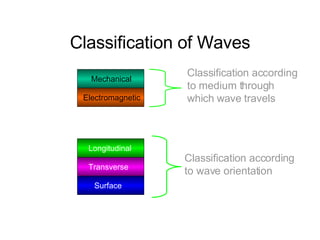
Classification of Waves Mechanical Electromagnetic Longitudinal Transverse Surface Classification according to medium through which wave travels Classification according to wave orientation
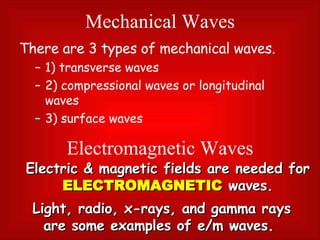
Light, radio, x-rays, and gamma rays are some examples of e/m waves.  Electric & magnetic fields are needed for ELECTROMAGNETIC   waves. Mechanical Waves There are 3 types of mechanical waves. 1) transverse waves  2) compressional waves or longitudinal waves 3) surface waves Electromagnetic Waves
Mechanical Waves Matter is the medium  Sound is a mechanical wave
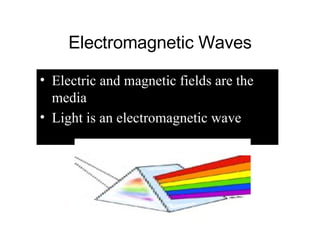
Electromagnetic Waves Electric and magnetic fields are the media  Light is an electromagnetic wave
 
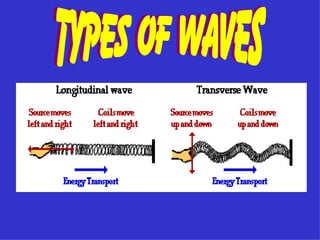
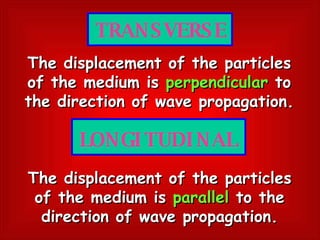
The displacement of the particles of the medium is   perpendicular   to the direction of wave propagation. TRANSVERSE LONGITUDINAL The displacement of the particles of the medium   is   parallel   to the direction of wave propagation.
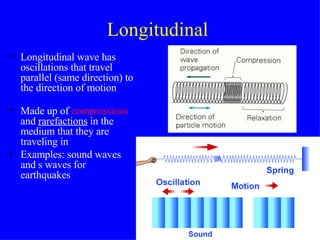
Longitudinal  Longitudinal wave has oscillations that travel parallel (same direction) to the direction of motion                    Made up of  compressions   and  rarefactions  in the medium that they are traveling in Examples: sound waves and s waves for earthquakes
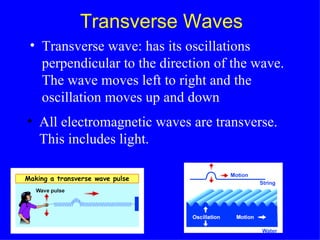
Transverse Waves All electromagnetic waves are transverse. This includes   light.   Transverse wave: has its oscillations perpendicular to the direction of the wave.  The wave moves left to right and the oscillation moves up and down
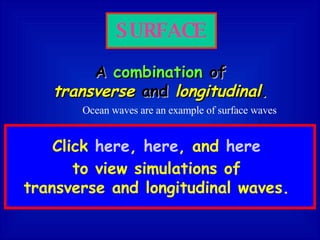
Click  here ,  here , and  here to view simulations of transverse and longitudinal waves. SURFACE A  combination  of transverse  and  longitudinal . Ocean waves are an example of surface waves
Properties of Waves The properties of a waveforms are: wavelength (period) amplitude velocity frequency All periodic (repeating) waveforms have these common characteristics
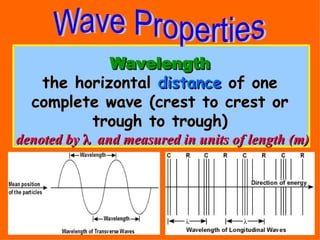
Wavelength the horizontal  distance  of one complete wave (crest to crest or trough to trough) denoted by    and measured in units of length (m)
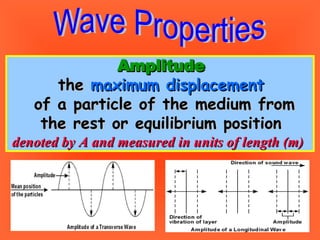
Amplitude the  maximum displacement of a particle of the medium from the rest or equilibrium position denoted by A and measured in units of length (m)
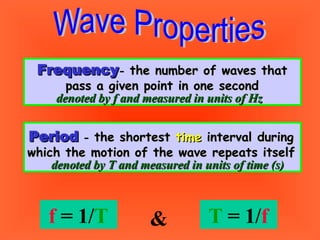
Frequency  -  the number of waves that pass a given point in one second denoted by f and measured in units of Hz Period  -  the shortest  time  interval during which the motion of the wave repeats itself denoted by T and measured in units of time (s) T  = 1/ f  & f  = 1/ T
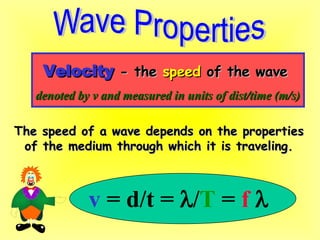
Velocity  - the  speed  of the wave denoted by v and measured in units of dist/time (m/s) v  = d/t =   / T  =  f    The speed of a wave depends on the properties of the medium through which it is traveling.
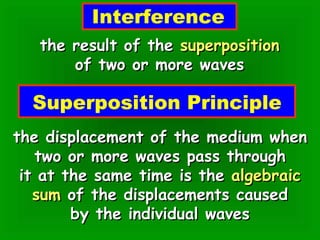
Interference the result of the  superposition of two or more waves Superposition Principle the displacement of the medium when two or more waves pass through it at the same time is the  algebraic sum  of the displacements caused by the individual waves
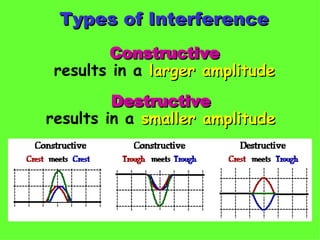
Constructive results in a  larger amplitude Types of Interference Destructive results in a  smaller amplitude
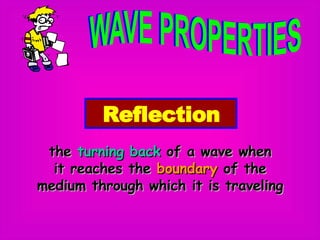
Reflection the  turning back  of a wave when it reaches the  boundary  of the medium through which it is traveling
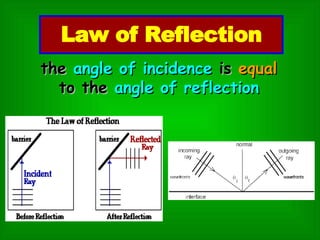
Law of Reflection the  angle of incidence  is  equal to the  angle of reflection
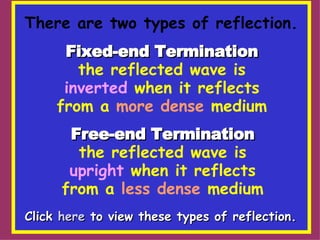
There are two types of reflection. Fixed-end Termination the reflected wave is inverted  when it reflects from a  more dense  medium Free-end Termination the reflected wave is upright  when it reflects from a  less dense  medium Click  here  to view these types of reflection.
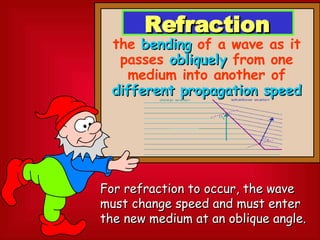
the   bending   of a wave as it passes   obliquely   from one medium into another of  different propagation speed Refraction For refraction to occur, the wave must change speed and must enter the new medium at an oblique angle.
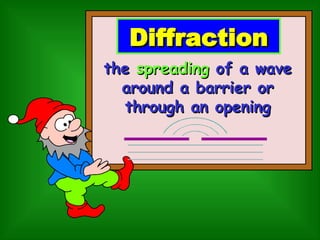
Diffraction the   spreading   of a wave around a barrier or through an opening
Read more about interference  here . Click  here  to view the interference pattern resulting from the superposition of two transverse waves. Click  here  and  here   to view simulations of the interference of two circular waves.
A  standing wave  is the result of two wave trains of the same wavelength ,  frequency , and  amplitude traveling in opposite directions through the same medium.
Learn more about standing waves here ,  here , and  here . Click  here  to view a simulation of the interference of two traveling waves that can result in a standing wave. Click  here  to view a simulation of standing waves on a string. Standing waves may be produced easily in water, string, and air columns.
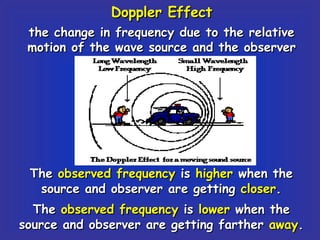
Doppler Effect the change in frequency due to the relative motion of the wave source and the observer The  observed frequency  is  higher  when the source and observer are getting  closer . The  observed frequency  is  lower  when the source and observer are getting farther  away .
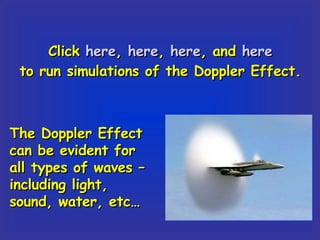
Click  here ,  here ,  here , and  here to run simulations of the Doppler Effect. The Doppler Effect can be evident for all types of waves – including light, sound, water, etc…

03-03-08 - Waves

  • 1.
  • 2.
    Wave are oscillations(repeating disturbance or movement) that transfers energy through matter or space . Waves move due to the movement of a vibration from a source through a medium longitudinal or compressional transverse pulse (single event) continuous (repeated events) Physical matter for mechanical waves Electric and magnetic fields for electromagnetic waves
  • 3.
    Classification of WavesMechanical Electromagnetic Longitudinal Transverse Surface Classification according to medium through which wave travels Classification according to wave orientation
  • 4.
    Light, radio, x-rays,and gamma rays are some examples of e/m waves. Electric & magnetic fields are needed for ELECTROMAGNETIC waves. Mechanical Waves There are 3 types of mechanical waves. 1) transverse waves 2) compressional waves or longitudinal waves 3) surface waves Electromagnetic Waves
  • 5.
    Mechanical Waves Matteris the medium Sound is a mechanical wave
  • 6.
    Electromagnetic Waves Electricand magnetic fields are the media Light is an electromagnetic wave
  • 7.
  • 8.
    The displacement ofthe particles of the medium is perpendicular to the direction of wave propagation. TRANSVERSE LONGITUDINAL The displacement of the particles of the medium is parallel to the direction of wave propagation.
  • 9.
    Longitudinal Longitudinalwave has oscillations that travel parallel (same direction) to the direction of motion                    Made up of compressions and rarefactions in the medium that they are traveling in Examples: sound waves and s waves for earthquakes
  • 10.
    Transverse Waves Allelectromagnetic waves are transverse. This includes light. Transverse wave: has its oscillations perpendicular to the direction of the wave. The wave moves left to right and the oscillation moves up and down
  • 11.
    Click here, here , and here to view simulations of transverse and longitudinal waves. SURFACE A combination of transverse and longitudinal . Ocean waves are an example of surface waves
  • 12.
    Properties of WavesThe properties of a waveforms are: wavelength (period) amplitude velocity frequency All periodic (repeating) waveforms have these common characteristics
  • 13.
    Wavelength the horizontal distance of one complete wave (crest to crest or trough to trough) denoted by  and measured in units of length (m)
  • 14.
    Amplitude the maximum displacement of a particle of the medium from the rest or equilibrium position denoted by A and measured in units of length (m)
  • 15.
    Frequency  - the number of waves that pass a given point in one second denoted by f and measured in units of Hz Period - the shortest time interval during which the motion of the wave repeats itself denoted by T and measured in units of time (s) T = 1/ f & f = 1/ T
  • 16.
    Velocity -the speed of the wave denoted by v and measured in units of dist/time (m/s) v = d/t =  / T = f  The speed of a wave depends on the properties of the medium through which it is traveling.
  • 17.
    Interference the resultof the superposition of two or more waves Superposition Principle the displacement of the medium when two or more waves pass through it at the same time is the algebraic sum of the displacements caused by the individual waves
  • 18.
    Constructive results ina larger amplitude Types of Interference Destructive results in a smaller amplitude
  • 19.
    Reflection the turning back of a wave when it reaches the boundary of the medium through which it is traveling
  • 20.
    Law of Reflectionthe angle of incidence is equal to the angle of reflection
  • 21.
    There are twotypes of reflection. Fixed-end Termination the reflected wave is inverted when it reflects from a more dense medium Free-end Termination the reflected wave is upright when it reflects from a less dense medium Click here to view these types of reflection.
  • 22.
    the bending of a wave as it passes obliquely from one medium into another of different propagation speed Refraction For refraction to occur, the wave must change speed and must enter the new medium at an oblique angle.
  • 23.
    Diffraction the spreading of a wave around a barrier or through an opening
  • 24.
    Read more aboutinterference here . Click here to view the interference pattern resulting from the superposition of two transverse waves. Click here and here to view simulations of the interference of two circular waves.
  • 25.
    A standingwave is the result of two wave trains of the same wavelength , frequency , and amplitude traveling in opposite directions through the same medium.
  • 26.
    Learn more aboutstanding waves here , here , and here . Click here to view a simulation of the interference of two traveling waves that can result in a standing wave. Click here to view a simulation of standing waves on a string. Standing waves may be produced easily in water, string, and air columns.
  • 27.
    Doppler Effect thechange in frequency due to the relative motion of the wave source and the observer The observed frequency is higher when the source and observer are getting closer . The observed frequency is lower when the source and observer are getting farther away .
  • 28.
    Click here, here , here , and here to run simulations of the Doppler Effect. The Doppler Effect can be evident for all types of waves – including light, sound, water, etc…