Sound
Overview The Facts of Sound Sound Vocabulary The Ear and Sound Musical Instruments and other uses of Sound Other types of waves
The Facts Sound … …  is a form of energy produced & transmitted by  vibrating matter  …  travels  in  longitudinal waves … travels   faster  through  solids  than  liquids or gases
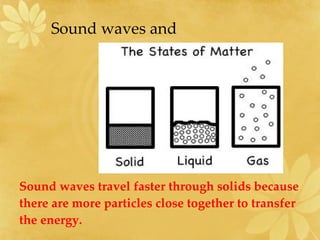
Sound waves travel faster through solids because there are more particles close together to transfer the energy. Sound waves and
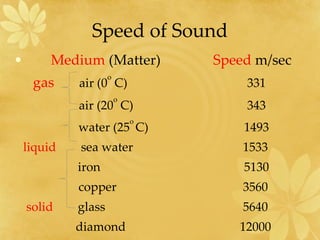
Speed of Sound Medium  (Matter)    Speed  m/sec   gas   air (0 o  C)     331 air (20 o  C)   343   water (25 o  C)       1493 liquid  sea water   1533 iron     5130   copper   3560 solid   glass   5640  diamond     12000
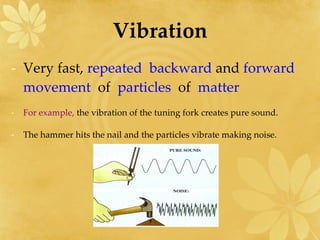
Vibration Very fast,  repeated  backward  and  forward  movement  of   particles  of   matter For example,  the vibration of the tuning fork creates pure sound. The hammer hits the nail and the particles vibrate making noise.
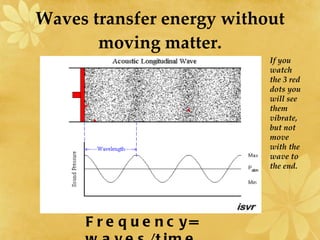
Waves transport energy without moving matter Watch the  3 red dots  You will see them  vibrate , but not move with the wave to  the end.  All  the  particles  are  vibrating  but stay  fixed
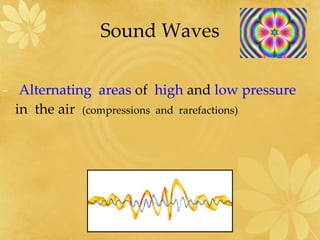
Sound Waves Alternating  areas  of  high  and  low pressure   in  the air  (compressions  and  rarefactions)
Sound Waves ALL  sound  is  carried  through  matter  as  sound  waves.  In a vacuum there are no particles so sound cannot travel. Alternating areas of high and low pressure in the air (compressions  and  rarefactions)
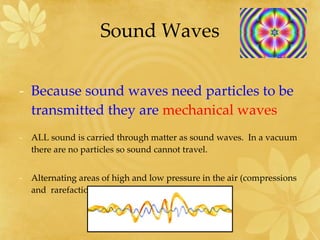
Sound Waves Because sound waves need particles to be transmitted they are  mechanical waves ALL sound is carried through matter as sound waves.  In a vacuum there are no particles so sound cannot travel. Alternating areas of high and low pressure in the air (compressions  and  rarefactions)
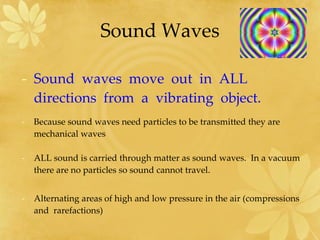
Sound Waves Sound  waves  move  out  in  ALL directions  from  a  vibrating  object. Because sound waves need particles to be transmitted they are mechanical waves ALL sound is carried through matter as sound waves.  In a vacuum there are no particles so sound cannot travel. Alternating areas of high and low pressure in the air (compressions  and  rarefactions)
Compression Where  particles  are  pressed together  as the sound wave moves through matter.
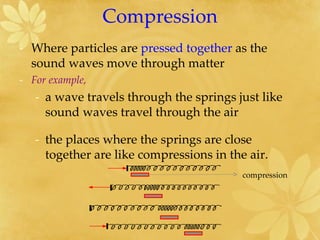
Compression Where particles are  pressed together  as the sound waves move through matter For example, a wave travels through the springs just like sound waves travel through the air the places where the springs are close together are like compressions in the air. compression
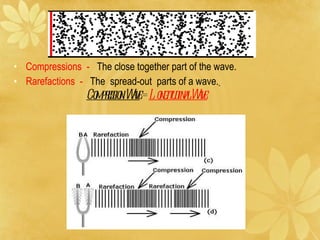
Compressions  -  The close together part of the wave. Rarefactions  -  The  spread-out  parts of a wave.   Compression Wave  =  Longitudinal Wave
Longitudinal Wave  (Compression Wave) Each wave particle vibrates back  and forth in the same direction of  the wave.
Sound waves covered till now: States of matter (solid, liquid, gas) Speed of sound through matter No sound in a vacuum Vibration Compression + Rarefaction Longitudinal waves Remember that ….
Waves transfer energy without moving matter. Frequency=  waves/time If you watch the 3 red dots you will see them vibrate, but not move with the wave to  the end.
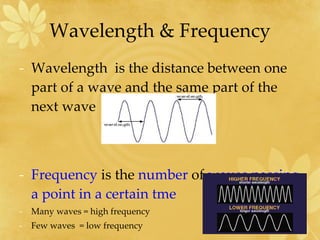
Wavelength & Frequency Wavelength  is the distance between one part of a wave and the same part of the next wave Frequency  is the  number  of  waves passing a point in a certain tme Many waves = high frequency Few waves  = low frequency
Pitch = Frequency How high or low a sound is Pitch  depends on the  frequency  of a sound wave For example, Low pitch Low frequency Longer wavelength High pitch High frequency Shorter wavelength
Frequency  is measured in  Hertz For example:  If 20 waves are made per second, then the frequency is 20 cycles per second = 20 Hertz  Hz
20 Hz – 20,000 Hz The human ear can only hear sounds  between  20Hz and 20,000 Hz  (Frequency/Pitch) Below  20 Hz  is  called  infrasound Above  20,000 Hz  is called  ultrasound
Ultrasound   sound waves with frequencies above the  normal human range of hearing.  Sounds in the range from 20,000-100,000Hz   Infrasound sounds waves with frequencies below the normal human range of hearing. Sounds in the  0.001 - 20Hz   range
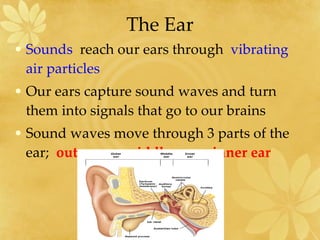
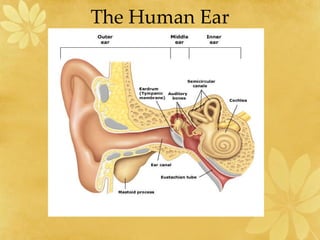
The Ear Sounds  reach our ears through   vibrating  air particles Our ears capture sound waves and turn them into signals that go to our brains Sound waves move through 3 parts of the ear;  outer ear ,  middle ear , +  inner ear
The Human Ear
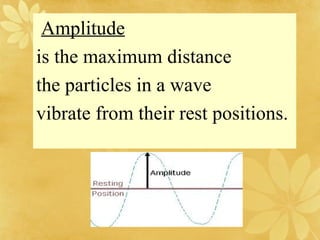
Amplitude is the maximum distance  the particles in a wave  vibrate from their rest positions.
Amplitude = loudness The  intensity  of a sound decreases as you move away from a sound.  The sound is softer. As the source of a sound comes  closer  the sound becomes louder,  more intense A loud sound has a high amplitude  A soft sound has low amplitude soft loud
Amplitude = loudness The volume or loudness of sound is measured in  decibels dB
Loudness of Sound in Decibels Sound Loudness (dbs) Hearing Damage Average Home 40-50 Loud Music 90-100 After long exposure Rock Concert 115-120 Progressive Jet Engine 120-170 Pain
Sound and Instruments Different musical instruments create different sound vibrations Wind instruments by blowing and vibrating the air  e.g. flute, saxophone, organ String instruments by touching and vibrating the strings  e.g. guitar, violin, piano Percussion instruments by hitting a surface  e.g. drums, cymbals, triangle
Sound and Instruments Instruments  can be played at different  pitches  (musical notes) by  changing  the lengths  of different parts. For example,  Another way to make different pitches is to  change  the  thickness  of the  material  that  vibrates. A trombone’s mute absorbs some of the sound waves produced, so a different sound is made.
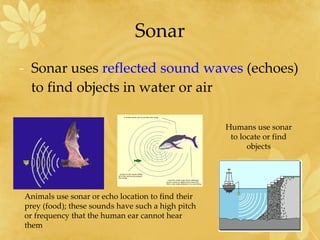
Sonar Sonar uses  reflected sound waves  (echoes) to find objects in water or air  Animals use sonar or echo location to find their prey (food); these sounds have such a high pitch or frequency that the human ear cannot hear them Humans use sonar to locate or find objects
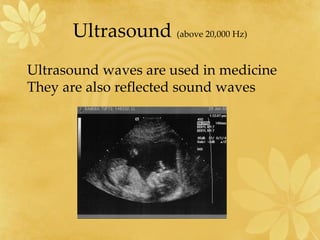
Ultrasound  (above 20,000 Hz) Ultrasound waves are used in medicine  They are also reflected sound waves
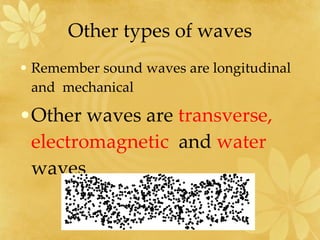
Other types of waves Remember sound waves are longitudinal  and  mechanical Other waves are  transverse,  electromagnetic  and  water  waves
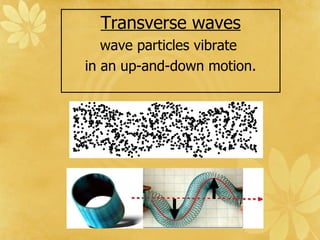
Transverse waves wave particles vibrate  in an up-and-down motion.
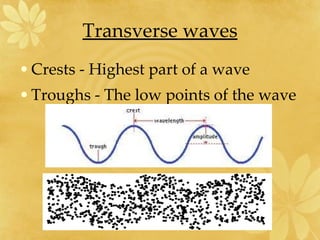
Transverse waves Crests - Highest part of a wave Troughs - The low points of the wave
Electromagnetic waves Electromagnetic waves travel as transverse waves Electromagnetic waves CAN travel through a vacuum Light, microwaves, x-rays, and TV and radio transmissions are all examples of electromagnetic waves
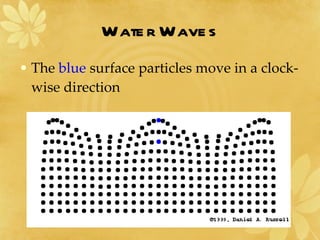
Water Waves The  blue  surface particles move in a clock-wise direction
Wave concepts covered in this power point: Sound Waves States of matter  (solid, liquid, gas) Speed of sound through matter No sound in a vacuum Vibration Compression + Rarefaction Longitudinal waves Wavelength Frequency = Pitch Hertz  Hz 20 – 20,000 Hz  Ear  ( outer, middle, inner ear) Amplitude = Loudness = Volume Decibels  dB Sonar Ultrasound, infrasound Other waves Transverse waves Crests Troughs Electromagnetic waves Water waves
That’s all folks!

Sound and waves grade 6 pps

  • 1.
  • 2.
    Overview The Factsof Sound Sound Vocabulary The Ear and Sound Musical Instruments and other uses of Sound Other types of waves
  • 3.
    The Facts Sound… … is a form of energy produced & transmitted by vibrating matter … travels in longitudinal waves … travels faster through solids than liquids or gases
  • 4.
    Sound waves travelfaster through solids because there are more particles close together to transfer the energy. Sound waves and
  • 5.
    Speed of SoundMedium (Matter) Speed m/sec gas air (0 o C) 331 air (20 o C) 343 water (25 o C) 1493 liquid sea water 1533 iron 5130 copper 3560 solid glass 5640 diamond 12000
  • 6.
    Vibration Very fast, repeated backward and forward movement of particles of matter For example, the vibration of the tuning fork creates pure sound. The hammer hits the nail and the particles vibrate making noise.
  • 7.
    Waves transport energywithout moving matter Watch the 3 red dots You will see them vibrate , but not move with the wave to the end. All the particles are vibrating but stay fixed
  • 8.
    Sound Waves Alternating areas of high and low pressure in the air (compressions and rarefactions)
  • 9.
    Sound Waves ALL sound is carried through matter as sound waves. In a vacuum there are no particles so sound cannot travel. Alternating areas of high and low pressure in the air (compressions and rarefactions)
  • 10.
    Sound Waves Becausesound waves need particles to be transmitted they are mechanical waves ALL sound is carried through matter as sound waves. In a vacuum there are no particles so sound cannot travel. Alternating areas of high and low pressure in the air (compressions and rarefactions)
  • 11.
    Sound Waves Sound waves move out in ALL directions from a vibrating object. Because sound waves need particles to be transmitted they are mechanical waves ALL sound is carried through matter as sound waves. In a vacuum there are no particles so sound cannot travel. Alternating areas of high and low pressure in the air (compressions and rarefactions)
  • 12.
    Compression Where particles are pressed together as the sound wave moves through matter.
  • 13.
    Compression Where particlesare pressed together as the sound waves move through matter For example, a wave travels through the springs just like sound waves travel through the air the places where the springs are close together are like compressions in the air. compression
  • 14.
    Compressions - The close together part of the wave. Rarefactions - The spread-out parts of a wave. Compression Wave = Longitudinal Wave
  • 15.
    Longitudinal Wave (Compression Wave) Each wave particle vibrates back and forth in the same direction of the wave.
  • 16.
    Sound waves coveredtill now: States of matter (solid, liquid, gas) Speed of sound through matter No sound in a vacuum Vibration Compression + Rarefaction Longitudinal waves Remember that ….
  • 17.
    Waves transfer energywithout moving matter. Frequency= waves/time If you watch the 3 red dots you will see them vibrate, but not move with the wave to the end.
  • 18.
    Wavelength & FrequencyWavelength is the distance between one part of a wave and the same part of the next wave Frequency is the number of waves passing a point in a certain tme Many waves = high frequency Few waves = low frequency
  • 19.
    Pitch = FrequencyHow high or low a sound is Pitch depends on the frequency of a sound wave For example, Low pitch Low frequency Longer wavelength High pitch High frequency Shorter wavelength
  • 20.
    Frequency ismeasured in Hertz For example: If 20 waves are made per second, then the frequency is 20 cycles per second = 20 Hertz Hz
  • 21.
    20 Hz –20,000 Hz The human ear can only hear sounds between 20Hz and 20,000 Hz (Frequency/Pitch) Below 20 Hz is called infrasound Above 20,000 Hz is called ultrasound
  • 22.
    Ultrasound sound waves with frequencies above the normal human range of hearing. Sounds in the range from 20,000-100,000Hz Infrasound sounds waves with frequencies below the normal human range of hearing. Sounds in the 0.001 - 20Hz range
  • 23.
    The Ear Sounds reach our ears through vibrating air particles Our ears capture sound waves and turn them into signals that go to our brains Sound waves move through 3 parts of the ear; outer ear , middle ear , + inner ear
  • 24.
  • 25.
    Amplitude is themaximum distance the particles in a wave vibrate from their rest positions.
  • 26.
    Amplitude = loudnessThe intensity of a sound decreases as you move away from a sound. The sound is softer. As the source of a sound comes closer the sound becomes louder, more intense A loud sound has a high amplitude A soft sound has low amplitude soft loud
  • 27.
    Amplitude = loudnessThe volume or loudness of sound is measured in decibels dB
  • 28.
    Loudness of Soundin Decibels Sound Loudness (dbs) Hearing Damage Average Home 40-50 Loud Music 90-100 After long exposure Rock Concert 115-120 Progressive Jet Engine 120-170 Pain
  • 29.
    Sound and InstrumentsDifferent musical instruments create different sound vibrations Wind instruments by blowing and vibrating the air e.g. flute, saxophone, organ String instruments by touching and vibrating the strings e.g. guitar, violin, piano Percussion instruments by hitting a surface e.g. drums, cymbals, triangle
  • 30.
    Sound and InstrumentsInstruments can be played at different pitches (musical notes) by changing the lengths of different parts. For example, Another way to make different pitches is to change the thickness of the material that vibrates. A trombone’s mute absorbs some of the sound waves produced, so a different sound is made.
  • 31.
    Sonar Sonar uses reflected sound waves (echoes) to find objects in water or air Animals use sonar or echo location to find their prey (food); these sounds have such a high pitch or frequency that the human ear cannot hear them Humans use sonar to locate or find objects
  • 32.
    Ultrasound (above20,000 Hz) Ultrasound waves are used in medicine They are also reflected sound waves
  • 33.
    Other types ofwaves Remember sound waves are longitudinal and mechanical Other waves are transverse, electromagnetic and water waves
  • 34.
    Transverse waves waveparticles vibrate in an up-and-down motion.
  • 35.
    Transverse waves Crests- Highest part of a wave Troughs - The low points of the wave
  • 36.
    Electromagnetic waves Electromagneticwaves travel as transverse waves Electromagnetic waves CAN travel through a vacuum Light, microwaves, x-rays, and TV and radio transmissions are all examples of electromagnetic waves
  • 37.
    Water Waves The blue surface particles move in a clock-wise direction
  • 38.
    Wave concepts coveredin this power point: Sound Waves States of matter (solid, liquid, gas) Speed of sound through matter No sound in a vacuum Vibration Compression + Rarefaction Longitudinal waves Wavelength Frequency = Pitch Hertz Hz 20 – 20,000 Hz Ear ( outer, middle, inner ear) Amplitude = Loudness = Volume Decibels dB Sonar Ultrasound, infrasound Other waves Transverse waves Crests Troughs Electromagnetic waves Water waves
  • 39.