Sound Waves and Its
Properties
BY--KHUSH AHUJA
What is Sound ?
 A sound is any vibration(wave) traveling through air or other medium
which can be heard when it reaches a person ear.
 In human frequencies lying between about 20 Hz to 20 kHz
 Sound waves is an example of mechanical wave, it requires a medium to
travel. It cannot travel in vacuum.
 It is of two type:-
 Longitudinal Waves :- oscillations parallel to propagation
 Transverse Waves (in solids):- also known as shear waves, have the
additional property, polarization, and are not a characteristic of sound
waves.
How sound is created?
 Sound is produced when an object vibrates, creating a pressure wave.
This pressure wave causes particles in the surrounding medium (air, water,
or solid) to have vibrational motion. As the particles vibrate, they move
nearby particles, transmitting the sound further through the medium.
 Any sound your ear can hear is created by the mechanical back and forth
motion of an object.
Properties of Sound Waves
 Sound that is perceptible by humans has frequencies from about 20 Hz to
20,000 Hz.
 In air at standard temperature and pressure, the corresponding
wavelengths of sound waves range from 17 m (56 ft) to 17 mm (0.67 in).
 Sometimes speed and direction are combined as a velocity vector; wave
number and direction are combined as a wave vector.
Speed of sound
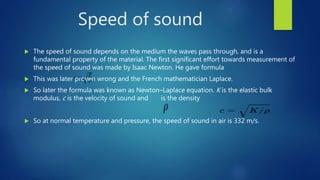
 The speed of sound depends on the medium the waves pass through, and is a
fundamental property of the material. The first significant effort towards measurement of
the speed of sound was made by Isaac Newton. He gave formula
 This was later proven wrong and the French mathematician Laplace.
 So later the formula was known as Newton–Laplace equation. K is the elastic bulk
modulus, c is the velocity of sound and is the density
 So at normal temperature and pressure, the speed of sound in air is 332 m/s.
Mechanical Waves
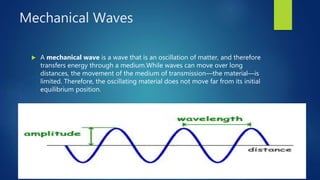
 A mechanical wave is a wave that is an oscillation of matter, and therefore
transfers energy through a medium.While waves can move over long
distances, the movement of the medium of transmission—the material—is
limited. Therefore, the oscillating material does not move far from its initial
equilibrium position.
Longitudinal Waves
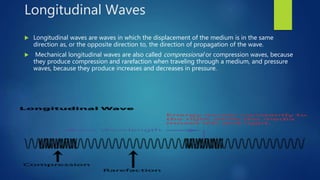
 Longitudinal waves are waves in which the displacement of the medium is in the same
direction as, or the opposite direction to, the direction of propagation of the wave.
 Mechanical longitudinal waves are also called compressional or compression waves, because
they produce compression and rarefaction when traveling through a medium, and pressure
waves, because they produce increases and decreases in pressure.
Transverse wave
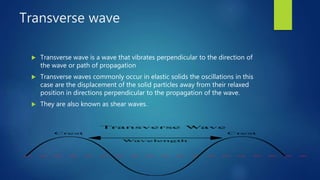
 Transverse wave is a wave that vibrates perpendicular to the direction of
the wave or path of propagation
 Transverse waves commonly occur in elastic solids the oscillations in this
case are the displacement of the solid particles away from their relaxed
position in directions perpendicular to the propagation of the wave.
 They are also known as shear waves.
Difference Between Longitudinal and
Transverse Wave
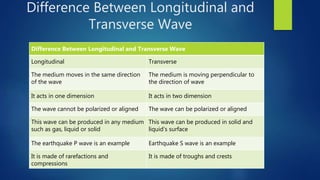
Difference Between Longitudinal and Transverse Wave
Longitudinal Transverse
The medium moves in the same direction
of the wave
The medium is moving perpendicular to
the direction of wave
It acts in one dimension It acts in two dimension
The wave cannot be polarized or aligned The wave can be polarized or aligned
This wave can be produced in any medium
such as gas, liquid or solid
This wave can be produced in solid and
liquid’s surface
The earthquake P wave is an example Earthquake S wave is an example
It is made of rarefactions and
compressions
It is made of troughs and crests
Sound used in medical field
 Ultrasound is sound waves with frequencies higher than 20,000 Hz (or
20 kHz) . Ultrasound is not different from "normal" (audible) sound in its
physical properties, except in that humans cannot hear it. Ultrasound is
commonly used for medical diagnostics such as sonograms.
 It can be used to cure cancer.
 Sound therapy, often called sound healing, has begun to attract a people.
THANK YOU

SOUND WAVES AND ITS PROPERTIES

  • 1.
    Sound Waves andIts Properties BY--KHUSH AHUJA
  • 2.
    What is Sound?  A sound is any vibration(wave) traveling through air or other medium which can be heard when it reaches a person ear.  In human frequencies lying between about 20 Hz to 20 kHz  Sound waves is an example of mechanical wave, it requires a medium to travel. It cannot travel in vacuum.  It is of two type:-  Longitudinal Waves :- oscillations parallel to propagation  Transverse Waves (in solids):- also known as shear waves, have the additional property, polarization, and are not a characteristic of sound waves.
  • 3.
    How sound iscreated?  Sound is produced when an object vibrates, creating a pressure wave. This pressure wave causes particles in the surrounding medium (air, water, or solid) to have vibrational motion. As the particles vibrate, they move nearby particles, transmitting the sound further through the medium.  Any sound your ear can hear is created by the mechanical back and forth motion of an object.
  • 4.
    Properties of SoundWaves  Sound that is perceptible by humans has frequencies from about 20 Hz to 20,000 Hz.  In air at standard temperature and pressure, the corresponding wavelengths of sound waves range from 17 m (56 ft) to 17 mm (0.67 in).  Sometimes speed and direction are combined as a velocity vector; wave number and direction are combined as a wave vector.
  • 5.
    Speed of sound The speed of sound depends on the medium the waves pass through, and is a fundamental property of the material. The first significant effort towards measurement of the speed of sound was made by Isaac Newton. He gave formula  This was later proven wrong and the French mathematician Laplace.  So later the formula was known as Newton–Laplace equation. K is the elastic bulk modulus, c is the velocity of sound and is the density  So at normal temperature and pressure, the speed of sound in air is 332 m/s.
  • 6.
    Mechanical Waves  Amechanical wave is a wave that is an oscillation of matter, and therefore transfers energy through a medium.While waves can move over long distances, the movement of the medium of transmission—the material—is limited. Therefore, the oscillating material does not move far from its initial equilibrium position.
  • 7.
    Longitudinal Waves  Longitudinalwaves are waves in which the displacement of the medium is in the same direction as, or the opposite direction to, the direction of propagation of the wave.  Mechanical longitudinal waves are also called compressional or compression waves, because they produce compression and rarefaction when traveling through a medium, and pressure waves, because they produce increases and decreases in pressure.
  • 8.
    Transverse wave  Transversewave is a wave that vibrates perpendicular to the direction of the wave or path of propagation  Transverse waves commonly occur in elastic solids the oscillations in this case are the displacement of the solid particles away from their relaxed position in directions perpendicular to the propagation of the wave.  They are also known as shear waves.
  • 9.
    Difference Between Longitudinaland Transverse Wave Difference Between Longitudinal and Transverse Wave Longitudinal Transverse The medium moves in the same direction of the wave The medium is moving perpendicular to the direction of wave It acts in one dimension It acts in two dimension The wave cannot be polarized or aligned The wave can be polarized or aligned This wave can be produced in any medium such as gas, liquid or solid This wave can be produced in solid and liquid’s surface The earthquake P wave is an example Earthquake S wave is an example It is made of rarefactions and compressions It is made of troughs and crests
  • 10.
    Sound used inmedical field  Ultrasound is sound waves with frequencies higher than 20,000 Hz (or 20 kHz) . Ultrasound is not different from "normal" (audible) sound in its physical properties, except in that humans cannot hear it. Ultrasound is commonly used for medical diagnostics such as sonograms.  It can be used to cure cancer.  Sound therapy, often called sound healing, has begun to attract a people.
  • 11.