

Department of Computer Science and Engineering
Hamdard University Bangladesh
SONET
Contents
 Introduction to SONET
 SONET/SDH Rates
 SONET Layers Compared with OSI Model
 SONET Architecture
 SONET Frames
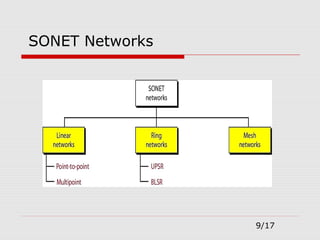
 SONET Network Types
 Advantages of SONET
 Disadvantages of SONET
2/17
Introduction to SONET
 SONET stands for Synchronous Optical Network.
 Standard for optical telecommunications transport.
 It defines optical carrier (OC) levels.
 Synchronous transport signals (STSs) for the fiber-
optic–based transmission hierarchy.
3/17
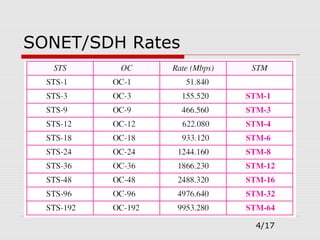
SONET/SDH Rates
4/17
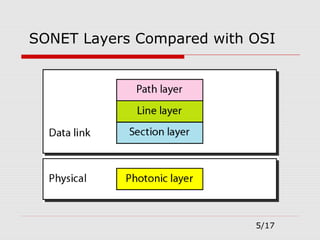
SONET Layers Compared with OSI
5/17
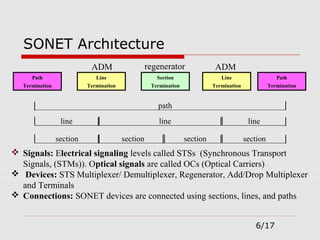
SONET Archıtecture
Path
Termination
Path
Termination
Line
Termination
Line
Termination
Section
Termination
path
line line line
ADM ADMregenerator
section section sectionsection
 Signals: Electrical signaling levels called STSs (Synchronous Transport
Signals, (STMs)). Optical signals are called OCs (Optical Carriers)
 Devices: STS Multiplexer/ Demultiplexer, Regenerator, Add/Drop Multiplexer
and Terminals
 Connections: SONET devices are connected using sections, lines, and paths
6/17
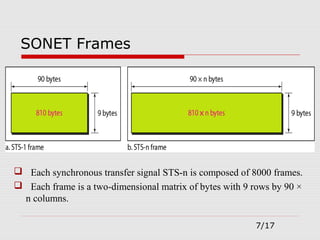
SONET Frames
 Each synchronous transfer signal STS-n is composed of 8000 frames.
 Each frame is a two-dimensional matrix of bytes with 9 rows by 90 ×
n columns.
7/17
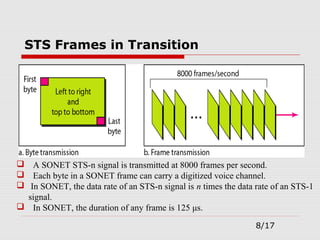
 A SONET STS-n signal is transmitted at 8000 frames per second.
 Each byte in a SONET frame can carry a digitized voice channel.
 In SONET, the data rate of an STS-n signal is n times the data rate of an STS-1
signal.
 In SONET, the duration of any frame is 125 μs.
STS Frames in Transition
8/17
SONET Networks
9/17
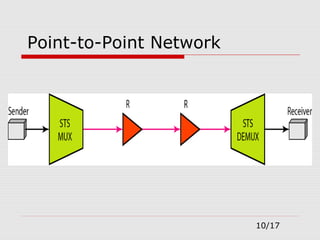
Point-to-Point Network
10/17
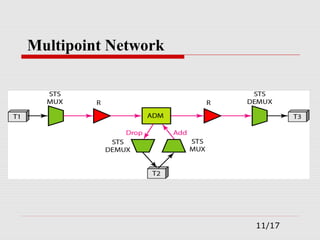
Multipoint Network
11/17
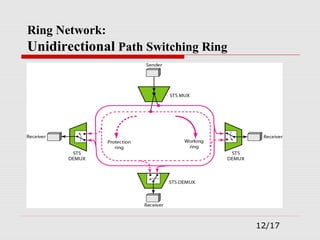
Ring Network:
Unidirectional Path Switching Ring
12/17
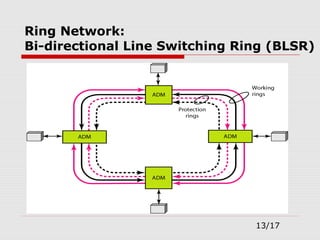
Ring Network:
Bi-directional Line Switching Ring (BLSR)
13/17
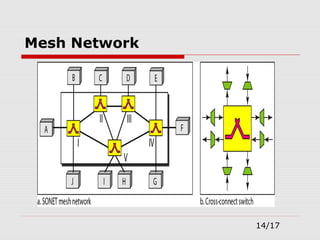
Mesh Network
14/17
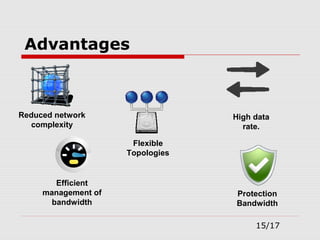
Reduced network
complexity
Protection
Bandwidth
High data
rate.
Flexible
Topologies
Efficient
management of
bandwidth
Advantages
15/17
 High cost.
 Complex equipment as compared to cheaper Ethernet
 Strict synchronization schemes required.
Disadvantages
16/17
Thats All !
Thanks for listening...

SONET-Communication Engineering

Editor's Notes

  • #6 SONET defines four layers: path, line, section, and photonic Path layer is responsible for the movement of a signal from its optical source to its optical destination Line layers is for the movement of a signal across a physical line Section layer is for the movement of a signal across a physical section, handling framing, scrambling, and error control Photonic layer corresponds to the physical layer of OSI model