Secure Electronic Transaction
Department of Computer Science and Engineering
Hamdard University Bangladesh
Contents
 Secure Electronic Transaction
 SET Business Requirements
 SET Protocols
 Parties in SET
 Key Technologies of SET
 Implementation of SET
 SET Transaction
 Dual Signatures
 Dual Signature in SET
 Dual Signature Operation
 SET Supported Transaction
 Credit Card Protocols 02 out of 17
Secure Electronic Transaction
• An application-layer security mechanism, consisting
of a set of protocols.
• Protect credit card transaction on the Internet.
• Companies involved:– MasterCard, Visa, IBM,
Microsoft, Netscape, RSA, Cyber Cash, Net Bill
• Not an ordinary payment system.
• It has a complex technical specification.
03 out of 17
SET Business Requirements
• Provide confidentiality of payment and ordering
information.
• Ensure the integrity of all transmitted data.
• Provide authentication that a cardholder is a ultimate
user of a credit card account.
• Provide authentication that a merchant can accept credit
card transactions through its relationship with a
financial institution.
04 out of 17
SET Business Requirements (cont’d)
• Ensure the use of the best security practices and system design
techniques to protect all legitimate parties in an electronic commerce
transaction.
• Create a protocol that neither depends on transport security
mechanisms nor prevents their use.
• Facilitate and encourage interoperability among software and
network providers.
05 out of 17
Secure Electronic Transaction :
Protocol
• Confidentiality: All messages are encrypted.
• Trust: All parties must have digital certificates.
• Privacy: information made available only when and where
necessary.
• Developed by Visa and MasterCard.
• Designed to protect credit card transactions.
05 out of 17
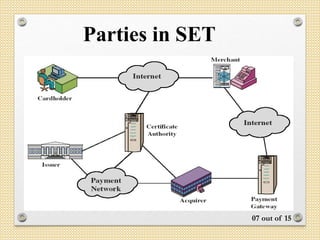
Parties in SET
07 out of 17
Key Technologies of SET
• Confidentiality of information: DES
• Integrity of data: RSA digital signatures with SHA-1 hash
codes
• Cardholder account authentication: X.509v3 digital
certificates with RSA signatures
• Merchant authentication: X.509v3 digital certificates with
RSA signatures
• Privacy: separation of order and payment information
using dual signatures
08 out of 17
Implementation of SET
• Data Confidentiality  Encryption
• Who am I dealing with?  Authentication
• Message integrity  Message Digest
• Non-repudiation  Digital Signature
• Access Control  Certificate Attributes
09 out of 17
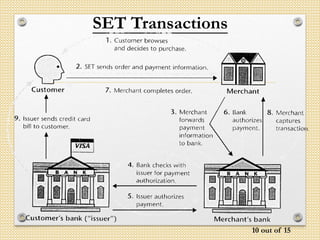
SET Transactions
• The customer sends order and payment information to
the merchant.
• The merchant requests payment authorization from the
payment gateway prior to shipment.
• The merchant confirms order to the customer.
• The merchant provides the goods or service to the
customer.
• The merchant requests payment from the payment
gateway.
10 out of 17
SET Transactions
11 out of 17
Dual Signatures
• Links two messages securely but allows only one party to read
each.
MESSAGE 1
DIGEST 1
NEW DIGEST
HASH 1 & 2
WITH SHA
MESSAGE 2
DIGEST 2
CONCATENATE DIGESTS
TOGETHER
HASH WITH SHA TO
CREATE NEW DIGEST
DUAL SIGNATURE
PRIVATE KEY
ENCRYPT NEW DIGEST
WITH SIGNER’S PRIVATE KEY
12 out of 17
Dual Signatures for SET
 Concept: Link Two Messages Intended for Two Different Receivers:
• Order Information (OI): Customer to Merchant
• Payment Information (PI): Customer to Bank
 Goal: Limit Information to A “Need-to-Know” Basis:
• Merchant does not need credit card number.
• Bank does not need details of customer order.
• Afford the customer extra protection in terms of privacy by keeping
these items separate.
• This link is needed to prove that payment is intended for this order and
not some other one.
13 out of 17
Dual Signature Operation
The operation for dual signature is as follows:
Take the hash (SHA-1) of the payment and order information.
These two hash values are concatenated [H(PI) || H(OI)] and
then the result is hashed.
Customer encrypts the final hash with a private key
creating the dual signature.
DS = EKRC [ H(H(PI) || H(OI)) ]
14 out of 17
SET Supported Transactions
 Card holder registration
 Merchant registration
 Purchase request
 Payment authorization
 Payment capture
 Certificate query
 Purchase inquiry
15 out of 17
Credit Card Protocols
• SSL (System Session Layer ) 1 or 2 parties have private keys
• TLS (Transport Layer Security)
• SEPP (Secure Encryption Payment Protocol)
– MasterCard, IBM, Netscape
• STT (Secure Transaction Technology)
– VISA, Microsoft
• SET (Secure Electronic Transactions)
– MasterCard, VISA all parties have certificates
16 out of 17
THANK YOU

Secure Electronic Transaction

  • 1.
    Secure Electronic Transaction Departmentof Computer Science and Engineering Hamdard University Bangladesh
  • 2.
    Contents  Secure ElectronicTransaction  SET Business Requirements  SET Protocols  Parties in SET  Key Technologies of SET  Implementation of SET  SET Transaction  Dual Signatures  Dual Signature in SET  Dual Signature Operation  SET Supported Transaction  Credit Card Protocols 02 out of 17
  • 3.
    Secure Electronic Transaction •An application-layer security mechanism, consisting of a set of protocols. • Protect credit card transaction on the Internet. • Companies involved:– MasterCard, Visa, IBM, Microsoft, Netscape, RSA, Cyber Cash, Net Bill • Not an ordinary payment system. • It has a complex technical specification. 03 out of 17
  • 4.
    SET Business Requirements •Provide confidentiality of payment and ordering information. • Ensure the integrity of all transmitted data. • Provide authentication that a cardholder is a ultimate user of a credit card account. • Provide authentication that a merchant can accept credit card transactions through its relationship with a financial institution. 04 out of 17
  • 5.
    SET Business Requirements(cont’d) • Ensure the use of the best security practices and system design techniques to protect all legitimate parties in an electronic commerce transaction. • Create a protocol that neither depends on transport security mechanisms nor prevents their use. • Facilitate and encourage interoperability among software and network providers. 05 out of 17
  • 6.
    Secure Electronic Transaction: Protocol • Confidentiality: All messages are encrypted. • Trust: All parties must have digital certificates. • Privacy: information made available only when and where necessary. • Developed by Visa and MasterCard. • Designed to protect credit card transactions. 05 out of 17
  • 7.
  • 8.
    Key Technologies ofSET • Confidentiality of information: DES • Integrity of data: RSA digital signatures with SHA-1 hash codes • Cardholder account authentication: X.509v3 digital certificates with RSA signatures • Merchant authentication: X.509v3 digital certificates with RSA signatures • Privacy: separation of order and payment information using dual signatures 08 out of 17
  • 9.
    Implementation of SET •Data Confidentiality  Encryption • Who am I dealing with?  Authentication • Message integrity  Message Digest • Non-repudiation  Digital Signature • Access Control  Certificate Attributes 09 out of 17
  • 10.
    SET Transactions • Thecustomer sends order and payment information to the merchant. • The merchant requests payment authorization from the payment gateway prior to shipment. • The merchant confirms order to the customer. • The merchant provides the goods or service to the customer. • The merchant requests payment from the payment gateway. 10 out of 17
  • 11.
  • 12.
    Dual Signatures • Linkstwo messages securely but allows only one party to read each. MESSAGE 1 DIGEST 1 NEW DIGEST HASH 1 & 2 WITH SHA MESSAGE 2 DIGEST 2 CONCATENATE DIGESTS TOGETHER HASH WITH SHA TO CREATE NEW DIGEST DUAL SIGNATURE PRIVATE KEY ENCRYPT NEW DIGEST WITH SIGNER’S PRIVATE KEY 12 out of 17
  • 13.
    Dual Signatures forSET  Concept: Link Two Messages Intended for Two Different Receivers: • Order Information (OI): Customer to Merchant • Payment Information (PI): Customer to Bank  Goal: Limit Information to A “Need-to-Know” Basis: • Merchant does not need credit card number. • Bank does not need details of customer order. • Afford the customer extra protection in terms of privacy by keeping these items separate. • This link is needed to prove that payment is intended for this order and not some other one. 13 out of 17
  • 14.
    Dual Signature Operation Theoperation for dual signature is as follows: Take the hash (SHA-1) of the payment and order information. These two hash values are concatenated [H(PI) || H(OI)] and then the result is hashed. Customer encrypts the final hash with a private key creating the dual signature. DS = EKRC [ H(H(PI) || H(OI)) ] 14 out of 17
  • 15.
    SET Supported Transactions Card holder registration  Merchant registration  Purchase request  Payment authorization  Payment capture  Certificate query  Purchase inquiry 15 out of 17
  • 16.
    Credit Card Protocols •SSL (System Session Layer ) 1 or 2 parties have private keys • TLS (Transport Layer Security) • SEPP (Secure Encryption Payment Protocol) – MasterCard, IBM, Netscape • STT (Secure Transaction Technology) – VISA, Microsoft • SET (Secure Electronic Transactions) – MasterCard, VISA all parties have certificates 16 out of 17
  • 17.