Click to edit Master title style
1
Modulation Formats : Direct
and External Modulation
S u b m i t t e d B y : P r a j j w a l R o h e l a
M . E ( E . C . E ) – R e g u l a r – 1 s t S e m e s t e r
D a t e & Ti m e : 0 4 . 0 2 . 2 0 2 1 ( 11 . 3 0 A M - 1 . 0 0 P M )
Click to edit Master title style
2
Table of Content:
 I n t r o d u c t i o n t o M o d u l a t i o n
 N e e d o f M o d u l a t i o n
 Ty p e s o f O p t i c a l M o d u l a t i o n
 M o d u l a t i o n Ty p e s
 I m p o r t a n t p a r a m e t e r s u s e d t o
c h a r a c t e r i z e a n d c o m p a r e
d i f f e r e n t m o d u l a t o r s
 D i r e c t M o d u l a t i o n
 D i r e c t A n a l o g M o d u l a t i o n
 L E D A n a l o g M o d u l a t i o n
 M o d u l a t i o n o f L E D
 M o d u l a t i o n o f L A S E R D i o d e
 L A S E R N o i s e
 L i m i t a t i o n s o f D i r e c t
M o d u l a t i o n
 E x t e r n a l O p t i c a l M o d u l a t i o n
 M a c h - Z e h n d e r m o d u l a t o r
 P a r a m e t e r s t o c h a r a c t e r i z e
p e r f o r m a n c e o f o p t i c a l
m o d u l a t i o n
 C h a r a c t e r i s t i c s o f M a c h –
Z e h n d e r M o d u l a t o r
 E l e c t r o - A b s o r p t i o n ( E A )
M o d u l a t o r
 C h a r a c t e r i s t i c s o f E A
M o d u l a t o r
 A d v a n t a g e s o f E A M o d u l a t o r
 I n t e g r a t i o n o f E A M o d u l a t o r
w i t h L D
 S u m m e r y o f O p t i c a l
M o d u l a t i o n Te c h n i q u e s
 R e f e r e n c e s 2
Click to edit Master title style
3
Introduction to Modulation
 Mo du lation is th e pro cess o f en cod ing inf or mation fr o m a
messag e so u r ce in a w ay th at is su itab le f o r tr an smissio n .
 I n th e mo du lation p rocess, a p arameter of th e carr ier w ave
( su ch as amp litu d e, fr eq u en cy o r p h ase) is v ar ied in
acco r d an ce w ith th e mo d u latin g sig n al .
3
Click to edit Master title style
4
Needs of Modulation
A communication link is established by transmission of information
reliably.
Optical modulation is embedding the information on the optical carrier
for this purpose.
The information can be digital (1,0) or analog (a continuous waveform).
The bit error rate (BER) is the performance measure in digital systems.
The signal to noise ratio (SNR) is the performance measure in analog
systems.
4
Click to edit Master title style
5
Types of Optical Modulation
5
Direct Modulation and External Modulation
Direct modulation is done by superimposing the modulating (message) signal on the driving
current.
External modulation is done after the light is generated; the laser is driven by a dc current
and the modulation is done after that separately.
Both these schemes can be done with either digital or analog modulating signals.
In external modulation, the laser emits continuous wave (CW) light and the modulation is done
in the fiber.
Click to edit Master title style
6
Important parameters used to characterize
and compare different modulators
Modulation efficiency: Defined differently depending on whether we
modulate intensity, phase or frequency.
For intensity it is defined as (Imax – Imin)/Imax.
Modulation depth: For intensity modulation it is defined in decibel by 10
log (Imax/Imin).
Modulation bandwidth: Defined as the high frequency at which the
efficiency has fallen by 3dB.
Power consumption: Simply the power consumption per unit bandwidth
needed for (intensity) modulation.
6
Click to edit Master title style
7
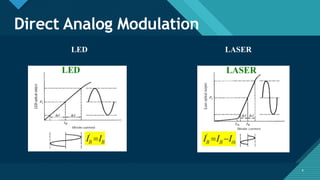
Direct Modulation
It is the easiest way to obtain modulation of intensity of a light beam, is
to modulate the current driving the light source, e.g. a laser diode. This
sort of modulation is called direct modulation.
The message signal (ac) is superimposed on the bias current (dc) which
modulates the laser.
Robust and simple, hence widely used.
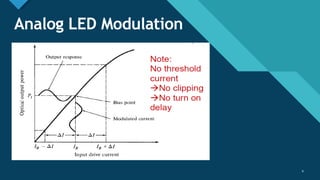
Issues: laser resonance frequency, chirp, turn on delay, clipping and laser
nonlinearity
7
Click to edit Master title style
8
Direct Analog Modulation
8
LED LASER
Click to edit Master title style
9
Analog LED Modulation
9
Click to edit Master title style
10
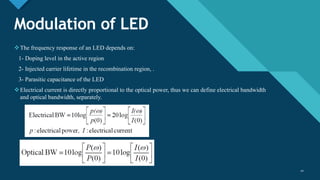
Modulation of LED
The frequency response of an LED depends on:
1- Doping level in the active region
2- Injected carrier lifetime in the recombination region, .
3- Parasitic capacitance of the LED
Electrical current is directly proportional to the optical power, thus we can define electrical bandwidth
and optical bandwidth, separately.
10
Click to edit Master title style
11
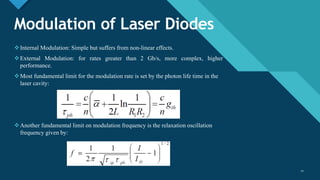
Modulation of Laser Diodes
Internal Modulation: Simple but suffers from non-linear effects.
External Modulation: for rates greater than 2 Gb/s, more complex, higher
performance.
Most fundamental limit for the modulation rate is set by the photon life time in the
laser cavity:
Another fundamental limit on modulation frequency is the relaxation oscillation
frequency given by:
11
Click to edit Master title style
12
Laser Noise
 Modal (speckle) Noise: Fluctuations in the distribution of energy among
various modes.
 Mode partition Noise: Intensity fluctuations in the longitudinal modes of a
laser diode, main source of noise in single mode fiber systems.
 Reflection Noise: Light output gets reflected back from the fiber into the laser,
couples with lasing modes, changing their phase, and generating noise peaks.
Isolators & index matching fluids can eliminate these reflections.
12
Click to edit Master title style
13
Limitations of Direct Modulation
Turn on delay and resonance frequency are the two major factors that
limit the speed of digital laser modulation.
Saturation and clipping introduces nonlinear distortion with analog
modulation (especially in multi carrier systems).
Nonlinear distortions introduce second and third order
intermodulation products.
Chirp: Laser output wavelength drifts with modulating current.
13
Click to edit Master title style
14
External Optical Modulation
Modulation and light generation are separated.
Offers much wider bandwidth up to 60 GHz.
More expensive and complex.
Used in high end systems.
14
Click to edit Master title style
15
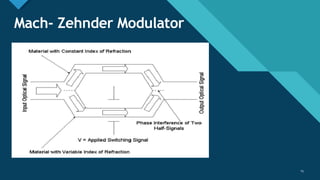
Mach- Zehnder Modulator
15
Click to edit Master title style
16
Parameters to characterize performance of
optical modulation
16
Modulation Depth
Bandwidth
Insertion Loss
Degree of Isolation
Power Handling
Induced Chirp
Click to edit Master title style
17
Mach- Zehnder Modulator
17
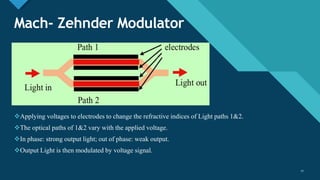
Applying voltages to electrodes to change the refractive indices of Light paths 1&2.
The optical paths of 1&2 vary with the applied voltage.
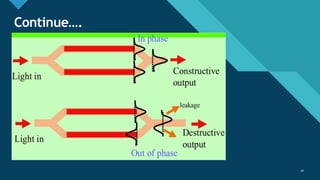
In phase: strong output light; out of phase: weak output.
Output Light is then modulated by voltage signal.
Click to edit Master title style
18
Continue….
18
Click to edit Master title style
19
Characteristics of Mach-Zehnder modulator
19
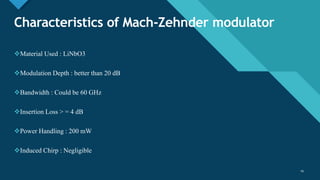
Material Used : LiNbO3
Modulation Depth : better than 20 dB
Bandwidth : Could be 60 GHz
Insertion Loss > = 4 dB
Power Handling : 200 mW
Induced Chirp : Negligible
Click to edit Master title style
20
Electro-absorption (EA) Modulator
20
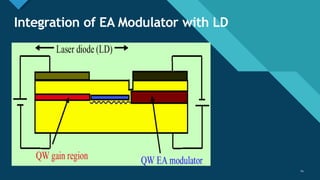
EA modulator is a semiconductor device with the same structure as the
laser diode.
In laser diodes, we inject large enough current to achieve stimulated
emission. While in EA modulator, we apply electric field (reverse bias) to
change the absorption spectrum. No carriers are injected into the active
region. However, carriers are generated due to absorption of light.
Click to edit Master title style
21
Continue….
21
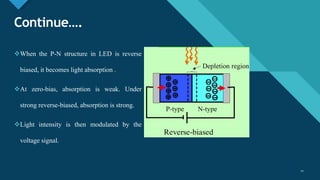
When the P-N structure in LED is reverse
biased, it becomes light absorption .
At zero-bias, absorption is weak. Under
strong reverse-biased, absorption is strong.
Light intensity is then modulated by the
voltage signal.
Click to edit Master title style
22
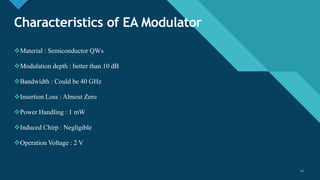
Characteristics of EA Modulator
22
Material : Semiconductor QWs
Modulation depth : better than 10 dB
Bandwidth : Could be 40 GHz
Insertion Loss : Almost Zero
Power Handling : 1 mW
Induced Chirp : Negligible
Operation Voltage : 2 V
Click to edit Master title style
23
Advantages of EA Modulators
23
Zero biasing voltage
Low driving voltage
Low/negative chirp
High bandwidth
Integrated with DFB
Click to edit Master title style
24
Integration of EA Modulator with LD
24
Click to edit Master title style
25
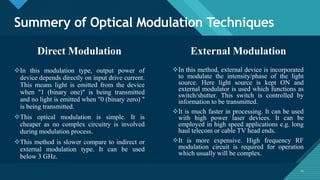
Summery of Optical Modulation Techniques
25
Direct Modulation External Modulation
In this modulation type, output power of
device depends directly on input drive current.
This means light is emitted from the device
when "1 (binary one)" is being transmitted
and no light is emitted when "0 (binary zero) "
is being transmitted.
This optical modulation is simple. It is
cheaper as no complex circuitry is involved
during modulation process.
This method is slower compare to indirect or
external modulation type. It can be used
below 3 GHz.
In this method, external device is incorporated
to modulate the intensity/phase of the light
source. Here light source is kept ON and
external modulator is used which functions as
switch/shutter. This switch is controlled by
information to be transmitted.
It is much faster in processing. It can be used
with high power laser devices. It can be
employed in high speed applications e.g. long
haul telecom or cable TV head ends.
It is more expensive. High frequency RF
modulation circuit is required for operation
which usually will be complex.
Click to edit Master title style
26
References
26
https://www.rfwireless-world.com/Terminology/Direct-modulation-vs-
External-modulation.html
http://www.ece.ucy.ac.cy/courses/ece645/docs/08_modulators_2015.pdf
https://iopscience.iop.org/article/10.1088/1742-6596/1038/1/012035/pdf
https://en.wikipedia.org/wiki/Optical_modulator
Click to edit Master title style
27
Thank You
Click to edit Master title style
28
Direct Modulation and External Modulation
28
Queries

Modulation formats : Direct and External Modulation

  • 1.
    Click to editMaster title style 1 Modulation Formats : Direct and External Modulation S u b m i t t e d B y : P r a j j w a l R o h e l a M . E ( E . C . E ) – R e g u l a r – 1 s t S e m e s t e r D a t e & Ti m e : 0 4 . 0 2 . 2 0 2 1 ( 11 . 3 0 A M - 1 . 0 0 P M )
  • 2.
    Click to editMaster title style 2 Table of Content:  I n t r o d u c t i o n t o M o d u l a t i o n  N e e d o f M o d u l a t i o n  Ty p e s o f O p t i c a l M o d u l a t i o n  M o d u l a t i o n Ty p e s  I m p o r t a n t p a r a m e t e r s u s e d t o c h a r a c t e r i z e a n d c o m p a r e d i f f e r e n t m o d u l a t o r s  D i r e c t M o d u l a t i o n  D i r e c t A n a l o g M o d u l a t i o n  L E D A n a l o g M o d u l a t i o n  M o d u l a t i o n o f L E D  M o d u l a t i o n o f L A S E R D i o d e  L A S E R N o i s e  L i m i t a t i o n s o f D i r e c t M o d u l a t i o n  E x t e r n a l O p t i c a l M o d u l a t i o n  M a c h - Z e h n d e r m o d u l a t o r  P a r a m e t e r s t o c h a r a c t e r i z e p e r f o r m a n c e o f o p t i c a l m o d u l a t i o n  C h a r a c t e r i s t i c s o f M a c h – Z e h n d e r M o d u l a t o r  E l e c t r o - A b s o r p t i o n ( E A ) M o d u l a t o r  C h a r a c t e r i s t i c s o f E A M o d u l a t o r  A d v a n t a g e s o f E A M o d u l a t o r  I n t e g r a t i o n o f E A M o d u l a t o r w i t h L D  S u m m e r y o f O p t i c a l M o d u l a t i o n Te c h n i q u e s  R e f e r e n c e s 2
  • 3.
    Click to editMaster title style 3 Introduction to Modulation  Mo du lation is th e pro cess o f en cod ing inf or mation fr o m a messag e so u r ce in a w ay th at is su itab le f o r tr an smissio n .  I n th e mo du lation p rocess, a p arameter of th e carr ier w ave ( su ch as amp litu d e, fr eq u en cy o r p h ase) is v ar ied in acco r d an ce w ith th e mo d u latin g sig n al . 3
  • 4.
    Click to editMaster title style 4 Needs of Modulation A communication link is established by transmission of information reliably. Optical modulation is embedding the information on the optical carrier for this purpose. The information can be digital (1,0) or analog (a continuous waveform). The bit error rate (BER) is the performance measure in digital systems. The signal to noise ratio (SNR) is the performance measure in analog systems. 4
  • 5.
    Click to editMaster title style 5 Types of Optical Modulation 5 Direct Modulation and External Modulation Direct modulation is done by superimposing the modulating (message) signal on the driving current. External modulation is done after the light is generated; the laser is driven by a dc current and the modulation is done after that separately. Both these schemes can be done with either digital or analog modulating signals. In external modulation, the laser emits continuous wave (CW) light and the modulation is done in the fiber.
  • 6.
    Click to editMaster title style 6 Important parameters used to characterize and compare different modulators Modulation efficiency: Defined differently depending on whether we modulate intensity, phase or frequency. For intensity it is defined as (Imax – Imin)/Imax. Modulation depth: For intensity modulation it is defined in decibel by 10 log (Imax/Imin). Modulation bandwidth: Defined as the high frequency at which the efficiency has fallen by 3dB. Power consumption: Simply the power consumption per unit bandwidth needed for (intensity) modulation. 6
  • 7.
    Click to editMaster title style 7 Direct Modulation It is the easiest way to obtain modulation of intensity of a light beam, is to modulate the current driving the light source, e.g. a laser diode. This sort of modulation is called direct modulation. The message signal (ac) is superimposed on the bias current (dc) which modulates the laser. Robust and simple, hence widely used. Issues: laser resonance frequency, chirp, turn on delay, clipping and laser nonlinearity 7
  • 8.
    Click to editMaster title style 8 Direct Analog Modulation 8 LED LASER
  • 9.
    Click to editMaster title style 9 Analog LED Modulation 9
  • 10.
    Click to editMaster title style 10 Modulation of LED The frequency response of an LED depends on: 1- Doping level in the active region 2- Injected carrier lifetime in the recombination region, . 3- Parasitic capacitance of the LED Electrical current is directly proportional to the optical power, thus we can define electrical bandwidth and optical bandwidth, separately. 10
  • 11.
    Click to editMaster title style 11 Modulation of Laser Diodes Internal Modulation: Simple but suffers from non-linear effects. External Modulation: for rates greater than 2 Gb/s, more complex, higher performance. Most fundamental limit for the modulation rate is set by the photon life time in the laser cavity: Another fundamental limit on modulation frequency is the relaxation oscillation frequency given by: 11
  • 12.
    Click to editMaster title style 12 Laser Noise  Modal (speckle) Noise: Fluctuations in the distribution of energy among various modes.  Mode partition Noise: Intensity fluctuations in the longitudinal modes of a laser diode, main source of noise in single mode fiber systems.  Reflection Noise: Light output gets reflected back from the fiber into the laser, couples with lasing modes, changing their phase, and generating noise peaks. Isolators & index matching fluids can eliminate these reflections. 12
  • 13.
    Click to editMaster title style 13 Limitations of Direct Modulation Turn on delay and resonance frequency are the two major factors that limit the speed of digital laser modulation. Saturation and clipping introduces nonlinear distortion with analog modulation (especially in multi carrier systems). Nonlinear distortions introduce second and third order intermodulation products. Chirp: Laser output wavelength drifts with modulating current. 13
  • 14.
    Click to editMaster title style 14 External Optical Modulation Modulation and light generation are separated. Offers much wider bandwidth up to 60 GHz. More expensive and complex. Used in high end systems. 14
  • 15.
    Click to editMaster title style 15 Mach- Zehnder Modulator 15
  • 16.
    Click to editMaster title style 16 Parameters to characterize performance of optical modulation 16 Modulation Depth Bandwidth Insertion Loss Degree of Isolation Power Handling Induced Chirp
  • 17.
    Click to editMaster title style 17 Mach- Zehnder Modulator 17 Applying voltages to electrodes to change the refractive indices of Light paths 1&2. The optical paths of 1&2 vary with the applied voltage. In phase: strong output light; out of phase: weak output. Output Light is then modulated by voltage signal.
  • 18.
    Click to editMaster title style 18 Continue…. 18
  • 19.
    Click to editMaster title style 19 Characteristics of Mach-Zehnder modulator 19 Material Used : LiNbO3 Modulation Depth : better than 20 dB Bandwidth : Could be 60 GHz Insertion Loss > = 4 dB Power Handling : 200 mW Induced Chirp : Negligible
  • 20.
    Click to editMaster title style 20 Electro-absorption (EA) Modulator 20 EA modulator is a semiconductor device with the same structure as the laser diode. In laser diodes, we inject large enough current to achieve stimulated emission. While in EA modulator, we apply electric field (reverse bias) to change the absorption spectrum. No carriers are injected into the active region. However, carriers are generated due to absorption of light.
  • 21.
    Click to editMaster title style 21 Continue…. 21 When the P-N structure in LED is reverse biased, it becomes light absorption . At zero-bias, absorption is weak. Under strong reverse-biased, absorption is strong. Light intensity is then modulated by the voltage signal.
  • 22.
    Click to editMaster title style 22 Characteristics of EA Modulator 22 Material : Semiconductor QWs Modulation depth : better than 10 dB Bandwidth : Could be 40 GHz Insertion Loss : Almost Zero Power Handling : 1 mW Induced Chirp : Negligible Operation Voltage : 2 V
  • 23.
    Click to editMaster title style 23 Advantages of EA Modulators 23 Zero biasing voltage Low driving voltage Low/negative chirp High bandwidth Integrated with DFB
  • 24.
    Click to editMaster title style 24 Integration of EA Modulator with LD 24
  • 25.
    Click to editMaster title style 25 Summery of Optical Modulation Techniques 25 Direct Modulation External Modulation In this modulation type, output power of device depends directly on input drive current. This means light is emitted from the device when "1 (binary one)" is being transmitted and no light is emitted when "0 (binary zero) " is being transmitted. This optical modulation is simple. It is cheaper as no complex circuitry is involved during modulation process. This method is slower compare to indirect or external modulation type. It can be used below 3 GHz. In this method, external device is incorporated to modulate the intensity/phase of the light source. Here light source is kept ON and external modulator is used which functions as switch/shutter. This switch is controlled by information to be transmitted. It is much faster in processing. It can be used with high power laser devices. It can be employed in high speed applications e.g. long haul telecom or cable TV head ends. It is more expensive. High frequency RF modulation circuit is required for operation which usually will be complex.
  • 26.
    Click to editMaster title style 26 References 26 https://www.rfwireless-world.com/Terminology/Direct-modulation-vs- External-modulation.html http://www.ece.ucy.ac.cy/courses/ece645/docs/08_modulators_2015.pdf https://iopscience.iop.org/article/10.1088/1742-6596/1038/1/012035/pdf https://en.wikipedia.org/wiki/Optical_modulator
  • 27.
    Click to editMaster title style 27 Thank You
  • 28.
    Click to editMaster title style 28 Direct Modulation and External Modulation 28 Queries