Download as PDF, PPTX


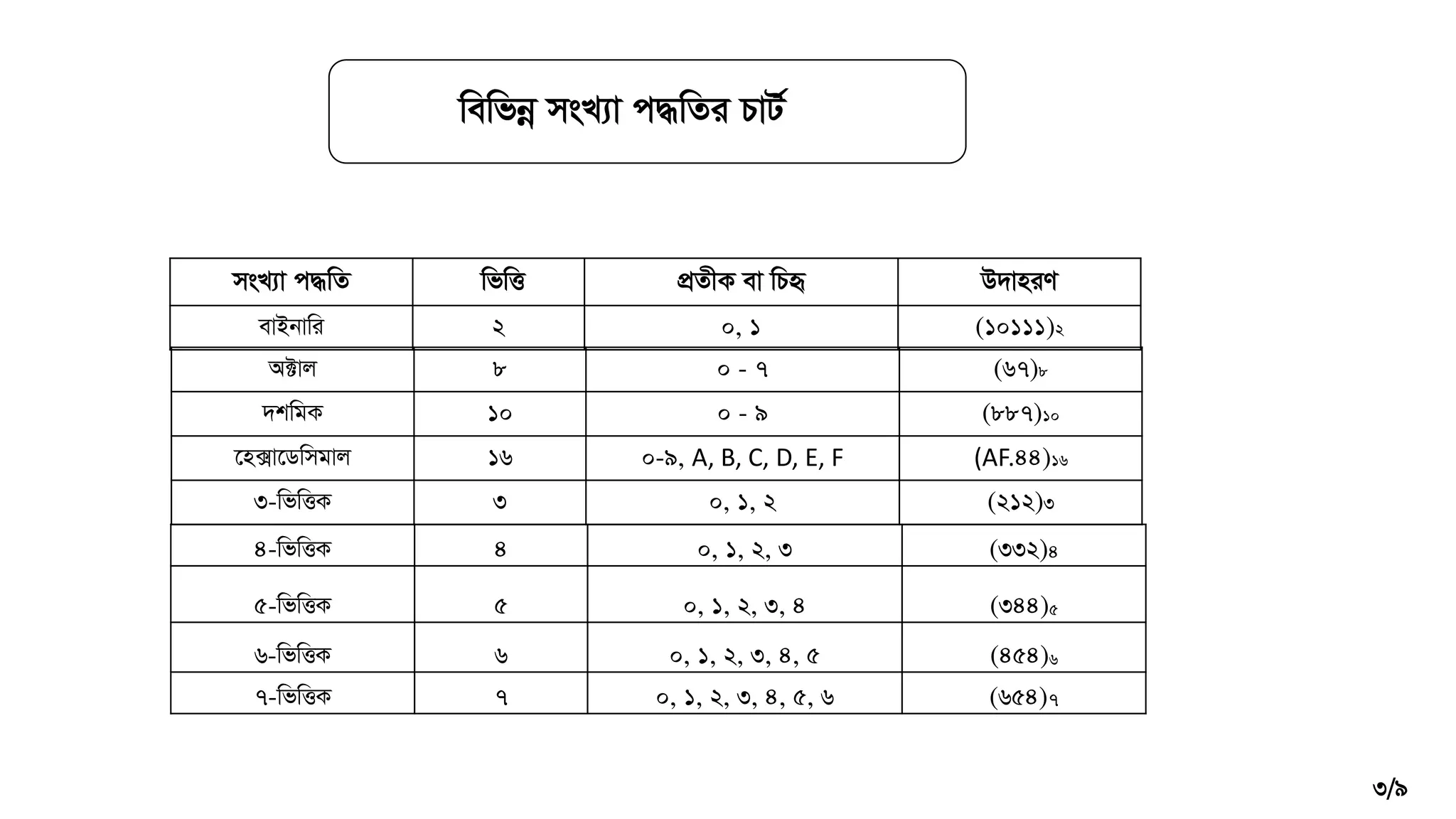


1. There are different number systems for representing numbers using sets of symbols. The common number systems include binary, octal, decimal, and hexadecimal. 2. Each number system has a base or radix and uses a defined set of digits. For example, binary uses 0 and 1, octal uses 0-7, decimal uses 0-9, and hexadecimal uses 0-9 and A-F. 3. Conversions can be done between any two number systems, such as decimal to binary, binary to decimal, or between any two systems like converting a decimal number to its equivalent octal number.
Introduction to number systems: binary, octal, decimal, and hexadecimal. Conversion examples from one base to another.
Detailed examples of converting numbers from one base to another, specifically involving decimal, octal, and binary.
Discussion on various coding systems like Binary Coded Decimal (BCD), ASCII, and Unicode, and their applications.
Final slide likely serves as a completion note or cue to conclude the presentation.


![Patigonit (inception plus) [www.chakritips.com]](https://cdn.slidesharecdn.com/ss_thumbnails/patigonitinceptionpluswww-201213080556-thumbnail.jpg?width=640&height=640&fit=bounds)


![05 average (math tutor by kabial noor) [www.itmona.com]](https://cdn.slidesharecdn.com/ss_thumbnails/05averagemathtutorbykabialnoorwww-201001090136-thumbnail.jpg?width=640&height=640&fit=bounds)
![03. root & square (math tutor by kabial noor) [www.itmona.com]](https://cdn.slidesharecdn.com/ss_thumbnails/03-201001090121-thumbnail.jpg?width=640&height=640&fit=bounds)
![Sucok o logaridom [www.onlinebcs.com]](https://cdn.slidesharecdn.com/ss_thumbnails/sucokologaridomwww-201019031724-thumbnail.jpg?width=640&height=640&fit=bounds)
![Bcs primary math suggetion[www.onlinebcs.com]](https://cdn.slidesharecdn.com/ss_thumbnails/bcsprimarymathsuggetionwww-201008034526-thumbnail.jpg?width=640&height=640&fit=bounds)
![02. number (math tutor by kabial noor) [www.itmona.com]](https://cdn.slidesharecdn.com/ss_thumbnails/02-201001090129-thumbnail.jpg?width=640&height=640&fit=bounds)


![05. average full chapter (math tutor by kabial noor [www.itmona.com]](https://cdn.slidesharecdn.com/ss_thumbnails/05-201001090114-thumbnail.jpg?width=640&height=640&fit=bounds)

![Math2 [www.onlinebcs.com]](https://cdn.slidesharecdn.com/ss_thumbnails/math2www-201215040724-thumbnail.jpg?width=640&height=640&fit=bounds)


