Module
4
Switched Communication
Networks
Version 2 CSE IIT, Kharagpur
Lesson
3
Synchronous Optical
Network (SONET)
Version 2 CSE IIT, Kharagpur
Specific Instructional Objectives
At the end of this lesson the student will be able to:
• Explain the operation of a SONET network
• Explain the function of different SONET layers
• Specify SONET frame format
4.3.1 Introduction
To satisfy the requirements of ever increasing data rate for diverse applications, ANSI
developed a standard known as Synchronous Optical Network (SONET) by utilizing the
enormous bandwidth of optical fiber. Another very similar standard developed by ITU-T
is known as Synchronous Digital Hierarchy (SDH). It is a synchronous TDM system
controlled by a master clock, which adds predictability. The comprehensive
SONET/synchronous digital hierarchy (SDH) standard is expected to provide the
transport infrastructure for worldwide telecommunications for at least the next two or
three decades.
The increased configuration flexibility and bandwidth availability of SONET
provides significant advantages over the older telecommunications system. These
advantages include the following:
• Reduction in equipment requirements and an increase in network reliability.
• Provision of overhead and payload bytes - the overhead bytes permit management of
the payload bytes on an individual basis and facilitate centralized fault
sectionalization
• Definition of a synchronous multiplexing format for carrying lower level digital
signals (such as DS–1, DS–3) and a synchronous structure that greatly simplifies the
interface to digital switches, digital cross-connect switches, and add-drop
multiplexers
• Availability of a set of generic standards that enable products from different vendors
to be connected
• Definition of a flexible architecture capable of accommodating future applications,
with a variety of transmission rates
In brief, SONET defines optical carrier (OC) levels and electrically equivalent
synchronous transport signals (STSs) for the fiber-optic–based transmission hierarchy.
4.3.2 Synchronization of Digital Signals
To understand the concepts and details of SONET correctly, it is important to follow the
meaning of synchronous, asynchronous, and plesiochronous. In a set of synchronous
signals, the digital transitions in the signals occur at exactly the same rate. There may,
however, be a phase difference between the transitions of the two signals, and this would
lie within specified limits. These phase differences may be due to propagation delays or
Version 2 CSE IIT, Kharagpur
jitter introduced into the transmission network. In a synchronous network, all the clocks
are traceable to one primary reference clock (PRC).
If two digital signals are plesiochronous, their transitions occur at almost the same
rate, with any variation being constrained within tight limits. For example, if two
networks must interwork, their clocks may be derived from two different primary
reference clocks (PRCs). Although these clocks are extremely accurate, there is a
difference between one clock and the other. This is known as a plesiochronous
difference.
In the case of asynchronous signals, the transitions of the signals do not
necessarily occur at the same nominal rate. Asynchronous, in this case, means that the
difference between two clocks is much greater than a plesiochronous difference. For
example, if two clocks are derived from free-running quartz oscillators, they could be
described as asynchronous.
4.3.2.1 Basic SONET Signal
SONET defines a technology for carrying many signals of different capacities through a
synchronous, flexible, optical hierarchy. This is accomplished by means of a byte-
interleaved multiplexing scheme. Byte interleaving simplifies multiplexing and offers
end-to-end network management.
The first step in the SONET multiplexing process involves the generation of the
lowest level or base signal. In SONET, this base signal is referred to as synchronous
transport signal–level 1, or simply STS–1, which operates at 51.84 Mbps. Higher-level
signals are integer multiples of STS–1, creating the family of STS–N signals in Table 1.
An STS–N signal is composed of N byte-interleaved STS–1 signals. This table also
includes the optical counterpart for each STS–N signal, designated optical carrier level N
(OC–N).
Version 2 CSE IIT, Kharagpur
Table 4.3.1 Synchronous transport signals and optical carriers
4.3.2 Why Synchronize?
In a synchronous system such as SONET, the average frequency of all clocks in the
system will be the same (synchronous) or nearly the same (plesiochronous). Every clock
can be traced back to a highly stable reference supply. Thus, the STS–1 rate remains at a
nominal 51.84 Mbps, allowing many synchronous STS–1 signals to be stacked together
when multiplexed without any bit-stuffing. Thus, the STS–1s are easily accessed at a
higher STS–N rate.
Low-speed synchronous virtual tributary (VT) signals are also simple to
interleave and transport at higher rates. At low speeds, DS–1s are transported by
synchronous VT–1.5 signals at a constant rate of 1.728 Mbps. Single-step multiplexing
up to STS–1 requires no bit stuffing, and VTs are easily accessed.
Pointers accommodate differences in the reference source frequencies and phase
wander and prevent frequency differences during synchronization failures.
4.3.2.1 Synchronization Hierarchy
Digital switches and digital cross-connect systems are commonly employed in the digital
network synchronization hierarchy. The network is organized with a master-slave
relationship with clocks of the higher-level nodes feeding timing signals to clocks of the
lower-level nodes. All nodes can be traced up to a primary reference source, a Stratum 1
Version 2 CSE IIT, Kharagpur
atomic clock with extremely high stability and accuracy. Less stable clocks are adequate
to support the lower nodes.
4.3.2.2 Synchronizing SONET
The internal clock of a SONET terminal may derive its timing signal from a building
integrated timing supply (BITS) used by switching systems and other equipment. Thus,
this terminal will serve as a master for other SONET nodes, providing timing on its
outgoing OC–N signal. Other SONET nodes will operate in a slave mode called loop
timing with their internal clocks timed by the incoming OC–N signal. Current standards
specify that a SONET network must be able to derive its timing from a Stratum 3 or
higher clock.
4.3.3 Physical Configuration and Network Elements
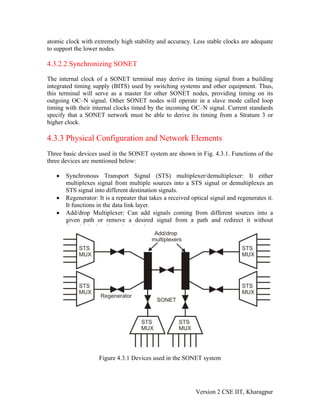
Three basic devices used in the SONET system are shown in Fig. 4.3.1. Functions of the
three devices are mentioned below:
• Synchronous Transport Signal (STS) multiplexer/demultiplexer: It either
multiplexes signal from multiple sources into a STS signal or demultiplexes an
STS signal into different destination signals.
• Regenerator: It is a repeater that takes a received optical signal and regenerates it.
It functions in the data link layer.
• Add/drop Multiplexer: Can add signals coming from different sources into a
given path or remove a desired signal from a path and redirect it without
demultiplexing the entire signal.
Figure 4.3.1 Devices used in the SONET system
Version 2 CSE IIT, Kharagpur
4.2.3.1 Section, Line and paths
A number of electrical signals are fed into an STS multiplexer, where they are combined
into a single optical signal. Regenerator recreates the optical signal without noise it has
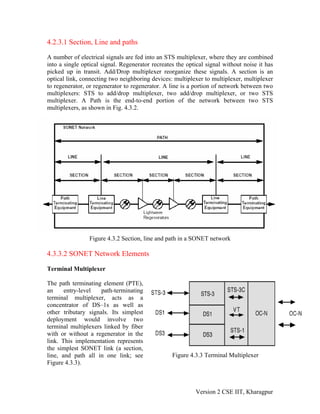
picked up in transit. Add/Drop multiplexer reorganize these signals. A section is an
optical link, connecting two neighboring devices: multiplexer to multiplexer, multiplexer
to regenerator, or regenerator to regenerator. A line is a portion of network between two
multiplexers: STS to add/drop multiplexer, two add/drop multiplexer, or two STS
multiplexer. A Path is the end-to-end portion of the network between two STS
multiplexers, as shown in Fig. 4.3.2.
Figure 4.3.2 Section, line and path in a SONET network
4.3.3.2 SONET Network Elements
Terminal Multiplexer
The path terminating element (PTE),
an entry-level path-terminating
terminal multiplexer, acts as a
concentrator of DS–1s as well as
other tributary signals. Its simplest
deployment would involve two
terminal multiplexers linked by fiber
with or without a regenerator in the
link. This implementation represents
the simplest SONET link (a section,
line, and path all in one link; see
Figure 4.3.3).
Figure 4.3.3 Terminal Multiplexer
Version 2 CSE IIT, Kharagpur
Regenerator
A regenerator is needed when, due to the
long distance between multiplexers, the
signal level in the fiber becomes too low.
The regenerator clocks itself off of the
received signal and replaces the section
overhead bytes before retransmitting the
signal. The line overhead, payload, and
POH are not altered (see Figure 4.3.4).
Add/Drop Multiplexer (ADM)
A single-stage multiplexer/demultiplexer
can multiplex various inputs into an OC–
ployed at a terminal site or any intermediate location for
N signal. It can add signals coming from
different sources into a given path or
remove a desired signal from a path and
redirect it without demultiplexing the
entire signal, as shown in Fig. 4.3.5.
Instead of relying on timing and bit
positions, add/drop multiplexer uses
header information such as addresses and
pointers to identify individual streams.
In rural applications, an ADM can be de
consolidating traffic from widely separated locations. Several ADMs can also be configured as a
survivable ring. SONET enables drop and repeat (also known as drop and continue)—a key capability
in both telephony and cable TV applications. With drop and repeat, a signal terminates at one node, is
duplicated (repeated), and is then sent to the next and subsequent nodes.
The add/drop multiplexer provides interfaces between the different network signals and SONET
signals. Single-stage multiplexing can multiplex/demultiplex one or more tributary (DS–1) signals
into/from an STS–N signal. It can be used in terminal sites, intermediate (add/drop) sites, or hub
configurations. At an add/drop site, it can drop lower-rate signals to be transported on different
facilities, or it can add lower-rate signals into the higher-rate STS–N signal. The rest of the traffic
simply continues straight through.
Figure 4.3.4 Regenerator
Figure 4.3.5 Add/drop Multiplexer
Version 2 CSE IIT, Kharagpur
Wideband Digital Cross-Connects
A SONET cross-connect accepts various
optical carrier rates, accesses the STS–1
signals, and switches at this level. It is
ideally used at a SONET hub as shown in
Fig. 4.3.6. One major difference between a
cross-connect and an add/drop multiplexer
is that a cross-connect may be used to
interconnect a much larger number of STS–
1s. The broadband cross-connect can be
used for grooming (consolidating or
segregating) of STS–1s or for broadband
traffic management. For example, it may be
used to segregate high-bandwidth from low-
bandwidth traffic and send it separately to
the high-bandwidth (e.g., video) switch and
a low-bandwidth (voice) switch. It is the
synchronous equivalent of a DS–3 digital
cross-connect and supports hubbed network.
architecture
Figure 4.3.6 Wideband digital cross-connect
4.3.4 Frame Format Structure
SONET uses a basic transmission rate of STS–1 that is equivalent to 51.84 Mbps.
Higher-level signals are integer multiples of the base rate. For example, STS–3 is three
times the rate of STS–1 (3 x 51.84 = 155.52 Mbps). An STS–12 rate would be 12 x 51.84
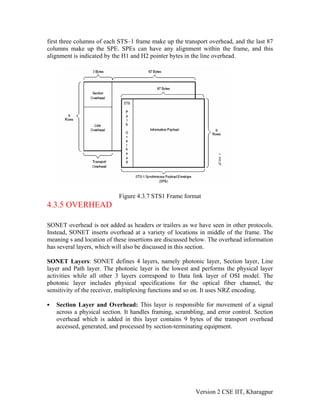
= 622.08 Mbps. SONET is based on the STS-1 frame. STS-1 Frame Format is shown in
Fig. 4.3.7.
• STS-1 consists of 810 octets
o 9 rows of 90 octets
o 27 overhead octets formed from the first 3 octets of each row
ƒ 9 used for section overhead
ƒ 18 used for line overhead
o 87x9 = 783 octets of payload
ƒ one column of the payload is path overhead - positioned by a
pointer in the line overhead
o Transmitted top to bottom, row by row from left to right
• STS-1 frame transmitted every 125 us: thus a transmission rate of 51.84 Mbps.
The synchronous payload envelope can also be divided into two parts: the STS path
overhead (POH) and the payload. Transport overhead is composed of section overhead
and line overhead. The STS–1 POH is part of the synchronous payload envelope. The
Version 2 CSE IIT, Kharagpur
first three columns of each STS–1 frame make up the transport overhead, and the last 87
columns make up the SPE. SPEs can have any alignment within the frame, and this
alignment is indicated by the H1 and H2 pointer bytes in the line overhead.
Figure 4.3.7 STS1 Frame format
4.3.5 OVERHEAD
SONET overhead is not added as headers or trailers as we have seen in other protocols.
Instead, SONET inserts overhead at a variety of locations in middle of the frame. The
meaning s and location of these insertions are discussed below. The overhead information
has several layers, which will also be discussed in this section.
SONET Layers: SONET defines 4 layers, namely photonic layer, Section layer, Line
layer and Path layer. The photonic layer is the lowest and performs the physical layer
activities while all other 3 layers correspond to Data link layer of OSI model. The
photonic layer includes physical specifications for the optical fiber channel, the
sensitivity of the receiver, multiplexing functions and so on. It uses NRZ encoding.
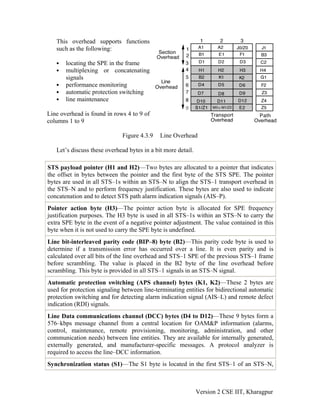
• Section Layer and Overhead: This layer is responsible for movement of a signal
across a physical section. It handles framing, scrambling, and error control. Section
overhead which is added in this layer contains 9 bytes of the transport overhead
accessed, generated, and processed by section-terminating equipment.
Version 2 CSE IIT, Kharagpur
This overhead supports functions
such as the following:
• performance monitoring (STS–
N signal)
• local orderwire
• data communication channels
to carry information for
OAM&P
• framing
Figure 4.3.8 Section Overhead
Let’s discuss these overhead bytes in a bit more detail.
Framing bytes (A1, A2)—These two bytes indicate the beginning of an STS–1 frame.
These are used for framing and synchronization. These Bytes are also called as Alignment
Bytes
Section trace (J0)/section growth (Z0)—This is also known as Identification Byte. It
carries a unique identifier for STS1 frame. This byte is necessary when multiple STS1
frames are multiplied to create higher rate STS. Information in this byte allows the various
signals to de-multiplex easily.
Parity byte (B1) —This is a for bit-interleaved parity (even parity), BIP used to check for
transmission errors over a regenerator section. Its value is calculated over all bits of the
previous STS–N frame after scrambling then placed in the B1 byte of STS–1 before
scrambling. Therefore, this byte is defined only for STS–1 number 1 of an STS–N signal
Orderwire byte (E1)—This byte is allocated to be used as a local orderwire channel for
voice communication between regenerators, hubs, and remote terminal locations.
User channel byte (F1)—This byte is set aside for the users' purposes. It terminates at all
section-terminating equipment within a line. It can be read and written to at each section-
terminating equipment in that line.
Data communications channel (DCC) bytes or Management byte (D1, D2, D3)—
Together, these 3 bytes form a 192–kbps message channel providing a message-based
channel for OAM&P between pieces of section-terminating equipment. The channel is
used from a central location for alarms, control, monitoring, administration, and other
communication needs. It is available for internally generated, externally generated, or
manufacturer-specific messages.
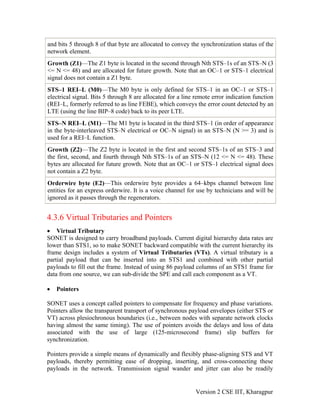
• Line Layer and Overhead: This layer is responsible for the movement of a signal
across a physical line. STS multiplexer and add/drop multiplexers provide line layer
functions. Line overhead contains 18 bytes of overhead accessed, generated, and
processed by line-terminating equipment.
Version 2 CSE IIT, Kharagpur
This overhead supports functions
such as the following:
• locating the SPE in the frame
• multiplexing or concatenating
signals
• performance monitoring
• automatic protection switching
• line maintenance
Line overhead is found in rows 4 to 9 of
columns 1 to 9
Figure 4.3.9 Line Overhead
Let’s discuss these overhead bytes in a bit more detail.
STS payload pointer (H1 and H2)—Two bytes are allocated to a pointer that indicates
the offset in bytes between the pointer and the first byte of the STS SPE. The pointer
bytes are used in all STS–1s within an STS–N to align the STS–1 transport overhead in
the STS–N and to perform frequency justification. These bytes are also used to indicate
concatenation and to detect STS path alarm indication signals (AIS–P).
Pointer action byte (H3)—The pointer action byte is allocated for SPE frequency
justification purposes. The H3 byte is used in all STS–1s within an STS–N to carry the
extra SPE byte in the event of a negative pointer adjustment. The value contained in this
byte when it is not used to carry the SPE byte is undefined.
Line bit-interleaved parity code (BIP–8) byte (B2)—This parity code byte is used to
determine if a transmission error has occurred over a line. It is even parity and is
calculated over all bits of the line overhead and STS–1 SPE of the previous STS–1 frame
before scrambling. The value is placed in the B2 byte of the line overhead before
scrambling. This byte is provided in all STS–1 signals in an STS–N signal.
Automatic protection switching (APS channel) bytes (K1, K2)—These 2 bytes are
used for protection signaling between line-terminating entities for bidirectional automatic
protection switching and for detecting alarm indication signal (AIS–L) and remote defect
indication (RDI) signals.
Line Data communications channel (DCC) bytes (D4 to D12)—These 9 bytes form a
576–kbps message channel from a central location for OAM&P information (alarms,
control, maintenance, remote provisioning, monitoring, administration, and other
communication needs) between line entities. They are available for internally generated,
externally generated, and manufacturer-specific messages. A protocol analyzer is
required to access the line–DCC information.
Synchronization status (S1)—The S1 byte is located in the first STS–1 of an STS–N,
Version 2 CSE IIT, Kharagpur
and bits 5 through 8 of that byte are allocated to convey the synchronization status of the
network element.
Growth (Z1)—The Z1 byte is located in the second through Nth STS–1s of an STS–N (3
<= N <= 48) and are allocated for future growth. Note that an OC–1 or STS–1 electrical
signal does not contain a Z1 byte.
STS–1 REI–L (M0)—The M0 byte is only defined for STS–1 in an OC–1 or STS–1
electrical signal. Bits 5 through 8 are allocated for a line remote error indication function
(REI–L, formerly referred to as line FEBE), which conveys the error count detected by an
LTE (using the line BIP–8 code) back to its peer LTE.
STS–N REI–L (M1)—The M1 byte is located in the third STS–1 (in order of appearance
in the byte-interleaved STS–N electrical or OC–N signal) in an STS–N (N >= 3) and is
used for a REI–L function.
Growth (Z2)—The Z2 byte is located in the first and second STS–1s of an STS–3 and
the first, second, and fourth through Nth STS–1s of an STS–N (12 <= N <= 48). These
bytes are allocated for future growth. Note that an OC–1 or STS–1 electrical signal does
not contain a Z2 byte.
Orderwire byte (E2)—This orderwire byte provides a 64–kbps channel between line
entities for an express orderwire. It is a voice channel for use by technicians and will be
ignored as it passes through the regenerators.
4.3.6 Virtual Tributaries and Pointers
• Virtual Tributary
SONET is designed to carry broadband payloads. Current digital hierarchy data rates are
lower than STS1, so to make SONET backward compatible with the current hierarchy its
frame design includes a system of Virtual Tributaries (VTs). A virtual tributary is a
partial payload that can be inserted into an STS1 and combined with other partial
payloads to fill out the frame. Instead of using 86 payload columns of an STS1 frame for
data from one source, we can sub-divide the SPE and call each component as a VT.
• Pointers
SONET uses a concept called pointers to compensate for frequency and phase variations.
Pointers allow the transparent transport of synchronous payload envelopes (either STS or
VT) across plesiochronous boundaries (i.e., between nodes with separate network clocks
having almost the same timing). The use of pointers avoids the delays and loss of data
associated with the use of large (125-microsecond frame) slip buffers for
synchronization.
Pointers provide a simple means of dynamically and flexibly phase-aligning STS and VT
payloads, thereby permitting ease of dropping, inserting, and cross-connecting these
payloads in the network. Transmission signal wander and jitter can also be readily
Version 2 CSE IIT, Kharagpur
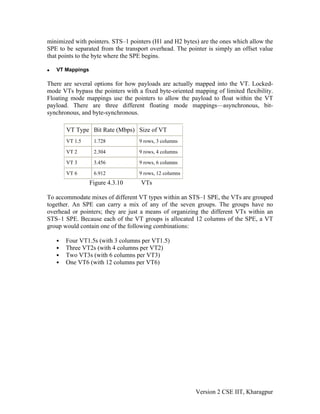
minimized with pointers. STS–1 pointers (H1 and H2 bytes) are the ones which allow the
SPE to be separated from the transport overhead. The pointer is simply an offset value
that points to the byte where the SPE begins.
• VT Mappings
There are several options for how payloads are actually mapped into the VT. Locked-
mode VTs bypass the pointers with a fixed byte-oriented mapping of limited flexibility.
Floating mode mappings use the pointers to allow the payload to float within the VT
payload. There are three different floating mode mappings—asynchronous, bit-
synchronous, and byte-synchronous.
VT Type Bit Rate (Mbps) Size of VT
VT 1.5 1.728 9 rows, 3 columns
VT 2 2.304 9 rows, 4 columns
VT 3 3.456 9 rows, 6 columns
VT 6 6.912 9 rows, 12 columns
Figure 4.3.10 VTs
To accommodate mixes of different VT types within an STS–1 SPE, the VTs are grouped
together. An SPE can carry a mix of any of the seven groups. The groups have no
overhead or pointers; they are just a means of organizing the different VTs within an
STS–1 SPE. Because each of the VT groups is allocated 12 columns of the SPE, a VT
group would contain one of the following combinations:
• Four VT1.5s (with 3 columns per VT1.5)
• Three VT2s (with 4 columns per VT2)
• Two VT3s (with 6 columns per VT3)
• One VT6 (with 12 columns per VT6)
Version 2 CSE IIT, Kharagpur
Fill in the blanks:
1. SONET is the abbreviation of __________________ network.
2. Synchronous optical network (SONET) is a standard for
______________________ transport.
3. SONET defines _______________ levels and electrically equivalent
_______________ signals for the fiber-optic–based transmission hierarchy.
4. In a SONET system, _________ removes noise from a signal and can also add or
remove headers.
5. In a SONET system, _________ remove signal from path.
6. The optical link between any two devices is called ___________.
7. The optical link between a STS multiplexer and a regenerator is called
___________.
8. The optical link between regenerator and add/drop multiplexer is called
___________.
9. SONET defines 4 layers, namely ______________ layer, ______________ layer,
__________ layer and __________ layer.
10. SONET’s __________ layer transfer data from its optical source to its optical
destination.
11. ________ Layer in SONET corresponds to data link layer of OSI.
12. STS multiplexer operates in _____________ layers.
13. In an STS1 Frame first three columns contains _____________.
14. Parity byte exists for an STS-1 frame’s __________.
15. _________ overhead contains pointers to the payload.
16. STS-1 can accommodated maximum of __________VT1.5s.
Short Answer Questions
1. Give the SONET hierarchy.
Ans:
Signal Bit Rate (Mbps) Capacity
STS1, OC1 51.840 28 DS1 or 1 DS3
STS3, OC3 155.520 84 DS1 or 3 DS3
STS12, OC12 622.080 336 DS1 or 12 DS3
STS48, OC48 2,488.320 1,344 DS1 or 48 DS3
STS192, OC192 9,953.280 5,376 DS1 or 192 DS3
Note: STS = synchronous transport signal; OC = optical carrier
Signal Bit Rate (Mbps) Channels
Table 1. SONET Hierarchy
Version 2 CSE IIT, Kharagpur
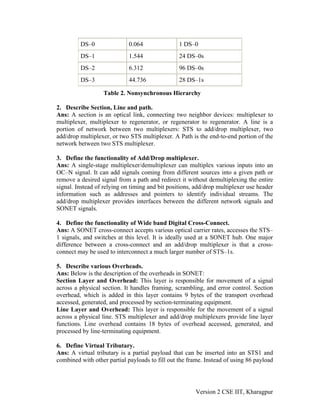
DS–0 0.064 1 DS–0
DS–1 1.544 24 DS–0s
DS–2 6.312 96 DS–0s
DS–3 44.736 28 DS–1s
Table 2. Nonsynchronous Hierarchy
2. Describe Section, Line and path.
Ans: A section is an optical link, connecting two neighbor devices: multiplexer to
multiplexer, multiplexer to regenerator, or regenerator to regenerator. A line is a
portion of network between two multiplexers: STS to add/drop multiplexer, two
add/drop multiplexer, or two STS multiplexer. A Path is the end-to-end portion of the
network between two STS multiplexer.
3. Define the functionality of Add/Drop multiplexer.
Ans: A single-stage multiplexer/demultiplexer can multiplex various inputs into an
OC–N signal. It can add signals coming from different sources into a given path or
remove a desired signal from a path and redirect it without demultiplexing the entire
signal. Instead of relying on timing and bit positions, add/drop multiplexer use header
information such as addresses and pointers to identify individual streams. The
add/drop multiplexer provides interfaces between the different network signals and
SONET signals.
4. Define the functionality of Wide band Digital Cross-Connect.
Ans: A SONET cross-connect accepts various optical carrier rates, accesses the STS–
1 signals, and switches at this level. It is ideally used at a SONET hub. One major
difference between a cross-connect and an add/drop multiplexer is that a cross-
connect may be used to interconnect a much larger number of STS–1s.
5. Describe various Overheads.
Ans: Below is the description of the overheads in SONET:
Section Layer and Overhead: This layer is responsible for movement of a signal
across a physical section. It handles framing, scrambling, and error control. Section
overhead, which is added in this layer contains 9 bytes of the transport overhead
accessed, generated, and processed by section-terminating equipment.
Line Layer and Overhead: This layer is responsible for the movement of a signal
across a physical line. STS multiplexer and add/drop multiplexers provide line layer
functions. Line overhead contains 18 bytes of overhead accessed, generated, and
processed by line-terminating equipment.
6. Define Virtual Tributary.
Ans: A virtual tributary is a partial payload that can be inserted into an STS1 and
combined with other partial payloads to fill out the frame. Instead of using 86 payload
Version 2 CSE IIT, Kharagpur
columns of an STS1 frame for data from one source, we can sub-divide the SPE and
call each component as a VT.
7. Describe the functionality of Pointers.
Ans: SONET uses a concept called pointers to compensate for frequency and phase
variations. Pointers allow the transparent transport of synchronous payload envelopes
(either STS or VT) across plesiochronous boundaries (i.e., between nodes with
separate network clocks having almost the same timing). The use of pointers avoids
the delays and loss of data associated with the use of large (125-microsecond frame)
slip buffers for synchronization.
Pointers provide a simple means of dynamically and flexibly phase-aligning STS and
VT payloads, thereby permitting ease of dropping, inserting, and cross-connecting
these payloads in the network.
Version 2 CSE IIT, Kharagpur

SONET.pdf

  • 1.
  • 2.
  • 3.
    Specific Instructional Objectives Atthe end of this lesson the student will be able to: • Explain the operation of a SONET network • Explain the function of different SONET layers • Specify SONET frame format 4.3.1 Introduction To satisfy the requirements of ever increasing data rate for diverse applications, ANSI developed a standard known as Synchronous Optical Network (SONET) by utilizing the enormous bandwidth of optical fiber. Another very similar standard developed by ITU-T is known as Synchronous Digital Hierarchy (SDH). It is a synchronous TDM system controlled by a master clock, which adds predictability. The comprehensive SONET/synchronous digital hierarchy (SDH) standard is expected to provide the transport infrastructure for worldwide telecommunications for at least the next two or three decades. The increased configuration flexibility and bandwidth availability of SONET provides significant advantages over the older telecommunications system. These advantages include the following: • Reduction in equipment requirements and an increase in network reliability. • Provision of overhead and payload bytes - the overhead bytes permit management of the payload bytes on an individual basis and facilitate centralized fault sectionalization • Definition of a synchronous multiplexing format for carrying lower level digital signals (such as DS–1, DS–3) and a synchronous structure that greatly simplifies the interface to digital switches, digital cross-connect switches, and add-drop multiplexers • Availability of a set of generic standards that enable products from different vendors to be connected • Definition of a flexible architecture capable of accommodating future applications, with a variety of transmission rates In brief, SONET defines optical carrier (OC) levels and electrically equivalent synchronous transport signals (STSs) for the fiber-optic–based transmission hierarchy. 4.3.2 Synchronization of Digital Signals To understand the concepts and details of SONET correctly, it is important to follow the meaning of synchronous, asynchronous, and plesiochronous. In a set of synchronous signals, the digital transitions in the signals occur at exactly the same rate. There may, however, be a phase difference between the transitions of the two signals, and this would lie within specified limits. These phase differences may be due to propagation delays or Version 2 CSE IIT, Kharagpur
  • 4.
    jitter introduced intothe transmission network. In a synchronous network, all the clocks are traceable to one primary reference clock (PRC). If two digital signals are plesiochronous, their transitions occur at almost the same rate, with any variation being constrained within tight limits. For example, if two networks must interwork, their clocks may be derived from two different primary reference clocks (PRCs). Although these clocks are extremely accurate, there is a difference between one clock and the other. This is known as a plesiochronous difference. In the case of asynchronous signals, the transitions of the signals do not necessarily occur at the same nominal rate. Asynchronous, in this case, means that the difference between two clocks is much greater than a plesiochronous difference. For example, if two clocks are derived from free-running quartz oscillators, they could be described as asynchronous. 4.3.2.1 Basic SONET Signal SONET defines a technology for carrying many signals of different capacities through a synchronous, flexible, optical hierarchy. This is accomplished by means of a byte- interleaved multiplexing scheme. Byte interleaving simplifies multiplexing and offers end-to-end network management. The first step in the SONET multiplexing process involves the generation of the lowest level or base signal. In SONET, this base signal is referred to as synchronous transport signal–level 1, or simply STS–1, which operates at 51.84 Mbps. Higher-level signals are integer multiples of STS–1, creating the family of STS–N signals in Table 1. An STS–N signal is composed of N byte-interleaved STS–1 signals. This table also includes the optical counterpart for each STS–N signal, designated optical carrier level N (OC–N). Version 2 CSE IIT, Kharagpur
  • 5.
    Table 4.3.1 Synchronoustransport signals and optical carriers 4.3.2 Why Synchronize? In a synchronous system such as SONET, the average frequency of all clocks in the system will be the same (synchronous) or nearly the same (plesiochronous). Every clock can be traced back to a highly stable reference supply. Thus, the STS–1 rate remains at a nominal 51.84 Mbps, allowing many synchronous STS–1 signals to be stacked together when multiplexed without any bit-stuffing. Thus, the STS–1s are easily accessed at a higher STS–N rate. Low-speed synchronous virtual tributary (VT) signals are also simple to interleave and transport at higher rates. At low speeds, DS–1s are transported by synchronous VT–1.5 signals at a constant rate of 1.728 Mbps. Single-step multiplexing up to STS–1 requires no bit stuffing, and VTs are easily accessed. Pointers accommodate differences in the reference source frequencies and phase wander and prevent frequency differences during synchronization failures. 4.3.2.1 Synchronization Hierarchy Digital switches and digital cross-connect systems are commonly employed in the digital network synchronization hierarchy. The network is organized with a master-slave relationship with clocks of the higher-level nodes feeding timing signals to clocks of the lower-level nodes. All nodes can be traced up to a primary reference source, a Stratum 1 Version 2 CSE IIT, Kharagpur
  • 6.
    atomic clock withextremely high stability and accuracy. Less stable clocks are adequate to support the lower nodes. 4.3.2.2 Synchronizing SONET The internal clock of a SONET terminal may derive its timing signal from a building integrated timing supply (BITS) used by switching systems and other equipment. Thus, this terminal will serve as a master for other SONET nodes, providing timing on its outgoing OC–N signal. Other SONET nodes will operate in a slave mode called loop timing with their internal clocks timed by the incoming OC–N signal. Current standards specify that a SONET network must be able to derive its timing from a Stratum 3 or higher clock. 4.3.3 Physical Configuration and Network Elements Three basic devices used in the SONET system are shown in Fig. 4.3.1. Functions of the three devices are mentioned below: • Synchronous Transport Signal (STS) multiplexer/demultiplexer: It either multiplexes signal from multiple sources into a STS signal or demultiplexes an STS signal into different destination signals. • Regenerator: It is a repeater that takes a received optical signal and regenerates it. It functions in the data link layer. • Add/drop Multiplexer: Can add signals coming from different sources into a given path or remove a desired signal from a path and redirect it without demultiplexing the entire signal. Figure 4.3.1 Devices used in the SONET system Version 2 CSE IIT, Kharagpur
  • 7.
    4.2.3.1 Section, Lineand paths A number of electrical signals are fed into an STS multiplexer, where they are combined into a single optical signal. Regenerator recreates the optical signal without noise it has picked up in transit. Add/Drop multiplexer reorganize these signals. A section is an optical link, connecting two neighboring devices: multiplexer to multiplexer, multiplexer to regenerator, or regenerator to regenerator. A line is a portion of network between two multiplexers: STS to add/drop multiplexer, two add/drop multiplexer, or two STS multiplexer. A Path is the end-to-end portion of the network between two STS multiplexers, as shown in Fig. 4.3.2. Figure 4.3.2 Section, line and path in a SONET network 4.3.3.2 SONET Network Elements Terminal Multiplexer The path terminating element (PTE), an entry-level path-terminating terminal multiplexer, acts as a concentrator of DS–1s as well as other tributary signals. Its simplest deployment would involve two terminal multiplexers linked by fiber with or without a regenerator in the link. This implementation represents the simplest SONET link (a section, line, and path all in one link; see Figure 4.3.3). Figure 4.3.3 Terminal Multiplexer Version 2 CSE IIT, Kharagpur
  • 8.
    Regenerator A regenerator isneeded when, due to the long distance between multiplexers, the signal level in the fiber becomes too low. The regenerator clocks itself off of the received signal and replaces the section overhead bytes before retransmitting the signal. The line overhead, payload, and POH are not altered (see Figure 4.3.4). Add/Drop Multiplexer (ADM) A single-stage multiplexer/demultiplexer can multiplex various inputs into an OC– ployed at a terminal site or any intermediate location for N signal. It can add signals coming from different sources into a given path or remove a desired signal from a path and redirect it without demultiplexing the entire signal, as shown in Fig. 4.3.5. Instead of relying on timing and bit positions, add/drop multiplexer uses header information such as addresses and pointers to identify individual streams. In rural applications, an ADM can be de consolidating traffic from widely separated locations. Several ADMs can also be configured as a survivable ring. SONET enables drop and repeat (also known as drop and continue)—a key capability in both telephony and cable TV applications. With drop and repeat, a signal terminates at one node, is duplicated (repeated), and is then sent to the next and subsequent nodes. The add/drop multiplexer provides interfaces between the different network signals and SONET signals. Single-stage multiplexing can multiplex/demultiplex one or more tributary (DS–1) signals into/from an STS–N signal. It can be used in terminal sites, intermediate (add/drop) sites, or hub configurations. At an add/drop site, it can drop lower-rate signals to be transported on different facilities, or it can add lower-rate signals into the higher-rate STS–N signal. The rest of the traffic simply continues straight through. Figure 4.3.4 Regenerator Figure 4.3.5 Add/drop Multiplexer Version 2 CSE IIT, Kharagpur
  • 9.
    Wideband Digital Cross-Connects ASONET cross-connect accepts various optical carrier rates, accesses the STS–1 signals, and switches at this level. It is ideally used at a SONET hub as shown in Fig. 4.3.6. One major difference between a cross-connect and an add/drop multiplexer is that a cross-connect may be used to interconnect a much larger number of STS– 1s. The broadband cross-connect can be used for grooming (consolidating or segregating) of STS–1s or for broadband traffic management. For example, it may be used to segregate high-bandwidth from low- bandwidth traffic and send it separately to the high-bandwidth (e.g., video) switch and a low-bandwidth (voice) switch. It is the synchronous equivalent of a DS–3 digital cross-connect and supports hubbed network. architecture Figure 4.3.6 Wideband digital cross-connect 4.3.4 Frame Format Structure SONET uses a basic transmission rate of STS–1 that is equivalent to 51.84 Mbps. Higher-level signals are integer multiples of the base rate. For example, STS–3 is three times the rate of STS–1 (3 x 51.84 = 155.52 Mbps). An STS–12 rate would be 12 x 51.84 = 622.08 Mbps. SONET is based on the STS-1 frame. STS-1 Frame Format is shown in Fig. 4.3.7. • STS-1 consists of 810 octets o 9 rows of 90 octets o 27 overhead octets formed from the first 3 octets of each row ƒ 9 used for section overhead ƒ 18 used for line overhead o 87x9 = 783 octets of payload ƒ one column of the payload is path overhead - positioned by a pointer in the line overhead o Transmitted top to bottom, row by row from left to right • STS-1 frame transmitted every 125 us: thus a transmission rate of 51.84 Mbps. The synchronous payload envelope can also be divided into two parts: the STS path overhead (POH) and the payload. Transport overhead is composed of section overhead and line overhead. The STS–1 POH is part of the synchronous payload envelope. The Version 2 CSE IIT, Kharagpur
  • 10.
    first three columnsof each STS–1 frame make up the transport overhead, and the last 87 columns make up the SPE. SPEs can have any alignment within the frame, and this alignment is indicated by the H1 and H2 pointer bytes in the line overhead. Figure 4.3.7 STS1 Frame format 4.3.5 OVERHEAD SONET overhead is not added as headers or trailers as we have seen in other protocols. Instead, SONET inserts overhead at a variety of locations in middle of the frame. The meaning s and location of these insertions are discussed below. The overhead information has several layers, which will also be discussed in this section. SONET Layers: SONET defines 4 layers, namely photonic layer, Section layer, Line layer and Path layer. The photonic layer is the lowest and performs the physical layer activities while all other 3 layers correspond to Data link layer of OSI model. The photonic layer includes physical specifications for the optical fiber channel, the sensitivity of the receiver, multiplexing functions and so on. It uses NRZ encoding. • Section Layer and Overhead: This layer is responsible for movement of a signal across a physical section. It handles framing, scrambling, and error control. Section overhead which is added in this layer contains 9 bytes of the transport overhead accessed, generated, and processed by section-terminating equipment. Version 2 CSE IIT, Kharagpur
  • 11.
    This overhead supportsfunctions such as the following: • performance monitoring (STS– N signal) • local orderwire • data communication channels to carry information for OAM&P • framing Figure 4.3.8 Section Overhead Let’s discuss these overhead bytes in a bit more detail. Let’s discuss these overhead bytes in a bit more detail. Framing bytes (A1, A2)—These two bytes indicate the beginning of an STS–1 frame. These are used for framing and synchronization. These Bytes are also called as Alignment Bytes Section trace (J0)/section growth (Z0)—This is also known as Identification Byte. It carries a unique identifier for STS1 frame. This byte is necessary when multiple STS1 frames are multiplied to create higher rate STS. Information in this byte allows the various signals to de-multiplex easily. Parity byte (B1) —This is a for bit-interleaved parity (even parity), BIP used to check for transmission errors over a regenerator section. Its value is calculated over all bits of the previous STS–N frame after scrambling then placed in the B1 byte of STS–1 before scrambling. Therefore, this byte is defined only for STS–1 number 1 of an STS–N signal Orderwire byte (E1)—This byte is allocated to be used as a local orderwire channel for voice communication between regenerators, hubs, and remote terminal locations. User channel byte (F1)—This byte is set aside for the users' purposes. It terminates at all section-terminating equipment within a line. It can be read and written to at each section- terminating equipment in that line. Data communications channel (DCC) bytes or Management byte (D1, D2, D3)— Together, these 3 bytes form a 192–kbps message channel providing a message-based channel for OAM&P between pieces of section-terminating equipment. The channel is used from a central location for alarms, control, monitoring, administration, and other communication needs. It is available for internally generated, externally generated, or manufacturer-specific messages. • Line Layer and Overhead: This layer is responsible for the movement of a signal across a physical line. STS multiplexer and add/drop multiplexers provide line layer functions. Line overhead contains 18 bytes of overhead accessed, generated, and processed by line-terminating equipment. Version 2 CSE IIT, Kharagpur
  • 12.
    This overhead supportsfunctions such as the following: • locating the SPE in the frame • multiplexing or concatenating signals • performance monitoring • automatic protection switching • line maintenance Line overhead is found in rows 4 to 9 of columns 1 to 9 Figure 4.3.9 Line Overhead Let’s discuss these overhead bytes in a bit more detail. STS payload pointer (H1 and H2)—Two bytes are allocated to a pointer that indicates the offset in bytes between the pointer and the first byte of the STS SPE. The pointer bytes are used in all STS–1s within an STS–N to align the STS–1 transport overhead in the STS–N and to perform frequency justification. These bytes are also used to indicate concatenation and to detect STS path alarm indication signals (AIS–P). Pointer action byte (H3)—The pointer action byte is allocated for SPE frequency justification purposes. The H3 byte is used in all STS–1s within an STS–N to carry the extra SPE byte in the event of a negative pointer adjustment. The value contained in this byte when it is not used to carry the SPE byte is undefined. Line bit-interleaved parity code (BIP–8) byte (B2)—This parity code byte is used to determine if a transmission error has occurred over a line. It is even parity and is calculated over all bits of the line overhead and STS–1 SPE of the previous STS–1 frame before scrambling. The value is placed in the B2 byte of the line overhead before scrambling. This byte is provided in all STS–1 signals in an STS–N signal. Automatic protection switching (APS channel) bytes (K1, K2)—These 2 bytes are used for protection signaling between line-terminating entities for bidirectional automatic protection switching and for detecting alarm indication signal (AIS–L) and remote defect indication (RDI) signals. Line Data communications channel (DCC) bytes (D4 to D12)—These 9 bytes form a 576–kbps message channel from a central location for OAM&P information (alarms, control, maintenance, remote provisioning, monitoring, administration, and other communication needs) between line entities. They are available for internally generated, externally generated, and manufacturer-specific messages. A protocol analyzer is required to access the line–DCC information. Synchronization status (S1)—The S1 byte is located in the first STS–1 of an STS–N, Version 2 CSE IIT, Kharagpur
  • 13.
    and bits 5through 8 of that byte are allocated to convey the synchronization status of the network element. Growth (Z1)—The Z1 byte is located in the second through Nth STS–1s of an STS–N (3 <= N <= 48) and are allocated for future growth. Note that an OC–1 or STS–1 electrical signal does not contain a Z1 byte. STS–1 REI–L (M0)—The M0 byte is only defined for STS–1 in an OC–1 or STS–1 electrical signal. Bits 5 through 8 are allocated for a line remote error indication function (REI–L, formerly referred to as line FEBE), which conveys the error count detected by an LTE (using the line BIP–8 code) back to its peer LTE. STS–N REI–L (M1)—The M1 byte is located in the third STS–1 (in order of appearance in the byte-interleaved STS–N electrical or OC–N signal) in an STS–N (N >= 3) and is used for a REI–L function. Growth (Z2)—The Z2 byte is located in the first and second STS–1s of an STS–3 and the first, second, and fourth through Nth STS–1s of an STS–N (12 <= N <= 48). These bytes are allocated for future growth. Note that an OC–1 or STS–1 electrical signal does not contain a Z2 byte. Orderwire byte (E2)—This orderwire byte provides a 64–kbps channel between line entities for an express orderwire. It is a voice channel for use by technicians and will be ignored as it passes through the regenerators. 4.3.6 Virtual Tributaries and Pointers • Virtual Tributary SONET is designed to carry broadband payloads. Current digital hierarchy data rates are lower than STS1, so to make SONET backward compatible with the current hierarchy its frame design includes a system of Virtual Tributaries (VTs). A virtual tributary is a partial payload that can be inserted into an STS1 and combined with other partial payloads to fill out the frame. Instead of using 86 payload columns of an STS1 frame for data from one source, we can sub-divide the SPE and call each component as a VT. • Pointers SONET uses a concept called pointers to compensate for frequency and phase variations. Pointers allow the transparent transport of synchronous payload envelopes (either STS or VT) across plesiochronous boundaries (i.e., between nodes with separate network clocks having almost the same timing). The use of pointers avoids the delays and loss of data associated with the use of large (125-microsecond frame) slip buffers for synchronization. Pointers provide a simple means of dynamically and flexibly phase-aligning STS and VT payloads, thereby permitting ease of dropping, inserting, and cross-connecting these payloads in the network. Transmission signal wander and jitter can also be readily Version 2 CSE IIT, Kharagpur
  • 14.
    minimized with pointers.STS–1 pointers (H1 and H2 bytes) are the ones which allow the SPE to be separated from the transport overhead. The pointer is simply an offset value that points to the byte where the SPE begins. • VT Mappings There are several options for how payloads are actually mapped into the VT. Locked- mode VTs bypass the pointers with a fixed byte-oriented mapping of limited flexibility. Floating mode mappings use the pointers to allow the payload to float within the VT payload. There are three different floating mode mappings—asynchronous, bit- synchronous, and byte-synchronous. VT Type Bit Rate (Mbps) Size of VT VT 1.5 1.728 9 rows, 3 columns VT 2 2.304 9 rows, 4 columns VT 3 3.456 9 rows, 6 columns VT 6 6.912 9 rows, 12 columns Figure 4.3.10 VTs To accommodate mixes of different VT types within an STS–1 SPE, the VTs are grouped together. An SPE can carry a mix of any of the seven groups. The groups have no overhead or pointers; they are just a means of organizing the different VTs within an STS–1 SPE. Because each of the VT groups is allocated 12 columns of the SPE, a VT group would contain one of the following combinations: • Four VT1.5s (with 3 columns per VT1.5) • Three VT2s (with 4 columns per VT2) • Two VT3s (with 6 columns per VT3) • One VT6 (with 12 columns per VT6) Version 2 CSE IIT, Kharagpur
  • 15.
    Fill in theblanks: 1. SONET is the abbreviation of __________________ network. 2. Synchronous optical network (SONET) is a standard for ______________________ transport. 3. SONET defines _______________ levels and electrically equivalent _______________ signals for the fiber-optic–based transmission hierarchy. 4. In a SONET system, _________ removes noise from a signal and can also add or remove headers. 5. In a SONET system, _________ remove signal from path. 6. The optical link between any two devices is called ___________. 7. The optical link between a STS multiplexer and a regenerator is called ___________. 8. The optical link between regenerator and add/drop multiplexer is called ___________. 9. SONET defines 4 layers, namely ______________ layer, ______________ layer, __________ layer and __________ layer. 10. SONET’s __________ layer transfer data from its optical source to its optical destination. 11. ________ Layer in SONET corresponds to data link layer of OSI. 12. STS multiplexer operates in _____________ layers. 13. In an STS1 Frame first three columns contains _____________. 14. Parity byte exists for an STS-1 frame’s __________. 15. _________ overhead contains pointers to the payload. 16. STS-1 can accommodated maximum of __________VT1.5s. Short Answer Questions 1. Give the SONET hierarchy. Ans: Signal Bit Rate (Mbps) Capacity STS1, OC1 51.840 28 DS1 or 1 DS3 STS3, OC3 155.520 84 DS1 or 3 DS3 STS12, OC12 622.080 336 DS1 or 12 DS3 STS48, OC48 2,488.320 1,344 DS1 or 48 DS3 STS192, OC192 9,953.280 5,376 DS1 or 192 DS3 Note: STS = synchronous transport signal; OC = optical carrier Signal Bit Rate (Mbps) Channels Table 1. SONET Hierarchy Version 2 CSE IIT, Kharagpur
  • 16.
    DS–0 0.064 1DS–0 DS–1 1.544 24 DS–0s DS–2 6.312 96 DS–0s DS–3 44.736 28 DS–1s Table 2. Nonsynchronous Hierarchy 2. Describe Section, Line and path. Ans: A section is an optical link, connecting two neighbor devices: multiplexer to multiplexer, multiplexer to regenerator, or regenerator to regenerator. A line is a portion of network between two multiplexers: STS to add/drop multiplexer, two add/drop multiplexer, or two STS multiplexer. A Path is the end-to-end portion of the network between two STS multiplexer. 3. Define the functionality of Add/Drop multiplexer. Ans: A single-stage multiplexer/demultiplexer can multiplex various inputs into an OC–N signal. It can add signals coming from different sources into a given path or remove a desired signal from a path and redirect it without demultiplexing the entire signal. Instead of relying on timing and bit positions, add/drop multiplexer use header information such as addresses and pointers to identify individual streams. The add/drop multiplexer provides interfaces between the different network signals and SONET signals. 4. Define the functionality of Wide band Digital Cross-Connect. Ans: A SONET cross-connect accepts various optical carrier rates, accesses the STS– 1 signals, and switches at this level. It is ideally used at a SONET hub. One major difference between a cross-connect and an add/drop multiplexer is that a cross- connect may be used to interconnect a much larger number of STS–1s. 5. Describe various Overheads. Ans: Below is the description of the overheads in SONET: Section Layer and Overhead: This layer is responsible for movement of a signal across a physical section. It handles framing, scrambling, and error control. Section overhead, which is added in this layer contains 9 bytes of the transport overhead accessed, generated, and processed by section-terminating equipment. Line Layer and Overhead: This layer is responsible for the movement of a signal across a physical line. STS multiplexer and add/drop multiplexers provide line layer functions. Line overhead contains 18 bytes of overhead accessed, generated, and processed by line-terminating equipment. 6. Define Virtual Tributary. Ans: A virtual tributary is a partial payload that can be inserted into an STS1 and combined with other partial payloads to fill out the frame. Instead of using 86 payload Version 2 CSE IIT, Kharagpur
  • 17.
    columns of anSTS1 frame for data from one source, we can sub-divide the SPE and call each component as a VT. 7. Describe the functionality of Pointers. Ans: SONET uses a concept called pointers to compensate for frequency and phase variations. Pointers allow the transparent transport of synchronous payload envelopes (either STS or VT) across plesiochronous boundaries (i.e., between nodes with separate network clocks having almost the same timing). The use of pointers avoids the delays and loss of data associated with the use of large (125-microsecond frame) slip buffers for synchronization. Pointers provide a simple means of dynamically and flexibly phase-aligning STS and VT payloads, thereby permitting ease of dropping, inserting, and cross-connecting these payloads in the network. Version 2 CSE IIT, Kharagpur