


![Type Systems
• Collection of rules for assigning type expressions.
• A sound type system eliminates run-time type checking for
type errors.
• A programming language is strongly-typed, if every program
its compiler accepts will execute without type errors.
- Ex: int x[100]; … x[i] most of the compilers cannot guarantee that
i will be between 0 and 99
7](https://image.slidesharecdn.com/lecture14-15-160802160657/85/Type-Checking-Compiler-Design-ShareThisIfYouLike-7-320.jpg)
![(a) Array. If T is a type expression, then array(I, T ) is a type
expression denoting an array with elements of type T and
index range in I—e.g., array[1..10] of int == array(1..10,int);
(a) Product. If T1 e T2 are type expressions, then their Cartesian
Product
T1 × T2 is a type expression;
Type constructors
11](https://image.slidesharecdn.com/lecture14-15-160802160657/85/Type-Checking-Compiler-Design-ShareThisIfYouLike-11-320.jpg)

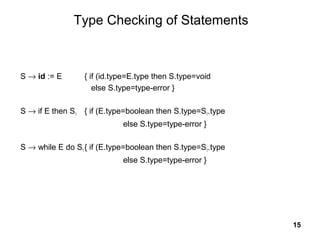
![A Simple Type Checking System
Program → Declaration;
Statement →Declaration; Declaration
| id: Type
Statement → Statement; Statement
| id := Expression
| if Expression then Statement
| while Expression do Statement
Expression → literal | num | id
| Expression mod Expression
| E[E] | E ↑ | E (E)
13](https://image.slidesharecdn.com/lecture14-15-160802160657/85/Type-Checking-Compiler-Design-ShareThisIfYouLike-13-320.jpg)
![Type Checking of Expressions
E → id { E.type:=lookup(id.entry) }
E → literal { E.type:=char }
E → int { E.type:=int }
E → real { E.type:=real }
E → E1 mod E2 { if (E1.type=int and E2.type=int) then E.type:=int
else E.type:=type-error }
E → E1 [E2] { if (E2.type=int and E1.type=array(s,t)) then E.type:=t
else E.type:=type-error }
E → E1 ↑ { if (E1.type=pointer(t)) then E.type:=t
else E.type:=type-error }
14](https://image.slidesharecdn.com/lecture14-15-160802160657/85/Type-Checking-Compiler-Design-ShareThisIfYouLike-14-320.jpg)

The document discusses type checking in programming languages, which verifies that operations adhere to the language's type system. It distinguishes between static and dynamic type checking, elaborating on how static checks are performed at compile-time while dynamic checks are enforced at run-time. Additionally, it outlines the rules for type expressions and the implementation of type checking in programming constructs such as arrays, records, and functions.


