SONET/SDH
17.2
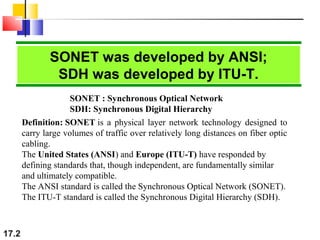
SONET was developed by ANSI;
SDH was developed by ITU-T.
SONET : Synchronous Optical Network
SDH: Synchronous Digital Hierarchy
Definition: SONET is  a  physical layer  network technology  designed to 
carry large volumes of traffic over relatively long distances on fiber optic 
cabling.
The United States (ANSI) and Europe (ITU-T) have responded by 
defining standards that, though independent, are fundamentally similar 
and ultimately compatible. 
The ANSI standard is called the Synchronous Optical Network (SONET). 
The ITU-T standard is called the Synchronous Digital Hierarchy (SDH).
17.3
ARCHITECTUREARCHITECTURE
Let us first introduce the architecture of a SONETLet us first introduce the architecture of a SONET
system: signals, devices, and connections.system: signals, devices, and connections.
Signals
SONET Devices
Connections
Topics discussed in this section:Topics discussed in this section:
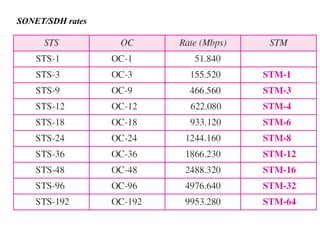
SONET/SDH rates
A simple network using SONET equipment
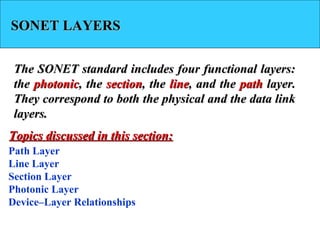
SONET LAYERSSONET LAYERS
The SONET standard includes four functional layers:The SONET standard includes four functional layers:
thethe photonicphotonic, the, the sectionsection, the, the lineline, and the, and the pathpath layer.layer.
They correspond to both the physical and the data linkThey correspond to both the physical and the data link
layers.layers.
Path Layer
Line Layer
Section Layer
Photonic Layer
Device–Layer Relationships
Topics discussed in this section:Topics discussed in this section:
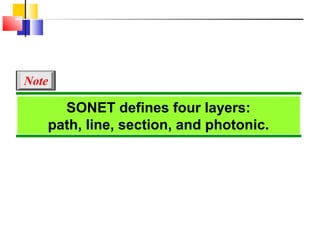
SONET defines four layers:
path, line, section, and photonic.
Note
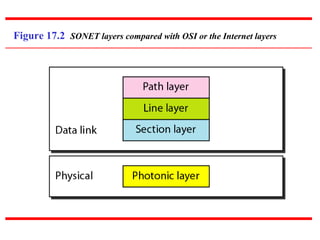
Figure 17.2 SONET layers compared with OSI or the Internet layers
SONET layers : Path Layer
Path Layer is responsible for the movement of a signal from its optical
source to its optical destination.
The signal is change from an electronic form to into optical form.
Multiplexed with other signal.
Encapsulated in a frame.
STS multiplexers provide path layer functions.
SONET layers : Line Layer
Line Layer is responsible for the movement of a signal across a physical
line.
Line layer overhead is added to the frame at this layer.
STS multiplexers and add/drop multiplexers provide the line layer function.
SONET layers : Section Layer
Section Layer is responsible for the movement of a signal across a physical
line.
It handles framing, scrambling and error control.
Section layer overhead is added to the frame at this layer.
SONET layers : Photonic Layer
Photonic layer corresponds to the physical layer of the OSI model.
It includes physical specification for the optical fiber channel.
SONET uses NRZ encoding.
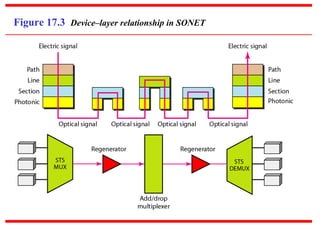
Figure 17.3 Device–layer relationship in SONET
17-3 SONET FRAMES17-3 SONET FRAMES
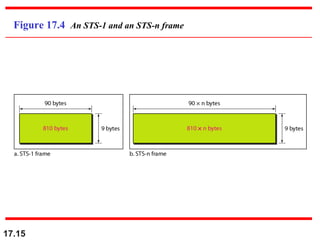
Each synchronous transfer signal STS-n is composedEach synchronous transfer signal STS-n is composed
of 8000 frames. Each frame is a two-dimensionalof 8000 frames. Each frame is a two-dimensional
matrix of bytes with 9 rows by 90 × n columns.matrix of bytes with 9 rows by 90 × n columns.
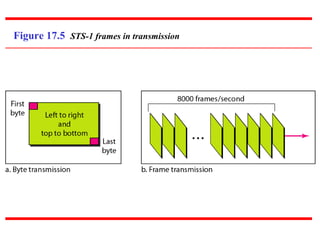
Frame, Byte, and Bit Transmission
STS-1 Frame Format
17.15
Figure 17.4 An STS-1 and an STS-n frame
Figure 17.5 STS-1 frames in transmission
A SONET STS-n
signal is transmitted at
8000 frames per second.
Note
Each byte in a SONET frame can carry a
digitized voice channel.
Note
17.19
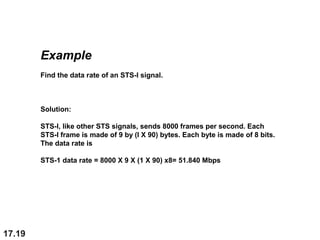
Example
Find the data rate of an STS-l signal.
Solution:
STS-l, like other STS signals, sends 8000 frames per second. Each
STS-l frame is made of 9 by (l X 90) bytes. Each byte is made of 8 bits.
The data rate is
STS-1 data rate = 8000 X 9 X (1 X 90) x8= 51.840 Mbps
17.20
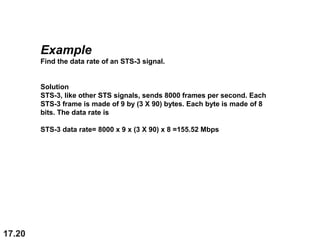
Example
Find the data rate of an STS-3 signal.
Solution
STS-3, like other STS signals, sends 8000 frames per second. Each
STS-3 frame is made of 9 by (3 X 90) bytes. Each byte is made of 8
bits. The data rate is
STS-3 data rate= 8000 x 9 x (3 X 90) x 8 =155.52 Mbps
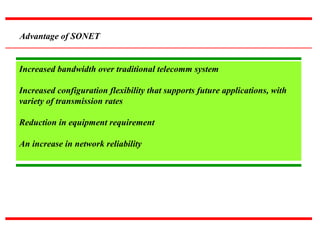
Advantage of SONET
Increased bandwidth over traditional telecomm system
Increased configuration flexibility that supports future applications, with
variety of transmission rates
Reduction in equipment requirement
An increase in network reliability
17.22
DRONACHARYA COLLEGE OF ENGINEERING, GURGAON
Computer Science & Engineering
Assignment
Semester- VI (I & II) Branch: CSE
Subject with Code: Computer Networks (IT-305-F)
-----------------------------------------------------------------------------------------------
Q:1 What is Frame Relay? Explain SONET/SDH in detail.

LAYER PROTOCOL ,SONET,SDH

  • 1.
  • 2.
    17.2 SONET was developedby ANSI; SDH was developed by ITU-T. SONET : Synchronous Optical Network SDH: Synchronous Digital Hierarchy Definition: SONET is  a  physical layer  network technology  designed to  carry large volumes of traffic over relatively long distances on fiber optic  cabling. The United States (ANSI) and Europe (ITU-T) have responded by  defining standards that, though independent, are fundamentally similar  and ultimately compatible.  The ANSI standard is called the Synchronous Optical Network (SONET).  The ITU-T standard is called the Synchronous Digital Hierarchy (SDH).
  • 3.
    17.3 ARCHITECTUREARCHITECTURE Let us firstintroduce the architecture of a SONETLet us first introduce the architecture of a SONET system: signals, devices, and connections.system: signals, devices, and connections. Signals SONET Devices Connections Topics discussed in this section:Topics discussed in this section:
  • 4.
  • 5.
    A simple networkusing SONET equipment
  • 6.
    SONET LAYERSSONET LAYERS TheSONET standard includes four functional layers:The SONET standard includes four functional layers: thethe photonicphotonic, the, the sectionsection, the, the lineline, and the, and the pathpath layer.layer. They correspond to both the physical and the data linkThey correspond to both the physical and the data link layers.layers. Path Layer Line Layer Section Layer Photonic Layer Device–Layer Relationships Topics discussed in this section:Topics discussed in this section:
  • 7.
    SONET defines fourlayers: path, line, section, and photonic. Note
  • 8.
    Figure 17.2 SONETlayers compared with OSI or the Internet layers
  • 9.
    SONET layers :Path Layer Path Layer is responsible for the movement of a signal from its optical source to its optical destination. The signal is change from an electronic form to into optical form. Multiplexed with other signal. Encapsulated in a frame. STS multiplexers provide path layer functions.
  • 10.
    SONET layers :Line Layer Line Layer is responsible for the movement of a signal across a physical line. Line layer overhead is added to the frame at this layer. STS multiplexers and add/drop multiplexers provide the line layer function.
  • 11.
    SONET layers :Section Layer Section Layer is responsible for the movement of a signal across a physical line. It handles framing, scrambling and error control. Section layer overhead is added to the frame at this layer.
  • 12.
    SONET layers :Photonic Layer Photonic layer corresponds to the physical layer of the OSI model. It includes physical specification for the optical fiber channel. SONET uses NRZ encoding.
  • 13.
    Figure 17.3 Device–layerrelationship in SONET
  • 14.
    17-3 SONET FRAMES17-3SONET FRAMES Each synchronous transfer signal STS-n is composedEach synchronous transfer signal STS-n is composed of 8000 frames. Each frame is a two-dimensionalof 8000 frames. Each frame is a two-dimensional matrix of bytes with 9 rows by 90 × n columns.matrix of bytes with 9 rows by 90 × n columns. Frame, Byte, and Bit Transmission STS-1 Frame Format
  • 15.
    17.15 Figure 17.4 AnSTS-1 and an STS-n frame
  • 16.
    Figure 17.5 STS-1frames in transmission
  • 17.
    A SONET STS-n signalis transmitted at 8000 frames per second. Note
  • 18.
    Each byte ina SONET frame can carry a digitized voice channel. Note
  • 19.
    17.19 Example Find the datarate of an STS-l signal. Solution: STS-l, like other STS signals, sends 8000 frames per second. Each STS-l frame is made of 9 by (l X 90) bytes. Each byte is made of 8 bits. The data rate is STS-1 data rate = 8000 X 9 X (1 X 90) x8= 51.840 Mbps
  • 20.
    17.20 Example Find the datarate of an STS-3 signal. Solution STS-3, like other STS signals, sends 8000 frames per second. Each STS-3 frame is made of 9 by (3 X 90) bytes. Each byte is made of 8 bits. The data rate is STS-3 data rate= 8000 x 9 x (3 X 90) x 8 =155.52 Mbps
  • 21.
    Advantage of SONET Increasedbandwidth over traditional telecomm system Increased configuration flexibility that supports future applications, with variety of transmission rates Reduction in equipment requirement An increase in network reliability
  • 22.
    17.22 DRONACHARYA COLLEGE OFENGINEERING, GURGAON Computer Science & Engineering Assignment Semester- VI (I & II) Branch: CSE Subject with Code: Computer Networks (IT-305-F) ----------------------------------------------------------------------------------------------- Q:1 What is Frame Relay? Explain SONET/SDH in detail.