Introduc)on	
  to	
  SONET	
  
Op)cal	
  Networks	
  
•  Networks	
  using	
  op)cal	
  
fiber	
  can	
  be	
  thought	
  as	
  
client	
  layers	
  of	
  op)cal	
  
layer	
  
–  Backbone	
  	
  
–  Access	
  
–  Metro	
  	
  
•  Backbone	
  op)cal	
  fiber	
  
client	
  layers	
  
–  SONET	
  /	
  SDH	
  	
  
–  Ethernet	
  	
  
–  Op)cal	
  Transport	
  Network	
  	
  
Other	
  Client	
  Layers	
  -­‐	
  Metro	
  
•  Gigabit Ethernet
•  10-Gigabit Ethernet
•  Fibre Channel (storage network)
•  Resilient Packet Ring (RPR) – packet
traffic
•  SONET/SDH	
  
SONET/SDH	
  
•  SONET/SDH: first generation of optical networks
deployed in backbone networks
•  Supports constant bit rate (CBR) connections
•  Multiplexes CBR connections into higher speed
optical connections by using time division
multiplexing
•  Originally designed for low speed voice and CBR
connections, up to 51 Mb/s
•  Supports data network, packet traffic that can
have link transmission rates in the tens of gigabits
per second.
•  It provides carrier grade service of high availability	
  
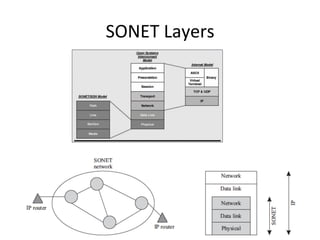
SONET	
  Layers	
  
SONET/SDH	
  
•  	
  Synchronous	
  Op)cal	
  Network	
  
– Transmission and multiplexing standard for
high-speed signals within the carrier
infrastructure in North America	
  
•  SDH (Synchronous Digital Hierarchy), has
been adopted in Europe and Japan	
  
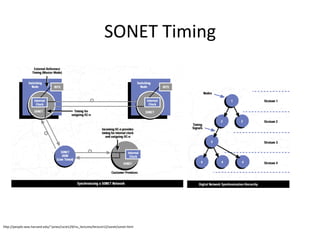
SONET	
  Timing	
  
hHp://people.seas.harvard.edu/~jones/cscie129/nu_lectures/lecture12/sonet/sonet.html	
  
Synchroniza)on	
  vs.	
  Plesiochronous	
  
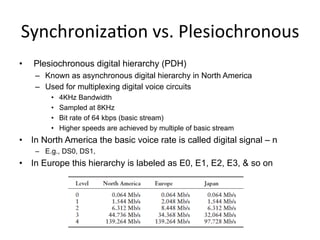
•  Plesiochronous digital hierarchy (PDH)
–  Known as asynchronous digital hierarchy in North America
–  Used for multiplexing digital voice circuits
•  4KHz Bandwidth
•  Sampled at 8KHz
•  Bit rate of 64 kbps (basic stream)
•  Higher speeds are achieved by multiple of basic stream
•  In North America the basic voice rate is called digital signal – n
–  E.g., DS0, DS1,
•  In Europe this hierarchy is labeled as E0, E1, E2, E3, & so on
•  Each	
  system	
  has	
  its	
  own	
  clock	
  (asynchronous)	
  –	
  nominal	
  
clock	
  	
  
–  Difference	
  in	
  clock	
  can	
  generate	
  serious	
  synch.	
  Issues	
  	
  
•  20	
  ppm	
  difference	
  between	
  clocks	
  à	
  1.8	
  kbps	
  bit	
  rate	
  difference	
  	
  
–  Bit	
  stuffing	
  is	
  typically	
  used	
  to	
  compensate	
  for	
  difference	
  in	
  
transmission	
  rates	
  
•  Transmission	
  rates	
  are	
  not	
  exactly	
  integral	
  mul)ple	
  of	
  the	
  basic	
  rate	
  
(64	
  kbps)	
  
•  DS1	
  (1.544	
  Mbps)	
  >	
  24	
  x	
  64	
  kbps	
  !	
  	
  
–  In	
  order	
  to	
  extract	
  lower	
  rate	
  the	
  en)re	
  signal	
  has	
  to	
  be	
  
demul)plexed	
  –	
  expensive!	
  	
  
•  Provides	
  liHle/no	
  management	
  informa)on	
  including	
  
performance	
  monitoring	
  
•  Offers	
  liHle	
  standards	
  for	
  reliability	
  
Plesiochronous	
  -­‐	
  Issues	
  
SONET	
  /	
  SDH	
  Standards	
  -­‐	
  Advantages	
  
•  Higher	
  bit	
  rates	
  are	
  integral	
  mul)ples	
  of	
  lower	
  
rates	
  	
  
•  All	
  clocks	
  are	
  perfectly	
  synchronized	
  (via	
  a	
  
master	
  clock)	
  
•  Incorporate	
  extensive	
  management	
  
informa)on,	
  e.g.,	
  performance	
  monitoring	
  	
  
•  Provides	
  interoperability	
  between	
  different	
  
devices	
  by	
  different	
  vendors	
  	
  
•  Fast	
  restora)on	
  )me	
  (much	
  longer	
  in	
  PDH)	
  	
  
SONET	
  /	
  SDH	
  Mul)plexing	
  
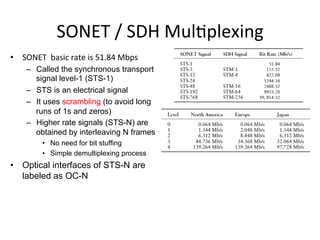
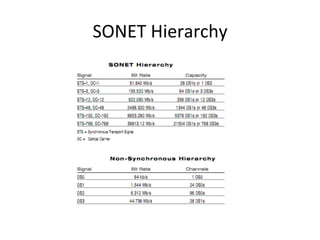
•  SONET	
  	
  basic	
  rate	
  is	
  51.84	
  Mbps	


–  Called the synchronous transport
signal level-1 (STS-1)
–  STS is an electrical signal
–  It uses scrambling (to avoid long
runs of 1s and zeros)
–  Higher rate signals (STS-N) are
obtained by interleaving N frames
•  No need for bit stuffing
•  Simple demultiplexing process
•  Optical interfaces of STS-N are
labeled as OC-N	
  
SONET	
  Hierarchy	
  
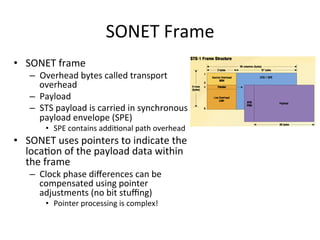
SONET	
  Frame	
  
•  SONET	
  frame	
  	
  
–  Overhead	
  bytes	
  called	
  transport	
  
overhead	
  	
  
–  Payload	
  	
  
–  STS	
  payload	
  is	
  carried	
  in	
  synchronous	
  
payload	
  envelope	
  (SPE)	
  
•  SPE	
  contains	
  addi)onal	
  path	
  overhead	
  	
  
•  SONET	
  uses	
  pointers	
  to	
  indicate	
  the	
  
loca)on	
  of	
  the	
  payload	
  data	
  within	
  
the	
  frame	
  	
  
–  Clock	
  phase	
  differences	
  can	
  be	
  
compensated	
  using	
  pointer	
  
adjustments	
  (no	
  bit	
  stuffing)	
  
•  Pointer	
  processing	
  is	
  complex!	
  	
  
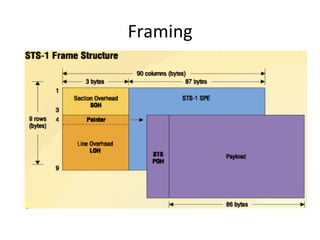
Framing	
  
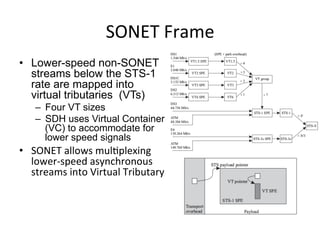
SONET	
  Frame	
  
•  Lower-speed non-SONET
streams below the STS-1
rate are mapped into
virtual tributaries (VTs)
–  Four VT sizes
–  SDH uses Virtual Container
(VC) to accommodate for
lower speed signals
•  SONET	
  allows	
  mul)plexing	
  
lower-­‐speed	
  asynchronous	
  
streams	
  into	
  Virtual	
  Tributary	
  
SONET	
  Concatena)on	
  	
  
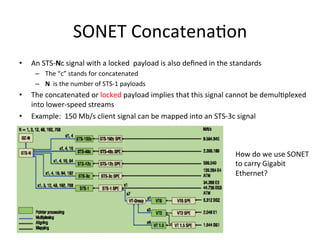
•  An	
  STS-­‐Nc	
  signal	
  with	
  a	
  locked	
  	
  payload	
  is	
  also	
  defined	
  in	
  the	
  standards	
  	
  
–  The	
  “c”	
  stands	
  for	
  concatenated	
  
–  N	
  	
  is	
  the	
  number	
  of	
  STS-­‐1	
  payloads	
  
•  The	
  concatenated	
  or	
  locked	
  payload	
  implies	
  that	
  this	
  signal	
  cannot	
  be	
  demul)plexed	
  
into	
  lower-­‐speed	
  streams	
  
•  Example:	
  	
  150	
  Mb/s	
  client	
  signal	
  can	
  be	
  mapped	
  into	
  an	
  STS-­‐3c	
  signal	
  
How	
  do	
  we	
  use	
  SONET	
  
to	
  carry	
  Gigabit	
  
Ethernet?	
  	
  
Virtual	
  Concatena)on	
  
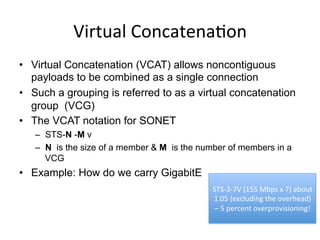
•  Virtual Concatenation (VCAT) allows noncontiguous
payloads to be combined as a single connection
•  Such a grouping is referred to as a virtual concatenation
group (VCG)
•  The VCAT notation for SONET
–  STS-N -M v
–  N is the size of a member & M is the number of members in a
VCG
•  Example: How do we carry GigabitE	
  
STS-­‐3-­‐7V	
  (155	
  Mbps	
  x	
  7)	
  about	
  
1.05	
  (excluding	
  the	
  overhead)	
  
–	
  5	
  percent	
  overprovisioning!	
  
SONET	
  Layers	
  
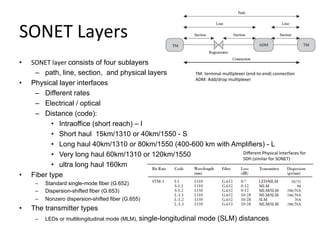
TM:	
  terminal	
  mul)plexer	
  (end-­‐to-­‐end)	
  connec)on	
  
ADM:	
  Add/drop	
  mul)plexer	
  	
  
•  SONET	
  layer	
  consists of four sublayers
–  path, line, section, and physical layers
•  Physical layer interfaces
–  Different rates
–  Electrical / optical
–  Distance (code):
•  Intraoffice (short reach) – I
•  Short haul 15km/1310 or 40km/1550 - S
•  Long haul 40km/1310 or 80km/1550 (400-600 km with Amplifiers) - L
•  Very long haul 60km/1310 or 120km/1550
•  ultra long haul 160km
•  Fiber type
–  Standard single-mode fiber (G.652)
–  Dispersion-shifted fiber (G.653)
–  Nonzero dispersion-shifted fiber (G.655)
•  The transmitter types
–  LEDs or multilongitudinal mode (MLM), single-longitudinal mode (SLM) distances
Different	
  Physical	
  Interfaces	
  for	
  
SDH	
  (similar	
  for	
  SONET)	
  
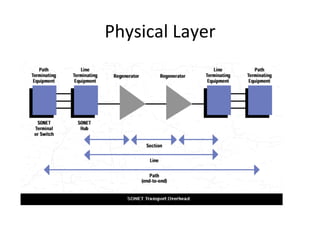
Physical	
  Layer	
  
SONET	
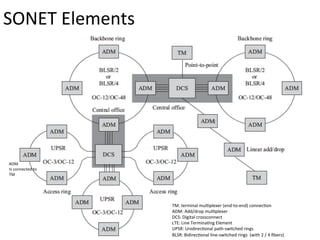
  Elements	
  
TM:	
  terminal	
  mul)plexer	
  (end-­‐to-­‐end)	
  connec)on	
  
ADM:	
  Add/drop	
  mul)plexer	
  	
  
DCS:	
  Digital	
  crossconnect	
  	
  
LTE:	
  Line	
  Termina)ng	
  Element	
  
UPSR:	
  Unidirec)onal	
  path-­‐switched	
  rings	
  	
  
BLSR:	
  Bidirec)onal	
  line-­‐switched	
  rings	
  	
  (with	
  2	
  /	
  4	
  fibers)	
  
ADM	
  
Is	
  connected	
  to	
  	
  
TM	
  
SONET	
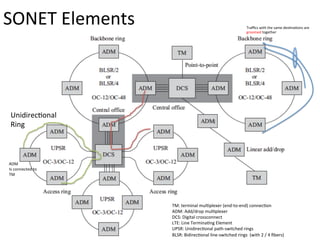
  Elements	
  
TM:	
  terminal	
  mul)plexer	
  (end-­‐to-­‐end)	
  connec)on	
  
ADM:	
  Add/drop	
  mul)plexer	
  	
  
DCS:	
  Digital	
  crossconnect	
  	
  
LTE:	
  Line	
  Termina)ng	
  Element	
  
UPSR:	
  Unidirec)onal	
  path-­‐switched	
  rings	
  	
  
BLSR:	
  Bidirec)onal	
  line-­‐switched	
  rings	
  	
  (with	
  2	
  /	
  4	
  fibers)	
  
Traffics	
  with	
  the	
  same	
  des)na)ons	
  are	
  
groomed	
  together	
  
Unidirec)onal	
  	
  
Ring	
  
ADM	
  
Is	
  connected	
  to	
  	
  
TM	
  
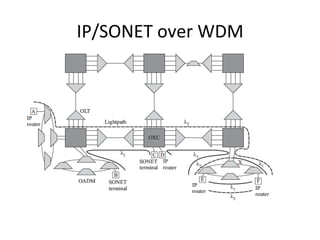
IP/SONET	
  over	
  WDM	
  
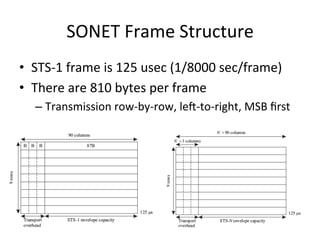
SONET	
  Frame	
  Structure	
  
•  STS-­‐1	
  frame	
  is	
  125	
  usec	
  (1/8000	
  sec/frame)	
  
•  There	
  are	
  810	
  bytes	
  per	
  frame	
  	
  
– Transmission	
  row-­‐by-­‐row,	
  lem-­‐to-­‐right,	
  MSB	
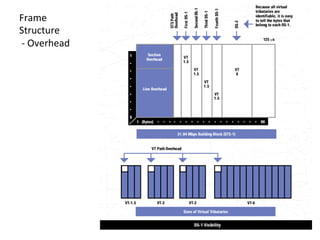
  first	
  
Frame	
  	
  
Structure	
  
	
  -­‐	
  Overhead	
  
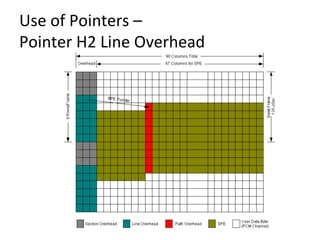
Use	
  of	
  Pointers	
  –	
  	
  
Pointer	
  H2	
  Line	
  Overhead	
  
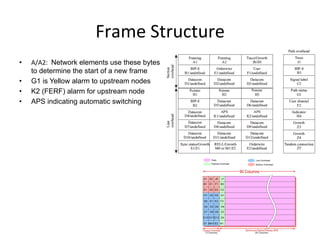
Frame	
  Structure	
  
•  A/A2:	
   Network elements use these bytes
to determine the start of a new frame
•  G1 is Yellow alarm to upstream nodes
•  K2 (FERF) alarm for upstream node
•  APS indicating automatic switching
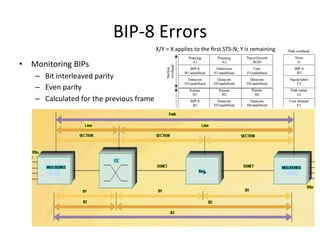
BIP-­‐8	
  Errors	
  
•  Monitoring	
  BIPs	
  
–  Bit	
  interleaved	
  parity	
  
–  Even	
  parity	
  	
  
–  Calculated	
  for	
  the	
  previous	
  frame	
  
X/Y	
  =	
  X	
  applies	
  to	
  the	
  first	
  STS-­‐N;	
  Y	
  is	
  remaining	
  
Calcula)ng	
  BIP-­‐8	
  
•  Calculated	
  BIP-­‐8	
  (B1)	
  is	
  based	
  on	
  the	
  previous	
  
STS-­‐N	
  frame	
  amer	
  scrambling	
  	
  
– Odd	
  parity	
  means	
  there	
  is	
  an	
  error	
  	
  
•  B2	
  is	
  based	
  on	
  calcula)ng	
  line	
  overhead	
  of	
  the	
  
line	
  overhead	
  –	
  checked	
  by	
  the	
  line	
  
termina)ng	
  equipment	
  	
  
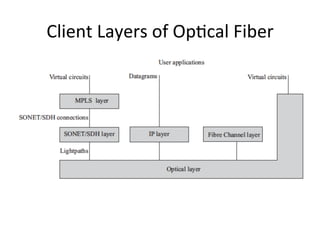
Client	
  Layers	
  of	
  Op)cal	
  Fiber	
  
SONET	
  Protec)on	
  	
  
•  Chapter	
  9	
  	
  -­‐	
  up	
  to	
  9.3	
  
SONET	
  Protec)on	
  
•  Availability:	
  A	
  common	
  requirement	
  that	
  the	
  connec)on	
  will	
  be	
  available	
  
99.999%	
  
•  Thus	
  network	
  has	
  to	
  be	
  survivable	
  
–  continue providing service in the presence of failures
•  Protection switching is the key technique used to ensure survivability
–  The term restoration to schemes where traffic is restored
•  There	
  are	
  many	
  failures	
  	
  
–  Human	
  errors	
  /	
  disasters	
  /	
  AHacks	
  /	
  etc.	
  
–  Component	
  failures	
  
–  Link failures:
•  There are estimates that long-haul networks annually suffer 3 fiber cuts for every 1000
miles of fiber
•  For a large network of 30,000 miles of fiber cable, that would be 90 cuts per year	
  
Protec)on	
  Key	
  Parameters	
  
•  Detect	
  failures	
  	
  
•  Protect	
  against	
  failures	
  (single	
  failures)	
  
•  Restora)on	
  )me	
  (60	
  msec	
  –	
  including	
  
detec)on	
  and	
  restora)on)	
  
•  Topology	
  (Ring	
  /	
  Mesh)	
  
•  Signaling	
  	
  
Basic	
  Protec)on	
  Concepts	
  
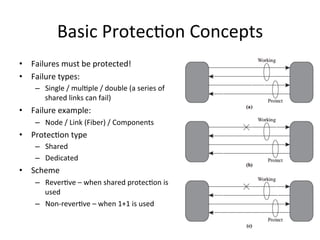
•  Failures	
  must	
  be	
  protected!	
  	
  
•  Failure	
  types:	
  
–  Single	
  /	
  mul)ple	
  /	
  double	
  (a	
  series	
  of	
  
shared	
  links	
  can	
  fail)	
  	
  
•  Failure	
  example:	
  	
  
–  Node	
  /	
  Link	
  (Fiber)	
  /	
  Components	
  	
  
•  Protec)on	
  type	
  
–  Shared	
  	
  
–  Dedicated	
  	
  
•  Scheme	
  	
  
–  Rever)ve	
  –	
  when	
  shared	
  protec)on	
  is	
  
used	
  
–  Non-­‐rever)ve	
  –	
  when	
  1+1	
  is	
  used	
  
Protec)on	
  Switching	
  	
  
•  Automa)c	
  Protec)on	
  Switching	
  (ASP)	
  	
  
•  Unidirec)onal	
  
–  ASP	
  Required	
  
–  Signaling	
  is	
  required	


•  Bidirec)onal	
  
–  No	
  ASP	
  is	
  required	


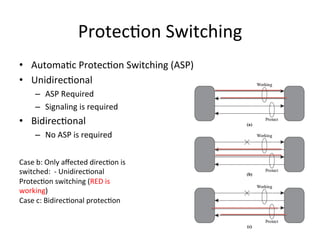
Case	
  b:	
  Only	
  affected	
  direc)on	
  is	
  
switched:	
  	
  -­‐	
  Unidirec)onal	
  
Protec)on	
  switching	
  (RED	
  is	
  
working)	
  
Case	
  c:	
  Bidirec)onal	
  protec)on	
  
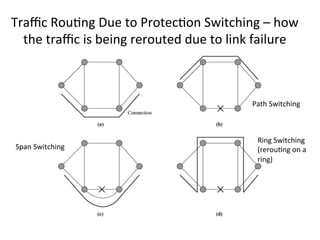
Traffic	
  Rou)ng	
  Due	
  to	
  Protec)on	
  Switching	
  –	
  how	
  
the	
  traffic	
  is	
  being	
  rerouted	
  due	
  to	
  link	
  failure	
  
Path	
  Switching	
  
Span	
  Switching	
  
Ring	
  Switching	
  
(rerou)ng	
  on	
  a	
  
ring)	
  
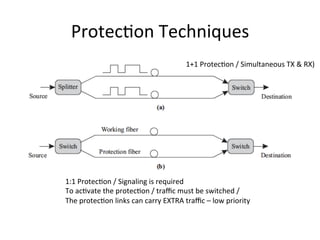
Protec)on	
  Techniques	
  
1+1	
  Protec)on	
  /	
  Simultaneous	
  TX	
  &	
  RX)	
  
1:1	
  Protec)on	
  /	
  Signaling	
  is	
  required	
  	
  
To	
  ac)vate	
  the	
  protec)on	
  /	
  traffic	
  must	
  be	
  switched	
  /	
  
The	
  protec)on	
  links	
  can	
  carry	
  EXTRA	
  traffic	
  –	
  low	
  priority	
  
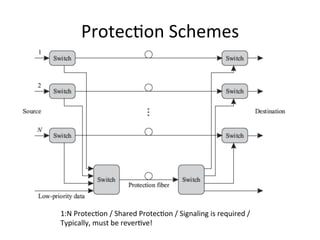
Protec)on	
  Schemes	
  
1:N	
  Protec)on	
  /	
  Shared	
  Protec)on	
  /	
  Signaling	
  is	
  required	
  /	
  	
  
Typically,	
  must	
  be	
  rever)ve!	
  
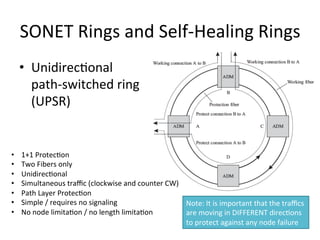
SONET	
  Rings	
  and	
  Self-­‐Healing	
  Rings	
  
•  Unidirec)onal	
  
path-­‐switched	
  ring	
  
(UPSR)	
  
•  1+1	
  Protec)on	
  	
  
•  Two	
  Fibers	
  only	
  
•  Unidirec)onal	
  	
  
•  Simultaneous	
  traffic	
  (clockwise	
  and	
  counter	
  CW)	
  
•  Path	
  Layer	
  Protec)on	
  	
  
•  Simple	
  /	
  requires	
  no	
  signaling	
  
•  No	
  node	
  limita)on	
  /	
  no	
  length	
  limita)on	


Note:	
  It	
  is	
  important	
  that	
  the	
  traffics	
  	
  
are	
  moving	
  in	
  DIFFERENT	
  direc)ons	
  	
  
to	
  protect	
  against	
  any	
  node	
  failure	
  	
  
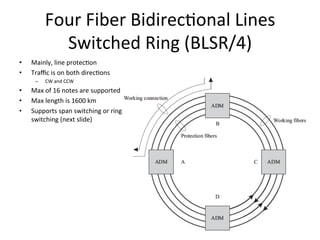
Four	
  Fiber	
  Bidirec)onal	
  Lines	
  
Switched	
  Ring	
  (BLSR/4)	
  
•  Mainly,	
  line	
  protec)on	
  
•  Traffic	
  is	
  on	
  both	
  direc)ons	
  	
  
–  CW	
  and	
  CCW	
  
•  Max	
  of	
  16	
  notes	
  are	
  supported	
  	
  
•  Max	
  length	
  is	
  1600	
  km	
  	
  
•  Supports	
  span	
  switching	
  or	
  ring	
  
switching	
  (next	
  slide)	
  
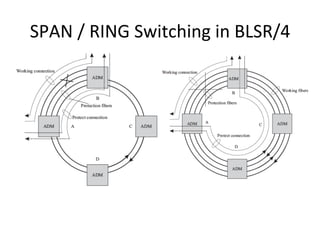
SPAN	
  /	
  RING	
  Switching	
  in	
  BLSR/4	
  
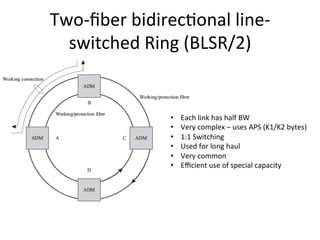
Two-­‐fiber	
  bidirec)onal	
  line-­‐
switched	
  Ring	
  (BLSR/2)	
  
•  k	
  
•  Each	
  link	
  has	
  half	
  BW	
  	
  
•  Very	
  complex	
  –	
  uses	
  APS	
  (K1/K2	
  bytes)	
  
•  1:1	
  Switching	
  	
  
•  Used	
  for	
  long	
  haul	
  	
  
•  Very	
  common	
  	
  
•  Efficient	
  use	
  of	
  special	
  capacity	


Example:	
  BLSR/2	
  is	
  much	
  more	
  
efficient	
  than	
  UPSR	
  (2	
  fiber)	
  
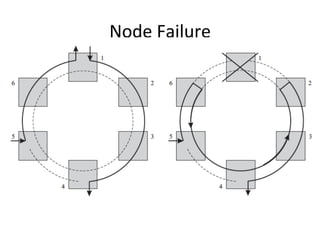
Node	
  Failure	
  
Lab	
  
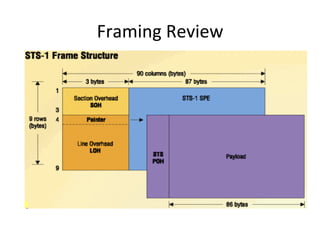
Framing	
  Review	
  
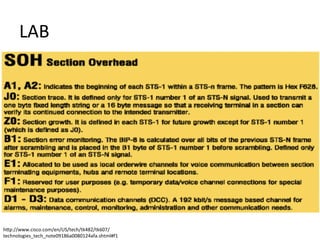
LAB	
  
hHp://www.cisco.com/en/US/tech/tk482/tk607/
technologies_tech_note09186a0080124afa.shtml#f1	
  
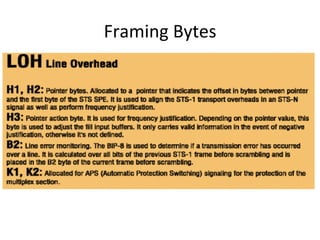
Framing	
  Bytes	
  
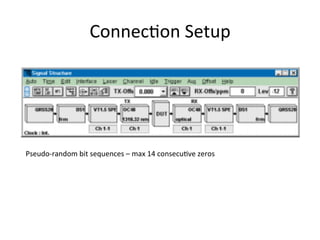
Connec)on	
  Setup	
  
	
  Pseudo-­‐random	
  bit	
  sequences	
  –	
  max	
  14	
  consecu)ve	
  zeros	
  
References	
  
•  hHp://www.cisco.com/en/US/tech/tk482/
tk607/
technologies_tech_note09186a0080094313.s
html	


•  hHp://www.op)cus.co.uk/pdf/WhitePaper-­‐
Understanding_Error_Checking_Using_Parity_
Bytes.pdf	


Sonet fall2011

  • 1.
  • 2.
    Op)cal  Networks   • Networks  using  op)cal   fiber  can  be  thought  as   client  layers  of  op)cal   layer   –  Backbone     –  Access   –  Metro     •  Backbone  op)cal  fiber   client  layers   –  SONET  /  SDH     –  Ethernet     –  Op)cal  Transport  Network    
  • 3.
    Other  Client  Layers  -­‐  Metro   •  Gigabit Ethernet •  10-Gigabit Ethernet •  Fibre Channel (storage network) •  Resilient Packet Ring (RPR) – packet traffic •  SONET/SDH  
  • 4.
    SONET/SDH   •  SONET/SDH:first generation of optical networks deployed in backbone networks •  Supports constant bit rate (CBR) connections •  Multiplexes CBR connections into higher speed optical connections by using time division multiplexing •  Originally designed for low speed voice and CBR connections, up to 51 Mb/s •  Supports data network, packet traffic that can have link transmission rates in the tens of gigabits per second. •  It provides carrier grade service of high availability  
  • 5.
  • 6.
    SONET/SDH   •   Synchronous  Op)cal  Network   – Transmission and multiplexing standard for high-speed signals within the carrier infrastructure in North America   •  SDH (Synchronous Digital Hierarchy), has been adopted in Europe and Japan  
  • 7.
  • 8.
    Synchroniza)on  vs.  Plesiochronous   •  Plesiochronous digital hierarchy (PDH) –  Known as asynchronous digital hierarchy in North America –  Used for multiplexing digital voice circuits •  4KHz Bandwidth •  Sampled at 8KHz •  Bit rate of 64 kbps (basic stream) •  Higher speeds are achieved by multiple of basic stream •  In North America the basic voice rate is called digital signal – n –  E.g., DS0, DS1, •  In Europe this hierarchy is labeled as E0, E1, E2, E3, & so on
  • 9.
    •  Each  system  has  its  own  clock  (asynchronous)  –  nominal   clock     –  Difference  in  clock  can  generate  serious  synch.  Issues     •  20  ppm  difference  between  clocks  à  1.8  kbps  bit  rate  difference     –  Bit  stuffing  is  typically  used  to  compensate  for  difference  in   transmission  rates   •  Transmission  rates  are  not  exactly  integral  mul)ple  of  the  basic  rate   (64  kbps)   •  DS1  (1.544  Mbps)  >  24  x  64  kbps  !     –  In  order  to  extract  lower  rate  the  en)re  signal  has  to  be   demul)plexed  –  expensive!     •  Provides  liHle/no  management  informa)on  including   performance  monitoring   •  Offers  liHle  standards  for  reliability   Plesiochronous  -­‐  Issues  
  • 10.
    SONET  /  SDH  Standards  -­‐  Advantages   •  Higher  bit  rates  are  integral  mul)ples  of  lower   rates     •  All  clocks  are  perfectly  synchronized  (via  a   master  clock)   •  Incorporate  extensive  management   informa)on,  e.g.,  performance  monitoring     •  Provides  interoperability  between  different   devices  by  different  vendors     •  Fast  restora)on  )me  (much  longer  in  PDH)    
  • 11.
    SONET  /  SDH  Mul)plexing   •  SONET    basic  rate  is  51.84  Mbps       –  Called the synchronous transport signal level-1 (STS-1) –  STS is an electrical signal –  It uses scrambling (to avoid long runs of 1s and zeros) –  Higher rate signals (STS-N) are obtained by interleaving N frames •  No need for bit stuffing •  Simple demultiplexing process •  Optical interfaces of STS-N are labeled as OC-N  
  • 12.
  • 13.
    SONET  Frame   • SONET  frame     –  Overhead  bytes  called  transport   overhead     –  Payload     –  STS  payload  is  carried  in  synchronous   payload  envelope  (SPE)   •  SPE  contains  addi)onal  path  overhead     •  SONET  uses  pointers  to  indicate  the   loca)on  of  the  payload  data  within   the  frame     –  Clock  phase  differences  can  be   compensated  using  pointer   adjustments  (no  bit  stuffing)   •  Pointer  processing  is  complex!    
  • 14.
  • 15.
    SONET  Frame   • Lower-speed non-SONET streams below the STS-1 rate are mapped into virtual tributaries (VTs) –  Four VT sizes –  SDH uses Virtual Container (VC) to accommodate for lower speed signals •  SONET  allows  mul)plexing   lower-­‐speed  asynchronous   streams  into  Virtual  Tributary  
  • 16.
    SONET  Concatena)on     •  An  STS-­‐Nc  signal  with  a  locked    payload  is  also  defined  in  the  standards     –  The  “c”  stands  for  concatenated   –  N    is  the  number  of  STS-­‐1  payloads   •  The  concatenated  or  locked  payload  implies  that  this  signal  cannot  be  demul)plexed   into  lower-­‐speed  streams   •  Example:    150  Mb/s  client  signal  can  be  mapped  into  an  STS-­‐3c  signal   How  do  we  use  SONET   to  carry  Gigabit   Ethernet?    
  • 17.
    Virtual  Concatena)on   • Virtual Concatenation (VCAT) allows noncontiguous payloads to be combined as a single connection •  Such a grouping is referred to as a virtual concatenation group (VCG) •  The VCAT notation for SONET –  STS-N -M v –  N is the size of a member & M is the number of members in a VCG •  Example: How do we carry GigabitE   STS-­‐3-­‐7V  (155  Mbps  x  7)  about   1.05  (excluding  the  overhead)   –  5  percent  overprovisioning!  
  • 18.
    SONET  Layers   TM:  terminal  mul)plexer  (end-­‐to-­‐end)  connec)on   ADM:  Add/drop  mul)plexer     •  SONET  layer  consists of four sublayers –  path, line, section, and physical layers •  Physical layer interfaces –  Different rates –  Electrical / optical –  Distance (code): •  Intraoffice (short reach) – I •  Short haul 15km/1310 or 40km/1550 - S •  Long haul 40km/1310 or 80km/1550 (400-600 km with Amplifiers) - L •  Very long haul 60km/1310 or 120km/1550 •  ultra long haul 160km •  Fiber type –  Standard single-mode fiber (G.652) –  Dispersion-shifted fiber (G.653) –  Nonzero dispersion-shifted fiber (G.655) •  The transmitter types –  LEDs or multilongitudinal mode (MLM), single-longitudinal mode (SLM) distances Different  Physical  Interfaces  for   SDH  (similar  for  SONET)  
  • 19.
  • 20.
    SONET  Elements   TM:  terminal  mul)plexer  (end-­‐to-­‐end)  connec)on   ADM:  Add/drop  mul)plexer     DCS:  Digital  crossconnect     LTE:  Line  Termina)ng  Element   UPSR:  Unidirec)onal  path-­‐switched  rings     BLSR:  Bidirec)onal  line-­‐switched  rings    (with  2  /  4  fibers)   ADM   Is  connected  to     TM  
  • 21.
    SONET  Elements   TM:  terminal  mul)plexer  (end-­‐to-­‐end)  connec)on   ADM:  Add/drop  mul)plexer     DCS:  Digital  crossconnect     LTE:  Line  Termina)ng  Element   UPSR:  Unidirec)onal  path-­‐switched  rings     BLSR:  Bidirec)onal  line-­‐switched  rings    (with  2  /  4  fibers)   Traffics  with  the  same  des)na)ons  are   groomed  together   Unidirec)onal     Ring   ADM   Is  connected  to     TM  
  • 22.
  • 23.
    SONET  Frame  Structure   •  STS-­‐1  frame  is  125  usec  (1/8000  sec/frame)   •  There  are  810  bytes  per  frame     – Transmission  row-­‐by-­‐row,  lem-­‐to-­‐right,  MSB  first  
  • 24.
    Frame     Structure    -­‐  Overhead  
  • 25.
    Use  of  Pointers  –     Pointer  H2  Line  Overhead  
  • 26.
    Frame  Structure   • A/A2:   Network elements use these bytes to determine the start of a new frame •  G1 is Yellow alarm to upstream nodes •  K2 (FERF) alarm for upstream node •  APS indicating automatic switching
  • 27.
    BIP-­‐8  Errors   • Monitoring  BIPs   –  Bit  interleaved  parity   –  Even  parity     –  Calculated  for  the  previous  frame   X/Y  =  X  applies  to  the  first  STS-­‐N;  Y  is  remaining  
  • 28.
    Calcula)ng  BIP-­‐8   • Calculated  BIP-­‐8  (B1)  is  based  on  the  previous   STS-­‐N  frame  amer  scrambling     – Odd  parity  means  there  is  an  error     •  B2  is  based  on  calcula)ng  line  overhead  of  the   line  overhead  –  checked  by  the  line   termina)ng  equipment    
  • 29.
    Client  Layers  of  Op)cal  Fiber  
  • 30.
    SONET  Protec)on     •  Chapter  9    -­‐  up  to  9.3  
  • 31.
    SONET  Protec)on   • Availability:  A  common  requirement  that  the  connec)on  will  be  available   99.999%   •  Thus  network  has  to  be  survivable   –  continue providing service in the presence of failures •  Protection switching is the key technique used to ensure survivability –  The term restoration to schemes where traffic is restored •  There  are  many  failures     –  Human  errors  /  disasters  /  AHacks  /  etc.   –  Component  failures   –  Link failures: •  There are estimates that long-haul networks annually suffer 3 fiber cuts for every 1000 miles of fiber •  For a large network of 30,000 miles of fiber cable, that would be 90 cuts per year  
  • 32.
    Protec)on  Key  Parameters   •  Detect  failures     •  Protect  against  failures  (single  failures)   •  Restora)on  )me  (60  msec  –  including   detec)on  and  restora)on)   •  Topology  (Ring  /  Mesh)   •  Signaling    
  • 33.
    Basic  Protec)on  Concepts   •  Failures  must  be  protected!     •  Failure  types:   –  Single  /  mul)ple  /  double  (a  series  of   shared  links  can  fail)     •  Failure  example:     –  Node  /  Link  (Fiber)  /  Components     •  Protec)on  type   –  Shared     –  Dedicated     •  Scheme     –  Rever)ve  –  when  shared  protec)on  is   used   –  Non-­‐rever)ve  –  when  1+1  is  used  
  • 34.
    Protec)on  Switching     •  Automa)c  Protec)on  Switching  (ASP)     •  Unidirec)onal   –  ASP  Required   –  Signaling  is  required       •  Bidirec)onal   –  No  ASP  is  required       Case  b:  Only  affected  direc)on  is   switched:    -­‐  Unidirec)onal   Protec)on  switching  (RED  is   working)   Case  c:  Bidirec)onal  protec)on  
  • 35.
    Traffic  Rou)ng  Due  to  Protec)on  Switching  –  how   the  traffic  is  being  rerouted  due  to  link  failure   Path  Switching   Span  Switching   Ring  Switching   (rerou)ng  on  a   ring)  
  • 36.
    Protec)on  Techniques   1+1  Protec)on  /  Simultaneous  TX  &  RX)   1:1  Protec)on  /  Signaling  is  required     To  ac)vate  the  protec)on  /  traffic  must  be  switched  /   The  protec)on  links  can  carry  EXTRA  traffic  –  low  priority  
  • 37.
    Protec)on  Schemes   1:N  Protec)on  /  Shared  Protec)on  /  Signaling  is  required  /     Typically,  must  be  rever)ve!  
  • 38.
    SONET  Rings  and  Self-­‐Healing  Rings   •  Unidirec)onal   path-­‐switched  ring   (UPSR)   •  1+1  Protec)on     •  Two  Fibers  only   •  Unidirec)onal     •  Simultaneous  traffic  (clockwise  and  counter  CW)   •  Path  Layer  Protec)on     •  Simple  /  requires  no  signaling   •  No  node  limita)on  /  no  length  limita)on         Note:  It  is  important  that  the  traffics     are  moving  in  DIFFERENT  direc)ons     to  protect  against  any  node  failure    
  • 39.
    Four  Fiber  Bidirec)onal  Lines   Switched  Ring  (BLSR/4)   •  Mainly,  line  protec)on   •  Traffic  is  on  both  direc)ons     –  CW  and  CCW   •  Max  of  16  notes  are  supported     •  Max  length  is  1600  km     •  Supports  span  switching  or  ring   switching  (next  slide)  
  • 40.
    SPAN  /  RING  Switching  in  BLSR/4  
  • 41.
    Two-­‐fiber  bidirec)onal  line-­‐ switched  Ring  (BLSR/2)   •  k   •  Each  link  has  half  BW     •  Very  complex  –  uses  APS  (K1/K2  bytes)   •  1:1  Switching     •  Used  for  long  haul     •  Very  common     •  Efficient  use  of  special  capacity    
  • 42.
    Example:  BLSR/2  is  much  more   efficient  than  UPSR  (2  fiber)  
  • 43.
  • 44.
  • 45.
  • 46.
  • 47.
  • 48.
    Connec)on  Setup    Pseudo-­‐random  bit  sequences  –  max  14  consecu)ve  zeros  
  • 49.
    References   •  hHp://www.cisco.com/en/US/tech/tk482/ tk607/ technologies_tech_note09186a0080094313.s html         •  hHp://www.op)cus.co.uk/pdf/WhitePaper-­‐ Understanding_Error_Checking_Using_Parity_ Bytes.pdf