ASSIGNMENT


        COMPUTER
        NETWORKS
Submitted To: -   Submitted By: -
Mr. Yogesh        Soumya Subhadarshi Behera
CSE Lecturer      1826
                  B.Tech 6th Sem
Synchronous optical networking/Synchronous Digital Hierarchy

Synchronous Optical Networking (SONET) and Synchronous Digital Hierarchy (SDH) are
standardized multiplexing protocols that transfer multiple digital bit streams over optical
fiber using lasers or highly coherent light from light-emitting diodes (LEDs). At low transmission rates
data can also be transferred via an electrical interface. The method was developed to replace
the Plesiochronous Digital Hierarchy (PDH) system for transporting large amounts of telephone calls
and data traffic over the same fiber without synchronization problems.

SONET and SDH, which are essentially the same, were originally designed to transport circuit mode
communications (e.g., DS1, DS3) from a variety of different sources, but they were primarily designed
to support real-time, uncompressed, circuit-switched voice encoded in PCM format.[3] The primary
difficulty in doing this prior to SONET/SDH was that the synchronization sources of these various
circuits were different. This meant that each circuit was actually operating at a slightly different rate
and with different phase. SONET/SDH allowed for the simultaneous transport of many different
circuits of differing origin within a single framing protocol. SONET/SDH is not itself a communications
protocol per se, but a transport protocol.

Due to SONET/SDH's essential protocol neutrality and transport-oriented features, SONET/SDH was
the obvious choice for transporting the fixed length Asynchronous Transfer Mode (ATM) frames also
known as cells. It quickly evolved mapping structures and concatenated payload containers to
transport ATM connections. In other words, for ATM (and eventually other protocols such as
Ethernet), the internal complex structure previously used to transport circuit-oriented connections was
removed and replaced with a large and concatenated frame (such as OC-3c) into which ATM cells, IP
packets, or Ethernet frames are placed.

The SDH standard was originally defined by the European Telecommunications Standards Institute
(ETSI), and is formalized as International Telecommunication Union (ITU) standards G.707,[4]
G.783,[5] G.784,[6] and G.803.[7][8] The SONET standard was defined by Telcordia[1] and American
National Standards Institute (ANSI) standard T1.105.

FEATURES OF SONET/SDH :-

High transmission rates

Transmission rates of up to 40 Gb/s can be achieved in modern SONET systems making it the most
suitable technology for backbones - the superhighways in today's telecommunications networks.

Simplified add and drop function

Compared to the older DSn system, low bit rate channels can be easily extracted from and inserted
into the high-speed bit streams in SONET. It is now no longer necessary to apply the complex and
costly procedure of demultiplexing then remultiplexing the plesiochronous structure.
High availability and capacity matching

With SONET, network providers can react quickly and easily to the requirements of their customers.
For example, leased lines can be switched in a matter of minutes. The network provider can use
standardized network elements (NE) that can be controlled and monitored from a central location via
a telecommunications management network (TMN) system.

Reliability

Modern SONET networks include various automatic back-up circuit and repair mechanisms which are
designed to cope with system faults and are monitored by management. As a result, failure of a link
or an NE does not lead to failure of the entire network.

Future-proof platform for new services

SONET is the ideal platform for a wide range of services including POTS, ISDN, mobile radio, and
data communications (LAN, WAN, etc.). It is also able to handle more recent services such as video
on demand and digital video broadcasting via ATM.

Interconnection
SONET makes it much easier to set up gateways between different network providers and to SDH
systems. The SONET interfaces are globally standardized, making it possible to combine NEs from
different manufacturers into a single network thus reducing equipment costs. The trend in transport
networks is toward ever-higher bit rates, such as OC768 (time division multiplex, TDM). The current
high costs of such NEs however are a restricting factor. The alternative lies in dense wavelength
division multiplexing (DWDM), a technology enabling the multiple use of single-mode optical fibers.
As a result, a number of wavelengths can be used as carriers for the digital signals and transmitted
simultaneously through the fibers.

Main goals of SONET/SDH:

      Fault tolerance of telecom providers requirement (99.999% - five nines - availability)

      Interoperability among different manufacturers

      Flexibility of upper layer formats to adapt to different source (not only voice)

      Complex monitoring capabilities of performance and of traffic (50 ms of recovery time)
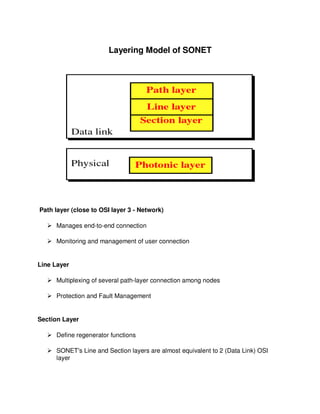
Layering Model of SONET


Path layer (close to OSI layer 3 - Network)

     Manages end-to-end connection

     Monitoring and management of user connection


Line Layer

     Multiplexing of several path-layer connection among nodes

     Protection and Fault Management


Section Layer

     Define regenerator functions

     SONET's Line and Section layers are almost equivalent to 2 (Data Link) OSI
     layer
Photonic Layer (same as OSI layer 1)

      Defines all the transmission requirements of signals.


The differences between SDH and SONET


SDH stands for synchronous digital hierarchy. SDH is the synchronous technology used
everywhere except the US, Canada and Japan. Development of this international
counterpart to SONET began a few years after SONET.

The differences between SONET and SDH are based primarily on the different
synchronous bit rates that must be mapped into them. In developing these two
technologies, there was a need to integrate existing transmission techniques in order to
enable network operators to gradually introduce SONET and SDH.

Because the highest-order commonly used multiplex signal in N.A. is 45 Mb/s,51 Mb/s
was a sufficient synchronous primary rate for virtually any SONET application. However
in the rest of the world, where 140 Mb/s mux signals are very common, 155 Mb/s (STM-
1) was chosen as the primary synchronous mux rate. This bit rate is exactly the same
as the STS-3 or OC-3 bit rate.

Cn assignment

  • 1.
    ASSIGNMENT COMPUTER NETWORKS Submitted To: - Submitted By: - Mr. Yogesh Soumya Subhadarshi Behera CSE Lecturer 1826 B.Tech 6th Sem
  • 2.
    Synchronous optical networking/SynchronousDigital Hierarchy Synchronous Optical Networking (SONET) and Synchronous Digital Hierarchy (SDH) are standardized multiplexing protocols that transfer multiple digital bit streams over optical fiber using lasers or highly coherent light from light-emitting diodes (LEDs). At low transmission rates data can also be transferred via an electrical interface. The method was developed to replace the Plesiochronous Digital Hierarchy (PDH) system for transporting large amounts of telephone calls and data traffic over the same fiber without synchronization problems. SONET and SDH, which are essentially the same, were originally designed to transport circuit mode communications (e.g., DS1, DS3) from a variety of different sources, but they were primarily designed to support real-time, uncompressed, circuit-switched voice encoded in PCM format.[3] The primary difficulty in doing this prior to SONET/SDH was that the synchronization sources of these various circuits were different. This meant that each circuit was actually operating at a slightly different rate and with different phase. SONET/SDH allowed for the simultaneous transport of many different circuits of differing origin within a single framing protocol. SONET/SDH is not itself a communications protocol per se, but a transport protocol. Due to SONET/SDH's essential protocol neutrality and transport-oriented features, SONET/SDH was the obvious choice for transporting the fixed length Asynchronous Transfer Mode (ATM) frames also known as cells. It quickly evolved mapping structures and concatenated payload containers to transport ATM connections. In other words, for ATM (and eventually other protocols such as Ethernet), the internal complex structure previously used to transport circuit-oriented connections was removed and replaced with a large and concatenated frame (such as OC-3c) into which ATM cells, IP packets, or Ethernet frames are placed. The SDH standard was originally defined by the European Telecommunications Standards Institute (ETSI), and is formalized as International Telecommunication Union (ITU) standards G.707,[4] G.783,[5] G.784,[6] and G.803.[7][8] The SONET standard was defined by Telcordia[1] and American National Standards Institute (ANSI) standard T1.105. FEATURES OF SONET/SDH :- High transmission rates Transmission rates of up to 40 Gb/s can be achieved in modern SONET systems making it the most suitable technology for backbones - the superhighways in today's telecommunications networks. Simplified add and drop function Compared to the older DSn system, low bit rate channels can be easily extracted from and inserted into the high-speed bit streams in SONET. It is now no longer necessary to apply the complex and costly procedure of demultiplexing then remultiplexing the plesiochronous structure.
  • 3.
    High availability andcapacity matching With SONET, network providers can react quickly and easily to the requirements of their customers. For example, leased lines can be switched in a matter of minutes. The network provider can use standardized network elements (NE) that can be controlled and monitored from a central location via a telecommunications management network (TMN) system. Reliability Modern SONET networks include various automatic back-up circuit and repair mechanisms which are designed to cope with system faults and are monitored by management. As a result, failure of a link or an NE does not lead to failure of the entire network. Future-proof platform for new services SONET is the ideal platform for a wide range of services including POTS, ISDN, mobile radio, and data communications (LAN, WAN, etc.). It is also able to handle more recent services such as video on demand and digital video broadcasting via ATM. Interconnection SONET makes it much easier to set up gateways between different network providers and to SDH systems. The SONET interfaces are globally standardized, making it possible to combine NEs from different manufacturers into a single network thus reducing equipment costs. The trend in transport networks is toward ever-higher bit rates, such as OC768 (time division multiplex, TDM). The current high costs of such NEs however are a restricting factor. The alternative lies in dense wavelength division multiplexing (DWDM), a technology enabling the multiple use of single-mode optical fibers. As a result, a number of wavelengths can be used as carriers for the digital signals and transmitted simultaneously through the fibers. Main goals of SONET/SDH: Fault tolerance of telecom providers requirement (99.999% - five nines - availability) Interoperability among different manufacturers Flexibility of upper layer formats to adapt to different source (not only voice) Complex monitoring capabilities of performance and of traffic (50 ms of recovery time)
  • 4.
    Layering Model ofSONET Path layer (close to OSI layer 3 - Network) Manages end-to-end connection Monitoring and management of user connection Line Layer Multiplexing of several path-layer connection among nodes Protection and Fault Management Section Layer Define regenerator functions SONET's Line and Section layers are almost equivalent to 2 (Data Link) OSI layer
  • 5.
    Photonic Layer (sameas OSI layer 1) Defines all the transmission requirements of signals. The differences between SDH and SONET SDH stands for synchronous digital hierarchy. SDH is the synchronous technology used everywhere except the US, Canada and Japan. Development of this international counterpart to SONET began a few years after SONET. The differences between SONET and SDH are based primarily on the different synchronous bit rates that must be mapped into them. In developing these two technologies, there was a need to integrate existing transmission techniques in order to enable network operators to gradually introduce SONET and SDH. Because the highest-order commonly used multiplex signal in N.A. is 45 Mb/s,51 Mb/s was a sufficient synchronous primary rate for virtually any SONET application. However in the rest of the world, where 140 Mb/s mux signals are very common, 155 Mb/s (STM- 1) was chosen as the primary synchronous mux rate. This bit rate is exactly the same as the STS-3 or OC-3 bit rate.