
Corona Prediction from
Symptoms
Contribution: Team Members
Introduction
01
2
Agenda Corona Prediction from Symptoms
State of the Art
02
Methodology / System Diagram
03
Training & Testing Corpus
04
Result & Discussion
05
Future Work
06
Real Time System Demonstration
07
Conclusion
08
Introduction
Presenting By
Kushol Tahsin Alam (012192018)
Sabina Yasmin (012181002)
3
Coronavirus & Prevention
“Coronavirus Disease- 2019”, is a respiratory illness caused by the
severe acute respiratory syndrome coronavirus-2 (SARS-CoV-2).
● First reported to affect human life in Wuhan City, in the
Hubei province of China in December 2019
● Later, spread like wildfire throughout the rest of the world,
marking its presence in 235 countries & independent
territories with confirmed death of 9,67,164 [1]
● Immediate Countermeasures are highly need to curb this
catastrophic effects
Algorithms
That Can Be Used To Solve This Problem
● Similarity Based Algorithm
● Machine Learning Algorithm
● Deep Learning Algorithm
Introduction
4
Corona Prediction from Symptoms
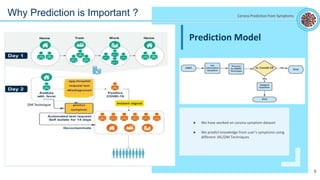
Prediction Model
● We have worked on corona symptom dataset
● We predict knowledge from user's symptoms using
different ML/DM Techniques
Why Prediction is Important ?
5
Corona Prediction from Symptoms
State of the Art
Presenting By
Dipongker Sen (012191010)
Parvin Akter (012193013)
6
State of the Art
State-of-the-art (SoTA) is a step to demonstrate the novelty of your
research results.
● Less work is being done on and predicting using text data.
● The major problem in the identification of COVID-19 is
detection and diagnosis.
● Different prediction models are built using machine learning
algorithms
Recent Studies on COVID Data
Data Types Algorithm Findings
Blood test report and
symptoms
CNN, LR Accuracy:
CNN (77%), LR (71%)
Based on age group [24] Random Forest Regressor
Random Forest Classifier
Accuracy: 96.6%
CT images [22] Neural Network Accuracy: 93.9%
Textual clinical data [23] Naïve Bayesian
Classification
Accuracy: 96.2%
Precision: 94%
Recall: 96%
7
Corona Prediction from Symptoms
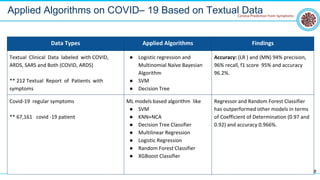
Applied Algorithms on COVID– 19 Based on Textual Data
Data Types Applied Algorithms Findings
Textual Clinical Data labeled with COVID,
ARDS, SARS and Both (COVID, ARDS)
** 212 Textual Report of Patients with
symptoms
● Logistic regression and
Multinomial Naïve Bayesian
Algorithm
● SVM
● Decision Tree
Accuracy: (LR ) and (MN) 94% precision,
96% recall, f1 score 95% and accuracy
96.2%.
Covid-19 regular symptoms
** 67,161 covid -19 patient
ML models based algorithm like
● SVM
● KNN+NCA
● Decision Tree Classifier
● Multilinear Regression
● Logistic Regression
● Random Forest Classifier
● XGBoost Classifier
Regressor and Random Forest Classifier
has outperformed other models in terms
of Coefficient of Determination (0.97 and
0.92) and accuracy 0.966%.
8
Corona Prediction from Symptoms
Presenting By
Farzana Sharmin (012202008)
Methodology
9
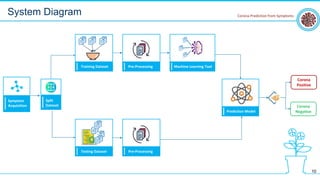
System Diagram
10
Corona Prediction from Symptoms
Symptom
Acquisition
Split
Dataset
Training Dataset
Testing Dataset
Pre-Processing Machine Learning Tool
Pre-Processing
Prediction Model
Corona
Positive
Corona
Negative
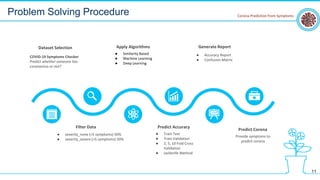
COVID-19 Symptoms Checker
Predict whether someone has
coronavirus or not?
Dataset Selection
● severity_none (<5 symptoms) 50%
● severity_severe (>5 symptoms) 50%
Filter Data
● Train Test
● Train Validation
● 2, 5, 10 Fold Cross
Validation
● Jackknife Method
Predict Accuracy
● Similarity Based
● Machine Learning
● Deep Learning
Apply Algorithms
● Accuracy Report
● Confusion Matrix
Generate Report
Provide symptoms to
predict corona
Predict Corona
Problem Solving Procedure
11
Corona Prediction from Symptoms
Presenting By
Toufiqur Rahman (012201030)
Testing - Training
Corpus
12
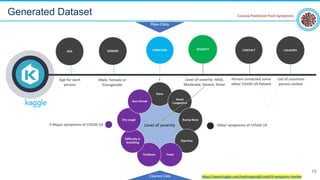
Generated Dataset
13
Corona Prediction from Symptoms
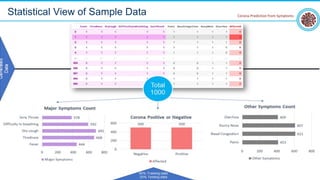
Statistical View of Sample Data
15
Corona Prediction from Symptoms
Result &
Discussion
Presenting By
Rana Md Shahariar Parbez (012192030)
Suchita Sultana (012193016)
16
Bagging (Random Forest)
Boosting (XGB Classifier)
Bagging, Boosting
59% Accuracy
Naïve Bayes (Multinomial)
50000 Data, 2 Classes
SVM, KNN
1 Hidden Layer, 70000 Epochs, 1000 Data
Multi-Layer Neural Network
Linear Regression, Logistic Regression
50000 Data, 2 Classes
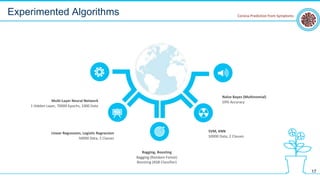
Experimented Algorithms
17
Corona Prediction from Symptoms
18
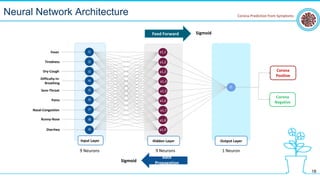
Neural Network Architecture Corona Prediction from Symptoms
Input Layer Hidden Layer Output Layer
Fever
Tiredness
Dry-Cough
Difficulty-in-
Breathing
Pains
Nasal-Congestion
Runny-Nose
Sore-Throat
Diarrhea
Corona
Positive
Corona
Negative
9 Neurons 9 Neurons 1 Neuron
Feed Forward
Back
Propagation
a1,1
a1,2
a1,3
a1,4
a1,5
a1,6
a1,7
a1,8
a1,9
I1
I2
I3
I4
I5
I6
I7
I8
I9
O
Sigmoid
Sigmoid
VS
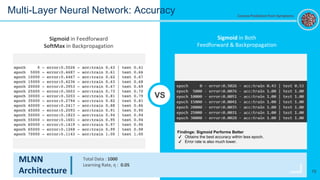
Sigmoid in Feedforward
SoftMax in Backpropagation
Sigmoid in Both
Feedforward & Backpropagation
Findings: Sigmoid Performs Better
✔ Obtains the best accuracy within less epoch.
✔ Error rate is also much lower.
Multi-Layer Neural Network: Accuracy
MLNN
Architecture
Total Data : 1000
Learning Rate, η : 0.05
19
Corona Prediction from Symptoms
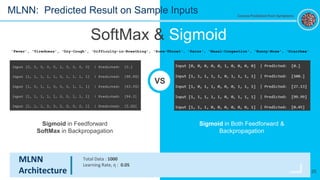
SoftMax & Sigmoid
VS
Sigmoid in Feedforward
SoftMax in Backpropagation
Sigmoid in Both Feedforward &
Backpropagation
20
MLNN: Predicted Result on Sample Inputs
'Fever', 'Tiredness', 'Dry-Cough', 'Difficulty-in-Breathing', 'Sore-Throat', 'Pains', 'Nasal-Congestion', 'Runny-Nose', 'Diarrhea'
20
MLNN
Architecture
Total Data : 1000
Learning Rate, η : 0.05
Corona Prediction from Symptoms
21
MLNN
Architecture
Total Data : 30,000
Learning Rate, η : 0.0015 instead of 0.05
Activation Function : Sigmoid in Both Feedforward & Backpropagation
MLNN: Larger Dataset with Tuned Learning Rate
Accuracy Predicted Result
Input [0, 0, 0, 0, 0, 0, 0, 0, 0] | Predicted: [0.]
Input [1, 1, 1, 1, 1, 1, 1, 1, 1] | Predicted: [100.]
Input [1, 0, 1, 1, 0, 0, 1, 1, 1] | Predicted: [99.84]
Input [1, 1, 1, 1, 1, 0, 1, 1, 1] | Predicted: [100.]
Input [1, 1, 1, 0, 0, 0, 0, 0, 1] | Predicted: [0.57]
epoch 0 - error:0.5010 - acc:train 0.50 | test 0.50
epoch 5000 - error:0.0082 - acc:train 1.00 | test 1.00
epoch 10000 - error:0.0057 - acc:train 1.00 | test 1.00
epoch 15000 - error:0.0046 - acc:train 1.00 | test 1.00
epoch 20000 - error:0.0040 - acc:train 1.00 | test 1.00
epoch 25000 - error:0.0036 - acc:train 1.00 | test 1.00
epoch 30000 - error:0.0032 - acc:train 1.00 | test 1.00
Corona Prediction from Symptoms
Predicted result by
different algorithms.
Predicted Result
Input [0, 0, 0, 0, 0, 1, 0, 0, 0, 0] | Predicted: [0.]
Input [1, 1, 1, 1, 1, 0, 1, 1, 1, 1] | Predicted: [98.89]
Input [1, 0, 1, 1, 0, 0, 0, 1, 1, 1] | Predicted: [63.59]
Input [1, 1, 1, 1, 1, 0, 0, 1, 1, 1] | Predicted: [94.3]
Input [1, 1, 1, 0, 0, 0, 0, 0, 0, 1] | Predicted: [5.26]
Multi Layer Neural Network
Input [0, 0, 0, 0, 0, 1, 0, 0, 0, 0] | Predicted: [1]
Input [1, 1, 1, 1, 1, 0, 1, 1, 1, 1] | Predicted: [0]
Input [1, 0, 1, 1, 0, 0, 0, 1, 1, 1] | Predicted: [0]
Input [1, 1, 1, 1, 1, 0, 0, 1, 1, 1] | Predicted: [0]
Input [1, 1, 1, 0, 0, 0, 0, 0, 0, 1] | Predicted: [1]
Naïve Bayes Classifier (Multinomial)
Input [0, 0, 0, 0, 0, 1, 0, 0, 0, 0] | Predicted: [1.]
Input [1, 1, 1, 1, 1, 0, 1, 1, 1, 1] | Predicted: [0.]
Input [1, 0, 1, 1, 0, 0, 0, 1, 1, 1] | Predicted: [0.]
Input [1, 1, 1, 1, 1, 0, 0, 1, 1, 1] | Predicted: [0.]
Input [1, 1, 1, 0, 0, 0, 0, 0, 0, 1] | Predicted: [1.]
KNN (Regression)
Input [0, 0, 0, 0, 0, 1, 0, 0, 0, 0] | Predicted: [False]
Input [1, 1, 1, 1, 1, 0, 1, 1, 1, 1] | Predicted: [ True]
Input [1, 0, 1, 1, 0, 0, 0, 1, 1, 1] | Predicted: [ True]
Input [1, 1, 1, 1, 1, 0, 0, 1, 1, 1] | Predicted: [ True]
Input [1, 1, 1, 0, 0, 0, 0, 0, 0, 1] | Predicted: [False]
Linear Regression
22
'Fever', 'Tiredness', 'Dry-Cough', 'Difficulty-in-Breathing', 'Sore-Throat', 'Pains', 'Nasal-
Congestion', 'Runny-Nose', 'Diarrhea'
Predicted Results: Other Algorithms Corona Prediction from Symptoms
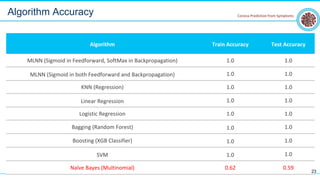
Algorithm Train Accuracy Test Accuracy
MLNN (Sigmoid in Feedforward, SoftMax in Backpropagation) 1.0 1.0
MLNN (Sigmoid in both Feedforward and Backpropagation) 1.0 1.0
KNN (Regression) 1.0 1.0
Linear Regression 1.0 1.0
Logistic Regression 1.0 1.0
Bagging (Random Forest) 1.0 1.0
Boosting (XGB Classifier) 1.0 1.0
SVM 1.0 1.0
Naïve Bayes (Multinomial) 0.62 0.59
Algorithm Accuracy
23
Corona Prediction from Symptoms
2-Fold Cross Validation 5-Fold Cross Validation
Multi Layer Neural Network:
[0.9925, 0.995]
Naïve Bayesian Classifier
[0.6175, 0.63]
Multi Layer Neural Network:
[1.0, 0.99375, 0.98125, 0.99375, 1.0]
Naïve Bayesian Classifier
[0.5625, 0.6625, 0.64375, 0.66875, 0.5625]
Multi Layer Neural Network:
[1.0, 1.0, 1.0, 0.9875, 0.975, 0.9875, 1.0, 0.9875, 1.0, 1.0]
Naïve Bayesian Classifier
[0.6, 0.5, 0.6125, 0.6875, 0.625, 0.6625, 0.6875, 0.6375,
0.5875, 0.5375]
24
Validation: K-Fold Cross Validation
10-Fold Cross Validation
Corona Prediction from Symptoms
2-Fold Cross Validation 5-Fold Cross Validation
[0.6175, 0.63]
Naïve Bayesian Classifier
[0.5625, 0.6625, 0.64375, 0.66875, 0.5625]
Validation: Jackknife Method
10-Fold Cross Validation
● Multi Layer Neural Network (MLNN)
● K-Nearest Neighbour (KNN)
● Support Vector Machine (SVM)
● Linear Regression (LR)
● Logistic Regression
● Random Forest (RM)
● XGB Classifier
Algorithms
25
Naive
Bayesian
Classifier
Corona Prediction from Symptoms
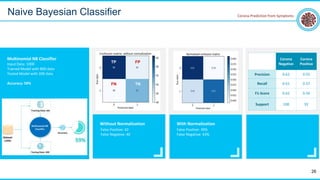
● Validation Applied for 1000
data
● All Algorithms except NB
provides same validation result
Input Data: 1000
Trained Model with 800 data
Tested Model with 200 data
Accuracy: 59%
Multinomial NB Classifier Corona
Negative
Corona
Positive
Precision 0.62 0.55
Recall 0.61 0.57
F1-Score 0.62 0.56
Support 108 92
False Positive: 42
False Negative: 40
Without Normalization
False Positive: 39%
False Negative: 43%
With Normalization
Naive Bayesian Classifier
26
Corona Prediction from Symptoms
TP
TN
FP
FN
Future Work
Presenting By
Suchita Sultana (012193016)
2
Statistical analysis on
user’s testing in our
system.
3
Take clinical symptoms
(Pulse Rate, Oxygen Level,
Blood Pressure, Chest X-
Ray, CT scan) to provide
better and reliable
accuracy.
4
Develop our algorithm
(modified version) and publish a
research paper.
1
Apply our system on real
data.
28
Future Work Corona Prediction from Symptoms
29
Real-Time
System Demonstration
Presenting By
Md. Abu Raihan Srabon(012201024)
http://covid.lazycoder.ninja/
30
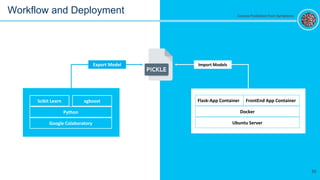
Workflow and Deployment
30
Corona Prediction from Symptoms
Google Colaboratory
Python
Scikit Learn xgboost
Ubuntu Server
Docker
Flask-App Container FrontEnd App Container
Export Model Import Models
31
Conclusion
Presenting By
Md. Abu Raihan Srabon(012201024)
[1] N. Chen et al., “Epidemiological and clinical characteristics of 99 cases of 2019 novel coronavirus pneumonia in Wuhan, China: a descriptive study,” Lancet, vol. 395, no. 10223, pp. 507–513, 2020, doi: 10.1016/S0140-
6736(20)30211-7.
[2] S. J. Fong, N. Dey, and J. Chaki, “Artificial Intelligence for Coronavirus Outbreak,” An Introd. to COVID-19, pp. 1–22, 2021, doi: 10.1007/978-981-15-5936-5.
[3] C. Menni et al., “Real-time tracking of self-reported symptoms to predict potential COVID-19,” Nat. Med., vol. 26, no. 7, pp. 1037–1040, 2020, doi: 10.1038/s41591-020-0916-2.
[4] Y. Lecun, Y. Bengio, and G. Hinton, “Deep learning,” Nature, vol. 521, no. 7553, pp. 436–444, 2015, doi: 10.1038/nature14539.
[5] V. Chamola, V. Hassija, V. Gupta, and M. Guizani, “A Comprehensive Review of the COVID-19 Pandemic and the Role of IoT, Drones, AI, Blockchain, and 5G in Managing its Impact,” IEEE Access, vol. 8, no. April, pp. 90225–
90265, 2020, doi: 10.1109/ACCESS.2020.2992341.
[6] X. Zhang, J. Kim, R. E. Patzer, S. R. Pitts, A. Patzer, and J. D. Schrager, “Prediction of emergency department hospital admission based on natural language processing and neural networks,” Methods Inf. Med., vol. 56, no. 5,
pp. 377–389, 2017, doi: 10.3414/ME17-01-0024.
[7] W. Naudé, “Artificial intelligence vs COVID-19: limitations, constraints and pitfalls,” AI Soc., vol. 35, no. 3, pp. 761–765, 2020, doi: 10.1007/s00146-020-00978-0.
[8] S. Lalmuanawma, J. Hussain, and L. Chhakchhuak, “Applications of machine learning and artificial intelligence for Covid-19 (SARS-CoV-2) pandemic: A review,” Chaos, Solitons and Fractals, vol. 139, 2020, doi:
10.1016/j.chaos.2020.110059.
[9] M. M. Ahamad et al., “A machine learning model to identify early stage symptoms of SARS-Cov-2 infected patients,” Expert Syst. Appl., vol. 160, p. 113661, 2020, doi: 10.1016/j.eswa.2020.113661.
[10] M. E. H. Chowdhury et al., “Can AI Help in Screening Viral and COVID-19 Pneumonia?,” IEEE Access, vol. 8, pp. 132665–132676, 2020, doi: 10.1109/ACCESS.2020.3010287.
[11] E. J. Chow et al., “Symptom Screening at Illness Onset of Health Care Personnel with SARS-CoV-2 Infection in King County, Washington,” JAMA - J. Am. Med. Assoc., vol. 323, no. 20, pp. 2087–2089, 2020, doi:
10.1001/jama.2020.6637.
[12] D. Wang et al., “Clinical Characteristics of 138 Hospitalized Patients with 2019 Novel Coronavirus-Infected Pneumonia in Wuhan, China,” JAMA - J. Am. Med. Assoc., vol. 323, no. 11, pp. 1061–1069, 2020, doi:
10.1001/jama.2020.1585.
[13] H. Swapnarekha, H. S. Behera, J. Nayak, and B. Naik, “Role of intelligent computing in COVID-19 prognosis: A state-of-the-art review,” Chaos, Solitons and Fractals, vol. 138, p. 109947, 2020, doi:
10.1016/j.chaos.2020.109947.
[14] D. A. Drew et al., “Rapid implementation of mobile technology for real-time epidemiology of COVID-19,” Science (80-. )., vol. 368, no. 6497, pp. 1362–1367, 2020, doi: 10.1126/science.abc0473.
[15] A. Bansal, R. P. Padappayil, C. Garg, A. Singal, M. Gupta, and A. Klein, “Utility of Artificial Intelligence Amidst the COVID 19 Pandemic: A Review,” J. Med. Syst., vol. 44, no. 9, pp. 19–24, 2020, doi: 10.1007/s10916-020-
01617-3.
[16] J. S. Obeid, M. Davis, M. Turner, S. M. Meystre, P. M. Heider, and L. A. Lenert, “An AI approach to COVID-19 infection risk assessment in virtual visits: a case report,” J. Am. Med. Informatics Assoc., vol. 0, no. May, pp. 1–5,
2020, doi: 10.1093/jamia/ocaa105.
[17] Q. V. Pham, D. C. Nguyen, T. Huynh-The, W. J. Hwang, and P. N. Pathirana, “Artificial Intelligence (AI) and Big Data for Coronavirus (COVID-19) Pandemic: A Survey on the State-of-the-Arts,” IEEE Access, vol. 8, no. Cdc, pp.
130820–130839, 2020, doi: 10.1109/ACCESS.2020.3009328.
[18] C. Huang et al., “Clinical features of patients infected with 2019 novel coronavirus in Wuhan, China,” Lancet, vol. 395, no. 10223, pp. 497–506, 2020, doi: 10.1016/S0140-6736(20)30183-5.
[19] H. Jelodar, Y. Wang, R. Orji, and H. Huang, “Deep Sentiment Classification and Topic Discovery on Novel Coronavirus or COVID-19 Online Discussions: NLP Using LSTM Recurrent Neural Network Approach,” IEEE J. Biomed.
Heal. Informatics, vol. 2194, no. c, pp. 1–1, 2020, doi: 10.1109/jbhi.2020.3001216.
[20] M. Jamshidi et al., “Artificial Intelligence and COVID-19: Deep Learning Approaches for Diagnosis and Treatment,” IEEE Access, vol. 8, no. December 2019, pp. 109581–109595, 2020, doi: 10.1109/ACCESS.2020.3001973.
[21] X. Jiang et al., “Towards an artificial intelligence framework for data-driven prediction of coronavirus clinical severity,” 2020.
[22] H. Kang et al., “Diagnosis of Coronavirus Disease 2019 (COVID-19) with Structured Latent Multi-View Representation Learning,” IEEE Trans. Med. Imaging, vol. 39, no. 8, pp. 2606–2614, 2020, doi:
10.1109/TMI.2020.2992546.
[23] A. M. U. D. Khanday, S. T. Rabani, Q. R. Khan, N. Rouf, and M. Mohi Ud Din, “Machine learning based approaches for detecting COVID-19 using clinical text data,” Int. J. Inf. Technol., vol. 12, no. 3, pp. 731–739, 2020, doi:
10.1007/s41870-020-00495-9.
[24] J. Wu et al., “Rapid and accurate identification of COVID-19 infection through machine learning based on clinical available blood test results,” 2020, doi: 10.1101/2020.04.02.20051136.
[25] “Coronavirus disease (COVID-19) Pandemic.” [Online]. Available:https://www.who.int/emergencies/diseases/novel-coronavirus-2019
32
References Corona Prediction from Symptoms
Thank you
33

Corona prediction from symptoms v1.4

  • 1.
  • 2.
    Introduction 01 2 Agenda Corona Predictionfrom Symptoms State of the Art 02 Methodology / System Diagram 03 Training & Testing Corpus 04 Result & Discussion 05 Future Work 06 Real Time System Demonstration 07 Conclusion 08
  • 3.
    Introduction Presenting By Kushol TahsinAlam (012192018) Sabina Yasmin (012181002) 3
  • 4.
    Coronavirus & Prevention “CoronavirusDisease- 2019”, is a respiratory illness caused by the severe acute respiratory syndrome coronavirus-2 (SARS-CoV-2). ● First reported to affect human life in Wuhan City, in the Hubei province of China in December 2019 ● Later, spread like wildfire throughout the rest of the world, marking its presence in 235 countries & independent territories with confirmed death of 9,67,164 [1] ● Immediate Countermeasures are highly need to curb this catastrophic effects Algorithms That Can Be Used To Solve This Problem ● Similarity Based Algorithm ● Machine Learning Algorithm ● Deep Learning Algorithm Introduction 4 Corona Prediction from Symptoms
  • 5.
    Prediction Model ● Wehave worked on corona symptom dataset ● We predict knowledge from user's symptoms using different ML/DM Techniques Why Prediction is Important ? 5 Corona Prediction from Symptoms
  • 6.
    State of theArt Presenting By Dipongker Sen (012191010) Parvin Akter (012193013) 6
  • 7.
    State of theArt State-of-the-art (SoTA) is a step to demonstrate the novelty of your research results. ● Less work is being done on and predicting using text data. ● The major problem in the identification of COVID-19 is detection and diagnosis. ● Different prediction models are built using machine learning algorithms Recent Studies on COVID Data Data Types Algorithm Findings Blood test report and symptoms CNN, LR Accuracy: CNN (77%), LR (71%) Based on age group [24] Random Forest Regressor Random Forest Classifier Accuracy: 96.6% CT images [22] Neural Network Accuracy: 93.9% Textual clinical data [23] Naïve Bayesian Classification Accuracy: 96.2% Precision: 94% Recall: 96% 7 Corona Prediction from Symptoms
  • 8.
    Applied Algorithms onCOVID– 19 Based on Textual Data Data Types Applied Algorithms Findings Textual Clinical Data labeled with COVID, ARDS, SARS and Both (COVID, ARDS) ** 212 Textual Report of Patients with symptoms ● Logistic regression and Multinomial Naïve Bayesian Algorithm ● SVM ● Decision Tree Accuracy: (LR ) and (MN) 94% precision, 96% recall, f1 score 95% and accuracy 96.2%. Covid-19 regular symptoms ** 67,161 covid -19 patient ML models based algorithm like ● SVM ● KNN+NCA ● Decision Tree Classifier ● Multilinear Regression ● Logistic Regression ● Random Forest Classifier ● XGBoost Classifier Regressor and Random Forest Classifier has outperformed other models in terms of Coefficient of Determination (0.97 and 0.92) and accuracy 0.966%. 8 Corona Prediction from Symptoms
  • 9.
    Presenting By Farzana Sharmin(012202008) Methodology 9
  • 10.
    System Diagram 10 Corona Predictionfrom Symptoms Symptom Acquisition Split Dataset Training Dataset Testing Dataset Pre-Processing Machine Learning Tool Pre-Processing Prediction Model Corona Positive Corona Negative
  • 11.
    COVID-19 Symptoms Checker Predictwhether someone has coronavirus or not? Dataset Selection ● severity_none (<5 symptoms) 50% ● severity_severe (>5 symptoms) 50% Filter Data ● Train Test ● Train Validation ● 2, 5, 10 Fold Cross Validation ● Jackknife Method Predict Accuracy ● Similarity Based ● Machine Learning ● Deep Learning Apply Algorithms ● Accuracy Report ● Confusion Matrix Generate Report Provide symptoms to predict corona Predict Corona Problem Solving Procedure 11 Corona Prediction from Symptoms
  • 12.
    Presenting By Toufiqur Rahman(012201030) Testing - Training Corpus 12
  • 13.
  • 14.
    Statistical View ofSample Data 15 Corona Prediction from Symptoms
  • 15.
    Result & Discussion Presenting By RanaMd Shahariar Parbez (012192030) Suchita Sultana (012193016) 16
  • 16.
    Bagging (Random Forest) Boosting(XGB Classifier) Bagging, Boosting 59% Accuracy Naïve Bayes (Multinomial) 50000 Data, 2 Classes SVM, KNN 1 Hidden Layer, 70000 Epochs, 1000 Data Multi-Layer Neural Network Linear Regression, Logistic Regression 50000 Data, 2 Classes Experimented Algorithms 17 Corona Prediction from Symptoms
  • 17.
    18 Neural Network ArchitectureCorona Prediction from Symptoms Input Layer Hidden Layer Output Layer Fever Tiredness Dry-Cough Difficulty-in- Breathing Pains Nasal-Congestion Runny-Nose Sore-Throat Diarrhea Corona Positive Corona Negative 9 Neurons 9 Neurons 1 Neuron Feed Forward Back Propagation a1,1 a1,2 a1,3 a1,4 a1,5 a1,6 a1,7 a1,8 a1,9 I1 I2 I3 I4 I5 I6 I7 I8 I9 O Sigmoid Sigmoid
  • 18.
    VS Sigmoid in Feedforward SoftMaxin Backpropagation Sigmoid in Both Feedforward & Backpropagation Findings: Sigmoid Performs Better ✔ Obtains the best accuracy within less epoch. ✔ Error rate is also much lower. Multi-Layer Neural Network: Accuracy MLNN Architecture Total Data : 1000 Learning Rate, η : 0.05 19 Corona Prediction from Symptoms
  • 19.
    SoftMax & Sigmoid VS Sigmoidin Feedforward SoftMax in Backpropagation Sigmoid in Both Feedforward & Backpropagation 20 MLNN: Predicted Result on Sample Inputs 'Fever', 'Tiredness', 'Dry-Cough', 'Difficulty-in-Breathing', 'Sore-Throat', 'Pains', 'Nasal-Congestion', 'Runny-Nose', 'Diarrhea' 20 MLNN Architecture Total Data : 1000 Learning Rate, η : 0.05 Corona Prediction from Symptoms
  • 20.
    21 MLNN Architecture Total Data :30,000 Learning Rate, η : 0.0015 instead of 0.05 Activation Function : Sigmoid in Both Feedforward & Backpropagation MLNN: Larger Dataset with Tuned Learning Rate Accuracy Predicted Result Input [0, 0, 0, 0, 0, 0, 0, 0, 0] | Predicted: [0.] Input [1, 1, 1, 1, 1, 1, 1, 1, 1] | Predicted: [100.] Input [1, 0, 1, 1, 0, 0, 1, 1, 1] | Predicted: [99.84] Input [1, 1, 1, 1, 1, 0, 1, 1, 1] | Predicted: [100.] Input [1, 1, 1, 0, 0, 0, 0, 0, 1] | Predicted: [0.57] epoch 0 - error:0.5010 - acc:train 0.50 | test 0.50 epoch 5000 - error:0.0082 - acc:train 1.00 | test 1.00 epoch 10000 - error:0.0057 - acc:train 1.00 | test 1.00 epoch 15000 - error:0.0046 - acc:train 1.00 | test 1.00 epoch 20000 - error:0.0040 - acc:train 1.00 | test 1.00 epoch 25000 - error:0.0036 - acc:train 1.00 | test 1.00 epoch 30000 - error:0.0032 - acc:train 1.00 | test 1.00 Corona Prediction from Symptoms
  • 21.
    Predicted result by differentalgorithms. Predicted Result Input [0, 0, 0, 0, 0, 1, 0, 0, 0, 0] | Predicted: [0.] Input [1, 1, 1, 1, 1, 0, 1, 1, 1, 1] | Predicted: [98.89] Input [1, 0, 1, 1, 0, 0, 0, 1, 1, 1] | Predicted: [63.59] Input [1, 1, 1, 1, 1, 0, 0, 1, 1, 1] | Predicted: [94.3] Input [1, 1, 1, 0, 0, 0, 0, 0, 0, 1] | Predicted: [5.26] Multi Layer Neural Network Input [0, 0, 0, 0, 0, 1, 0, 0, 0, 0] | Predicted: [1] Input [1, 1, 1, 1, 1, 0, 1, 1, 1, 1] | Predicted: [0] Input [1, 0, 1, 1, 0, 0, 0, 1, 1, 1] | Predicted: [0] Input [1, 1, 1, 1, 1, 0, 0, 1, 1, 1] | Predicted: [0] Input [1, 1, 1, 0, 0, 0, 0, 0, 0, 1] | Predicted: [1] Naïve Bayes Classifier (Multinomial) Input [0, 0, 0, 0, 0, 1, 0, 0, 0, 0] | Predicted: [1.] Input [1, 1, 1, 1, 1, 0, 1, 1, 1, 1] | Predicted: [0.] Input [1, 0, 1, 1, 0, 0, 0, 1, 1, 1] | Predicted: [0.] Input [1, 1, 1, 1, 1, 0, 0, 1, 1, 1] | Predicted: [0.] Input [1, 1, 1, 0, 0, 0, 0, 0, 0, 1] | Predicted: [1.] KNN (Regression) Input [0, 0, 0, 0, 0, 1, 0, 0, 0, 0] | Predicted: [False] Input [1, 1, 1, 1, 1, 0, 1, 1, 1, 1] | Predicted: [ True] Input [1, 0, 1, 1, 0, 0, 0, 1, 1, 1] | Predicted: [ True] Input [1, 1, 1, 1, 1, 0, 0, 1, 1, 1] | Predicted: [ True] Input [1, 1, 1, 0, 0, 0, 0, 0, 0, 1] | Predicted: [False] Linear Regression 22 'Fever', 'Tiredness', 'Dry-Cough', 'Difficulty-in-Breathing', 'Sore-Throat', 'Pains', 'Nasal- Congestion', 'Runny-Nose', 'Diarrhea' Predicted Results: Other Algorithms Corona Prediction from Symptoms
  • 22.
    Algorithm Train AccuracyTest Accuracy MLNN (Sigmoid in Feedforward, SoftMax in Backpropagation) 1.0 1.0 MLNN (Sigmoid in both Feedforward and Backpropagation) 1.0 1.0 KNN (Regression) 1.0 1.0 Linear Regression 1.0 1.0 Logistic Regression 1.0 1.0 Bagging (Random Forest) 1.0 1.0 Boosting (XGB Classifier) 1.0 1.0 SVM 1.0 1.0 Naïve Bayes (Multinomial) 0.62 0.59 Algorithm Accuracy 23 Corona Prediction from Symptoms
  • 23.
    2-Fold Cross Validation5-Fold Cross Validation Multi Layer Neural Network: [0.9925, 0.995] Naïve Bayesian Classifier [0.6175, 0.63] Multi Layer Neural Network: [1.0, 0.99375, 0.98125, 0.99375, 1.0] Naïve Bayesian Classifier [0.5625, 0.6625, 0.64375, 0.66875, 0.5625] Multi Layer Neural Network: [1.0, 1.0, 1.0, 0.9875, 0.975, 0.9875, 1.0, 0.9875, 1.0, 1.0] Naïve Bayesian Classifier [0.6, 0.5, 0.6125, 0.6875, 0.625, 0.6625, 0.6875, 0.6375, 0.5875, 0.5375] 24 Validation: K-Fold Cross Validation 10-Fold Cross Validation Corona Prediction from Symptoms
  • 24.
    2-Fold Cross Validation5-Fold Cross Validation [0.6175, 0.63] Naïve Bayesian Classifier [0.5625, 0.6625, 0.64375, 0.66875, 0.5625] Validation: Jackknife Method 10-Fold Cross Validation ● Multi Layer Neural Network (MLNN) ● K-Nearest Neighbour (KNN) ● Support Vector Machine (SVM) ● Linear Regression (LR) ● Logistic Regression ● Random Forest (RM) ● XGB Classifier Algorithms 25 Naive Bayesian Classifier Corona Prediction from Symptoms ● Validation Applied for 1000 data ● All Algorithms except NB provides same validation result
  • 25.
    Input Data: 1000 TrainedModel with 800 data Tested Model with 200 data Accuracy: 59% Multinomial NB Classifier Corona Negative Corona Positive Precision 0.62 0.55 Recall 0.61 0.57 F1-Score 0.62 0.56 Support 108 92 False Positive: 42 False Negative: 40 Without Normalization False Positive: 39% False Negative: 43% With Normalization Naive Bayesian Classifier 26 Corona Prediction from Symptoms TP TN FP FN
  • 26.
  • 27.
    2 Statistical analysis on user’stesting in our system. 3 Take clinical symptoms (Pulse Rate, Oxygen Level, Blood Pressure, Chest X- Ray, CT scan) to provide better and reliable accuracy. 4 Develop our algorithm (modified version) and publish a research paper. 1 Apply our system on real data. 28 Future Work Corona Prediction from Symptoms
  • 28.
    29 Real-Time System Demonstration Presenting By Md.Abu Raihan Srabon(012201024) http://covid.lazycoder.ninja/
  • 29.
    30 Workflow and Deployment 30 CoronaPrediction from Symptoms Google Colaboratory Python Scikit Learn xgboost Ubuntu Server Docker Flask-App Container FrontEnd App Container Export Model Import Models
  • 30.
    31 Conclusion Presenting By Md. AbuRaihan Srabon(012201024)
  • 31.
    [1] N. Chenet al., “Epidemiological and clinical characteristics of 99 cases of 2019 novel coronavirus pneumonia in Wuhan, China: a descriptive study,” Lancet, vol. 395, no. 10223, pp. 507–513, 2020, doi: 10.1016/S0140- 6736(20)30211-7. [2] S. J. Fong, N. Dey, and J. Chaki, “Artificial Intelligence for Coronavirus Outbreak,” An Introd. to COVID-19, pp. 1–22, 2021, doi: 10.1007/978-981-15-5936-5. [3] C. Menni et al., “Real-time tracking of self-reported symptoms to predict potential COVID-19,” Nat. Med., vol. 26, no. 7, pp. 1037–1040, 2020, doi: 10.1038/s41591-020-0916-2. [4] Y. Lecun, Y. Bengio, and G. Hinton, “Deep learning,” Nature, vol. 521, no. 7553, pp. 436–444, 2015, doi: 10.1038/nature14539. [5] V. Chamola, V. Hassija, V. Gupta, and M. Guizani, “A Comprehensive Review of the COVID-19 Pandemic and the Role of IoT, Drones, AI, Blockchain, and 5G in Managing its Impact,” IEEE Access, vol. 8, no. April, pp. 90225– 90265, 2020, doi: 10.1109/ACCESS.2020.2992341. [6] X. Zhang, J. Kim, R. E. Patzer, S. R. Pitts, A. Patzer, and J. D. Schrager, “Prediction of emergency department hospital admission based on natural language processing and neural networks,” Methods Inf. Med., vol. 56, no. 5, pp. 377–389, 2017, doi: 10.3414/ME17-01-0024. [7] W. Naudé, “Artificial intelligence vs COVID-19: limitations, constraints and pitfalls,” AI Soc., vol. 35, no. 3, pp. 761–765, 2020, doi: 10.1007/s00146-020-00978-0. [8] S. Lalmuanawma, J. Hussain, and L. Chhakchhuak, “Applications of machine learning and artificial intelligence for Covid-19 (SARS-CoV-2) pandemic: A review,” Chaos, Solitons and Fractals, vol. 139, 2020, doi: 10.1016/j.chaos.2020.110059. [9] M. M. Ahamad et al., “A machine learning model to identify early stage symptoms of SARS-Cov-2 infected patients,” Expert Syst. Appl., vol. 160, p. 113661, 2020, doi: 10.1016/j.eswa.2020.113661. [10] M. E. H. Chowdhury et al., “Can AI Help in Screening Viral and COVID-19 Pneumonia?,” IEEE Access, vol. 8, pp. 132665–132676, 2020, doi: 10.1109/ACCESS.2020.3010287. [11] E. J. Chow et al., “Symptom Screening at Illness Onset of Health Care Personnel with SARS-CoV-2 Infection in King County, Washington,” JAMA - J. Am. Med. Assoc., vol. 323, no. 20, pp. 2087–2089, 2020, doi: 10.1001/jama.2020.6637. [12] D. Wang et al., “Clinical Characteristics of 138 Hospitalized Patients with 2019 Novel Coronavirus-Infected Pneumonia in Wuhan, China,” JAMA - J. Am. Med. Assoc., vol. 323, no. 11, pp. 1061–1069, 2020, doi: 10.1001/jama.2020.1585. [13] H. Swapnarekha, H. S. Behera, J. Nayak, and B. Naik, “Role of intelligent computing in COVID-19 prognosis: A state-of-the-art review,” Chaos, Solitons and Fractals, vol. 138, p. 109947, 2020, doi: 10.1016/j.chaos.2020.109947. [14] D. A. Drew et al., “Rapid implementation of mobile technology for real-time epidemiology of COVID-19,” Science (80-. )., vol. 368, no. 6497, pp. 1362–1367, 2020, doi: 10.1126/science.abc0473. [15] A. Bansal, R. P. Padappayil, C. Garg, A. Singal, M. Gupta, and A. Klein, “Utility of Artificial Intelligence Amidst the COVID 19 Pandemic: A Review,” J. Med. Syst., vol. 44, no. 9, pp. 19–24, 2020, doi: 10.1007/s10916-020- 01617-3. [16] J. S. Obeid, M. Davis, M. Turner, S. M. Meystre, P. M. Heider, and L. A. Lenert, “An AI approach to COVID-19 infection risk assessment in virtual visits: a case report,” J. Am. Med. Informatics Assoc., vol. 0, no. May, pp. 1–5, 2020, doi: 10.1093/jamia/ocaa105. [17] Q. V. Pham, D. C. Nguyen, T. Huynh-The, W. J. Hwang, and P. N. Pathirana, “Artificial Intelligence (AI) and Big Data for Coronavirus (COVID-19) Pandemic: A Survey on the State-of-the-Arts,” IEEE Access, vol. 8, no. Cdc, pp. 130820–130839, 2020, doi: 10.1109/ACCESS.2020.3009328. [18] C. Huang et al., “Clinical features of patients infected with 2019 novel coronavirus in Wuhan, China,” Lancet, vol. 395, no. 10223, pp. 497–506, 2020, doi: 10.1016/S0140-6736(20)30183-5. [19] H. Jelodar, Y. Wang, R. Orji, and H. Huang, “Deep Sentiment Classification and Topic Discovery on Novel Coronavirus or COVID-19 Online Discussions: NLP Using LSTM Recurrent Neural Network Approach,” IEEE J. Biomed. Heal. Informatics, vol. 2194, no. c, pp. 1–1, 2020, doi: 10.1109/jbhi.2020.3001216. [20] M. Jamshidi et al., “Artificial Intelligence and COVID-19: Deep Learning Approaches for Diagnosis and Treatment,” IEEE Access, vol. 8, no. December 2019, pp. 109581–109595, 2020, doi: 10.1109/ACCESS.2020.3001973. [21] X. Jiang et al., “Towards an artificial intelligence framework for data-driven prediction of coronavirus clinical severity,” 2020. [22] H. Kang et al., “Diagnosis of Coronavirus Disease 2019 (COVID-19) with Structured Latent Multi-View Representation Learning,” IEEE Trans. Med. Imaging, vol. 39, no. 8, pp. 2606–2614, 2020, doi: 10.1109/TMI.2020.2992546. [23] A. M. U. D. Khanday, S. T. Rabani, Q. R. Khan, N. Rouf, and M. Mohi Ud Din, “Machine learning based approaches for detecting COVID-19 using clinical text data,” Int. J. Inf. Technol., vol. 12, no. 3, pp. 731–739, 2020, doi: 10.1007/s41870-020-00495-9. [24] J. Wu et al., “Rapid and accurate identification of COVID-19 infection through machine learning based on clinical available blood test results,” 2020, doi: 10.1101/2020.04.02.20051136. [25] “Coronavirus disease (COVID-19) Pandemic.” [Online]. Available:https://www.who.int/emergencies/diseases/novel-coronavirus-2019 32 References Corona Prediction from Symptoms
  • 32.