Warm - up What is physics? the natural science which examines basic concepts such as energy, force, and space-time and all that derives from these, such as mass, charge, matter and its motion. What do you have you done today that involves physics?
1-2: Physics & Measurements Identify  the major fields of physics. Describe  the process of the scientific method. List  basic SI Units. Distinguish  between accuracy and precision. Use  significant figures.
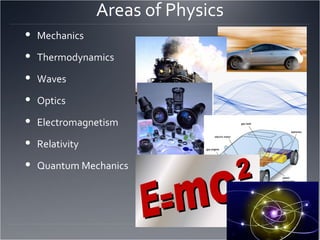
Areas of Physics Mechanics Thermodynamics Waves  Optics Electromagnetism Relativity Quantum Mechanics
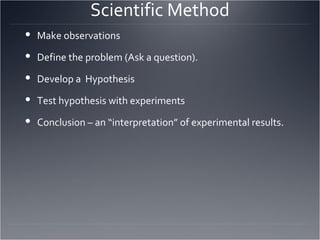
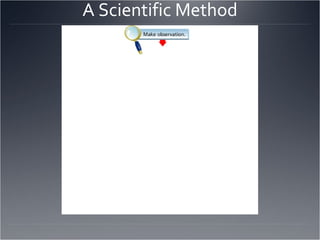
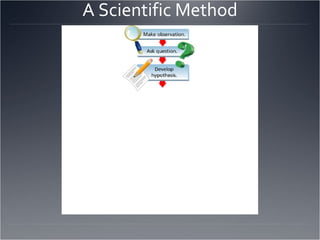
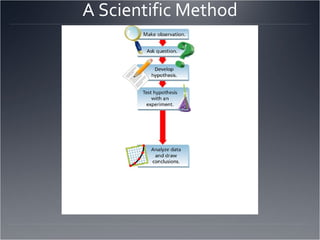
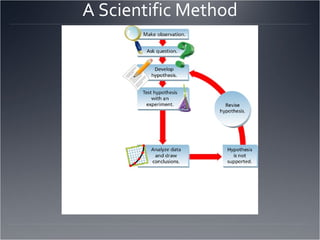
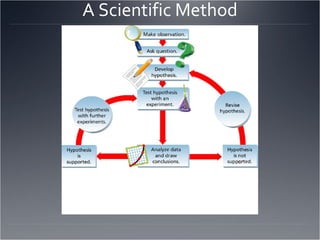
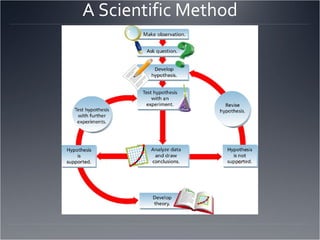
Scientific Method Make observations Define the problem (Ask a question). Develop a  Hypothesis  Test hypothesis with experiments Conclusion – an ā€œinterpretationā€ of experimental results.
A Scientific Method
A Scientific Method
A Scientific Method
A Scientific Method
A Scientific Method
A Scientific Method
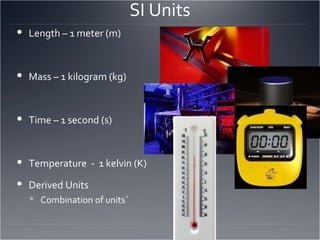
SI Units Length – 1 meter (m) Mass – 1 kilogram (kg) Time – 1 second (s) Temperature  -  1 kelvin (K) Derived Units  Combination of units`
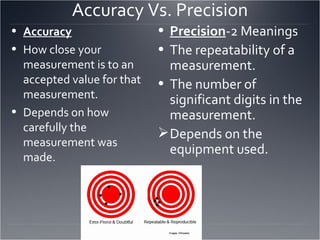
Accuracy Vs. Precision Accuracy How close your measurement is to an accepted value for that measurement. Depends on how carefully the measurement was made. Precision -2 Meanings The repeatability of a  measurement. The number of significant digits in the measurement. Depends on the equipment used.
Scientific Notation A number written as a product of two numbers: a coefficient and a power of 10  Designed for the expression of very big and very small numbers 3.6 x 10 4 1 gram of hydrogen contains 301,000,000,000,000,000,000,000 molecules 3.01 x 10 23  molecules 0.00081 = 8.1 x 10 -4 Decimal moves 4 place to the right 34,000 = 3.4 x 10 4 Decimal move 4 places to the left
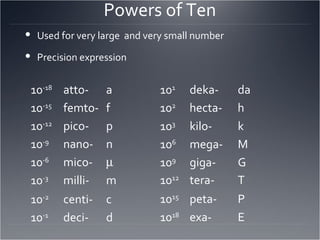
Powers of Ten Used for very large  and very small number  Precision expression d deci- 10 -1 E exa- 10 18 c centi- 10 -2 P peta- 10 15 m milli- 10 -3 T tera- 10 12  mico- 10 -6 G giga- 10 9 n nano- 10 -9 M mega- 10 6 p pico- 10 -12 k kilo- 10 3 f femto- 10 -15 da deka- 10 1 a atto- 10 -18 h hecta- 10 2
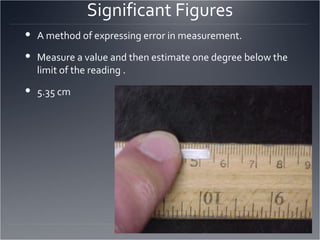
Significant Figures A method of expressing error in measurement.  Measure a value and then estimate one degree below the limit of the reading . 5.35 cm
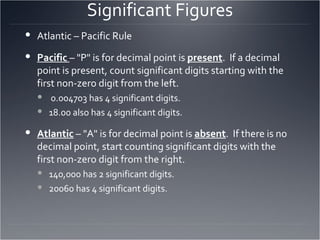
Significant Figures Atlantic – Pacific Rule Pacific  – "P" is for decimal point is  present .  If a decimal point is present, count significant digits starting with the first non-zero digit from the left. 0.004703 has 4 significant digits. 18.00 also has 4 significant digits. Atlantic  – "A" is for decimal point is  absent .  If there is no decimal point, start counting significant digits with the first non-zero digit from the right. 140,000 has 2 significant digits. 20060 has 4 significant digits.
Summary  What are the seven areas of physics? Mechanics, Thermodynamics, Waves, Optics, Electromagnetism, Relativity, Quantum Mechanics What is the difference between accuracy and precision? Accuracy is measuring the accepted value. Precision is repeating very similar measurements. What is the purpose of Significant figures? To express precision. Determine the number of digits to write.

1-2 Physics & Measurement

  • 1.
    Warm - upWhat is physics? the natural science which examines basic concepts such as energy, force, and space-time and all that derives from these, such as mass, charge, matter and its motion. What do you have you done today that involves physics?
  • 2.
    1-2: Physics &Measurements Identify the major fields of physics. Describe the process of the scientific method. List basic SI Units. Distinguish between accuracy and precision. Use significant figures.
  • 3.
    Areas of PhysicsMechanics Thermodynamics Waves Optics Electromagnetism Relativity Quantum Mechanics
  • 4.
    Scientific Method Makeobservations Define the problem (Ask a question). Develop a Hypothesis Test hypothesis with experiments Conclusion – an ā€œinterpretationā€ of experimental results.
  • 5.
  • 6.
  • 7.
  • 8.
  • 9.
  • 10.
  • 11.
    SI Units Length– 1 meter (m) Mass – 1 kilogram (kg) Time – 1 second (s) Temperature - 1 kelvin (K) Derived Units Combination of units`
  • 12.
    Accuracy Vs. PrecisionAccuracy How close your measurement is to an accepted value for that measurement. Depends on how carefully the measurement was made. Precision -2 Meanings The repeatability of a measurement. The number of significant digits in the measurement. Depends on the equipment used.
  • 13.
    Scientific Notation Anumber written as a product of two numbers: a coefficient and a power of 10 Designed for the expression of very big and very small numbers 3.6 x 10 4 1 gram of hydrogen contains 301,000,000,000,000,000,000,000 molecules 3.01 x 10 23 molecules 0.00081 = 8.1 x 10 -4 Decimal moves 4 place to the right 34,000 = 3.4 x 10 4 Decimal move 4 places to the left
  • 14.
    Powers of TenUsed for very large and very small number Precision expression d deci- 10 -1 E exa- 10 18 c centi- 10 -2 P peta- 10 15 m milli- 10 -3 T tera- 10 12  mico- 10 -6 G giga- 10 9 n nano- 10 -9 M mega- 10 6 p pico- 10 -12 k kilo- 10 3 f femto- 10 -15 da deka- 10 1 a atto- 10 -18 h hecta- 10 2
  • 15.
    Significant Figures Amethod of expressing error in measurement. Measure a value and then estimate one degree below the limit of the reading . 5.35 cm
  • 16.
    Significant Figures Atlantic– Pacific Rule Pacific – "P" is for decimal point is present . If a decimal point is present, count significant digits starting with the first non-zero digit from the left. 0.004703 has 4 significant digits. 18.00 also has 4 significant digits. Atlantic – "A" is for decimal point is absent . If there is no decimal point, start counting significant digits with the first non-zero digit from the right. 140,000 has 2 significant digits. 20060 has 4 significant digits.
  • 17.
    Summary Whatare the seven areas of physics? Mechanics, Thermodynamics, Waves, Optics, Electromagnetism, Relativity, Quantum Mechanics What is the difference between accuracy and precision? Accuracy is measuring the accepted value. Precision is repeating very similar measurements. What is the purpose of Significant figures? To express precision. Determine the number of digits to write.