Bond Energies
Dr. K. Shahzad. Baig
Memorial University of Newfoundland
(MUN), Canada
Petrucci, et al. 2011. General Chemistry: Principles and Modern Applications. Pearson Canada Inc., Toronto, Ontario.
Tro, N.J. 2010. Principles of Chemistry. : a molecular approach. Pearson Education, Inc
Bond Energies
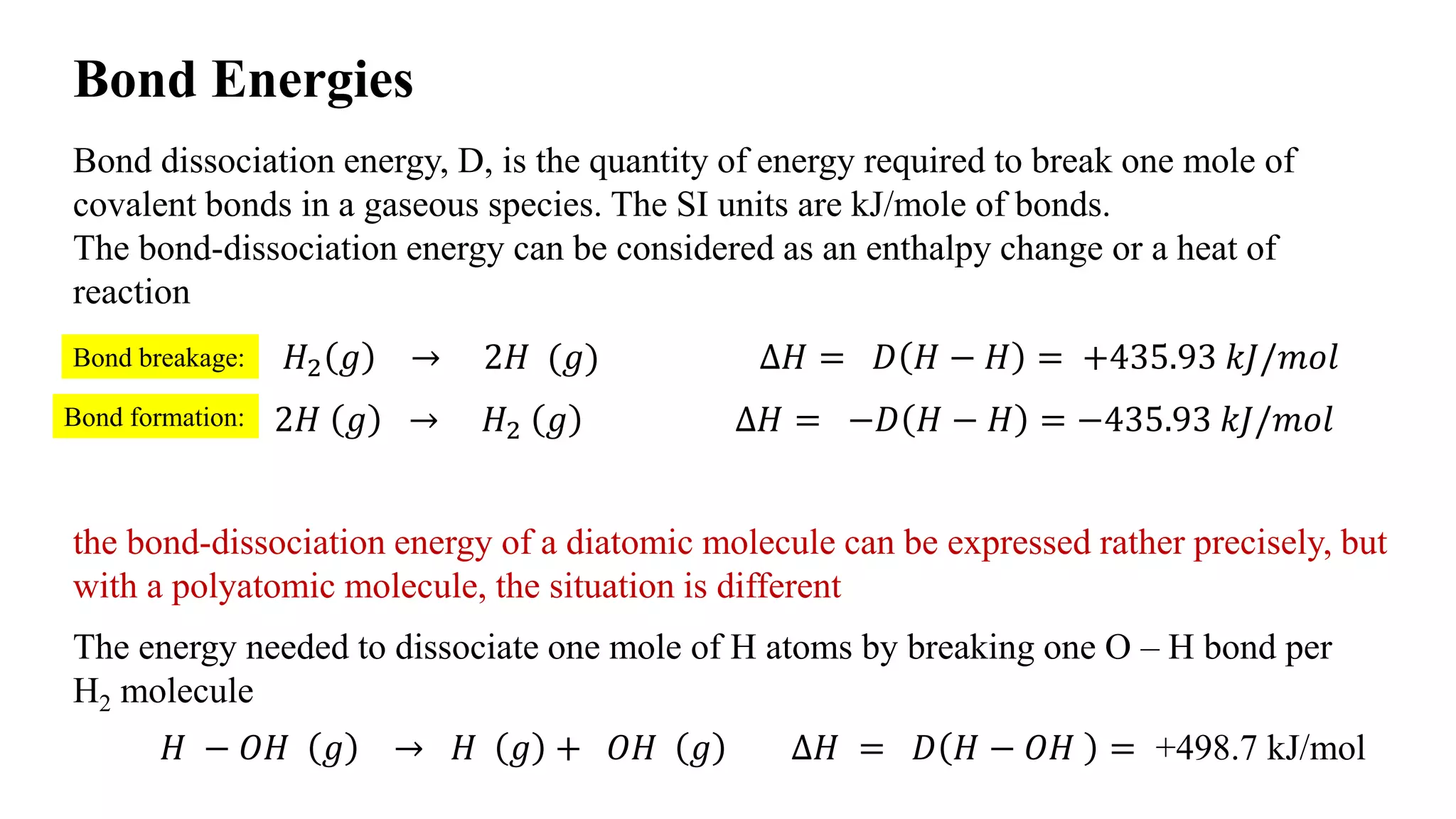
Bond dissociation energy, D, is the quantity of energy required to break one mole of
covalent bonds in a gaseous species. The SI units are kJ/mole of bonds.
The bond-dissociation energy can be considered as an enthalpy change or a heat of
reaction
𝐻2 𝑔 → 2𝐻 (𝑔) ∆𝐻 = 𝐷 𝐻 − 𝐻 = +435.93 𝑘𝐽/𝑚𝑜𝑙
2𝐻 𝑔 → 𝐻2 𝑔 ∆𝐻 = −𝐷 𝐻 − 𝐻 = −435.93 𝑘𝐽/𝑚𝑜𝑙
Bond breakage:
Bond formation:
the bond-dissociation energy of a diatomic molecule can be expressed rather precisely, but
with a polyatomic molecule, the situation is different
The energy needed to dissociate one mole of H atoms by breaking one O – H bond per
H2 molecule
𝐻 − 𝑂𝐻 𝑔 → 𝐻 𝑔 + 𝑂𝐻 𝑔 ∆𝐻 = 𝐷 𝐻 − 𝑂𝐻 = +498.7 kJ/mol
is different from the energy required to dissociate one mole of H atoms by breaking the
bonds in [OH (g)]:
𝑂 − 𝐻 𝑔 → 𝐻 𝑔 + 𝑂 𝑔 ∆𝐻 = 𝐷 𝑂 − 𝐻 = +428.0 𝑘𝐽/𝑚𝑜𝑙
The two O – H bonds in H2O are identical; therefore, they should have identical
energies.
This energy, which we can call the bond energy in is the average of the two values listed
above: [(498.7 + 428.0)/2 = 463.35]= 463.35 kJ / mol
The bond dissociation energy for O – H bond in CH3OH = 436.8 kJ/mol
An average bond energy is the average of bond-dissociation energies for a number of
different species containing the particular bond. (these values are not precise)
∆𝐻𝑟𝑥𝑛 = ∆𝐻 (𝑏𝑜𝑛𝑑 𝑏𝑟𝑎𝑘𝑎𝑔𝑒) + ∆𝐻 (𝑏𝑜𝑛𝑑 𝑓𝑜𝑟𝑚𝑎𝑡𝑖𝑜𝑛)
≈ 𝐵𝐸 (𝑟𝑒𝑎𝑐𝑡𝑎𝑛𝑡𝑠) − 𝐵𝑒 (𝑝𝑟𝑜𝑑𝑢𝑐𝑡𝑠)
Enthalpy of reaction from bond energies
Calculating an Enthalpy of Reaction from Bond Energies
Example 10-15
The reaction of methane and chlorine produces a mixture of products called chloromethanes.
One of these is monochloromethane, used in the preparation of silicones. Calculate for the
reaction
𝐶𝐻4 𝑔 + 𝐶𝑙2 𝑔 → 𝐶𝐻3 𝐶𝑙 𝑔 + 𝐻𝐶𝑙 𝑔
draw structural formulas (or Lewis structures)
Solution
Bonds that are broken are shown in red and bonds that are formed, in blue. Bonds that remain
unchanged are black.
It is required to break four C – H bonds and one Cl – Cl bond and form three C – H bonds,
one C – Cl bond, and one H – Cl bond. The net change, however, is the breaking of one C
– H bond and one Cl – Cl bond, followed by the formation of one C Cl bond and one H –
Cl bond
∆H for net bond breakage: 1 mol C – H bond +414 kJ
1 mol Cl – Cl bond +243 kJ
Sum +657 kJ
∆H for net bond formation: 1 mol C – Cl bonds -339 kJ
1 mol H – Cl bond -431 kJ
Sum - 770 kJ
Enthalpy of reaction: ∆𝐻 = 657 − 770 = −113 𝑘𝐽
Using Bond Energies to Predict Exothermic and Endothermic
Reactions
Example
One of the steps in the formation of monochloromethane (Example 10-15) is the reaction of a
gaseous chlorine atom (a chlorine radical) with a molecule of methane. The products are an
unstable methyl radical and HCl(g). Is this reaction endothermic or exothermic?
𝐶𝐻4 𝑔 + 𝐶𝑙 𝑔 → 𝐶𝐻3 𝑔 + 𝐻𝐶𝑙 𝑔
Solution
In the reaction, one C – H bond is broken for every C – H bond formed. Thus, we must
compare the bond energies for the C- H and H – Cl bonds to decide whether the reaction
is endothermic or exothermic.
Bond breaking (C – H) =
414 kJ /mol of bonds
Bond formation (H – Cl) =
434 kJ /mol of bonds
Because more energy
is released, Therefore,
Exothermic

Bond energies, 10 (4)

  • 1.
    Bond Energies Dr. K.Shahzad. Baig Memorial University of Newfoundland (MUN), Canada Petrucci, et al. 2011. General Chemistry: Principles and Modern Applications. Pearson Canada Inc., Toronto, Ontario. Tro, N.J. 2010. Principles of Chemistry. : a molecular approach. Pearson Education, Inc
  • 2.
    Bond Energies Bond dissociationenergy, D, is the quantity of energy required to break one mole of covalent bonds in a gaseous species. The SI units are kJ/mole of bonds. The bond-dissociation energy can be considered as an enthalpy change or a heat of reaction 𝐻2 𝑔 → 2𝐻 (𝑔) ∆𝐻 = 𝐷 𝐻 − 𝐻 = +435.93 𝑘𝐽/𝑚𝑜𝑙 2𝐻 𝑔 → 𝐻2 𝑔 ∆𝐻 = −𝐷 𝐻 − 𝐻 = −435.93 𝑘𝐽/𝑚𝑜𝑙 Bond breakage: Bond formation: the bond-dissociation energy of a diatomic molecule can be expressed rather precisely, but with a polyatomic molecule, the situation is different The energy needed to dissociate one mole of H atoms by breaking one O – H bond per H2 molecule 𝐻 − 𝑂𝐻 𝑔 → 𝐻 𝑔 + 𝑂𝐻 𝑔 ∆𝐻 = 𝐷 𝐻 − 𝑂𝐻 = +498.7 kJ/mol
  • 3.
    is different fromthe energy required to dissociate one mole of H atoms by breaking the bonds in [OH (g)]: 𝑂 − 𝐻 𝑔 → 𝐻 𝑔 + 𝑂 𝑔 ∆𝐻 = 𝐷 𝑂 − 𝐻 = +428.0 𝑘𝐽/𝑚𝑜𝑙 The two O – H bonds in H2O are identical; therefore, they should have identical energies. This energy, which we can call the bond energy in is the average of the two values listed above: [(498.7 + 428.0)/2 = 463.35]= 463.35 kJ / mol The bond dissociation energy for O – H bond in CH3OH = 436.8 kJ/mol An average bond energy is the average of bond-dissociation energies for a number of different species containing the particular bond. (these values are not precise)
  • 5.
    ∆𝐻𝑟𝑥𝑛 = ∆𝐻(𝑏𝑜𝑛𝑑 𝑏𝑟𝑎𝑘𝑎𝑔𝑒) + ∆𝐻 (𝑏𝑜𝑛𝑑 𝑓𝑜𝑟𝑚𝑎𝑡𝑖𝑜𝑛) ≈ 𝐵𝐸 (𝑟𝑒𝑎𝑐𝑡𝑎𝑛𝑡𝑠) − 𝐵𝑒 (𝑝𝑟𝑜𝑑𝑢𝑐𝑡𝑠) Enthalpy of reaction from bond energies
  • 6.
    Calculating an Enthalpyof Reaction from Bond Energies Example 10-15 The reaction of methane and chlorine produces a mixture of products called chloromethanes. One of these is monochloromethane, used in the preparation of silicones. Calculate for the reaction 𝐶𝐻4 𝑔 + 𝐶𝑙2 𝑔 → 𝐶𝐻3 𝐶𝑙 𝑔 + 𝐻𝐶𝑙 𝑔 draw structural formulas (or Lewis structures) Solution Bonds that are broken are shown in red and bonds that are formed, in blue. Bonds that remain unchanged are black.
  • 7.
    It is requiredto break four C – H bonds and one Cl – Cl bond and form three C – H bonds, one C – Cl bond, and one H – Cl bond. The net change, however, is the breaking of one C – H bond and one Cl – Cl bond, followed by the formation of one C Cl bond and one H – Cl bond ∆H for net bond breakage: 1 mol C – H bond +414 kJ 1 mol Cl – Cl bond +243 kJ Sum +657 kJ ∆H for net bond formation: 1 mol C – Cl bonds -339 kJ 1 mol H – Cl bond -431 kJ Sum - 770 kJ Enthalpy of reaction: ∆𝐻 = 657 − 770 = −113 𝑘𝐽
  • 8.
    Using Bond Energiesto Predict Exothermic and Endothermic Reactions Example One of the steps in the formation of monochloromethane (Example 10-15) is the reaction of a gaseous chlorine atom (a chlorine radical) with a molecule of methane. The products are an unstable methyl radical and HCl(g). Is this reaction endothermic or exothermic? 𝐶𝐻4 𝑔 + 𝐶𝑙 𝑔 → 𝐶𝐻3 𝑔 + 𝐻𝐶𝑙 𝑔 Solution In the reaction, one C – H bond is broken for every C – H bond formed. Thus, we must compare the bond energies for the C- H and H – Cl bonds to decide whether the reaction is endothermic or exothermic. Bond breaking (C – H) = 414 kJ /mol of bonds Bond formation (H – Cl) = 434 kJ /mol of bonds Because more energy is released, Therefore, Exothermic

Editor's Notes

  • #3 Bond energy, bond length, and bond order are interrelated properties in this sense: the higher the bond order, the shorter the bond between two atoms and the greater the bond energy. Energy is released when isolated atoms join to form a covalent bond, and energy must be absorbed to break apart covalently bonded atoms.