Thyroidectomy Dr Sanjoy Sanyal Consultant Surgeon Victoria Hospital, Ministry of Health, Seychelles 2005 Lecture for nursing students, Victoria Hospital, MOH, Seychelles 2005
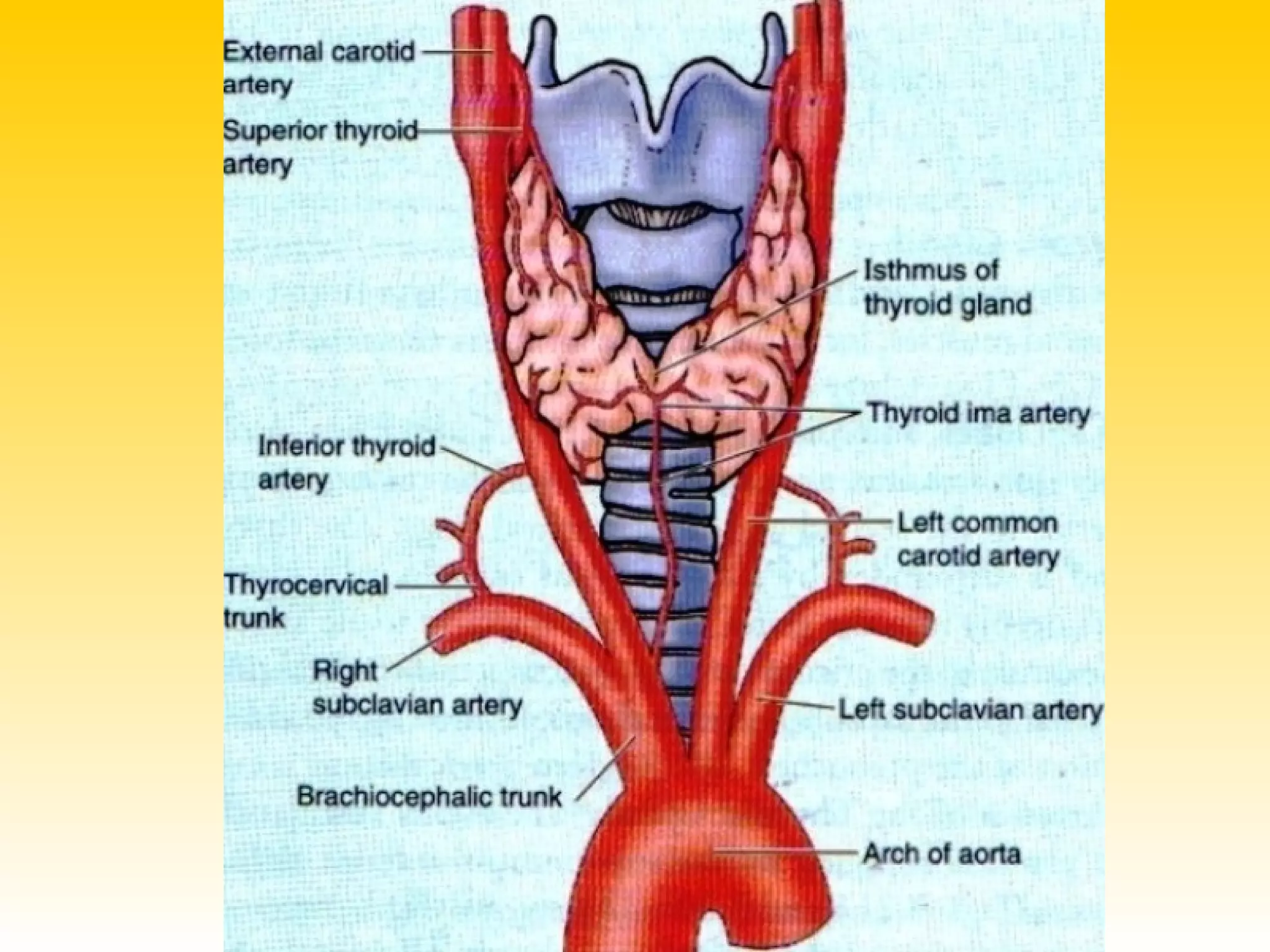
Thyroid gland surgical anatomy Location : Thyroid is situated in the neck in relation to 2 nd  3 rd  and 4 th  tracheal rings Two lobes : Right and left, joined by an ‘isthmus’ Arteries : Supplied by superior and inferior thyroid arteries Veins : Drained by superior, middle and inferior thyroid veins
 
Surgical anatomy – cont’d Important nerves in relation to thyroid External laryngeal nerve : Close to superior pole of thyroid.  Injury produces voice weakness Recurrent laryngeal nerve : Related to lower pole of gland as it runs upwards in the tracheo-esophageal groove.  Injury produces vocal cord paralysis.
Surgical anatomy – cont’d From superficial to deep: Skin Platysma (a muscle in superficial fascia of neck) Investing layer of deep cervical fascia Pre-tracheal layer of deep cervical fascia Strap muscles of neck (thin flat muscles)
Thyroidectomy – Indications Goitre (any non-neoplastic swelling of the thyroid gland is classified as a goitre) Single swelling (Solitary nodular goitre) Multiple swellings (Multi-nodular goitre) Carcinoma Follicular carcinoma Papillary carcinoma Rare varieties
Thyroidectomy – Types Hemi-thyroidectomy : Removal of half of thyroid gland (Hemi = Half) Lobectomy : Removal of either right of left lobe of thyroid gland Both these are done in solitary goitre Total thyroidectomy : Removal of whole thyroid gland This is done in cases of malignancy
Thyroidectomy types – cont’d Subtotal thyroidectomy : Removal of a little less than total; done in multi-nodular goitre Near-total thyroidectomy : Almost same as total, but a little thyroid tissue around one parathyroid gland is preserved Isthmusectomy : Dividing the isthmus
Pre-operative investigations Full blood count (CBC) Serum Urea, Electrolytes, Creatinine Thyroid Profile: T3, T4, TSH Ultrasound thyroid gland Radio-iodine ( 99m Tc /  131 I) scan of thyroid
Pre-operative investigations X-ray neck  X-ray chest (Both AP / lateral) Fine Needle Aspiration Cytology (FNAC) of thyroid nodule, if any palpable Indirect laryngoscopy to assess pre-operative function of both vocal cords.
INFORMED CONSENT FOR THE SURGERY IS ESSENTIAL
Thyroidectomy Steps 1 – The preliminaries Position of patient :  Supine position,  Neck slightly extended,  Sand bag under shoulder  Foot end slightly down
Thyroidectomy Steps 1 – The preliminaries Preparing the part :  The entire front of neck, from jaw line to nipples, is cleaned with Cholorhexidine, surgical spirit and Betadine.
Thyroidectomy Steps 1 – The preliminaries Draping :  Sterile sheets are draped above, below and on either sides of neck, keeping only neck portion visible.  Some surgeons cover this area with self-adhesive Opsite to enhance sterility.
Thyroidectomy Steps 2–  Incision and raising flaps   Incision :  Size 22 blade on Bard-Parker handle Curvilinear  skin incision along neck crease, from one sterno-mastoid to other, 1.5 cm above manubrium notch  Incision is deepened through skin, subcutaneous tissue, superficial fascia and platysma
Thyroidectomy Steps 2– Incision and raising flaps   Skin flaps :  Two skin flaps raised; one above and below.  Held in place with  Joll’s retractor. Strict haemostasis  (control of bleeding) Essential during entire procedure  Achieved by coagulating diathermy and/or ligation using 2-0 Vicryl sutures.
Thyroidectomy steps 3 – Exposing the gland Investing deep cervical fascia is split open Strap muscles of neck divided between clamps This exposes the thyroid gland enclosed in pre-tracheal layer of deep cervical fascia. This layer of fascia is also opened and thyroid exposed, with the nodule (or any pathology) visible.
Thyroidectomy steps 4 – Dealing with vessels Arteries before veins (to prevent venous engorgement)  Vessels clamped, divided and ligated with 2-0 vicryl Superior  thyroid artery ligated  close  to the upper pole of the gland.  This is to prevent damage to external laryngeal nerve.
Thyroidectomy steps 4 – Dealing with vessels Inferior  thyroid artery is similarly dealt with  far away  from the lower pole of the gland. This is to safeguard recurrent laryngeal nerve. Then  superior ,  middle  and  inferior  thyroid veins are dealt with in a similar manner.
Thyroidectomy steps 5 – Removing the gland proper Multiple artery forceps are applied around the thyroid gland  Appropriate portion (hemi-, subtotal, total thyroidectomy, lobectomy etc) is removed. Be sure to preserve the excised specimen in Formalin solution for biopsy.
Thyroidectomy steps 5 – Removing the gland proper Cut edge of the gland usually bleeds profusely.  This is stopped by under-running with multiple continuous 2-0 Vicryl sutures. Accurate haemostasis is essential, at all times, now more than ever.
Thyroidectomy Steps 6 – Winding up process Redivac (suction) drain is inserted in the cavity left by the excised thyroid gland, Brought out through a separate stab incision at the side of the neck,  Sutured to the skin with 2-0 Silk sutures.
Thyroidectomy Steps 6 – Winding up process Strap muscles are sutured with 2-0 Vicryl. Cut edges of deep cervical fascia are also sutured with 2-0 Vicryl. Again, haemostasis is minutely checked. Joll’s retractor, which was holding the skin-platysma flaps open, is removed.
Thyroidectomy steps 7 – Closure Platysma and subcutaneous tissues are closed with 2-0 Vicryl interrupted sutures. Skin closed with 3-0 Nylon, horizontal mattress sutures or subcuticular sutures. The latter gives a finer scar, but it requires more technical expertise, finesse and time.
Post-operative management Patient is kept NPO/NBM (Nil Per Oral / Nil By Mouth) on the day of surgery. Supplemental IV fluid usually given on day of surgery; usually between 2.5 to 3 litres. Compatible blood may be transfused if there had been excessive blood loss during surgery.
Post-operative management Oral intake initiated from next day, starting with ‘clear fluids’, going on to ‘free fluids’, then to soft diet and finally to normal diet  Analgesics essential in post-operative period; there is invariably severe pain during first night. Antibiotics avoided in clean elective surgeries
Post-operative management Daily vital (PTR, BP) chart is maintained.  Rise of temperature after 3 rd  post-operative day indicates infection.  This may require inspection of suture line. Careful note is made of daily output from Redivac drain.  Drain removed after 48 hours or when drainage falls to few ml during last 24-hour period, whichever is earlier.
Post-operative management Initial dressing changed after 48-72 hours (to inspect for infection of suture line),  Unless there is soakage, when it should be removed earlier.  Dry dressings sufficient every alternate day, if suture line is clean and dry. Sutures usually removed on 5 th  post-operative day.  This gives minimum scarring.
Thyroidectomy – Possible complications Hemorrhage Respiratory distress or stridor Hoarseness of voice Total vocal cord paralysis – aphonia  Hypocalcemic tetany (due to accidental removal of parathyroid glands during total thyroidectomy) Wound infection: This may manifest after 48 hours of surgery

Thyroidectomy for Nursing Students

  • 1.
    Thyroidectomy Dr SanjoySanyal Consultant Surgeon Victoria Hospital, Ministry of Health, Seychelles 2005 Lecture for nursing students, Victoria Hospital, MOH, Seychelles 2005
  • 2.
    Thyroid gland surgicalanatomy Location : Thyroid is situated in the neck in relation to 2 nd 3 rd and 4 th tracheal rings Two lobes : Right and left, joined by an ‘isthmus’ Arteries : Supplied by superior and inferior thyroid arteries Veins : Drained by superior, middle and inferior thyroid veins
  • 3.
  • 4.
    Surgical anatomy –cont’d Important nerves in relation to thyroid External laryngeal nerve : Close to superior pole of thyroid. Injury produces voice weakness Recurrent laryngeal nerve : Related to lower pole of gland as it runs upwards in the tracheo-esophageal groove. Injury produces vocal cord paralysis.
  • 5.
    Surgical anatomy –cont’d From superficial to deep: Skin Platysma (a muscle in superficial fascia of neck) Investing layer of deep cervical fascia Pre-tracheal layer of deep cervical fascia Strap muscles of neck (thin flat muscles)
  • 6.
    Thyroidectomy – IndicationsGoitre (any non-neoplastic swelling of the thyroid gland is classified as a goitre) Single swelling (Solitary nodular goitre) Multiple swellings (Multi-nodular goitre) Carcinoma Follicular carcinoma Papillary carcinoma Rare varieties
  • 7.
    Thyroidectomy – TypesHemi-thyroidectomy : Removal of half of thyroid gland (Hemi = Half) Lobectomy : Removal of either right of left lobe of thyroid gland Both these are done in solitary goitre Total thyroidectomy : Removal of whole thyroid gland This is done in cases of malignancy
  • 8.
    Thyroidectomy types –cont’d Subtotal thyroidectomy : Removal of a little less than total; done in multi-nodular goitre Near-total thyroidectomy : Almost same as total, but a little thyroid tissue around one parathyroid gland is preserved Isthmusectomy : Dividing the isthmus
  • 9.
    Pre-operative investigations Fullblood count (CBC) Serum Urea, Electrolytes, Creatinine Thyroid Profile: T3, T4, TSH Ultrasound thyroid gland Radio-iodine ( 99m Tc / 131 I) scan of thyroid
  • 10.
    Pre-operative investigations X-rayneck X-ray chest (Both AP / lateral) Fine Needle Aspiration Cytology (FNAC) of thyroid nodule, if any palpable Indirect laryngoscopy to assess pre-operative function of both vocal cords.
  • 11.
    INFORMED CONSENT FORTHE SURGERY IS ESSENTIAL
  • 12.
    Thyroidectomy Steps 1– The preliminaries Position of patient : Supine position, Neck slightly extended, Sand bag under shoulder Foot end slightly down
  • 13.
    Thyroidectomy Steps 1– The preliminaries Preparing the part : The entire front of neck, from jaw line to nipples, is cleaned with Cholorhexidine, surgical spirit and Betadine.
  • 14.
    Thyroidectomy Steps 1– The preliminaries Draping : Sterile sheets are draped above, below and on either sides of neck, keeping only neck portion visible. Some surgeons cover this area with self-adhesive Opsite to enhance sterility.
  • 15.
    Thyroidectomy Steps 2– Incision and raising flaps Incision : Size 22 blade on Bard-Parker handle Curvilinear skin incision along neck crease, from one sterno-mastoid to other, 1.5 cm above manubrium notch Incision is deepened through skin, subcutaneous tissue, superficial fascia and platysma
  • 16.
    Thyroidectomy Steps 2–Incision and raising flaps Skin flaps : Two skin flaps raised; one above and below. Held in place with Joll’s retractor. Strict haemostasis (control of bleeding) Essential during entire procedure Achieved by coagulating diathermy and/or ligation using 2-0 Vicryl sutures.
  • 17.
    Thyroidectomy steps 3– Exposing the gland Investing deep cervical fascia is split open Strap muscles of neck divided between clamps This exposes the thyroid gland enclosed in pre-tracheal layer of deep cervical fascia. This layer of fascia is also opened and thyroid exposed, with the nodule (or any pathology) visible.
  • 18.
    Thyroidectomy steps 4– Dealing with vessels Arteries before veins (to prevent venous engorgement) Vessels clamped, divided and ligated with 2-0 vicryl Superior thyroid artery ligated close to the upper pole of the gland. This is to prevent damage to external laryngeal nerve.
  • 19.
    Thyroidectomy steps 4– Dealing with vessels Inferior thyroid artery is similarly dealt with far away from the lower pole of the gland. This is to safeguard recurrent laryngeal nerve. Then superior , middle and inferior thyroid veins are dealt with in a similar manner.
  • 20.
    Thyroidectomy steps 5– Removing the gland proper Multiple artery forceps are applied around the thyroid gland Appropriate portion (hemi-, subtotal, total thyroidectomy, lobectomy etc) is removed. Be sure to preserve the excised specimen in Formalin solution for biopsy.
  • 21.
    Thyroidectomy steps 5– Removing the gland proper Cut edge of the gland usually bleeds profusely. This is stopped by under-running with multiple continuous 2-0 Vicryl sutures. Accurate haemostasis is essential, at all times, now more than ever.
  • 22.
    Thyroidectomy Steps 6– Winding up process Redivac (suction) drain is inserted in the cavity left by the excised thyroid gland, Brought out through a separate stab incision at the side of the neck, Sutured to the skin with 2-0 Silk sutures.
  • 23.
    Thyroidectomy Steps 6– Winding up process Strap muscles are sutured with 2-0 Vicryl. Cut edges of deep cervical fascia are also sutured with 2-0 Vicryl. Again, haemostasis is minutely checked. Joll’s retractor, which was holding the skin-platysma flaps open, is removed.
  • 24.
    Thyroidectomy steps 7– Closure Platysma and subcutaneous tissues are closed with 2-0 Vicryl interrupted sutures. Skin closed with 3-0 Nylon, horizontal mattress sutures or subcuticular sutures. The latter gives a finer scar, but it requires more technical expertise, finesse and time.
  • 25.
    Post-operative management Patientis kept NPO/NBM (Nil Per Oral / Nil By Mouth) on the day of surgery. Supplemental IV fluid usually given on day of surgery; usually between 2.5 to 3 litres. Compatible blood may be transfused if there had been excessive blood loss during surgery.
  • 26.
    Post-operative management Oralintake initiated from next day, starting with ‘clear fluids’, going on to ‘free fluids’, then to soft diet and finally to normal diet Analgesics essential in post-operative period; there is invariably severe pain during first night. Antibiotics avoided in clean elective surgeries
  • 27.
    Post-operative management Dailyvital (PTR, BP) chart is maintained. Rise of temperature after 3 rd post-operative day indicates infection. This may require inspection of suture line. Careful note is made of daily output from Redivac drain. Drain removed after 48 hours or when drainage falls to few ml during last 24-hour period, whichever is earlier.
  • 28.
    Post-operative management Initialdressing changed after 48-72 hours (to inspect for infection of suture line), Unless there is soakage, when it should be removed earlier. Dry dressings sufficient every alternate day, if suture line is clean and dry. Sutures usually removed on 5 th post-operative day. This gives minimum scarring.
  • 29.
    Thyroidectomy – Possiblecomplications Hemorrhage Respiratory distress or stridor Hoarseness of voice Total vocal cord paralysis – aphonia Hypocalcemic tetany (due to accidental removal of parathyroid glands during total thyroidectomy) Wound infection: This may manifest after 48 hours of surgery