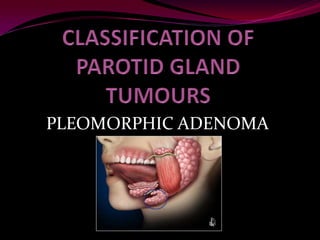
PLEOMORPHIC ADENOMA
ANATOMY
 Para- around       otis-ear

 Largest salivary gland


 Parts – superficial
  (80%) , deep (20%)

 Duct – Stensen’s
HISTOLOGY
FACIAL NERVE
FACIOVENOUS PLANE OF PATEY
 BLOOD SUPPLY:
 External carotid artery

 VENOUS DRAINAGE :
 External jugular vein

 LYMPHATIC
 DRAINAGE : Deep
 cervical nodes
CLASSIFICATION OF PAROTID
GLAND TUMOURS
 EPITHELIAL( 90%)


 NONEPITHELIAL
   Hemangioma
   Lymphangioma
   Neurofibroma


•   MALIGNANT LYMPHOMA – NHL TYPE
EPITHELIAL (90%)
 BENIGN (ADENOMAS)
   Pleomorphic adenoma
   Monomorphic adenoma
      Warthin’s tumour (adenolymhoma)
      Oncocytoma ( oxyphil adenoma )
      Basal cell adenoma
EPITHELIAL ( 90% )
 MALIGNANT
   LOW GRADE           • HIGH GRADE
      Acinic cell       • Adenocarcinoma
       carcinoma
      Adenoid cystic    •Squamous cell
       carcinoma         carcinoma
      Low grade
       mucoepidermoid    •High grade
       carcinoma         mucoepidermoid
                         carcinoma
CASE
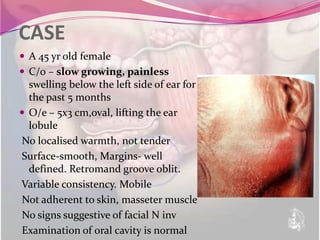
 A 45 yr old female
 C/0 – slow growing, painless
  swelling below the left side of ear for
  the past 5 months
 O/e – 5x3 cm,oval, lifting the ear
  lobule
No localised warmth, not tender
Surface-smooth, Margins- well
  defined. Retromand groove oblit.
Variable consistency. Mobile
Not adherent to skin, masseter muscle
No signs suggestive of facial N inv
Examination of oral cavity is normal
 FNAC : shows ductal cells, chondromyxoid
 matrix and myoepithelial cells

 DIAGNOSIS : PLEOMORPHIC
 ADENOMA
PLEOMORPHIC ADENOMA
 MIXED TUMOUR


 SITE : MC: PAROTID GLAND ( 90%)- MC –Tail of gland
            Submandibular gland (7%)
            Minor salivary glands-MC : Palate

Occurs more commonly in females (3:1)
AGE : any age . MC : 40-50yrs
Usually unilateral
PATHOLOGY
 BENIGN TUMOR
 Tumor capsule-well formed, but incomplete
 Tiny excrescences (pseudopods) project outside.
 Give rise to recurrences.


 GROSS :
 CUT SECTION:
MICROSCOPIC APPEARANCE
 2 groups of cells :
 Well differentiated epithelial
    cells-acini/cords/sheets
   Spindle/stellate cells
   Abundant intercellular
    mucoid material-resembles
    cartilage
   Pleomorphic stroma
   No necrosis
   Rarity of mitotic figures
CLINICAL FEATURES
 Painless slow growing swelling
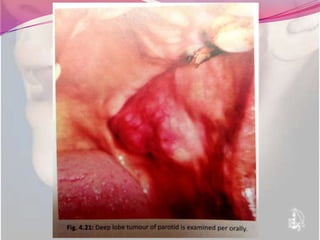
 In the parotid both lobes involved. If only deep lobe
    involved – DUMB BELL TUMOUR
   Dysphagia if deep lobe is involved
   Deviation of uvula&pharyngeal wall towards midline-deep
   Deep lobe swelling passes through
     PATEY’S STYLOMANDIBULAR TUNNEL
   Raised ear lobule
   Cannot be moved abv zygomatic bone-CURTAIN SIGN
   FACIAL NERVE NOT INVOLVED
INVESTIGATION
 FNAC – IMPORTANT AND DIAGNOSTIC


 OPEN BIOPSY – CONTRAINDICATED
    DUE TO : chance of injury to facial nerve,
    seedling & high chance of recurrence,
    Parotid fistula formation
 CT SCAN


 MRI
MANAGEMENT
 Tumor is RADIO RESISTANT
 SURGERY :
 ENUCLEATION –avoided. High recurrence.
 TOC : SUPERFICIAL PAROTIDECTOMY –
 PATEY’S OPERATION( if supf lobe alone involved)

 TOTAL CONSERVATIVE PAROTIDECTOMY (If both
 lobes involved)
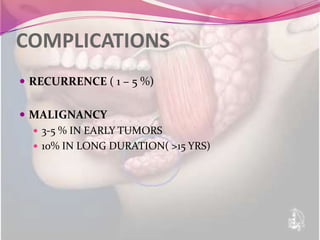
COMPLICATIONS
 RECURRENCE ( 1 – 5 %)


 MALIGNANCY
   3-5 % IN EARLY TUMORS
   10% IN LONG DURATION( >15 YRS)
RECURRENCE AFTER SURGERY
 DUE TO : Spillage
 Inadequate margin
 Retained pseudopods
 Multicentricity
 Improper technique


 Recurrent tumor is multinodular without capsule
 Marker to predict recurrence : MUC1/DF3
CARCINOMA IN EX PLEOMORPHIC
ADENOMA
 Long standing Pl.adenoma-malignant
    transformation
   Recent increase in size
   Pain , nodularity
   Involvement of skin, ulceration
   Involvement of masseter
   Involvement of facial nerve
   Neck lymph node
   Restriction of jaw movements
TAKE HOME MESSAGE
 MOST COMMON TUMOUR OF PAROTID


 FACIAL NERVE IS NOT INVOLVED


 TOC : SUPERFICIAL PAROTIDECTOMY


 FACIAL NERVE IS PRESERVED.


 CARCINOMA IN EX PLEOMORPHIC ADENOMA.
-AISHWARYA. G

Pleomorphic adenoma

  • 1.
  • 2.
    ANATOMY  Para- around otis-ear  Largest salivary gland  Parts – superficial (80%) , deep (20%)  Duct – Stensen’s
  • 3.
  • 4.
  • 5.
  • 6.
     BLOOD SUPPLY: External carotid artery  VENOUS DRAINAGE : External jugular vein  LYMPHATIC DRAINAGE : Deep cervical nodes
  • 8.
    CLASSIFICATION OF PAROTID GLANDTUMOURS  EPITHELIAL( 90%)  NONEPITHELIAL  Hemangioma  Lymphangioma  Neurofibroma • MALIGNANT LYMPHOMA – NHL TYPE
  • 9.
    EPITHELIAL (90%)  BENIGN(ADENOMAS)  Pleomorphic adenoma  Monomorphic adenoma  Warthin’s tumour (adenolymhoma)  Oncocytoma ( oxyphil adenoma )  Basal cell adenoma
  • 10.
    EPITHELIAL ( 90%)  MALIGNANT  LOW GRADE • HIGH GRADE  Acinic cell • Adenocarcinoma carcinoma  Adenoid cystic •Squamous cell carcinoma carcinoma  Low grade mucoepidermoid •High grade carcinoma mucoepidermoid carcinoma
  • 11.
    CASE  A 45yr old female  C/0 – slow growing, painless swelling below the left side of ear for the past 5 months  O/e – 5x3 cm,oval, lifting the ear lobule No localised warmth, not tender Surface-smooth, Margins- well defined. Retromand groove oblit. Variable consistency. Mobile Not adherent to skin, masseter muscle No signs suggestive of facial N inv Examination of oral cavity is normal
  • 12.
     FNAC :shows ductal cells, chondromyxoid matrix and myoepithelial cells  DIAGNOSIS : PLEOMORPHIC ADENOMA
  • 13.
    PLEOMORPHIC ADENOMA  MIXEDTUMOUR  SITE : MC: PAROTID GLAND ( 90%)- MC –Tail of gland Submandibular gland (7%) Minor salivary glands-MC : Palate Occurs more commonly in females (3:1) AGE : any age . MC : 40-50yrs Usually unilateral
  • 14.
    PATHOLOGY  BENIGN TUMOR Tumor capsule-well formed, but incomplete  Tiny excrescences (pseudopods) project outside.  Give rise to recurrences.  GROSS :  CUT SECTION:
  • 15.
    MICROSCOPIC APPEARANCE  2groups of cells :  Well differentiated epithelial cells-acini/cords/sheets  Spindle/stellate cells  Abundant intercellular mucoid material-resembles cartilage  Pleomorphic stroma  No necrosis  Rarity of mitotic figures
  • 16.
    CLINICAL FEATURES  Painlessslow growing swelling  In the parotid both lobes involved. If only deep lobe involved – DUMB BELL TUMOUR  Dysphagia if deep lobe is involved  Deviation of uvula&pharyngeal wall towards midline-deep  Deep lobe swelling passes through PATEY’S STYLOMANDIBULAR TUNNEL  Raised ear lobule  Cannot be moved abv zygomatic bone-CURTAIN SIGN  FACIAL NERVE NOT INVOLVED
  • 19.
    INVESTIGATION  FNAC –IMPORTANT AND DIAGNOSTIC  OPEN BIOPSY – CONTRAINDICATED  DUE TO : chance of injury to facial nerve,  seedling & high chance of recurrence,  Parotid fistula formation  CT SCAN  MRI
  • 21.
    MANAGEMENT  Tumor isRADIO RESISTANT  SURGERY :  ENUCLEATION –avoided. High recurrence.  TOC : SUPERFICIAL PAROTIDECTOMY – PATEY’S OPERATION( if supf lobe alone involved)  TOTAL CONSERVATIVE PAROTIDECTOMY (If both lobes involved)
  • 22.
    COMPLICATIONS  RECURRENCE (1 – 5 %)  MALIGNANCY  3-5 % IN EARLY TUMORS  10% IN LONG DURATION( >15 YRS)
  • 23.
    RECURRENCE AFTER SURGERY DUE TO : Spillage  Inadequate margin  Retained pseudopods  Multicentricity  Improper technique  Recurrent tumor is multinodular without capsule  Marker to predict recurrence : MUC1/DF3
  • 24.
    CARCINOMA IN EXPLEOMORPHIC ADENOMA  Long standing Pl.adenoma-malignant transformation  Recent increase in size  Pain , nodularity  Involvement of skin, ulceration  Involvement of masseter  Involvement of facial nerve  Neck lymph node  Restriction of jaw movements
  • 25.
    TAKE HOME MESSAGE MOST COMMON TUMOUR OF PAROTID  FACIAL NERVE IS NOT INVOLVED  TOC : SUPERFICIAL PAROTIDECTOMY  FACIAL NERVE IS PRESERVED.  CARCINOMA IN EX PLEOMORPHIC ADENOMA.
  • 26.