Dr. SANJAY MAHARJAN
2ND Yr Resident, ENT-HNS
MTH
APPROACH TO
THYROID NODULE
INTRODUCTION
• Discrete lesion within thyroid gland that is
radiologically distinct from surrounding parenchyma
• Noted by patient, or as an incidental finding
• May be
Palpable or impalpable,
Functioning or nonfunctioning
EPIDEMIOLOGY:
• Framingham study
Ages  35 – 59
Women  6.4 %
Men  1.5 %
• Prevalence increases with
Age
Exposure to ionizing
radiation (Nodule in
radiated patient: 35-40%
cancer)
• Pregnancy increases risk
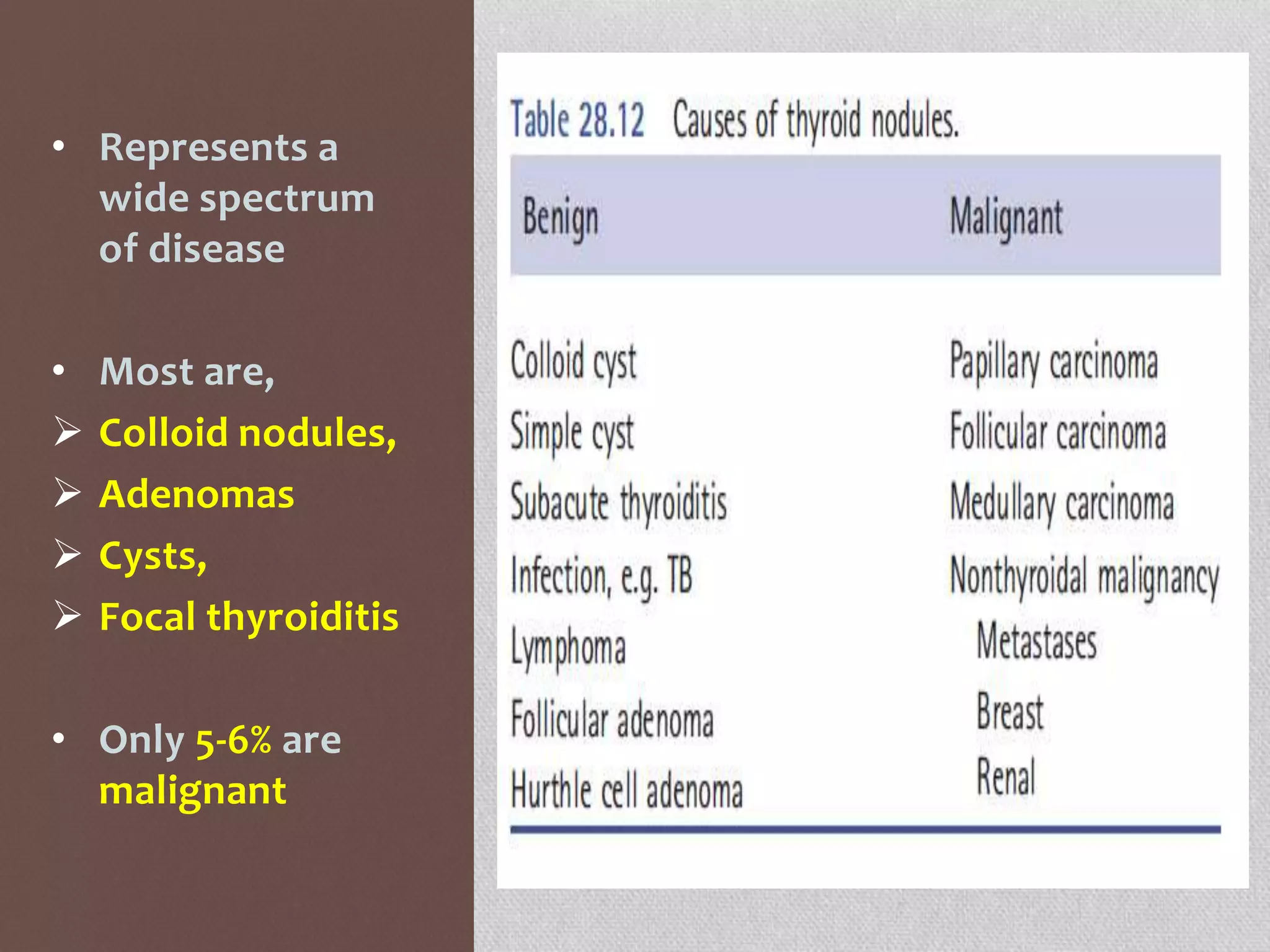
• Represents a
wide spectrum
of disease
• Most are,
 Colloid nodules,
 Adenomas
 Cysts,
 Focal thyroiditis
• Only 5-6% are
malignant
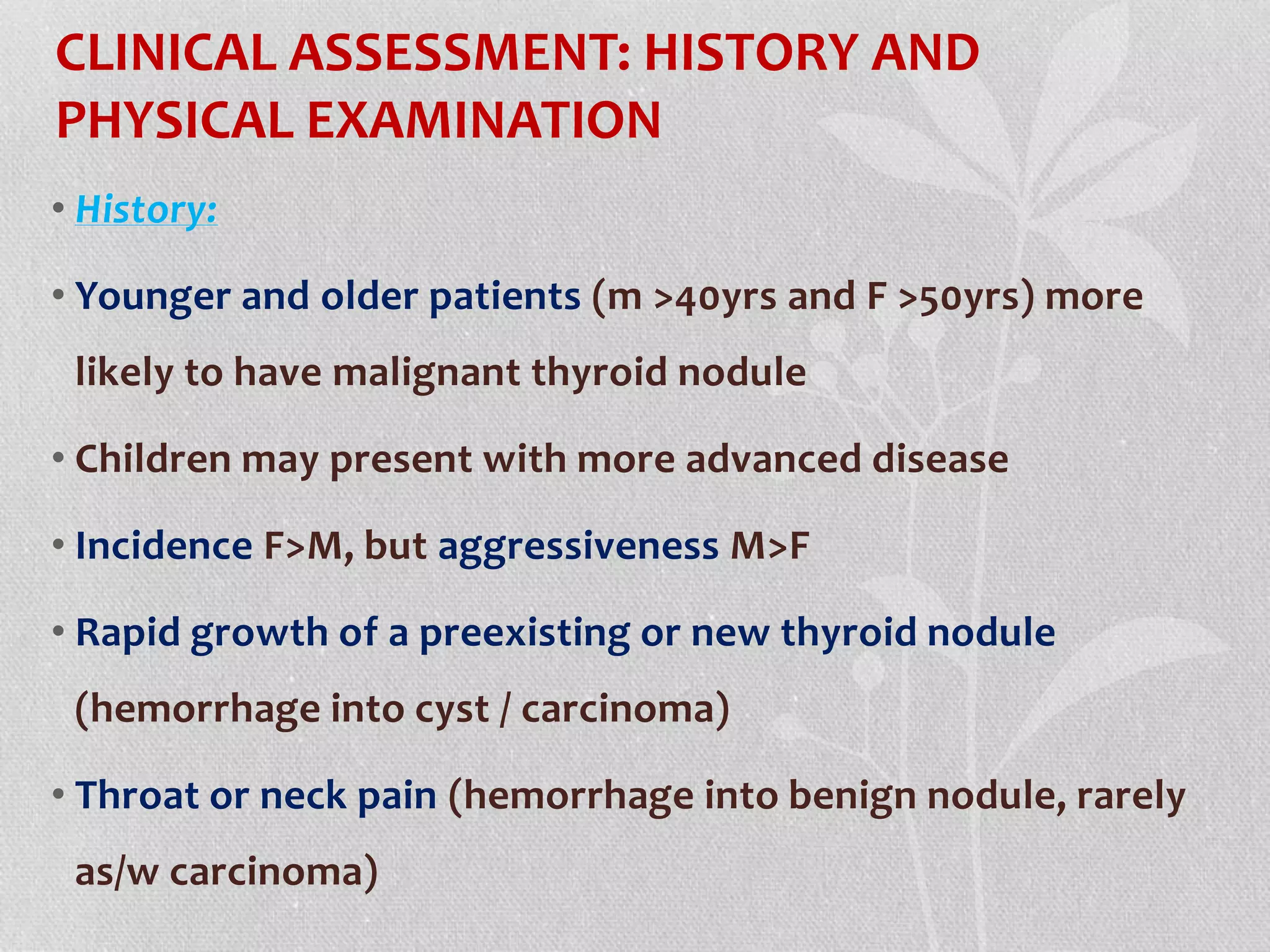
CLINICAL ASSESSMENT: HISTORY AND
PHYSICAL EXAMINATION
• History:
• Younger and older patients (m >40yrs and F >50yrs) more
likely to have malignant thyroid nodule
• Children may present with more advanced disease
• Incidence F>M, but aggressiveness M>F
• Rapid growth of a preexisting or new thyroid nodule
(hemorrhage into cyst / carcinoma)
• Throat or neck pain (hemorrhage into benign nodule, rarely
as/w carcinoma)
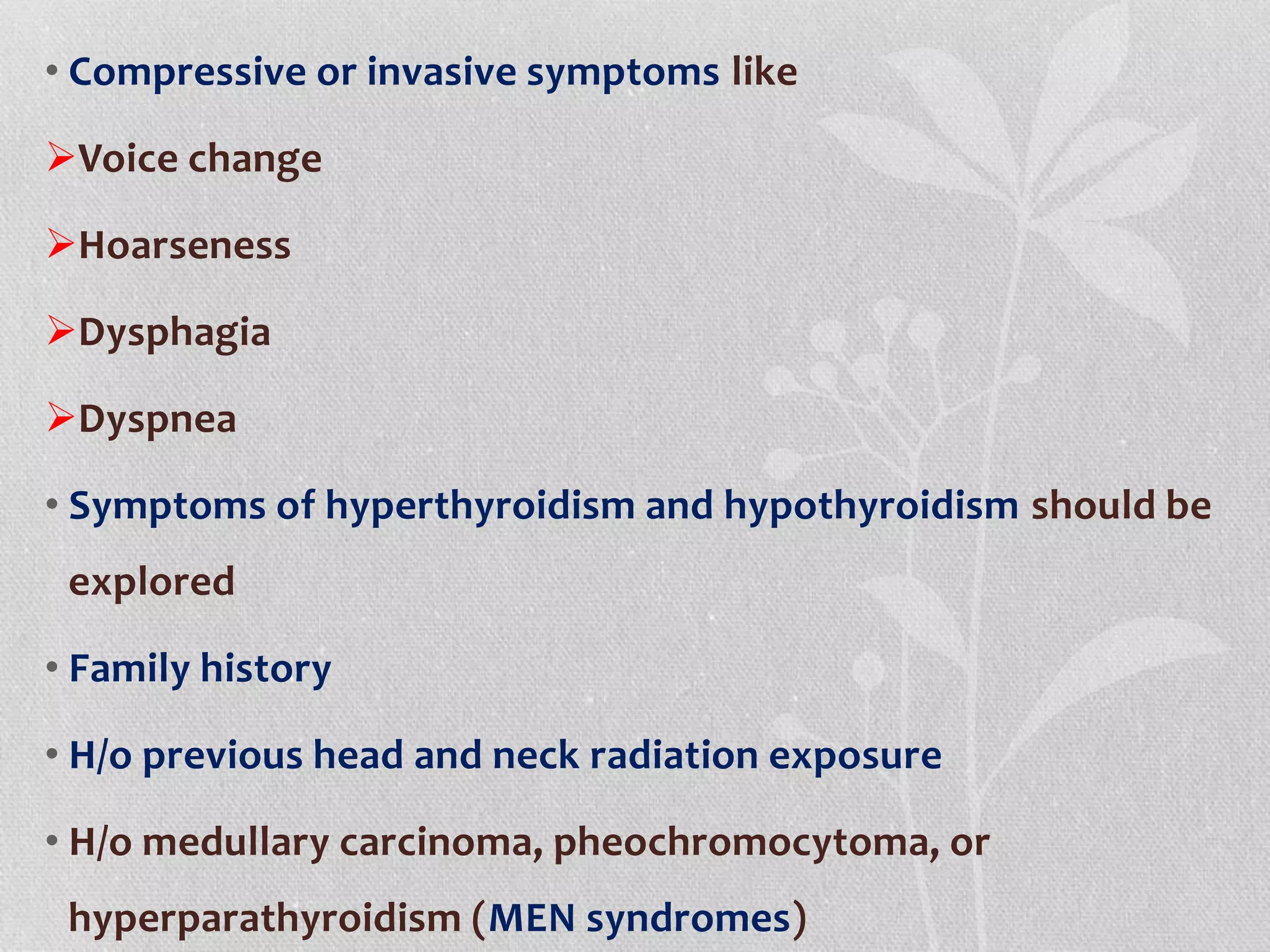
• Compressive or invasive symptoms like
Voice change
Hoarseness
Dysphagia
Dyspnea
• Symptoms of hyperthyroidism and hypothyroidism should be
explored
• Family history
• H/o previous head and neck radiation exposure
• H/o medullary carcinoma, pheochromocytoma, or
hyperparathyroidism (MEN syndromes)
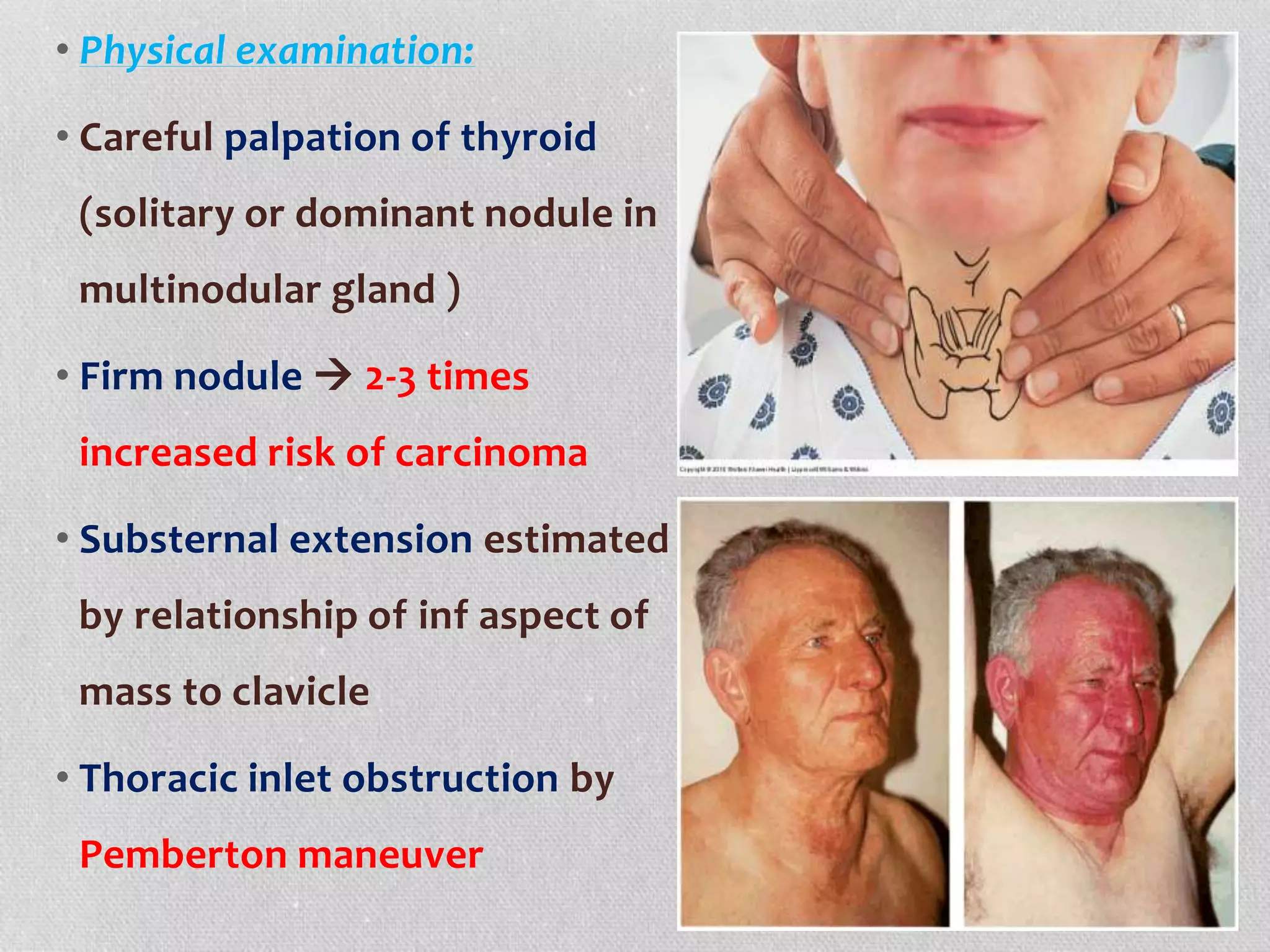
• Physical examination:
• Careful palpation of thyroid
(solitary or dominant nodule in
multinodular gland )
• Firm nodule  2-3 times
increased risk of carcinoma
• Substernal extension estimated
by relationship of inf aspect of
mass to clavicle
• Thoracic inlet obstruction by
Pemberton maneuver
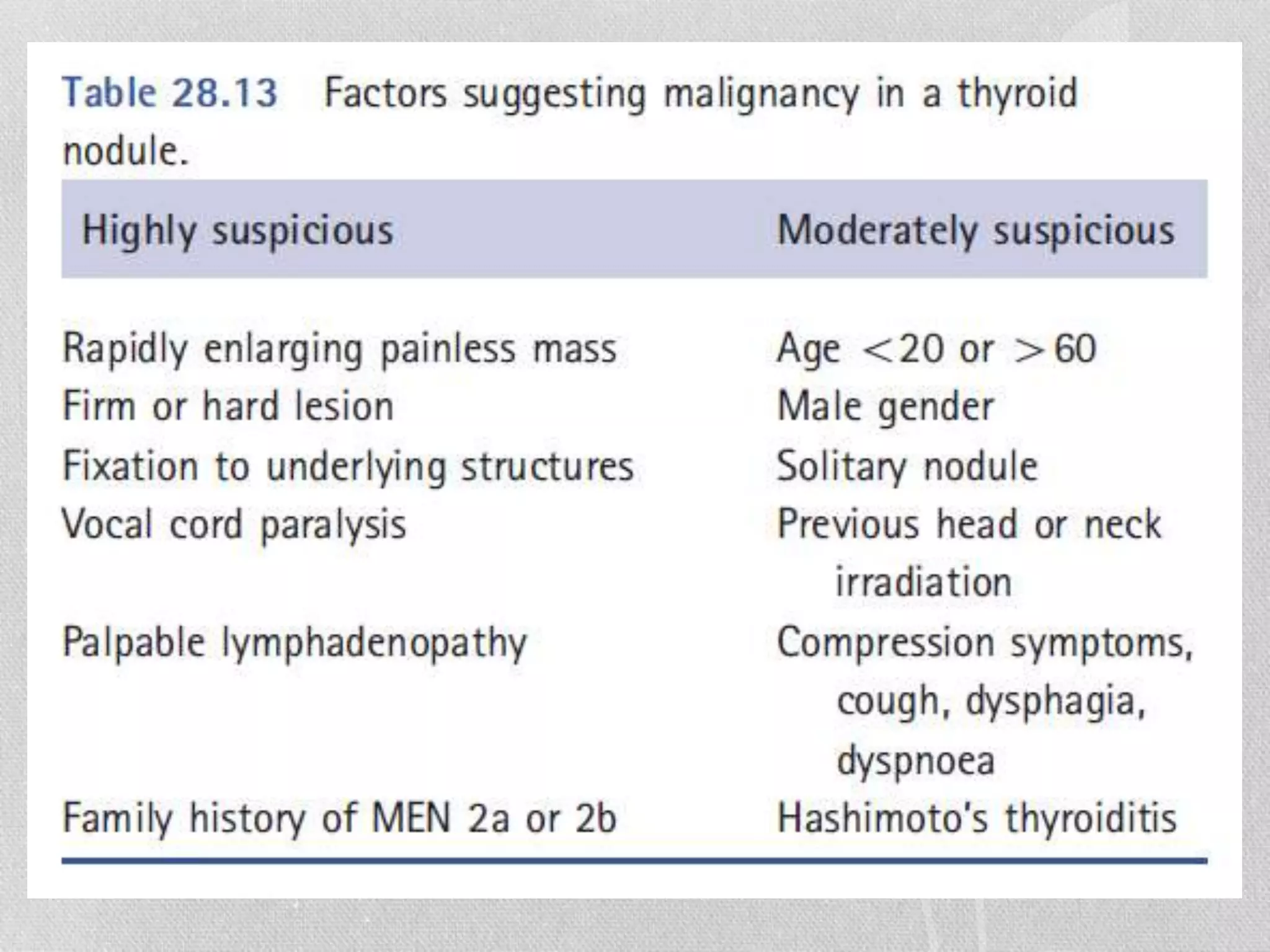
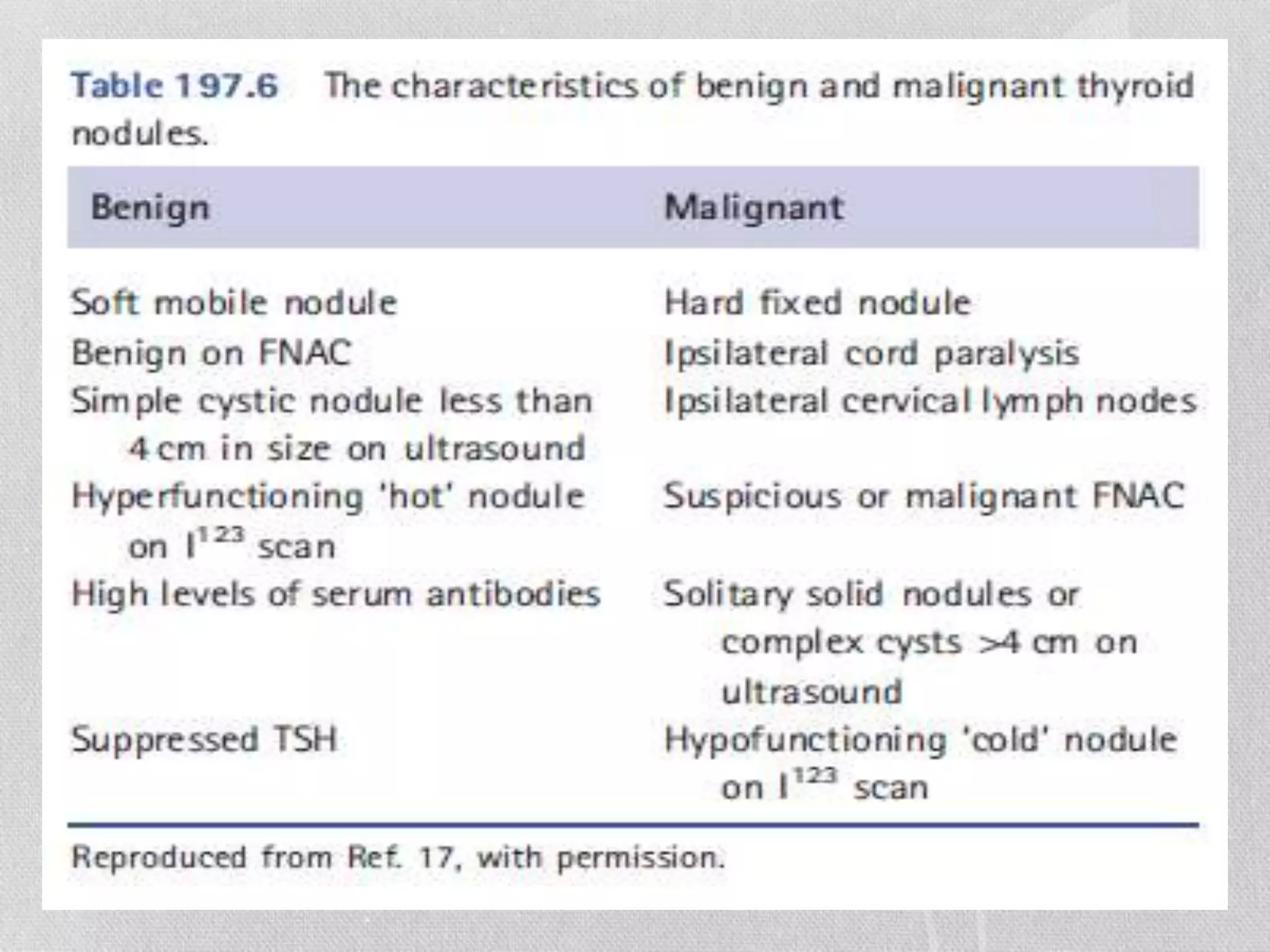
• Physical findings suggesting possible malignancy include
Vocal cord paralysis
Cervical lymphadenopathy (also in Hashimoto thyroiditis,
Graves disease, or infection)
Fixation of nodule to surrounding tissues
INVESTIGATION
• Lab investigations :
 CBC, ESR for inflammatory or infectious thyroiditis
 TFT, Most patients are euthyroid
 TSH is an independent risk factor for predicting malignancy
 TPO antibodies in pts with high TSH (Hashimoto's
thyroiditis)
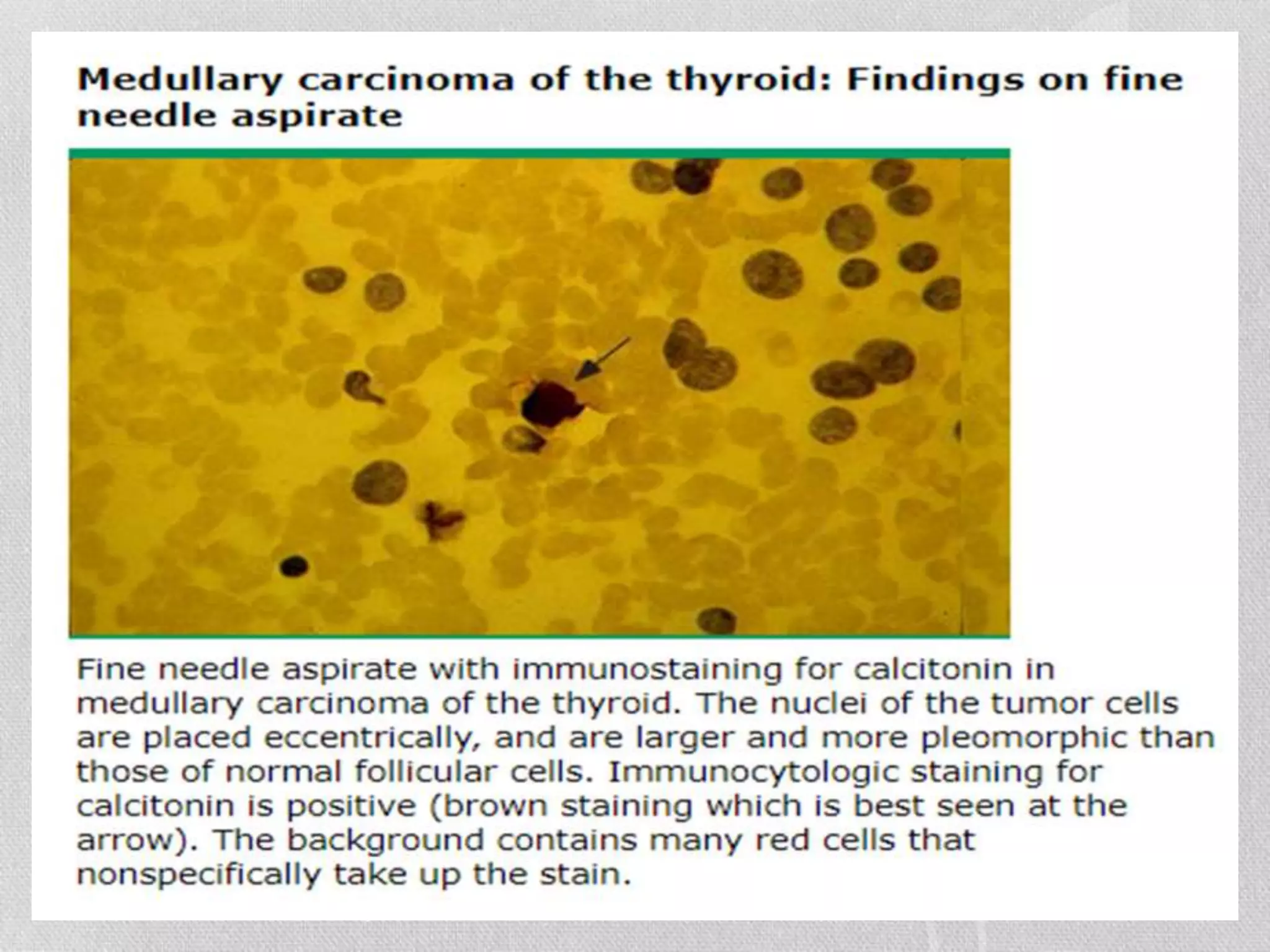
 Serum calcitonin is elevated in medullary carcinoma of
thyroid
 24-hour urine for metanephrines and catecholamines
 Serum calcium to exclude hyperparathyroidism
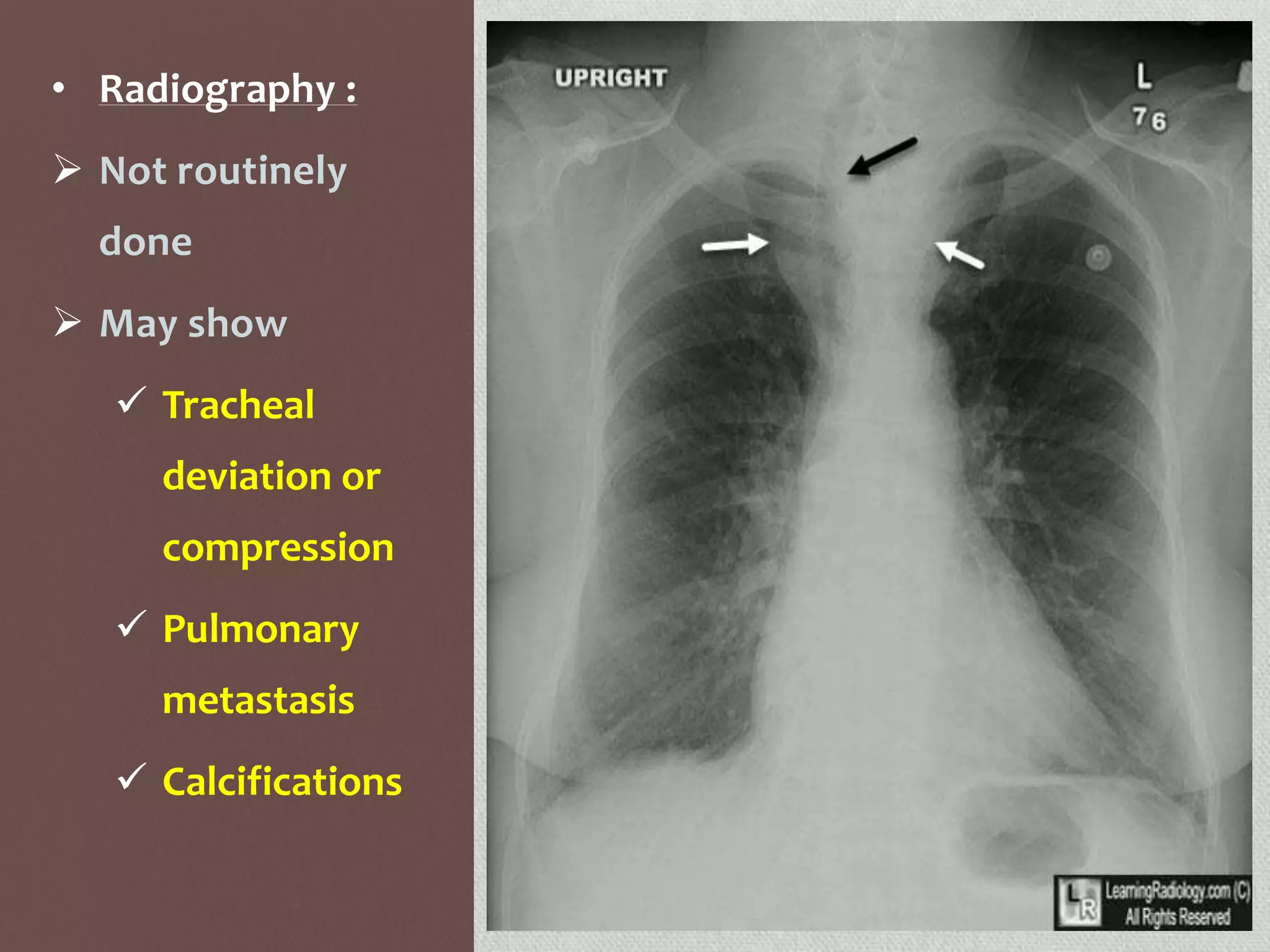
• Radiography :
 Not routinely
done
 May show
 Tracheal
deviation or
compression
 Pulmonary
metastasis
 Calcifications
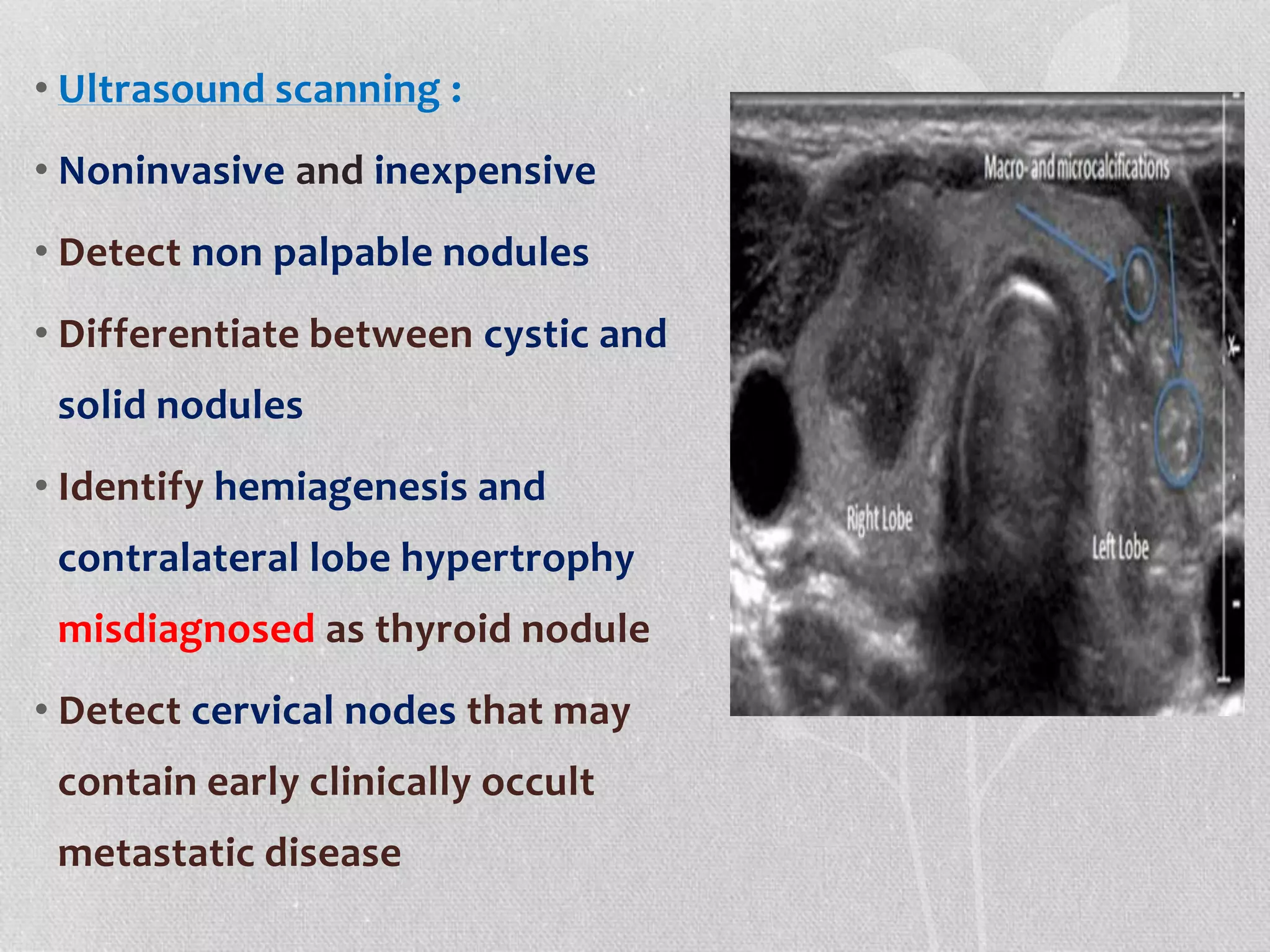
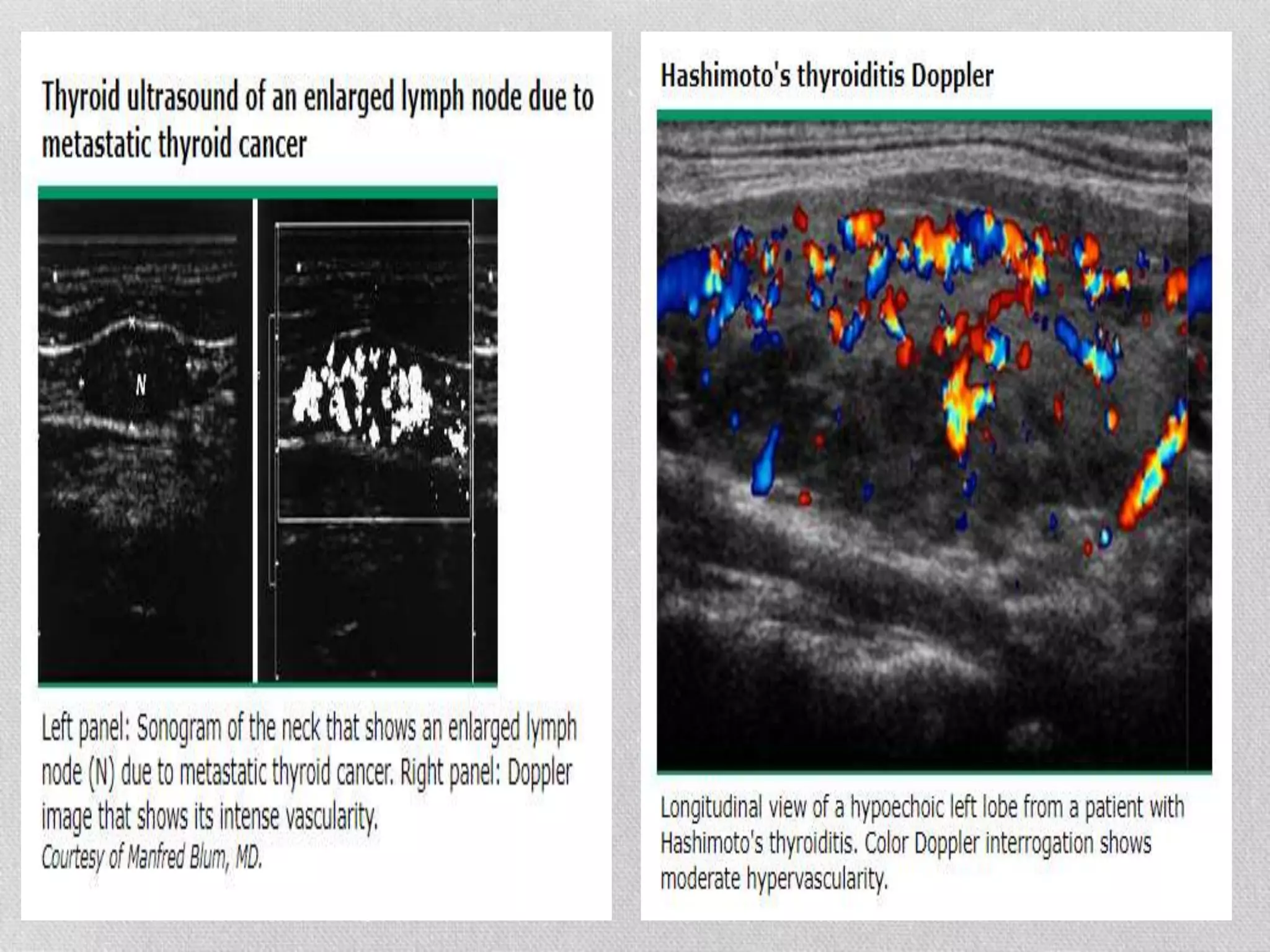
• Ultrasound scanning :
• Noninvasive and inexpensive
• Detect non palpable nodules
• Differentiate between cystic and
solid nodules
• Identify hemiagenesis and
contralateral lobe hypertrophy
misdiagnosed as thyroid nodule
• Detect cervical nodes that may
contain early clinically occult
metastatic disease
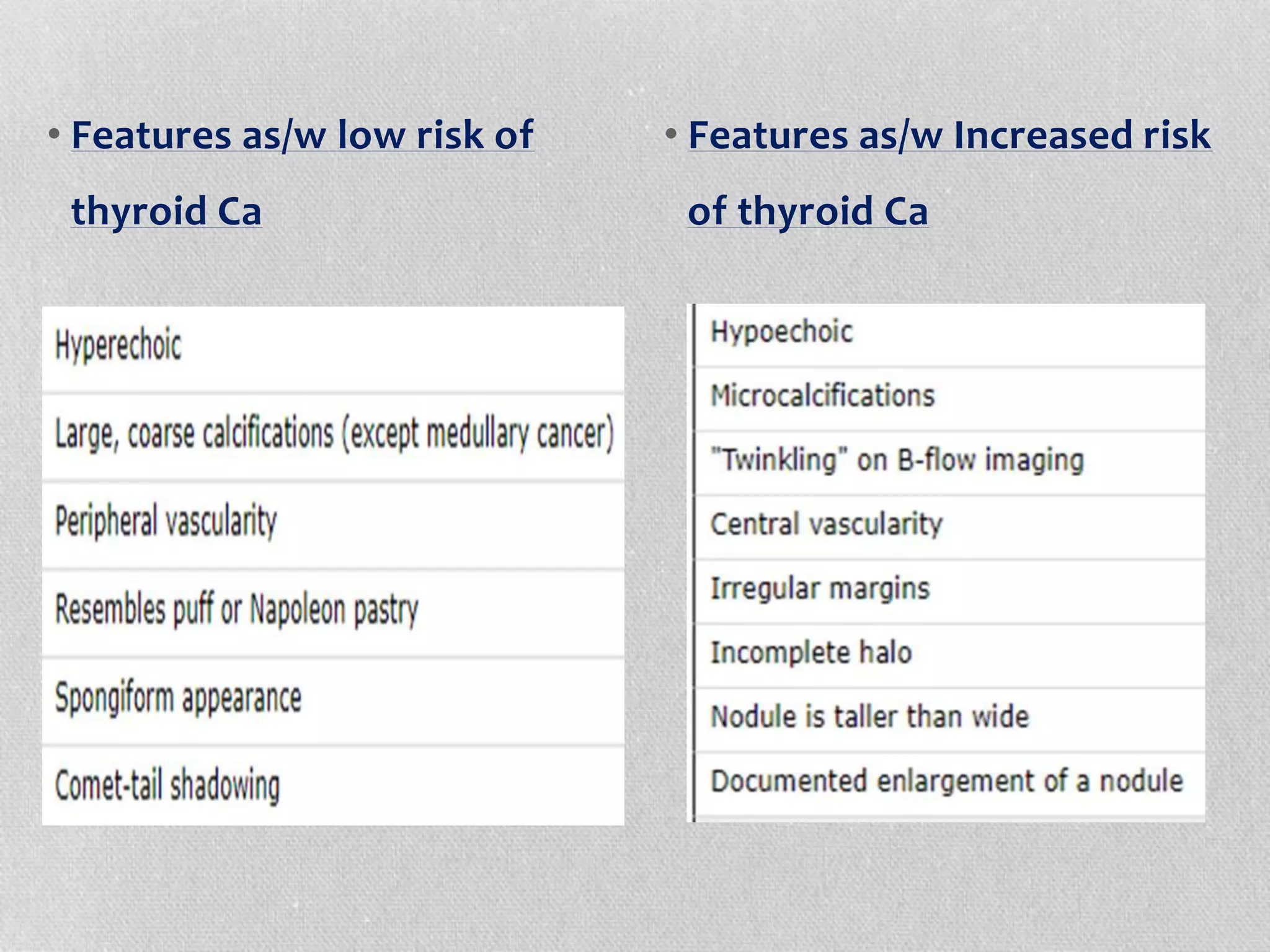
• Features as/w low risk of
thyroid Ca
• Features as/w Increased risk
of thyroid Ca
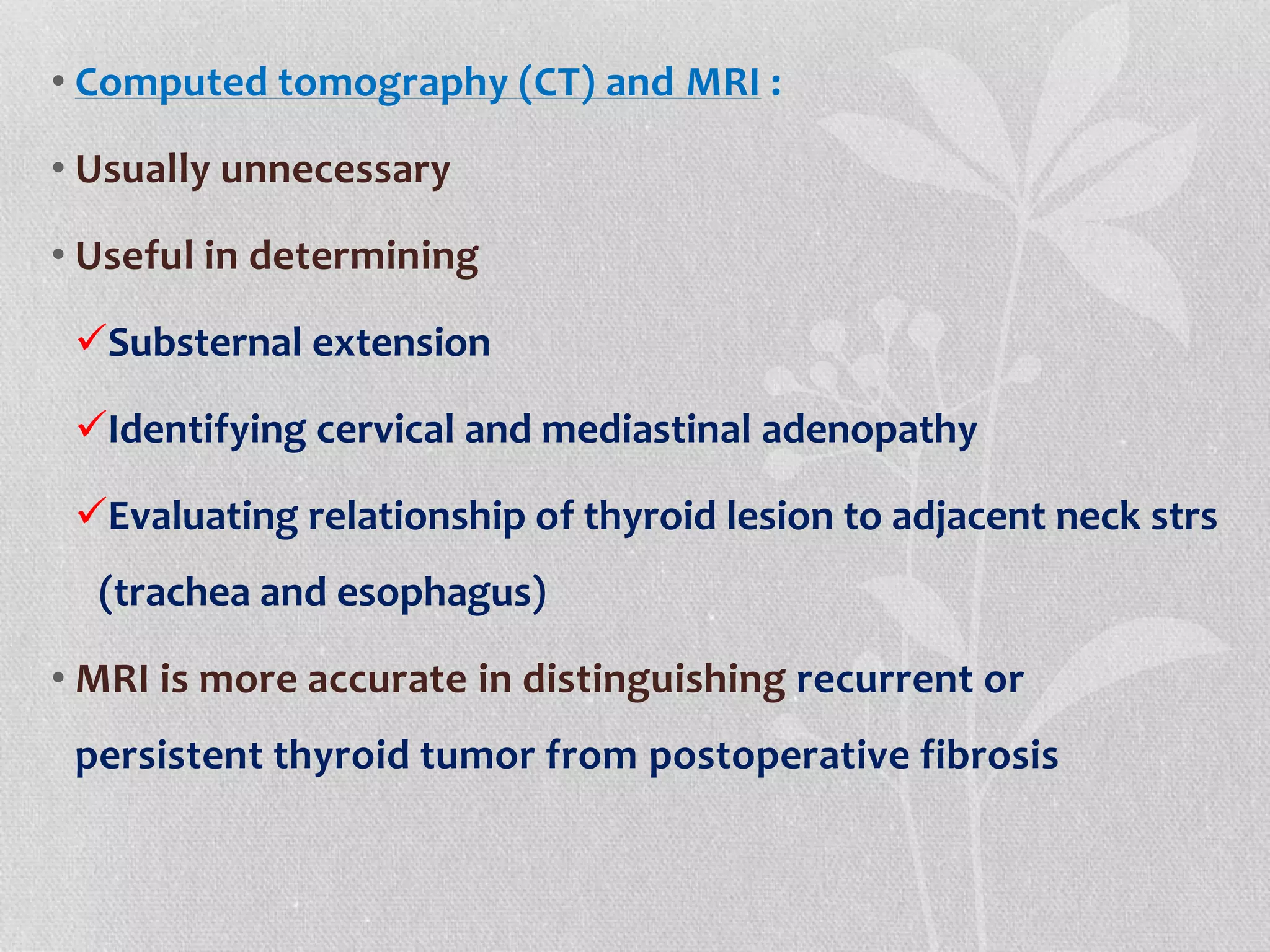
• Computed tomography (CT) and MRI :
• Usually unnecessary
• Useful in determining
Substernal extension
Identifying cervical and mediastinal adenopathy
Evaluating relationship of thyroid lesion to adjacent neck strs
(trachea and esophagus)
• MRI is more accurate in distinguishing recurrent or
persistent thyroid tumor from postoperative fibrosis
• FNAC :
• Emerged in 1970s
• Procedure of choice in evaluation of thyroid nodules
• Minimally invasive
• Improved diagnostic accuracy
• Higher malignancy yield at the time of surgery
• Significant cost reductions
• Specifity : 72 – 100% , sensitivity : 65 – 98%
Bethesda System for Reporting Thyroid
Cytopathology
Respective risk of malignancy associated with each
diagnostic category (Bethesda System) is
1. Non diagnostic
2. Benign - < 1%
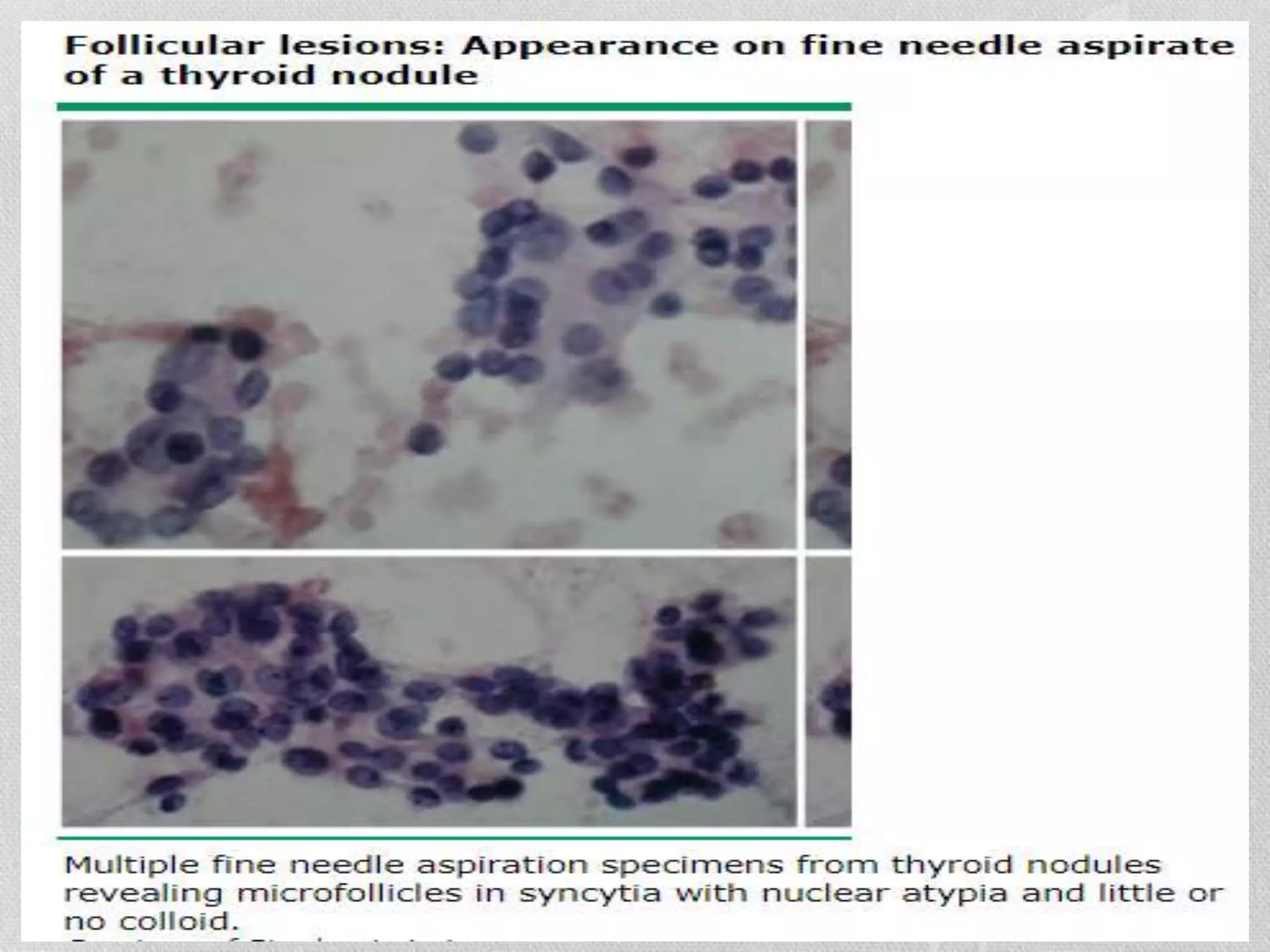
3. Atypia of undetermined significance/ follicular lesion of
undetermined significance (AUS/FLUS) - 5-10%
4. Follicular neoplasm/suspicious - 20-30%
5. Suspicious for malignancy - 50-75%
6. Malignant - 100%
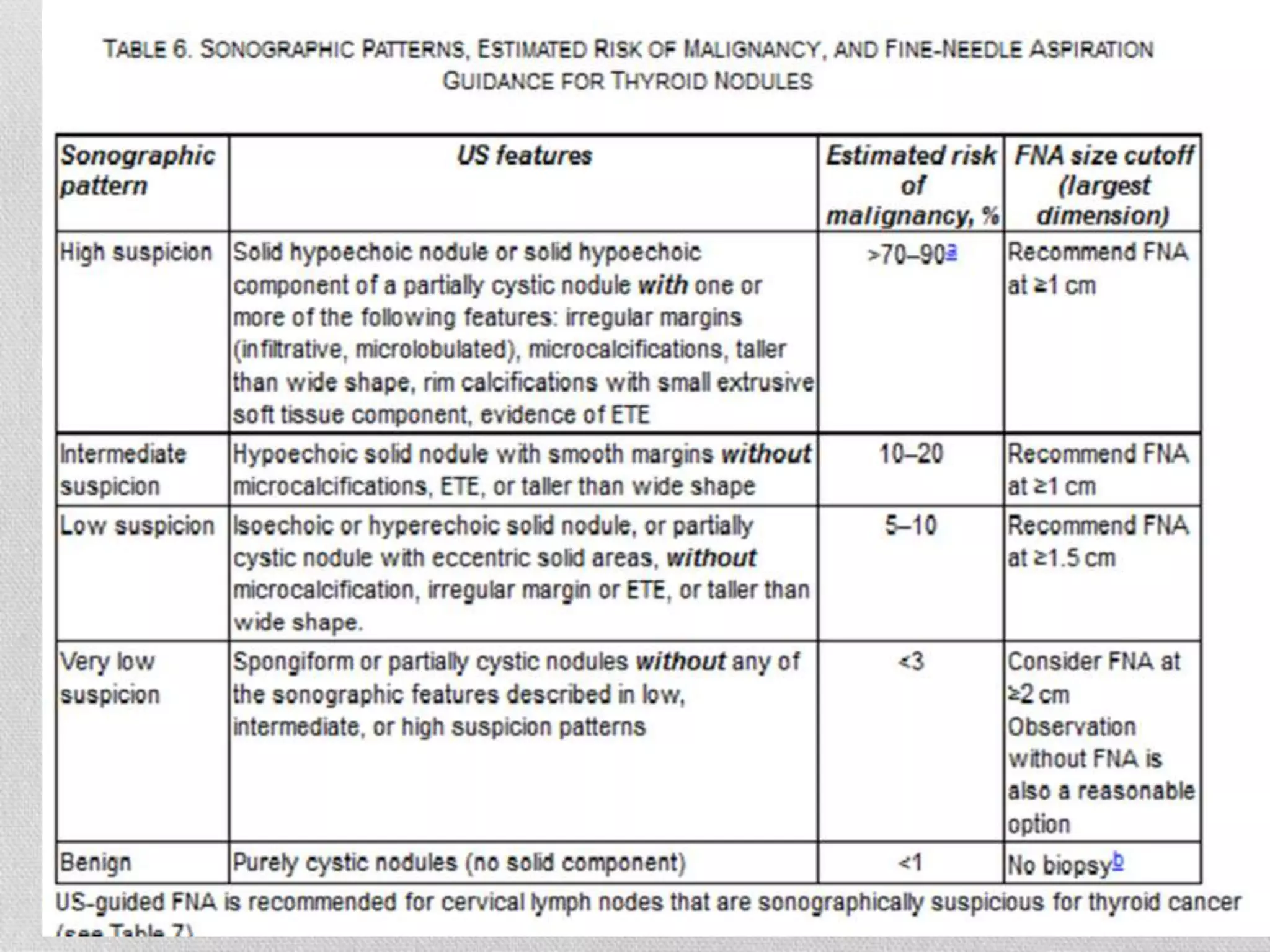
• Thyroid nodule diagnostic FNA is recommended for:
A) Nodules > 1cm in greatest dimension with high suspicion
sonographic pattern
B) Nodules > 1 cm in greatest dimension with intermediate
suspicion sonographic pattern
C) Nodules > 1.5cm in greatest dimension with low suspicion
sonographic pattern
D) Nodules > 2cm in greatest dimension with very low
suspicion sonographic pattern
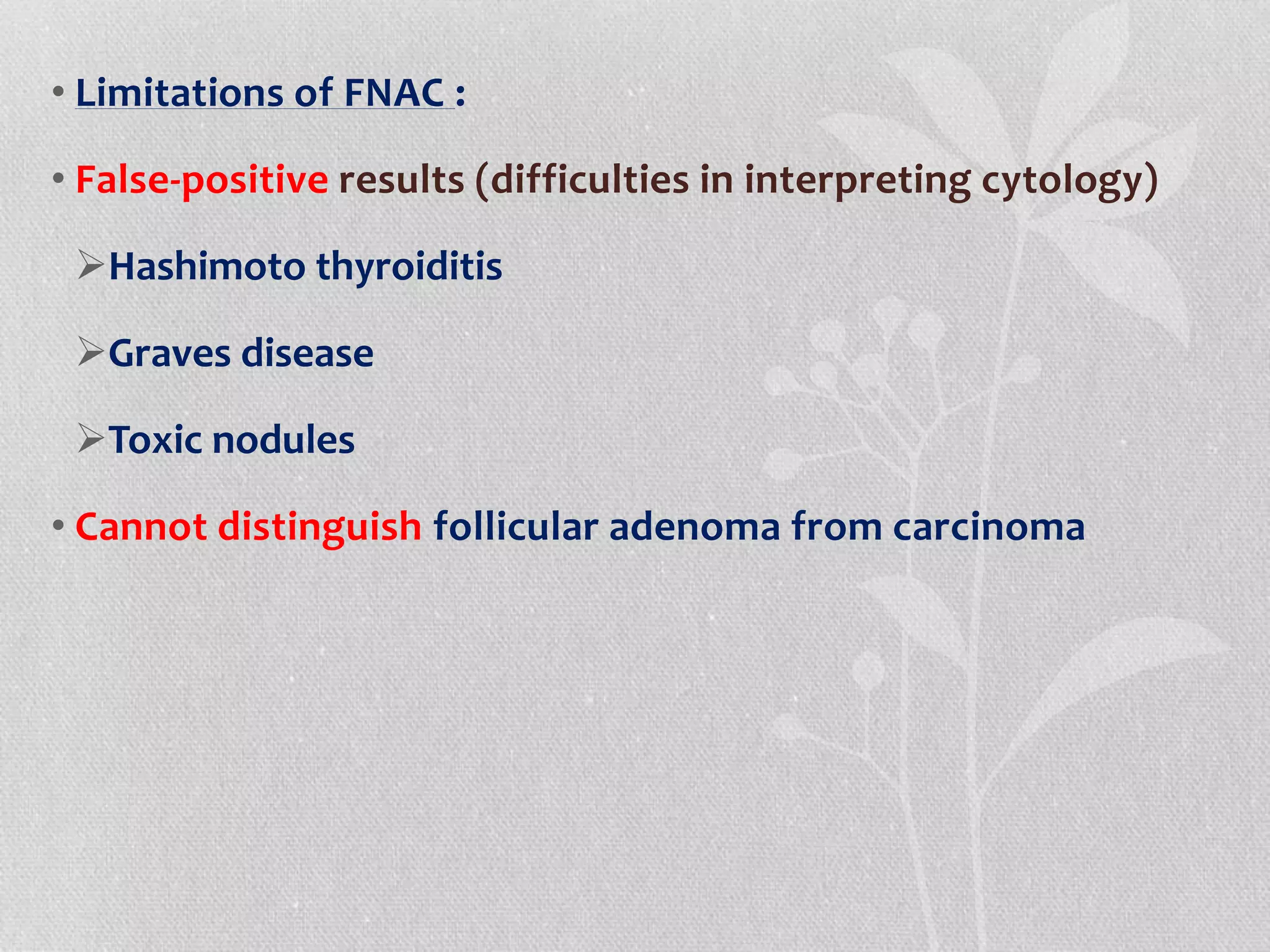
• Limitations of FNAC :
• False-positive results (difficulties in interpreting cytology)
Hashimoto thyroiditis
Graves disease
Toxic nodules
• Cannot distinguish follicular adenoma from carcinoma
• Thyroid scintigraphy :
• Should be performed in patients with low serum TSH
• Utilizes one of iodine radioisotopes (usu. I123) or
technetium-99m pertechnetate
• Others : Thallium-201 scan, Gallium-67, Tc-99m sestamibi
• Most benign and virtually all malignant thyroid nodules
concentrate both radioisotopes less avidly
• Advantage of technetium :
a. Required in smaller dose
b. Less expensive
c. Less radiation exposure
d. Shorter ½ life
• Disadvantage:
1. Only tests iodine transport (I123 also organification of I)
2. Hot nodules require I123 scanning for confirmation
3. Does not penetrate sternum - not useful in sub-sternal
extension
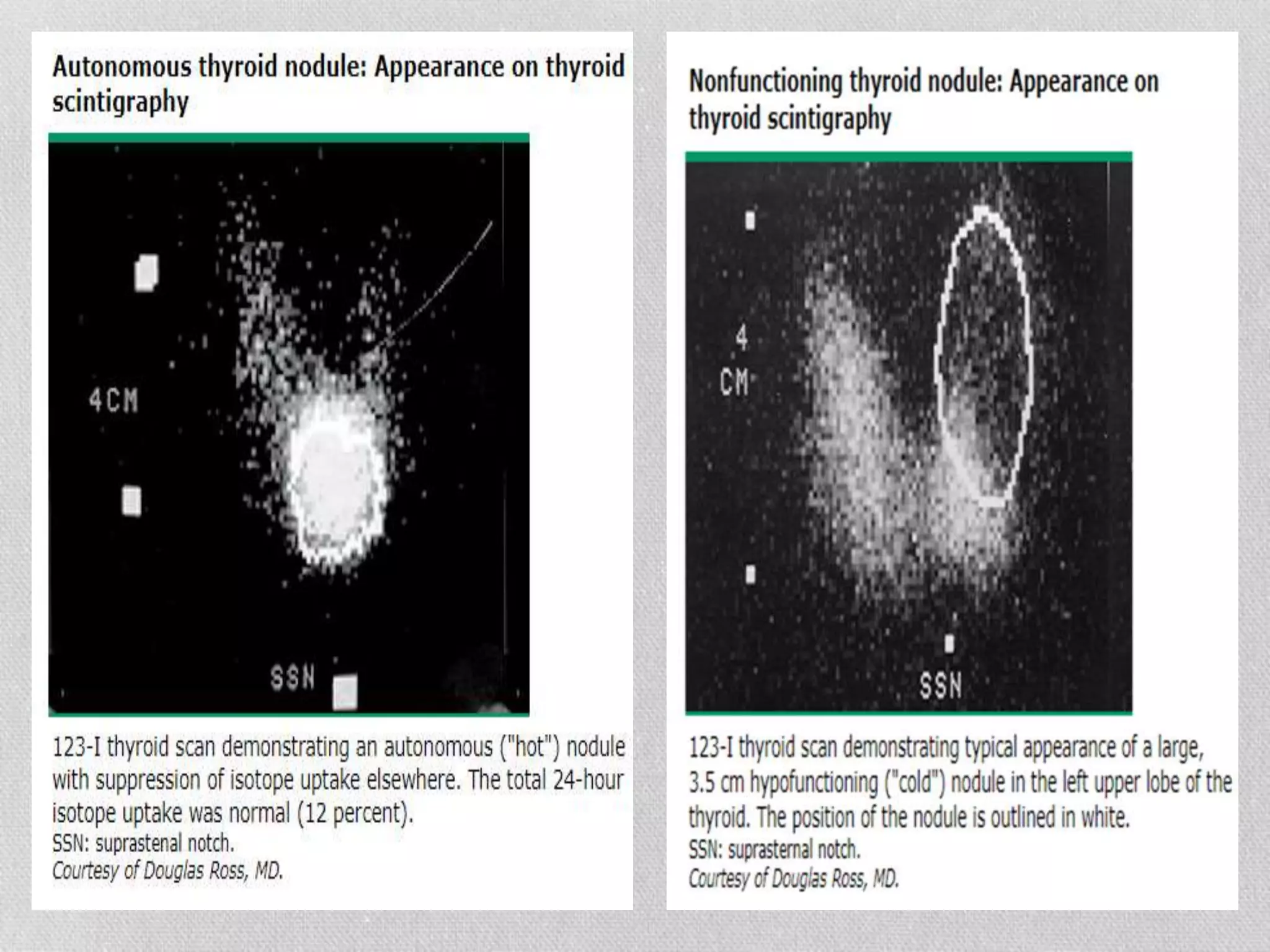
• Hyper functioning - ‘‘HOT’’
tracer uptake is greater than
surrounding thyroid (~5%
malignant)
• Iso-functioning - ‘‘WARM’’-
tracer uptake is equal to
surrounding thyroid (~10%
malignant)
• Non-functioning - ‘‘COLD ’’
uptake less than surrounding
thyroid (~20% malignant)
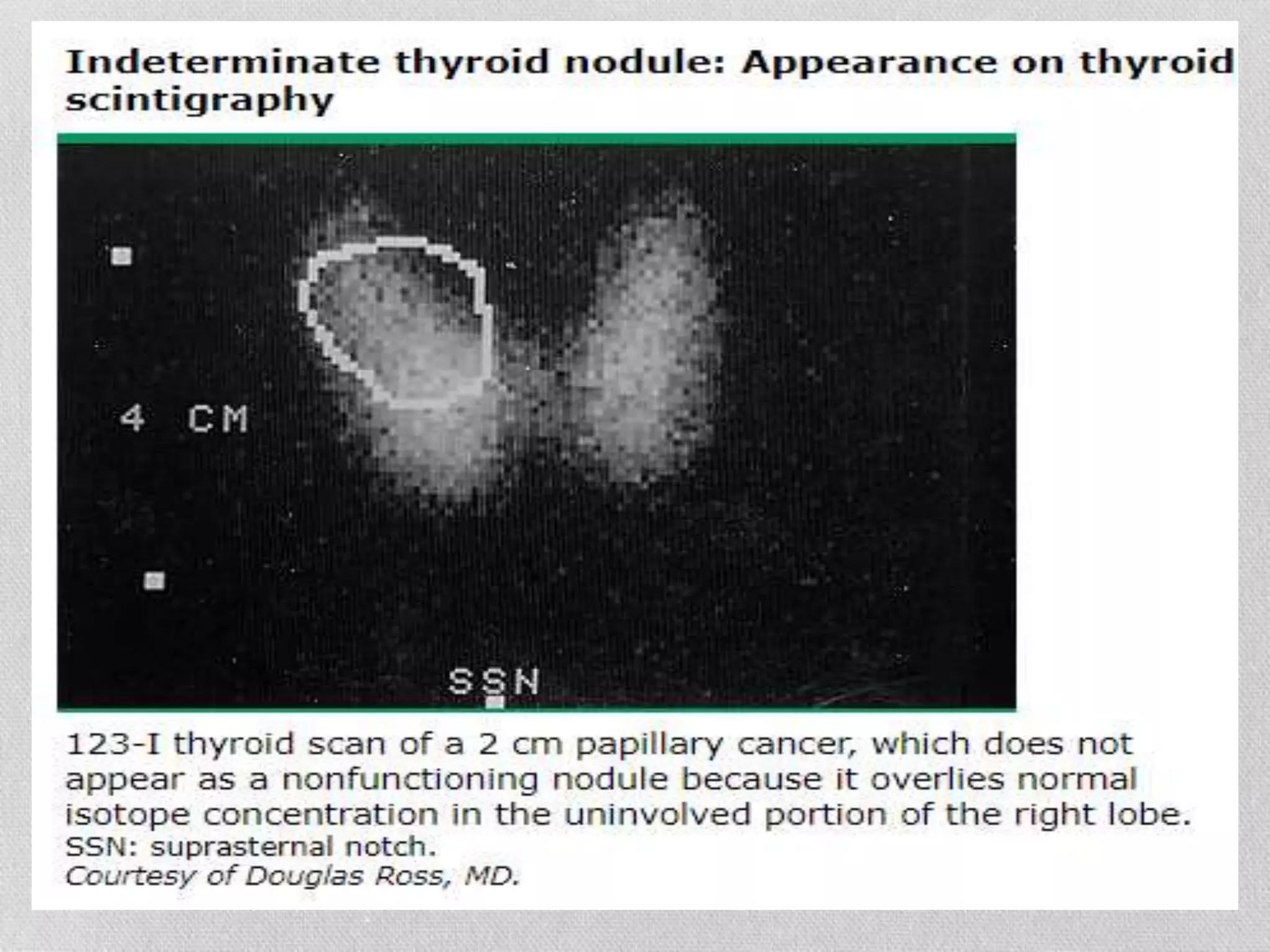
• Indeterminate :
• Superimposition of abnormal nodular tissue and normally
functioning thyroid tissue
• Should be evaluated by FNA
• Can be also be assessed by suppression scanning
Thyroid hormone sufficient to suppress TSH secretion
(2 mcg/kg for 10 days)
Second scan once TSH suppression documented
Uptake of radioiodine low or undetectable in non-
autonomous, but persist in autonomous tissue
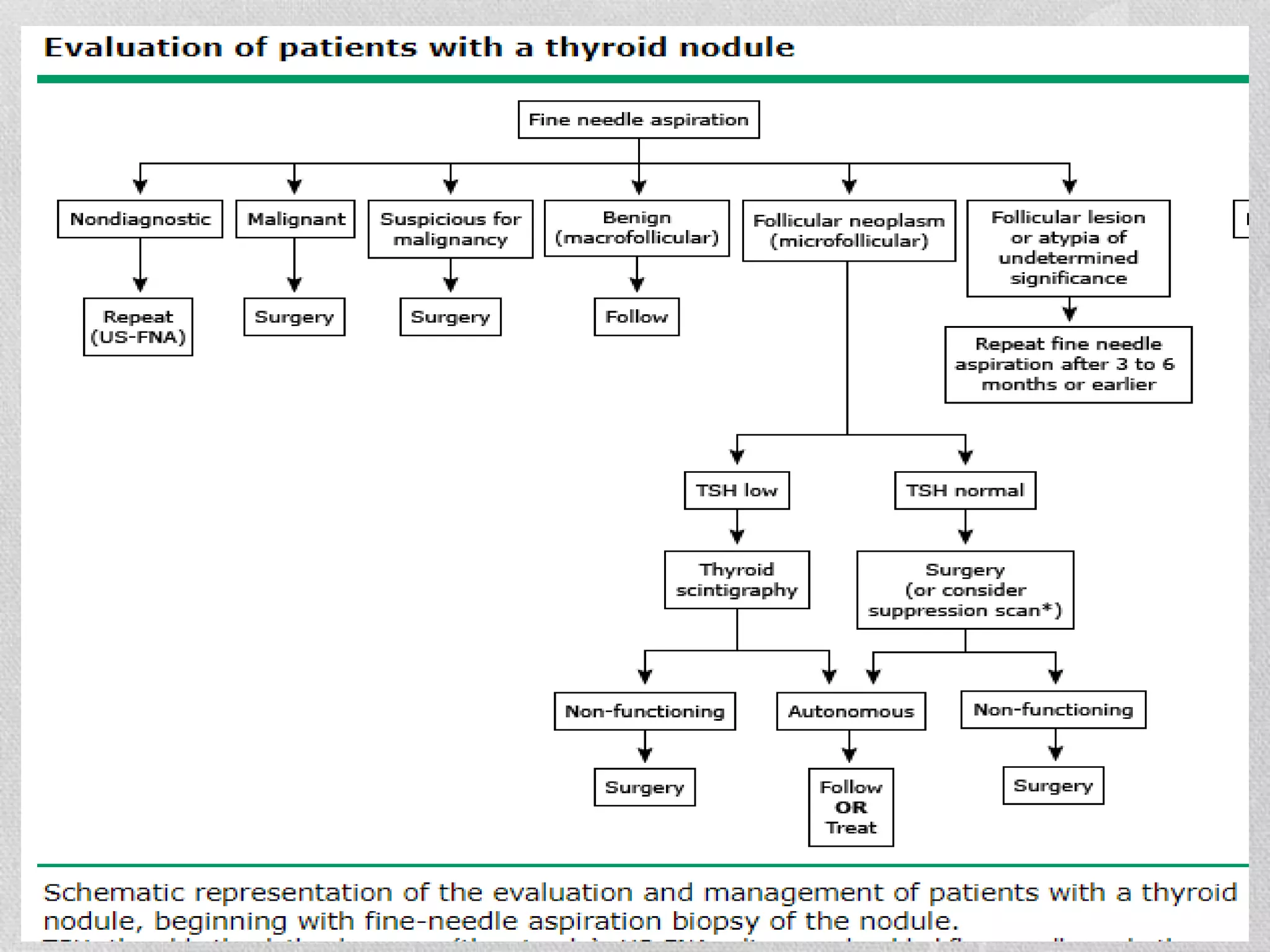
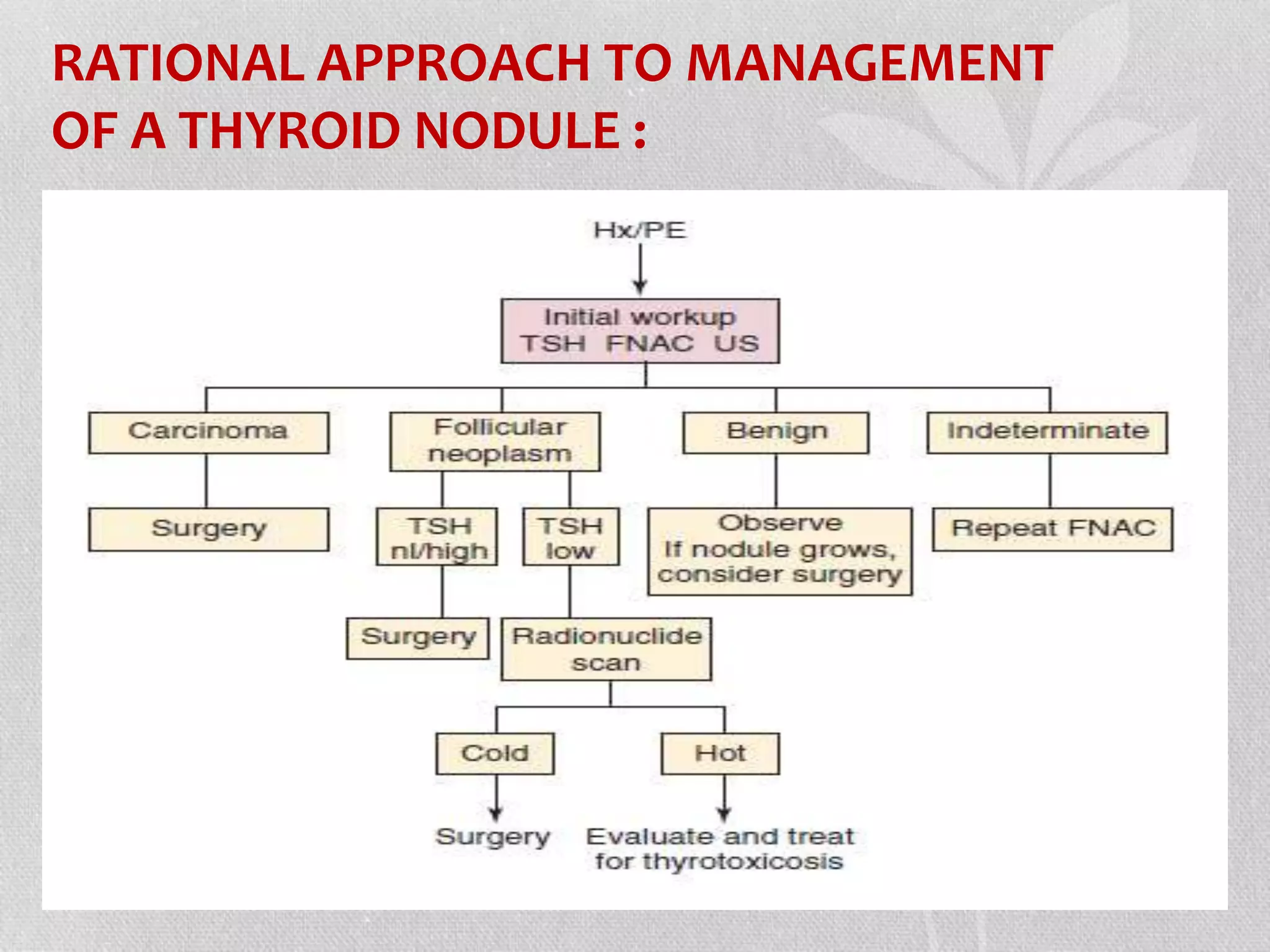
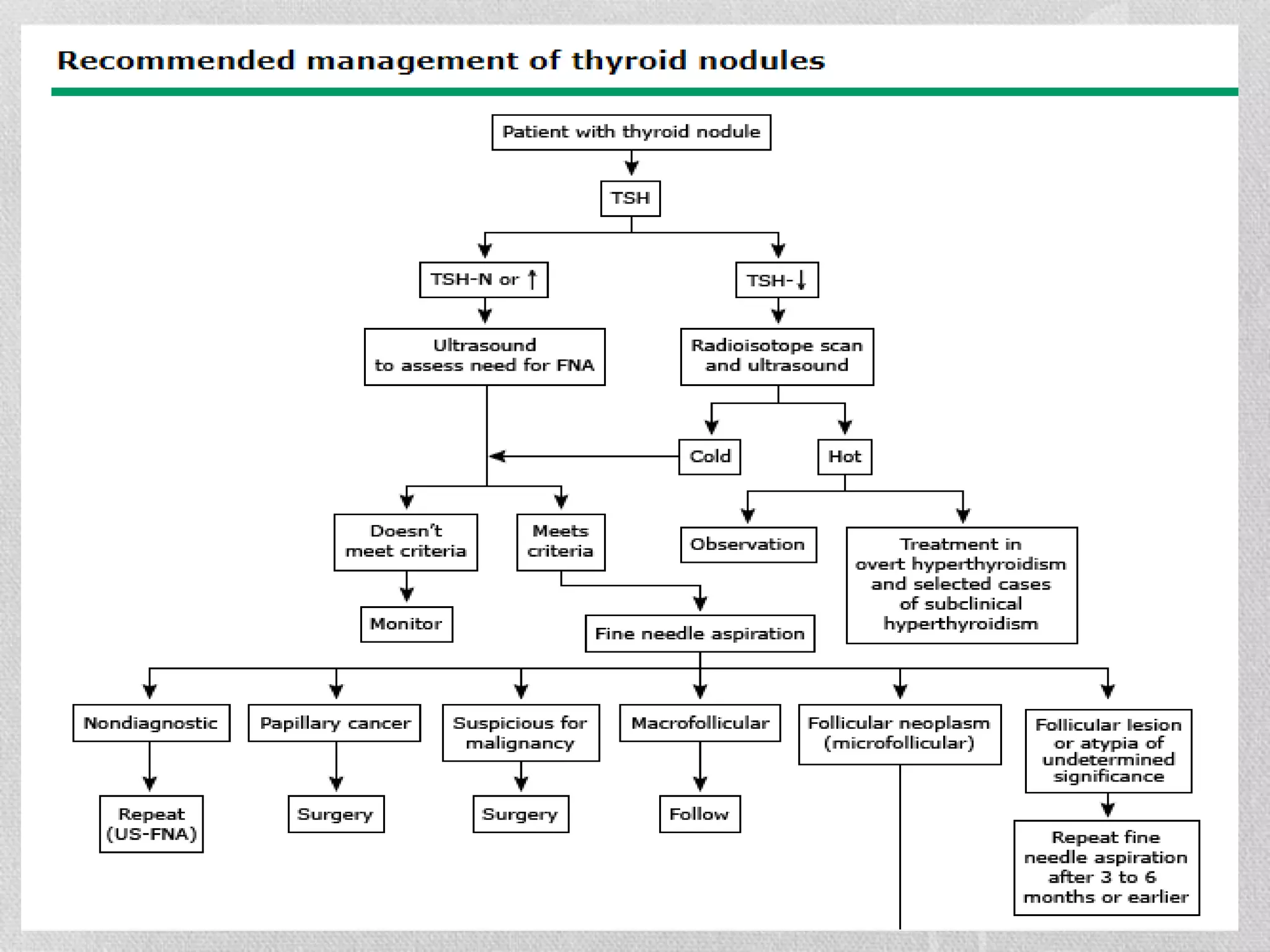
RATIONAL APPROACH TO MANAGEMENT
OF A THYROID NODULE :
THANK YOU

Approach to Thyroid nodule

  • 1.
    Dr. SANJAY MAHARJAN 2NDYr Resident, ENT-HNS MTH APPROACH TO THYROID NODULE
  • 2.
    INTRODUCTION • Discrete lesionwithin thyroid gland that is radiologically distinct from surrounding parenchyma • Noted by patient, or as an incidental finding • May be Palpable or impalpable, Functioning or nonfunctioning
  • 3.
    EPIDEMIOLOGY: • Framingham study Ages 35 – 59 Women  6.4 % Men  1.5 % • Prevalence increases with Age Exposure to ionizing radiation (Nodule in radiated patient: 35-40% cancer) • Pregnancy increases risk
  • 4.
    • Represents a widespectrum of disease • Most are,  Colloid nodules,  Adenomas  Cysts,  Focal thyroiditis • Only 5-6% are malignant
  • 6.
    CLINICAL ASSESSMENT: HISTORYAND PHYSICAL EXAMINATION • History: • Younger and older patients (m >40yrs and F >50yrs) more likely to have malignant thyroid nodule • Children may present with more advanced disease • Incidence F>M, but aggressiveness M>F • Rapid growth of a preexisting or new thyroid nodule (hemorrhage into cyst / carcinoma) • Throat or neck pain (hemorrhage into benign nodule, rarely as/w carcinoma)
  • 7.
    • Compressive orinvasive symptoms like Voice change Hoarseness Dysphagia Dyspnea • Symptoms of hyperthyroidism and hypothyroidism should be explored • Family history • H/o previous head and neck radiation exposure • H/o medullary carcinoma, pheochromocytoma, or hyperparathyroidism (MEN syndromes)
  • 8.
    • Physical examination: •Careful palpation of thyroid (solitary or dominant nodule in multinodular gland ) • Firm nodule  2-3 times increased risk of carcinoma • Substernal extension estimated by relationship of inf aspect of mass to clavicle • Thoracic inlet obstruction by Pemberton maneuver
  • 9.
    • Physical findingssuggesting possible malignancy include Vocal cord paralysis Cervical lymphadenopathy (also in Hashimoto thyroiditis, Graves disease, or infection) Fixation of nodule to surrounding tissues
  • 10.
    INVESTIGATION • Lab investigations:  CBC, ESR for inflammatory or infectious thyroiditis  TFT, Most patients are euthyroid  TSH is an independent risk factor for predicting malignancy  TPO antibodies in pts with high TSH (Hashimoto's thyroiditis)  Serum calcitonin is elevated in medullary carcinoma of thyroid  24-hour urine for metanephrines and catecholamines  Serum calcium to exclude hyperparathyroidism
  • 11.
    • Radiography : Not routinely done  May show  Tracheal deviation or compression  Pulmonary metastasis  Calcifications
  • 12.
    • Ultrasound scanning: • Noninvasive and inexpensive • Detect non palpable nodules • Differentiate between cystic and solid nodules • Identify hemiagenesis and contralateral lobe hypertrophy misdiagnosed as thyroid nodule • Detect cervical nodes that may contain early clinically occult metastatic disease
  • 13.
    • Features as/wlow risk of thyroid Ca • Features as/w Increased risk of thyroid Ca
  • 17.
    • Computed tomography(CT) and MRI : • Usually unnecessary • Useful in determining Substernal extension Identifying cervical and mediastinal adenopathy Evaluating relationship of thyroid lesion to adjacent neck strs (trachea and esophagus) • MRI is more accurate in distinguishing recurrent or persistent thyroid tumor from postoperative fibrosis
  • 18.
    • FNAC : •Emerged in 1970s • Procedure of choice in evaluation of thyroid nodules • Minimally invasive • Improved diagnostic accuracy • Higher malignancy yield at the time of surgery • Significant cost reductions • Specifity : 72 – 100% , sensitivity : 65 – 98%
  • 19.
    Bethesda System forReporting Thyroid Cytopathology
  • 20.
    Respective risk ofmalignancy associated with each diagnostic category (Bethesda System) is 1. Non diagnostic 2. Benign - < 1% 3. Atypia of undetermined significance/ follicular lesion of undetermined significance (AUS/FLUS) - 5-10% 4. Follicular neoplasm/suspicious - 20-30% 5. Suspicious for malignancy - 50-75% 6. Malignant - 100%
  • 21.
    • Thyroid nodulediagnostic FNA is recommended for: A) Nodules > 1cm in greatest dimension with high suspicion sonographic pattern B) Nodules > 1 cm in greatest dimension with intermediate suspicion sonographic pattern C) Nodules > 1.5cm in greatest dimension with low suspicion sonographic pattern D) Nodules > 2cm in greatest dimension with very low suspicion sonographic pattern
  • 27.
    • Limitations ofFNAC : • False-positive results (difficulties in interpreting cytology) Hashimoto thyroiditis Graves disease Toxic nodules • Cannot distinguish follicular adenoma from carcinoma
  • 29.
    • Thyroid scintigraphy: • Should be performed in patients with low serum TSH • Utilizes one of iodine radioisotopes (usu. I123) or technetium-99m pertechnetate • Others : Thallium-201 scan, Gallium-67, Tc-99m sestamibi • Most benign and virtually all malignant thyroid nodules concentrate both radioisotopes less avidly
  • 30.
    • Advantage oftechnetium : a. Required in smaller dose b. Less expensive c. Less radiation exposure d. Shorter ½ life • Disadvantage: 1. Only tests iodine transport (I123 also organification of I) 2. Hot nodules require I123 scanning for confirmation 3. Does not penetrate sternum - not useful in sub-sternal extension
  • 31.
    • Hyper functioning- ‘‘HOT’’ tracer uptake is greater than surrounding thyroid (~5% malignant) • Iso-functioning - ‘‘WARM’’- tracer uptake is equal to surrounding thyroid (~10% malignant) • Non-functioning - ‘‘COLD ’’ uptake less than surrounding thyroid (~20% malignant)
  • 33.
    • Indeterminate : •Superimposition of abnormal nodular tissue and normally functioning thyroid tissue • Should be evaluated by FNA • Can be also be assessed by suppression scanning Thyroid hormone sufficient to suppress TSH secretion (2 mcg/kg for 10 days) Second scan once TSH suppression documented Uptake of radioiodine low or undetectable in non- autonomous, but persist in autonomous tissue
  • 37.
    RATIONAL APPROACH TOMANAGEMENT OF A THYROID NODULE :
  • 39.