



1 
Lec. (7) 
Structure of matter
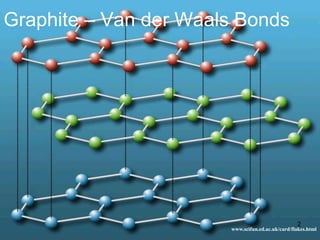
Graphite – Van der Waals Bonds 
2 
www.scifun.ed.ac.uk/card/flakes.html
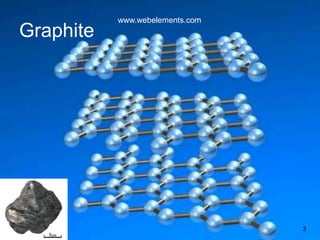
www.webelements.com 
Graphite 
3
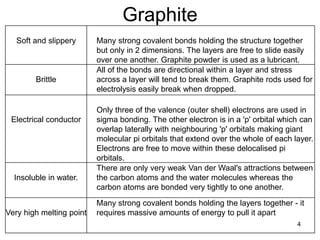
Graphite 
Soft and slippery Many strong covalent bonds holding the structure together 
but only in 2 dimensions. The layers are free to slide easily 
over one another. Graphite powder is used as a lubricant. 
Brittle 
All of the bonds are directional within a layer and stress 
across a layer will tend to break them. Graphite rods used for 
electrolysis easily break when dropped. 
Electrical conductor 
Only three of the valence (outer shell) electrons are used in 
sigma bonding. The other electron is in a 'p' orbital which can 
overlap laterally with neighbouring 'p' orbitals making giant 
molecular pi orbitals that extend over the whole of each layer. 
Electrons are free to move within these delocalised pi 
orbitals. 
Insoluble in water. 
There are only very weak Van der Waal's attractions between 
the carbon atoms and the water molecules whereas the 
carbon atoms are bonded very tightly to one another. 
Very high melting point 
Many strong covalent bonds holding the layers together - it 
requires massive amounts of energy to pull it apart 
4
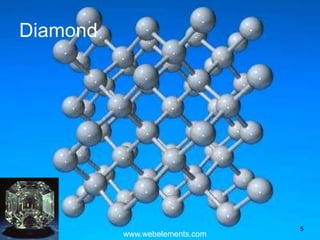
www.webelements.com 
Diamond 
5
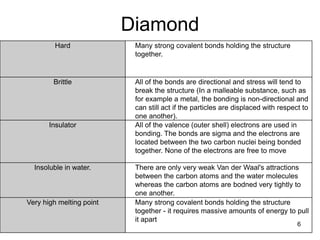
Diamond 
Hard Many strong covalent bonds holding the structure 
together. 
Brittle All of the bonds are directional and stress will tend to 
break the structure (In a malleable substance, such as 
for example a metal, the bonding is non-directional and 
can still act if the particles are displaced with respect to 
one another). 
Insulator All of the valence (outer shell) electrons are used in 
bonding. The bonds are sigma and the electrons are 
located between the two carbon nuclei being bonded 
together. None of the electrons are free to move 
Insoluble in water. There are only very weak Van der Waal's attractions 
between the carbon atoms and the water molecules 
whereas the carbon atoms are bodned very tightly to 
one another. 
Very high melting point Many strong covalent bonds holding the structure 
together - it requires massive amounts of energy to pull 
it apart 
6
www.webelements.com 
Diamond 
7
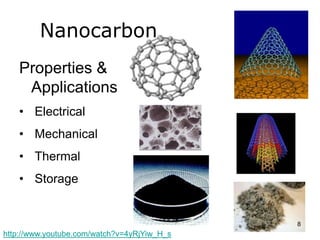
Nanocarbon 
Properties & 
Applications 
• Electrical 
• Mechanical 
• Thermal 
• Storage 
http://www.youtube.com/watch?v=4yRjYiw_H_s 
8
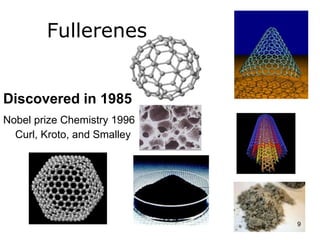
Fullerenes 
Discovered in 1985 
Nobel prize Chemistry 1996 
Curl, Kroto, and Smalley 
9
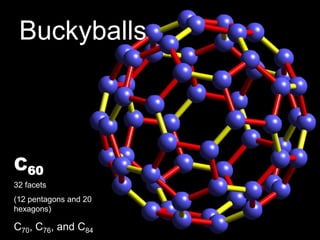
Buckyballs 
C 
60 
32 facets 
(12 pentagons and 20 
hexagons) 
C70, C76, and C84 
10
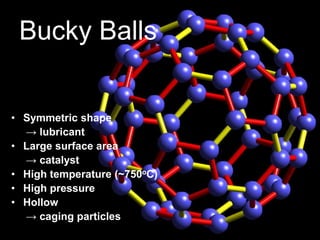
Bucky Balls 
• Symmetric shape 
→ lubricant 
• Large surface area 
→ catalyst 
• High temperature (~750oC) 
• High pressure 
• Hollow 
→ caging particles 
11
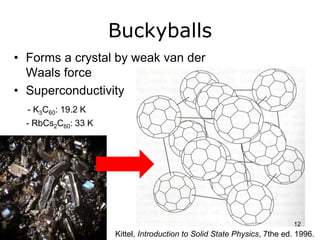
Buckyballs 
• Forms a crystal by weak van der 
Waals force 
• Superconductivity 
- K3C60: 19.2 K 
- RbCs2C60: 33 K 
12 
Kittel, Introduction to Solid State Physics, 7the ed. 1996.
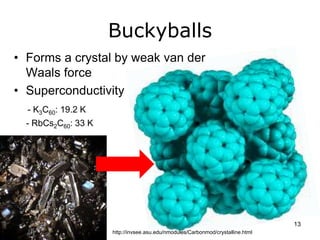
Buckyballs 
• Forms a crystal by weak van der 
Waals force 
• Superconductivity 
- K3C60: 19.2 K 
- RbCs2C60: 33 K 
http://invsee.asu.edu/nmodules/Carbonmod/crystalline.html 
13
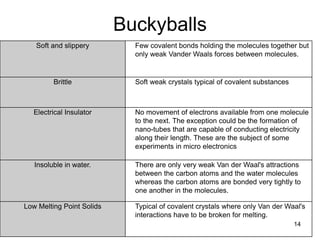
Buckyballs 
Soft and slippery Few covalent bonds holding the molecules together but 
only weak Vander Waals forces between molecules. 
Brittle Soft weak crystals typical of covalent substances 
Electrical Insulator No movement of electrons available from one molecule 
to the next. The exception could be the formation of 
nano-tubes that are capable of conducting electricity 
along their length. These are the subject of some 
experiments in micro electronics 
Insoluble in water. There are only very weak Van der Waal's attractions 
between the carbon atoms and the water molecules 
whereas the carbon atoms are bonded very tightly to 
one another in the molecules. 
Low Melting Point Solids Typical of covalent crystals where only Van der Waal's 
interactions have to be broken for melting. 
14
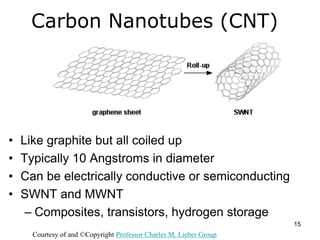
Carbon Nanotubes (CNT) 
• Like graphite but all coiled up 
• Typically 10 Angstroms in diameter 
• Can be electrically conductive or semiconducting 
• SWNT and MWNT 
– Composites, transistors, hydrogen storage 
Courtesy of and ©Copyright Professor Charles M. Lieber Group 
15
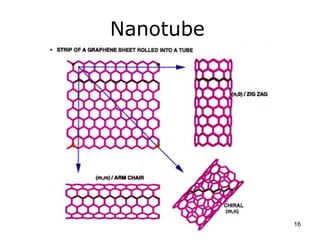
Nanotube 
16
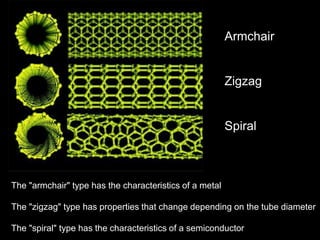
The "armchair" type has the characteristics of a metal 
Armchair 
Zigzag 
Spiral 
The "zigzag" type has properties that change depending on the tube diameter 
The "spiral" type has the characteristics of a semiconductor 
17
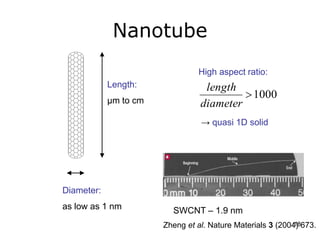
Nanotube 
length 
SWCNT – 1.9 nm 
Zheng et al. Nature Materials 3 (2004) 673. 
Length: 
μm to cm 
Diameter: 
as low as 1 nm 
High aspect ratio: 
1000 
diameter 
→ quasi 1D solid 
18
Nanotube Intro Video 
• Earth and sky: Properties of Nanotubes 
• http://www.youtube.com/watch?v=zQAK4xxPGfM&mode=related&search=Nanotube 
19
Introduction 
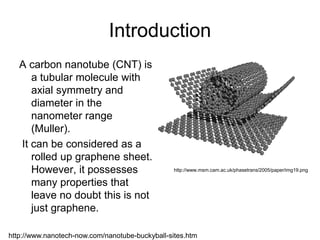
A carbon nanotube (CNT) is 
a tubular molecule with 
axial symmetry and 
diameter in the 
nanometer range 
(Muller). 
It can be considered as a 
rolled up graphene sheet. 
However, it possesses 
many properties that 
leave no doubt this is not 
just graphene. 
http://www.msm.cam.ac.uk/phasetrans/2005/paper/img19.png 
http://www.nanotech-now.com/nanotube-buckyball-sites.htm
Types 
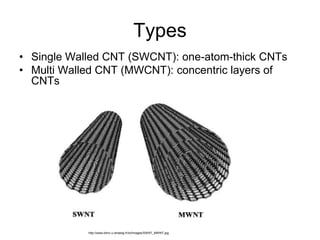
• Single Walled CNT (SWCNT): one-atom-thick CNTs 
• Multi Walled CNT (MWCNT): concentric layers of 
CNTs 
http://www-ibmc.u-strasbg.fr/ict/images/SWNT_MWNT.jpg
Properties 
Among some of the 
properties of the CNTs 
we can find: 
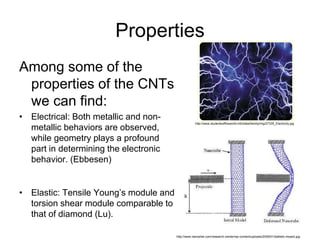
• Electrical: Both metallic and non-metallic 
behaviors are observed, 
while geometry plays a profound 
part in determining the electronic 
behavior. (Ebbesen) 
• Elastic: Tensile Young’s module and 
torsion shear module comparable to 
that of diamond (Lu). 
http://www.studentsoftheworld.info/sites/family/img/27335_Electricity.jpg 
http://www.nanoshel.com/research-center/wp-content/uploads/2009/01/ballistic-impact.jpg
Properties 
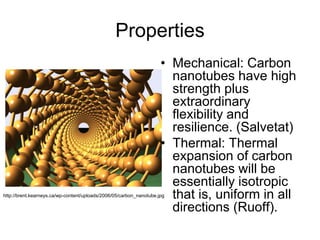
• Mechanical: Carbon 
nanotubes have high 
strength plus 
extraordinary 
flexibility and 
resilience. (Salvetat) 
• Thermal: Thermal 
expansion of carbon 
nanotubes will be 
essentially isotropic 
that is, uniform in all 
directions (Ruoff). 
http://brent.kearneys.ca/wp-content/uploads/2006/05/carbon_nanotube.jpg
Nanotube Stats 
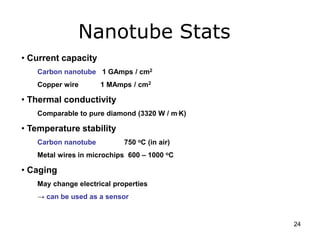
• Current capacity 
Carbon nanotube 1 GAmps / cm2 
Copper wire 1 MAmps / cm2 
• Thermal conductivity 
Comparable to pure diamond (3320 W / m.K) 
• Temperature stability 
Carbon nanotube 750 oC (in air) 
Metal wires in microchips 600 – 1000 oC 
• Caging 
May change electrical properties 
→ can be used as a sensor 
24
Nanotubes 
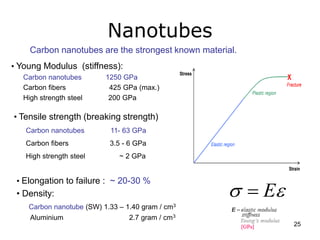
Carbon nanotubes are the strongest known material. 
• Young Modulus (stiffness): 
Carbon nanotubes 1250 GPa 
Carbon fibers 425 GPa (max.) 
High strength steel 200 GPa 
• Tensile strength (breaking strength) 
Carbon nanotubes 11- 63 GPa 
Carbon fibers 3.5 - 6 GPa 
High strength steel ~ 2 GPa 
• Elongation to failure : ~ 20-30 % 
• Density: 
Carbon nanotube (SW) 1.33 – 1.40 gram / cm3 
Aluminium 2.7 gram / cm3 
  E 
25
Synthesis of Carbon Nanotubes 
• IFW-Dresden Carbon Nanotubes 
• http://www.youtube.com/watch?v=tgToxaOqF10&mode=related&search=Nanotube 
• Synthesis of Carbon nanotube 
• http://www.youtube.com/watch?v=8N79nlhwcgM&mode=related&search=C60%20Ful 
lerene%20Fullereno%20Buckyball 
• Growth of Carbon nanotube 
• http://www.youtube.com/watch?v=1p8vFdCJRZE&NR=1&feature=fvwp 
26
27
28
29
Water Resistant Coatings 
http://www.youtube.com/watch?v=HIGMB_R3pgI&feature=related 
http://www.youtube.com/watch?v=nTbz8w1SB1U&feature=fvw 
30
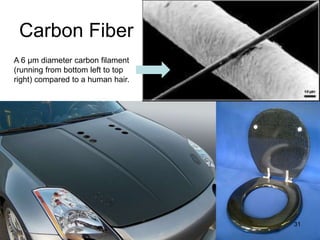
Carbon Fiber 
A 6 μm diameter carbon filament 
(running from bottom left to top 
right) compared to a human hair. 
31
CNT Carbon Nanotube Opti-Flex composite handle technology, 
provids maximum handle flex-three times greater than aluminum 
Sports Equipment 
32
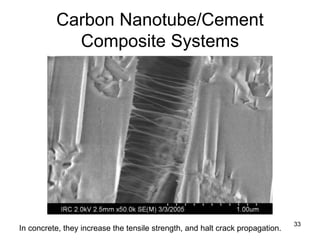
Carbon Nanotube/Cement 
Composite Systems 
In concrete, they increase the tensile strength, and halt crack propagation. 
33
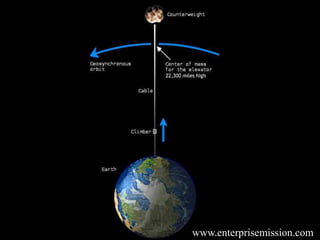
The Space Elevator 
http://www.youtube.com/watch?v=lVV0S9cNLKI&feature=related 
www.nanooze.org 
34
35 
www.enterprisemission.com
Space Elevator 
• NOVA space elevator intro 
• http://www.youtube.com/watch?v=pnwZmWoymeI& 
mode=related&search 
• 2 minute space elevator intro 
• http://www.youtube.com/watch?v=F2UZDHHDhog 
• Space Elevator Competition: USST's 
First Place Climb 
• http://www.youtube.com/watch?v=VkdfuQdoW_Q&mode=related&sear 
ch=space-elevator%20turbo%20crawler 
36
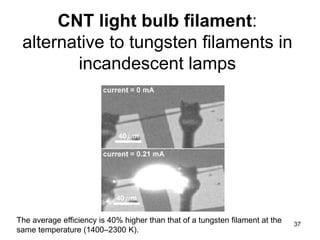
CNT light bulb filament: 
alternative to tungsten filaments in 
incandescent lamps 
The average efficiency is 40% higher than that of a tungsten filament at the 
same temperature (1400–2300 K). 
37
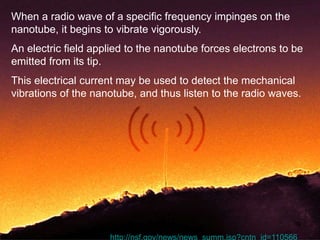
Nano Radio 
38 
•http://nsf.gov/news/news_summ.jsp?cntn_id=110566
When a radio wave of a specific frequency impinges on the 
nanotube, it begins to vibrate vigorously. 
An electric field applied to the nanotube forces electrons to be 
emitted from its tip. 
This electrical current may be used to detect the mechanical 
vibrations of the nanotube, and thus listen to the radio waves. 
39 
•http://nsf.gov/news/news_summ.jsp?cntn_id=110566
Nanotube Radio 
• http://www.youtube.com/watch?v=gkQkzvnstkg 
• http://www.youtube.com/watch?v=yQz9C7yE1kc 
&feature=related 
40
Carbon Nanotube 
Electronics 
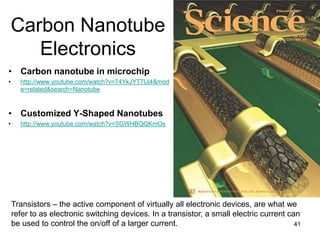
• Carbon nanotube in microchip 
• http://www.youtube.com/watch?v=74YkJYT7Uj4&mod 
e=related&search=Nanotube 
• Customized Y-Shaped Nanotubes 
• http://www.youtube.com/watch?v=SGWHBQQKmOs 
Transistors – the active component of virtually all electronic devices, are what we 
refer to as electronic switching devices. In a transistor, a small electric current can 
be used to control the on/off of a larger current. 41
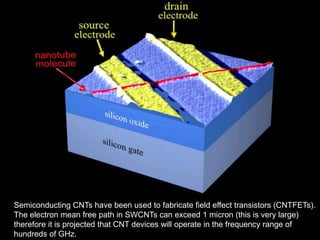
Semiconducting CNTs have been used to fabricate field effect transistors (CNTFETs). 
The electron mean free path in SWCNTs can exceed 1 micron (this is very large) 
therefore it is projected that CNT devices will operate in the frequency range of 
42 
hundreds of GHz.
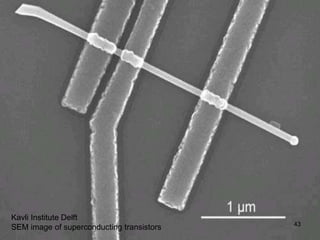
Kavli Institute Delft 
SEM image of superconducting transistors 43
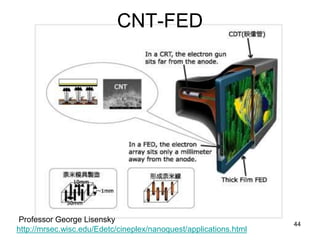
CNT-FED 
Professor George Lisensky 
http://mrsec.wisc.edu/Edetc/cineplex/nanoquest/applications.html 
44
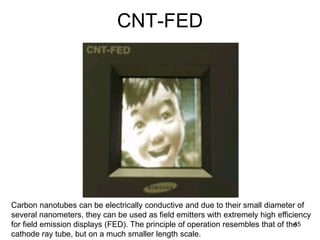
CNT-FED 
Carbon nanotubes can be electrically conductive and due to their small diameter of 
several nanometers, they can be used as field emitters with extremely high efficiency 
for field emission displays (FED). The principle of operation resembles that of the 
45 
cathode ray tube, but on a much smaller length scale.
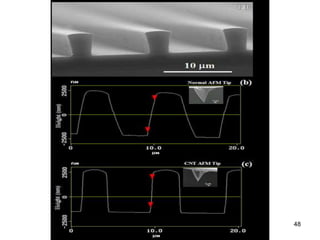
Bucky Paper 
A thin sheet made from nanotubes that are 250 times stronger than steel and 10 
times lighter that could be used as a heat sink for chipboards, a backlight for LCD 
screens or as a faraday cage to protect electrical devices 46
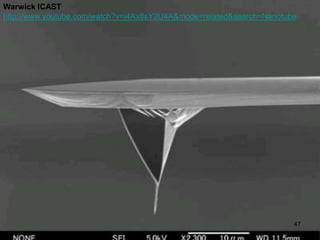
Warwick ICAST 
http://www.youtube.com/watch?v=i4Ax8sY2U4A&mode=related&search=Nanotube 
47
48
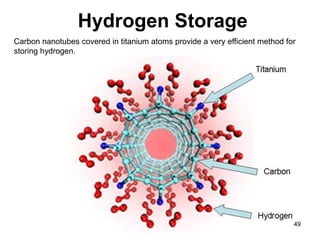
Hydrogen Storage 
Carbon nanotubes covered in titanium atoms provide a very efficient method for 
storing hydrogen. 
49
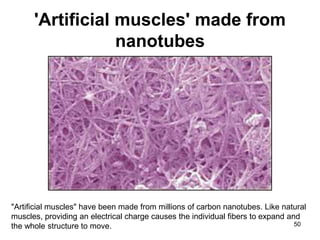
'Artificial muscles' made from 
nanotubes 
"Artificial muscles" have been made from millions of carbon nanotubes. Like natural 
muscles, providing an electrical charge causes the individual fibers to expand and 
the whole structure to move. 50
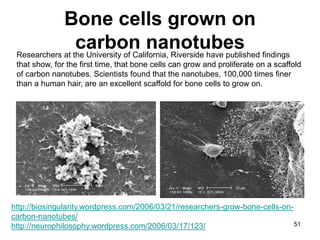
Bone cells grown on 
carbon nanotubes 
Researchers at the University of California, Riverside have published findings 
that show, for the first time, that bone cells can grow and proliferate on a scaffold 
of carbon nanotubes. Scientists found that the nanotubes, 100,000 times finer 
than a human hair, are an excellent scaffold for bone cells to grow on. 
http://biosingularity.wordpress.com/2006/03/21/researchers-grow-bone-cells-on-carbon- 
nanotubes/ 
http://neurophilosophy.wordpress.com/2006/03/17/123/ 51
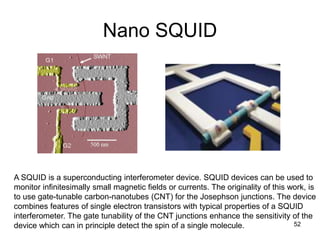
Nano SQUID 
A SQUID is a superconducting interferometer device. SQUID devices can be used to 
monitor infinitesimally small magnetic fields or currents. The originality of this work, is 
to use gate-tunable carbon-nanotubes (CNT) for the Josephson junctions. The device 
combines features of single electron transistors with typical properties of a SQUID 
interferometer. The gate tunability of the CNT junctions enhance the sensitivity of the 
device which can in principle detect the spin of a single molecule. 52

Phys 4190 lec (7)

  • 1.
    1 Lec. (7) Structure of matter
  • 2.
    Graphite – Vander Waals Bonds 2 www.scifun.ed.ac.uk/card/flakes.html
  • 3.
  • 4.
    Graphite Soft andslippery Many strong covalent bonds holding the structure together but only in 2 dimensions. The layers are free to slide easily over one another. Graphite powder is used as a lubricant. Brittle All of the bonds are directional within a layer and stress across a layer will tend to break them. Graphite rods used for electrolysis easily break when dropped. Electrical conductor Only three of the valence (outer shell) electrons are used in sigma bonding. The other electron is in a 'p' orbital which can overlap laterally with neighbouring 'p' orbitals making giant molecular pi orbitals that extend over the whole of each layer. Electrons are free to move within these delocalised pi orbitals. Insoluble in water. There are only very weak Van der Waal's attractions between the carbon atoms and the water molecules whereas the carbon atoms are bonded very tightly to one another. Very high melting point Many strong covalent bonds holding the layers together - it requires massive amounts of energy to pull it apart 4
  • 5.
  • 6.
    Diamond Hard Manystrong covalent bonds holding the structure together. Brittle All of the bonds are directional and stress will tend to break the structure (In a malleable substance, such as for example a metal, the bonding is non-directional and can still act if the particles are displaced with respect to one another). Insulator All of the valence (outer shell) electrons are used in bonding. The bonds are sigma and the electrons are located between the two carbon nuclei being bonded together. None of the electrons are free to move Insoluble in water. There are only very weak Van der Waal's attractions between the carbon atoms and the water molecules whereas the carbon atoms are bodned very tightly to one another. Very high melting point Many strong covalent bonds holding the structure together - it requires massive amounts of energy to pull it apart 6
  • 7.
  • 8.
    Nanocarbon Properties & Applications • Electrical • Mechanical • Thermal • Storage http://www.youtube.com/watch?v=4yRjYiw_H_s 8
  • 9.
    Fullerenes Discovered in1985 Nobel prize Chemistry 1996 Curl, Kroto, and Smalley 9
  • 10.
    Buckyballs C 60 32 facets (12 pentagons and 20 hexagons) C70, C76, and C84 10
  • 11.
    Bucky Balls •Symmetric shape → lubricant • Large surface area → catalyst • High temperature (~750oC) • High pressure • Hollow → caging particles 11
  • 12.
    Buckyballs • Formsa crystal by weak van der Waals force • Superconductivity - K3C60: 19.2 K - RbCs2C60: 33 K 12 Kittel, Introduction to Solid State Physics, 7the ed. 1996.
  • 13.
    Buckyballs • Formsa crystal by weak van der Waals force • Superconductivity - K3C60: 19.2 K - RbCs2C60: 33 K http://invsee.asu.edu/nmodules/Carbonmod/crystalline.html 13
  • 14.
    Buckyballs Soft andslippery Few covalent bonds holding the molecules together but only weak Vander Waals forces between molecules. Brittle Soft weak crystals typical of covalent substances Electrical Insulator No movement of electrons available from one molecule to the next. The exception could be the formation of nano-tubes that are capable of conducting electricity along their length. These are the subject of some experiments in micro electronics Insoluble in water. There are only very weak Van der Waal's attractions between the carbon atoms and the water molecules whereas the carbon atoms are bonded very tightly to one another in the molecules. Low Melting Point Solids Typical of covalent crystals where only Van der Waal's interactions have to be broken for melting. 14
  • 15.
    Carbon Nanotubes (CNT) • Like graphite but all coiled up • Typically 10 Angstroms in diameter • Can be electrically conductive or semiconducting • SWNT and MWNT – Composites, transistors, hydrogen storage Courtesy of and ©Copyright Professor Charles M. Lieber Group 15
  • 16.
  • 17.
    The "armchair" typehas the characteristics of a metal Armchair Zigzag Spiral The "zigzag" type has properties that change depending on the tube diameter The "spiral" type has the characteristics of a semiconductor 17
  • 18.
    Nanotube length SWCNT– 1.9 nm Zheng et al. Nature Materials 3 (2004) 673. Length: μm to cm Diameter: as low as 1 nm High aspect ratio: 1000 diameter → quasi 1D solid 18
  • 19.
    Nanotube Intro Video • Earth and sky: Properties of Nanotubes • http://www.youtube.com/watch?v=zQAK4xxPGfM&mode=related&search=Nanotube 19
  • 20.
    Introduction A carbonnanotube (CNT) is a tubular molecule with axial symmetry and diameter in the nanometer range (Muller). It can be considered as a rolled up graphene sheet. However, it possesses many properties that leave no doubt this is not just graphene. http://www.msm.cam.ac.uk/phasetrans/2005/paper/img19.png http://www.nanotech-now.com/nanotube-buckyball-sites.htm
  • 21.
    Types • SingleWalled CNT (SWCNT): one-atom-thick CNTs • Multi Walled CNT (MWCNT): concentric layers of CNTs http://www-ibmc.u-strasbg.fr/ict/images/SWNT_MWNT.jpg
  • 22.
    Properties Among someof the properties of the CNTs we can find: • Electrical: Both metallic and non-metallic behaviors are observed, while geometry plays a profound part in determining the electronic behavior. (Ebbesen) • Elastic: Tensile Young’s module and torsion shear module comparable to that of diamond (Lu). http://www.studentsoftheworld.info/sites/family/img/27335_Electricity.jpg http://www.nanoshel.com/research-center/wp-content/uploads/2009/01/ballistic-impact.jpg
  • 23.
    Properties • Mechanical:Carbon nanotubes have high strength plus extraordinary flexibility and resilience. (Salvetat) • Thermal: Thermal expansion of carbon nanotubes will be essentially isotropic that is, uniform in all directions (Ruoff). http://brent.kearneys.ca/wp-content/uploads/2006/05/carbon_nanotube.jpg
  • 24.
    Nanotube Stats •Current capacity Carbon nanotube 1 GAmps / cm2 Copper wire 1 MAmps / cm2 • Thermal conductivity Comparable to pure diamond (3320 W / m.K) • Temperature stability Carbon nanotube 750 oC (in air) Metal wires in microchips 600 – 1000 oC • Caging May change electrical properties → can be used as a sensor 24
  • 25.
    Nanotubes Carbon nanotubesare the strongest known material. • Young Modulus (stiffness): Carbon nanotubes 1250 GPa Carbon fibers 425 GPa (max.) High strength steel 200 GPa • Tensile strength (breaking strength) Carbon nanotubes 11- 63 GPa Carbon fibers 3.5 - 6 GPa High strength steel ~ 2 GPa • Elongation to failure : ~ 20-30 % • Density: Carbon nanotube (SW) 1.33 – 1.40 gram / cm3 Aluminium 2.7 gram / cm3   E 25
  • 26.
    Synthesis of CarbonNanotubes • IFW-Dresden Carbon Nanotubes • http://www.youtube.com/watch?v=tgToxaOqF10&mode=related&search=Nanotube • Synthesis of Carbon nanotube • http://www.youtube.com/watch?v=8N79nlhwcgM&mode=related&search=C60%20Ful lerene%20Fullereno%20Buckyball • Growth of Carbon nanotube • http://www.youtube.com/watch?v=1p8vFdCJRZE&NR=1&feature=fvwp 26
  • 27.
  • 28.
  • 29.
  • 30.
    Water Resistant Coatings http://www.youtube.com/watch?v=HIGMB_R3pgI&feature=related http://www.youtube.com/watch?v=nTbz8w1SB1U&feature=fvw 30
  • 31.
    Carbon Fiber A6 μm diameter carbon filament (running from bottom left to top right) compared to a human hair. 31
  • 32.
    CNT Carbon NanotubeOpti-Flex composite handle technology, provids maximum handle flex-three times greater than aluminum Sports Equipment 32
  • 33.
    Carbon Nanotube/Cement CompositeSystems In concrete, they increase the tensile strength, and halt crack propagation. 33
  • 34.
    The Space Elevator http://www.youtube.com/watch?v=lVV0S9cNLKI&feature=related www.nanooze.org 34
  • 35.
  • 36.
    Space Elevator •NOVA space elevator intro • http://www.youtube.com/watch?v=pnwZmWoymeI& mode=related&search • 2 minute space elevator intro • http://www.youtube.com/watch?v=F2UZDHHDhog • Space Elevator Competition: USST's First Place Climb • http://www.youtube.com/watch?v=VkdfuQdoW_Q&mode=related&sear ch=space-elevator%20turbo%20crawler 36
  • 37.
    CNT light bulbfilament: alternative to tungsten filaments in incandescent lamps The average efficiency is 40% higher than that of a tungsten filament at the same temperature (1400–2300 K). 37
  • 38.
    Nano Radio 38 •http://nsf.gov/news/news_summ.jsp?cntn_id=110566
  • 39.
    When a radiowave of a specific frequency impinges on the nanotube, it begins to vibrate vigorously. An electric field applied to the nanotube forces electrons to be emitted from its tip. This electrical current may be used to detect the mechanical vibrations of the nanotube, and thus listen to the radio waves. 39 •http://nsf.gov/news/news_summ.jsp?cntn_id=110566
  • 40.
    Nanotube Radio •http://www.youtube.com/watch?v=gkQkzvnstkg • http://www.youtube.com/watch?v=yQz9C7yE1kc &feature=related 40
  • 41.
    Carbon Nanotube Electronics • Carbon nanotube in microchip • http://www.youtube.com/watch?v=74YkJYT7Uj4&mod e=related&search=Nanotube • Customized Y-Shaped Nanotubes • http://www.youtube.com/watch?v=SGWHBQQKmOs Transistors – the active component of virtually all electronic devices, are what we refer to as electronic switching devices. In a transistor, a small electric current can be used to control the on/off of a larger current. 41
  • 42.
    Semiconducting CNTs havebeen used to fabricate field effect transistors (CNTFETs). The electron mean free path in SWCNTs can exceed 1 micron (this is very large) therefore it is projected that CNT devices will operate in the frequency range of 42 hundreds of GHz.
  • 43.
    Kavli Institute Delft SEM image of superconducting transistors 43
  • 44.
    CNT-FED Professor GeorgeLisensky http://mrsec.wisc.edu/Edetc/cineplex/nanoquest/applications.html 44
  • 45.
    CNT-FED Carbon nanotubescan be electrically conductive and due to their small diameter of several nanometers, they can be used as field emitters with extremely high efficiency for field emission displays (FED). The principle of operation resembles that of the 45 cathode ray tube, but on a much smaller length scale.
  • 46.
    Bucky Paper Athin sheet made from nanotubes that are 250 times stronger than steel and 10 times lighter that could be used as a heat sink for chipboards, a backlight for LCD screens or as a faraday cage to protect electrical devices 46
  • 47.
  • 48.
  • 49.
    Hydrogen Storage Carbonnanotubes covered in titanium atoms provide a very efficient method for storing hydrogen. 49
  • 50.
    'Artificial muscles' madefrom nanotubes "Artificial muscles" have been made from millions of carbon nanotubes. Like natural muscles, providing an electrical charge causes the individual fibers to expand and the whole structure to move. 50
  • 51.
    Bone cells grownon carbon nanotubes Researchers at the University of California, Riverside have published findings that show, for the first time, that bone cells can grow and proliferate on a scaffold of carbon nanotubes. Scientists found that the nanotubes, 100,000 times finer than a human hair, are an excellent scaffold for bone cells to grow on. http://biosingularity.wordpress.com/2006/03/21/researchers-grow-bone-cells-on-carbon- nanotubes/ http://neurophilosophy.wordpress.com/2006/03/17/123/ 51
  • 52.
    Nano SQUID ASQUID is a superconducting interferometer device. SQUID devices can be used to monitor infinitesimally small magnetic fields or currents. The originality of this work, is to use gate-tunable carbon-nanotubes (CNT) for the Josephson junctions. The device combines features of single electron transistors with typical properties of a SQUID interferometer. The gate tunability of the CNT junctions enhance the sensitivity of the device which can in principle detect the spin of a single molecule. 52