Auger Electron
Spectroscopy
By:
      NanoWhite Group
What is AES?

 AES  is an analytical techniques for
  determining the composition of the
  surface layers of a sample.
 Auger spectroscopy can be considered
  as involving three basic steps :
 (1) Atomic ionization (by removal of a
  core electron)
 (2) Electron emission (the Auger process)
 (3) Analysis of the emitted Auger
  electrons
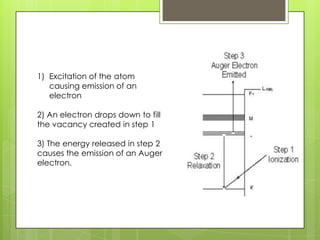
1) Excitation of the atom
   causing emission of an
   electron

2) An electron drops down to fill
the vacancy created in step 1

3) The energy released in step 2
causes the emission of an Auger
electron.
i-ionization
   The Auger process is initiated by creation of a core hole - this is
    typically carried out by exposing the sample to a beam of
    high energy electrons (typically having a primary energy in
    the range 2 - 10 keV). Such electrons have sufficient energy to
    ionise all levels of the lighter elements, and higher core levels
    of the heavier elements.
ii- Electron
                                      Emission
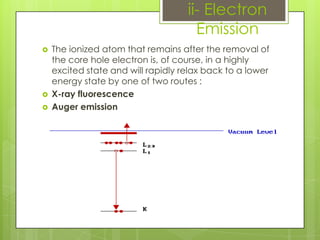
   The ionized atom that remains after the removal of
    the core hole electron is, of course, in a highly
    excited state and will rapidly relax back to a lower
    energy state by one of two routes :
   X-ray fluorescence
   Auger emission
iii- Emitted Auger
                             Electron
 The  energy of Auger electrons is usually
  between 20 and 2000 eV.
 The depths from which Auger electrons
  are able to escape from the sample
  without losing too much energy are low,
  usually less than 50 angstroms.
 Thus, Auger electrons collected by the
  AES come from the surface or just
  beneath the surface.
 AES can only provide compositional
  information about the surface of the
  sample.
THANK YOU
   ^_^

Auger electron spectroscopy

  • 1.
  • 2.
    What is AES? AES is an analytical techniques for determining the composition of the surface layers of a sample.  Auger spectroscopy can be considered as involving three basic steps :  (1) Atomic ionization (by removal of a core electron)  (2) Electron emission (the Auger process)  (3) Analysis of the emitted Auger electrons
  • 3.
    1) Excitation ofthe atom causing emission of an electron 2) An electron drops down to fill the vacancy created in step 1 3) The energy released in step 2 causes the emission of an Auger electron.
  • 5.
    i-ionization  The Auger process is initiated by creation of a core hole - this is typically carried out by exposing the sample to a beam of high energy electrons (typically having a primary energy in the range 2 - 10 keV). Such electrons have sufficient energy to ionise all levels of the lighter elements, and higher core levels of the heavier elements.
  • 6.
    ii- Electron Emission  The ionized atom that remains after the removal of the core hole electron is, of course, in a highly excited state and will rapidly relax back to a lower energy state by one of two routes :  X-ray fluorescence  Auger emission
  • 7.
    iii- Emitted Auger Electron  The energy of Auger electrons is usually between 20 and 2000 eV.  The depths from which Auger electrons are able to escape from the sample without losing too much energy are low, usually less than 50 angstroms.  Thus, Auger electrons collected by the AES come from the surface or just beneath the surface.  AES can only provide compositional information about the surface of the sample.
  • 8.