Heating Applications & other
Solar Applications of Solar Energy
SOLAR THERMAL ENERGY, CONCENTRATING SOLAR, APPLICATIONS AND PERFORMANCE;
SOLAR THERMAL POWER PLANTS, THERMAL ENERGY STORAGE FOR SOLAR HEATING AND
COOLING, LIMITATIONS, AIR AND WATER HEATING SYSTEMS, SOLAR PUMPS, SOLAR
LIGHTING SYSTEMS, SOLAR COOKERS, SOLAR DRYING OF GRAINS.
31-08-2016 IEC-803 ENERGY BASICS BY DR N R KIDWAI, INTEGRAL UNIVERSITY 1
Solar Thermal Energy
31-08-2016 IEC-803 ENERGY BASICS BY DR N R KIDWAI, INTEGRAL UNIVERSITY 2
Solar thermal technology uses the sun’s energy,, to generate low-cost, environmentally
friendly thermal energy.
This energy is used to heat water or other fluids, which can be used to generate electricity.
Solar thermal systems differ from solar PV systems, which generate electricity directly
Solar thermal collectors on a roof, shade structure or other location absorb solar energy.
Solar fluid circulated through the collectors by a pump delivers heat to a water storage tank.
For hot water use, solar-heated water in the storage tank feeds the water-heating system
thereby reducing energy bill for heating
Solar Thermal Energy
31-08-2016 IEC-803 ENERGY BASICS BY DR N R KIDWAI, INTEGRAL UNIVERSITY 3
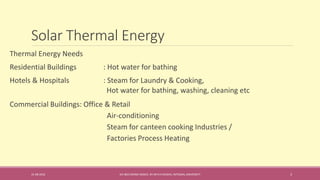
Thermal Energy Needs
Residential Buildings : Hot water for bathing
Hotels & Hospitals : Steam for Laundry & Cooking,
Hot water for bathing, washing, cleaning etc
Commercial Buildings: Office & Retail
Air-conditioning
Steam for canteen cooking Industries /
Factories Process Heating
Solar Thermal Energy
31-08-2016 IEC-803 ENERGY BASICS BY DR N R KIDWAI, INTEGRAL UNIVERSITY 4
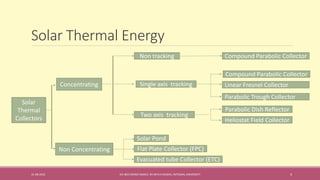
Solar
Thermal
Collectors
Non Concentrating
Evacuated tube Collector (ETC)
Flat Plate Collector (FPC)
Solar Pond
Concentrating
Heliostat Field Collector
Parabolic Dish Reflector
Single axis tracking
Non tracking
Two axis tracking
Compound Parabolic Collector
Parabolic Trough Collector
Linear Fresnel Collector
Compound Parabolic Collector
Concentrating Solar Technologies
31-08-2016 IEC-803 ENERGY BASICS BY DR N R KIDWAI, INTEGRAL UNIVERSITY 5
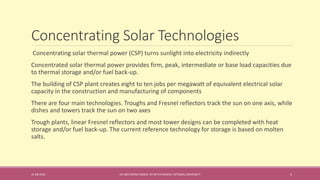
Concentrating solar thermal power (CSP) turns sunlight into electricity indirectly
Concentrated solar thermal power provides firm, peak, intermediate or base load capacities due
to thermal storage and/or fuel back-up.
The building of CSP plant creates eight to ten jobs per megawatt of equivalent electrical solar
capacity in the construction and manufacturing of components
There are four main technologies. Troughs and Fresnel reflectors track the sun on one axis, while
dishes and towers track the sun on two axes
Trough plants, linear Fresnel reflectors and most tower designs can be completed with heat
storage and/or fuel back-up. The current reference technology for storage is based on molten
salts.
Concentrating Solar Technologies
31-08-2016 IEC-803 ENERGY BASICS BY DR N R KIDWAI, INTEGRAL UNIVERSITY 6
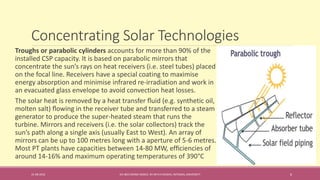
Troughs or parabolic cylinders accounts for more than 90% of the
installed CSP capacity. It is based on parabolic mirrors that
concentrate the sun’s rays on heat receivers (i.e. steel tubes) placed
on the focal line. Receivers have a special coating to maximise
energy absorption and minimise infrared re-irradiation and work in
an evacuated glass envelope to avoid convection heat losses.
The solar heat is removed by a heat transfer fluid (e.g. synthetic oil,
molten salt) flowing in the receiver tube and transferred to a steam
generator to produce the super-heated steam that runs the
turbine. Mirrors and receivers (i.e. the solar collectors) track the
sun’s path along a single axis (usually East to West). An array of
mirrors can be up to 100 metres long with a aperture of 5-6 metres.
Most PT plants have capacities between 14-80 MW, efficiencies of
around 14-16% and maximum operating temperatures of 390°C
Concentrating Solar Technologies
31-08-2016 IEC-803 ENERGY BASICS BY DR N R KIDWAI, INTEGRAL UNIVERSITY 7
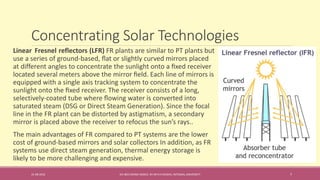
Linear Fresnel reflectors (LFR) FR plants are similar to PT plants but
use a series of ground-based, flat or slightly curved mirrors placed
at different angles to concentrate the sunlight onto a fixed receiver
located several meters above the mirror field. Each line of mirrors is
equipped with a single axis tracking system to concentrate the
sunlight onto the fixed receiver. The receiver consists of a long,
selectively-coated tube where flowing water is converted into
saturated steam (DSG or Direct Steam Generation). Since the focal
line in the FR plant can be distorted by astigmatism, a secondary
mirror is placed above the receiver to refocus the sun’s rays..
The main advantages of FR compared to PT systems are the lower
cost of ground-based mirrors and solar collectors In addition, as FR
systems use direct steam generation, thermal energy storage is
likely to be more challenging and expensive.
Concentrating Solar Technologies
31-08-2016 IEC-803 ENERGY BASICS BY DR N R KIDWAI, INTEGRAL UNIVERSITY 8
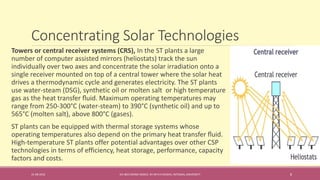
Towers or central receiver systems (CRS), In the ST plants a large
number of computer assisted mirrors (heliostats) track the sun
individually over two axes and concentrate the solar irradiation onto a
single receiver mounted on top of a central tower where the solar heat
drives a thermodynamic cycle and generates electricity. The ST plants
use water-steam (DSG), synthetic oil or molten salt or high temperature
gas as the heat transfer fluid. Maximum operating temperatures may
range from 250-300°C (water-steam) to 390°C (synthetic oil) and up to
565°C (molten salt), above 800°C (gases).
ST plants can be equipped with thermal storage systems whose
operating temperatures also depend on the primary heat transfer fluid.
High-temperature ST plants offer potential advantages over other CSP
technologies in terms of efficiency, heat storage, performance, capacity
factors and costs.
Concentrating Solar Technologies
31-08-2016 IEC-803 ENERGY BASICS BY DR N R KIDWAI, INTEGRAL UNIVERSITY 9
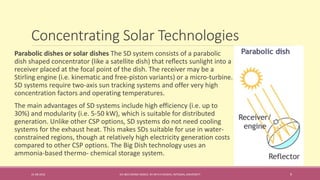
Parabolic dishes or solar dishes The SD system consists of a parabolic
dish shaped concentrator (like a satellite dish) that reflects sunlight into a
receiver placed at the focal point of the dish. The receiver may be a
Stirling engine (i.e. kinematic and free-piston variants) or a micro-turbine.
SD systems require two-axis sun tracking systems and offer very high
concentration factors and operating temperatures.
The main advantages of SD systems include high efficiency (i.e. up to
30%) and modularity (i.e. 5-50 kW), which is suitable for distributed
generation. Unlike other CSP options, SD systems do not need cooling
systems for the exhaust heat. This makes SDs suitable for use in water-
constrained regions, though at relatively high electricity generation costs
compared to other CSP options. The Big Dish technology uses an
ammonia-based thermo- chemical storage system.
Solar thermal power plants
31-08-2016 IEC-803 ENERGY BASICS BY DR N R KIDWAI, INTEGRAL UNIVERSITY 10
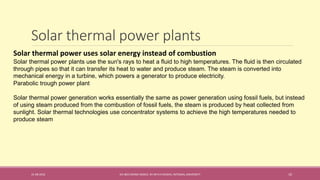
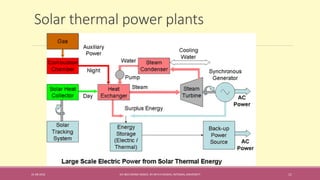
Solar thermal power uses solar energy instead of combustion
Solar thermal power plants use the sun's rays to heat a fluid to high temperatures. The fluid is then circulated
through pipes so that it can transfer its heat to water and produce steam. The steam is converted into
mechanical energy in a turbine, which powers a generator to produce electricity.
Parabolic trough power plant
Solar thermal power generation works essentially the same as power generation using fossil fuels, but instead
of using steam produced from the combustion of fossil fuels, the steam is produced by heat collected from
sunlight. Solar thermal technologies use concentrator systems to achieve the high temperatures needed to
produce steam
Solar thermal power plants
31-08-2016 IEC-803 ENERGY BASICS BY DR N R KIDWAI, INTEGRAL UNIVERSITY 11
Solar thermal power plants
31-08-2016 IEC-803 ENERGY BASICS BY DR N R KIDWAI, INTEGRAL UNIVERSITY 12
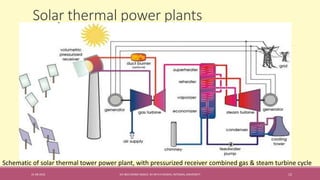
Schematic of solar thermal tower power plant, with pressurized receiver combined gas & steam turbine cycle
Air and Water heating systems,
31-08-2016 IEC-803 ENERGY BASICS BY DR N R KIDWAI, INTEGRAL UNIVERSITY 13
Over 70% of the household’s energy use goes into space and water
heating/ cooling. Covering a big part with a solar system leads to energy
as well as financial savings. Solar heating/ cooling is a well established
renewable energy source and applied in numerous projects worldwide.
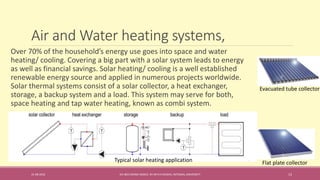
Solar thermal systems consist of a solar collector, a heat exchanger,
storage, a backup system and a load. This system may serve for both,
space heating and tap water heating, known as combi system.
Typical solar heating application Flat plate collector
Evacuated tube collector
Solar Thermal Cooling Systems,
31-08-2016 IEC-803 ENERGY BASICS BY DR N R KIDWAI, INTEGRAL UNIVERSITY 14
There are three thermal driven systems:
• Absorption cooling with chilled water
• Adsorption cooling with chilled water
• Desiccant cooling for air based cooling systems
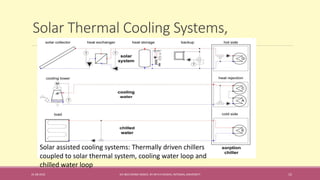
Solar assisted cooling systems involve solar thermal collectors connected to thermally driven cooling
devices. They consist of several components: the solar collectors, heat buffer storage, the air
conditioning subsystem, including various forms of cold distribution, and auxiliary subsystems
Advantages of thermal Cooling systems
The availability of high solar radiation during the time when cooling is needed
the applicability of thermal energy as driving energy
low operating costs and low electrical power rating, Durability and environmental compatibility
The disadvantage of solar cooling systems are the still high installation costs, the space needed for
heat storage and the additional backup system necessary
Solar Thermal Cooling Systems,
31-08-2016 IEC-803 ENERGY BASICS BY DR N R KIDWAI, INTEGRAL UNIVERSITY 15
Solar assisted cooling systems: Thermally driven chillers
coupled to solar thermal system, cooling water loop and
chilled water loop
solar pumps,
31-08-2016 IEC-803 ENERGY BASICS BY DR N R KIDWAI, INTEGRAL UNIVERSITY 16
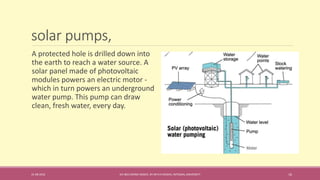
A protected hole is drilled down into
the earth to reach a water source. A
solar panel made of photovoltaic
modules powers an electric motor -
which in turn powers an underground
water pump. This pump can draw
clean, fresh water, every day.
solar lighting systems, Standalone street light
31-08-2016 IEC-803 ENERGY BASICS BY DR N R KIDWAI, INTEGRAL UNIVERSITY 17
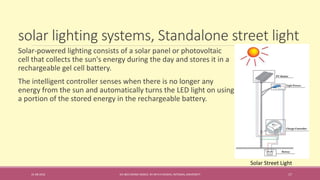
Solar-powered lighting consists of a solar panel or photovoltaic
cell that collects the sun's energy during the day and stores it in a
rechargeable gel cell battery.
The intelligent controller senses when there is no longer any
energy from the sun and automatically turns the LED light on using
a portion of the stored energy in the rechargeable battery.
Solar Street Light
solar cookers,
31-08-2016 IEC-803 ENERGY BASICS BY DR N R KIDWAI, INTEGRAL UNIVERSITY 18
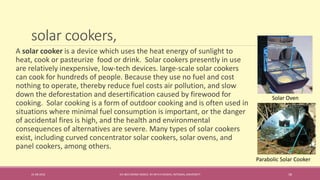
A solar cooker is a device which uses the heat energy of sunlight to
heat, cook or pasteurize food or drink. Solar cookers presently in use
are relatively inexpensive, low-tech devices. large-scale solar cookers
can cook for hundreds of people. Because they use no fuel and cost
nothing to operate, thereby reduce fuel costs air pollution, and slow
down the deforestation and desertification caused by firewood for
cooking. Solar cooking is a form of outdoor cooking and is often used in
situations where minimal fuel consumption is important, or the danger
of accidental fires is high, and the health and environmental
consequences of alternatives are severe. Many types of solar cookers
exist, including curved concentrator solar cookers, solar ovens, and
panel cookers, among others.
Solar Oven
Parabolic Solar Cooker
solar drying of grains.
31-08-2016 IEC-803 ENERGY BASICS BY DR N R KIDWAI, INTEGRAL UNIVERSITY 19
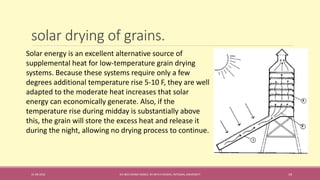
Solar energy is an excellent alternative source of
supplemental heat for low-temperature grain drying
systems. Because these systems require only a few
degrees additional temperature rise 5-10 F, they are well
adapted to the moderate heat increases that solar
energy can economically generate. Also, if the
temperature rise during midday is substantially above
this, the grain will store the excess heat and release it
during the night, allowing no drying process to continue.
Solar pond
31-08-2016 IEC-803 ENERGY BASICS BY DR N R KIDWAI, INTEGRAL UNIVERSITY 20
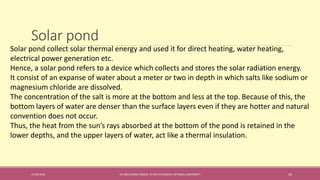
Solar pond collect solar thermal energy and used it for direct heating, water heating,
electrical power generation etc.
Hence, a solar pond refers to a device which collects and stores the solar radiation energy.
It consist of an expanse of water about a meter or two in depth in which salts like sodium or
magnesium chloride are dissolved.
The concentration of the salt is more at the bottom and less at the top. Because of this, the
bottom layers of water are denser than the surface layers even if they are hotter and natural
convention does not occur.
Thus, the heat from the sun’s rays absorbed at the bottom of the pond is retained in the
lower depths, and the upper layers of water, act like a thermal insulation.
Solar pond
31-08-2016 IEC-803 ENERGY BASICS BY DR N R KIDWAI, INTEGRAL UNIVERSITY 21
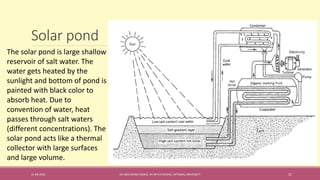
The solar pond is large shallow
reservoir of salt water. The
water gets heated by the
sunlight and bottom of pond is
painted with black color to
absorb heat. Due to
convention of water, heat
passes through salt waters
(different concentrations). The
solar pond acts like a thermal
collector with large surfaces
and large volume.

Solar Thermal Systems

  • 1.
    Heating Applications &other Solar Applications of Solar Energy SOLAR THERMAL ENERGY, CONCENTRATING SOLAR, APPLICATIONS AND PERFORMANCE; SOLAR THERMAL POWER PLANTS, THERMAL ENERGY STORAGE FOR SOLAR HEATING AND COOLING, LIMITATIONS, AIR AND WATER HEATING SYSTEMS, SOLAR PUMPS, SOLAR LIGHTING SYSTEMS, SOLAR COOKERS, SOLAR DRYING OF GRAINS. 31-08-2016 IEC-803 ENERGY BASICS BY DR N R KIDWAI, INTEGRAL UNIVERSITY 1
  • 2.
    Solar Thermal Energy 31-08-2016IEC-803 ENERGY BASICS BY DR N R KIDWAI, INTEGRAL UNIVERSITY 2 Solar thermal technology uses the sun’s energy,, to generate low-cost, environmentally friendly thermal energy. This energy is used to heat water or other fluids, which can be used to generate electricity. Solar thermal systems differ from solar PV systems, which generate electricity directly Solar thermal collectors on a roof, shade structure or other location absorb solar energy. Solar fluid circulated through the collectors by a pump delivers heat to a water storage tank. For hot water use, solar-heated water in the storage tank feeds the water-heating system thereby reducing energy bill for heating
  • 3.
    Solar Thermal Energy 31-08-2016IEC-803 ENERGY BASICS BY DR N R KIDWAI, INTEGRAL UNIVERSITY 3 Thermal Energy Needs Residential Buildings : Hot water for bathing Hotels & Hospitals : Steam for Laundry & Cooking, Hot water for bathing, washing, cleaning etc Commercial Buildings: Office & Retail Air-conditioning Steam for canteen cooking Industries / Factories Process Heating
  • 4.
    Solar Thermal Energy 31-08-2016IEC-803 ENERGY BASICS BY DR N R KIDWAI, INTEGRAL UNIVERSITY 4 Solar Thermal Collectors Non Concentrating Evacuated tube Collector (ETC) Flat Plate Collector (FPC) Solar Pond Concentrating Heliostat Field Collector Parabolic Dish Reflector Single axis tracking Non tracking Two axis tracking Compound Parabolic Collector Parabolic Trough Collector Linear Fresnel Collector Compound Parabolic Collector
  • 5.
    Concentrating Solar Technologies 31-08-2016IEC-803 ENERGY BASICS BY DR N R KIDWAI, INTEGRAL UNIVERSITY 5 Concentrating solar thermal power (CSP) turns sunlight into electricity indirectly Concentrated solar thermal power provides firm, peak, intermediate or base load capacities due to thermal storage and/or fuel back-up. The building of CSP plant creates eight to ten jobs per megawatt of equivalent electrical solar capacity in the construction and manufacturing of components There are four main technologies. Troughs and Fresnel reflectors track the sun on one axis, while dishes and towers track the sun on two axes Trough plants, linear Fresnel reflectors and most tower designs can be completed with heat storage and/or fuel back-up. The current reference technology for storage is based on molten salts.
  • 6.
    Concentrating Solar Technologies 31-08-2016IEC-803 ENERGY BASICS BY DR N R KIDWAI, INTEGRAL UNIVERSITY 6 Troughs or parabolic cylinders accounts for more than 90% of the installed CSP capacity. It is based on parabolic mirrors that concentrate the sun’s rays on heat receivers (i.e. steel tubes) placed on the focal line. Receivers have a special coating to maximise energy absorption and minimise infrared re-irradiation and work in an evacuated glass envelope to avoid convection heat losses. The solar heat is removed by a heat transfer fluid (e.g. synthetic oil, molten salt) flowing in the receiver tube and transferred to a steam generator to produce the super-heated steam that runs the turbine. Mirrors and receivers (i.e. the solar collectors) track the sun’s path along a single axis (usually East to West). An array of mirrors can be up to 100 metres long with a aperture of 5-6 metres. Most PT plants have capacities between 14-80 MW, efficiencies of around 14-16% and maximum operating temperatures of 390°C
  • 7.
    Concentrating Solar Technologies 31-08-2016IEC-803 ENERGY BASICS BY DR N R KIDWAI, INTEGRAL UNIVERSITY 7 Linear Fresnel reflectors (LFR) FR plants are similar to PT plants but use a series of ground-based, flat or slightly curved mirrors placed at different angles to concentrate the sunlight onto a fixed receiver located several meters above the mirror field. Each line of mirrors is equipped with a single axis tracking system to concentrate the sunlight onto the fixed receiver. The receiver consists of a long, selectively-coated tube where flowing water is converted into saturated steam (DSG or Direct Steam Generation). Since the focal line in the FR plant can be distorted by astigmatism, a secondary mirror is placed above the receiver to refocus the sun’s rays.. The main advantages of FR compared to PT systems are the lower cost of ground-based mirrors and solar collectors In addition, as FR systems use direct steam generation, thermal energy storage is likely to be more challenging and expensive.
  • 8.
    Concentrating Solar Technologies 31-08-2016IEC-803 ENERGY BASICS BY DR N R KIDWAI, INTEGRAL UNIVERSITY 8 Towers or central receiver systems (CRS), In the ST plants a large number of computer assisted mirrors (heliostats) track the sun individually over two axes and concentrate the solar irradiation onto a single receiver mounted on top of a central tower where the solar heat drives a thermodynamic cycle and generates electricity. The ST plants use water-steam (DSG), synthetic oil or molten salt or high temperature gas as the heat transfer fluid. Maximum operating temperatures may range from 250-300°C (water-steam) to 390°C (synthetic oil) and up to 565°C (molten salt), above 800°C (gases). ST plants can be equipped with thermal storage systems whose operating temperatures also depend on the primary heat transfer fluid. High-temperature ST plants offer potential advantages over other CSP technologies in terms of efficiency, heat storage, performance, capacity factors and costs.
  • 9.
    Concentrating Solar Technologies 31-08-2016IEC-803 ENERGY BASICS BY DR N R KIDWAI, INTEGRAL UNIVERSITY 9 Parabolic dishes or solar dishes The SD system consists of a parabolic dish shaped concentrator (like a satellite dish) that reflects sunlight into a receiver placed at the focal point of the dish. The receiver may be a Stirling engine (i.e. kinematic and free-piston variants) or a micro-turbine. SD systems require two-axis sun tracking systems and offer very high concentration factors and operating temperatures. The main advantages of SD systems include high efficiency (i.e. up to 30%) and modularity (i.e. 5-50 kW), which is suitable for distributed generation. Unlike other CSP options, SD systems do not need cooling systems for the exhaust heat. This makes SDs suitable for use in water- constrained regions, though at relatively high electricity generation costs compared to other CSP options. The Big Dish technology uses an ammonia-based thermo- chemical storage system.
  • 10.
    Solar thermal powerplants 31-08-2016 IEC-803 ENERGY BASICS BY DR N R KIDWAI, INTEGRAL UNIVERSITY 10 Solar thermal power uses solar energy instead of combustion Solar thermal power plants use the sun's rays to heat a fluid to high temperatures. The fluid is then circulated through pipes so that it can transfer its heat to water and produce steam. The steam is converted into mechanical energy in a turbine, which powers a generator to produce electricity. Parabolic trough power plant Solar thermal power generation works essentially the same as power generation using fossil fuels, but instead of using steam produced from the combustion of fossil fuels, the steam is produced by heat collected from sunlight. Solar thermal technologies use concentrator systems to achieve the high temperatures needed to produce steam
  • 11.
    Solar thermal powerplants 31-08-2016 IEC-803 ENERGY BASICS BY DR N R KIDWAI, INTEGRAL UNIVERSITY 11
  • 12.
    Solar thermal powerplants 31-08-2016 IEC-803 ENERGY BASICS BY DR N R KIDWAI, INTEGRAL UNIVERSITY 12 Schematic of solar thermal tower power plant, with pressurized receiver combined gas & steam turbine cycle
  • 13.
    Air and Waterheating systems, 31-08-2016 IEC-803 ENERGY BASICS BY DR N R KIDWAI, INTEGRAL UNIVERSITY 13 Over 70% of the household’s energy use goes into space and water heating/ cooling. Covering a big part with a solar system leads to energy as well as financial savings. Solar heating/ cooling is a well established renewable energy source and applied in numerous projects worldwide. Solar thermal systems consist of a solar collector, a heat exchanger, storage, a backup system and a load. This system may serve for both, space heating and tap water heating, known as combi system. Typical solar heating application Flat plate collector Evacuated tube collector
  • 14.
    Solar Thermal CoolingSystems, 31-08-2016 IEC-803 ENERGY BASICS BY DR N R KIDWAI, INTEGRAL UNIVERSITY 14 There are three thermal driven systems: • Absorption cooling with chilled water • Adsorption cooling with chilled water • Desiccant cooling for air based cooling systems Solar assisted cooling systems involve solar thermal collectors connected to thermally driven cooling devices. They consist of several components: the solar collectors, heat buffer storage, the air conditioning subsystem, including various forms of cold distribution, and auxiliary subsystems Advantages of thermal Cooling systems The availability of high solar radiation during the time when cooling is needed the applicability of thermal energy as driving energy low operating costs and low electrical power rating, Durability and environmental compatibility The disadvantage of solar cooling systems are the still high installation costs, the space needed for heat storage and the additional backup system necessary
  • 15.
    Solar Thermal CoolingSystems, 31-08-2016 IEC-803 ENERGY BASICS BY DR N R KIDWAI, INTEGRAL UNIVERSITY 15 Solar assisted cooling systems: Thermally driven chillers coupled to solar thermal system, cooling water loop and chilled water loop
  • 16.
    solar pumps, 31-08-2016 IEC-803ENERGY BASICS BY DR N R KIDWAI, INTEGRAL UNIVERSITY 16 A protected hole is drilled down into the earth to reach a water source. A solar panel made of photovoltaic modules powers an electric motor - which in turn powers an underground water pump. This pump can draw clean, fresh water, every day.
  • 17.
    solar lighting systems,Standalone street light 31-08-2016 IEC-803 ENERGY BASICS BY DR N R KIDWAI, INTEGRAL UNIVERSITY 17 Solar-powered lighting consists of a solar panel or photovoltaic cell that collects the sun's energy during the day and stores it in a rechargeable gel cell battery. The intelligent controller senses when there is no longer any energy from the sun and automatically turns the LED light on using a portion of the stored energy in the rechargeable battery. Solar Street Light
  • 18.
    solar cookers, 31-08-2016 IEC-803ENERGY BASICS BY DR N R KIDWAI, INTEGRAL UNIVERSITY 18 A solar cooker is a device which uses the heat energy of sunlight to heat, cook or pasteurize food or drink. Solar cookers presently in use are relatively inexpensive, low-tech devices. large-scale solar cookers can cook for hundreds of people. Because they use no fuel and cost nothing to operate, thereby reduce fuel costs air pollution, and slow down the deforestation and desertification caused by firewood for cooking. Solar cooking is a form of outdoor cooking and is often used in situations where minimal fuel consumption is important, or the danger of accidental fires is high, and the health and environmental consequences of alternatives are severe. Many types of solar cookers exist, including curved concentrator solar cookers, solar ovens, and panel cookers, among others. Solar Oven Parabolic Solar Cooker
  • 19.
    solar drying ofgrains. 31-08-2016 IEC-803 ENERGY BASICS BY DR N R KIDWAI, INTEGRAL UNIVERSITY 19 Solar energy is an excellent alternative source of supplemental heat for low-temperature grain drying systems. Because these systems require only a few degrees additional temperature rise 5-10 F, they are well adapted to the moderate heat increases that solar energy can economically generate. Also, if the temperature rise during midday is substantially above this, the grain will store the excess heat and release it during the night, allowing no drying process to continue.
  • 20.
    Solar pond 31-08-2016 IEC-803ENERGY BASICS BY DR N R KIDWAI, INTEGRAL UNIVERSITY 20 Solar pond collect solar thermal energy and used it for direct heating, water heating, electrical power generation etc. Hence, a solar pond refers to a device which collects and stores the solar radiation energy. It consist of an expanse of water about a meter or two in depth in which salts like sodium or magnesium chloride are dissolved. The concentration of the salt is more at the bottom and less at the top. Because of this, the bottom layers of water are denser than the surface layers even if they are hotter and natural convention does not occur. Thus, the heat from the sun’s rays absorbed at the bottom of the pond is retained in the lower depths, and the upper layers of water, act like a thermal insulation.
  • 21.
    Solar pond 31-08-2016 IEC-803ENERGY BASICS BY DR N R KIDWAI, INTEGRAL UNIVERSITY 21 The solar pond is large shallow reservoir of salt water. The water gets heated by the sunlight and bottom of pond is painted with black color to absorb heat. Due to convention of water, heat passes through salt waters (different concentrations). The solar pond acts like a thermal collector with large surfaces and large volume.