INTRODUCTION
SOLAR POWER PLANT IS BASED ON CONVERSION
OF SUNLIGHT INTO ELECTRICITY, EITHER DIRECTLY USING
PHOTOVOLTAIC(PV), OR INDIRECTLY USING CONCENTRATED
SOLAR POWER(CSP), OR A COMBINATION.
CONCENTRATED SOLAR POWER SYSTEM USE
LENSES OR MIRROR AND TRACKING SYSTEMS TO FOCUS A
LARGE AREA OF SUNLIGHT INTO A SMALL BEAM.
PHOTOVOLTAIC CELLS CONVERT LIGHT INTO AN
ELECTRIC CURRENT USING PHOTOVOLTAIC EFFECT
SOLAR THERMAL SYSTEMS
• PASSIVE:
A passive system requires no equipment, like when heat builds
up inside your car when its parked in the sun.
• ACTIVE:
An active system requires some way to absorb and collect
solar radiation and then store it.
e.g. solar thermal power plants
WORKING OF SOLAR POWER PLANT
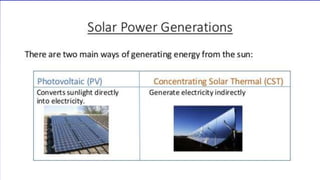
1. PHOTOVOLTAIC ELECTRICITY:
This method uses photovoltaic cells that absorb
the direct sunlight just like the solar cells that see on some
calculators.
2. SOLAR-THERMAL ELECTRICITY:
This also uses a solar collector, it has mirrored
surface that reflects the sunlight onto the receiver that heats
up a liquid. this heated liquid is used to make steam that
produces electricity.
BASIC PRINCIPLE OF SOLAR ENERGY
• SOLAR THERMAL POWER GENERATION SYSTEMS USE MIRRORS TO COLLECT
SUNLIGHT AND PRODUCE STEAM BY SOLAR HEAT TO DRIVE TURBINES FOR
GENERATING POWER.
• THIS SYSTEM GENERATES MORE POWER BY ROTATING TURBINES LIKE THERMAL
AND NUCLEAR POWER PLANTS, AND THEREFORE IS SUITABLE FOR LARGE SCALE
POWER GENERATION.
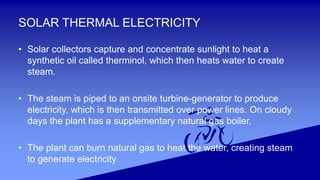
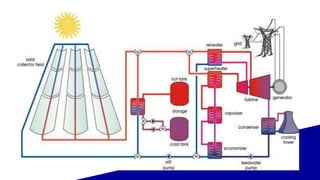
SOLAR THERMAL ELECTRICITY
• Solar collectors capture and concentrate sunlight to heat a
synthetic oil called therminol, which then heats water to create
steam.
• The steam is piped to an onsite turbine-generator to produce
electricity, which is then transmitted over power lines. On cloudy
days the plant has a supplementary natural gas boiler.
• The plant can burn natural gas to heat the water, creating steam
to generate electricity
THERMAL ENERGY STORAGE(TES)
TES are high-pressure liquid storage tanks used along with a solar thermal
system to allow plants to bank several hours of potential electricity.
1.TWO-TANK DIRECT SYSTEM:
Solar thermal energy is stored right in the same heat transfer fluid that
collected it.
2.TWO-TANK INDIRECT SYSTEM:
functions basically yhe same as the direct system except it works with
different types of heat transfer fluids.
3.SINGLE-TANK THERMOCLINE SYSTEM:
stores thermal energy as a solid, usually silica sand.
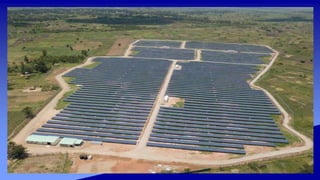
PHOTOVOLTAIC SOLAR PLANTS
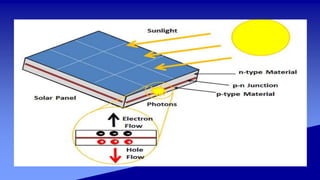
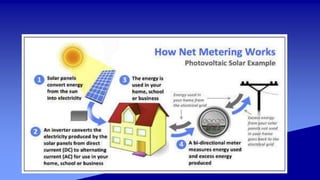
• As light hits the solar panels, the solar radiation is converted into
direct current electricity(DC).
• The current flows through the panels and is converted into
alternating current(AC) used by local electric utilities.
• Finally the electricity travels through transformers, and the voltage
is boosted for delivery onto the transmission lines so local electric
utilities can distribute the electricity to homes and businesses.
• 1) No Fuel Cost – Solar Thermal Energy does not require any fuel like most
other sources of renewable energy. This is a huge advantage over other
fossil fuels whose costs are increasing at a drastic rate every year. Electricity
prices are increasingly rapidly in most parts of the world much faster than
general inflation. Price shocks due to high fuel costs are a big risk with fossil
fuel energy these days.
• 2) Predictable, 24/7 Power -Solar Thermal Energy can generate power 24
hours a day. This is made possible as solar thermal power plants store the
energy in the form of molten salts etc. The electricity supply is much more
uniform and reliable.
ADVANTAGES
• 3) No Pollution and Global Warming Effects – Solar Thermal Energy does
not cause pollution which is one of the biggest advantages.
• 4) Using Existing Industrial Base – Solar Thermal Energy uses equipment
like solar thermal mirrors and turbines which is made in large scale at low
cost by the existing Industrial Base and requires no major changes in
equipment and materials unlike new technologies such as CIGs Panels.
1) High Costs – Solar Thermal Energy costs at least Euro 3.5/watt and has
not declined too much in the last 3-4 years. However these costs are too
high as Solar PV already costs Euro 2.5/watt and even on a conservative
basis will have its costs reduced by 5% in the next 10 years making it attain
half the cost of Solar Thermal Technology by 2020.
2) Water Issue – Solar Thermal Plants use lots of Water which is Major
Problem in Desert Areas. Using non-water cooling raises the cost of CSP
projects too much. While using Sea Water has been proposed it remains to
be seen if it possible to implement this solution as this would imply building
Plants very near the Coastline.
DISADVANTAGES
5) Limited Locations and Size Limitations – Solar Thermal Energy can only be
built in places which have the high amount of solar radiation. They can be built in
deserts mostly and require a large land area. This means its not possible to build
them in populated areas. Solar Thermal Energy also can only be built in large sizes
which are at least 50 MW in size to be economical. This contrasts to Solar PV
which is sold in sizes as low as 5 Watts.
6) Long Gestation Time Leading to Cost Overruns – The Gestation Time for
permitting, financing, drilling etc. can easily take 5-7 years to develop a
concentrated solar thermal power plant. Compare this to 6 months for a small wind
farm or 3 months for a Solar PV plant.
7) Financing – is the biggest problem in developing projects particularly for small
solar thermal developers in this industry.
APPLICATIONS
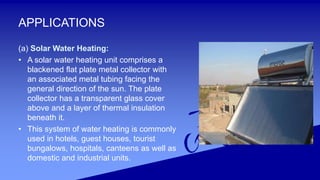
(a) Solar Water Heating:
• A solar water heating unit comprises a
blackened flat plate metal collector with
an associated metal tubing facing the
general direction of the sun. The plate
collector has a transparent glass cover
above and a layer of thermal insulation
beneath it.
• This system of water heating is commonly
used in hotels, guest houses, tourist
bungalows, hospitals, canteens as well as
domestic and industrial units.
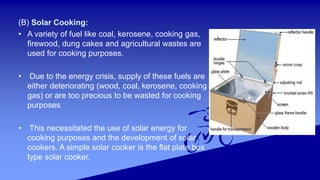
(B) Solar Cooking:
• A variety of fuel like coal, kerosene, cooking gas,
firewood, dung cakes and agricultural wastes are
used for cooking purposes.
• Due to the energy crisis, supply of these fuels are
either deteriorating (wood, coal, kerosene, cooking
gas) or are too precious to be wasted for cooking
purposes
• This necessitated the use of solar energy for
cooking purposes and the development of solar
cookers. A simple solar cooker is the flat plate box
type solar cooker.
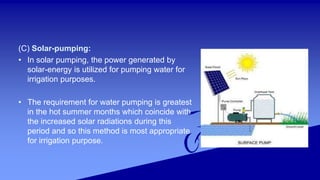
(C) Solar-pumping:
• In solar pumping, the power generated by
solar-energy is utilized for pumping water for
irrigation purposes.
• The requirement for water pumping is greatest
in the hot summer months which coincide with
the increased solar radiations during this
period and so this method is most appropriate
for irrigation purpose.
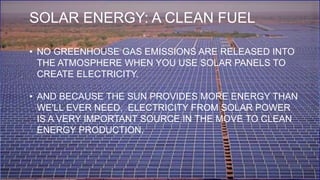
• NO GREENHOUSE GAS EMISSIONS ARE RELEASED INTO
THE ATMOSPHERE WHEN YOU USE SOLAR PANELS TO
CREATE ELECTRICITY.
• AND BECAUSE THE SUN PROVIDES MORE ENERGY THAN
WE'LL EVER NEED, ELECTRICITY FROM SOLAR POWER
IS A VERY IMPORTANT SOURCE IN THE MOVE TO CLEAN
ENERGY PRODUCTION.
SOLAR ENERGY: A CLEAN FUEL
CONCLUSION
 In the face of global warming, rising fuel costs and an ever growing
demand for energy, energy needs are expected to increase by nearly the
equivalent of 335 million barrels of oil per day, mostly for electricity.
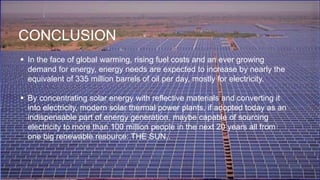
 By concentrating solar energy with reflective materials and converting it
into electricity, modern solar thermal power plants, if adopted today as an
indispensable part of energy generation, maybe capable of sourcing
electricity to more than 100 million people in the next 20 years all from
one big renewable resource: THE SUN..

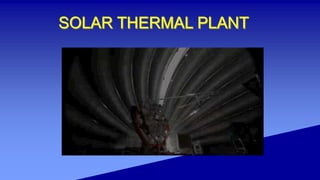
SOLAR THERMAL PLANT

  • 3.
    INTRODUCTION SOLAR POWER PLANTIS BASED ON CONVERSION OF SUNLIGHT INTO ELECTRICITY, EITHER DIRECTLY USING PHOTOVOLTAIC(PV), OR INDIRECTLY USING CONCENTRATED SOLAR POWER(CSP), OR A COMBINATION. CONCENTRATED SOLAR POWER SYSTEM USE LENSES OR MIRROR AND TRACKING SYSTEMS TO FOCUS A LARGE AREA OF SUNLIGHT INTO A SMALL BEAM. PHOTOVOLTAIC CELLS CONVERT LIGHT INTO AN ELECTRIC CURRENT USING PHOTOVOLTAIC EFFECT
  • 4.
    SOLAR THERMAL SYSTEMS •PASSIVE: A passive system requires no equipment, like when heat builds up inside your car when its parked in the sun. • ACTIVE: An active system requires some way to absorb and collect solar radiation and then store it. e.g. solar thermal power plants
  • 5.
    WORKING OF SOLARPOWER PLANT 1. PHOTOVOLTAIC ELECTRICITY: This method uses photovoltaic cells that absorb the direct sunlight just like the solar cells that see on some calculators. 2. SOLAR-THERMAL ELECTRICITY: This also uses a solar collector, it has mirrored surface that reflects the sunlight onto the receiver that heats up a liquid. this heated liquid is used to make steam that produces electricity.
  • 7.
    BASIC PRINCIPLE OFSOLAR ENERGY • SOLAR THERMAL POWER GENERATION SYSTEMS USE MIRRORS TO COLLECT SUNLIGHT AND PRODUCE STEAM BY SOLAR HEAT TO DRIVE TURBINES FOR GENERATING POWER. • THIS SYSTEM GENERATES MORE POWER BY ROTATING TURBINES LIKE THERMAL AND NUCLEAR POWER PLANTS, AND THEREFORE IS SUITABLE FOR LARGE SCALE POWER GENERATION.
  • 8.
    SOLAR THERMAL ELECTRICITY •Solar collectors capture and concentrate sunlight to heat a synthetic oil called therminol, which then heats water to create steam. • The steam is piped to an onsite turbine-generator to produce electricity, which is then transmitted over power lines. On cloudy days the plant has a supplementary natural gas boiler. • The plant can burn natural gas to heat the water, creating steam to generate electricity
  • 9.
    THERMAL ENERGY STORAGE(TES) TESare high-pressure liquid storage tanks used along with a solar thermal system to allow plants to bank several hours of potential electricity. 1.TWO-TANK DIRECT SYSTEM: Solar thermal energy is stored right in the same heat transfer fluid that collected it. 2.TWO-TANK INDIRECT SYSTEM: functions basically yhe same as the direct system except it works with different types of heat transfer fluids. 3.SINGLE-TANK THERMOCLINE SYSTEM: stores thermal energy as a solid, usually silica sand.
  • 11.
    PHOTOVOLTAIC SOLAR PLANTS •As light hits the solar panels, the solar radiation is converted into direct current electricity(DC). • The current flows through the panels and is converted into alternating current(AC) used by local electric utilities. • Finally the electricity travels through transformers, and the voltage is boosted for delivery onto the transmission lines so local electric utilities can distribute the electricity to homes and businesses.
  • 14.
    • 1) NoFuel Cost – Solar Thermal Energy does not require any fuel like most other sources of renewable energy. This is a huge advantage over other fossil fuels whose costs are increasing at a drastic rate every year. Electricity prices are increasingly rapidly in most parts of the world much faster than general inflation. Price shocks due to high fuel costs are a big risk with fossil fuel energy these days. • 2) Predictable, 24/7 Power -Solar Thermal Energy can generate power 24 hours a day. This is made possible as solar thermal power plants store the energy in the form of molten salts etc. The electricity supply is much more uniform and reliable. ADVANTAGES
  • 15.
    • 3) NoPollution and Global Warming Effects – Solar Thermal Energy does not cause pollution which is one of the biggest advantages. • 4) Using Existing Industrial Base – Solar Thermal Energy uses equipment like solar thermal mirrors and turbines which is made in large scale at low cost by the existing Industrial Base and requires no major changes in equipment and materials unlike new technologies such as CIGs Panels.
  • 16.
    1) High Costs– Solar Thermal Energy costs at least Euro 3.5/watt and has not declined too much in the last 3-4 years. However these costs are too high as Solar PV already costs Euro 2.5/watt and even on a conservative basis will have its costs reduced by 5% in the next 10 years making it attain half the cost of Solar Thermal Technology by 2020. 2) Water Issue – Solar Thermal Plants use lots of Water which is Major Problem in Desert Areas. Using non-water cooling raises the cost of CSP projects too much. While using Sea Water has been proposed it remains to be seen if it possible to implement this solution as this would imply building Plants very near the Coastline. DISADVANTAGES
  • 17.
    5) Limited Locationsand Size Limitations – Solar Thermal Energy can only be built in places which have the high amount of solar radiation. They can be built in deserts mostly and require a large land area. This means its not possible to build them in populated areas. Solar Thermal Energy also can only be built in large sizes which are at least 50 MW in size to be economical. This contrasts to Solar PV which is sold in sizes as low as 5 Watts. 6) Long Gestation Time Leading to Cost Overruns – The Gestation Time for permitting, financing, drilling etc. can easily take 5-7 years to develop a concentrated solar thermal power plant. Compare this to 6 months for a small wind farm or 3 months for a Solar PV plant. 7) Financing – is the biggest problem in developing projects particularly for small solar thermal developers in this industry.
  • 18.
    APPLICATIONS (a) Solar WaterHeating: • A solar water heating unit comprises a blackened flat plate metal collector with an associated metal tubing facing the general direction of the sun. The plate collector has a transparent glass cover above and a layer of thermal insulation beneath it. • This system of water heating is commonly used in hotels, guest houses, tourist bungalows, hospitals, canteens as well as domestic and industrial units.
  • 19.
    (B) Solar Cooking: •A variety of fuel like coal, kerosene, cooking gas, firewood, dung cakes and agricultural wastes are used for cooking purposes. • Due to the energy crisis, supply of these fuels are either deteriorating (wood, coal, kerosene, cooking gas) or are too precious to be wasted for cooking purposes • This necessitated the use of solar energy for cooking purposes and the development of solar cookers. A simple solar cooker is the flat plate box type solar cooker.
  • 20.
    (C) Solar-pumping: • Insolar pumping, the power generated by solar-energy is utilized for pumping water for irrigation purposes. • The requirement for water pumping is greatest in the hot summer months which coincide with the increased solar radiations during this period and so this method is most appropriate for irrigation purpose.
  • 21.
    • NO GREENHOUSEGAS EMISSIONS ARE RELEASED INTO THE ATMOSPHERE WHEN YOU USE SOLAR PANELS TO CREATE ELECTRICITY. • AND BECAUSE THE SUN PROVIDES MORE ENERGY THAN WE'LL EVER NEED, ELECTRICITY FROM SOLAR POWER IS A VERY IMPORTANT SOURCE IN THE MOVE TO CLEAN ENERGY PRODUCTION. SOLAR ENERGY: A CLEAN FUEL
  • 22.
    CONCLUSION  In theface of global warming, rising fuel costs and an ever growing demand for energy, energy needs are expected to increase by nearly the equivalent of 335 million barrels of oil per day, mostly for electricity.  By concentrating solar energy with reflective materials and converting it into electricity, modern solar thermal power plants, if adopted today as an indispensable part of energy generation, maybe capable of sourcing electricity to more than 100 million people in the next 20 years all from one big renewable resource: THE SUN..