An Introduction ppt - Saurabh Mehta Renewable Energy Technologies in Power Generation
Introduction Wind Energy Solar Energy Contents
Introduction Renewable Energy – “any sustainable energy source that comes from natural environment.” Some Aspects of Renewable Energy It exists  perpetually  and in abundant in the environment Ready to be harnessed,  inexhaustible It is a  clean alternative  to fossil fuels “ energy that is derived from natural process that are replenished constantly ” -- defined by the RENEWABLE ENERGY WORKING PARTY of the INTERNATIONAL ENERGY AGENCY
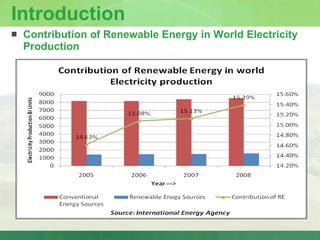
Introduction Contribution of Renewable Energy in World Electricity Production
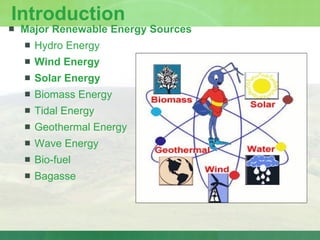
Introduction Major Renewable Energy Sources Hydro Energy Wind Energy Solar Energy Biomass Energy Tidal Energy Geothermal Energy Wave Energy Bio-fuel Bagasse
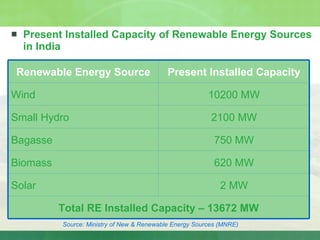
Present Installed Capacity of Renewable Energy Sources in India Source: Ministry of New & Renewable Energy Sources (MNRE) Total RE Installed Capacity – 13672 MW 2 MW Solar 620 MW Biomass 750 MW Bagasse 2100 MW Small Hydro 10200 MW Wind Present Installed Capacity Renewable Energy Source
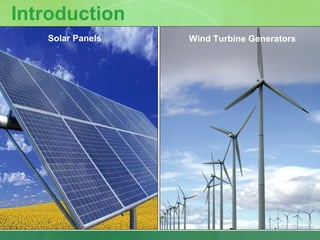
Introduction Solar Panels Wind Turbine Generators
Introduction Wind Energy Solar Energy Contents
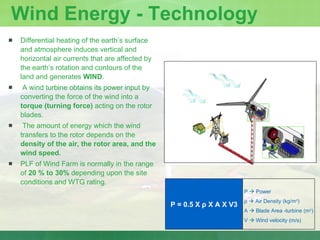
Wind Energy - Technology Differential heating of the earth’s surface and atmosphere induces vertical and horizontal air currents that are affected by the earth’s rotation and contours of the land and generates  WIND . A wind turbine obtains its power input by converting the force of the wind into a  torque (turning force)  acting on the rotor blades. The amount of energy which the wind transfers to the rotor depends on the  density of the air, the rotor area, and the wind speed. PLF of Wind Farm is normally in the range of  20 % to 30%  depending upon the site conditions and WTG rating. P    Power ρ     Air Density (kg/m 3 ) A    Blade Area -turbine (m 2 ) V    Wind velocity (m/s) P = 0.5 X  ρ  X A X V3
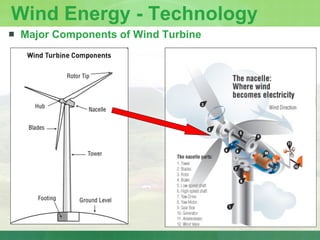
Major Components of Wind Turbine Wind Energy - Technology
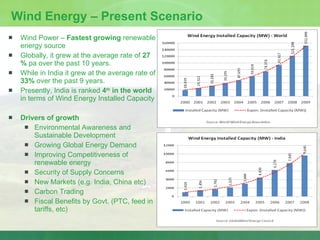
Wind Energy – Present Scenario Wind Power –  Fastest growing  renewable energy source Globally, it grew at the average rate of  27 %  pa over the past 10 years. While in India it grew at the average rate of  33%  over the past 9 years. Presently, India is ranked  4 th  in the world  in terms of Wind Energy Installed Capacity Drivers of growth Environmental Awareness and Sustainable Development Growing Global Energy Demand  Improving Competitiveness of renewable energy Security of Supply Concerns New Markets (e.g. India, China etc) Carbon Trading Fiscal Benefits by Govt. (PTC, feed in tariffs, etc)
Introduction Wind Energy Solar Energy Contents
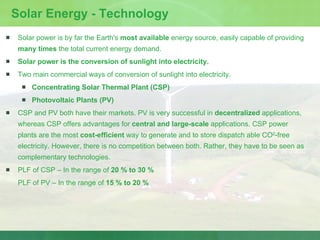
Solar Energy - Technology Solar power is by far the Earth's  most available  energy source, easily capable of providing  many times  the total current energy demand. Solar power is the conversion of sunlight into electricity. Two main commercial ways of conversion of sunlight into electricity. Concentrating Solar Thermal Plant (CSP) Photovoltaic Plants (PV) CSP and PV both have their markets. PV is very successful in  decentralized  applications, whereas CSP offers advantages for  central and large-scale  applications. CSP power plants are the most  cost-efficient  way to generate and to store dispatch able CO 2 -free electricity. However, there is no competition between both. Rather, they have to be seen as complementary technologies.  PLF of CSP – In the range of  20 % to 30 % PLF of PV – In the range of  15 % to 20 %
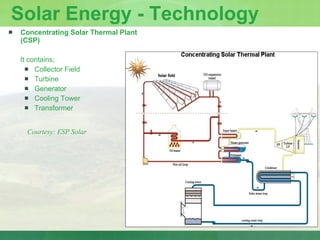
Solar Energy - Technology Concentrating Solar Thermal Plant (CSP) It contains; Collector Field Turbine Generator Cooling Tower Transformer Courtesy: ESP Solar
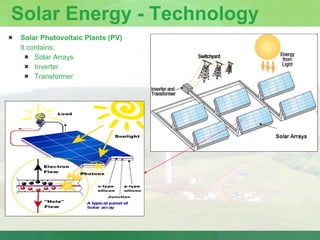
Solar Photovoltaic Plants (PV) It contains; Solar Arrays Inverter Transformer Solar Energy - Technology
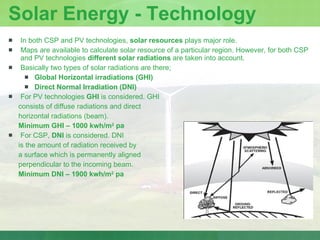
Solar Energy - Technology In both CSP and PV technologies,  solar resources  plays major role. Maps are available to calculate solar resource of a particular region. However, for both CSP and PV technologies  different solar radiations  are taken into account. Basically two types of solar radiations are there; Global Horizontal irradiations (GHI) Direct Normal Irradiation (DNI) For PV technologies  GHI  is considered. GHI  consists of diffuse radiations and direct  horizontal radiations (beam). Minimum GHI – 1000 kwh/m 2  pa For CSP,  DNI  is considered. DNI  is the amount of radiation received by  a surface which is permanently aligned  perpendicular to the incoming beam. Minimum DNI – 1900 kwh/m 2  pa
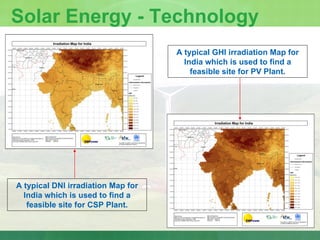
Solar Energy - Technology A typical DNI irradiation Map for India which is used to find a feasible site for CSP Plant. A typical GHI irradiation Map for India which is used to find a feasible site for PV Plant.
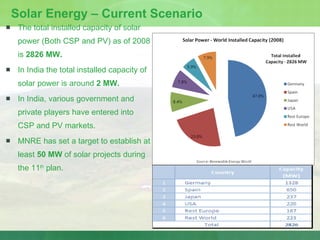
Solar Energy – Current Scenario The total installed capacity of solar power (Both CSP and PV) as of 2008 is  2826 MW. In India the total installed capacity of solar power is around  2 MW. In India, various government and private players have entered into CSP and PV markets. MNRE has set a target to establish at least  50 MW  of solar projects during the 11 th  plan.
Welcome to the World of  Renewable Enegy....

Renewable Energy - Intro ppt

  • 1.
    An Introduction ppt- Saurabh Mehta Renewable Energy Technologies in Power Generation
  • 2.
    Introduction Wind EnergySolar Energy Contents
  • 3.
    Introduction Wind EnergySolar Energy Contents
  • 4.
    Introduction Renewable Energy– “any sustainable energy source that comes from natural environment.” Some Aspects of Renewable Energy It exists perpetually and in abundant in the environment Ready to be harnessed, inexhaustible It is a clean alternative to fossil fuels “ energy that is derived from natural process that are replenished constantly ” -- defined by the RENEWABLE ENERGY WORKING PARTY of the INTERNATIONAL ENERGY AGENCY
  • 5.
    Introduction Contribution ofRenewable Energy in World Electricity Production
  • 6.
    Introduction Major RenewableEnergy Sources Hydro Energy Wind Energy Solar Energy Biomass Energy Tidal Energy Geothermal Energy Wave Energy Bio-fuel Bagasse
  • 7.
    Present Installed Capacityof Renewable Energy Sources in India Source: Ministry of New & Renewable Energy Sources (MNRE) Total RE Installed Capacity – 13672 MW 2 MW Solar 620 MW Biomass 750 MW Bagasse 2100 MW Small Hydro 10200 MW Wind Present Installed Capacity Renewable Energy Source
  • 8.
    Introduction Solar PanelsWind Turbine Generators
  • 9.
    Introduction Wind EnergySolar Energy Contents
  • 10.
    Wind Energy -Technology Differential heating of the earth’s surface and atmosphere induces vertical and horizontal air currents that are affected by the earth’s rotation and contours of the land and generates WIND . A wind turbine obtains its power input by converting the force of the wind into a torque (turning force) acting on the rotor blades. The amount of energy which the wind transfers to the rotor depends on the density of the air, the rotor area, and the wind speed. PLF of Wind Farm is normally in the range of 20 % to 30% depending upon the site conditions and WTG rating. P  Power ρ  Air Density (kg/m 3 ) A  Blade Area -turbine (m 2 ) V  Wind velocity (m/s) P = 0.5 X ρ X A X V3
  • 11.
    Major Components ofWind Turbine Wind Energy - Technology
  • 12.
    Wind Energy –Present Scenario Wind Power – Fastest growing renewable energy source Globally, it grew at the average rate of 27 % pa over the past 10 years. While in India it grew at the average rate of 33% over the past 9 years. Presently, India is ranked 4 th in the world in terms of Wind Energy Installed Capacity Drivers of growth Environmental Awareness and Sustainable Development Growing Global Energy Demand Improving Competitiveness of renewable energy Security of Supply Concerns New Markets (e.g. India, China etc) Carbon Trading Fiscal Benefits by Govt. (PTC, feed in tariffs, etc)
  • 13.
    Introduction Wind EnergySolar Energy Contents
  • 14.
    Solar Energy -Technology Solar power is by far the Earth's most available energy source, easily capable of providing many times the total current energy demand. Solar power is the conversion of sunlight into electricity. Two main commercial ways of conversion of sunlight into electricity. Concentrating Solar Thermal Plant (CSP) Photovoltaic Plants (PV) CSP and PV both have their markets. PV is very successful in decentralized applications, whereas CSP offers advantages for central and large-scale applications. CSP power plants are the most cost-efficient way to generate and to store dispatch able CO 2 -free electricity. However, there is no competition between both. Rather, they have to be seen as complementary technologies. PLF of CSP – In the range of 20 % to 30 % PLF of PV – In the range of 15 % to 20 %
  • 15.
    Solar Energy -Technology Concentrating Solar Thermal Plant (CSP) It contains; Collector Field Turbine Generator Cooling Tower Transformer Courtesy: ESP Solar
  • 16.
    Solar Photovoltaic Plants(PV) It contains; Solar Arrays Inverter Transformer Solar Energy - Technology
  • 17.
    Solar Energy -Technology In both CSP and PV technologies, solar resources plays major role. Maps are available to calculate solar resource of a particular region. However, for both CSP and PV technologies different solar radiations are taken into account. Basically two types of solar radiations are there; Global Horizontal irradiations (GHI) Direct Normal Irradiation (DNI) For PV technologies GHI is considered. GHI consists of diffuse radiations and direct horizontal radiations (beam). Minimum GHI – 1000 kwh/m 2 pa For CSP, DNI is considered. DNI is the amount of radiation received by a surface which is permanently aligned perpendicular to the incoming beam. Minimum DNI – 1900 kwh/m 2 pa
  • 18.
    Solar Energy -Technology A typical DNI irradiation Map for India which is used to find a feasible site for CSP Plant. A typical GHI irradiation Map for India which is used to find a feasible site for PV Plant.
  • 19.
    Solar Energy –Current Scenario The total installed capacity of solar power (Both CSP and PV) as of 2008 is 2826 MW. In India the total installed capacity of solar power is around 2 MW. In India, various government and private players have entered into CSP and PV markets. MNRE has set a target to establish at least 50 MW of solar projects during the 11 th plan.
  • 20.
    Welcome to theWorld of Renewable Enegy....