1-The concept of concentrated solar energy.
2-Types and applications of concentrated solar collectors.
3 - Comparison between the types of concentrated solar
power plants.
Topics of Symposium
INTRODUCTION
INTRODUCTION
INTRODUCTION
INTRODUCTION
INTRODUCTION
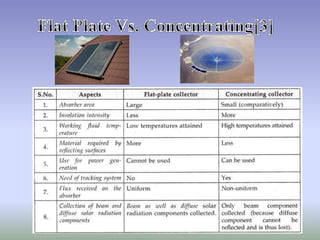
For Central power generation, and numerous industrial heat
requirements, flat plate collectors generally can not provide carrier
fluids at temperatures sufficiently elevated to be effective [1].
INTRODUCTION
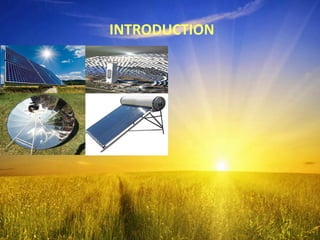
Concentrated solar power (also called concentrating solar power,
concentrated solar thermal, and CSP) systems generate solar power by
using mirrors or lenses to concentrate a large area of sunlight, or solar
thermal energy, onto a small area. Electricity is generated when the
concentrated light is converted to heat, which drives a heat engine
(usually a steam turbine) connected to an electrical power generator[2].
Concentrator: are oriented to track the sun so
that the beam radiation will be directed onto
the absorbing surface. Collector that directs
radiation onto the receiver.
Receiver: Radiation is absorbed and converted
to some other energy form (e.g. heat)
These are devices that optically reflect
and focus incident solar energy onto a
small receiving area [4].
Collector: Concentrator & Receiver
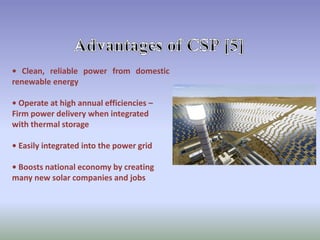
• Clean, reliable power from domestic
renewable energy
• Operate at high annual efficiencies –
Firm power delivery when integrated
with thermal storage
• Easily integrated into the power grid
• Boosts national economy by creating
many new solar companies and jobs
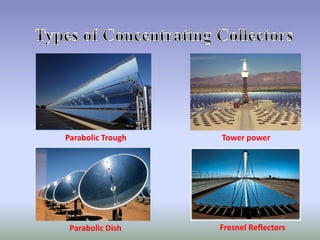
Parabolic Trough Tower power
Parabolic Dish Fresnel Reflectors
Parabolic Dish System
Abel Pifre
1882
Who developed the first solar power printing press, The device consisted of a
concave mirror 3.5 meters in diameter centering on a cylindrical steam boiler,
which powered a small vertical engine of 2/5 horse power.
The press operated continuously from 1:00 pm to 5:30 pm, producing
approximately five hundred copies per hour of a journal which was produced
specifically for the event with the appropriate name "Soleil-Journal“ [6].
Parabolic Dish Stirling System
A parabolic dish collector is similar in appearance to a large satellite dish, but has
mirror-like reflectors and an absorber at the focal point. It uses a .dual axis sun tracker .A
parabolic dish system uses a computer to track the sun and concentrate the sun's rays
onto a receiver located at the focal point in front of the dish [7].
Parabolic Dish Stirling System
Characteristics[8]
· Temp~700-800°C
· Point Focusing
· Uses Dish concentrator
· Stirling Engine
· Generally 25 kW units
· High Efficiency ~ 30%
· Dry cooling
· No water requirement
· Heat storage difficult
· Commercially under development
Parabolic Trough System
John Ericsson
1883
Around 1883, Captain John Ericsson used a longitudinal parabolic concentrator to
operate a steam engine for pumping water. His experiments with solar engines
never advanced beyond the prototype stage [6].
Parabolic Trough System
Parabolic troughs are devices that are shaped like the letter “u”. The troughs concentrate
sunlight onto a receiver tube that is positioned along the focal line of the trough.
Sometimes a transparent glass tube envelops the receiver tube to reduce heat loss[7] .
Parabolic trough power plant(PTPP)
Characteristics[8]
• Temp~400°C
• Line Focusing
• Linear Receiver tube
• Water consuming
• Conc.: Parabolic Mirrors
• Heat Storage feasible
• Most Commercialized
• Good for Hybrid option
• Requires flat land
• Good receiver η but low turbine η
Central Tower System
William Adams
1878
William Adams started in 1878 by gradually adding 17x10 inch flat mirrors and
measuring the resulting rising temperatures. He estimated that to reach the 1,200
oF needed to produce the high pressure steam needed to operate off the shelf
steam engines, the reflector would be composed of 72 mirrors[6].
Central Tower System
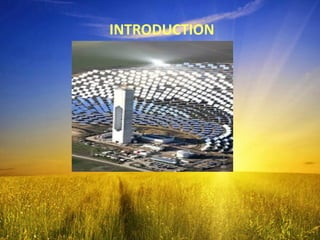
Solar power tower consists of an array of dual-axis tracking reflectors that concentrate
sunlight on a central receiver atop a tower; the receiver contains a fluid deposit, which
can consist of sea water. The working fluid in the receiver is heated to 500–1000 °C and
then used as a heat source for a power generation or energy storage system[9].
Solar Tower Concentrated
Characteristics[8]
• Temp~600-800°C
• Point Focusing
• Flat Conc. Mirrors
• Commercially proven
• Central Receiver
• Water consuming
• Heat Storage capability
• Feasible on Non Flat sites
• Good performance for large
capacity & temperatures
• Low receiver η but good turbine
Linear Fresnel Collector
Giovanni Francia
1964
Giovanni Francia, an Italian Mathematician, developed the first system that applies
the LFR technology. He designed and built the first LFR prototype in 1963 and tested
it in 1964 at Lacédémone-Marseilles solar station. The plant generated 38 kg/h of
steam at 100 atmospheric pressure and 450°C [10].
Linear Fresnel Collector
Linear Fresnel reflectors (LFRs) approximate the parabolic shape of trough systems but by
using long rows of flat or slightly curved mirrors to reflect the sun’s rays onto downward-
facing linear, fixed receiver. A more recent design, known as compact linear Fresnel
reflectors (CLFRs), uses two parallel receivers for each row of mirrors and thus needs less
land than parabolic troughs to produce a given output [9].
Fresnel solar power plant
Characteristics[8]
• Temp~400°C
• Line Focusing type
• Linear receiver
• Fixed absorber row
shared among mirrors
• Flat or curved conc.
mirrors
• Commercially under
development
• Less Structures
• 5 MW operational
highlights the key features of the three solar technologies[8]
Parabolic Trough Dish/Engine Power Tower
Size 30-320 MW 5-25 kW 10-200 MW
Operating
Temperature (ºC/ºF)
390/734 750/1382 565/1049
Annual Capacity
Factor
23-50 % 25 % 20-77 %
Peak Efficiency 20%(d) 29.4%(d) 23%(p)
Net Annual Efficiency 11(d)-16% 12-25%(p) 7(d)-20%
Commercial Status
Commercially Scale-
up Prototype
Demonstration AvailableDemonstration
Technology
Development Risk
Low High Medium
Storage Available Limited Battery Yes
Hybrid Designs Yes Yes Yes
Cost USD/W 2,7-4,0 1,3-12,6 2,5-4,4
(p) = predicted; (d) = demonstrated;
1-CSP is promising technology for future development in
power sector.
2-Concetrator solar collector is efficient than flat
plate solar collector.
3-CSP is non-conventional sources of energy and it is
very important in the future.
•-ultimate-the-energy-/solar4www.slideshare.net/musaibbhathttps://energy "Solar-1
"?from_action=save75738023-resource-renewable
2-Concentrated Solar Power“ https://en.wikipedia.org/wiki/Concentrated_solar_power“
3-Essay @ Solar Collectors | Devices | Solar Energy | Energy
-management/solar-http://www.indiaessays.com/essays/india/energyManagement
13755management/-energy-energy-solar-devices-collectors-solar-energy/essay
4-Sustainable Science and Engineering Center" Concentrating Collectors "
"https://esc.fsu.edu/documents/lectures/ECSII/ConcentratingCollector.pdf
•-25-19-01-02-2016www.alqamer.com/index.php/http://Solar Power (CSP)"Concentrated-5
“csp-/solar41
6-M. Ragheb "solar thermal power and energy storage historical perspective",2014
7-Concentrating Collectorshttps://www.slideshare.net/musaibbhat4/concentrating-collector
8-http://www.geocities.com/dieret/re/Solar/solar.html
•-solar-www.slideshare.net/raviloriya/concentratinghttps://Concetrating Solar Power-9
39369605-power
•10-Ahmed Khaled" TECHNICAL AND ECONOMIC PERFORMANCE OF PARABOLIC TROUGH IN
JORDAN" Master Thesis, Renewable Energy and Energy Efficiency for the MENA region,
Cairo University,2012.
“http://www.parabolicsolartrough.com/Parabolic Solar Trough"-11
•“/03/2016pursuitengineering.blogspot.com/https://Engineering"Mechanical-12
•0M1_wl5uG4QZ2s&list=LLbrgw103oAIhBvyirA&t=7://www.youtube.com/watch?v=https13
11uaTQ&index=3
•03M1_wl5uG4QZ2s&list=LLbrgw10k&t=0inP7www.youtube.com/watch?v=tdivW://https14
•7=uaTQ&index
15https://www.youtube.com/watch?v=xgdyNL6vKK8&t=0s&list=LLbrgw2QZ4uG5_wl1M03uaT
Q&index=6
16https://www.youtube.com/watch?v=LHdhbp9mZUg&t=1s&list=LLbrgw2QZ4uG5_wl1M03ua
TQ&index=3
17https://www.youtube.com/watch?v=rO5rUqeCFY4
Concentrator Solar Power Plants

Concentrator Solar Power Plants

  • 2.
    1-The concept ofconcentrated solar energy. 2-Types and applications of concentrated solar collectors. 3 - Comparison between the types of concentrated solar power plants. Topics of Symposium
  • 3.
  • 4.
  • 5.
  • 6.
  • 7.
  • 8.
    For Central powergeneration, and numerous industrial heat requirements, flat plate collectors generally can not provide carrier fluids at temperatures sufficiently elevated to be effective [1]. INTRODUCTION
  • 9.
    Concentrated solar power(also called concentrating solar power, concentrated solar thermal, and CSP) systems generate solar power by using mirrors or lenses to concentrate a large area of sunlight, or solar thermal energy, onto a small area. Electricity is generated when the concentrated light is converted to heat, which drives a heat engine (usually a steam turbine) connected to an electrical power generator[2].
  • 11.
    Concentrator: are orientedto track the sun so that the beam radiation will be directed onto the absorbing surface. Collector that directs radiation onto the receiver. Receiver: Radiation is absorbed and converted to some other energy form (e.g. heat) These are devices that optically reflect and focus incident solar energy onto a small receiving area [4]. Collector: Concentrator & Receiver
  • 12.
    • Clean, reliablepower from domestic renewable energy • Operate at high annual efficiencies – Firm power delivery when integrated with thermal storage • Easily integrated into the power grid • Boosts national economy by creating many new solar companies and jobs
  • 13.
    Parabolic Trough Towerpower Parabolic Dish Fresnel Reflectors
  • 14.
    Parabolic Dish System AbelPifre 1882 Who developed the first solar power printing press, The device consisted of a concave mirror 3.5 meters in diameter centering on a cylindrical steam boiler, which powered a small vertical engine of 2/5 horse power. The press operated continuously from 1:00 pm to 5:30 pm, producing approximately five hundred copies per hour of a journal which was produced specifically for the event with the appropriate name "Soleil-Journal“ [6].
  • 15.
    Parabolic Dish StirlingSystem A parabolic dish collector is similar in appearance to a large satellite dish, but has mirror-like reflectors and an absorber at the focal point. It uses a .dual axis sun tracker .A parabolic dish system uses a computer to track the sun and concentrate the sun's rays onto a receiver located at the focal point in front of the dish [7].
  • 16.
    Parabolic Dish StirlingSystem Characteristics[8] · Temp~700-800°C · Point Focusing · Uses Dish concentrator · Stirling Engine · Generally 25 kW units · High Efficiency ~ 30% · Dry cooling · No water requirement · Heat storage difficult · Commercially under development
  • 18.
    Parabolic Trough System JohnEricsson 1883 Around 1883, Captain John Ericsson used a longitudinal parabolic concentrator to operate a steam engine for pumping water. His experiments with solar engines never advanced beyond the prototype stage [6].
  • 19.
    Parabolic Trough System Parabolictroughs are devices that are shaped like the letter “u”. The troughs concentrate sunlight onto a receiver tube that is positioned along the focal line of the trough. Sometimes a transparent glass tube envelops the receiver tube to reduce heat loss[7] .
  • 20.
    Parabolic trough powerplant(PTPP) Characteristics[8] • Temp~400°C • Line Focusing • Linear Receiver tube • Water consuming • Conc.: Parabolic Mirrors • Heat Storage feasible • Most Commercialized • Good for Hybrid option • Requires flat land • Good receiver η but low turbine η
  • 22.
    Central Tower System WilliamAdams 1878 William Adams started in 1878 by gradually adding 17x10 inch flat mirrors and measuring the resulting rising temperatures. He estimated that to reach the 1,200 oF needed to produce the high pressure steam needed to operate off the shelf steam engines, the reflector would be composed of 72 mirrors[6].
  • 23.
    Central Tower System Solarpower tower consists of an array of dual-axis tracking reflectors that concentrate sunlight on a central receiver atop a tower; the receiver contains a fluid deposit, which can consist of sea water. The working fluid in the receiver is heated to 500–1000 °C and then used as a heat source for a power generation or energy storage system[9].
  • 24.
    Solar Tower Concentrated Characteristics[8] •Temp~600-800°C • Point Focusing • Flat Conc. Mirrors • Commercially proven • Central Receiver • Water consuming • Heat Storage capability • Feasible on Non Flat sites • Good performance for large capacity & temperatures • Low receiver η but good turbine
  • 26.
    Linear Fresnel Collector GiovanniFrancia 1964 Giovanni Francia, an Italian Mathematician, developed the first system that applies the LFR technology. He designed and built the first LFR prototype in 1963 and tested it in 1964 at Lacédémone-Marseilles solar station. The plant generated 38 kg/h of steam at 100 atmospheric pressure and 450°C [10].
  • 27.
    Linear Fresnel Collector LinearFresnel reflectors (LFRs) approximate the parabolic shape of trough systems but by using long rows of flat or slightly curved mirrors to reflect the sun’s rays onto downward- facing linear, fixed receiver. A more recent design, known as compact linear Fresnel reflectors (CLFRs), uses two parallel receivers for each row of mirrors and thus needs less land than parabolic troughs to produce a given output [9].
  • 28.
    Fresnel solar powerplant Characteristics[8] • Temp~400°C • Line Focusing type • Linear receiver • Fixed absorber row shared among mirrors • Flat or curved conc. mirrors • Commercially under development • Less Structures • 5 MW operational
  • 31.
    highlights the keyfeatures of the three solar technologies[8] Parabolic Trough Dish/Engine Power Tower Size 30-320 MW 5-25 kW 10-200 MW Operating Temperature (ºC/ºF) 390/734 750/1382 565/1049 Annual Capacity Factor 23-50 % 25 % 20-77 % Peak Efficiency 20%(d) 29.4%(d) 23%(p) Net Annual Efficiency 11(d)-16% 12-25%(p) 7(d)-20% Commercial Status Commercially Scale- up Prototype Demonstration AvailableDemonstration Technology Development Risk Low High Medium Storage Available Limited Battery Yes Hybrid Designs Yes Yes Yes Cost USD/W 2,7-4,0 1,3-12,6 2,5-4,4 (p) = predicted; (d) = demonstrated;
  • 34.
    1-CSP is promisingtechnology for future development in power sector. 2-Concetrator solar collector is efficient than flat plate solar collector. 3-CSP is non-conventional sources of energy and it is very important in the future.
  • 35.
    •-ultimate-the-energy-/solar4www.slideshare.net/musaibbhathttps://energy "Solar-1 "?from_action=save75738023-resource-renewable 2-Concentrated SolarPower“ https://en.wikipedia.org/wiki/Concentrated_solar_power“ 3-Essay @ Solar Collectors | Devices | Solar Energy | Energy -management/solar-http://www.indiaessays.com/essays/india/energyManagement 13755management/-energy-energy-solar-devices-collectors-solar-energy/essay 4-Sustainable Science and Engineering Center" Concentrating Collectors " "https://esc.fsu.edu/documents/lectures/ECSII/ConcentratingCollector.pdf •-25-19-01-02-2016www.alqamer.com/index.php/http://Solar Power (CSP)"Concentrated-5 “csp-/solar41 6-M. Ragheb "solar thermal power and energy storage historical perspective",2014 7-Concentrating Collectorshttps://www.slideshare.net/musaibbhat4/concentrating-collector 8-http://www.geocities.com/dieret/re/Solar/solar.html
  • 36.
    •-solar-www.slideshare.net/raviloriya/concentratinghttps://Concetrating Solar Power-9 39369605-power •10-AhmedKhaled" TECHNICAL AND ECONOMIC PERFORMANCE OF PARABOLIC TROUGH IN JORDAN" Master Thesis, Renewable Energy and Energy Efficiency for the MENA region, Cairo University,2012. “http://www.parabolicsolartrough.com/Parabolic Solar Trough"-11 •“/03/2016pursuitengineering.blogspot.com/https://Engineering"Mechanical-12 •0M1_wl5uG4QZ2s&list=LLbrgw103oAIhBvyirA&t=7://www.youtube.com/watch?v=https13 11uaTQ&index=3 •03M1_wl5uG4QZ2s&list=LLbrgw10k&t=0inP7www.youtube.com/watch?v=tdivW://https14 •7=uaTQ&index 15https://www.youtube.com/watch?v=xgdyNL6vKK8&t=0s&list=LLbrgw2QZ4uG5_wl1M03uaT Q&index=6 16https://www.youtube.com/watch?v=LHdhbp9mZUg&t=1s&list=LLbrgw2QZ4uG5_wl1M03ua TQ&index=3 17https://www.youtube.com/watch?v=rO5rUqeCFY4