Solar High Temperature
Thermal Systems
By
Moustafa M. Elsayed
Professor & Consultant
1
Contents
• Solar Radiation & Solar Angles
• Overview of Solar Thermal
Power Plants
• Solar Dish/Engine Systems
• Solar Linear Concentrating
Systems
• Solar Towers
• Economic Sizes of Solar Power
Plants
2
• Thermal Storage
• Benefits and Drawbacks of
Solar Thermal Systems
• Noor Solar Complex (Morocco)
Project
• Cost Comparison
Solar Radiation & Solar Angles
3
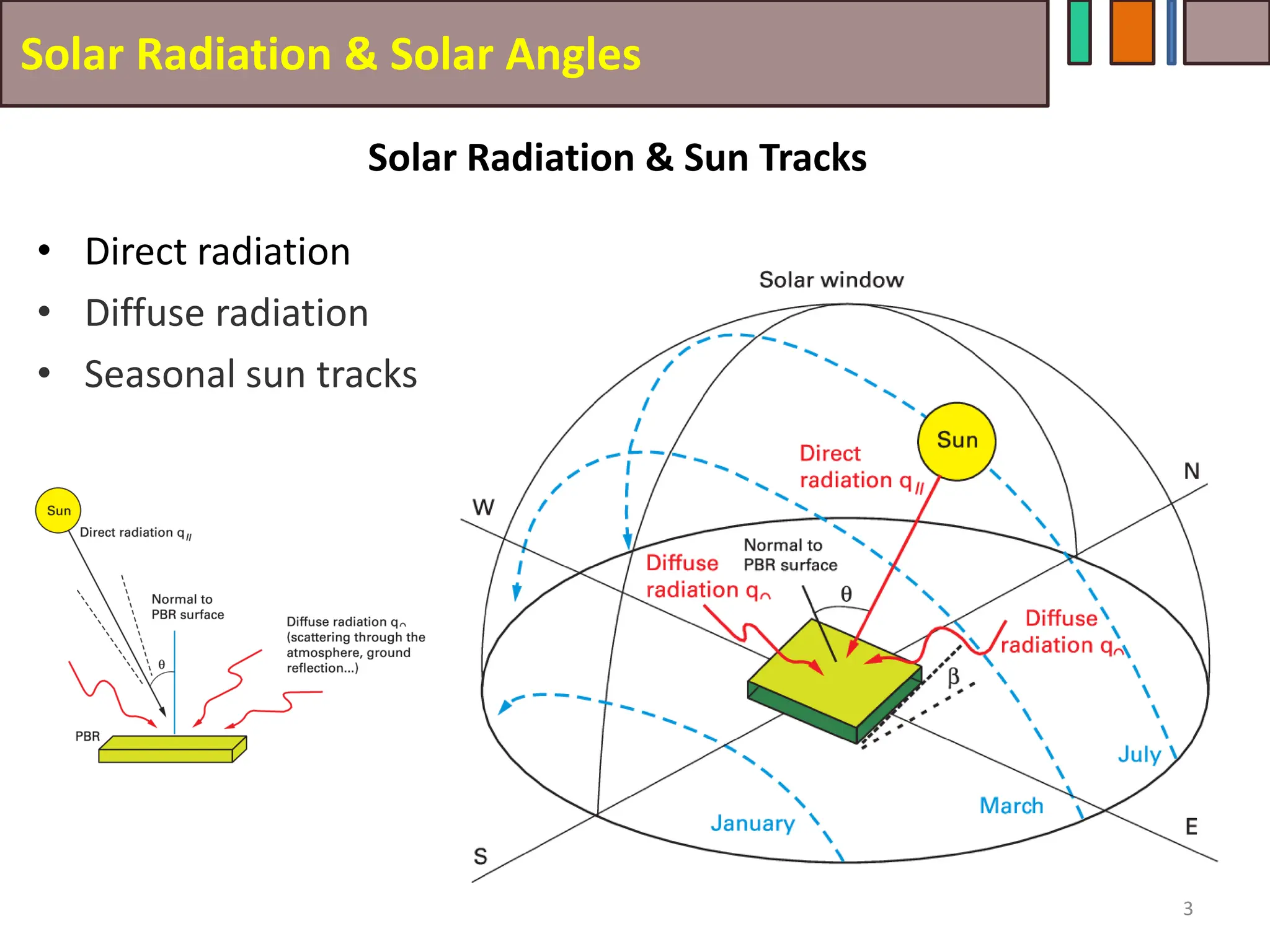
Solar Radiation & Sun Tracks
• Direct radiation
• Diffuse radiation
• Seasonal sun tracks
Solar Radiation & Solar Angles
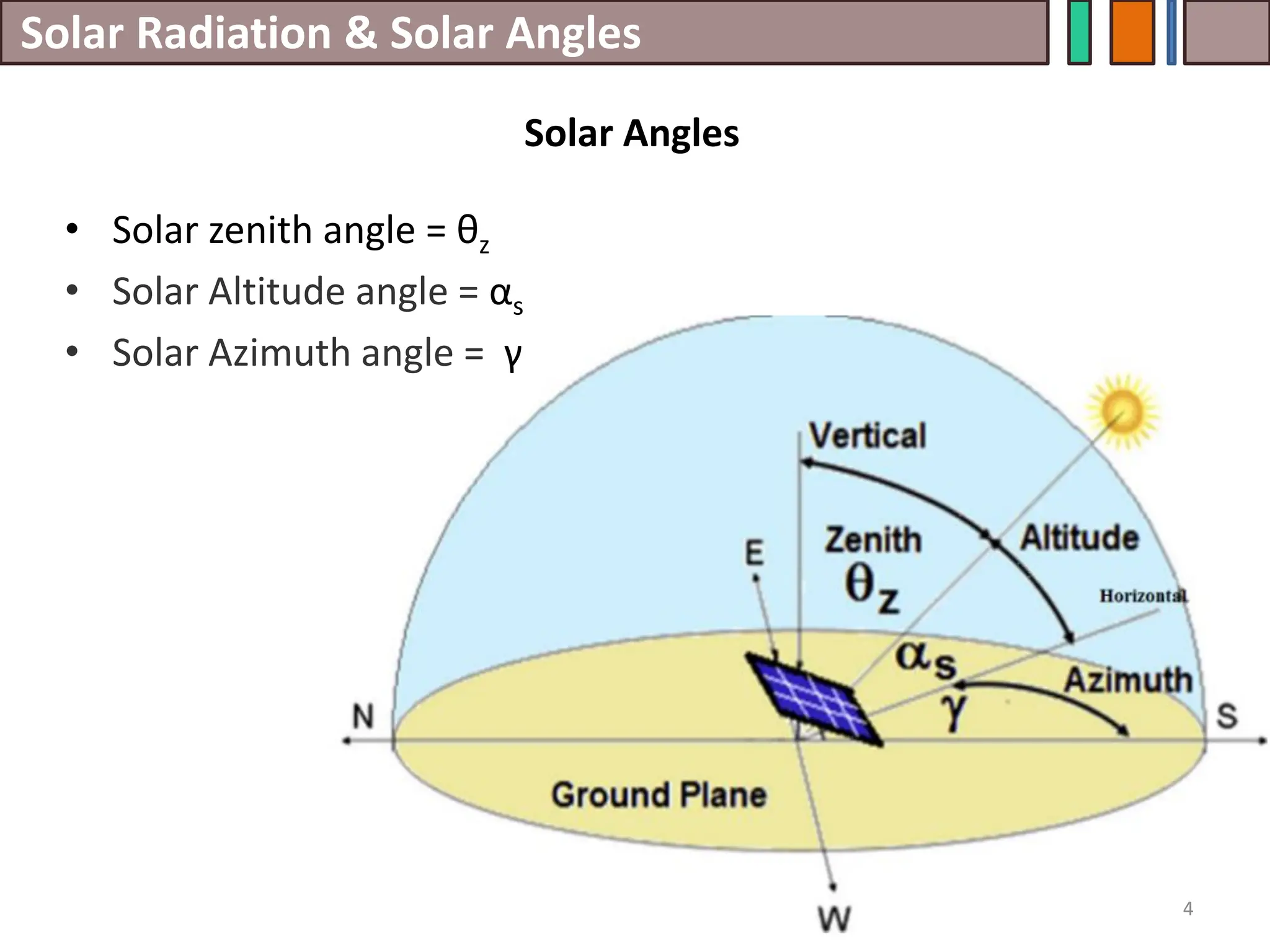
• Solar zenith angle = θz
• Solar Altitude angle = αs
• Solar Azimuth angle = γ
4
Solar Angles
Solar Radiation & Solar Angles
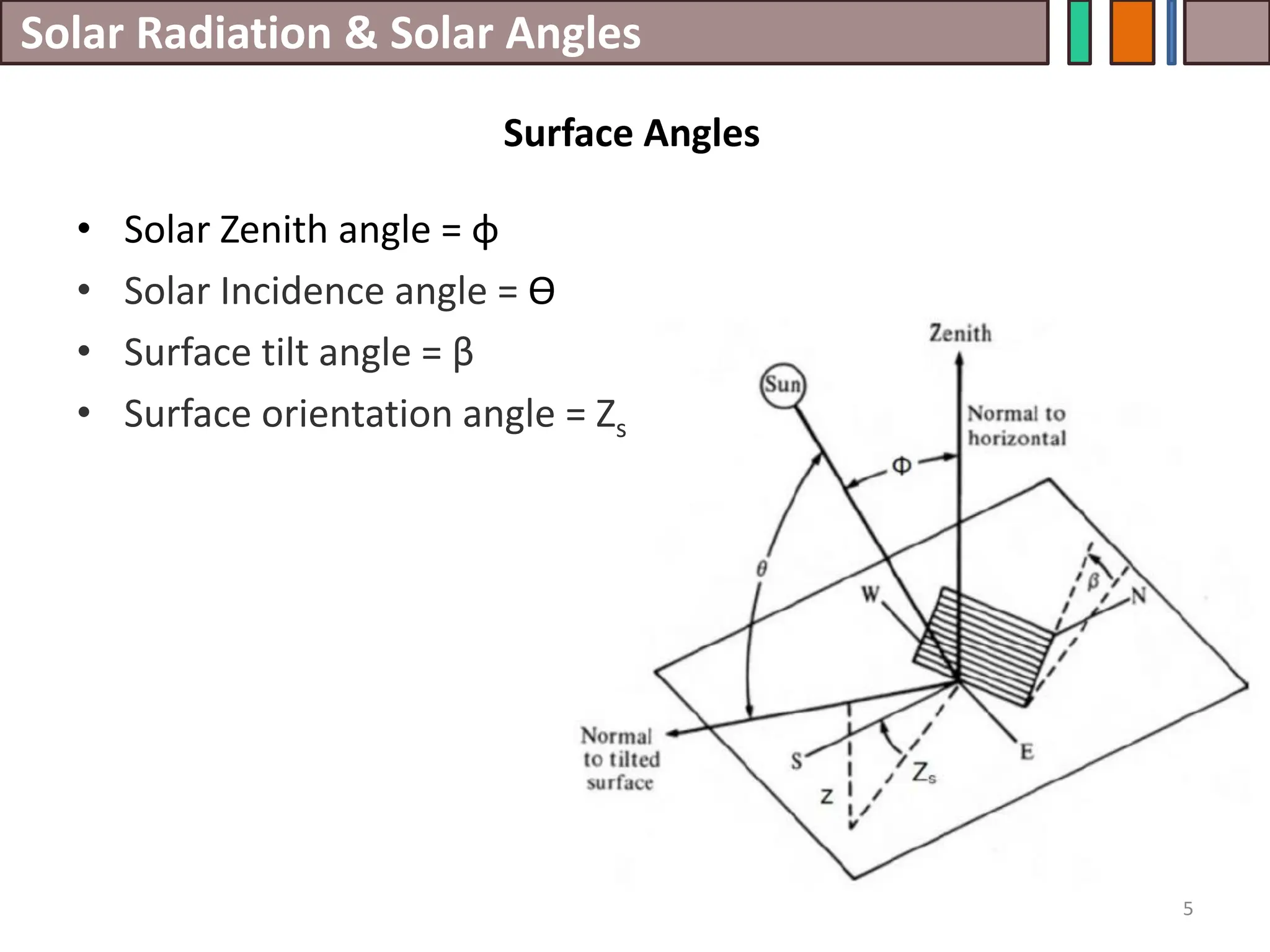
• Solar Zenith angle = ɸ
• Solar Incidence angle = Ө
• Surface tilt angle = β
• Surface orientation angle = Zs
5
Surface Angles
Solar Radiation & Solar Angles
6
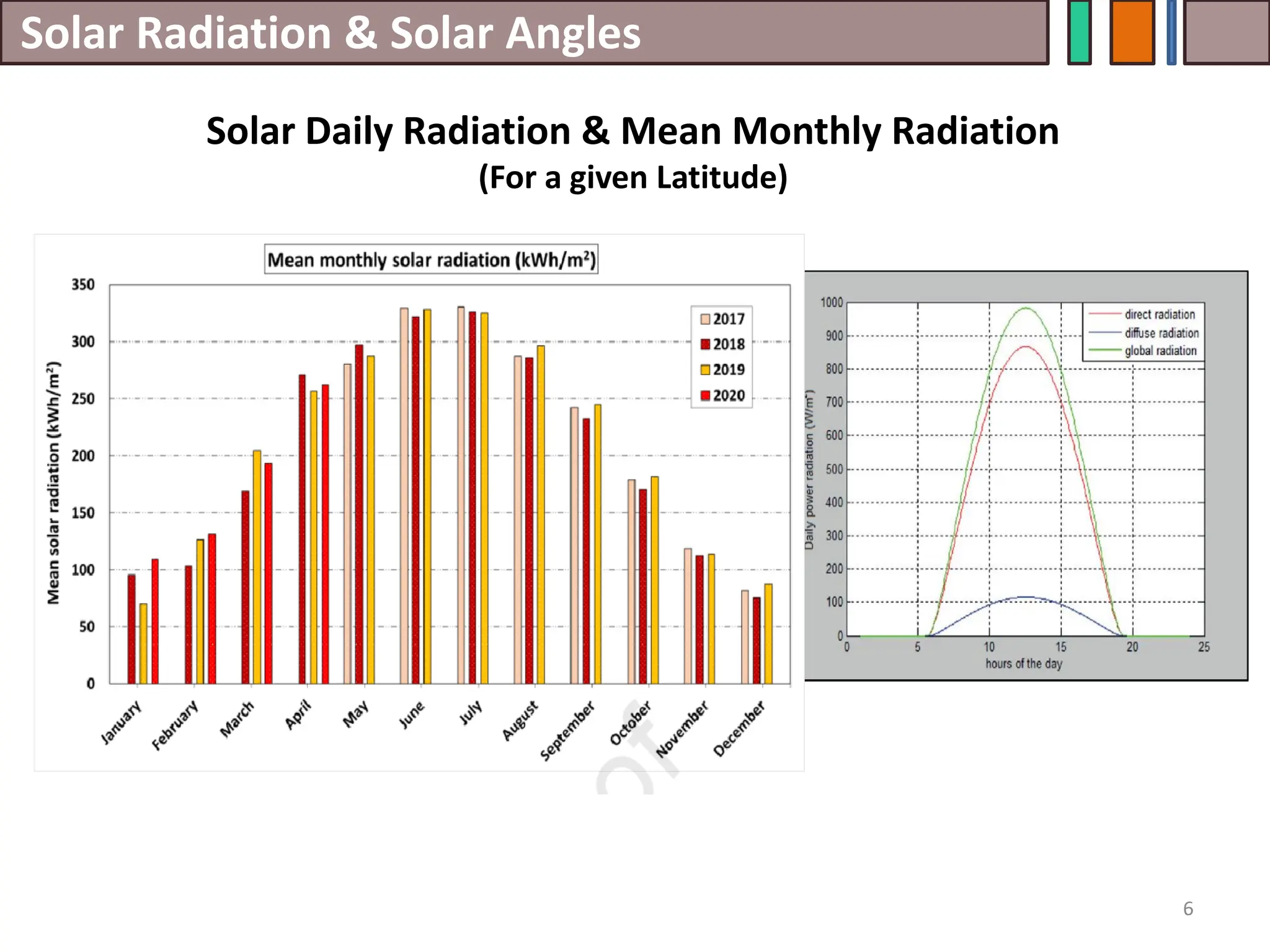
Solar Daily Radiation & Mean Monthly Radiation
(For a given Latitude)
Solar Radiation & Solar Angles
7
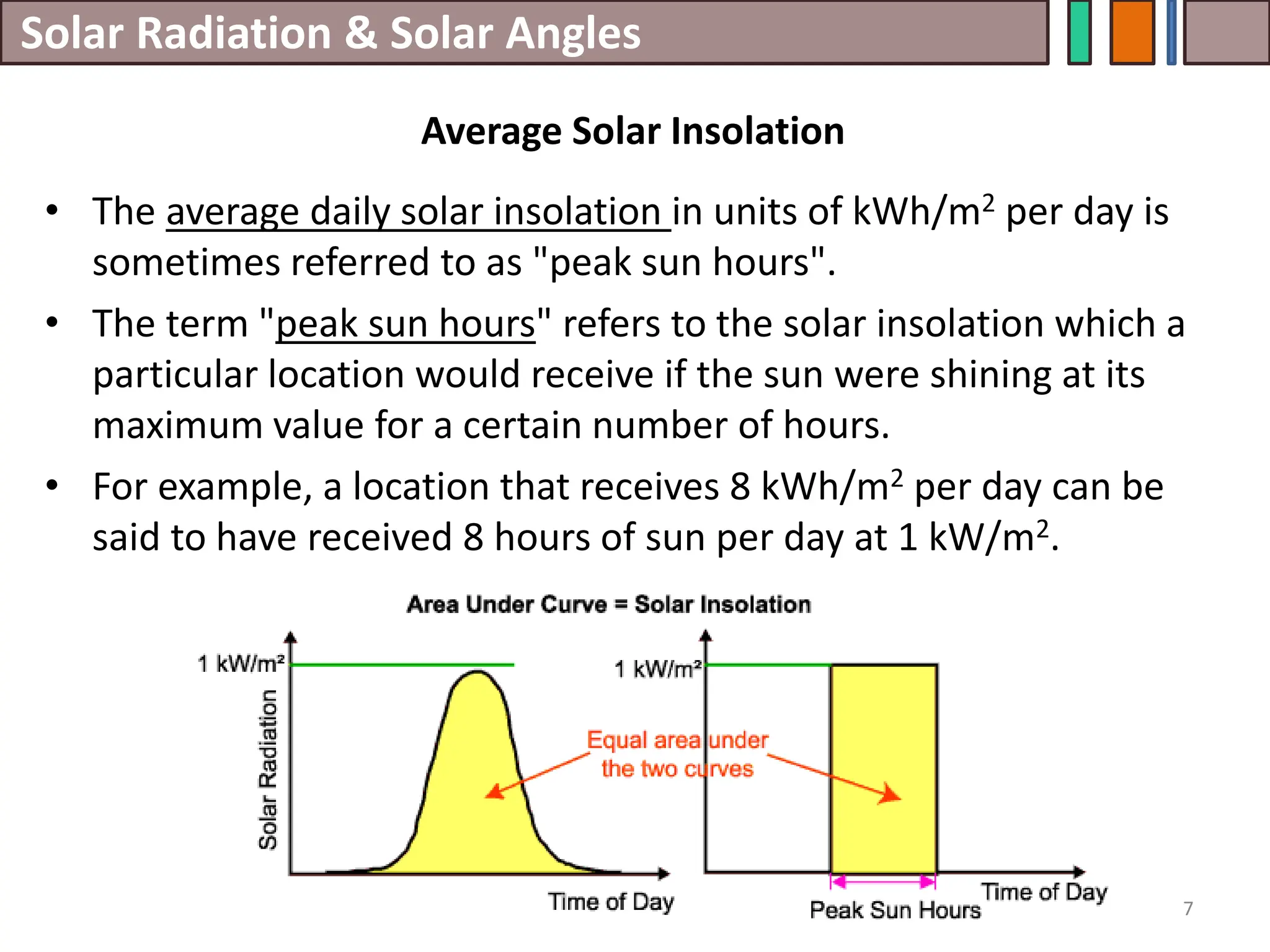
Average Solar Insolation
• The average daily solar insolation in units of kWh/m2 per day is
sometimes referred to as "peak sun hours".
• The term "peak sun hours" refers to the solar insolation which a
particular location would receive if the sun were shining at its
maximum value for a certain number of hours.
• For example, a location that receives 8 kWh/m2 per day can be
said to have received 8 hours of sun per day at 1 kW/m2.
Solar Radiation & Solar Angles
8
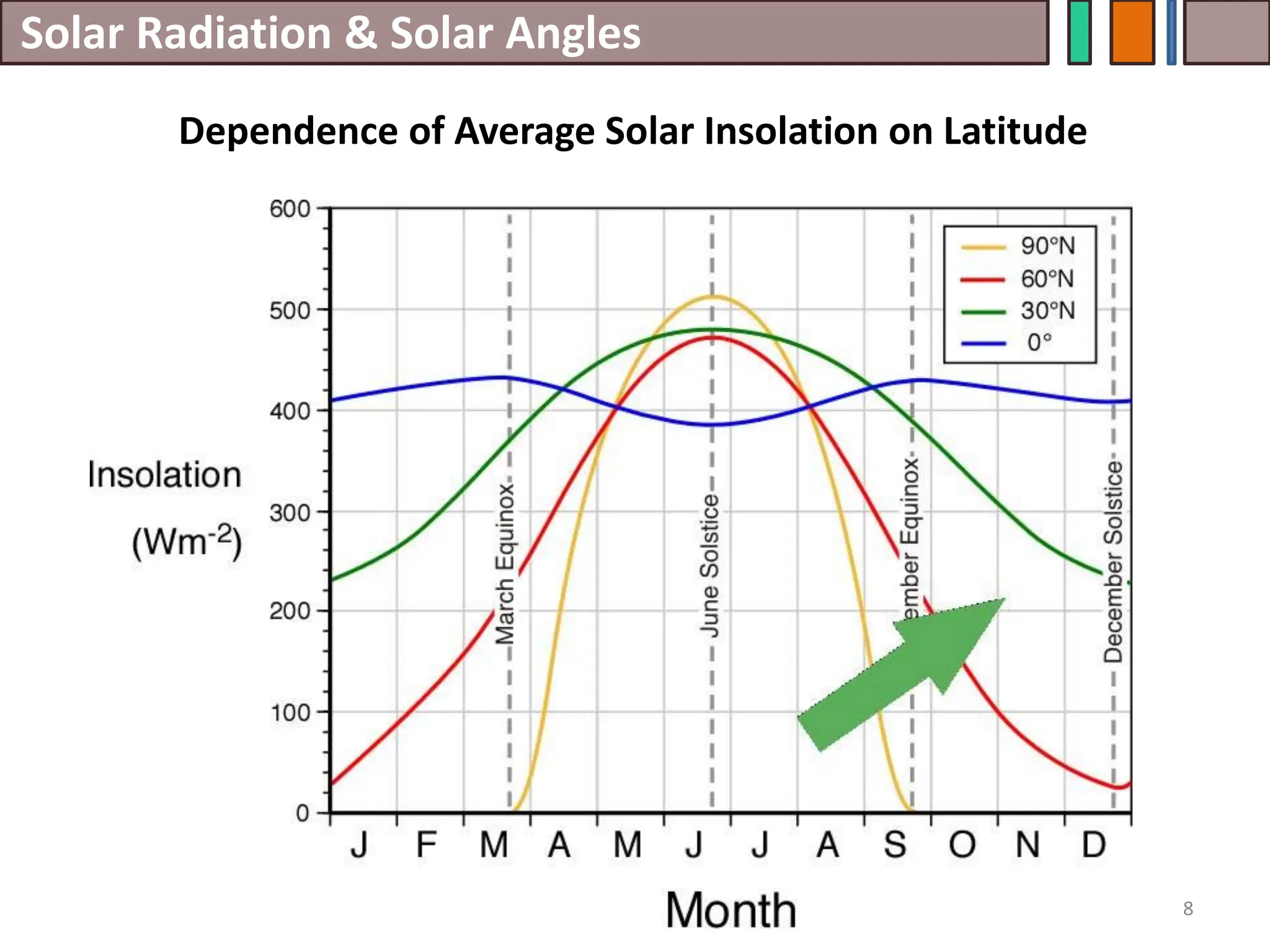
Dependence of Average Solar Insolation on Latitude
Overview of Solar Thermal Power Plants
• In solar thermal power plants, solar radiation is used to generate
heat energy which is used to generate electricity in a
conventional power plant process.
• Mirrors concentrate the sunlight on a radiation collector and
heat up a heat-bearing medium, generally thermal oil.
• A turbine transforms this energy into electricity.
• Unlike photovoltaic solar panels, which convert sunlight directly
into electricity, solar thermal power plants use the sun's heat to
create steam, which then drives a turbine to generate electricity.
9
About Solar Thermal Power Plants (STPP) - 1
Overview of Solar Thermal Power Plants
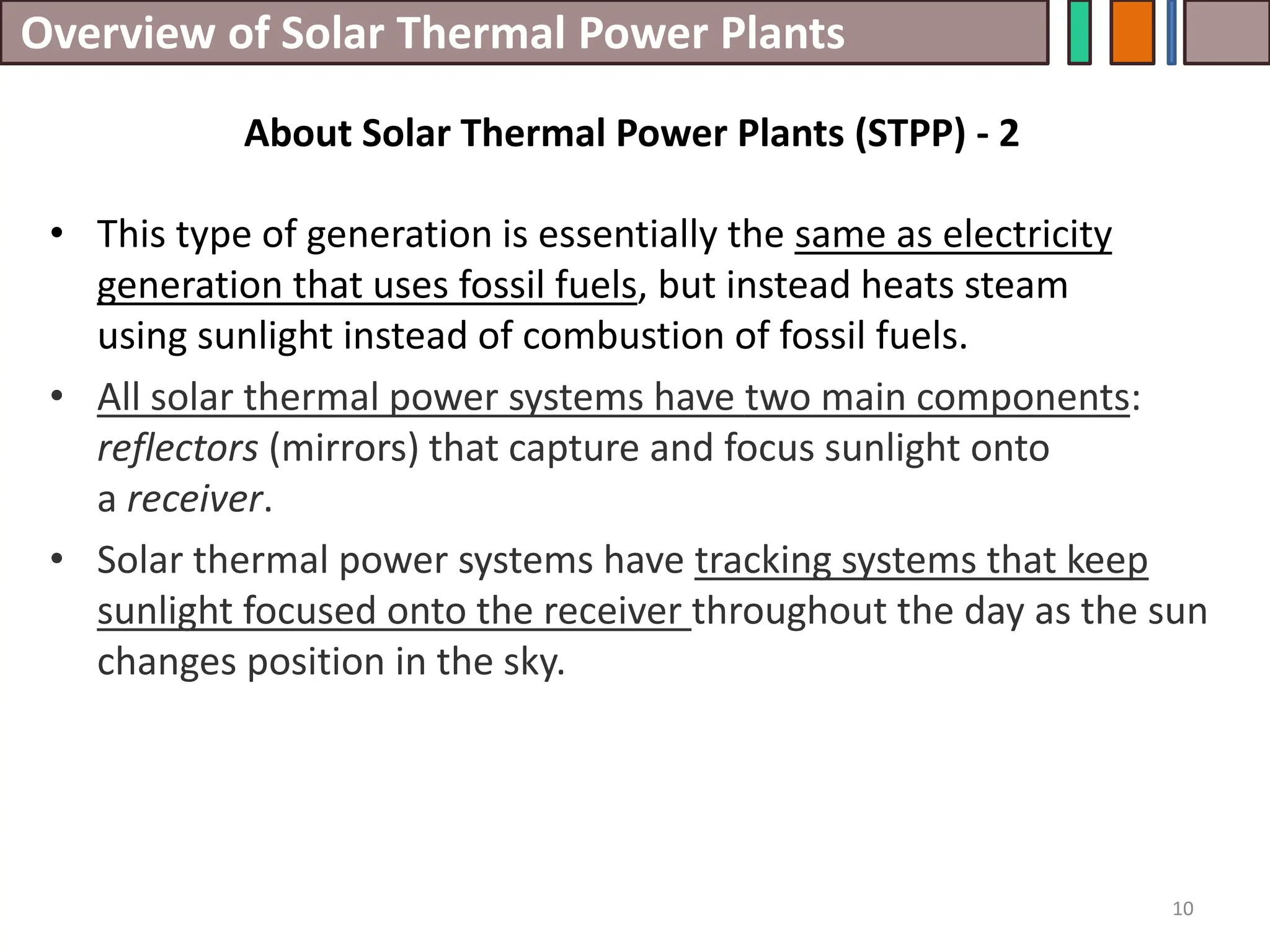
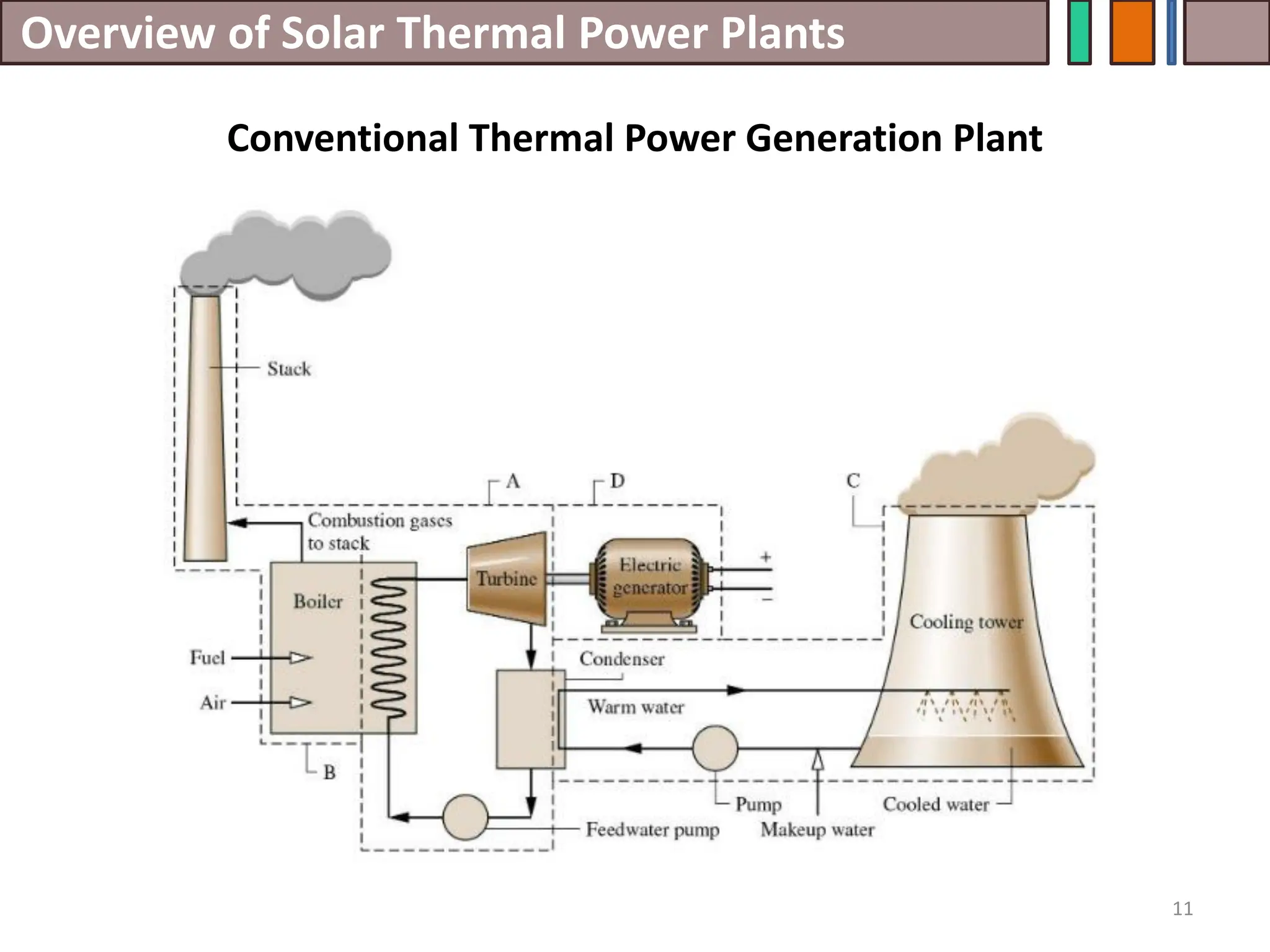
• This type of generation is essentially the same as electricity
generation that uses fossil fuels, but instead heats steam
using sunlight instead of combustion of fossil fuels.
• All solar thermal power systems have two main components:
reflectors (mirrors) that capture and focus sunlight onto
a receiver.
• Solar thermal power systems have tracking systems that keep
sunlight focused onto the receiver throughout the day as the sun
changes position in the sky.
10
About Solar Thermal Power Plants (STPP) - 2
Overview of Solar Thermal Power Plants
11
Conventional Thermal Power Generation Plant
Overview of Solar Thermal Power Plants
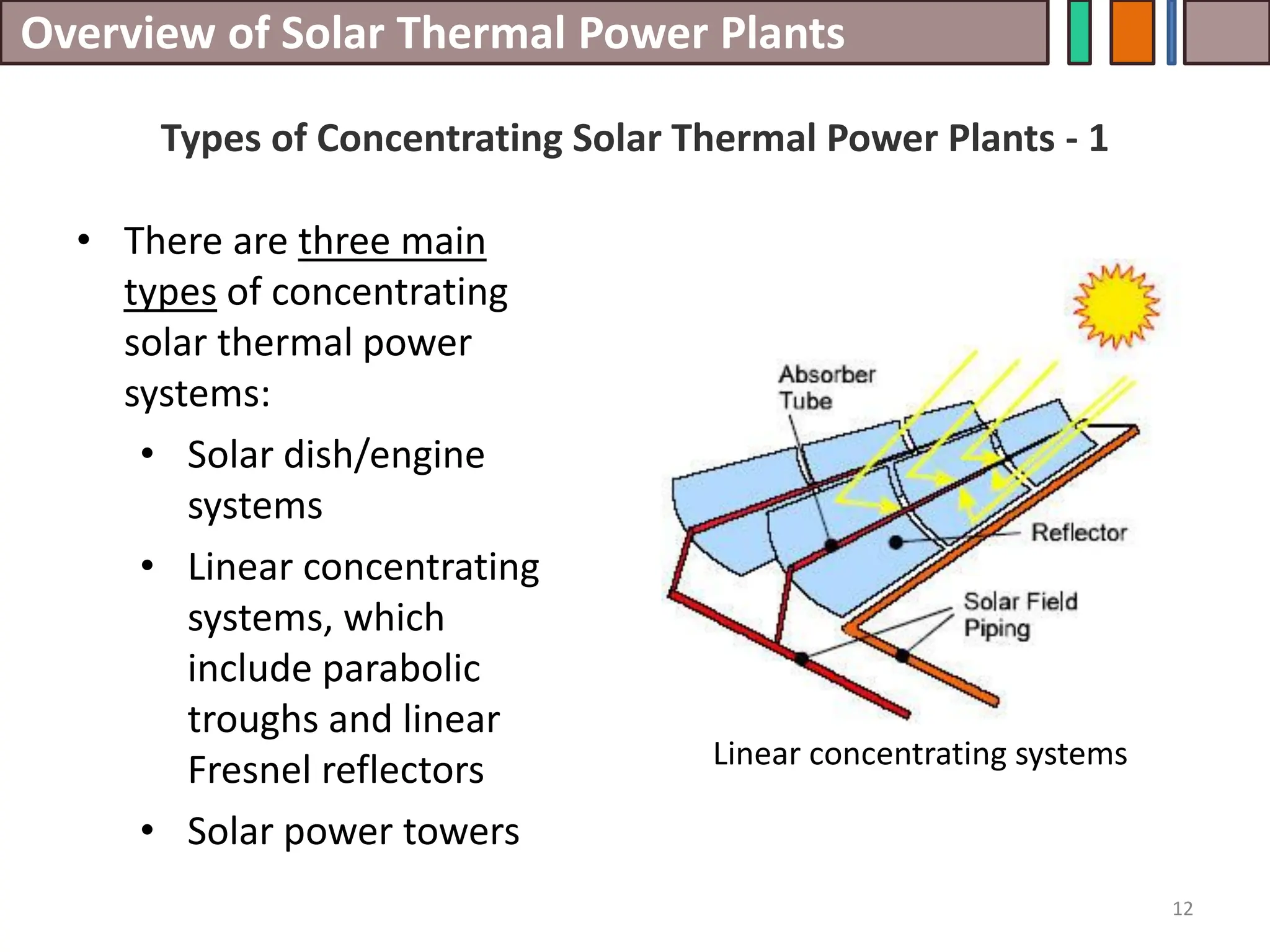
12
Types of Concentrating Solar Thermal Power Plants - 1
• There are three main
types of concentrating
solar thermal power
systems:
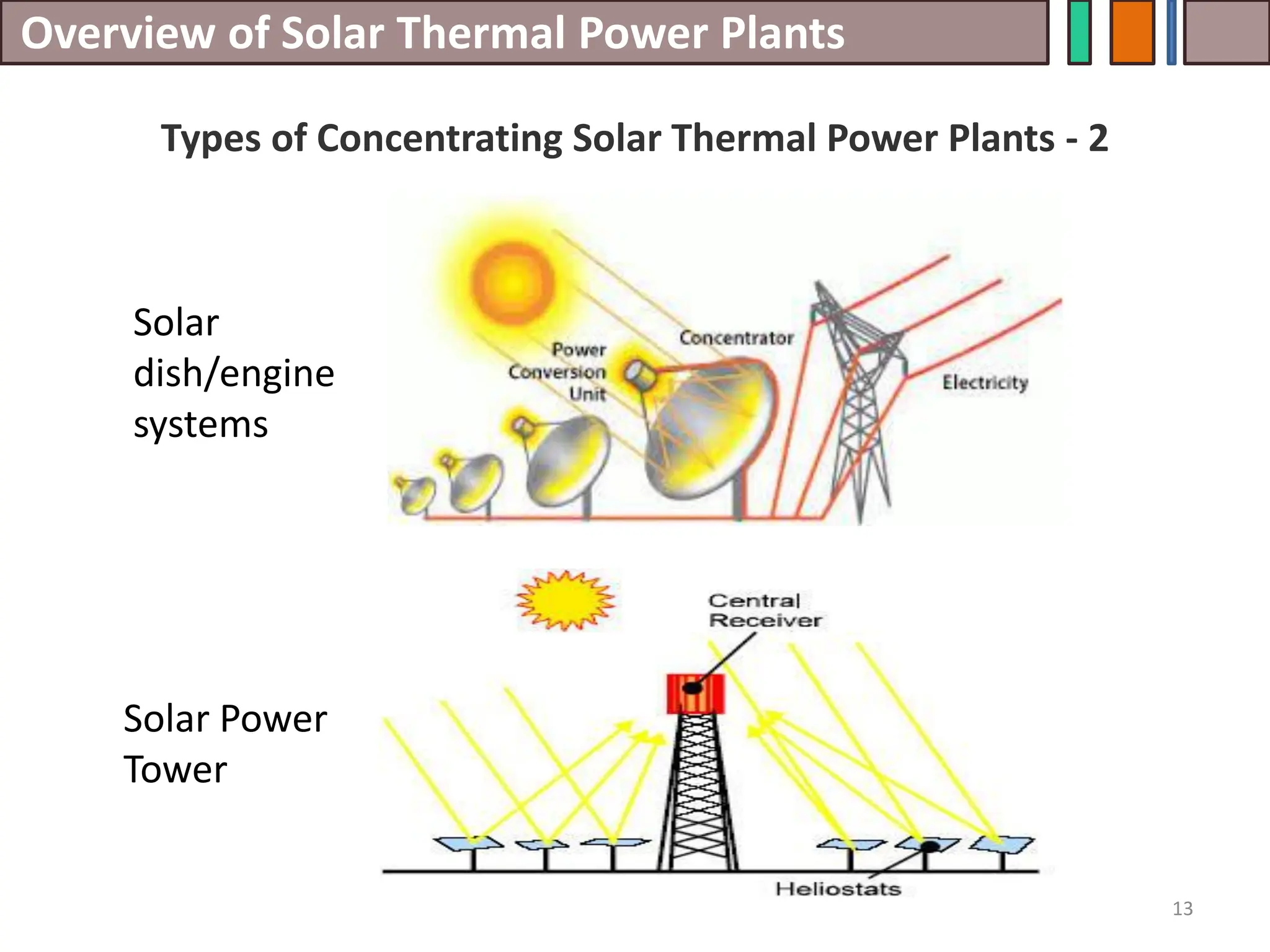
• Solar dish/engine
systems
• Linear concentrating
systems, which
include parabolic
troughs and linear
Fresnel reflectors
• Solar power towers
Linear concentrating systems
Overview of Solar Thermal Power Plants
13
Types of Concentrating Solar Thermal Power Plants - 2
Solar
dish/engine
systems
Solar Power
Tower
Parabolic Dishes
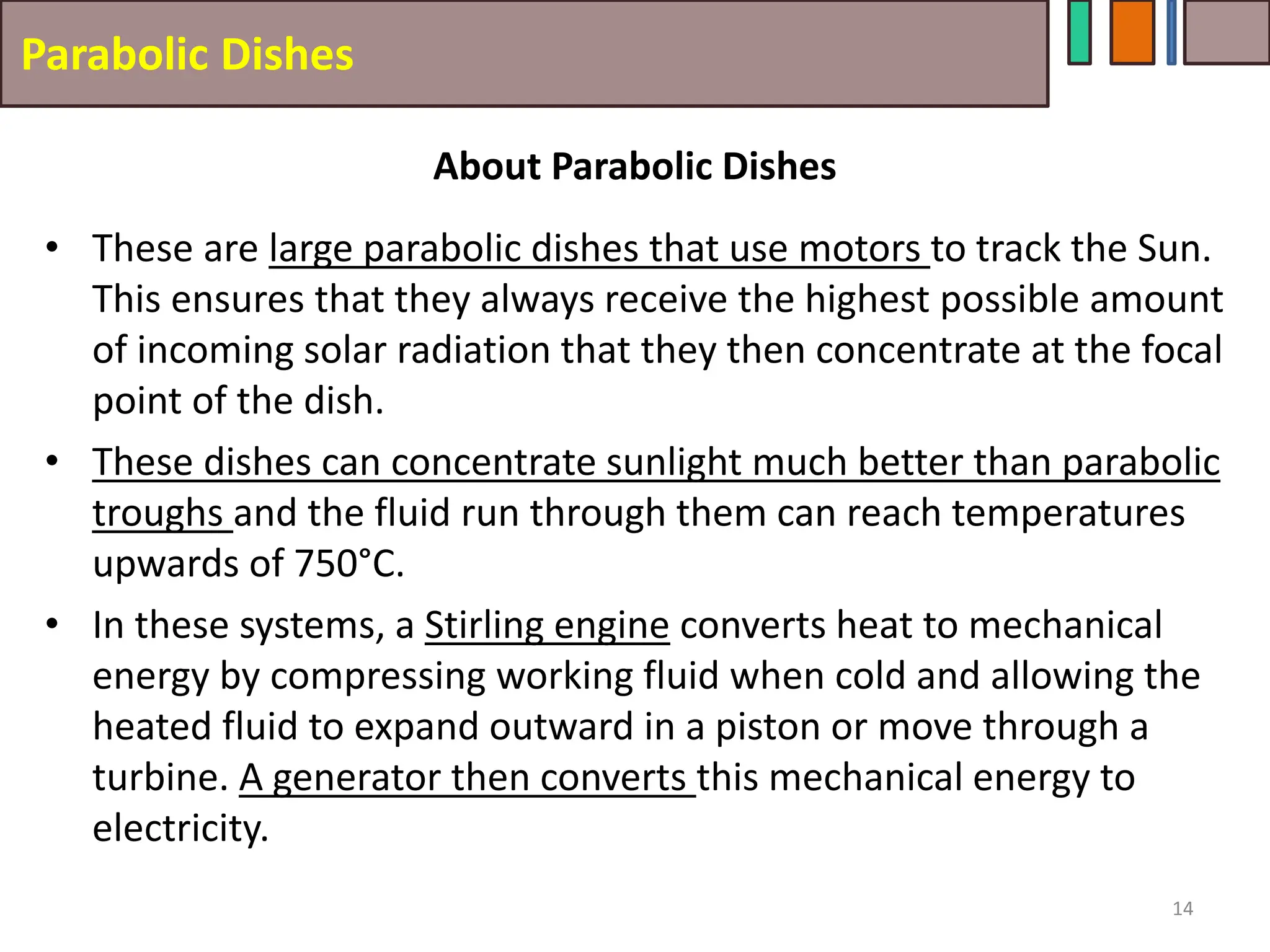
• These are large parabolic dishes that use motors to track the Sun.
This ensures that they always receive the highest possible amount
of incoming solar radiation that they then concentrate at the focal
point of the dish.
• These dishes can concentrate sunlight much better than parabolic
troughs and the fluid run through them can reach temperatures
upwards of 750°C.
• In these systems, a Stirling engine converts heat to mechanical
energy by compressing working fluid when cold and allowing the
heated fluid to expand outward in a piston or move through a
turbine. A generator then converts this mechanical energy to
electricity.
14
About Parabolic Dishes
Parabolic Dishes
15
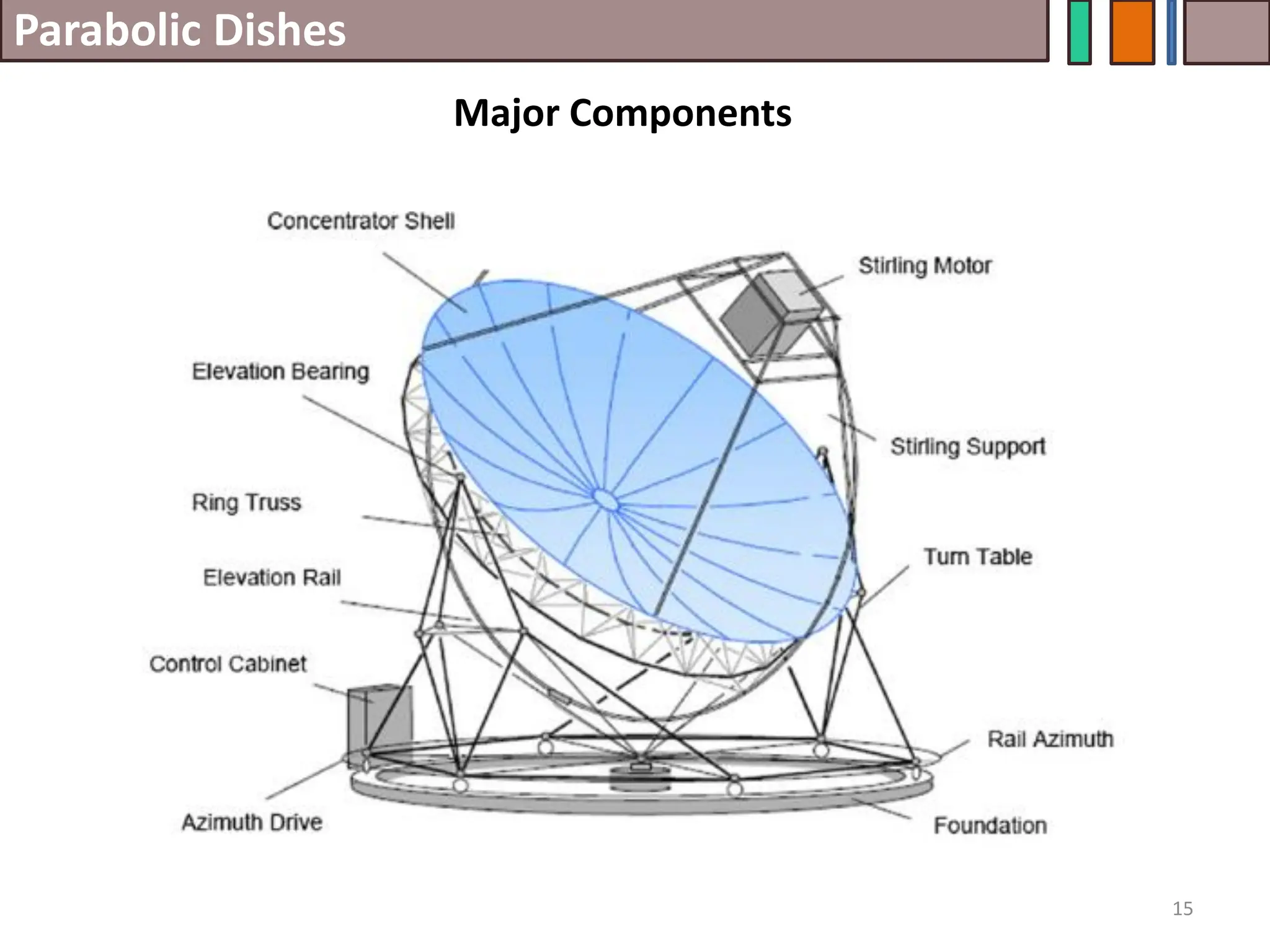
Major Components
Solar Linear Concentrating Systems
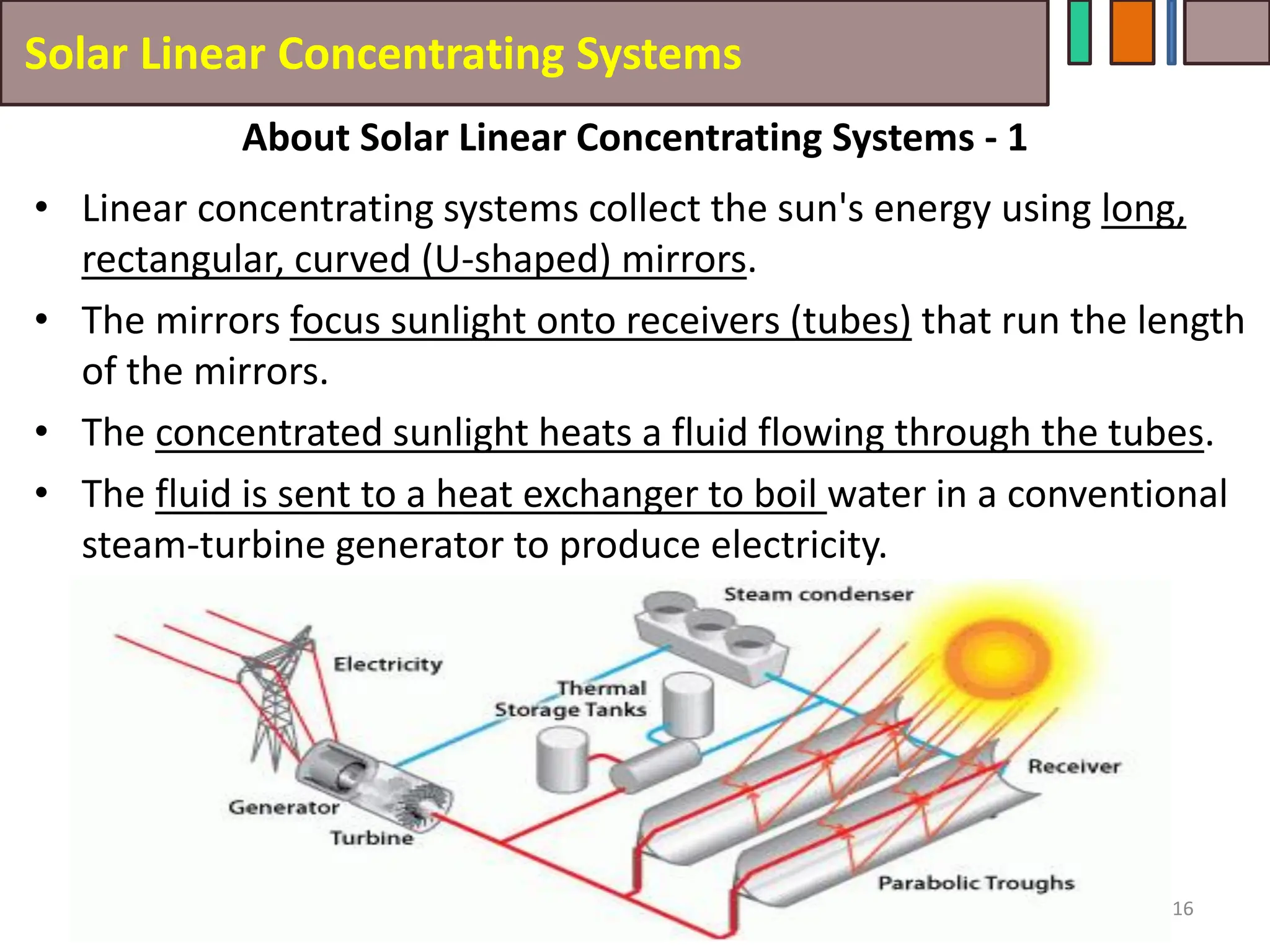
• Linear concentrating systems collect the sun's energy using long,
rectangular, curved (U-shaped) mirrors.
• The mirrors focus sunlight onto receivers (tubes) that run the length
of the mirrors.
• The concentrated sunlight heats a fluid flowing through the tubes.
• The fluid is sent to a heat exchanger to boil water in a conventional
steam-turbine generator to produce electricity.
16
About Solar Linear Concentrating Systems - 1
Solar Linear Concentrating Systems
• There are two major types of linear concentrator systems:
• parabolic trough systems, where receiver tubes are
positioned along the focal line of each parabolic mirror
• linear Fresnel reflector systems, where one receiver tube is
positioned above several mirrors to allow the mirrors greater
mobility in tracking the sun.
• A linear concentrating collector power plant has a large number
of collectors in parallel rows that are typically aligned in a north-
south orientation to maximize solar energy collection.
• This configuration enables the mirrors to track the sun from east
to west during the day and concentrate sunlight continuously
onto the receiver tubes.
17
About Solar Linear Concentrating Systems - 2
Solar Linear Concentrating Systems
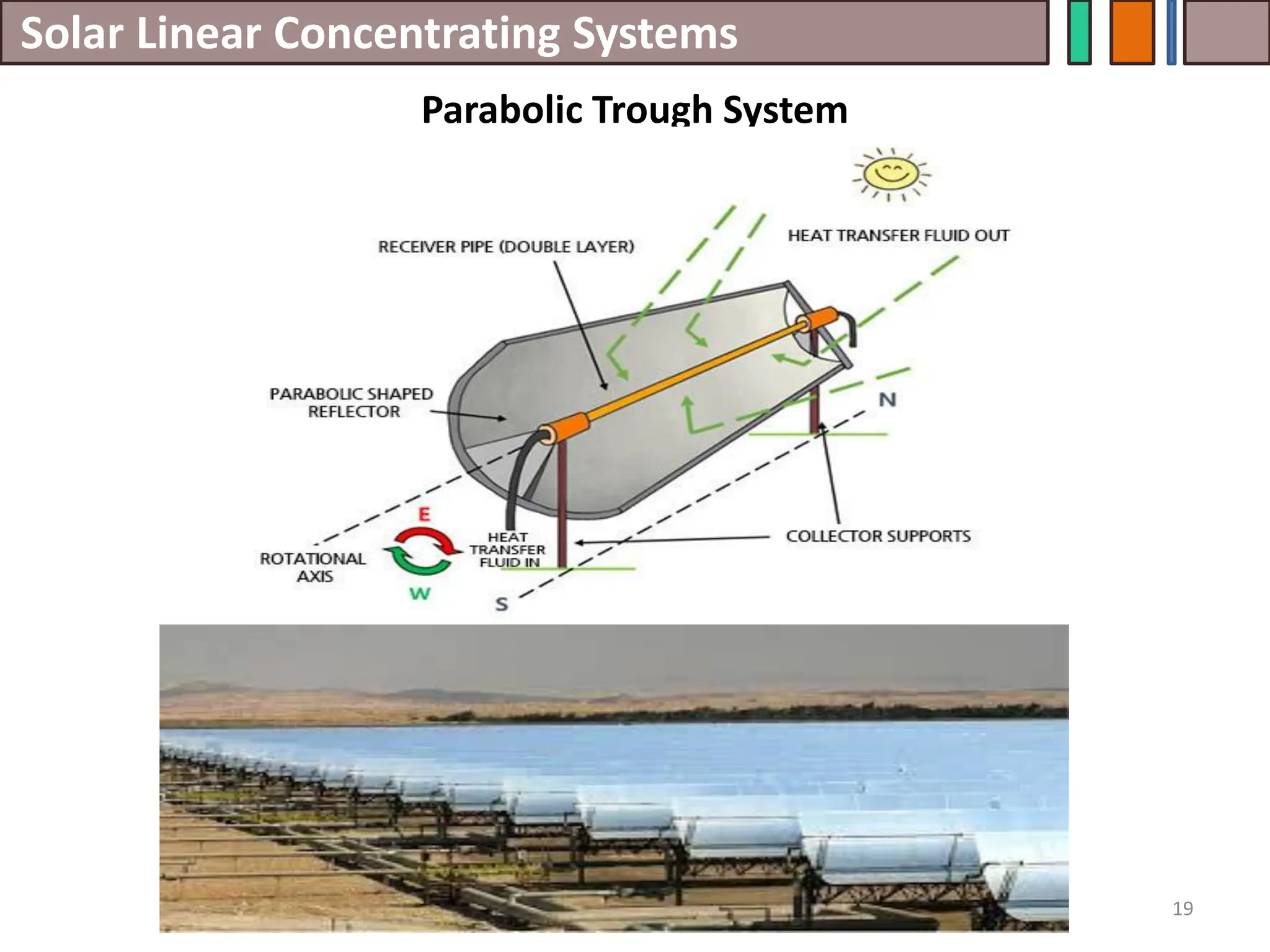
• These troughs, also known as line focus collectors, are composed
of a long, parabolic shaped reflector that concentrates incident
sunlight on a pipe that runs down the trough.
• The collectors sometimes utilize a single-axis Solar tracking
system to track the Sun across the sky as it moves from east to
west to ensure that there is always maximum solar energy
incident on the mirrors.
• The receiver pipe in the center can reach temperatures upward
of 400°C as the trough focuses Sun at 30-100 times its normal
intensity
18
Parabolic Trough System
Solar Linear Concentrating Systems
19
Parabolic Trough System
Solar Linear Concentrating Systems
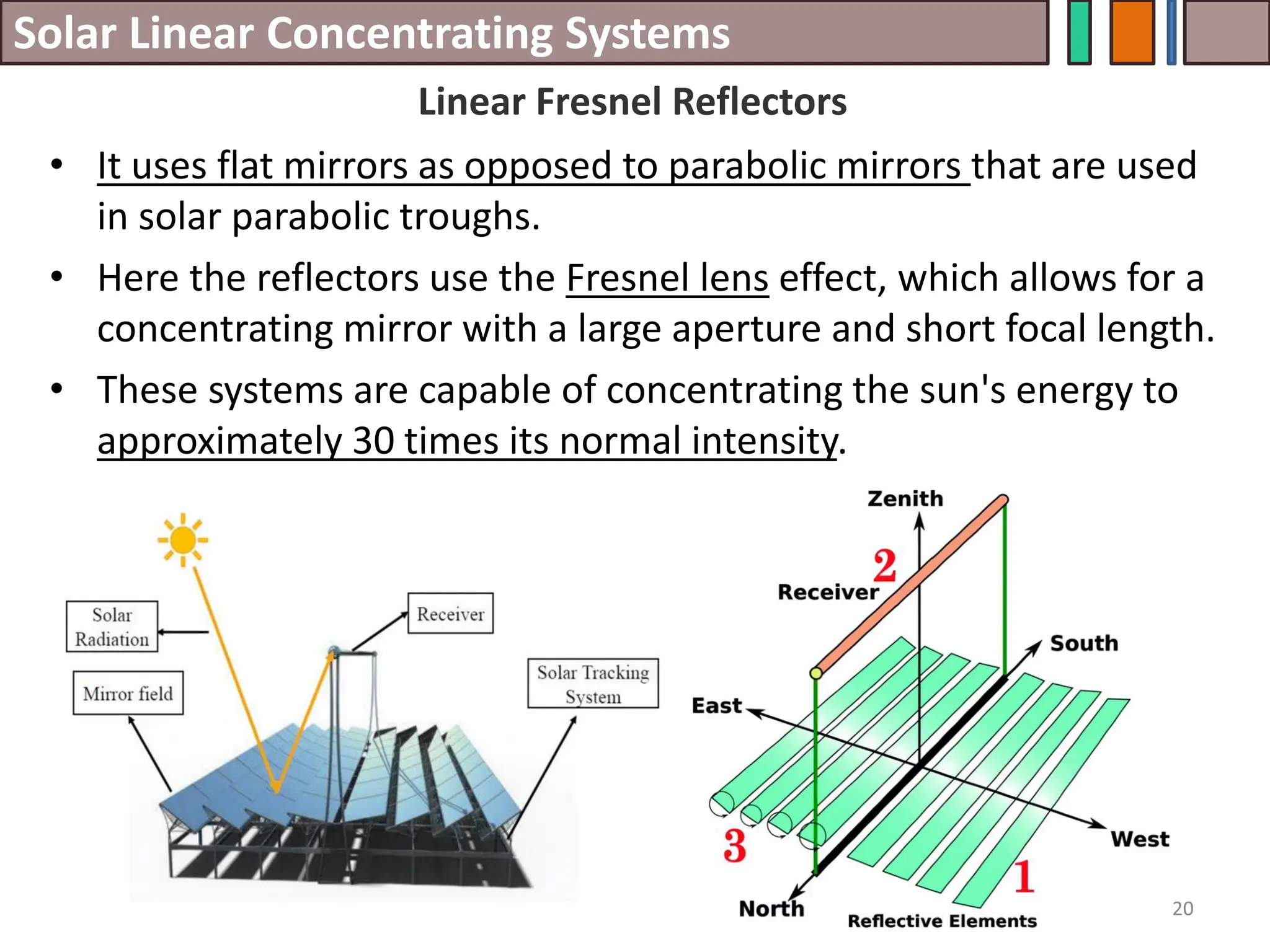
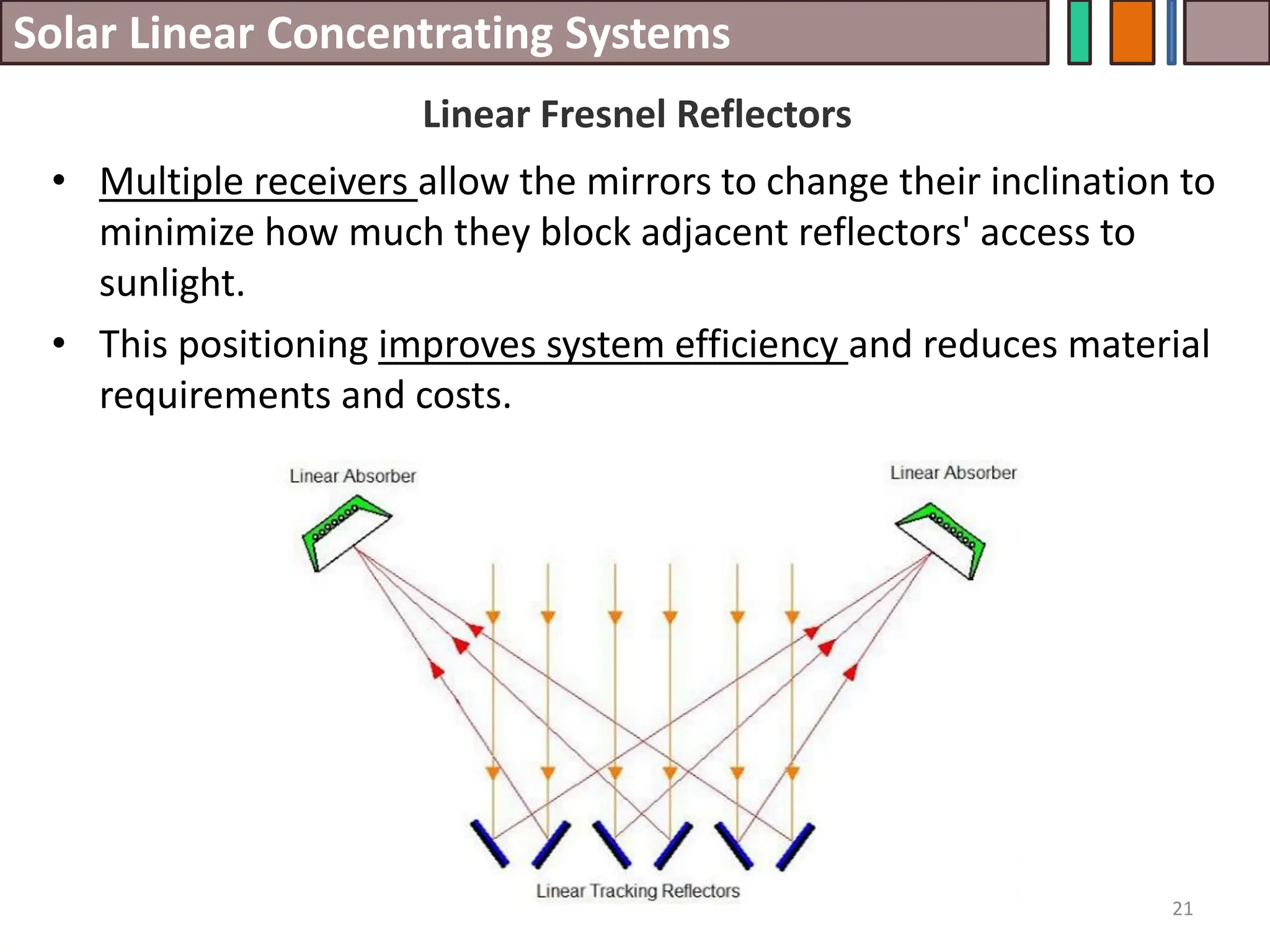
• It uses flat mirrors as opposed to parabolic mirrors that are used
in solar parabolic troughs.
• Here the reflectors use the Fresnel lens effect, which allows for a
concentrating mirror with a large aperture and short focal length.
• These systems are capable of concentrating the sun's energy to
approximately 30 times its normal intensity.
20
Linear Fresnel Reflectors
Solar Linear Concentrating Systems
• Multiple receivers allow the mirrors to change their inclination to
minimize how much they block adjacent reflectors' access to
sunlight.
• This positioning improves system efficiency and reduces material
requirements and costs.
21
Linear Fresnel Reflectors
Solar Towers
• A solar power tower is a system that converts energy from Sun
radiation into electricity.
• The setup includes an array of large, sun-tracking mirrors known
as heliostats that focus sunlight on a receiver at the top of a tower.
• In this receiver, a fluid is heated up to 500 oC and used to generate
steam that powers a conventional turbine generator producing
electricity.
• These systems may also have a thermal energy storage
system component that allows the solar collector system to heat an
energy storage system during the day, and the heat from the storage
system is used to produce electricity in the evening or during cloudy
weather.
• Solar thermal power plants may also be hybrid systems that use other
fuels (usually natural gas) to supplement energy from the sun during
periods of low solar radiation. 22
Solar Towers
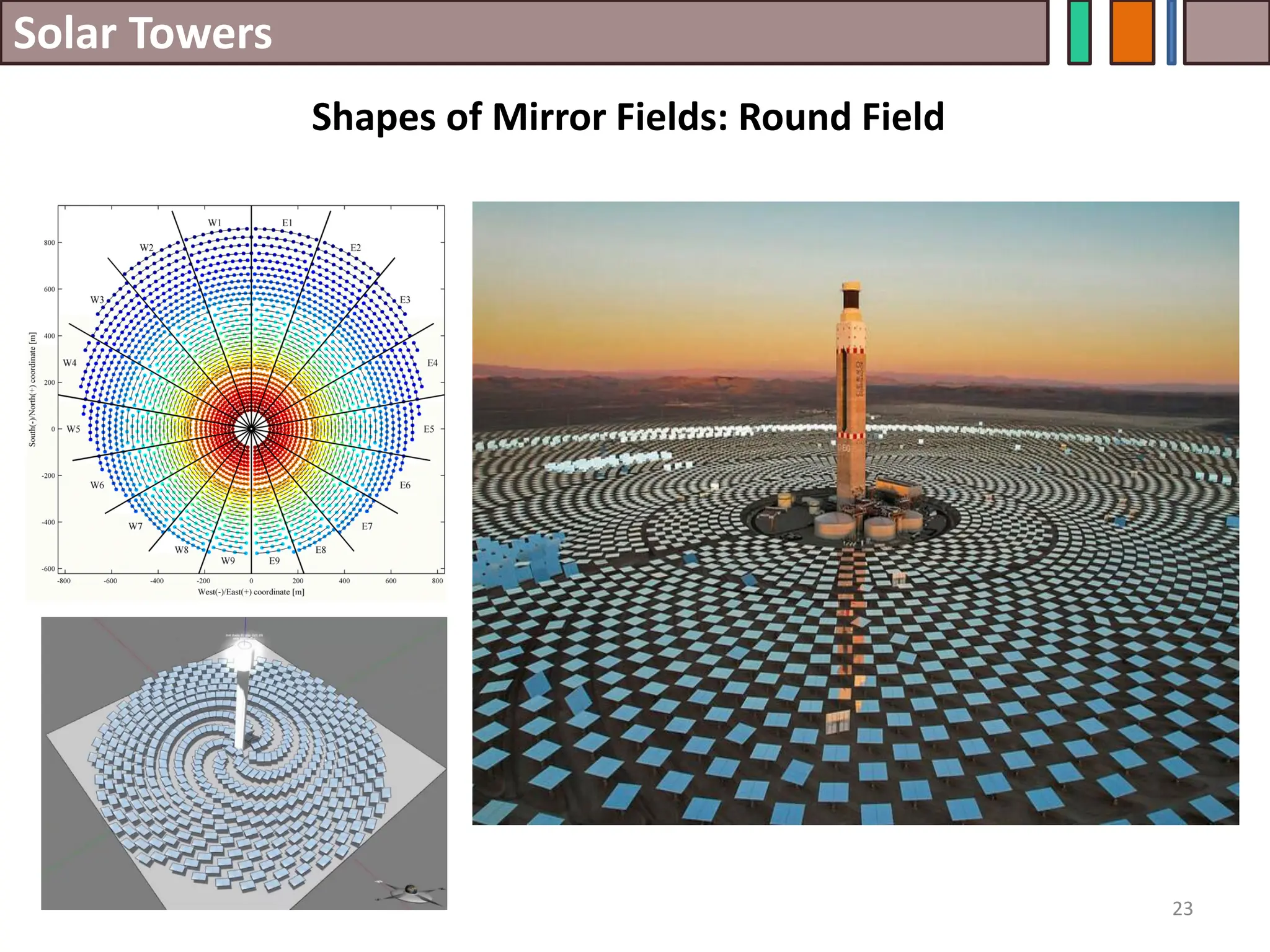
23
Shapes of Mirror Fields: Round Field
Solar Towers
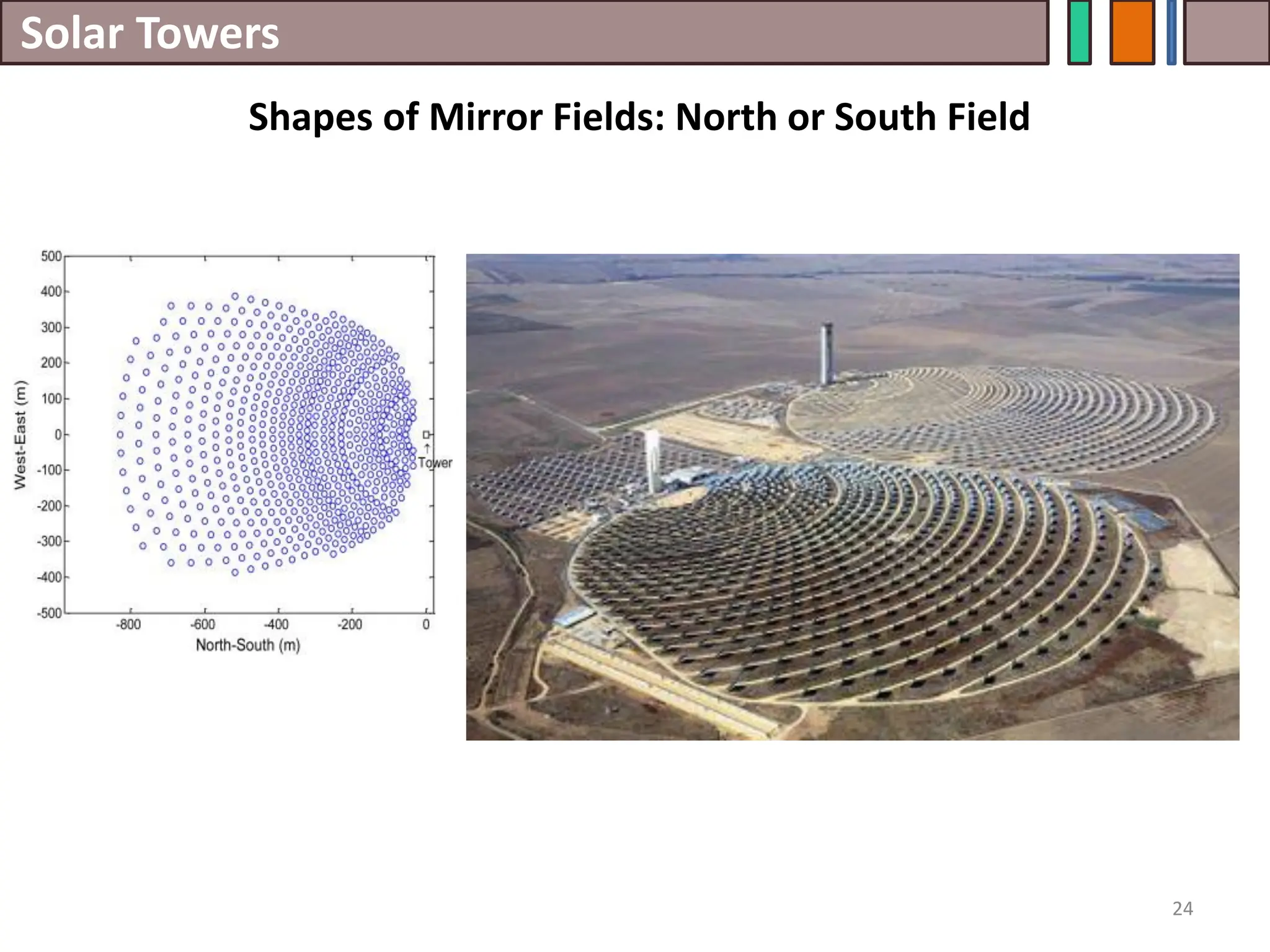
24
Shapes of Mirror Fields: North or South Field
Solar Towers
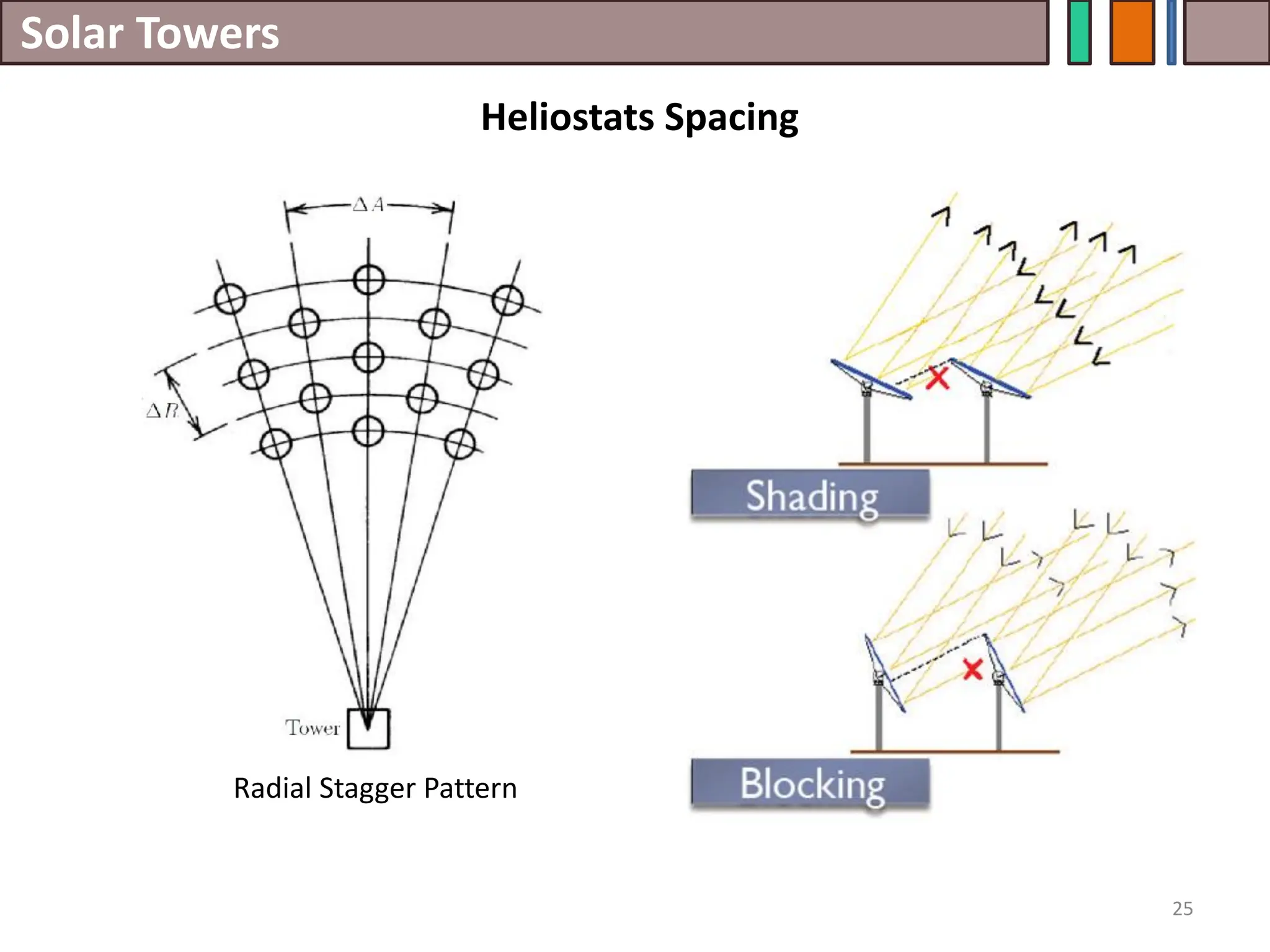
25
Heliostats Spacing
Radial Stagger Pattern
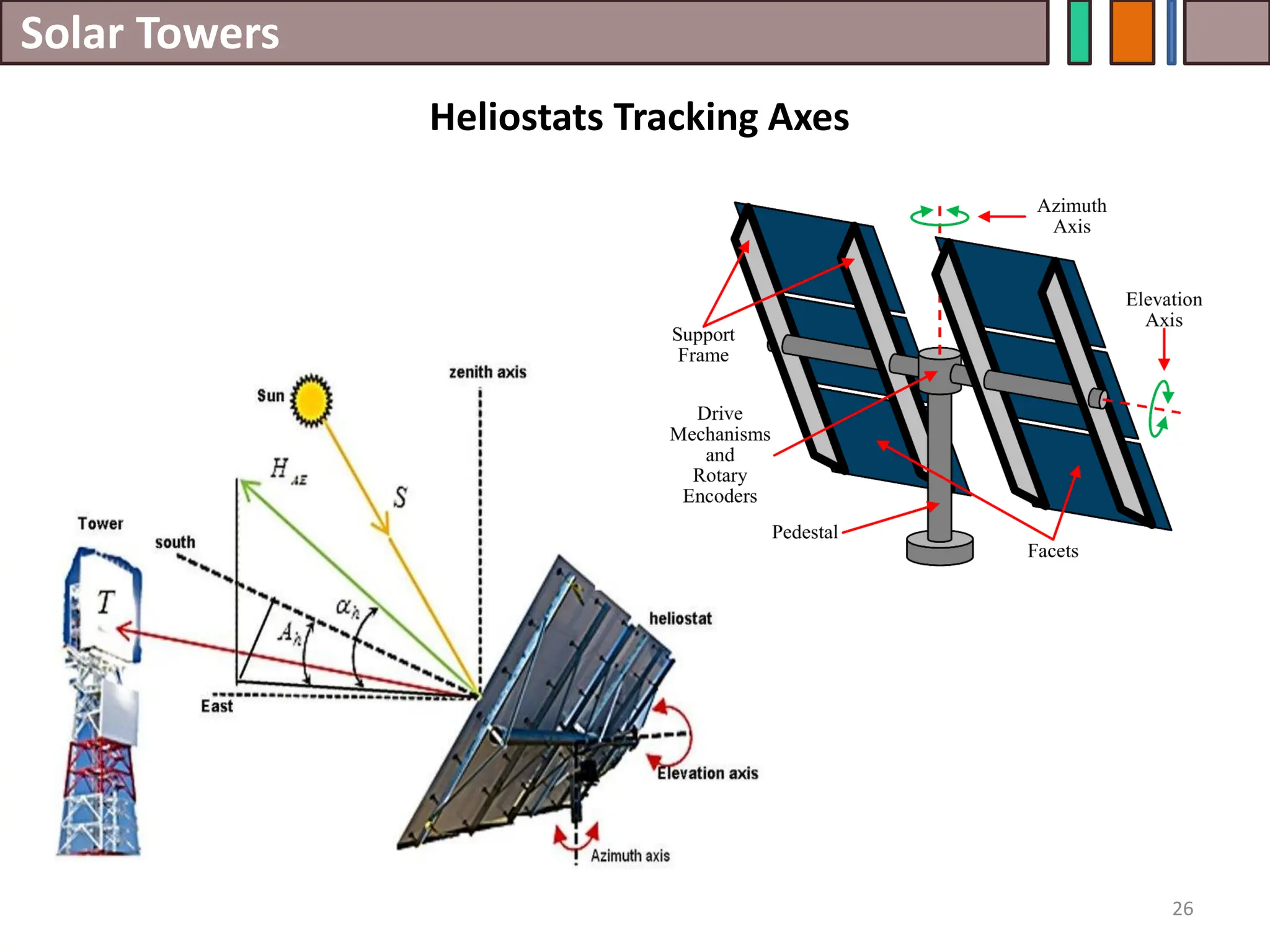
Solar Towers
26
Heliostats Tracking Axes
Economic Sizes of Solar Power Plants
• Distributed solar energy generation refers to the use of solar
energy by households, enterprises, public institutions, and other
small-scale power generation systems.
• Centralized solar energy generation, refers to large-scale solar
plant installations, in usually remote locations. They are large solar
power generation farms, producing substantial electricity, that is
fed into the grid.
• Centralized solar farms need:
• same infrastructure & electrical substations as those for
conventional power stations
• same transmission lines to be run over long distances to get
the solar power into the grid and to the consumer
27
Distributed and Centralized Solar Energy Generation
Economic Sizes of Solar Power Plants
• “Bigger is better” is a good rule of thumb when planning
renewable energy projects.
• Thus, a 120 MW project might be more cost effective than a dozen
10 MW projects, because you only pay for one permit, one grid
connection, one engineering, procurement and construction
contract, and so on.
• The dish Stirling is not cost effective for centralized plant. For
distributed plants it could not compete with PV power generation
plants.
• The linear Fresnel, had potential for relatively small-scale
deployments. It was more successful than dish Stirling, but
ultimately also failed to compete with PV low cost plants.
28
https://www.pacificgreen.com/articles/whats-best-size-concentrated-solar-power-plant/
Economical Size of Dish Stirling & Linear Fresnel Power Plant
Economic Sizes of Solar Power Plants
• Both parabolic trough and power tower technologies are
economical feasible for centralized large scale solar power projects.
• In theory, the parabolic trough technology could be built on an
almost infinitely large scale. All that is needed is increasing rows of
parabolic troughs and a big enough steam turbine and storage tank.
• In practice, it is important that the troughs are not too far distant
from the balance of plant because otherwise the heat transfer
fluid—typically synthetic oil - could cool down on its way to the
turbine and storage.
• As a result, recent studies estimated that the optimum size for a
parabolic trough plant is probably around 200 MW.
29
https://www.pacificgreen.com/articles/whats-best-size-concentrated-solar-power-plant/
Economical Size of Parabolic Trough Power Plant
Economic Sizes of Solar Power Plants
• Very big power towers suffer from two problems.
• These plants use heliostats to focus sunlight on a single
receiver high up on a tower. If the heliostat is too far from the
tower, the light can be attenuated by airborne particles such
as dust and soot. That reduces the efficiency of the system.
• Getting heliostats to focus on very distant receivers requires a
high level of precision both in the mirror and the control
system, which does not help to keep costs down.
• Because of the above limitations, some researchers believe the
optimum size for power towers could be around 30 MW.
30
https://www.pacificgreen.com/articles/whats-best-size-concentrated-solar-power-plant/
Economical Size of Solar Tower Power Plant
Economic Sizes of Solar Power Plants
• In both parabolic trough and power tower projects, however, the
size of the solar field is just one factor. Another important feature
is the size of the power block.
• In the existing plants, the steam turbines can range from 10 MW
up to 200 MW, but this technology too, benefits from economies
of scale.
• For both the parabolic trough and tower technology, power block
considerations could constrain most projects to a minimum size
of around 50 MW.
31
https://www.pacificgreen.com/articles/whats-best-size-concentrated-solar-power-plant/
Economical Size of the Balance Power Block
Economic Sizes of Solar Power Plants
• Besides the technical considerations, perhaps one of the biggest
determinants of Concentrating Solar Power (CSP) plant size is
financing. The bigger the plant, the more it will cost in capital
terms. The higher the capital cost, the more difficult it can be to
find finance.
• Financing CSP plants is complicated by the fact that, unlike PV
projects, they cannot be built out yet a modular basis. Whereas
you can start generating electricity from PV with just a single array
and inverter in place, for CSP you must commission the whole
plant in one go.
• That somewhat increases the risk for investors and will consider
concessional finance (i.e. financing at high interest rate) that may
affect the feasibility of building a new CSP plant.
32
https://www.pacificgreen.com/articles/whats-best-size-concentrated-solar-power-plant/
Financing of Large Size Concentrated Solar Power Plants
Thermal Storage
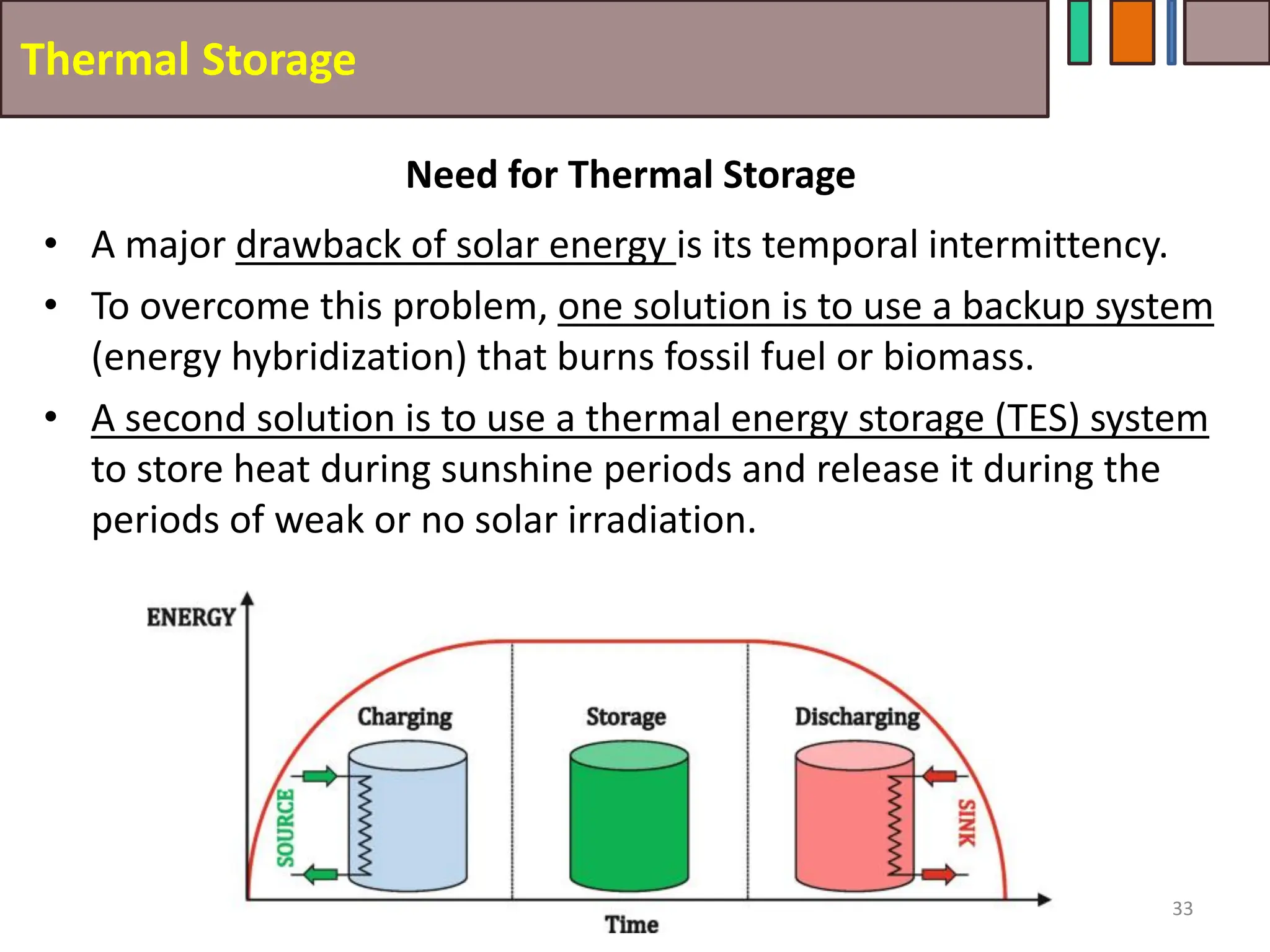
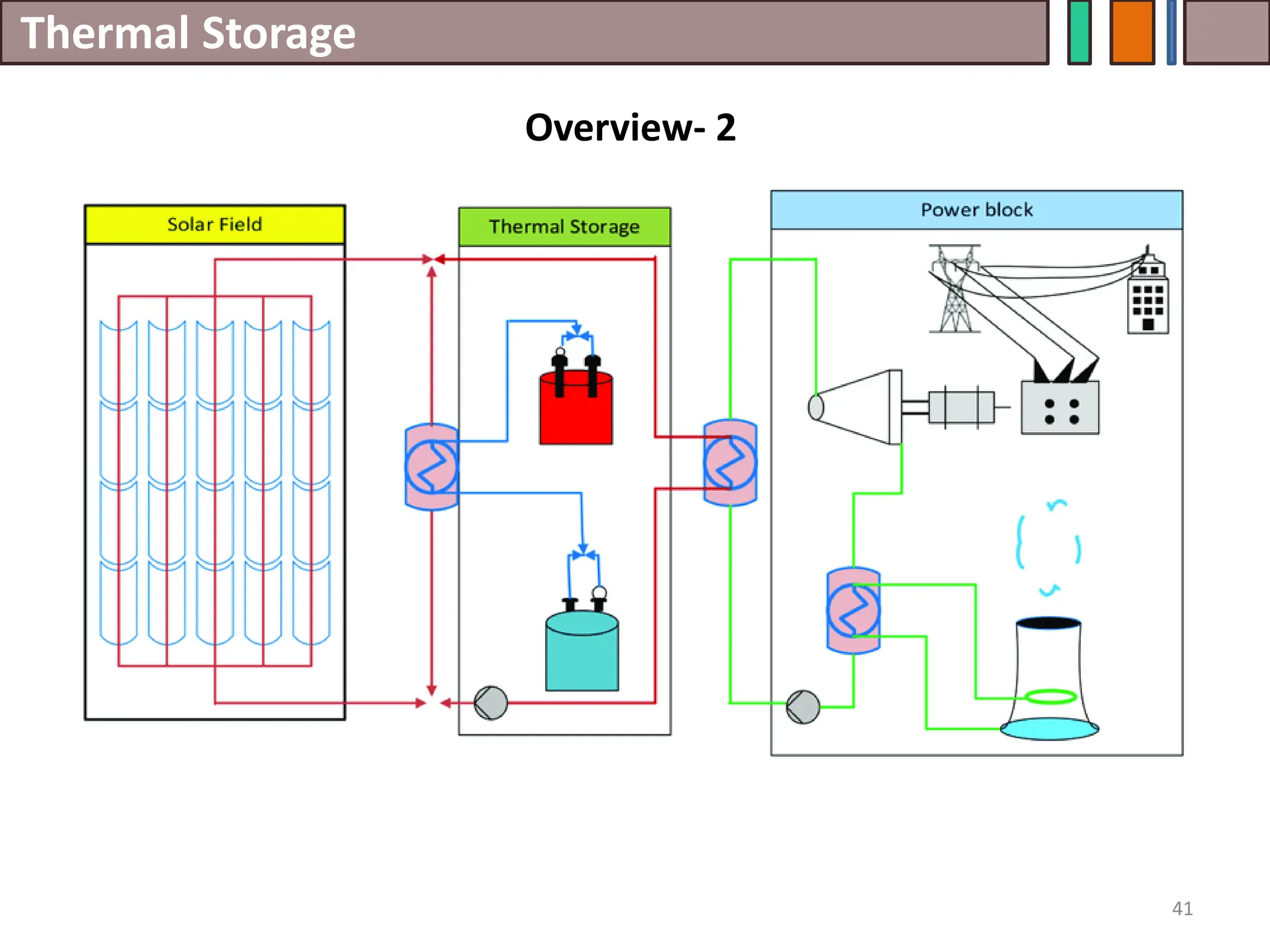
• A major drawback of solar energy is its temporal intermittency.
• To overcome this problem, one solution is to use a backup system
(energy hybridization) that burns fossil fuel or biomass.
• A second solution is to use a thermal energy storage (TES) system
to store heat during sunshine periods and release it during the
periods of weak or no solar irradiation.
33
Need for Thermal Storage
Thermal Storage
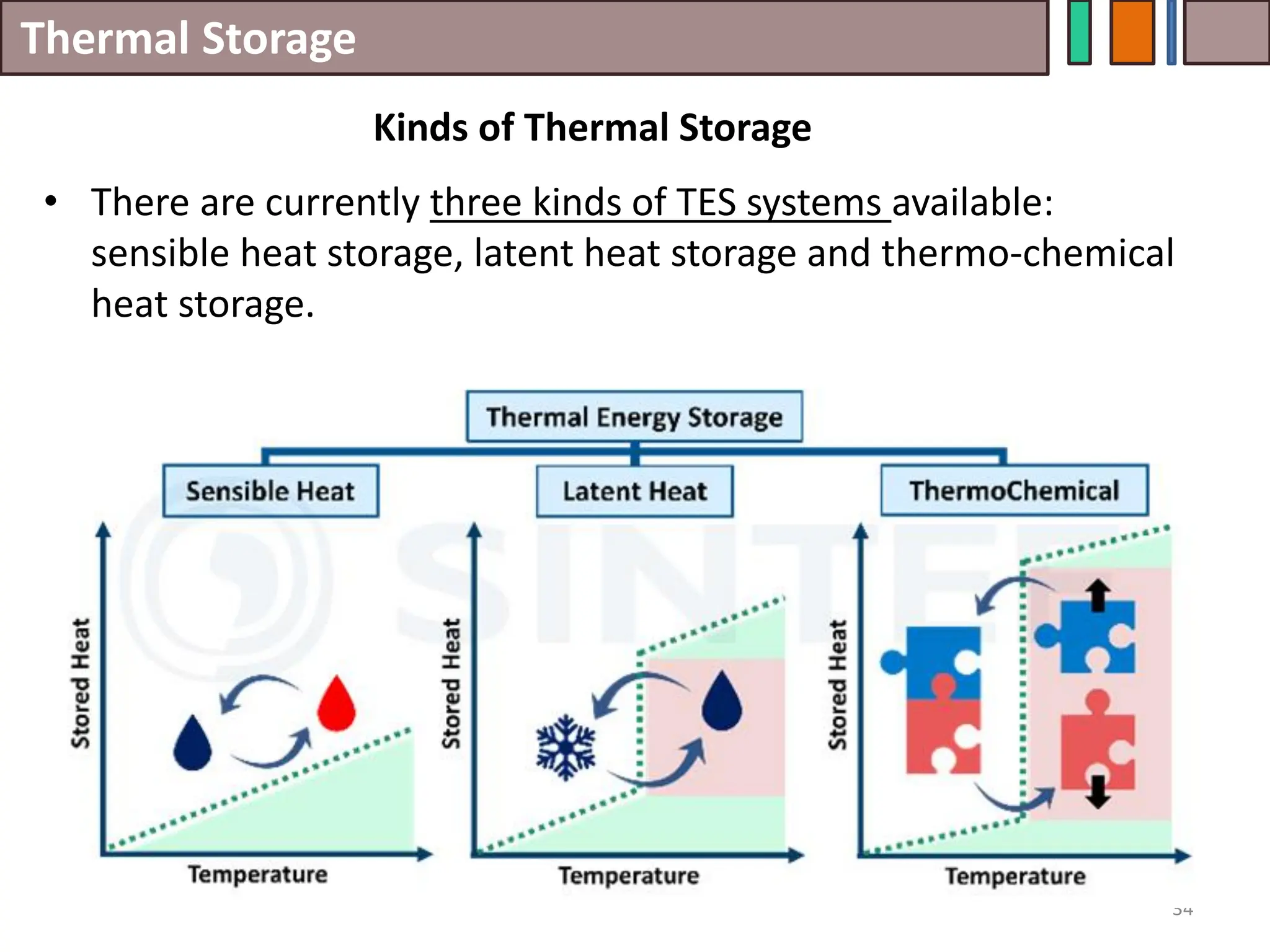
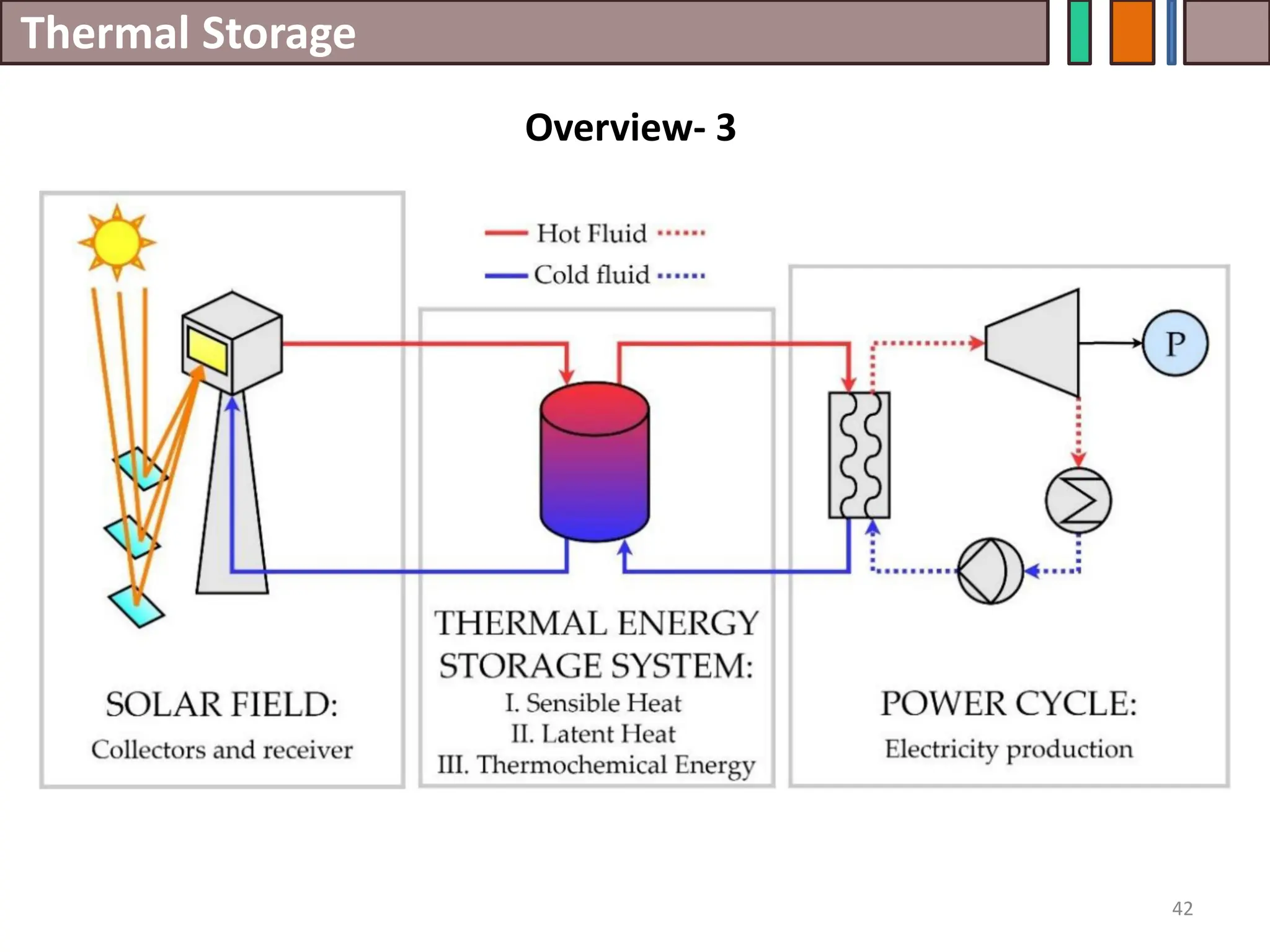
• There are currently three kinds of TES systems available:
sensible heat storage, latent heat storage and thermo-chemical
heat storage.
34
Kinds of Thermal Storage
Thermal Storage
• Sensible heat storage systems are most mature.
• Sensible TES is heat storage through traditional heating of a
material, such as hot water tanks.
• In a sensible TES material, temperature and energy are
proportional, so the more energy you put into the material, the
higher its temperature will be.
• One of the cheapest, most commonly used options is a water
tank, but materials such as molten salts or metals can be heated
to higher temperatures and therefore offer a higher storage
capacity.
35
Sensible Heat Storage - 1
Thermal Storage
• A disadvantage of SHS is its dependence on the properties of
the storage medium. Storage capacities are limited by
the specific heat capacity of the storage material, and the
system needs to be properly designed to ensure energy
extraction at a constant temperature.
• Molten salts is employed as a thermal energy storage method
to retain thermal energy.
• The salt melts at 131 °C. It is kept liquid at 288 °C in an insulated
"cold" storage tank. The liquid salt is pumped through panels in
a solar collector where the focused sun heats it to 566 °C .
36
Sensible Heat Storage - 2
Thermal Storage
37
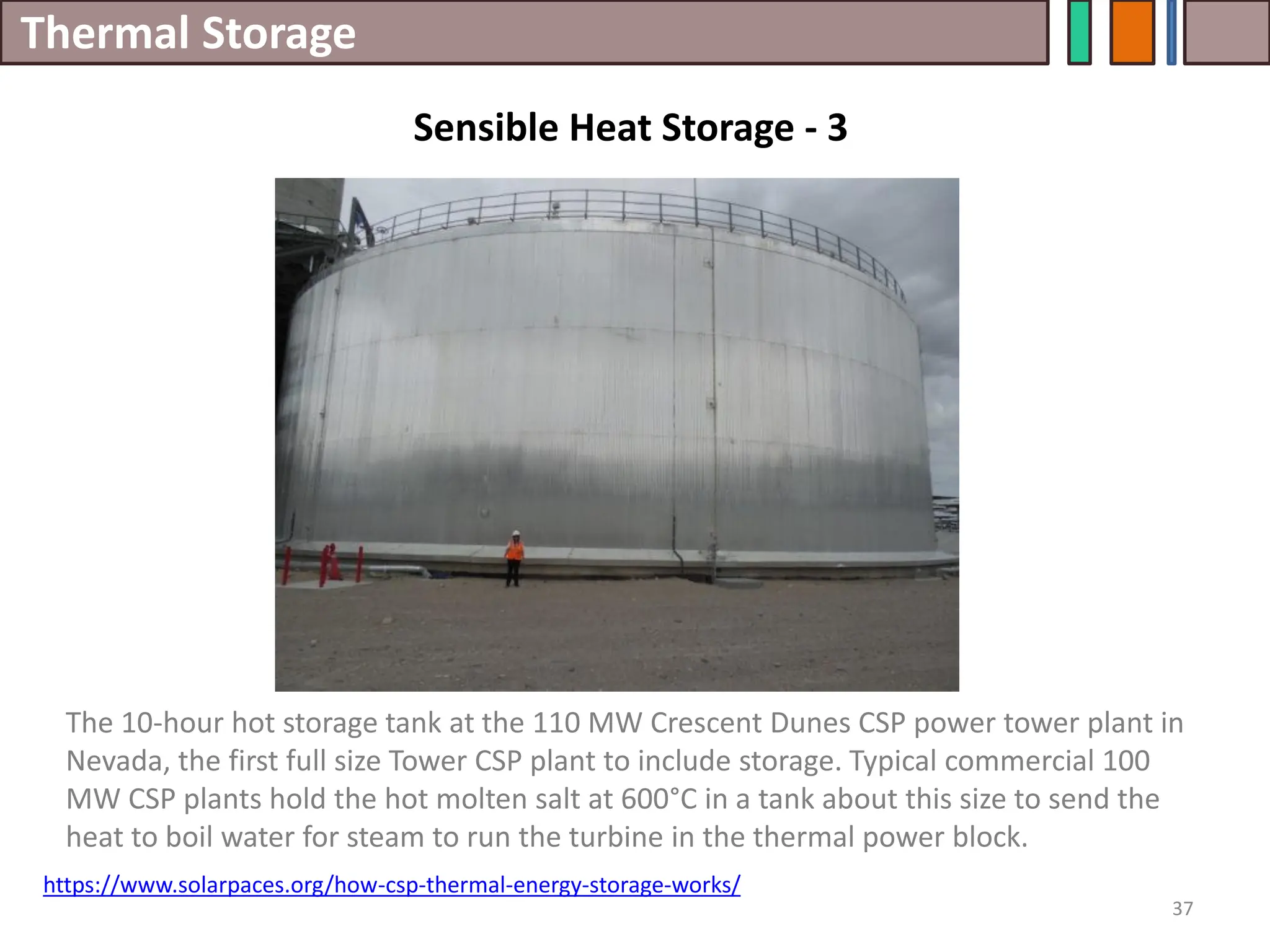
The 10-hour hot storage tank at the 110 MW Crescent Dunes CSP power tower plant in
Nevada, the first full size Tower CSP plant to include storage. Typical commercial 100
MW CSP plants hold the hot molten salt at 600°C in a tank about this size to send the
heat to boil water for steam to run the turbine in the thermal power block.
https://www.solarpaces.org/how-csp-thermal-energy-storage-works/
Sensible Heat Storage - 3
Thermal Storage
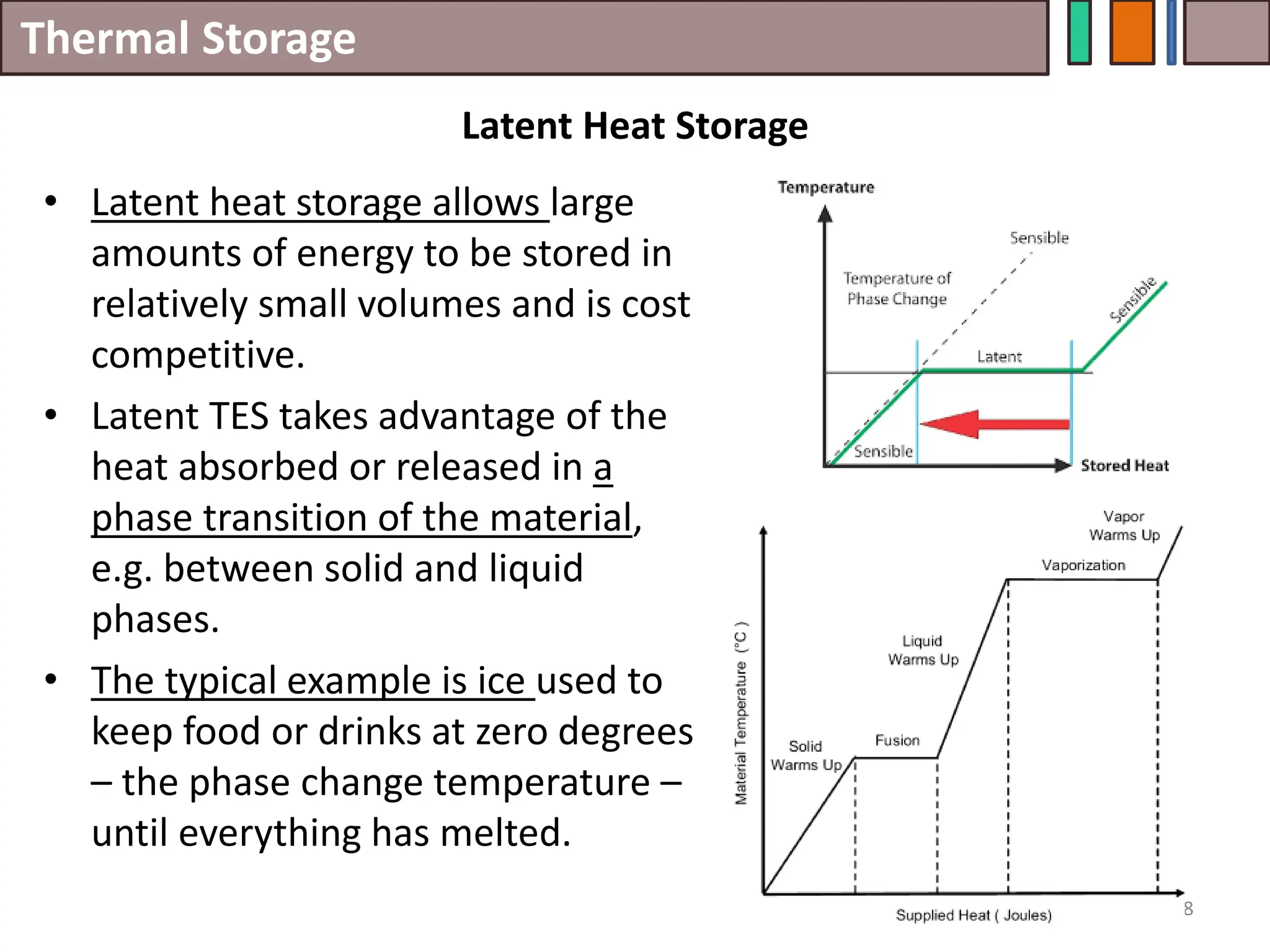
• Latent heat storage allows large
amounts of energy to be stored in
relatively small volumes and is cost
competitive.
• Latent TES takes advantage of the
heat absorbed or released in a
phase transition of the material,
e.g. between solid and liquid
phases.
• The typical example is ice used to
keep food or drinks at zero degrees
– the phase change temperature –
until everything has melted.
38
Latent Heat Storage
Thermal Storage
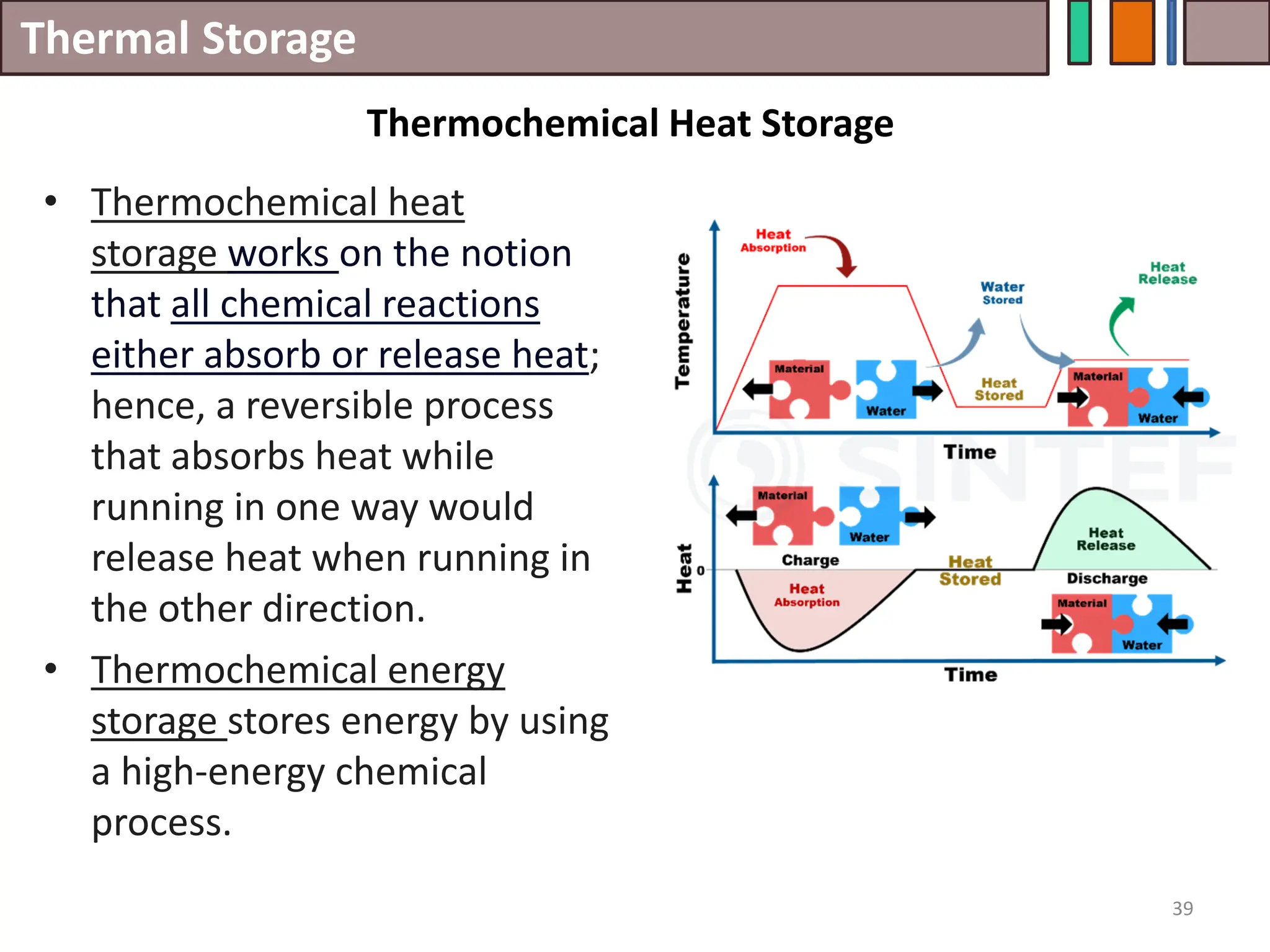
• Thermochemical heat
storage works on the notion
that all chemical reactions
either absorb or release heat;
hence, a reversible process
that absorbs heat while
running in one way would
release heat when running in
the other direction.
• Thermochemical energy
storage stores energy by using
a high-energy chemical
process.
39
Thermochemical Heat Storage
Thermal Storage
40
Overview- 1
Thermal Storage
41
Overview- 2
Thermal Storage
42
Overview- 3
Thermal Storage
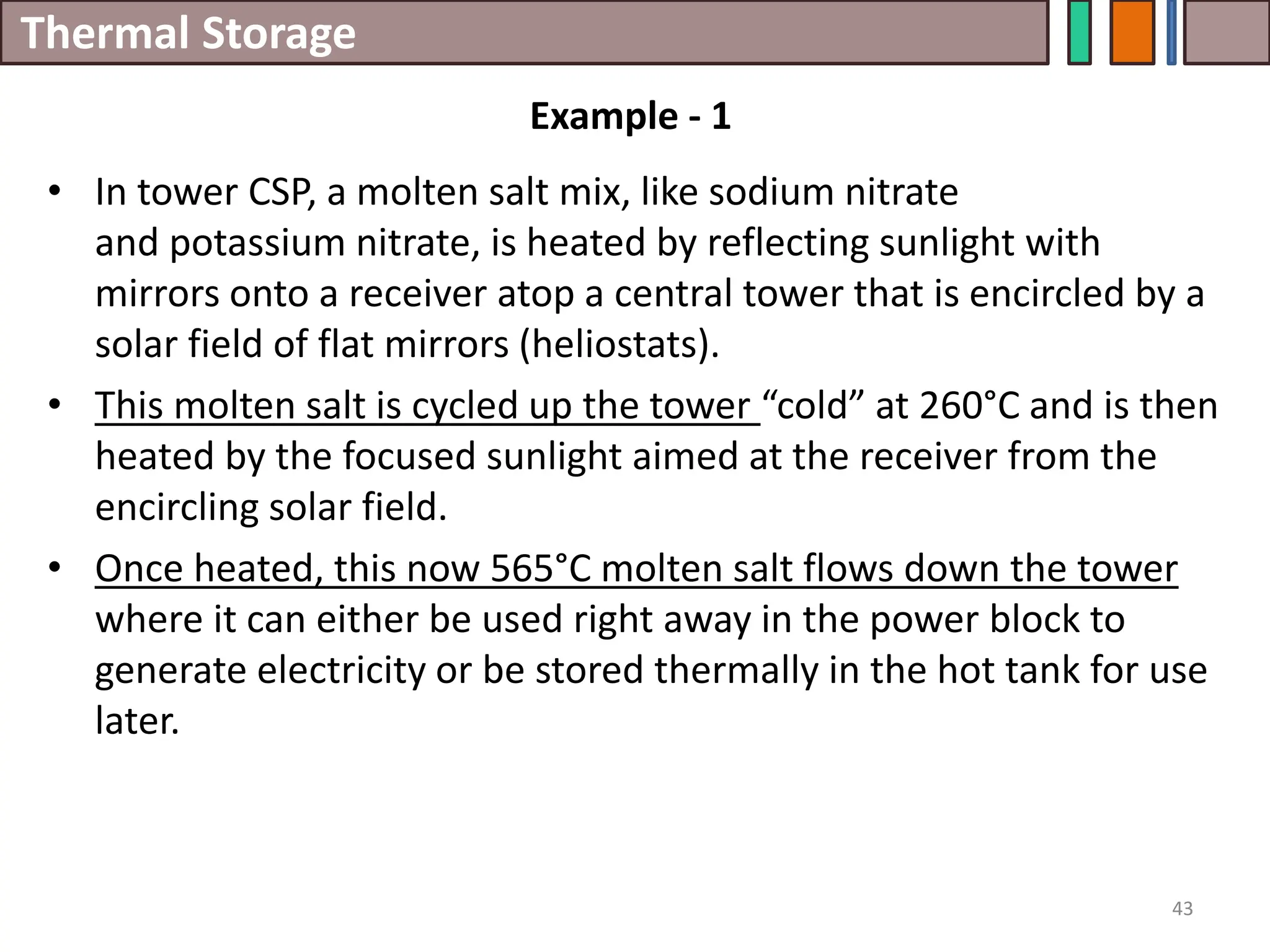
• In tower CSP, a molten salt mix, like sodium nitrate
and potassium nitrate, is heated by reflecting sunlight with
mirrors onto a receiver atop a central tower that is encircled by a
solar field of flat mirrors (heliostats).
• This molten salt is cycled up the tower “cold” at 260°C and is then
heated by the focused sunlight aimed at the receiver from the
encircling solar field.
• Once heated, this now 565°C molten salt flows down the tower
where it can either be used right away in the power block to
generate electricity or be stored thermally in the hot tank for use
later.
43
Example - 1
Thermal Storage
• In a parabolic trough type of CSP plant, the heat transfer fluid
(HTF) – which is usually an oil – is heated in pipes throughout the
solar field by reflecting focused sunlight on a narrow pipe that
runs the length of its reflecting trough-shaped mirrors.
• This hot oil then transfers solar-heat along bigger pipes to the
power block where it can either be used straight away or held in
the holding tank storing thermal energy until it is needed.
44
Example - 2
Benefits and Drawbacks of Solar Thermal Systems
Benefits
• Because the Solar Thermal Power Plants (STPP) systems can
generate steam of such high temperatures, the conversion of
heat energy to electricity is more efficient than PV systems.
• The storage of heat is more efficient and cost-effective than
storing electricity in PV systems.
• These plants can produce a reliable amount of energy and can be
turned on or up at well, meeting the energy demands of society.
• These plants uses electricity generation technology that is
cleaner than generating electricity by using fossil fuels.
• Solar thermal power plants can be very efficient at converting
sunlight into electricity, with efficiencies of up to 40%.
45
Benefits and Drawbacks of Solar Thermal Systems
Drawbacks
• Large amount of land necessary for these plants to operate
efficiently.
• They require clear skies and direct sunlight to operate efficiently,
which limits their location options.
• The water demand of these plants can also be seen as an issue,
as the production of enough steam requires large volumes of
water.
• A final potential impact of the use of large focusing mirrors is the
harmful effect these plants have on birds. Birds that fly in the
way of the focused rays of Sun can be incinerated. Some reports
of bird deaths at power plants such as these amount the deaths
to about one bird every two minutes.
46
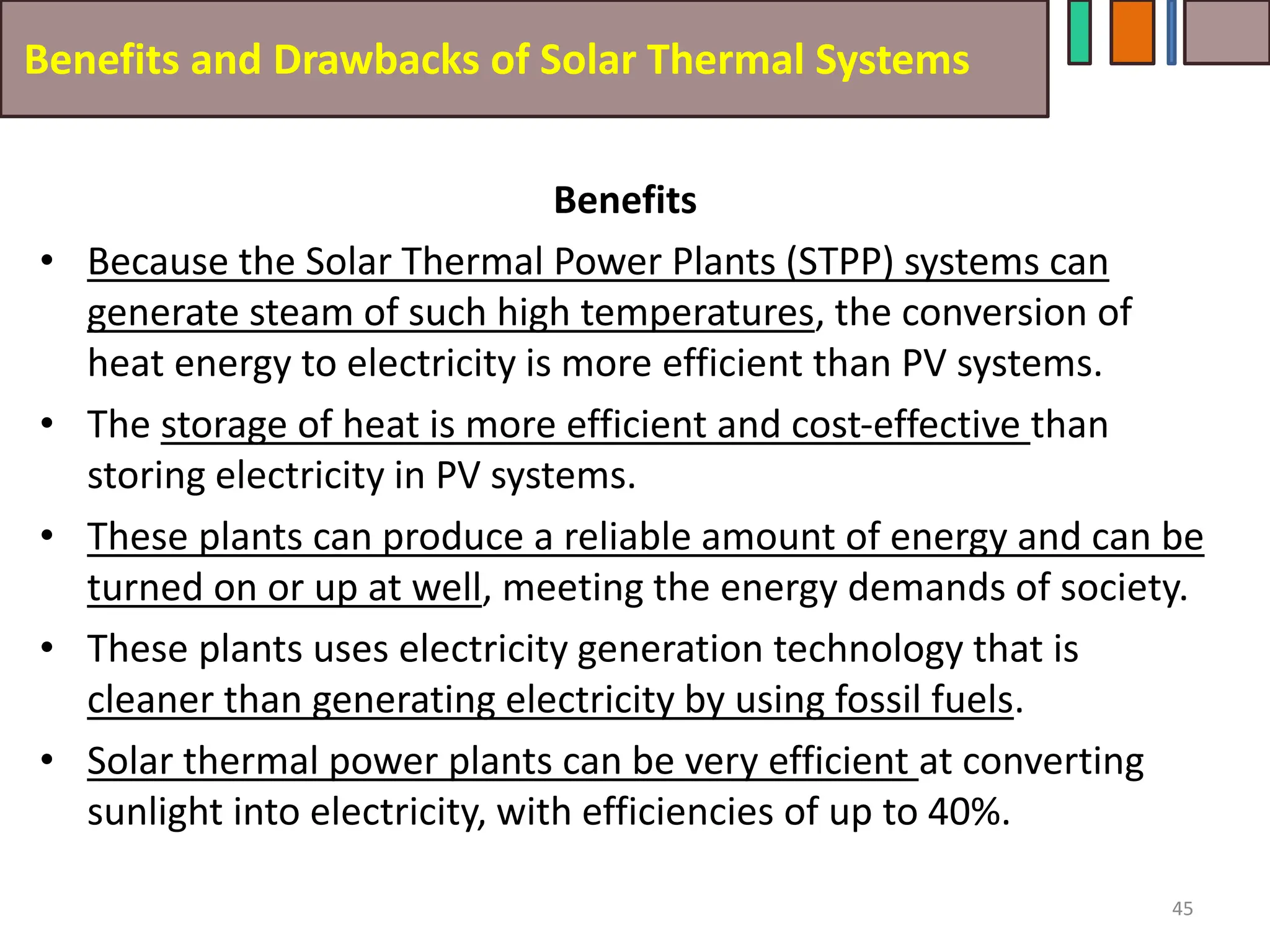
Noor Solar Complex (Morocco) Project
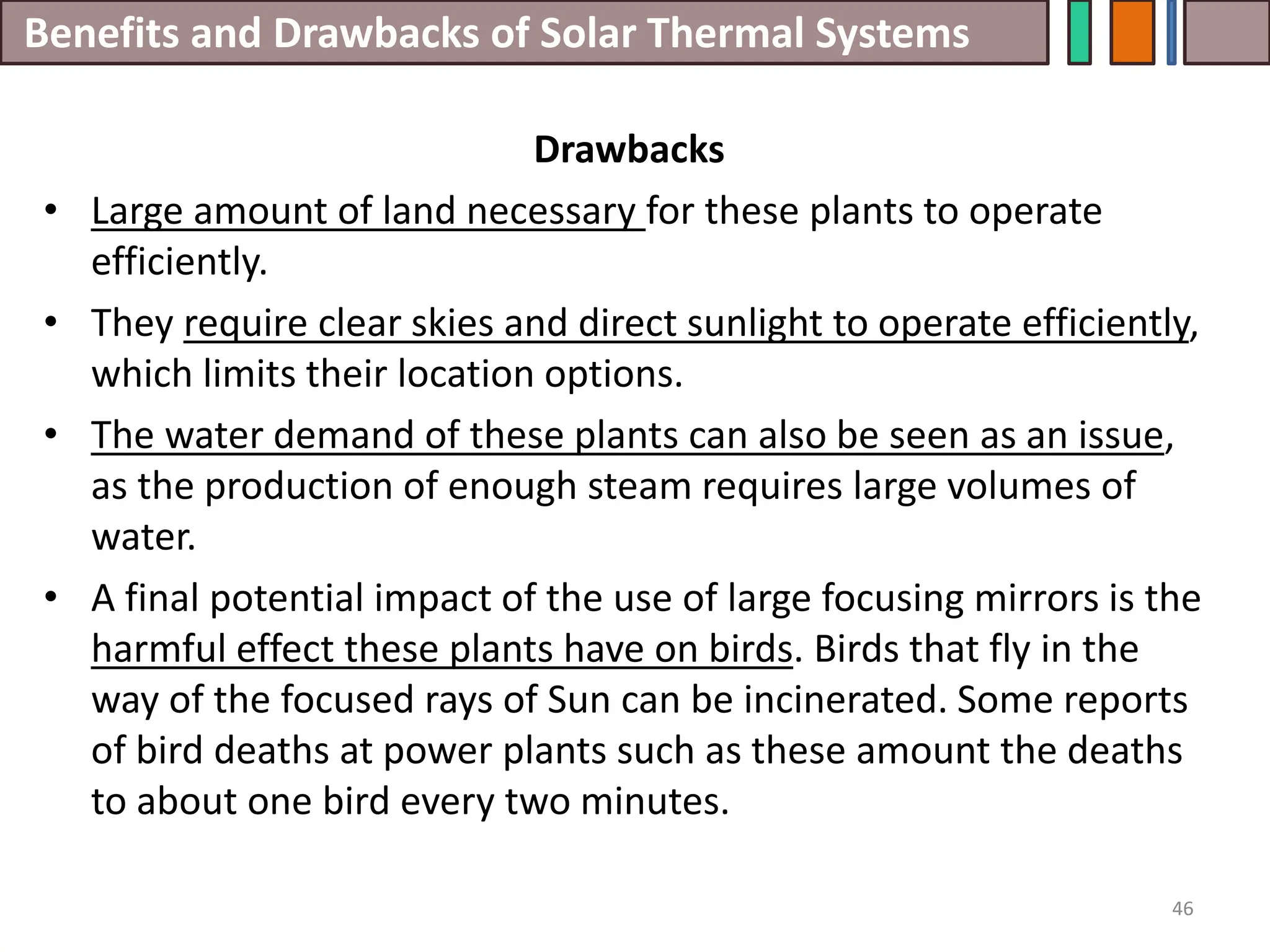
• Noor Complex is the world’s largest
concentrated solar power (CSP)
plant, located in the Sahara Desert.
• It is located 10 kilometers north of
the Moroccan city of Ouarzazate.
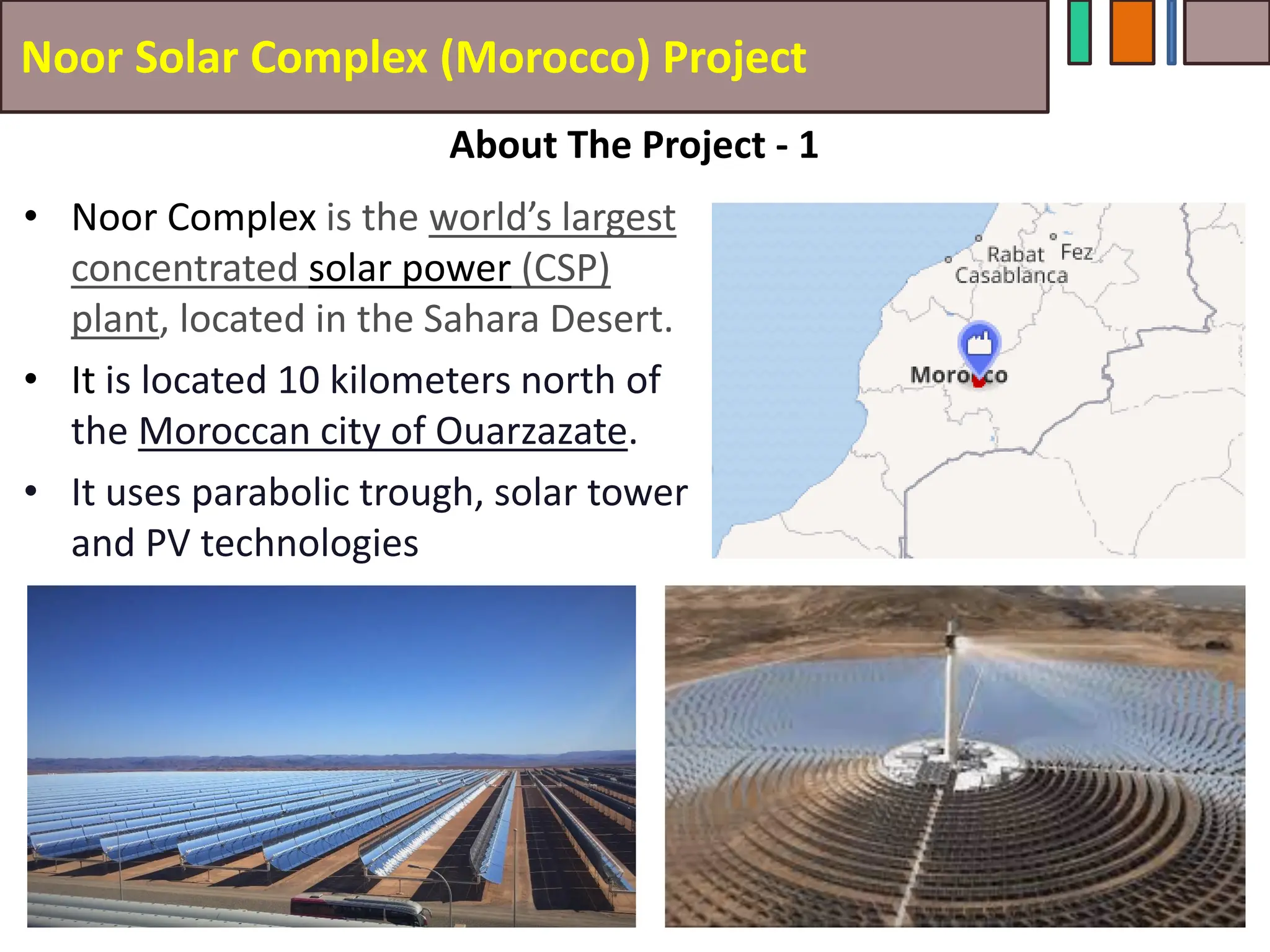
• It uses parabolic trough, solar tower
and PV technologies
47
About The Project - 1
Noor Solar Complex (Morocco) Project
• It’s the world’s biggest concentrated solar power facility.
• The project has 4 phases: Noor I, Noor II, Noor III and Noor IV.
• The project has a 580-megawatt capacity.
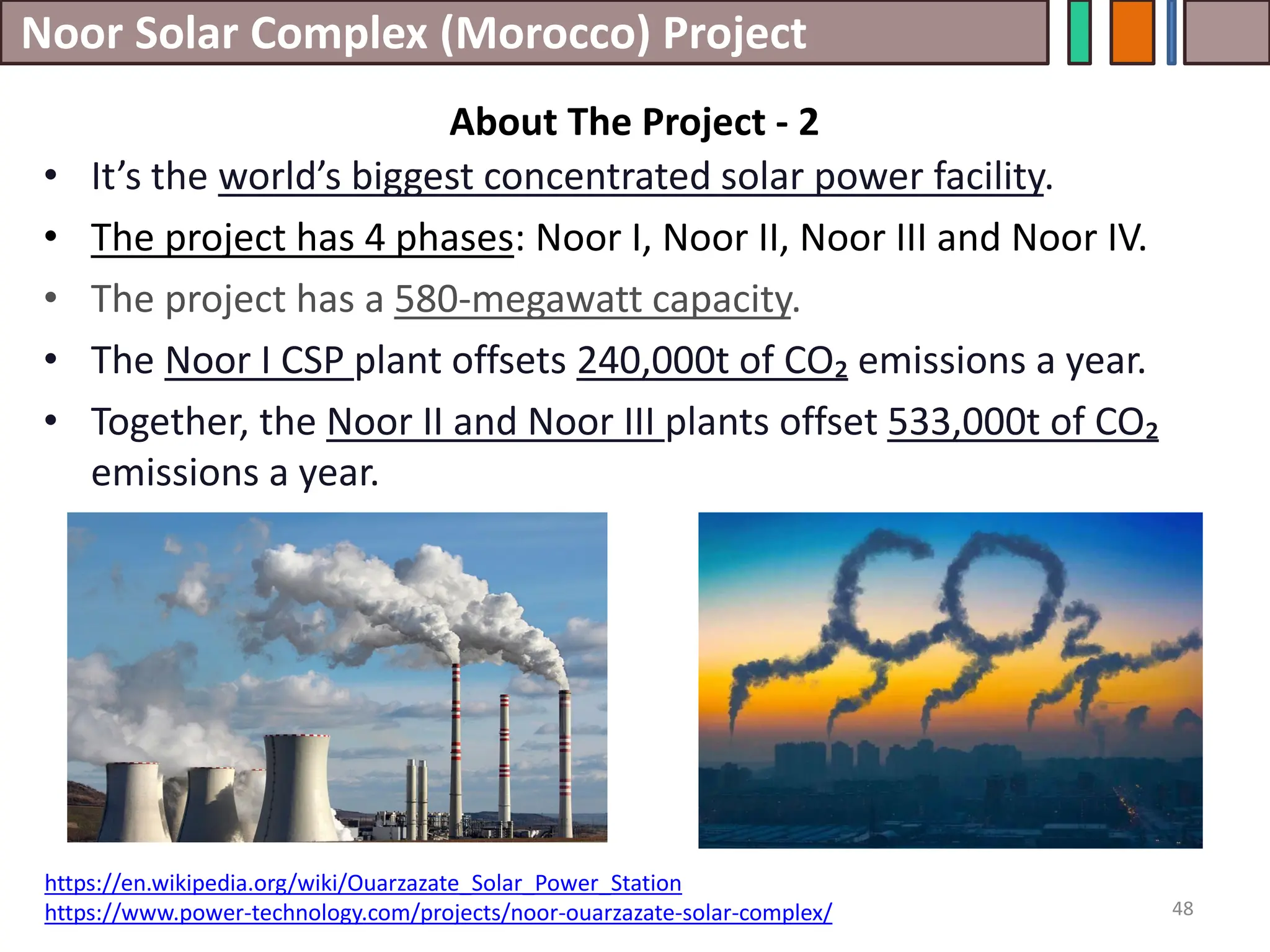
• The Noor I CSP plant offsets 240,000t of CO₂ emissions a year.
• Together, the Noor II and Noor III plants offset 533,000t of CO₂
emissions a year.
48
About The Project - 2
https://en.wikipedia.org/wiki/Ouarzazate_Solar_Power_Station
https://www.power-technology.com/projects/noor-ouarzazate-solar-complex/
Noor Solar Complex (Morocco) Project
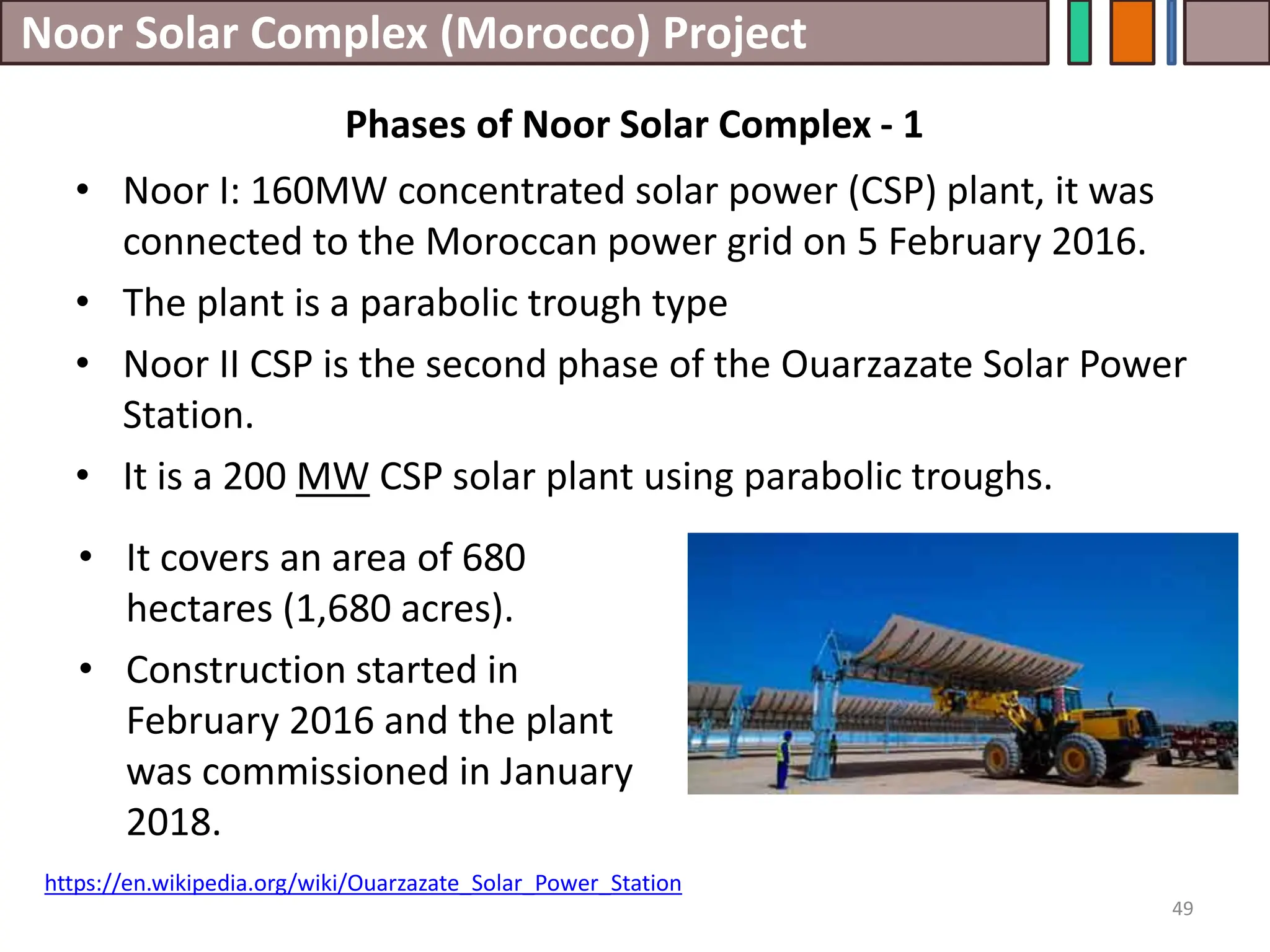
• Noor I: 160MW concentrated solar power (CSP) plant, it was
connected to the Moroccan power grid on 5 February 2016.
• The plant is a parabolic trough type
• Noor II CSP is the second phase of the Ouarzazate Solar Power
Station.
• It is a 200 MW CSP solar plant using parabolic troughs.
49
Phases of Noor Solar Complex - 1
https://en.wikipedia.org/wiki/Ouarzazate_Solar_Power_Station
• It covers an area of 680
hectares (1,680 acres).
• Construction started in
February 2016 and the plant
was commissioned in January
2018.
Noor Solar Complex (Morocco) Project
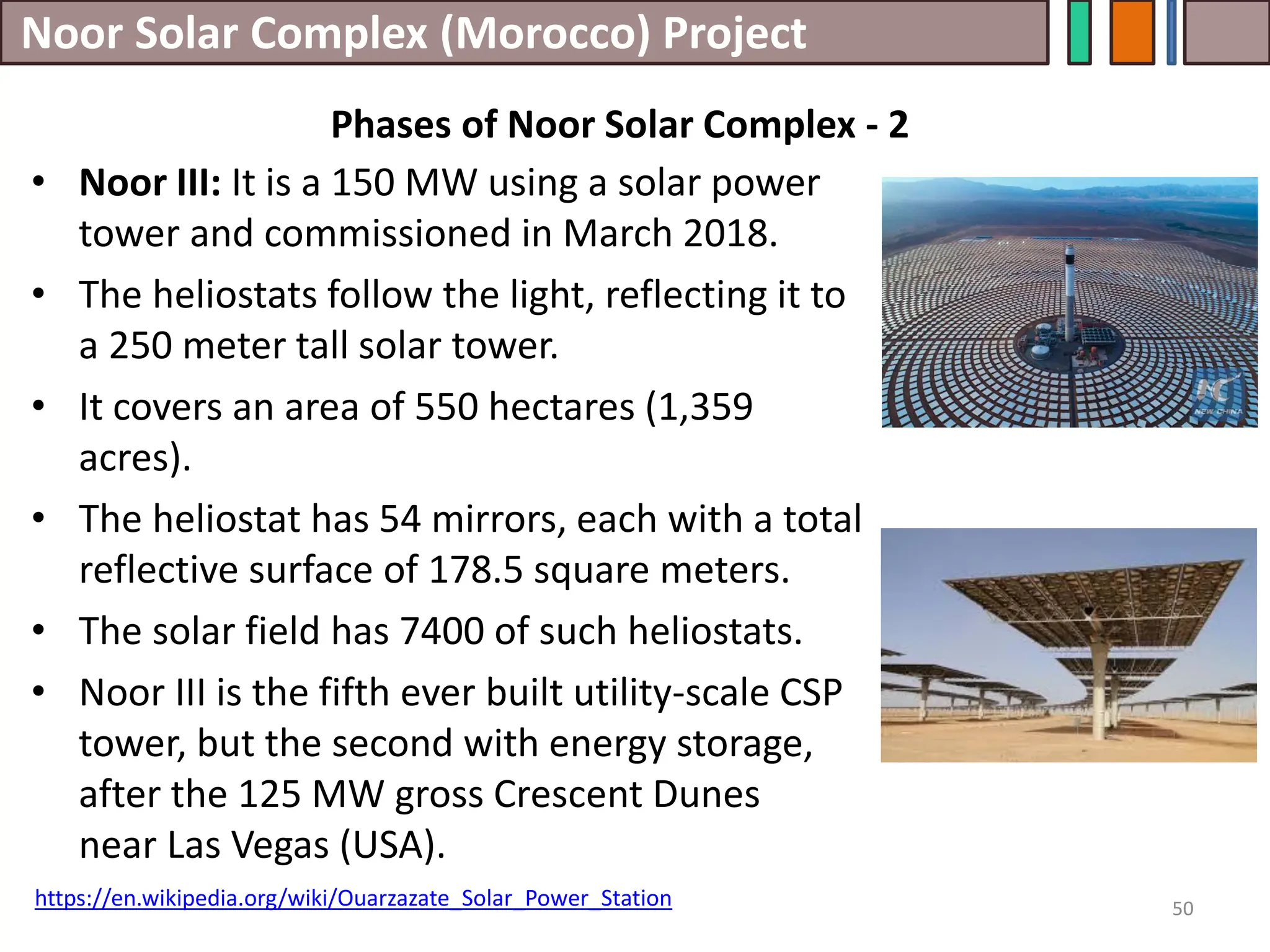
• Noor III: It is a 150 MW using a solar power
tower and commissioned in March 2018.
• The heliostats follow the light, reflecting it to
a 250 meter tall solar tower.
• It covers an area of 550 hectares (1,359
acres).
• The heliostat has 54 mirrors, each with a total
reflective surface of 178.5 square meters.
• The solar field has 7400 of such heliostats.
• Noor III is the fifth ever built utility-scale CSP
tower, but the second with energy storage,
after the 125 MW gross Crescent Dunes
near Las Vegas (USA).
50
https://en.wikipedia.org/wiki/Ouarzazate_Solar_Power_Station
Phases of Noor Solar Complex - 2
Noor Solar Complex (Morocco) Project
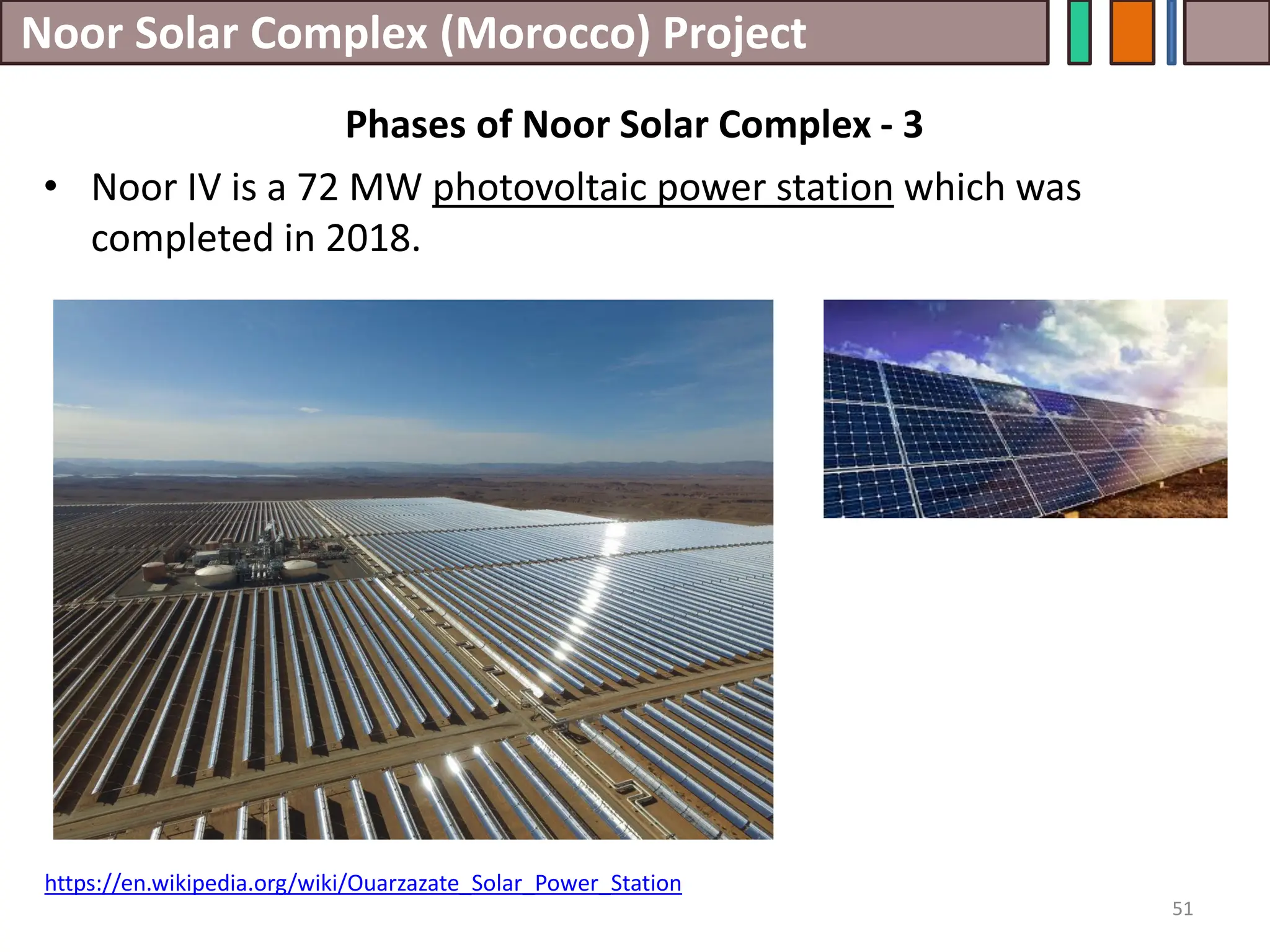
• Noor IV is a 72 MW photovoltaic power station which was
completed in 2018.
51
https://en.wikipedia.org/wiki/Ouarzazate_Solar_Power_Station
Phases of Noor Solar Complex - 3
Noor Solar Complex (Morocco) Project
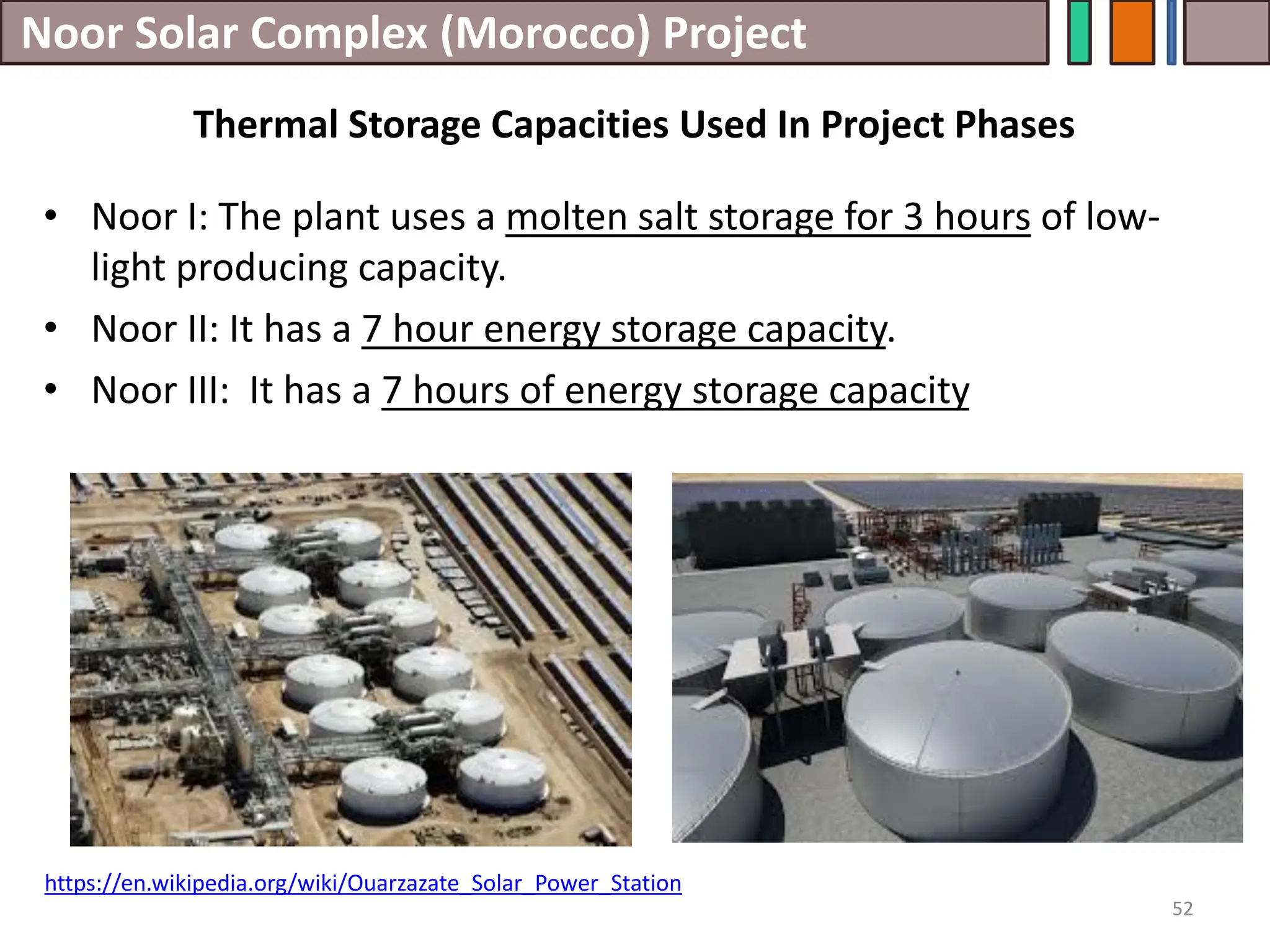
• Noor I: The plant uses a molten salt storage for 3 hours of low-
light producing capacity.
• Noor II: It has a 7 hour energy storage capacity.
• Noor III: It has a 7 hours of energy storage capacity
52
Thermal Storage Capacities Used In Project Phases
https://en.wikipedia.org/wiki/Ouarzazate_Solar_Power_Station
Noor Solar Complex (Morocco) Project
53
Water Use
• Water consumption for the Ouarzazate Noor complex is
estimated at 2.5 to 3 million m3 per year for one wet-cooling
project (Noor I) and two dry-cooling projects (Noor II and III).
• The water required for the plants will be sourced from the
Mansour Eddabhi dam located approximately 12km from the
project site and stored in water storage reservoirs with a total
capacity of 300,000m³.
• Water is needed for cooling, as well as to clean the reflectors
regularly with high-pressure water hoses and brushes from
trucks.
https://en.wikipedia.org/wiki/Ouarzazate_Solar_Power_Station
https://www.power-technology.com/projects/noor-ouarzazate-solar-complex/
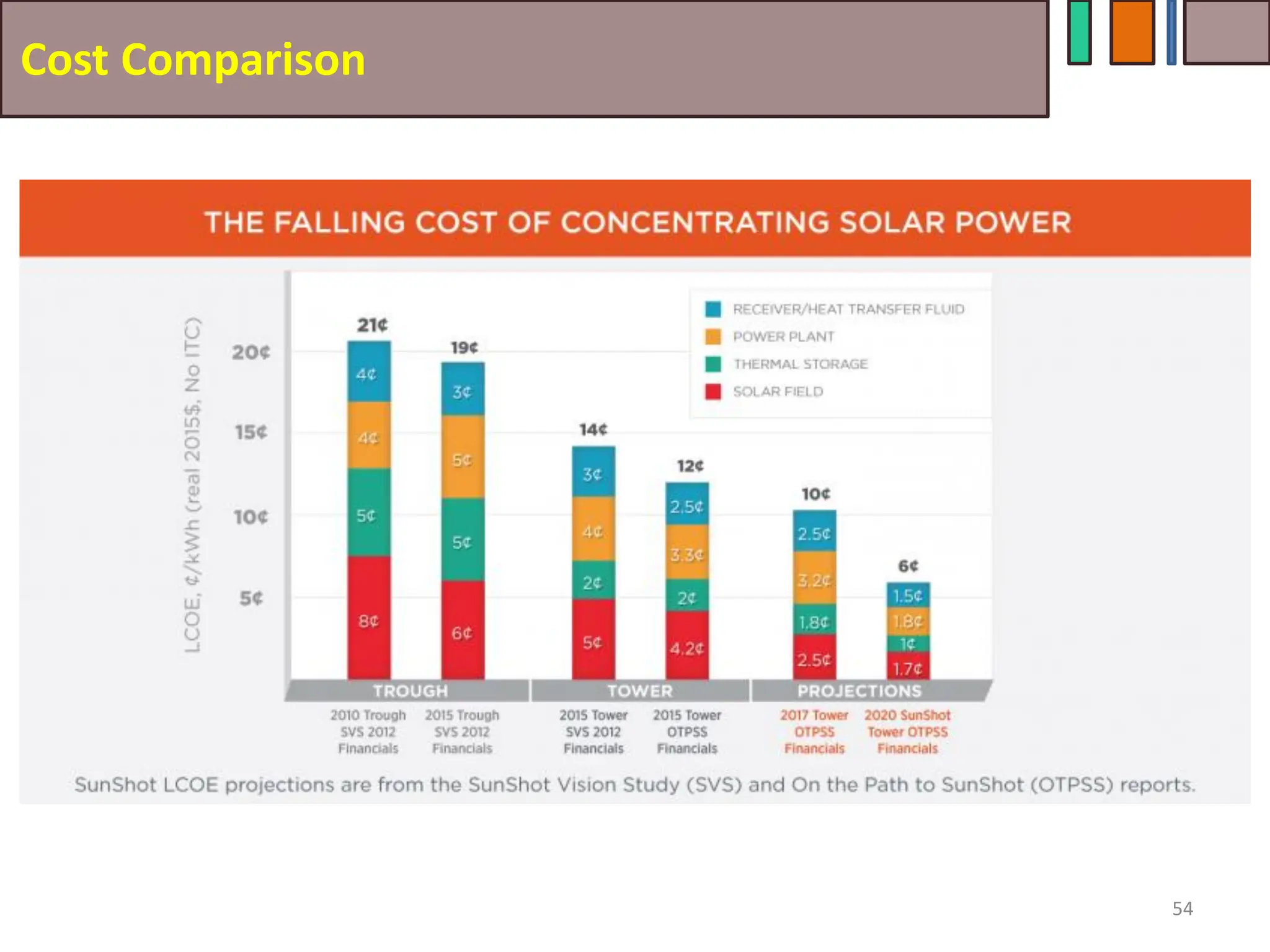
Cost Comparison
54
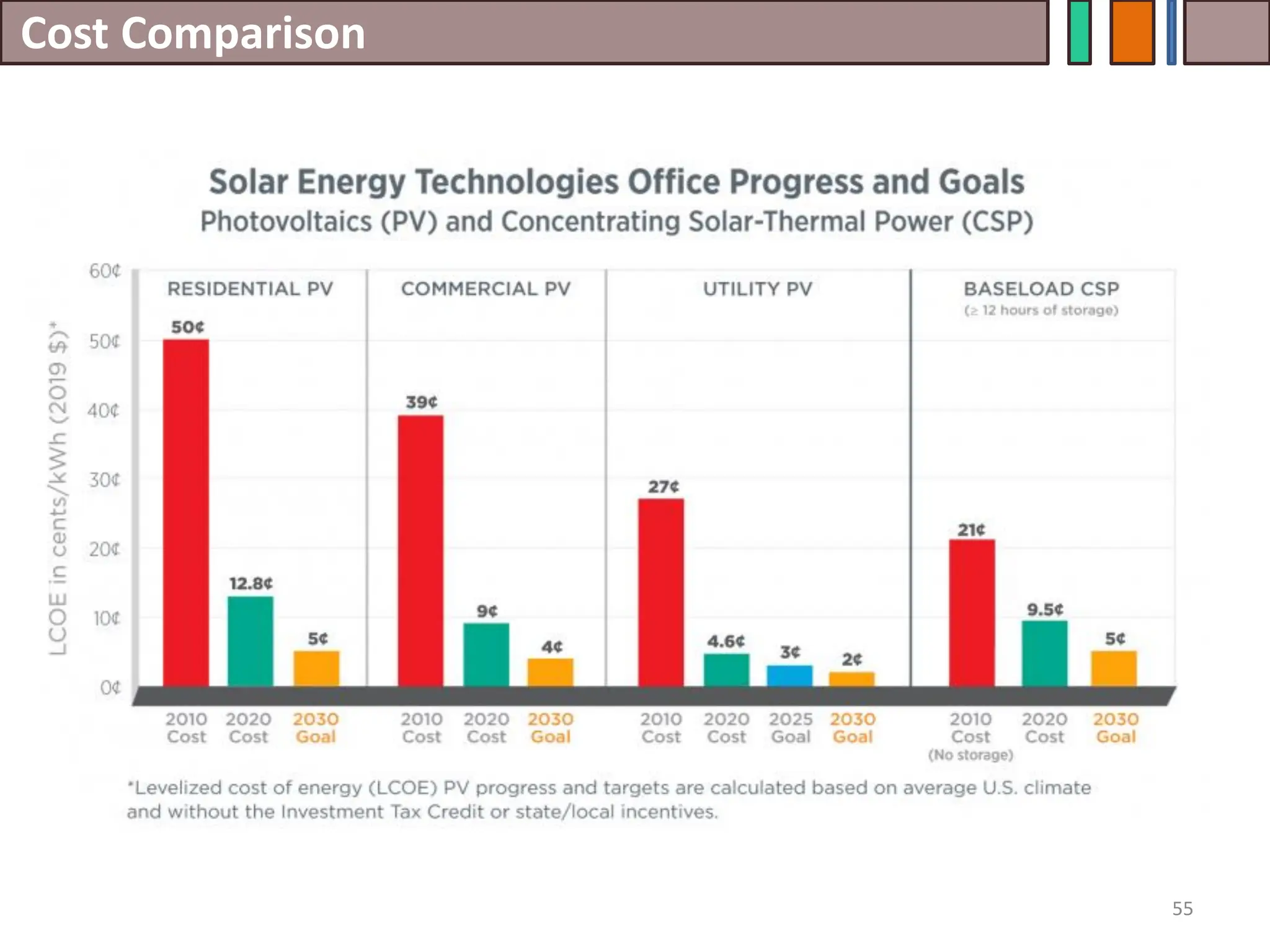
Cost Comparison
55
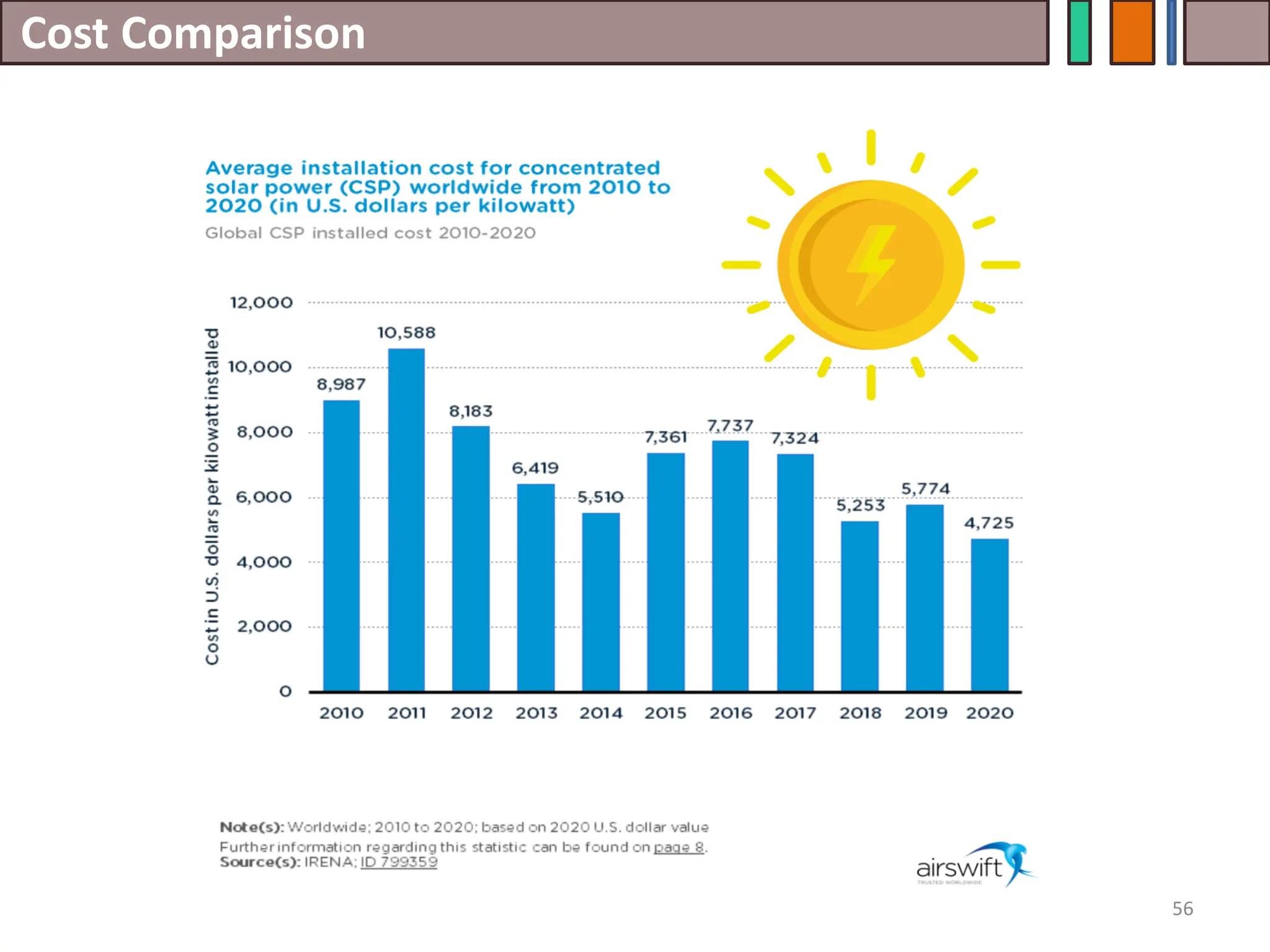
Cost Comparison
56
Discussion
57

T22 Solar High Temperature Thermal Systems 240414.pdf

  • 1.
    Solar High Temperature ThermalSystems By Moustafa M. Elsayed Professor & Consultant 1
  • 2.
    Contents • Solar Radiation& Solar Angles • Overview of Solar Thermal Power Plants • Solar Dish/Engine Systems • Solar Linear Concentrating Systems • Solar Towers • Economic Sizes of Solar Power Plants 2 • Thermal Storage • Benefits and Drawbacks of Solar Thermal Systems • Noor Solar Complex (Morocco) Project • Cost Comparison
  • 3.
    Solar Radiation &Solar Angles 3 Solar Radiation & Sun Tracks • Direct radiation • Diffuse radiation • Seasonal sun tracks
  • 4.
    Solar Radiation &Solar Angles • Solar zenith angle = θz • Solar Altitude angle = αs • Solar Azimuth angle = γ 4 Solar Angles
  • 5.
    Solar Radiation &Solar Angles • Solar Zenith angle = ɸ • Solar Incidence angle = Ө • Surface tilt angle = β • Surface orientation angle = Zs 5 Surface Angles
  • 6.
    Solar Radiation &Solar Angles 6 Solar Daily Radiation & Mean Monthly Radiation (For a given Latitude)
  • 7.
    Solar Radiation &Solar Angles 7 Average Solar Insolation • The average daily solar insolation in units of kWh/m2 per day is sometimes referred to as "peak sun hours". • The term "peak sun hours" refers to the solar insolation which a particular location would receive if the sun were shining at its maximum value for a certain number of hours. • For example, a location that receives 8 kWh/m2 per day can be said to have received 8 hours of sun per day at 1 kW/m2.
  • 8.
    Solar Radiation &Solar Angles 8 Dependence of Average Solar Insolation on Latitude
  • 9.
    Overview of SolarThermal Power Plants • In solar thermal power plants, solar radiation is used to generate heat energy which is used to generate electricity in a conventional power plant process. • Mirrors concentrate the sunlight on a radiation collector and heat up a heat-bearing medium, generally thermal oil. • A turbine transforms this energy into electricity. • Unlike photovoltaic solar panels, which convert sunlight directly into electricity, solar thermal power plants use the sun's heat to create steam, which then drives a turbine to generate electricity. 9 About Solar Thermal Power Plants (STPP) - 1
  • 10.
    Overview of SolarThermal Power Plants • This type of generation is essentially the same as electricity generation that uses fossil fuels, but instead heats steam using sunlight instead of combustion of fossil fuels. • All solar thermal power systems have two main components: reflectors (mirrors) that capture and focus sunlight onto a receiver. • Solar thermal power systems have tracking systems that keep sunlight focused onto the receiver throughout the day as the sun changes position in the sky. 10 About Solar Thermal Power Plants (STPP) - 2
  • 11.
    Overview of SolarThermal Power Plants 11 Conventional Thermal Power Generation Plant
  • 12.
    Overview of SolarThermal Power Plants 12 Types of Concentrating Solar Thermal Power Plants - 1 • There are three main types of concentrating solar thermal power systems: • Solar dish/engine systems • Linear concentrating systems, which include parabolic troughs and linear Fresnel reflectors • Solar power towers Linear concentrating systems
  • 13.
    Overview of SolarThermal Power Plants 13 Types of Concentrating Solar Thermal Power Plants - 2 Solar dish/engine systems Solar Power Tower
  • 14.
    Parabolic Dishes • Theseare large parabolic dishes that use motors to track the Sun. This ensures that they always receive the highest possible amount of incoming solar radiation that they then concentrate at the focal point of the dish. • These dishes can concentrate sunlight much better than parabolic troughs and the fluid run through them can reach temperatures upwards of 750°C. • In these systems, a Stirling engine converts heat to mechanical energy by compressing working fluid when cold and allowing the heated fluid to expand outward in a piston or move through a turbine. A generator then converts this mechanical energy to electricity. 14 About Parabolic Dishes
  • 15.
  • 16.
    Solar Linear ConcentratingSystems • Linear concentrating systems collect the sun's energy using long, rectangular, curved (U-shaped) mirrors. • The mirrors focus sunlight onto receivers (tubes) that run the length of the mirrors. • The concentrated sunlight heats a fluid flowing through the tubes. • The fluid is sent to a heat exchanger to boil water in a conventional steam-turbine generator to produce electricity. 16 About Solar Linear Concentrating Systems - 1
  • 17.
    Solar Linear ConcentratingSystems • There are two major types of linear concentrator systems: • parabolic trough systems, where receiver tubes are positioned along the focal line of each parabolic mirror • linear Fresnel reflector systems, where one receiver tube is positioned above several mirrors to allow the mirrors greater mobility in tracking the sun. • A linear concentrating collector power plant has a large number of collectors in parallel rows that are typically aligned in a north- south orientation to maximize solar energy collection. • This configuration enables the mirrors to track the sun from east to west during the day and concentrate sunlight continuously onto the receiver tubes. 17 About Solar Linear Concentrating Systems - 2
  • 18.
    Solar Linear ConcentratingSystems • These troughs, also known as line focus collectors, are composed of a long, parabolic shaped reflector that concentrates incident sunlight on a pipe that runs down the trough. • The collectors sometimes utilize a single-axis Solar tracking system to track the Sun across the sky as it moves from east to west to ensure that there is always maximum solar energy incident on the mirrors. • The receiver pipe in the center can reach temperatures upward of 400°C as the trough focuses Sun at 30-100 times its normal intensity 18 Parabolic Trough System
  • 19.
    Solar Linear ConcentratingSystems 19 Parabolic Trough System
  • 20.
    Solar Linear ConcentratingSystems • It uses flat mirrors as opposed to parabolic mirrors that are used in solar parabolic troughs. • Here the reflectors use the Fresnel lens effect, which allows for a concentrating mirror with a large aperture and short focal length. • These systems are capable of concentrating the sun's energy to approximately 30 times its normal intensity. 20 Linear Fresnel Reflectors
  • 21.
    Solar Linear ConcentratingSystems • Multiple receivers allow the mirrors to change their inclination to minimize how much they block adjacent reflectors' access to sunlight. • This positioning improves system efficiency and reduces material requirements and costs. 21 Linear Fresnel Reflectors
  • 22.
    Solar Towers • Asolar power tower is a system that converts energy from Sun radiation into electricity. • The setup includes an array of large, sun-tracking mirrors known as heliostats that focus sunlight on a receiver at the top of a tower. • In this receiver, a fluid is heated up to 500 oC and used to generate steam that powers a conventional turbine generator producing electricity. • These systems may also have a thermal energy storage system component that allows the solar collector system to heat an energy storage system during the day, and the heat from the storage system is used to produce electricity in the evening or during cloudy weather. • Solar thermal power plants may also be hybrid systems that use other fuels (usually natural gas) to supplement energy from the sun during periods of low solar radiation. 22
  • 23.
    Solar Towers 23 Shapes ofMirror Fields: Round Field
  • 24.
    Solar Towers 24 Shapes ofMirror Fields: North or South Field
  • 25.
  • 26.
  • 27.
    Economic Sizes ofSolar Power Plants • Distributed solar energy generation refers to the use of solar energy by households, enterprises, public institutions, and other small-scale power generation systems. • Centralized solar energy generation, refers to large-scale solar plant installations, in usually remote locations. They are large solar power generation farms, producing substantial electricity, that is fed into the grid. • Centralized solar farms need: • same infrastructure & electrical substations as those for conventional power stations • same transmission lines to be run over long distances to get the solar power into the grid and to the consumer 27 Distributed and Centralized Solar Energy Generation
  • 28.
    Economic Sizes ofSolar Power Plants • “Bigger is better” is a good rule of thumb when planning renewable energy projects. • Thus, a 120 MW project might be more cost effective than a dozen 10 MW projects, because you only pay for one permit, one grid connection, one engineering, procurement and construction contract, and so on. • The dish Stirling is not cost effective for centralized plant. For distributed plants it could not compete with PV power generation plants. • The linear Fresnel, had potential for relatively small-scale deployments. It was more successful than dish Stirling, but ultimately also failed to compete with PV low cost plants. 28 https://www.pacificgreen.com/articles/whats-best-size-concentrated-solar-power-plant/ Economical Size of Dish Stirling & Linear Fresnel Power Plant
  • 29.
    Economic Sizes ofSolar Power Plants • Both parabolic trough and power tower technologies are economical feasible for centralized large scale solar power projects. • In theory, the parabolic trough technology could be built on an almost infinitely large scale. All that is needed is increasing rows of parabolic troughs and a big enough steam turbine and storage tank. • In practice, it is important that the troughs are not too far distant from the balance of plant because otherwise the heat transfer fluid—typically synthetic oil - could cool down on its way to the turbine and storage. • As a result, recent studies estimated that the optimum size for a parabolic trough plant is probably around 200 MW. 29 https://www.pacificgreen.com/articles/whats-best-size-concentrated-solar-power-plant/ Economical Size of Parabolic Trough Power Plant
  • 30.
    Economic Sizes ofSolar Power Plants • Very big power towers suffer from two problems. • These plants use heliostats to focus sunlight on a single receiver high up on a tower. If the heliostat is too far from the tower, the light can be attenuated by airborne particles such as dust and soot. That reduces the efficiency of the system. • Getting heliostats to focus on very distant receivers requires a high level of precision both in the mirror and the control system, which does not help to keep costs down. • Because of the above limitations, some researchers believe the optimum size for power towers could be around 30 MW. 30 https://www.pacificgreen.com/articles/whats-best-size-concentrated-solar-power-plant/ Economical Size of Solar Tower Power Plant
  • 31.
    Economic Sizes ofSolar Power Plants • In both parabolic trough and power tower projects, however, the size of the solar field is just one factor. Another important feature is the size of the power block. • In the existing plants, the steam turbines can range from 10 MW up to 200 MW, but this technology too, benefits from economies of scale. • For both the parabolic trough and tower technology, power block considerations could constrain most projects to a minimum size of around 50 MW. 31 https://www.pacificgreen.com/articles/whats-best-size-concentrated-solar-power-plant/ Economical Size of the Balance Power Block
  • 32.
    Economic Sizes ofSolar Power Plants • Besides the technical considerations, perhaps one of the biggest determinants of Concentrating Solar Power (CSP) plant size is financing. The bigger the plant, the more it will cost in capital terms. The higher the capital cost, the more difficult it can be to find finance. • Financing CSP plants is complicated by the fact that, unlike PV projects, they cannot be built out yet a modular basis. Whereas you can start generating electricity from PV with just a single array and inverter in place, for CSP you must commission the whole plant in one go. • That somewhat increases the risk for investors and will consider concessional finance (i.e. financing at high interest rate) that may affect the feasibility of building a new CSP plant. 32 https://www.pacificgreen.com/articles/whats-best-size-concentrated-solar-power-plant/ Financing of Large Size Concentrated Solar Power Plants
  • 33.
    Thermal Storage • Amajor drawback of solar energy is its temporal intermittency. • To overcome this problem, one solution is to use a backup system (energy hybridization) that burns fossil fuel or biomass. • A second solution is to use a thermal energy storage (TES) system to store heat during sunshine periods and release it during the periods of weak or no solar irradiation. 33 Need for Thermal Storage
  • 34.
    Thermal Storage • Thereare currently three kinds of TES systems available: sensible heat storage, latent heat storage and thermo-chemical heat storage. 34 Kinds of Thermal Storage
  • 35.
    Thermal Storage • Sensibleheat storage systems are most mature. • Sensible TES is heat storage through traditional heating of a material, such as hot water tanks. • In a sensible TES material, temperature and energy are proportional, so the more energy you put into the material, the higher its temperature will be. • One of the cheapest, most commonly used options is a water tank, but materials such as molten salts or metals can be heated to higher temperatures and therefore offer a higher storage capacity. 35 Sensible Heat Storage - 1
  • 36.
    Thermal Storage • Adisadvantage of SHS is its dependence on the properties of the storage medium. Storage capacities are limited by the specific heat capacity of the storage material, and the system needs to be properly designed to ensure energy extraction at a constant temperature. • Molten salts is employed as a thermal energy storage method to retain thermal energy. • The salt melts at 131 °C. It is kept liquid at 288 °C in an insulated "cold" storage tank. The liquid salt is pumped through panels in a solar collector where the focused sun heats it to 566 °C . 36 Sensible Heat Storage - 2
  • 37.
    Thermal Storage 37 The 10-hourhot storage tank at the 110 MW Crescent Dunes CSP power tower plant in Nevada, the first full size Tower CSP plant to include storage. Typical commercial 100 MW CSP plants hold the hot molten salt at 600°C in a tank about this size to send the heat to boil water for steam to run the turbine in the thermal power block. https://www.solarpaces.org/how-csp-thermal-energy-storage-works/ Sensible Heat Storage - 3
  • 38.
    Thermal Storage • Latentheat storage allows large amounts of energy to be stored in relatively small volumes and is cost competitive. • Latent TES takes advantage of the heat absorbed or released in a phase transition of the material, e.g. between solid and liquid phases. • The typical example is ice used to keep food or drinks at zero degrees – the phase change temperature – until everything has melted. 38 Latent Heat Storage
  • 39.
    Thermal Storage • Thermochemicalheat storage works on the notion that all chemical reactions either absorb or release heat; hence, a reversible process that absorbs heat while running in one way would release heat when running in the other direction. • Thermochemical energy storage stores energy by using a high-energy chemical process. 39 Thermochemical Heat Storage
  • 40.
  • 41.
  • 42.
  • 43.
    Thermal Storage • Intower CSP, a molten salt mix, like sodium nitrate and potassium nitrate, is heated by reflecting sunlight with mirrors onto a receiver atop a central tower that is encircled by a solar field of flat mirrors (heliostats). • This molten salt is cycled up the tower “cold” at 260°C and is then heated by the focused sunlight aimed at the receiver from the encircling solar field. • Once heated, this now 565°C molten salt flows down the tower where it can either be used right away in the power block to generate electricity or be stored thermally in the hot tank for use later. 43 Example - 1
  • 44.
    Thermal Storage • Ina parabolic trough type of CSP plant, the heat transfer fluid (HTF) – which is usually an oil – is heated in pipes throughout the solar field by reflecting focused sunlight on a narrow pipe that runs the length of its reflecting trough-shaped mirrors. • This hot oil then transfers solar-heat along bigger pipes to the power block where it can either be used straight away or held in the holding tank storing thermal energy until it is needed. 44 Example - 2
  • 45.
    Benefits and Drawbacksof Solar Thermal Systems Benefits • Because the Solar Thermal Power Plants (STPP) systems can generate steam of such high temperatures, the conversion of heat energy to electricity is more efficient than PV systems. • The storage of heat is more efficient and cost-effective than storing electricity in PV systems. • These plants can produce a reliable amount of energy and can be turned on or up at well, meeting the energy demands of society. • These plants uses electricity generation technology that is cleaner than generating electricity by using fossil fuels. • Solar thermal power plants can be very efficient at converting sunlight into electricity, with efficiencies of up to 40%. 45
  • 46.
    Benefits and Drawbacksof Solar Thermal Systems Drawbacks • Large amount of land necessary for these plants to operate efficiently. • They require clear skies and direct sunlight to operate efficiently, which limits their location options. • The water demand of these plants can also be seen as an issue, as the production of enough steam requires large volumes of water. • A final potential impact of the use of large focusing mirrors is the harmful effect these plants have on birds. Birds that fly in the way of the focused rays of Sun can be incinerated. Some reports of bird deaths at power plants such as these amount the deaths to about one bird every two minutes. 46
  • 47.
    Noor Solar Complex(Morocco) Project • Noor Complex is the world’s largest concentrated solar power (CSP) plant, located in the Sahara Desert. • It is located 10 kilometers north of the Moroccan city of Ouarzazate. • It uses parabolic trough, solar tower and PV technologies 47 About The Project - 1
  • 48.
    Noor Solar Complex(Morocco) Project • It’s the world’s biggest concentrated solar power facility. • The project has 4 phases: Noor I, Noor II, Noor III and Noor IV. • The project has a 580-megawatt capacity. • The Noor I CSP plant offsets 240,000t of CO₂ emissions a year. • Together, the Noor II and Noor III plants offset 533,000t of CO₂ emissions a year. 48 About The Project - 2 https://en.wikipedia.org/wiki/Ouarzazate_Solar_Power_Station https://www.power-technology.com/projects/noor-ouarzazate-solar-complex/
  • 49.
    Noor Solar Complex(Morocco) Project • Noor I: 160MW concentrated solar power (CSP) plant, it was connected to the Moroccan power grid on 5 February 2016. • The plant is a parabolic trough type • Noor II CSP is the second phase of the Ouarzazate Solar Power Station. • It is a 200 MW CSP solar plant using parabolic troughs. 49 Phases of Noor Solar Complex - 1 https://en.wikipedia.org/wiki/Ouarzazate_Solar_Power_Station • It covers an area of 680 hectares (1,680 acres). • Construction started in February 2016 and the plant was commissioned in January 2018.
  • 50.
    Noor Solar Complex(Morocco) Project • Noor III: It is a 150 MW using a solar power tower and commissioned in March 2018. • The heliostats follow the light, reflecting it to a 250 meter tall solar tower. • It covers an area of 550 hectares (1,359 acres). • The heliostat has 54 mirrors, each with a total reflective surface of 178.5 square meters. • The solar field has 7400 of such heliostats. • Noor III is the fifth ever built utility-scale CSP tower, but the second with energy storage, after the 125 MW gross Crescent Dunes near Las Vegas (USA). 50 https://en.wikipedia.org/wiki/Ouarzazate_Solar_Power_Station Phases of Noor Solar Complex - 2
  • 51.
    Noor Solar Complex(Morocco) Project • Noor IV is a 72 MW photovoltaic power station which was completed in 2018. 51 https://en.wikipedia.org/wiki/Ouarzazate_Solar_Power_Station Phases of Noor Solar Complex - 3
  • 52.
    Noor Solar Complex(Morocco) Project • Noor I: The plant uses a molten salt storage for 3 hours of low- light producing capacity. • Noor II: It has a 7 hour energy storage capacity. • Noor III: It has a 7 hours of energy storage capacity 52 Thermal Storage Capacities Used In Project Phases https://en.wikipedia.org/wiki/Ouarzazate_Solar_Power_Station
  • 53.
    Noor Solar Complex(Morocco) Project 53 Water Use • Water consumption for the Ouarzazate Noor complex is estimated at 2.5 to 3 million m3 per year for one wet-cooling project (Noor I) and two dry-cooling projects (Noor II and III). • The water required for the plants will be sourced from the Mansour Eddabhi dam located approximately 12km from the project site and stored in water storage reservoirs with a total capacity of 300,000m³. • Water is needed for cooling, as well as to clean the reflectors regularly with high-pressure water hoses and brushes from trucks. https://en.wikipedia.org/wiki/Ouarzazate_Solar_Power_Station https://www.power-technology.com/projects/noor-ouarzazate-solar-complex/
  • 54.
  • 55.
  • 56.
  • 57.