INTERNATIONAL RESEARCH JOURNAL OF ENGINEERING AND TECHNOLOGY (IRJET) E-ISSN: 2395-0056
VOLUME: 06 ISSUE: 05 | MAY 2019 WWW.IRJET.NET P-ISSN: 2395-0072
© 2019, IRJET | Impact Factor value: 7.211 | ISO 9001:2008 Certified Journal | Page 7143
SOIL STABILIZATION USING FLY ASH
Rahul Jain 1, Mohd Irfan2, Rajan Kumar3, Kanish Tikoo4, Sunil Sharma5, Dushyant Parasar6
1,2,3,4B.Tech Students(4th year), Department of Civil Engineering, Dr. Akhilesh Das Gupta Institute of Technology
and Management
5,6 Assistant Professor, Department of Civil Engineering, Dr. Akhilesh Das Gupta Institute of Technology and
Management
------------------------------------------------------------------------***-------------------------------------------------------------------------
Abstract — Soil is the basic foundation for any structure of
civil engineering. As it is required to bear the loads without
failure and at some places where soil is not stable we need
soil stabilization. Some waste material such Fly Ash, rice
husk, lime may use to make the soil to be stable. Addition of
Fly Ash will increase the physical as well as chemical
properties of soil. Some of the properties which can be
improved by addition of fly ash are CBR value, Plasticity
index etc. Plasticity index of used soil is 12.41 and with
addition of fly ash( 0%, 5%, 10% & 15% ) plasticity index
become 0 which mean soil become non plastic with addition
of Fly Ash. Addition of Fly Ash resulted in appreciable
increase in the CBR of the soil. Increment of CBR value is
used to reduce the thickness of pavement.
Keywords—Fly ash, california bearing ratio, pavement,
Atterberg limits, Proctor Test
INTRODUCTION
Subgrade soil of pavement should be stable enough to
sustain the load. To improve the soil capacity we need the
soil stabilization as unstable soil can create enormous
problems. The main objective of soil stabilization is to
increase the bearing capacity of soil. The materials which
are used for soil stabilization are lime, fly ash, Portland
cement etc.
Fly ash is waste material obtained from thermal
power plant. There are large number of power plant across
the world which produces huge amount of fly ash. Use of
fly ash is economic and it also prevent environmental
pollution. Unsafe disposal of fly ash will cause irritation in
breathing and causes many diseases like asthma. Fly ash
are micro-sized particles consisting of alumina, silica and
iron. Fly ash can be used in combination with other
materials for soil stabilization.
FLY ASH
Currently, over 20 million metric tons (22 million tons) of
fly ash are used annually in a variety of engineering
applications. Typical highway engineering applications
include: portland cement concrete (PCC), soil and road
base stabilization, flowable fills, grouts, structural fill and
asphalt filler.
Class C ashes are derived from sub-bituminous coals and
consist of calcium alumino-sulfate glass, as well as quartz,
and free lime (CaO). Class C ash is also referred to as high
calcium fly ash because it contains more than 20 percent
CaO. Class F ashes are typically derived from bituminous
and anthracite coals and consist primarily of an alumino-
silicate glass, with quartz, mullite, and magnetite also
present. Class F, or low calcium fly ash has less than 10
percent CaO.
Fly ash has pozzolonic properties. Pozzolans are
siliceous and aluminous materials, which in a finely divided
form and in the presence of water, react with calcium
hydroxide at ordinary temperatures to produce
cementitious compounds.
REVIEW OF LITERATURE
2.1. Tanveer acid zerdi et. al.(05may,2010) did soil
stabilisation using by lime and brick dust. They did
numbers of experiment and soil to enhance the
engineering property.
The result of experiment was satisfactory and given
below:-
1. Atterberg’s limit
2. Modified protector test
From such result be concluded that impact of brick dust
and lime on soil is positive by replacing soil by 35% of
brick and 5% of lime of its dry weight. Improve
engineering properties so use of brick dust and lime is
INTERNATIONAL RESEARCH JOURNAL OF ENGINEERING AND TECHNOLOGY (IRJET) E-ISSN: 2395-0056
VOLUME: 06 ISSUE: 05 | MAY 2019 WWW.IRJET.NET P-ISSN: 2395-0072
© 2019, IRJET | Impact Factor value: 7.211 | ISO 9001:2008 Certified Journal | Page 7144
preferable for establishing the soil because it gave positive
results as stabilizer and also it is waste utilization.
2.2. S. Bhuvanehwari et. al. did soil stabilization using fly
ash and based on laboratory and field tests, he made
following conclusions: As the locally available borrow soil
has generally high plasticity(LL>50)it was difficult to use
it directly for construction. The tests carried out with
different proportion of fly ash indicated that the
workability is maximum with 25% fly ash. Also the dry
density observed is maximum for 25% fly ash. Presence of
dry clay lumps in the borrow soil increases the number of
passes of disc harrow for mixing. It is therefore necessary
to eliminate such soil lumps in the construction. Strict
quality control shall be exercised with regard to quality of
borrow soil, its natural moisture content, number of disc
harrow passes, density and moisture content after
compaction, etc.
2.3. Pandian et.al. (2002). Studied the effect of two types
of Fly Ashes Raichur Fly Ash (Class F) and Neyveli Fly Ash
(Class C) on the CBR characteristics of the black cotton
soil. The Fly Ash content was increased from 0 to 100%.
Generally the CBR/strength is contributed by its cohesion
and friction. The CBR of BC soil, which consists of
predominantly of finer particles, is contributed by
cohesion. The CBR of Fly Ash, which consists
predominantly of coarser particles, is contributed by its
frictional component. The low CBR of BC soil is attributed
to the inherent low strength, which is due to the
dominance of clay fraction. The addition of Fly Ash to BC
soil increases the CBR of the mix up to the first optimum
level due to the frictional resistance from Fly Ash in
addition to the cohesion from BC soil. Further addition of
Fly Ash beyond the optimum level causes a decrease up to
60% and then up to the second optimum level there is an
increase. Thus the variation of CBR of Fly Ash-BC soil
mixes can be attributed to the relative contribution of
frictional or cohesive resistance from Fly Ash or BC soil,
respectively
2.4. Phanikumar and Sharma (2004): A similar study was
carried out by Phanikumar and Sharma and the effect of
Fly Ash on engineering properties of expansive soil
through an experimental programme. The effect on
parameters like free swell index (FSI), swell potential,
swelling pressure, plasticity, compaction, strength and
hydraulic conductivity of expansive soil was studied. The
ash blended expansive soil with FLYASH contents of 0, 5,
10,15 and 20% on a dry weight basis and they inferred
that increase in FLY ASH content reduces plasticity
characteristics and the FSI was reduced by about 50% by
the addition of 20% Fly Ash. The hydraulic conductivity of
expansive soils mixed with Fly Ash decreases with an
increase in Fly Ash content, due to the increase in
maximum dry unit weight with an increase in Fly Ash
content. When the Fly Ash content increases there is a
decrease in the optimum moisture content and the
maximum dry unit weight increases
METHODOLOGY
Study Area
The soil used for these experiments was brought from a
college ground after digging it to reach level of
subgrade.Fly ash for the study was brought from Alpha
Test House,Guru Harkishan Nagar,Paschim Vihar. It is
finely divided residue resulting from combustion of coal
from electric generating plants.
Materials
Soil
Fly ash
Methods
EXPERIMENT TO BE CONDUCTED:
1. Atterberg Limits
2. Specific Gravity Test
3. Proctor Compaction Test
4. C.B.R Test
5. Sieve Analysis
These tests are conducted to find the different
properties of soil and variation in their properties
addition of additives.
Compaction test is done to find optimum water
content and dry density of soil.
Specific gravity test to find average value of all the
solid particles present in the soil mass. It is also an
important parameters used for the determination of
voids ratio and particles size.
 Liquid limit is find by casagrande's Apparatus
 plastic limit is find by noting minimum water
content at which soil begins to crumble or
crack when rolled in 3mm diameter thread.
 proctor Compaction Test is find by
compacting the specimen by using rammer
 specific gravity is find by using pycnometer
 C.B.R test is penetration test to find the
subgrade strength.
specific gravity The specific gravity of soil is the
ratio between the weight of the soil solids and
weight of equal volume of water
Specific Gravity G = W2−W1
(W4−W1) −( W3−W2 )
W1- Weight of empty pycnometer in gms
W2- Weight of empty pycnometer + Dry soil in
gms
W3- Weight of empty pycnometer + Soil + Water
W4- Weight of empty pycnometer + Water
INTERNATIONAL RESEARCH JOURNAL OF ENGINEERING AND TECHNOLOGY (IRJET) E-ISSN: 2395-0056
VOLUME: 06 ISSUE: 05 | MAY 2019 WWW.IRJET.NET P-ISSN: 2395-0072
© 2019, IRJET | Impact Factor value: 7.211 | ISO 9001:2008 Certified Journal | Page 7145
Liquid limit The Casagrande tool cuts a groove of size
2mm wide at the bottom and 11 mm wide at the top and 8
mm high. The number of blows used for the two soil
samples to come in contact is noted down. Graph is plotted
taking number of blows on a logarithmic scale on the
abscissa and water content on the ordinate. Liquid limit
corresponds to 25 blows.
Plastic limit This is determined by rolling out soil till its
diameter reaches approximately 3 mm and measuring
water content for the soil which crumbles on reaching this
diameter.
Plasticity index (Ip) was also calculated with the help of
liquid limit and plastic limit;
Ip = wL - wP
wL- Liquid limit
wP- Plastic limit
Particle size distribution The ratio of, D10 and D60 gives
the uniformity coefficient (Cu) which in turn is a measure
of the particle size range.
a.
Proctor compaction test This experiment gives a clear
relationship between the dry density of the soil and the
moisture content of the soil. Optimum moisture content is
moisture content at maximum dry density.
RESULT AND DISCUSSION
Atterberg’s limit:
LIQUID LIMIT
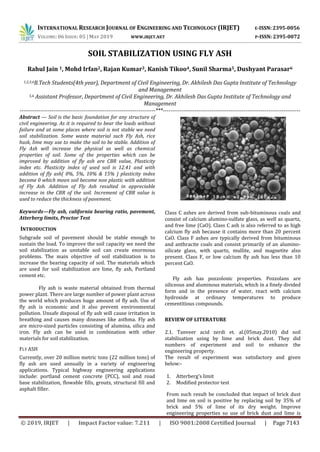
The liquid limit of soil with varying percentage of fly ash(
0, 5, 10 ,15% ) in table 1 and figure no. 1
% fly ash Liquid Limit(%)
0 25
5 10
10 11.11
15 11.11
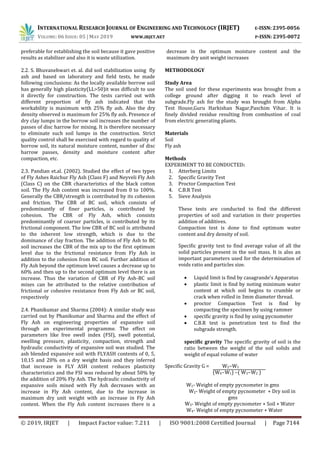
The graph of liquid limit at various % of flyash are
PLASTIC LIMIT
The Plastic limit of the soil with varying percentage of fly
ash in table 2 and figure 2:
% fly ash Plastic limit (%)
0 11.764
5 28.57
10 33.33
15 20
Specific Gravity:
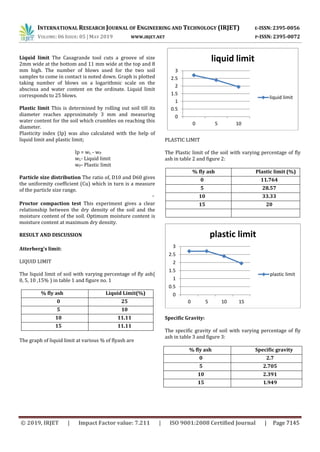
The specific gravity of soil with varying percentage of fly
ash in table 3 and figure 3:
% fly ash Specific gravity
0 2.7
5 2.705
10 2.391
15 1.949
0
0.5
1
1.5
2
2.5
3
0 5 10
liquid limit
liquid limit
0
0.5
1
1.5
2
2.5
3
0 5 10 15
plastic limit
plastic limit
INTERNATIONAL RESEARCH JOURNAL OF ENGINEERING AND TECHNOLOGY (IRJET) E-ISSN: 2395-0056
VOLUME: 06 ISSUE: 05 | MAY 2019 WWW.IRJET.NET P-ISSN: 2395-0072
© 2019, IRJET | Impact Factor value: 7.211 | ISO 9001:2008 Certified Journal | Page 7146
Proctor Compaction Test:
OMC of soil with varying percentage of fly ash in table 4
and figure 4:
% fly ash OMC (%)
0 10.526
5 13.04
10 14.28
15 13.043
Maximum Dry Density:
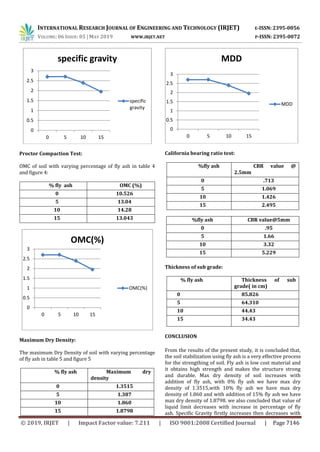
The maximum Dry Density of soil with varying percentage
of fly ash in table 5 and figure 5
% fly ash Maximum dry
density
0 1.3515
5 1.387
10 1.860
15 1.8798
California bearing ratio test:
%fly ash CBR value @
2.5mm
0 .713
5 1.069
10 1.426
15 2.495
%fly ash CBR value@5mm
0 .95
5 1.66
10 3.32
15 5.229
Thickness of sub grade:
% fly ash Thickness of sub
grade( in cm)
0 85.826
5 64.310
10 44.43
15 34.43
CONCLUSION
From the results of the present study, it is concluded that,
the soil stabilization using fly ash is a very effective process
for the strengthing of soil. Fly ash is low cost material and
it obtains high strength and makes the structure strong
and durable. Max dry density of soil increases with
addition of fly ash, with 0% fly ash we have max dry
density of 1.3515,with 10% fly ash we have max dry
density of 1.860 and with addition of 15% fly ash we have
max dry density of 1.8798. we also concluded that value of
liquid limit decreases with increase in percentage of fly
ash. Specific Gravity firstly increases then decreases with
0
0.5
1
1.5
2
2.5
3
0 5 10 15
specific gravity
specific
gravity
0
0.5
1
1.5
2
2.5
3
0 5 10 15
OMC(%)
OMC(%)
0
0.5
1
1.5
2
2.5
3
0 5 10 15
MDD
MDD
INTERNATIONAL RESEARCH JOURNAL OF ENGINEERING AND TECHNOLOGY (IRJET) E-ISSN: 2395-0056
VOLUME: 06 ISSUE: 05 | MAY 2019 WWW.IRJET.NET P-ISSN: 2395-0072
© 2019, IRJET | Impact Factor value: 7.211 | ISO 9001:2008 Certified Journal | Page 7147
addition of 5%,10% and 15% fly ash. Subgrade soil is
initially a medium plastic soil which become non plastic
with addition of fly ash.
REFERENCES
[1] N.Krithiga,D.Pujitha,T.Palayam,A.revathy(2017),"S
oil Stabilization Using Lime And Fly ash",SSRG
International Journal of civil
engineering,ISSN:2348-8352.
[2] Abhinav Rawat,Anupam Mital(2015),"Soil
Stabilization Using Different Traditional And Non-
Traditional Additives",Ijrrest,Issn:2278-6643.
[3] Gopal and Ranjan Rao,Soil Mechanics.
[4] Erdal Cokca (2001) “Use Of Class C Fly Ashes for
the Stabilization – of an Expansive Soil” Journal of
Geotechnical .
[5] Karthik, Ashok Kumar, Gowtham.P,” Soil
Stabilization By Using Fly Ash”, IOSR Journal of
Mechanical and Civil Engineering (IOSR-JMCE).
BIOGRAPHIES
B.Tech (civil)4th year
student of Dr. Akhilesh
Das Gupta institute of
technology and
managent

IRJET- Soil Stabilization using Fly Ash

  • 1.
    INTERNATIONAL RESEARCH JOURNALOF ENGINEERING AND TECHNOLOGY (IRJET) E-ISSN: 2395-0056 VOLUME: 06 ISSUE: 05 | MAY 2019 WWW.IRJET.NET P-ISSN: 2395-0072 © 2019, IRJET | Impact Factor value: 7.211 | ISO 9001:2008 Certified Journal | Page 7143 SOIL STABILIZATION USING FLY ASH Rahul Jain 1, Mohd Irfan2, Rajan Kumar3, Kanish Tikoo4, Sunil Sharma5, Dushyant Parasar6 1,2,3,4B.Tech Students(4th year), Department of Civil Engineering, Dr. Akhilesh Das Gupta Institute of Technology and Management 5,6 Assistant Professor, Department of Civil Engineering, Dr. Akhilesh Das Gupta Institute of Technology and Management ------------------------------------------------------------------------***------------------------------------------------------------------------- Abstract — Soil is the basic foundation for any structure of civil engineering. As it is required to bear the loads without failure and at some places where soil is not stable we need soil stabilization. Some waste material such Fly Ash, rice husk, lime may use to make the soil to be stable. Addition of Fly Ash will increase the physical as well as chemical properties of soil. Some of the properties which can be improved by addition of fly ash are CBR value, Plasticity index etc. Plasticity index of used soil is 12.41 and with addition of fly ash( 0%, 5%, 10% & 15% ) plasticity index become 0 which mean soil become non plastic with addition of Fly Ash. Addition of Fly Ash resulted in appreciable increase in the CBR of the soil. Increment of CBR value is used to reduce the thickness of pavement. Keywords—Fly ash, california bearing ratio, pavement, Atterberg limits, Proctor Test INTRODUCTION Subgrade soil of pavement should be stable enough to sustain the load. To improve the soil capacity we need the soil stabilization as unstable soil can create enormous problems. The main objective of soil stabilization is to increase the bearing capacity of soil. The materials which are used for soil stabilization are lime, fly ash, Portland cement etc. Fly ash is waste material obtained from thermal power plant. There are large number of power plant across the world which produces huge amount of fly ash. Use of fly ash is economic and it also prevent environmental pollution. Unsafe disposal of fly ash will cause irritation in breathing and causes many diseases like asthma. Fly ash are micro-sized particles consisting of alumina, silica and iron. Fly ash can be used in combination with other materials for soil stabilization. FLY ASH Currently, over 20 million metric tons (22 million tons) of fly ash are used annually in a variety of engineering applications. Typical highway engineering applications include: portland cement concrete (PCC), soil and road base stabilization, flowable fills, grouts, structural fill and asphalt filler. Class C ashes are derived from sub-bituminous coals and consist of calcium alumino-sulfate glass, as well as quartz, and free lime (CaO). Class C ash is also referred to as high calcium fly ash because it contains more than 20 percent CaO. Class F ashes are typically derived from bituminous and anthracite coals and consist primarily of an alumino- silicate glass, with quartz, mullite, and magnetite also present. Class F, or low calcium fly ash has less than 10 percent CaO. Fly ash has pozzolonic properties. Pozzolans are siliceous and aluminous materials, which in a finely divided form and in the presence of water, react with calcium hydroxide at ordinary temperatures to produce cementitious compounds. REVIEW OF LITERATURE 2.1. Tanveer acid zerdi et. al.(05may,2010) did soil stabilisation using by lime and brick dust. They did numbers of experiment and soil to enhance the engineering property. The result of experiment was satisfactory and given below:- 1. Atterberg’s limit 2. Modified protector test From such result be concluded that impact of brick dust and lime on soil is positive by replacing soil by 35% of brick and 5% of lime of its dry weight. Improve engineering properties so use of brick dust and lime is
  • 2.
    INTERNATIONAL RESEARCH JOURNALOF ENGINEERING AND TECHNOLOGY (IRJET) E-ISSN: 2395-0056 VOLUME: 06 ISSUE: 05 | MAY 2019 WWW.IRJET.NET P-ISSN: 2395-0072 © 2019, IRJET | Impact Factor value: 7.211 | ISO 9001:2008 Certified Journal | Page 7144 preferable for establishing the soil because it gave positive results as stabilizer and also it is waste utilization. 2.2. S. Bhuvanehwari et. al. did soil stabilization using fly ash and based on laboratory and field tests, he made following conclusions: As the locally available borrow soil has generally high plasticity(LL>50)it was difficult to use it directly for construction. The tests carried out with different proportion of fly ash indicated that the workability is maximum with 25% fly ash. Also the dry density observed is maximum for 25% fly ash. Presence of dry clay lumps in the borrow soil increases the number of passes of disc harrow for mixing. It is therefore necessary to eliminate such soil lumps in the construction. Strict quality control shall be exercised with regard to quality of borrow soil, its natural moisture content, number of disc harrow passes, density and moisture content after compaction, etc. 2.3. Pandian et.al. (2002). Studied the effect of two types of Fly Ashes Raichur Fly Ash (Class F) and Neyveli Fly Ash (Class C) on the CBR characteristics of the black cotton soil. The Fly Ash content was increased from 0 to 100%. Generally the CBR/strength is contributed by its cohesion and friction. The CBR of BC soil, which consists of predominantly of finer particles, is contributed by cohesion. The CBR of Fly Ash, which consists predominantly of coarser particles, is contributed by its frictional component. The low CBR of BC soil is attributed to the inherent low strength, which is due to the dominance of clay fraction. The addition of Fly Ash to BC soil increases the CBR of the mix up to the first optimum level due to the frictional resistance from Fly Ash in addition to the cohesion from BC soil. Further addition of Fly Ash beyond the optimum level causes a decrease up to 60% and then up to the second optimum level there is an increase. Thus the variation of CBR of Fly Ash-BC soil mixes can be attributed to the relative contribution of frictional or cohesive resistance from Fly Ash or BC soil, respectively 2.4. Phanikumar and Sharma (2004): A similar study was carried out by Phanikumar and Sharma and the effect of Fly Ash on engineering properties of expansive soil through an experimental programme. The effect on parameters like free swell index (FSI), swell potential, swelling pressure, plasticity, compaction, strength and hydraulic conductivity of expansive soil was studied. The ash blended expansive soil with FLYASH contents of 0, 5, 10,15 and 20% on a dry weight basis and they inferred that increase in FLY ASH content reduces plasticity characteristics and the FSI was reduced by about 50% by the addition of 20% Fly Ash. The hydraulic conductivity of expansive soils mixed with Fly Ash decreases with an increase in Fly Ash content, due to the increase in maximum dry unit weight with an increase in Fly Ash content. When the Fly Ash content increases there is a decrease in the optimum moisture content and the maximum dry unit weight increases METHODOLOGY Study Area The soil used for these experiments was brought from a college ground after digging it to reach level of subgrade.Fly ash for the study was brought from Alpha Test House,Guru Harkishan Nagar,Paschim Vihar. It is finely divided residue resulting from combustion of coal from electric generating plants. Materials Soil Fly ash Methods EXPERIMENT TO BE CONDUCTED: 1. Atterberg Limits 2. Specific Gravity Test 3. Proctor Compaction Test 4. C.B.R Test 5. Sieve Analysis These tests are conducted to find the different properties of soil and variation in their properties addition of additives. Compaction test is done to find optimum water content and dry density of soil. Specific gravity test to find average value of all the solid particles present in the soil mass. It is also an important parameters used for the determination of voids ratio and particles size.  Liquid limit is find by casagrande's Apparatus  plastic limit is find by noting minimum water content at which soil begins to crumble or crack when rolled in 3mm diameter thread.  proctor Compaction Test is find by compacting the specimen by using rammer  specific gravity is find by using pycnometer  C.B.R test is penetration test to find the subgrade strength. specific gravity The specific gravity of soil is the ratio between the weight of the soil solids and weight of equal volume of water Specific Gravity G = W2−W1 (W4−W1) −( W3−W2 ) W1- Weight of empty pycnometer in gms W2- Weight of empty pycnometer + Dry soil in gms W3- Weight of empty pycnometer + Soil + Water W4- Weight of empty pycnometer + Water
  • 3.
    INTERNATIONAL RESEARCH JOURNALOF ENGINEERING AND TECHNOLOGY (IRJET) E-ISSN: 2395-0056 VOLUME: 06 ISSUE: 05 | MAY 2019 WWW.IRJET.NET P-ISSN: 2395-0072 © 2019, IRJET | Impact Factor value: 7.211 | ISO 9001:2008 Certified Journal | Page 7145 Liquid limit The Casagrande tool cuts a groove of size 2mm wide at the bottom and 11 mm wide at the top and 8 mm high. The number of blows used for the two soil samples to come in contact is noted down. Graph is plotted taking number of blows on a logarithmic scale on the abscissa and water content on the ordinate. Liquid limit corresponds to 25 blows. Plastic limit This is determined by rolling out soil till its diameter reaches approximately 3 mm and measuring water content for the soil which crumbles on reaching this diameter. Plasticity index (Ip) was also calculated with the help of liquid limit and plastic limit; Ip = wL - wP wL- Liquid limit wP- Plastic limit Particle size distribution The ratio of, D10 and D60 gives the uniformity coefficient (Cu) which in turn is a measure of the particle size range. a. Proctor compaction test This experiment gives a clear relationship between the dry density of the soil and the moisture content of the soil. Optimum moisture content is moisture content at maximum dry density. RESULT AND DISCUSSION Atterberg’s limit: LIQUID LIMIT The liquid limit of soil with varying percentage of fly ash( 0, 5, 10 ,15% ) in table 1 and figure no. 1 % fly ash Liquid Limit(%) 0 25 5 10 10 11.11 15 11.11 The graph of liquid limit at various % of flyash are PLASTIC LIMIT The Plastic limit of the soil with varying percentage of fly ash in table 2 and figure 2: % fly ash Plastic limit (%) 0 11.764 5 28.57 10 33.33 15 20 Specific Gravity: The specific gravity of soil with varying percentage of fly ash in table 3 and figure 3: % fly ash Specific gravity 0 2.7 5 2.705 10 2.391 15 1.949 0 0.5 1 1.5 2 2.5 3 0 5 10 liquid limit liquid limit 0 0.5 1 1.5 2 2.5 3 0 5 10 15 plastic limit plastic limit
  • 4.
    INTERNATIONAL RESEARCH JOURNALOF ENGINEERING AND TECHNOLOGY (IRJET) E-ISSN: 2395-0056 VOLUME: 06 ISSUE: 05 | MAY 2019 WWW.IRJET.NET P-ISSN: 2395-0072 © 2019, IRJET | Impact Factor value: 7.211 | ISO 9001:2008 Certified Journal | Page 7146 Proctor Compaction Test: OMC of soil with varying percentage of fly ash in table 4 and figure 4: % fly ash OMC (%) 0 10.526 5 13.04 10 14.28 15 13.043 Maximum Dry Density: The maximum Dry Density of soil with varying percentage of fly ash in table 5 and figure 5 % fly ash Maximum dry density 0 1.3515 5 1.387 10 1.860 15 1.8798 California bearing ratio test: %fly ash CBR value @ 2.5mm 0 .713 5 1.069 10 1.426 15 2.495 %fly ash CBR value@5mm 0 .95 5 1.66 10 3.32 15 5.229 Thickness of sub grade: % fly ash Thickness of sub grade( in cm) 0 85.826 5 64.310 10 44.43 15 34.43 CONCLUSION From the results of the present study, it is concluded that, the soil stabilization using fly ash is a very effective process for the strengthing of soil. Fly ash is low cost material and it obtains high strength and makes the structure strong and durable. Max dry density of soil increases with addition of fly ash, with 0% fly ash we have max dry density of 1.3515,with 10% fly ash we have max dry density of 1.860 and with addition of 15% fly ash we have max dry density of 1.8798. we also concluded that value of liquid limit decreases with increase in percentage of fly ash. Specific Gravity firstly increases then decreases with 0 0.5 1 1.5 2 2.5 3 0 5 10 15 specific gravity specific gravity 0 0.5 1 1.5 2 2.5 3 0 5 10 15 OMC(%) OMC(%) 0 0.5 1 1.5 2 2.5 3 0 5 10 15 MDD MDD
  • 5.
    INTERNATIONAL RESEARCH JOURNALOF ENGINEERING AND TECHNOLOGY (IRJET) E-ISSN: 2395-0056 VOLUME: 06 ISSUE: 05 | MAY 2019 WWW.IRJET.NET P-ISSN: 2395-0072 © 2019, IRJET | Impact Factor value: 7.211 | ISO 9001:2008 Certified Journal | Page 7147 addition of 5%,10% and 15% fly ash. Subgrade soil is initially a medium plastic soil which become non plastic with addition of fly ash. REFERENCES [1] N.Krithiga,D.Pujitha,T.Palayam,A.revathy(2017),"S oil Stabilization Using Lime And Fly ash",SSRG International Journal of civil engineering,ISSN:2348-8352. [2] Abhinav Rawat,Anupam Mital(2015),"Soil Stabilization Using Different Traditional And Non- Traditional Additives",Ijrrest,Issn:2278-6643. [3] Gopal and Ranjan Rao,Soil Mechanics. [4] Erdal Cokca (2001) “Use Of Class C Fly Ashes for the Stabilization – of an Expansive Soil” Journal of Geotechnical . [5] Karthik, Ashok Kumar, Gowtham.P,” Soil Stabilization By Using Fly Ash”, IOSR Journal of Mechanical and Civil Engineering (IOSR-JMCE). BIOGRAPHIES B.Tech (civil)4th year student of Dr. Akhilesh Das Gupta institute of technology and managent