Proctor Compaction Test
Presented By:
Faizan Tanoli
ProctorCompactionTest
Introduction:
Proctor Test is used to determine the compaction of different types
of soil and the properties of soil with a change in moisture content.
Compaction is the process of densification of soil by reducing air
voids. The degree of compaction of a given soil is measured in
terms of its dry density. The dry density is maximum at the
optimum water content. A curve is drawn between the water
content and the dry density to obtain the maximum dry density and
the optimum water content.
ProctorCompactionTest
Dry density of soil:
Where:
M = total mass of the soil,
V= volume of soil,
w= water content.
ProctorCompactionTest
Standard Proctor Test
Apparatus:
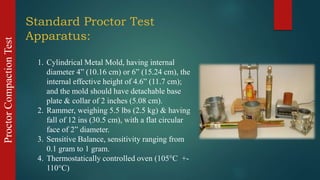
1. Cylindrical Metal Mold, having internal
diameter 4” (10.16 cm) or 6” (15.24 cm), the
internal effective height of 4.6” (11.7 cm);
and the mold should have detachable base
plate & collar of 2 inches (5.08 cm).
2. Rammer, weighing 5.5 lbs (2.5 kg) & having
fall of 12 ins (30.5 cm), with a flat circular
face of 2” diameter.
3. Sensitive Balance, sensitivity ranging from
0.1 gram to 1 gram.
4. Thermostatically controlled oven (105°C +-
110°C)
ProctorCompactionTest
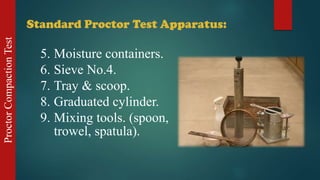
5. Moisture containers.
6. Sieve No.4.
7. Tray & scoop.
8. Graduated cylinder.
9. Mixing tools. (spoon,
trowel, spatula).
ProctorCompactionTest
Standard Proctor Test Procedure:
1. Take sufficient quantity of representative soil, air dry &
pulverize it with a rubber mallet.
2. Sieve the soil through No: 4 sieve & reject the coarser material.
3. Take about, 3 kg of soil, add water to bring its water content to
about 5% below the estimated optimum moisture content (for
coarse-grained soil 4% initial water content & for fine-grained
soil 10% initial water content is preferable).
4. Then Mix it thoroughly.
5. Clean the mold, measure its diameter & height & weigh it
without the collar.
ProctorCompactionTest
Standard Proctor Test Procedure:
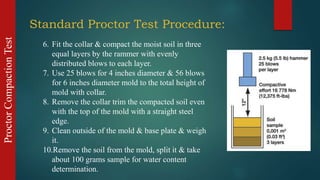
6. Fit the collar & compact the moist soil in three
equal layers by the rammer with evenly
distributed blows to each layer.
7. Use 25 blows for 4 inches diameter & 56 blows
for 6 inches diameter mold to the total height of
mold with collar.
8. Remove the collar trim the compacted soil even
with the top of the mold with a straight steel
edge.
9. Clean outside of the mold & base plate & weigh
it.
10.Remove the soil from the mold, split it & take
about 100 grams sample for water content
determination.
ProctorCompactionTest
11. Break the soil lamps, mix it with remaining soil in the tray.
12. Add more water to increase the water content by 2 to 3% & repeat
the compaction procedure for each increment of water until the mass
of the compacted soil decreases.
13. Calculate Water content for each trail & corresponding dry density.
14. Plot the compaction curve between water-content as abscissa & dry
density as ordinate.
15. Note the water content against the peak of the curve as optimum
moisture content & the corresponding dry density as maximum dry
density.
Standard Proctor Test Procedure:
ProctorCompactionTest
Result of Soil Compaction Test:
ProctorCompactionTest

Proctor compaction test

  • 1.
  • 2.
    ProctorCompactionTest Introduction: Proctor Test isused to determine the compaction of different types of soil and the properties of soil with a change in moisture content. Compaction is the process of densification of soil by reducing air voids. The degree of compaction of a given soil is measured in terms of its dry density. The dry density is maximum at the optimum water content. A curve is drawn between the water content and the dry density to obtain the maximum dry density and the optimum water content.
  • 3.
    ProctorCompactionTest Dry density ofsoil: Where: M = total mass of the soil, V= volume of soil, w= water content.
  • 4.
    ProctorCompactionTest Standard Proctor Test Apparatus: 1.Cylindrical Metal Mold, having internal diameter 4” (10.16 cm) or 6” (15.24 cm), the internal effective height of 4.6” (11.7 cm); and the mold should have detachable base plate & collar of 2 inches (5.08 cm). 2. Rammer, weighing 5.5 lbs (2.5 kg) & having fall of 12 ins (30.5 cm), with a flat circular face of 2” diameter. 3. Sensitive Balance, sensitivity ranging from 0.1 gram to 1 gram. 4. Thermostatically controlled oven (105°C +- 110°C)
  • 5.
    ProctorCompactionTest 5. Moisture containers. 6.Sieve No.4. 7. Tray & scoop. 8. Graduated cylinder. 9. Mixing tools. (spoon, trowel, spatula).
  • 6.
    ProctorCompactionTest Standard Proctor TestProcedure: 1. Take sufficient quantity of representative soil, air dry & pulverize it with a rubber mallet. 2. Sieve the soil through No: 4 sieve & reject the coarser material. 3. Take about, 3 kg of soil, add water to bring its water content to about 5% below the estimated optimum moisture content (for coarse-grained soil 4% initial water content & for fine-grained soil 10% initial water content is preferable). 4. Then Mix it thoroughly. 5. Clean the mold, measure its diameter & height & weigh it without the collar.
  • 7.
    ProctorCompactionTest Standard Proctor TestProcedure: 6. Fit the collar & compact the moist soil in three equal layers by the rammer with evenly distributed blows to each layer. 7. Use 25 blows for 4 inches diameter & 56 blows for 6 inches diameter mold to the total height of mold with collar. 8. Remove the collar trim the compacted soil even with the top of the mold with a straight steel edge. 9. Clean outside of the mold & base plate & weigh it. 10.Remove the soil from the mold, split it & take about 100 grams sample for water content determination.
  • 8.
    ProctorCompactionTest 11. Break thesoil lamps, mix it with remaining soil in the tray. 12. Add more water to increase the water content by 2 to 3% & repeat the compaction procedure for each increment of water until the mass of the compacted soil decreases. 13. Calculate Water content for each trail & corresponding dry density. 14. Plot the compaction curve between water-content as abscissa & dry density as ordinate. 15. Note the water content against the peak of the curve as optimum moisture content & the corresponding dry density as maximum dry density. Standard Proctor Test Procedure:
  • 9.
  • 10.