1
Geotechnical Engineering–II [CE-321]
BSc Civil Engineering – 5th Semester
by
Dr. Muhammad Irfan
Assistant Professor
Civil Engg. Dept. – UET Lahore
Email: mirfan1@msn.com
Lecture Handouts: https://groups.google.com/d/forum/geotech-ii_2015session
Lecture # 11
11-Oct-2017
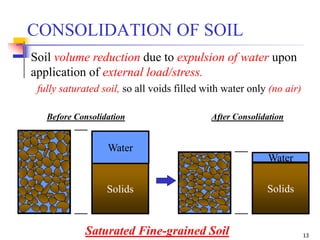
2
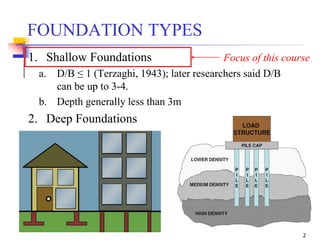
FOUNDATION TYPES
1. Shallow Foundations
a. D/B ≤ 1 (Terzaghi, 1943); later researchers said D/B
can be up to 3-4.
b. Depth generally less than 3m
2. Deep Foundations
Focus of this course
3
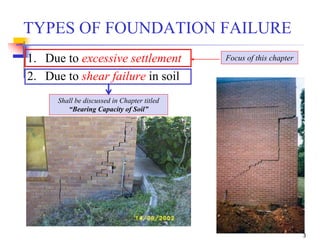
TYPES OF FOUNDATION FAILURE
1. Due to excessive settlement
2. Due to shear failure in soil
Focus of this chapter
Shall be discussed in Chapter titled
“Bearing Capacity of Soil”
4
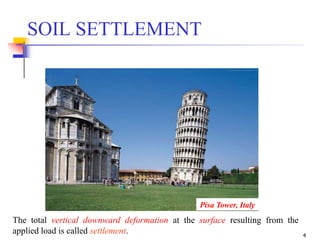
SOIL SETTLEMENT
Pisa Tower, Italy
The total vertical downward deformation at the surface resulting from the
applied load is called settlement.
5
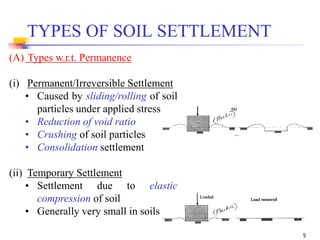
TYPES OF SOIL SETTLEMENT
(A) Types w.r.t. Permanence
(i) Permanent/Irreversible Settlement
• Caused by sliding/rolling of soil
particles under applied stress
• Reduction of void ratio
• Crushing of soil particles
• Consolidation settlement
(ii) Temporary Settlement
• Settlement due to elastic
compression of soil
• Generally very small in soils
TYPES OF SOIL SETTLEMENT
6
TYPES OF SOIL SETTLEMENT
(B) Types w.r.t. Uniformity
(i) Uniform Settlement
• All the points settle by equal
amount
• Generally occur under rigid
foundations loaded with uniform
pressure and resting over uniform
soil
• Minimal risk to structural stability
• Risk to serviceability (eg. utility
lines, etc.)
(ii) Differential Settlement
• Different parts of the structure settle
by different magnitude
7
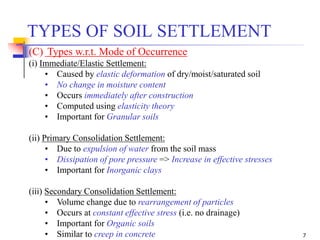
(C) Types w.r.t. Mode of Occurrence
(i) Immediate/Elastic Settlement:
• Caused by elastic deformation of dry/moist/saturated soil
• No change in moisture content
• Occurs immediately after construction
• Computed using elasticity theory
• Important for Granular soils
(ii) Primary Consolidation Settlement:
• Due to expulsion of water from the soil mass
• Dissipation of pore pressure => Increase in effective stresses
• Important for Inorganic clays
(iii) Secondary Consolidation Settlement:
• Volume change due to rearrangement of particles
• Occurs at constant effective stress (i.e. no drainage)
• Important for Organic soils
• Similar to creep in concrete
TYPES OF SOIL SETTLEMENT
9
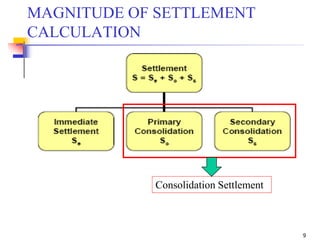
MAGNITUDE OF SETTLEMENT
CALCULATION
Consolidation Settlement
11
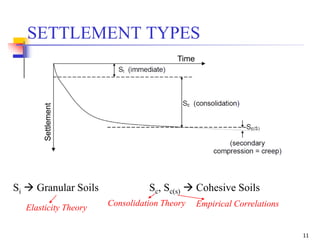
SETTLEMENT TYPES
Si  Granular Soils
Time
Settlement
Sc, Sc(s)  Cohesive Soils
Elasticity Theory
Consolidation Theory Empirical Correlations
12
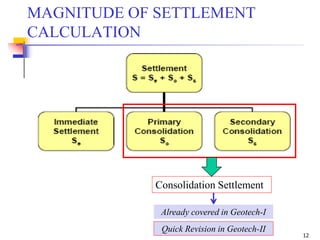
MAGNITUDE OF SETTLEMENT
CALCULATION
Consolidation Settlement
Already covered in Geotech-I
Quick Revision in Geotech-II
13
Before Consolidation
Solids
Water
After Consolidation
Soil volume reduction due to expulsion of water upon
application of external load/stress.
fully saturated soil, so all voids filled with water only (no air)
Solids
Water
CONSOLIDATION OF SOIL
Saturated Fine-grained Soil
14
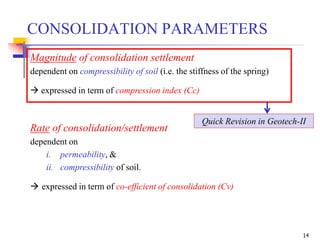
CONSOLIDATION PARAMETERS
Magnitude of consolidation settlement
dependent on compressibility of soil (i.e. the stiffness of the spring)
 expressed in term of compression index (Cc)
Rate of consolidation/settlement
dependent on
i. permeability, &
ii. compressibility of soil.
 expressed in term of co-efficient of consolidation (Cv)
Quick Revision in Geotech-II
15
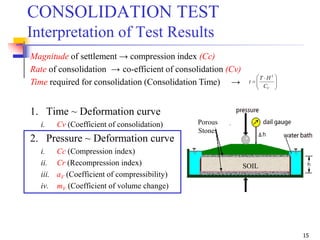
CONSOLIDATION TEST
Interpretation of Test Results





 

VC
HT
t
2
Magnitude of settlement → compression index (Cc)
Rate of consolidation → co-efficient of consolidation (Cv)
Time required for consolidation (Consolidation Time) →
1. Time ~ Deformation curve
i. Cv (Coefficient of consolidation)
2. Pressure ~ Deformation curve
i. Cc (Compression index)
ii. Cr (Recompression index)
iii. aV (Coefficient of compressibility)
iv. mV (Coefficient of volume change)
SOIL
Porous
Stones
16
CONSOLIDATION TEST
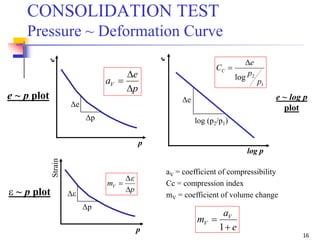
Pressure ~ Deformation Curve
p
e
aV



e ~ p plot
e
p
Δe
Δp
aV = coefficient of compressibility
Cc = compression index
mV = coefficient of volume change
Δe
log (p2/p1)
e
log p
1
2log
p
p
e
CC


e ~ log p
plot
e
a
m V
V


1
Strain
p
Δe
Δp
p
mV



e
e ~ p plot
17
CLAY
100,000 years ago
80,000 years ago
30,000 years ago
10,000 years ago
5,000 years ago
1,000 years ago
Today
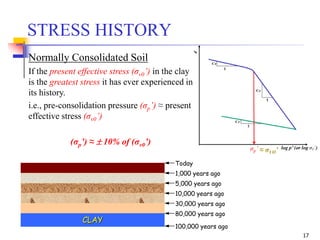
STRESS HISTORY
Normally Consolidated Soil
If the present effective stress (σv0’) in the clay
is the greatest stress it has ever experienced in
its history.
i.e., pre-consolidation pressure (σp’) ≈ present
effective stress (σv0’)
(σp’) ≈  10% of (σv0’)
≈ σVO’
18
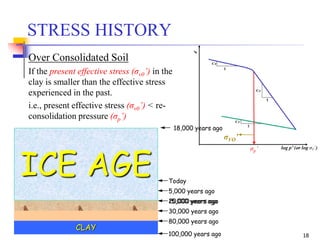
STRESS HISTORY
Over Consolidated Soil
If the present effective stress (σv0’) in the
clay is smaller than the effective stress
experienced in the past.
i.e., present effective stress (σv0’) < re-
consolidation pressure (σp’)
σVO’
CLAY
100,000 years ago
80,000 years ago
30,000 years ago
ICE AGE
20,000 years ago
18,000 years ago
15,000 years ago
5,000 years ago
Today
19
STRESS HISTORY
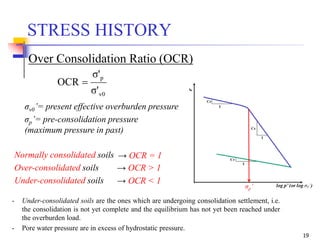
Over Consolidation Ratio (OCR)
v0
p
σ'
σ'
OCR 
σv0’= present effective overburden pressure
σp’= pre-consolidation pressure
(maximum pressure in past)
Normally consolidated soils
Over-consolidated soils
Under-consolidated soils
→ OCR = 1
→ OCR < 1
→ OCR > 1
- Under-consolidated soils are the ones which are undergoing consolidation settlement, i.e.
the consolidation is not yet complete and the equilibrium has not yet been reached under
the overburden load.
- Pore water pressure are in excess of hydrostatic pressure.
20
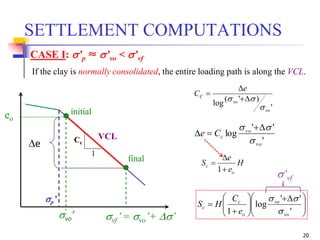
SETTLEMENT COMPUTATIONS
'
''
log
vo
vo
cCe

 

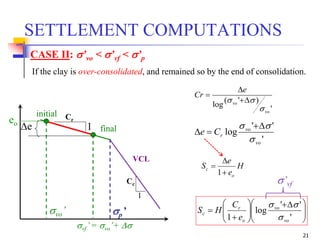
If the clay is normally consolidated, the entire loading path is along the VCL.
initial
vo’
eo
vf’= vo’+ ’
e
final
1
Cc
H
e
e
S
o
c



1
VCL





 








'
''
log
1 vo
vo
o
c
c
e
C
HS


’vf
'
)'(
log
vo
vo
C
e
C

 


CASE I: ’p ≈ ’vo < ’vf
p’
21
SETTLEMENT COMPUTATIONS
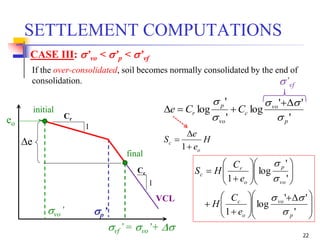
If the clay is over-consolidated, and remained so by the end of consolidation.
CASE II: ’vo < ’vf < ’p
initial
vo’
eo
vf’= vo’+ 
e final
1
Cc
VCL
1
Cr
p’
'
''
log
vo
vo
rCe

 

H
e
e
S
o
c



1





 








'
''
log
1 vo
vo
o
r
c
e
C
HS


’vf
'
)'(
log
vo
vo
e
Cr

 


22
SETTLEMENT COMPUTATIONS
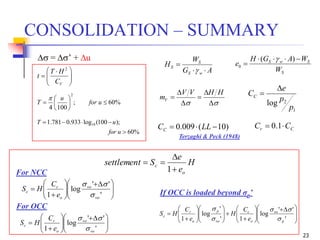
If the over-consolidated, soil becomes normally consolidated by the end of
consolidation.
CASE III: ’vo < ’p < ’vf
initial
vo’
eo
vf’= vo’+ 
e
final
1
Cc
VCL
1
Cr
p’
'
''
log
'
'
log
p
vo
c
vo
p
r CCe



 

H
e
e
S
o
c



1







 






















'
''
log
1
'
'
log
1
p
vo
o
c
vo
p
o
r
c
e
C
H
e
C
HS




’vf
23
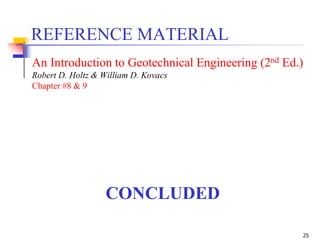
CONSOLIDATION – SUMMARY
H
e
e
Ssettlement
o
c



1
 = ’ + u





 

VC
HT
t
2
%60;
1004
2






 ufor
u
T

%60
);100(log933.0781.1 10


ufor
uT
AG
W
H
wS
S
S


 S
SwS
W
WAGH
e


)(
0

1
2log
p
p
e
CC


 





HHVV
mV





 








'
''
log
1 vo
vo
o
c
c
e
C
HS







 








'
''
log
1 vo
vo
o
r
c
e
C
HS

 






 





















'
''
log
1'
'
log
1 p
vo
o
c
vo
p
o
r
c
e
C
H
e
C
HS




For NCC
For OCC
If OCC is loaded beyond σp’
)10(009.0  LLCC Cr CC  1.0
Terzaghi & Peck (1948)
25
CONCLUDED
REFERENCE MATERIAL
An Introduction to Geotechnical Engineering (2nd Ed.)
Robert D. Holtz & William D. Kovacs
Chapter #8 & 9

Geotechnical Engineering-II [Lec #11: Settlement Computation]

  • 1.
    1 Geotechnical Engineering–II [CE-321] BScCivil Engineering – 5th Semester by Dr. Muhammad Irfan Assistant Professor Civil Engg. Dept. – UET Lahore Email: mirfan1@msn.com Lecture Handouts: https://groups.google.com/d/forum/geotech-ii_2015session Lecture # 11 11-Oct-2017
  • 2.
    2 FOUNDATION TYPES 1. ShallowFoundations a. D/B ≤ 1 (Terzaghi, 1943); later researchers said D/B can be up to 3-4. b. Depth generally less than 3m 2. Deep Foundations Focus of this course
  • 3.
    3 TYPES OF FOUNDATIONFAILURE 1. Due to excessive settlement 2. Due to shear failure in soil Focus of this chapter Shall be discussed in Chapter titled “Bearing Capacity of Soil”
  • 4.
    4 SOIL SETTLEMENT Pisa Tower,Italy The total vertical downward deformation at the surface resulting from the applied load is called settlement.
  • 5.
    5 TYPES OF SOILSETTLEMENT (A) Types w.r.t. Permanence (i) Permanent/Irreversible Settlement • Caused by sliding/rolling of soil particles under applied stress • Reduction of void ratio • Crushing of soil particles • Consolidation settlement (ii) Temporary Settlement • Settlement due to elastic compression of soil • Generally very small in soils TYPES OF SOIL SETTLEMENT
  • 6.
    6 TYPES OF SOILSETTLEMENT (B) Types w.r.t. Uniformity (i) Uniform Settlement • All the points settle by equal amount • Generally occur under rigid foundations loaded with uniform pressure and resting over uniform soil • Minimal risk to structural stability • Risk to serviceability (eg. utility lines, etc.) (ii) Differential Settlement • Different parts of the structure settle by different magnitude
  • 7.
    7 (C) Types w.r.t.Mode of Occurrence (i) Immediate/Elastic Settlement: • Caused by elastic deformation of dry/moist/saturated soil • No change in moisture content • Occurs immediately after construction • Computed using elasticity theory • Important for Granular soils (ii) Primary Consolidation Settlement: • Due to expulsion of water from the soil mass • Dissipation of pore pressure => Increase in effective stresses • Important for Inorganic clays (iii) Secondary Consolidation Settlement: • Volume change due to rearrangement of particles • Occurs at constant effective stress (i.e. no drainage) • Important for Organic soils • Similar to creep in concrete TYPES OF SOIL SETTLEMENT
  • 8.
  • 9.
    11 SETTLEMENT TYPES Si Granular Soils Time Settlement Sc, Sc(s)  Cohesive Soils Elasticity Theory Consolidation Theory Empirical Correlations
  • 10.
    12 MAGNITUDE OF SETTLEMENT CALCULATION ConsolidationSettlement Already covered in Geotech-I Quick Revision in Geotech-II
  • 11.
    13 Before Consolidation Solids Water After Consolidation Soilvolume reduction due to expulsion of water upon application of external load/stress. fully saturated soil, so all voids filled with water only (no air) Solids Water CONSOLIDATION OF SOIL Saturated Fine-grained Soil
  • 12.
    14 CONSOLIDATION PARAMETERS Magnitude ofconsolidation settlement dependent on compressibility of soil (i.e. the stiffness of the spring)  expressed in term of compression index (Cc) Rate of consolidation/settlement dependent on i. permeability, & ii. compressibility of soil.  expressed in term of co-efficient of consolidation (Cv) Quick Revision in Geotech-II
  • 13.
    15 CONSOLIDATION TEST Interpretation ofTest Results         VC HT t 2 Magnitude of settlement → compression index (Cc) Rate of consolidation → co-efficient of consolidation (Cv) Time required for consolidation (Consolidation Time) → 1. Time ~ Deformation curve i. Cv (Coefficient of consolidation) 2. Pressure ~ Deformation curve i. Cc (Compression index) ii. Cr (Recompression index) iii. aV (Coefficient of compressibility) iv. mV (Coefficient of volume change) SOIL Porous Stones
  • 14.
    16 CONSOLIDATION TEST Pressure ~Deformation Curve p e aV    e ~ p plot e p Δe Δp aV = coefficient of compressibility Cc = compression index mV = coefficient of volume change Δe log (p2/p1) e log p 1 2log p p e CC   e ~ log p plot e a m V V   1 Strain p Δe Δp p mV    e e ~ p plot
  • 15.
    17 CLAY 100,000 years ago 80,000years ago 30,000 years ago 10,000 years ago 5,000 years ago 1,000 years ago Today STRESS HISTORY Normally Consolidated Soil If the present effective stress (σv0’) in the clay is the greatest stress it has ever experienced in its history. i.e., pre-consolidation pressure (σp’) ≈ present effective stress (σv0’) (σp’) ≈  10% of (σv0’) ≈ σVO’
  • 16.
    18 STRESS HISTORY Over ConsolidatedSoil If the present effective stress (σv0’) in the clay is smaller than the effective stress experienced in the past. i.e., present effective stress (σv0’) < re- consolidation pressure (σp’) σVO’ CLAY 100,000 years ago 80,000 years ago 30,000 years ago ICE AGE 20,000 years ago 18,000 years ago 15,000 years ago 5,000 years ago Today
  • 17.
    19 STRESS HISTORY Over ConsolidationRatio (OCR) v0 p σ' σ' OCR  σv0’= present effective overburden pressure σp’= pre-consolidation pressure (maximum pressure in past) Normally consolidated soils Over-consolidated soils Under-consolidated soils → OCR = 1 → OCR < 1 → OCR > 1 - Under-consolidated soils are the ones which are undergoing consolidation settlement, i.e. the consolidation is not yet complete and the equilibrium has not yet been reached under the overburden load. - Pore water pressure are in excess of hydrostatic pressure.
  • 18.
    20 SETTLEMENT COMPUTATIONS ' '' log vo vo cCe     Ifthe clay is normally consolidated, the entire loading path is along the VCL. initial vo’ eo vf’= vo’+ ’ e final 1 Cc H e e S o c    1 VCL                ' '' log 1 vo vo o c c e C HS   ’vf ' )'( log vo vo C e C      CASE I: ’p ≈ ’vo < ’vf p’
  • 19.
    21 SETTLEMENT COMPUTATIONS If theclay is over-consolidated, and remained so by the end of consolidation. CASE II: ’vo < ’vf < ’p initial vo’ eo vf’= vo’+  e final 1 Cc VCL 1 Cr p’ ' '' log vo vo rCe     H e e S o c    1                ' '' log 1 vo vo o r c e C HS   ’vf ' )'( log vo vo e Cr     
  • 20.
    22 SETTLEMENT COMPUTATIONS If theover-consolidated, soil becomes normally consolidated by the end of consolidation. CASE III: ’vo < ’p < ’vf initial vo’ eo vf’= vo’+  e final 1 Cc VCL 1 Cr p’ ' '' log ' ' log p vo c vo p r CCe       H e e S o c    1                                ' '' log 1 ' ' log 1 p vo o c vo p o r c e C H e C HS     ’vf
  • 21.
    23 CONSOLIDATION – SUMMARY H e e Ssettlement o c    1 = ’ + u         VC HT t 2 %60; 1004 2        ufor u T  %60 );100(log933.0781.1 10   ufor uT AG W H wS S S    S SwS W WAGH e   )( 0  1 2log p p e CC          HHVV mV                ' '' log 1 vo vo o c c e C HS                  ' '' log 1 vo vo o r c e C HS                                 ' '' log 1' ' log 1 p vo o c vo p o r c e C H e C HS     For NCC For OCC If OCC is loaded beyond σp’ )10(009.0  LLCC Cr CC  1.0 Terzaghi & Peck (1948)
  • 22.
    25 CONCLUDED REFERENCE MATERIAL An Introductionto Geotechnical Engineering (2nd Ed.) Robert D. Holtz & William D. Kovacs Chapter #8 & 9