SOIL INVESTIGATION &
          FOUNDATION DESIGN


February, 2012   John Fox, College of North West London   1
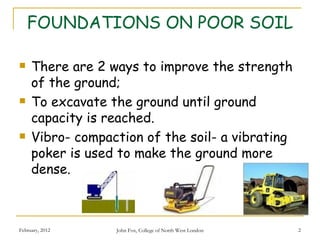
FOUNDATIONS ON POOR SOIL

    There are 2 ways to improve the strength
     of the ground;
    To excavate the ground until ground
     capacity is reached.
    Vibro- compaction of the soil- a vibrating
     poker is used to make the ground more
     dense.


February, 2012    John Fox, College of North West London   2
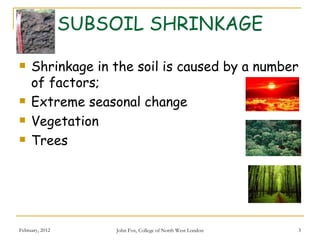
SUBSOIL SHRINKAGE

    Shrinkage in the soil is caused by a number
     of factors;
    Extreme seasonal change
    Vegetation
    Trees


February, 2012       John Fox, College of North West London   3
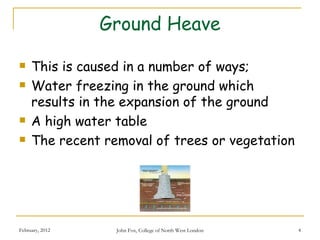
Ground Heave

    This is caused in a number of ways;
    Water freezing in the ground which
     results in the expansion of the ground
    A high water table
    The recent removal of trees or vegetation


February, 2012    John Fox, College of North West London   4
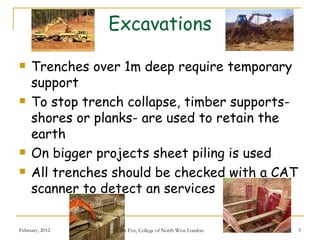
Excavations

    Trenches over 1m deep require temporary
     support
    To stop trench collapse, timber supports-
     shores or planks- are used to retain the
     earth
    On bigger projects sheet piling is used
    All trenches should be checked with a CAT
     scanner to detect an services

February, 2012    John Fox, College of North West London   5
Foundation Design

    The design of foundations is covered by
     document ‘A’ under Building Regs.
    Strip foundations for example require a
     minimum of 750mm in clay soils or 450mm
     in others.
    Most councils choose to go to 1m deep
    Other factors include ‘dead’ and imposed
     loads such as wind, snow, floors etc.

February, 2012     John Fox, College of North West London   6
Foundation Design
    When designing a foundation, Engineers
     concentrate on the unit of force (Kilonewtons )
     rather than weight.
    1 tonne is equal to 10 kilonewton
    An average building load to a house is 120 tonnes
     which exerts a force of 1200 kn to the ground
    This number is then divided into the perimeter
     length of the building eg. 30m which is then
     divided into 1200kn. This formula will show how
     much each metre run is carrying eg. 40kn
    Depending on the soil, a design on the foundation
     can be made

February, 2012      John Fox, College of North West London   7
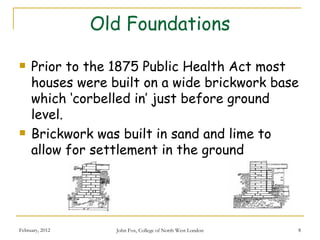
Old Foundations

    Prior to the 1875 Public Health Act most
     houses were built on a wide brickwork base
     which ‘corbelled in’ just before ground
     level.
    Brickwork was built in sand and lime to
     allow for settlement in the ground


February, 2012     John Fox, College of North West London   8
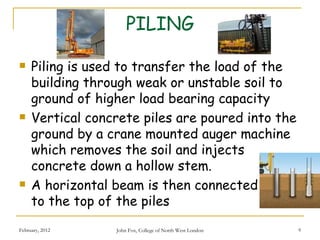
PILING

    Piling is used to transfer the load of the
     building through weak or unstable soil to
     ground of higher load bearing capacity
    Vertical concrete piles are poured into the
     ground by a crane mounted auger machine
     which removes the soil and injects
     concrete down a hollow stem.
    A horizontal beam is then connected to the
     to the top of the piles
February, 2012    John Fox, College of North West London   9
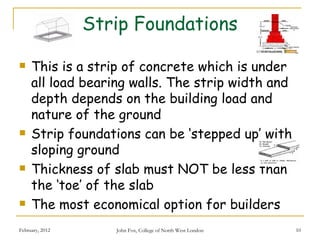
Strip Foundations

    This is a strip of concrete which is under
     all load bearing walls. The strip width and
     depth depends on the building load and
     nature of the ground
    Strip foundations can be ‘stepped up’ with
     sloping ground
    Thickness of slab must NOT be less than
     the ‘toe’ of the slab
    The most economical option for builders
February, 2012      John Fox, College of North West London   10
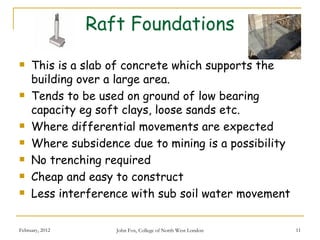
Raft Foundations
    This is a slab of concrete which supports the
     building over a large area.
    Tends to be used on ground of low bearing
     capacity eg soft clays, loose sands etc.
    Where differential movements are expected
    Where subsidence due to mining is a possibility
    No trenching required
    Cheap and easy to construct
    Less interference with sub soil water movement

February, 2012      John Fox, College of North West London   11
Pad Foundations
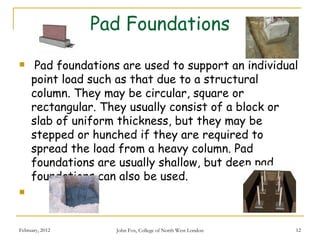
     Pad foundations are used to support an individual
     point load such as that due to a structural
     column. They may be circular, square or
     rectangular. They usually consist of a block or
     slab of uniform thickness, but they may be
     stepped or hunched if they are required to
     spread the load from a heavy column. Pad
     foundations are usually shallow, but deep pad
     foundations can also be used.
     


February, 2012      John Fox, College of North West London   12
Summary
    Strip foundations are suitable on;
    Rock, gravel, dense sand or stiff clay
    On soft clay or soft sandy clay, wider strip
     foundations are required

    Piled foundations are suitable for;
    Shrinkable clays
     Where the water table is high and where a firm
     layer of ground is at a suitable depth
    Where a firm layer of ground is at a considerable
     depth

February, 2012       John Fox, College of North West London   13
Summary

    Raft foundations are suitable on;
    Grounds of low bearing capacity such as
     soft clay or silt
    In mining areas where subsidence is a risk
    On deep areas of fill where piling would be
     uneconomic


February, 2012    John Fox, College of North West London   14

Soil investigation part2

  • 1.
    SOIL INVESTIGATION & FOUNDATION DESIGN February, 2012 John Fox, College of North West London 1
  • 2.
    FOUNDATIONS ON POORSOIL  There are 2 ways to improve the strength of the ground;  To excavate the ground until ground capacity is reached.  Vibro- compaction of the soil- a vibrating poker is used to make the ground more dense. February, 2012 John Fox, College of North West London 2
  • 3.
    SUBSOIL SHRINKAGE  Shrinkage in the soil is caused by a number of factors;  Extreme seasonal change  Vegetation  Trees February, 2012 John Fox, College of North West London 3
  • 4.
    Ground Heave  This is caused in a number of ways;  Water freezing in the ground which results in the expansion of the ground  A high water table  The recent removal of trees or vegetation February, 2012 John Fox, College of North West London 4
  • 5.
    Excavations  Trenches over 1m deep require temporary support  To stop trench collapse, timber supports- shores or planks- are used to retain the earth  On bigger projects sheet piling is used  All trenches should be checked with a CAT scanner to detect an services February, 2012 John Fox, College of North West London 5
  • 6.
    Foundation Design  The design of foundations is covered by document ‘A’ under Building Regs.  Strip foundations for example require a minimum of 750mm in clay soils or 450mm in others.  Most councils choose to go to 1m deep  Other factors include ‘dead’ and imposed loads such as wind, snow, floors etc. February, 2012 John Fox, College of North West London 6
  • 7.
    Foundation Design  When designing a foundation, Engineers concentrate on the unit of force (Kilonewtons ) rather than weight.  1 tonne is equal to 10 kilonewton  An average building load to a house is 120 tonnes which exerts a force of 1200 kn to the ground  This number is then divided into the perimeter length of the building eg. 30m which is then divided into 1200kn. This formula will show how much each metre run is carrying eg. 40kn  Depending on the soil, a design on the foundation can be made February, 2012 John Fox, College of North West London 7
  • 8.
    Old Foundations  Prior to the 1875 Public Health Act most houses were built on a wide brickwork base which ‘corbelled in’ just before ground level.  Brickwork was built in sand and lime to allow for settlement in the ground February, 2012 John Fox, College of North West London 8
  • 9.
    PILING  Piling is used to transfer the load of the building through weak or unstable soil to ground of higher load bearing capacity  Vertical concrete piles are poured into the ground by a crane mounted auger machine which removes the soil and injects concrete down a hollow stem.  A horizontal beam is then connected to the to the top of the piles February, 2012 John Fox, College of North West London 9
  • 10.
    Strip Foundations  This is a strip of concrete which is under all load bearing walls. The strip width and depth depends on the building load and nature of the ground  Strip foundations can be ‘stepped up’ with sloping ground  Thickness of slab must NOT be less than the ‘toe’ of the slab  The most economical option for builders February, 2012 John Fox, College of North West London 10
  • 11.
    Raft Foundations  This is a slab of concrete which supports the building over a large area.  Tends to be used on ground of low bearing capacity eg soft clays, loose sands etc.  Where differential movements are expected  Where subsidence due to mining is a possibility  No trenching required  Cheap and easy to construct  Less interference with sub soil water movement February, 2012 John Fox, College of North West London 11
  • 12.
    Pad Foundations  Pad foundations are used to support an individual point load such as that due to a structural column. They may be circular, square or rectangular. They usually consist of a block or slab of uniform thickness, but they may be stepped or hunched if they are required to spread the load from a heavy column. Pad foundations are usually shallow, but deep pad foundations can also be used.    February, 2012 John Fox, College of North West London 12
  • 13.
    Summary  Strip foundations are suitable on;  Rock, gravel, dense sand or stiff clay  On soft clay or soft sandy clay, wider strip foundations are required  Piled foundations are suitable for;  Shrinkable clays  Where the water table is high and where a firm layer of ground is at a suitable depth  Where a firm layer of ground is at a considerable depth February, 2012 John Fox, College of North West London 13
  • 14.
    Summary  Raft foundations are suitable on;  Grounds of low bearing capacity such as soft clay or silt  In mining areas where subsidence is a risk  On deep areas of fill where piling would be uneconomic February, 2012 John Fox, College of North West London 14

Editor's Notes

  • #2 08/03/12 John Fox, College of North West London Soil Investigation & Foundation Design